US Domestic Perspective Songs [War Years]
Introduction
"The Vietnam Conflict Spawning Heavy Barrage of Disk Tunes" the headline read in Billboard on 4 June 1966. It went on to report that: "since January, well over 100 Vietnam records have been released, with five making the Billboard Hot 100 and a dozen making Billboard's country charts..With Vietnam still the over-riding issue, and with little likelihood for an early settlement, the prospect for more war songs is certain".1
As always during war people on the home front often show concern for the plight of the soldiers fighting as well as the family and friends left behind, whether they support the war or are opposed to the war. And thus this is reflected in Vietnam War songs, many which told love stories, or parents missing their children or dealing with their death. Many of the songs focused on people in the US writing and receiving letters
Time Period & Criteria
- Pre-Gulf of Tonkin: 1960-1964
While many of these early songs may have been intending to refer to US troops in Germany, or Korea, or representing general Cold War fears, they were released in the run-up to the "Vietnam era" and the Gulf of Tonkin incident (1964), which led to a major escalation of US involvement in the conflict, and thus included in this list, as cultural perspectives. The criteria is the same as for the war years - the songs included mention Vietnam, or the lyrics deal with war-related themes, such as the draft, napalm, prisoners of war, demonstrations, references to soldiers and veterans, war & peace, and expressions of patriotism. - War Years: 1964-1975
Released during the key war years, the songs included mention Vietnam, or the lyrics deal with war-related themes, such as the draft, napalm, prisoners of war, demonstrations, references to soldiers and veterans, war & peace, and expressions of patriotism. While the war goes back to the 1954 Geneva conference, following the Gulf of Tonkin incident (1964), the US significantly expanded its presence in the region and its defence of South Vietnam, and thus using this date as the beginning of the core war years. These run to the collapse of South Vietnam (30 April 1975), in two periods: (a) 1964-1972, the years of major US combat involvement, up to the peace agreement; (b) 1973-1975, from the Paris Peace Accords (27 January 1973), which brought US troops and prisoners of war home, to the collapse of South Vietnam. This collection covers the war years only (1960-1975).
Themes
The songs on this list carry 97 different lyric themes (every song has at least one; most have several). The most frequent, with the number of songs: Home Front Perspective (232), Soldier's Perspective (98), K.I.A. (57), Religion (56), Soldier Boy (51), Christmas (34), Child (30), Patriotic (29), P.O.W. (25), Draft (24), Song Poem (22), Satire (18), Anti-War (15), Jody (13). The full breakdown, with every theme on the list, is in the Lyric theme data section below.
The themes that define this list- Home Front Perspective (232)
About family, friends etc. back home in the US. May be narrated in the first, second, or third person - K.I.A. (57)
Killed in Action: songs referencing a soldier killed in Vietnam - Soldier Boy (51)
Typically a song about the narrator’s love for the soldier boy heading off to war, often performed by Girl Groups and teen pop songs in the early 1960s - P.O.W. / M.I.A. (37)
Prisoner of War (P.O.W.): songs referencing those held captive in Vietnam. Missing in Action (M.I.A.): songs referencing a missing soldier – may also be P.O.W. - Jody (13)
The term "Jody" originated from "Joe the Grinder" (dated c.1939) - a mythical man in blues and jazz tunes who seduced the wives and girlfriends of soldiers, prisoners etc. "Grinder" was an old slang word for sex (dated c.1647). Thought to have been introduced into the army by African-Americans during the WW2, used in military cadences, such as "ain’t no use in going home, Jody’s got your girl and gone". This type of marching later got the nickname of "jodies" or "jody calls" - Combat (10)
Generic description of battle, fighting etc. Usually from the soldier’s perspective, but sometimes presented from the home front / domestic perspective. - Coming Home (9)
Reference to soldiers returning to the US - Lost Love (4)
Soldier’s sweetheart has left him for someone else / soldier has left his sweetheart who is waiting for him back in the US - Vietnamese Girls (3)
Reference to American GIs dating or getting married or having a child with a Vietnamese girl - Orphan (2)
Children left orphans by the war, for example father died in Vietnam, mother died at home. - Prostitution (1)
Reference to prostitution during the Vietnam War, typically American GIs in Saigon, such as on Tu Do Street (a popular destination for bars and prostitution)
Highlights
Each holiday season galvanised sentiment on the home front, with over 145 Christmas songs about the war. “Little Becky’s Christmas Wish” (1967), narrated by 6 year old Becky Lamb from Michigan, was one of dozens of child narrated Vietnam songs, which looked at the impact of war on young siblings. She plaintively requests “Santa… please bring Tommy home for Christmas”. However, a K.I.A. telegram arrived. Becky sadly recalls Tommy’s favourite record: “a man was talking and said not what my country can do, but what I can do”, a reference to JFK’s inaugural speech. It reached #2 in the Billboard Christmas chart.
A few songs looked at the unethical activities of soldiers on furlough, such as G.I.s visiting prostitutes on the famous Tu Do Street in Saigon, including The Soul Patrol’s funk-soul song “Saigon Strut” (1968). Others described married soldiers having affairs with Vietnamese women, and fathering children, like “What’s Been Going On in Viet Nam” (1968) by Ginger & Jean, members of the 1950s popular Oklahoma trio The Dinning Sisters.
1960-1964
Records from before 1960 are included as context.
In the 1964 presidential election 2/3rds of Americans said that they paid little or no attention to Vietnam.1 However, the Vietnam conflict had started to rise in the news agenda. The US had over 15,000 personnel in South Vietnam - mainly military experts, for training and support. Furthermore, on 7 August 1964, the US Congress passed the Gulf of Tonkin Resolution, following a naval clash between North Vietnam and US forces, which permitted President Lyndon B. Johnson (1963-1969) to send conventional forces to Vietnam.2 Thus, Vietnam started to become a focal point in the news and with topical singers.
- 8 November 1960: John F. Kennedy defeats Richard Nixon in US presidential election
- 20 December 1960: National Liberation Front (NFL) or the Viet Cong is established
- 2 November 1962: South Vietnamese leader Diem executed in coup
- 22 November 1963: Lyndon Baines Johnson becomes US president following Kennedy assassination
- 2-4 August 1964: North Vietnam attacks US ships in Gulf of Tonkin
- 7 August 1964: Gulf of Tonkin Resolution passed by US Congress, permitting intervention
- 3 November 1964: Johnson re-elected US president
1956
1959
1960
1961
Vocal by Julia Mainer, wife of Wade Mainer. Born Julia Mae Brown, known as Hillbilly Lillie on bluegrass scene. Recorded 7 April 1961, Cincinnati. Featured on 1961 album Soulful Sacred Songs by Wade Mainer's Mountaineers.12
Bluegrass gospel. Plight. Religion.
Teen pop - soldier boy song.
Sweetheart cries each night, writes him letters, sends her picture
On this 1962 LP featured the song "War Is Starting Again" (Vee-Jay Records # LP-1044), also released on the 1961 single Got Me a Louisiana Woman / War Is Starting Again ({Label185167] # 91272), which may have been too early to specifically be in reference to the Vietnam conflict. The narrator expressed fear of war coming, "well, I got news this morning, right now they need a million men" . This song also included a "Jody" reference - the term "Jody" originated from "Joe the Grinder" (dated c.1939) - a mythical man in blues and jazz tunes who seduced the wives and girlfriends of soldiers, prisoners, and those away from home. "Grinder" was an old slang word for sex (dated c.1647). It is thought to have been introduced into the army by African-Americans during the Second World War, used in military cadences (marches), such as "ain’t no use in going home, Jody’s got your girl and gone" - shouted out by a military officer, and repeated by the group of marching soldiers in unison. This type of marching later got the nickname of "jodies" or "jody calls". In this case, the narrator is the Jody: "you know my girlfriend got a boyfriend in the army, that fool gotta go overseas" . Hopkins later uses a similar line in the 1969 song "Please Settle in Viet Nam" .
Vietnam War songs by Lightnin Hopkins:
In 1962 Hopkins released the song "War Is Starting Again" on the album Lightnin' Strikes (Vee-Jay Records # LP-1044). In 1969, he released the anti-war single "Please Settle in Viet Nam" (Joliet # 205). He also recorded the song "Vietnam War" with his cousin Billy Bizor on the album Blowing My Blues Away in 1968. In fact, Hopkins released his own version of that song, called "Viet Nam War (Pt.1) & (Pt.2)" on the 1968 album Talkin' Some Sense (Jewel Records # LPS 5001). Finally, in 1970 Hopkins produced the song "Questionnaire Blues" on film, released in 1970 on video, but unreleased on audio format.
1962
Released in 1962, it is interesting to look into how much people in the US really knew what was going on in Vietnam. President Eisenhower had clearly attached American credibility, financial backing, and a limited military commitment to Vietnam (with around 900 advisers in the later 1950s). But under Kennedy this started to rise drastically - US military personnel in South Vietnam rose to 9,000 by 30 June 1962. While the war received more attention in the media, during the 1964 presidential election 2/3rds of Americans said that they paid little or no attention to Vietnam. So there is the question of whether this was intentionally about Vietnam - in any case, many people interpreted this as a Vietnam War song.
Written by Luther Dixon and Florence Greenberg (founder of Scepter), it described a tale of young, true love, as a soldier set off to war, with the narrator promising that she would stay faithful to her soldier boy: "take my love with you to any port or foreign shore...I'll be true to you" . It featured on the 1962 album Baby It's You (Scepter # SRM-504). The group followed this up in 1965 with the single "(Mama) My Soldier Boy Is Coming Home" (Scepter # SCE 12123).
The Velvelettes – "Your Heart Belong to Me" (1966: unreleased)
Teen pop. Soldier boy song
Early 1960s.
Billboard: "the boys are cashing in on the 'Soldier Boy' vogue. The side has no relation to the Shirelles disk but it has some interesting effects. Tex-Mex trumpet figures played in martial groove, martial rhythm and fem vocal chorus all add to the side"1
- 1 Billboard ↩
The picture sleeve (Dot Records #16370) lists "The Call of Summer" and "Say Your Heart Belongs to a Soldier" over a tinted photograph of the three smiling Crosby Brothers in dark suits. [From the record sleeve and labels]
- Label: Ronnie # 1040
- Songwriter: Mrs. E. A. Walters (female)
- Song poem, traditional pop, New York
- Cold December night, snow on the ground, ship outward bound
- Sweetheart shed a tear, farewell my love, parting gives me pain
- Maroon label, 1040-2, 1:57, Winslow Music, ASCAP, distributed from New York, N.Y.; "Soldier Boy" (Mrs. E. A. Walters). The label name is covered by a "Compliments WRIT Radio 1340 in Milwaukee" sticker. [From the record sleeve and labels]
Soldier boy theme - going overseas
I'll be waiting sweetheart, I'll be true
1963
- I still love you while you're overseas
- VN era
- Dodie Stevens aka Geraldine Stevens Dolton Records No. 88 (DO-780), blue label with the fish logo, "A Division of Liberty Records, Inc., Los Angeles 28, California"; "Sailor Boy" (F. Gari - J. Basile), T. M. Music Inc. - BMI, 2:13; Dodie Stevens, arranged by Ernie Freeman, producer Bob Reisdorff. Issued in a turquoise-and-black Dolton Records company sleeve. [From the record sleeve and labels]
- Vietnam era generic
- Eric Records 175 (E-1873), black and red label, "© Eric Record Co., Philadelphia, Pa."; "Navy Blue" (B. Crewe, E. Rambeau, B. Rehak), Saturday Music, Inc., ASCAP, 2:05; produced by Bob Crewe, arranged and conducted by Calello. [From the record sleeve and labels]
Teen pop, soldier boy song.
My Sweetheart Joey is coming home.
But he is not here! Where is he?
Army took him away: draft.
Pre-Vietnam era
Soul, girl group.
1963 - Vietnam-era update / cover of the Civil War song.
Soldier boy - gone for three years, but on his way home.
1964
- Eric Records 175 reissue, black and red label, © Eric Record Co., Philadelphia, Pa.; "Kiss Me Sailor" (E. Rambeau - B. Rehak), E-1874, Saturday Music, Inc. (ASCAP), time 2:25, produced by Bob Crewe; flip side "Navy Blue" (B. Crewe - E. Rambeau - B. Rehak), E-1873, Saturday Music, Inc. (ASCAP), time 2:05, produced by Bob Crewe, arranged and conducted by Calello. [From the record sleeve and labels]
1964 Vietnam-era soldier / sailor boy song
Girl Group. Brooklyn, New York
Country music.
Domestic perspective - sweetheart left behind.
Label: "I'm the Girl" (Joyce New), Hard Times Pub., BMI, 2:10; Split Records, 2621 Lakeland Drive, Nashville, Tenn. [From the record label]
Spoken word, 1964 debate Liberals vs Conservatives - how much state power? Communism, wars - South Vietnam, Cuba, Suez. Civil Rights, domestic, taxes, education - how to sway majority Narrator a conservative religious radio host, of "Voice of Americanism". [From Justin A. Brummer notes from RYM]
1965
- 2 March: US Rolling Thunder bombing campaign of North Vietnam kicks-off
- 8 March: Escalation of US combat troops in Vietnam
- 17 April: 20,000 attend anti-war demonstration in Washington D.C.
- 28 April: Australian PM Menzies send battalion to South Vietnam
- 4 May: LBJ requests additional $700m for the war
- 5 May: Berkeley students burn draft cards at city's draft board
- 27 May: New Zealand PM Holyoake announces sending first troops to S. Vietnam
- 28 July: LBJ commits additional 50,000 troop to Vietnam
- 31 August: LBJ criminalizes destruction of draft card
- 27 November: March on Washington for Peace in Vietnam demonstration
- 28 November: Philippines announces sending troops to S. Vietnam
- 24 December: LBJ halts bombing campaign
- 31 December: US personnel in S. Vietnam total 184k+, up from 23k+ from a year earlier.
1965
Co-written by Phil Spector (with Pete Andreoli and Vini Poncia), he produced this song with the The Ronettes in 1964, but it was unreleased until it appeared on some compilations, such as Phil Spector Wall of Sound Vol. 5: Rare Masters (1976).1Brenda Hall released a version of the song in October 1965: Soldier Baby (Of Mine) / Oh Eddy, My Baby (Loma Records # 2020) - this label was based in Los Angeles, California, a subsidiary of Warner Bros. Records, established in 1964 for the Soul and Rhythm & Blues market.
Folk pop. Generic soldier boy song. Vietnam-era.
Country. Minneapolis, Minnesota, USA.1
Soldier's sweetheart narrating: he's over there in the service across the sea.
They will marry when he returns. Vietnam-era genericfrgf
Teen pop, girl group. Mid-60s.
Generic soldier boy song
- Sweetheart went to war in the East.
- Returned home in a box
- Verve Folkways KF 5002 (65-VW-3), "Special Disc Jockey Record – Not for Sale"; "He's Coming Home" (Bennett), 2:16, Acuff Rose Publ., BMI; produced by Jack Merlin; "MGM Records • A Division of Metro-Goldwyn-Mayer, Inc. • Made in U.S.A." [From the record sleeve and labels]
Country, K.I.A., home front perspective.
Letter from Uncle Sam - a purple heart for your son.
He died a hero, for the USA
Jewel Records, Rec. No. 701 (15889); (Jimmy Reffitt); Rusty York Music, BMI; Box 78, Mt. Healthy, Ohio. [From the record label]
1966
- 11 February: Johnson announces 200,000 troop increase
- 19 March: South Korea sends another 20,000 troops
- 1 September: French President de Gaulle denounces the war
- 31 December: US military personal in Vietnam reaches 385,300
1966
The song started out with sound-effects, of bombs dropping, and then a man speaks, narrating from the perspective of a soldier who told the listener that he "had to go to Vietnam" - presumably because of the draft. The lyrics did not contain any political position. Then the girl jumped in with her song. She prayed to god "please bring daddy home for Christmas" . Lyrics credited to Wayne-Barnett. Released in Cincinatti, Ohio.
- 1 Newspapers.com ↩
- 1 Song Poem Music ↩
I'm at the White House sorting through mail, letter from a mother.
Wondering if she will see her son again - had four sons.
1st son died in WW2, 2nd in Korea, 3rd in Panama.
Now 4th son in Vietnam - please send him home.
- My buddy was sent over there
- Will the land be free? [patriotic sentiment]
- He can't come back
- Discogs lists Lost Weekend as side A and My Buddy Over There as side B. Published by Tenneva Music, Inc. (A) and Acuff & Rose (B). [From Discogs]
E&M Recording Company, Vocal 2907 (618E-3205, TK4M-3205), 3:01; (Pee Wee Maddox); Acuff & Rose, BMI. [From the record label]
- Soldier called sweetheart on the phone
- I hope to return, please wait for me
- Gemini 824P-3713 (TK4M-3713), black label; "Lonesome Soldier" (Garland Gaddy-Allen Lockridge-Patricia Powell), 2:23, Playridge Music, BMI; Gene Morgan; produced by G. Gaddy, A. Lockridge and E. Mastin. [From the record sleeve and labels]
- Phoenix, Arizona
- Originally released in 1944 - WW2
- Soldier boy type song - home front perspective
- Presta Records 45-1007, Presta International Corp., cream label; "Goodnight Soldier" (Harry Johnson), 2:10, Prestalane Pub. Co. - BMI; Patsy Montana; produced by Earl Perrin. Rim text: "Div. Buena Vista Productions • 29 E. Monterey Way • Phoenix, Arizona • Made in U.S.A." [From the record sleeve and labels]
About a high school couple. Billy drafted to fight in the war for his country. While gone, Sue met someone else, and sent Billy a Dear John letter, which broke his heart. He was killed why fighting. He died of a bullet and broken heart.
This is a story about Billy and Sue
Psychedelic folk. Soldier boy song. California, USA.
Young man, 18 off to war. Writes letter home from Vietnam.
Proud to serve even if too young to vote.
KIA - family received a medal of honor, they gave it to the soldier's sweetheart.
"Manufactured by Victor Record Company Ltd., Japan, by agreement with Cosdel Inc."; 発売元 日本ビクター株式会社; price ¥400. [From the record sleeve and labels]
Soldier boy song. Soul. New Orleans, Louisiana, USA.1
Member of The Rouzan Sisters - who released the Vietnam-era song Men of War
How I miss you. Been spending time with your family.
We are all praying you'll return home soon.
Country. Born West Virginia. Died in Tennessee.
A-side: old man at station to meet his son, in a coffin - KIA. Died a hero, a soldier.
B-side: tribute to the widows of JFK, Lee Harvey Oswald, and J.D. Tippit.
The front cover is titled "Country Music Goes to Viet Nam" and, on a central panel, "Country Music Goes to War, sung by Moore & Napier", flanked by the seals of the United States Army, Navy, Marines and Air Force on a red, white and blue stars-and-stripes design with silhouetted warplanes and tanks; the bottom slogans read "Moore & Napier sing red blooded songs" and "War songs for the true American".
Tracks listed on the cover: God Please Protect America, Is This a Useless War, Banjo Bugle, A Soldier's Prayer, Next Sunday Darling Is My Birthday, A Soldier's Grave, I'll Be Home, Filipino Baby, Have I Come Home to Die, Five String Special, Down Where the River Bends, When the Roses Bloom Again. The related single label for "Is This a Useless War" is King 45-6036 (K-45-12104), High Fidelity, blue label, (Moore-Napier), Soil-BMI, time 2:04, credited to Charlie Moore and Bill Napier. [From the record sleeve and labels]
Born 22 June 1931, Houston, TX, United States
Died 12 April 1992, Houston, TX, United States1
spoken-word. soulful, blues background music.
Don't forget to write, by by buddy"
Narrated from female childhood friend of two men drafted to Vietnam.
Both killed in action (KIA)
Soldier boy theme. Teen pop.
Decca Records # 31942
Country. Home front perspective, religion
Wansn't easy raiding a boy alone
Too young to vote, but not to hold a gun and fight in the war
May the hands of god protect him and bring him home from Vietnam
Traditional pop, home front perspective, religion
He gave me a music box before he left.
Can't help remember the day he left
Folk / psychedelic pop
Sweetheart: my man has died in battle.
Why? I miss him.
Vietnam-era
Billboard December 1966
Traditional pop.
Mother had three sons. Takes time to grow them, like a tree.
WW2 took the eldest.
Korea took the next son.
The final son went to Vietnam - KIA
Country, home front / soldier's perspective
Christmas reference
Transistor tape recorder for Christmas present
Now I can hear you say "I Love You" from Vietnam
- We're proud of you
- Hang in there soldier boy
- Back home thinking of you
- Label printed GATIT on both sides; Discogs also files it under GetIt Records, Inc. (described by Discogs as a 1960s soul label from Jamaica, New York - label's city, not confirmed as the group's). Cat. nos. 201 (A) / 202 (B). Publisher: Zerott Music (BMI). Writer: Preston Foster (both sides). A March 1966 Cash Box ad listed 'Innocent' as the A-side. April 1966 Record World review called the 201 side 'an upbeat tune geared to pep up the US soldiers on the warring fronts.' B-side Innocent 2:50.
"Only Seventeen" - boyfriend wants to be a marine, to get a gun and go to battle, for his country. Fills me with pride. But my selfish heart is glad that he is only seventeen.
Home front perspective, narrated from sweetheart of soldier.
Soldier K.I.A. after 6 months
Drafted to Vietnam
Plane landing, picking up flag-draped coffin.
Label: Sandlick Music, BMI; time 2:40; written by T. Morgan; produced by Pinnacle Productions; matrix T4KM-7457 / 643P-7457. Part of the label is torn by the centre hole ("…om: Featuring …aron & Kaye"). [From the record label]
- Battle continues, he won't be home
- Date 2-1540; published by Plymouth Music Co. and Music, Music, Music Inc. Sung to the tune of "When Johnny Comes Marching Home": the battle goes on and Johnny will not be home for Christmas.
1967
- 13 February 1967: US resumes bombing campaign of the North
- 22 February 1967: Beginning of largest US offensive - Operation Junction City
- 8 March 1967: Congress authorises $4.5 billion for the war
- 4 April 1967: Martin Luther King anti-war speech
- 15 April 1967: Mass anti-war demonstrations in New York ad other cities, attended by King
- 30 June 1967: US troop levels reach 448,800
- 21 October 1967: March on the Pentagon
- 31 December 1967: 485,600 US troops in Vietnam
1967
The picture sleeve front shows a photograph of Cathy Cass with a twelve-string acoustic guitar, titled "Pardon My Heartache b/w What It's Like in Viet Nam".
The back carries a letter from Wayside Records introducing "19-year-old Miss Cathy Cass" from Massachusetts, then appearing every Sunday at the Lone Star Ranch, Reeds Ferry, New Hampshire, alongside Webb Pierce, Kitty Wells and Hank Williams, Jr. [From the record sleeve and labels]
- Home front perspective
- Friend killed in action (K.I.A.)
- Chicago, Illinois
Singer/songwriter, anti-war.
About fathers killed in the war.
Home front perspective.
Very minor significance
Teen pop, home front perspective, religion
Received your letter, 2 years you are away - I miss you
Please take care of yourself, god bless you
The front prints a note that she had travelled 150,000 air miles with Bob Hope's annual U.S.O. Christmas tour to places such as Guantanamo Bay, Korea, Japan, Okinawa, Greece and Vietnam, quoting a personal letter from President Johnson: "I know how many hearts you have lifted in Vietnam—and God will surely bless you for bringing such hope and comfort to your fellow man." Back: "Manufactured by Columbia Records/CBS, Inc./51 W. 52 Street, New York, N.Y.", printed in U.S.A. [From the record sleeve and labels]
Country. Soldier dies in Vietnam, send home in a box. Mother received a purple heart for his service.
Sauk City, Wisconsin, USA. Country.
Soldier and home front perspective
Daddy away in Vietnam, due to return home.
Sent a letter home requesting a cake for his birthday, and to meet at home.
Day arrived, family received an army telegram - KIA.
So the child and mother light a candle in the church instead of the cake.
Detroit, Michigan. Written by Bob Seger. Girl group.
Mama Cats - aka Honey Ltd., under which they released the Vietnam song "The Warrior" on the 1968 album Honey Ltd. (LHI Records # LHI-12002).
Garage rock
My World Ended in South Vietnam, Mother
Rockabilly "What's It Like in Viet Nam"
Child singer?
Sweetheart's letter to soldier.
Hope he returns soon.
Proud of the soldier.
The back notes tell how Little Shirley, one of nine children born in a little town in northern Maine, won her first amateur contest at six singing "You Are My Sunshine", and that the Wranglers had played the Lone Star Ranch at Reeds Ferry, N.H., hotels along the Maine coast and lounges around New England; Bolt Records wishes the group "continued success". [From the record sleeve and labels]
"Speaking of New Comers, I've been hearing one ballad in particular lately done by Seth Connors which has really stuck in my mind. The song is entitled "Why Concern Yourself." I think a great many people will appreciate this, since it deals with people who know someone in Viet Nam.:It doesn't deal with the war itself, only with the people here at home that it concerns".1
Billboard spotlight 28 October 19672
"I Say a Little Prayer" , composed by Burt Bacharach and Hal David for Dionne Warwick. Lyricist Hal David said that it was composed from the perspective of a woman whose partner was serving in the Vietnam War. (Dominic, Serene, "Burt Bacharach, song by song: the ultimate Burt Bacharach reference for fans" (2003).
1
- Many soldiers killed in Vietnam
- Mother said my child is over there
- Home front perspective
- Jewel Records Devotional Series. Published by Su-Ma (BMI). Mastered at Ter Mar Studios, TM 1840 / TM 1843. Discogs note: '©1965 printed on labels'. Discogs writer credit 'Ecford' (release-level). Same group (Discogs 'The Southerners (6)') issued LP The Storm Is Passing Over, Jewel LPS 0020, Sept 1968.
Your man is in the army, send him a letter
10 year old boys tells man that his father went to Vietnam.
But telegram arrived, he's missing in action.
Does not mention P.O.W.s
Country, patriotic, home front perspective
Cover of Tubbs - updated for Vietnam
Postman delivered last letter - I miss you mother
In a trench, captain just gave order to go out - K.I.A.
God protect all sons fighting in Vietnam and help keep America free
Scenic Records S-4000 A, 2:53; (Tubb & Stewart); NOMA Music, BMI; produced by Bob Prather & Jim Horn. [From the record label]
You're not alone, I'll pray for you each day.
Keep our country free.
Fighting so we can live in harmony
Tide T-45-2017 (T-2017-AA), 2:40; (Triune); Cepha Pub. Co., BMI; 2146 West View St., Los Angeles 16, Calif. [From the record label]
Minor patriotic sentiment
Jewel Records 806J-738 (U4KM-5772), Side One; (Jim Riffitt); Rusty York Music, BMI; Box 78, Mt. Healthy, Ohio. [From the record label]
Sgt. Lucky (Southern, Hal) Soldier's perspective, combat description, novelty Telephone call to sweetheart: Vietcong been on the attack. But I made it, I'm back in the USA News report: Vietnam veteran killed in car accident on way home. New correction: the Vietnam vet, Sgt. Lucky, survived Meets the president to receive Medal of Honor [From Justin A. Brummer notes from RYM]
The Japanese picture sleeve, Dot SJET-1093 (SDOT-1016), "Stereo / Golden Couple Series", bills "帰らぬ少年兵 / 恋する少年兵" ("Freckle-Faced Soldier" / "Wait For Me, Sue") sung by コリーン・ラベット, and its back prints the full English lyrics of both songs: "Freckle-Faced Soldier" tells of an eighteen-year-old who writes home from Vietnam, then never writes again, his mother receiving a medal of honour, while "Wait For Me, Sue" tells of a girl waiting after a "Missing in action" telegram.
"Manufactured by Victor Record Company Ltd., Japan, by agreement with Cosdel Inc."; 発売元 日本ビクター株式会社; price ¥400. [From the record sleeve and labels]
1968
- 30 January 1968: NVA and Vietcong launch Tet Offensive
- 16 March 1968: My Lai Massacre led by Lt. William Calley [not released to public]
- 31 March 1968: Johnson decides not to seek re-election
- 4 April 1968: Assassination of civil rights leader Martin Luther King
- 10 May 1968: Peace talks start in Paris
- 1 July 1968: General Westmoreland replaced by General Abrams
- 28 August 1968: Anti-war protest outside Democratic National Convention, Chicago
- 31 October 1968: US Rolling Thunder bombing campaign halted
- 5 November 1968: Richard Nixon elected US president
- 27 November 1968: Henry Kissinger appointed National Security Adviser
1968
- Written by Burt Bacharach and Hal David for Dionne Warwick
- About a woman's concern for her man serving in Vietnam
- Top 10 hit for Aretha Franklin
- Atlantic 45-2546, 45 R.P.M., red and black label; "I Say a Little Prayer" (Burt Bacharach-Hal David), vocal, 2:41, published by Blue Seas-Jac, ASCAP; Aretha Franklin, "From Atlantic LP 8186". Rim text: "Mfg. by Atlantic Recording Corp., 1841 Broadway, New York, N.Y." [From the record sleeve and labels]
The Salem Travelers. Various artist compilation.
Christmas. Soul
Formed 1962, Chicago, IL, United States
1
"I received a letter from my brother fighting
Over in the war, he wrote me brother, I want
To come home, but tell the family I'm just too
Far, tell mama I want to come home, tell her
I wish I could come home for Christmas
Wish I could be there, he wrote it's bad living
Here, everyday your'e living in fear, knowing
When you lay down at night, in the morning
You might not be here, I wish could come home
Wish I could make it home, wish I could make it
For Christmas...this is between you and I, I might
Not see the family again...tell them I said goodbye
Tacoma, Washington, USA. Country.
Comedy recitation about a letter to a buddy in Vietnam about his wife having a fun time at home with other men. Originally released by Hank Penny in 1955 for the Korean War. Other Vietnam versions of the song by Joe Medwick, Johnny Bond, Charlie Wiggs, and Dick Bruce. Classified as a "jody" song??
Billboard, 30 July 1955: "This is a recitation...Penny reads a letter to a buddy in Korea, wherein he relates the happenings back home - his wife's gay behavior etc. It might be distressing to the buddy, but it's loaded with yocks for the listener with a slight touch of sadism"1
Easy listening, home front perspective. California, USA.
Papa went away. Miss games we played.
Mum says to pray and not worry.
Mother cries at night.
Teen pop, soldier boy song: Vietnam-era
Home front perspective
My man has shipped out to war.
Proud to fight for his country
Soul, home front perspective.
My baby is coming home from Vietnam.
Fighting for country day and night.
Please god protect him
Vietnam-era revival of Civil War song
Track also on LP This Is America (MGM SE-4561, 1968), produced by William 'Mickey' Stevenson, arranged by Marty Paich; LP credits the song 'Adapted By, Arranged By: Marty Paich'.
A-side 3:16. MGM K13928 SS (L 622), yellow "Special Disc Jockey Record – Not For Sale" promo label; Avant Garde Music ASCAP, time 2:39; arranged and adapted by Marty Paich; produced by Mickey Stevenson; from the album E/SE 4561. In the MGM "The Greatest Name in Entertainment!" company sleeve. [From the record label]
Documentary, spoken-word record, the first track on the B-side was titled "The Campaign Part III and Chicago Convention", with further details on the back of the LP, which said: "Chicago Convention: Mayor Richard Daley-hippies in Chicago-Walter Cronkite with the Mayor-Chicago Police". Produced by WBBM Newsradio 78 CBS Chicago. Presented by St. Paul Federal Savings of Chicago. Pressed by Columbia Record Productions.
Born 19 December 1908, Wakefield, Kentucky, USA.
Country, draft, home front perspective.
Billboard 30 March 19681
I used to be a soldier, I want to get back. Swap my son's name from the list for mine.
I've got experience, I can shoot just like I did in WW2.
I don't want my son to go.
Promotion copy, "Plug side"; 45-F-1206; Hickory Records, Inc., Nashville, Tenn. [From the record label]
K.I.A., soldier did his duty. Religion. Home front perspetive.
Switch between home front and soldier' perspective.
Home: I will wait for, proud that you answered the call.
Soldier: When I return I'll marry you.
Home: not received a letter in over a year, killed in action
Kid Cuz'n C.W. 3536, 2:55; (Dick Alexander); Pelton Publ. Co., B.M.I.; produced by C. O'Neal; Box 722, Radio City Station, New York 10019. [From the record label]
Note: need to catalogue songs
Protest, anti-war
UK
Front cover: "The Walter Reade Organization presents the Peter Brook Production 'Tell Me Lies' with the Royal Shakespeare Company", with a drawing of a giant hand of caricatured figures working a burning globe like a puppet. Back-cover credits: directed and produced by Peter Brook, designer Sally Jacobs, original text Denis Cannan, orchestra conducted by Tony Russell, chorus and music director Michael Reeves, music recording John Timperley (Chappell Studios), executive producer Peter Sykes; cast includes Glenda Jackson, Mark Jones, Robert Lloyd, Michael Williams, Marjie Lawrence and others, also with Stokely Carmichael and the Open Theatre Group; chorus by actors of the Royal Shakespeare Co. Soloists: Tell Me Lies (Mark Jones, Robert Lloyd), Road Number One (Glenda Jackson, Margie Lawrence, Pauline Munro, Ursula Mohan), Make and Break (Glenda Jackson, Michael Williams, Barry Stanton), Barry Bondhus (Robert Lloyd), God Is Flame (John Hussey, Margie Lawrence), The Leeches (Hugh Sullivan, Leon Lissek, Glenda Jackson), When Dreams Collide (Hugh Sullivan, Michael Williams, Robert Lloyd, Glenda Jackson), Rose of Saigon (Michael Williams, Margie Lawrence), Zapping the Cong (Michael Williams), Any Complaints (Margie Lawrence).
A note by Peter Brook explains that the film grew from the 1966 Royal Shakespeare Theatre stage show "US", was made without a script as a mixture of fiction and documentary examining London in relation to the Vietnam War in the summer of 1967, and is "not a documentary on Vietnam". [From the record sleeve and labels]
———
Note: need to catalogue songs
Protest, anti-war
UK
Front cover: "The Walter Reade Organization presents the Peter Brook Production 'Tell Me Lies' with the Royal Shakespeare Company", with a drawing of a giant hand of caricatured figures working a burning globe like a puppet. Back-cover credits: directed and produced by Peter Brook, designer Sally Jacobs, original text Denis Cannan, orchestra conducted by Tony Russell, chorus and music director Michael Reeves, music recording John Timperley (Chappell Studios), executive producer Peter Sykes; cast includes Glenda Jackson, Mark Jones, Robert Lloyd, Michael Williams, Marjie Lawrence and others, also with Stokely Carmichael and the Open Theatre Group; chorus by actors of the Royal Shakespeare Co. Soloists: Tell Me Lies (Mark Jones, Robert Lloyd), Road Number One (Glenda Jackson, Margie Lawrence, Pauline Munro, Ursula Mohan), Make and Break (Glenda Jackson, Michael Williams, Barry Stanton), Barry Bondhus (Robert Lloyd), God Is Flame (John Hussey, Margie Lawrence), The Leeches (Hugh Sullivan, Leon Lissek, Glenda Jackson), When Dreams Collide (Hugh Sullivan, Michael Williams, Robert Lloyd, Glenda Jackson), Rose of Saigon (Michael Williams, Margie Lawrence), Zapping the Cong (Michael Williams), Any Complaints (Margie Lawrence).
A note by Peter Brook explains that the film grew from the 1966 Royal Shakespeare Theatre stage show "US", was made without a script as a mixture of fiction and documentary examining London in relation to the Vietnam War in the summer of 1967, and is "not a documentary on Vietnam". [From the record sleeve and labels]
1969
- 25 January 1969: Peace talks in Paris begin
- 17 March 1969: Operation Menu - bombing of Cambodia
- 10-20 May 1969: Battle at Hamburger Hill
- 14 May 1969: Nixon announces Vietnamisation plan
- 8 July 1969: The first US troop withdrawals, starting with 800 men
- 2 September 1969: Ho Chi Minh dies
- 5 September 1969: Lt. Calley charged with murder over My Lai Massacre
- 15 October 1969: Moratorium to End the War in Vietnam
1969
- 1 a1artists.net ↩
Dodie Stevens - "Billy, I've Got to Go to Town" (World Pacific # 77927) (1969).
House, Gt. Cumberland Place, London, W.1". [From the record sleeve and labels]
This one is narrated from the perspective of the "Jody", a man having an affair with a woman who "is waiting on a man; right now he is in the army" . Of course, when he, "Johnny" , returns, the narrator will "have to pack my toys" . The narrator also feels that "what we are doing is wrong" , so he asks that someone "kick me right dead in the seat...go get a rope" because "I ain't got the sense, that the good lord give a goose" ! Once again, the song is written by Tex, and produced by Buddy Killen, founder of Dial.
- 1 flickr.com ↩
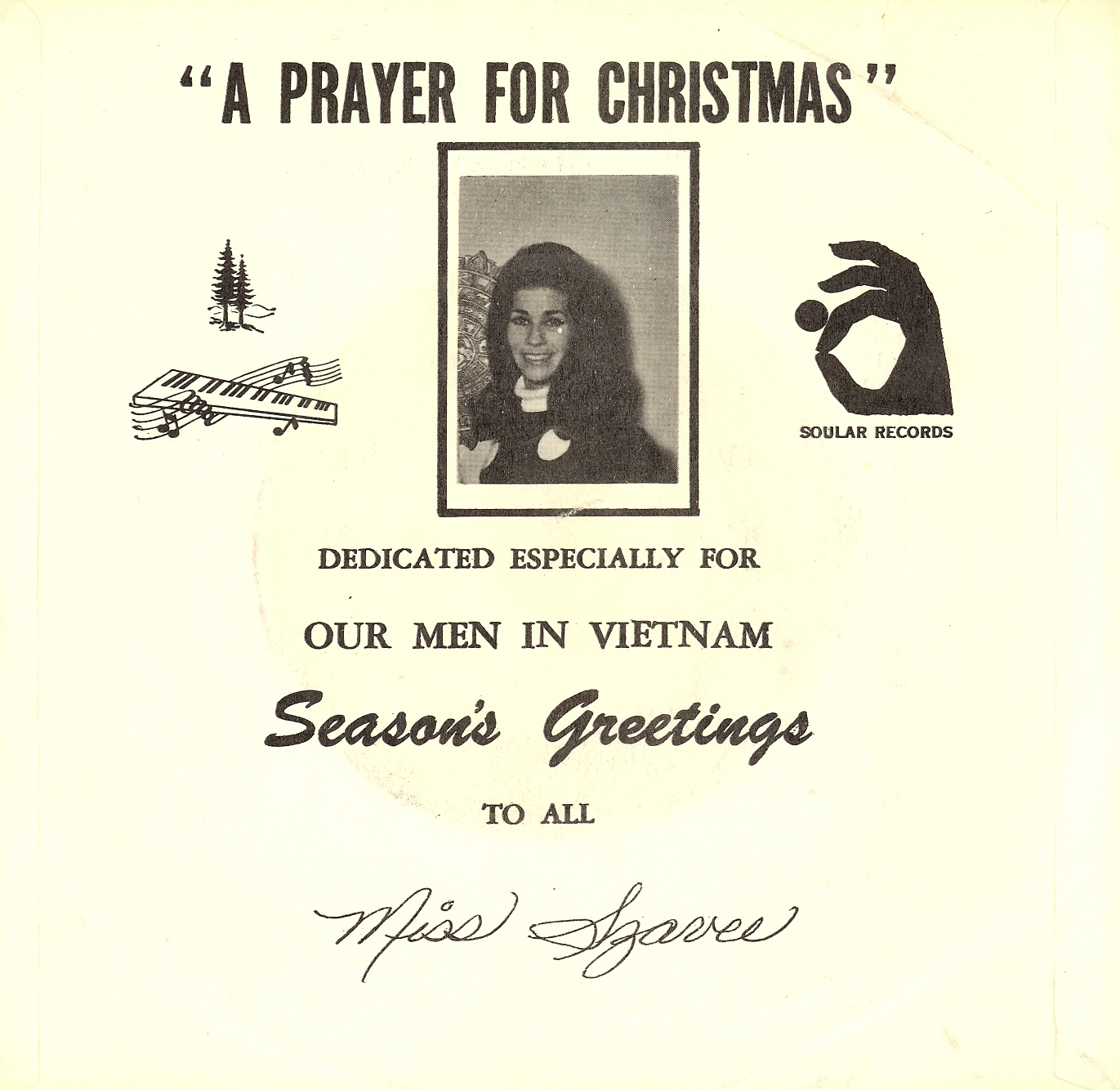
- Nashville label
- Letter from darling in Vietnam
- Had an affair with a Vietnamese girl, I won't be coming back
- Voice of Country VOC 142 (VOC 117), 45 rpm, "D. J. Copy"; "Dear Jane" (E. Thorn), 2:15, Window Music Co., Inc., BMI; produced by Pete Drake; Barbara Colson (vocal); distributed by Stop Records Inc., 809-B 18th Ave. S., Nashville, Tenn. [From the record sleeve and labels]
- A-side: Letter to parents - fighting day and night. Buddy K.I.A.
- B-side: Got days lefts then I'll be coming home
- Last words he wrote, K.I.A.
- We have one more son over there
- Vet-Co Records VCR 101-A, yellow label; "How Much Can a Mom & Dad Take" (R. Dalrymple), 3:10. [From the record sleeve and labels]
aka Dottie Stevens. Answer song to the well-known Kenny Rogers single Ruby, Don't Take Your Love to Town (Reprise Records # 0829), released in 1969, and composed by Mel Tillis. Johnny Darrell actually released an earlier, but less popular version in 1967 - Ruby, Don't Take Your Love to Town (United Artists Records # UA-50126). This Dodie Stevens answer went by the same tune as the original, with Mel Tillis receiving a credit on the label.
1
Also see the other answer record - Dori Helms - Ruby's Answer (Ruby Don't Take Your Love to Town)
Soul, Christmas. New York City, USA
Mr. President, I want my baby home this Christmas
I understand when you were called, but now I need you
What good is Christmas alone
Country, soldier and home front perspective. KIA.
Army visited man: your son has died in Vietnam
Battle description of how.
Received medal for bravery.
Soul, soldier's perspective.
Saying goodbye to his sweetheart. I'll be back
Motown subsidiary
- Label: Master Records # 1137
- Songwriter: Deckard, McKay
- Country, song poem label
- Stone Mountain, Georgia
- Home front perspective, contains patriotic sentiment
- "Dear Sir my mama was out last night, while daddy is somewhere over there helping put this world right, daddy love my mama sir, so please don't steal her heart, while daddy fights to save your world, don't tear his world apart"
.
Label: written by B. J. Hunter; Meadowlark Music Inc., ASCAP; time 2:23; 45-LJB-571; arranged by John Greek. "Thanks George Jay" and "Stacey" are handwritten on this copy. [From the record label]
Country, minor reference to draft dodging, Vietnam-era. Nashville, TN.
Home: Got your letter, waiting for you.
Soldier: in Vietnam, we got a job to do.
Going out to battle.
Crown Ltd. #120 (PRP 15081, SOB 1000), 2:33; (N. Hemphill); Moonsong Pub., BMI; dist. by Sound of B'ham, Div. of Crown Ltd. Records. [From the record label]
Contemporary folk. Famous song composed by John Denver in 1966 during a layover in DC leaving someone. Peter, Paul, and Mary released it in 1969 - many interpreted as a Vietnam War song. [From Justin A. Brummer notes from RYM]
A year later he released the song "Jody Got Your Girl and Gone" (Stax Records # STA-0085), which does not mention war or soldiers, but has often been associated with the Vietnam conflict, appearing on several compilations (such as Feel Like I’m Fixin’ to Die). The lyrics focused on the fear of a man loosing his girl while away from home - thoughts that are closely associated with the soldier figure. This theme often appeared in Vietnam War songs. The term "Jody" originated from "Joe the Grinder" (dated c.1939) - a mythical man in blues and jazz tunes who seduced the wives and girlfriends of soldiers, prisoners, and those away from home (for work or whatever). "Grinder" was an old slang word for sex (dated c.1647). It is thought to have been introduced into the army by African-Americans during the Second World War, used in military cadences (marches), such as "ain’t no use in going home, Jody’s got your girl and gone" - shouted out by a military officer, and repeated by the group of marching soldiers in unison. This type of marching later got the nickname of "jodies" or "jody calls".1
So in this song the narrator warned the soldiers that "there's a cat named Jody...in every town" who snuck around, using the soldier's home, bed, and food. The narrator concluded that it "ain't no sense in going home, Jody's got your girl and gone" . The song reached # 1 in the Billboard R&B charts on 20 February 1971, and peaked at # 28 on the Billboard Hot 100 on 27 February.23
1970
- 21 February 1970: Kissinger talks with Le Duc Tho begin
- 30 April 1970: Nixon announces the incursion into Cambodia
- 1 May 1970: Nixon calls protesters "bums"
- 4 May 1970: 4 Student killed at Kent State Ohio, by National Guardsmen
- 24 June 1970: Congress repeals the Gulf of Tonkin Resolution
- 12 November 1970: Trial of Lt. William Calley began
- 22 December 1970: Cooper-Church Amendment
1970
It started by recalling the childhood of Johnny, who got up to various misadventures, and eventually fell in love with a girl called Janie. This early section personalised the life of the soldiers sent to fight in Vietnam, focusing on their 'normal' or 'happy' American childhood. But then the protagonist received his draft letter: "orders from his country came" , and most likely the army sent him to Vietnam. At the end of the track, the listener discovered that Johnny "died in a foreign land all alone" , before having the chance to marry Janie. Thus this track mainly dealt with the impact of the war on both the life of the soldier and on those left behind in the US. To a small extent it leaned towards the anti-war side, by portraying the negative impact of the war.
The sleeve of the record said that the song was dedicated to Bill Henry Terry, K.I.A. in the Vietnam War, but refused burial at Elmwood Cemetery in Birmingham, Alabama, because he was African-American. His family filed a lawsuit and faced threats from the KKK.1. Furthermore, it was dedicated to Eugene Williams, K.I.A. in Vietnam, but denied burial in a "Caucasian‐only" cemetery in Florida.2
The label top is printed with a fox-fur pattern.
The picture sleeve prints the song's opening verses and is dedicated to PFC Bill Terry, Birmingham, Alabama, and Spec. 4 Poindexter Eugene Williams, Ft. Pierce, Florida. [From the record sleeve and labels]
Country, home front perspective. Kannapolis, North Carolina, USA
Sweetheart's letter to soldier
Received his letter which he wrote while KIA
Hope to see you when I return home...
Motown
Every morning waiting for the mailman to come.
But again he shook his head and said maybe tomorrow there'll be one.
He said, better than a letter, some guys just arrived.
I felt so much better that I ran to catch the 3:45.
I got to the station, oh, just a little bit late,
When I spotted a soldier turning through an exit gate.
Oh, I pushed through the crowd until I reached his side
And got the strangest look from a strangers eyes.
I cried, Bill, Bill, Bill when are you coming back.
I cried in a stranger's arms standing there by the railroad tracks.
Oh, yes I did.
The day you left me remains in my mind so clear.
You were saying you loved me, but the train made it hard to hear.
So, we moved by the Coke machine, oh, so we could say goodbye.
The people were staring, but I couldn't keep the tears from my eyes.
As the train departed your loving mother held me close.
We cried together, yeah, trying to keep each other host.
Oh, wherever you are you know you need it too,
â??Cause no one in this world needs you like I do.
I cried, Bill, Bill, Bill, Bill when are you coming back.
I cried in a stranger's arms standing there by the railroad tracks.
Oh, yes I did.
standing there by the railroad tracks.
Oh, yes I did.
No news is good news; at least, that's what your mama said.
But, I could see in her eyes, she too, is so afraid.
Now, I've got nothing to cling to except what I felt inside,
When I cried I loved you and looked into that stranger's eyes.
Oh, I miss you, Bill.
I can't stand the pain of knowing if I'll ever see you again!
I cried, Bill, Bill, Bill, Bill when are you coming back.
I cried in a stranger's arms standing there by the railroad tracks.
Oh, yes I did.
Billy, baby!
Billy, baby, when are you coming back?
I cried in a stranger's arms standing there by the railroad tracks.
Oh, yes I did.
Gospel
Documentary record, narrated by Walter Cronkite, well-known US broadcast journalist, for CBS, born 4 November 1916 in Saint Joseph, Missouri, USA, died 17 July 2009 in Manhattan, New York, USA. This record included the track "Republican and Democratic Conventions 1968". It was a 3-LP box-set.
18 years old, a soldier today in a land far away.
Why? It's Christmas time, decorations are up
Looking forward to his homecoming. But killed in action
Label: PR-1008B; Pano Pub. Inc., ASCAP, 2:36; mfg. by Panorama Recording Corp., 1819 Broadway, Nashville, Tenn. 37203. [From the record label]
Recorded Live at the V.C. Hilton Vietnam (Mason, Beni) Comedy recorded in Vietnam, performed to US troops [From Justin A. Brummer notes from RYM]
Hippie From Mississippi (Carroll, Chesley) Answer to Merle Haggard. Hippie country novelty. Father is mad I won't join the navy. Family is embarrassed No love-ins here, leading free student movement. [From Justin A. Brummer notes from RYM]
Hippie From Olema (Youngbloods, The) Hippie country novelty - answer to Merle Haggard. Long hair, we don't hate, we take in strangers Civil rights reference. Also ecology / environmental protection. [From Justin A. Brummer notes from RYM]
1971
- 30 January 1971: Operation Lam Son - Laos incursion
- 29 March 1971: Lt. Calley found guilty of My Lai murders
- 29 April 1971: US death toll in Vietnam reaches 45,000
- May 1971: Gallup reports 68% support for withdrawal from Vietnam
- 13 June 1971: New York Times publishes Pentagon Papers
- 15 June 1971: Nixon takes legal action against the NYT
- 18 June 1971: Washington Post starts publishing Pentagon Papers
- 30 June 1971: Supreme Court votes 6-3 in favour of NYT and WP
- 15 July 1971: Nixon announces that he will visit China
- 17 July 1971: Nixon established 'Plumbers' unit to stop leaks
- 18 August 1971: Australia and New Zealand announce withdrawal from Vietnam
- 22 September 1971: Captain Medina acquitted over My Lai massacre
- 31 December 1971: US troop numbers drop to 156,000
1971
On this album featured the song "Relaxing Town" (Atlantic # SD 7206), which expressed discontent with the protest movement, with the narrator wishing to settle down in a quit town, away from the demonstrations and revolution. It contained a minor reference to the confrontation between prominent hippie Jerry Rubin, one of the Chicago Seven, and Mayor Richard J. Daley: "Jerry Rubin versus Mayor Daley...admission is free, we can all stay home and watch it on TV".
Necaise performed the verses in which he described seeing a young child at a playground, looking very sad. The child explained that "my daddy is in Vietnam...gone since Christmas" . The child expressed concern for his mother who cried a lot. He asked the man if he could take him to Vietnam to visit his father. 'Lil' Gary D only sung the chorus, posing the question "mister where is Vietnam, is it very far away, I want to see my daddy, will you take me there someday" . At the end of the song, the man did not know how to react, so he walked away. This provided an interesting reflection of the impact of a soldier heading out to war on a young child, who did not know or understand the situation in Vietnam.
Traditional pop. Christmas. P.O.W. / M.I.A.
Please Santa bring daddy home for Christmas.
Billboard - song dedicated to prisoners of war.1
- 1 Billboard ↩
Christmas Vietnam.
Country.
Label Baton Rouge, Louisiana.
Musicians from Tazewell, Tennessee.
The stereo picture sleeve (#145) reads "'Ebb-Tide II Record's' presents 'Clay Webb'", with the title and "Merry Christmas" framing a photograph of two soldiers in a sandbagged trench, one writing on a helmet across his knee, "Dedicated to: (Our Boys in Viet-Nam)" and "The Big D. & B. from Tennessee". A typed letter from Clay M. Webb, 1005 East Mariposa, Phoenix, Arizona, dated November 22, 1971, to the Billboard Record Review Department encloses the Christmas single for review, describing Don Gully (a D.J.) and Buster Turner as new artists with many years of musical experience who reside at Tazewell, Tennessee and have done much radio and television work in and around Knoxville. [From the record sleeve and labels]
Pop, home front perspective.
Mammoth, West Virginia, USA
Children left as orphans by the war - Vietnam-era
Other side is a tribute to JFK, RFK, and brother killed in WW2
Pop rock. Plight of the soldiers and those back home.
Soldiers returning home from the war.
Friends and family gather to welcome them.
Pay tribute to those KIA.
Soul / funk, Chicago Illinois, USA
I support equality, let then have freedom
Like to see a captain of a ship to the moon
Congress should repeal law stopping women going to war
Country, home front perspective, K.I.A.
Grand Prairie, Texas, USA
Son was always good, he did not demonstrate and protest
Sent to war, to kill
But all that is left are his medals
Casket wrapped in flag.
Country, soldier / home front perspective.
Athens, Alabama, USA
I fought in a war, now my younger brother is in the East fighting.
Miss him. War is hell, but I love my country, defending freedom.
1972
- 10 March 1972: 101st Airbourne division withdrawn from Vietnam
- March 1972: North Vietnamese launch Eastertide Offensive
- 4 April 1972: "Freedom Train" begins - major US bombing of North Vietnam
- 15 April 1972: US Bombing of Hanoi and Haiphong harbour
- 9 May 1972: Beginning of Operation Linebacker: mass bombing of North Vietnam
- 22 May 1972: Nixon meets Brezhnev in Russia
- 17 June 1972: Watergate break-in
- 14 July 1972: George McGovern becomes Democratic presidential nominee
- 7 November 1972: Richard Nixon re-elected US president
- 23 August 1972: Last US combat troops leave Vietnam
- 18 December 1972: Operation Linebacker II ("Christmas Bombings")
1972
This song picked up on the "Jody" theme - the mythical man who stole the wives and girlfriends of soldiers away from home, as discussed with Johnnie Taylor's well-known "Jody Got Your Girl and Gone" . Sexton switched between narrating from the soldier's perspective to that of the soldier's girlfriend / wife. The soldier has noticed that something is wrong with his girl: "I know you've been running around" , he tells her. But the girl says that "I found me a man who loves me better" , adding the justification: "you've been gone too long" . Then in the third person, Sexton tells the listener the famous line: "ain't no use in coming home, cause Jody got your girl and gone" .
In 1972 he released the prisoner of war (P.O.W.) song "Hard Life, Hard Times (Prisoners)" (RCA Victor # 74-0801). It featured on the album Rocky Mountain High (RCA Victor # LSP-4731), under the track name "Prisoners" . He spoke about it on the Tonight Show on 19 September 1972, a US television show hosted by Johnny Carson.2 He said "I wrote it in January. The single is called 'Hard Life, Hard Times' but...on the album it's called 'Prisoners'. It's about prisoners of war".3 The lyrics present two perspectives. Firstly, it looked at those back home, the family of a P.O.W.: "Josie works...to help her pass the time, her mama keeps the baby and grandpa rambles on" . Secondly, the narrator switched to the perspective of the P.O.W.: "I see her face in the stone, I try to imagine our baby, I wish they would let me go home" . Produced by Milt Okun. The song got noted in Billboard on 16 September 1972 for strong radio play, especially in Chicago, Illinois.4 On 30 September it bubbled under the Hot 100 at #110.5 It peaked at # 103 on 4 November 1972.6
Her local newspaper in South Carolina, The Sumter Daily praised her single, writing that "on Sandy's recent trip to Nashville...she went to this great music center: to try to tell as many Americans as possible about the POW-MIA situation through music...Since her return, she has heard from (and talked with) Johnny Price, who is ready to release his own recording to help her cause, The Ballad of the POW".4Johnny Price did release the single "Ballad of Our P.O.W.'s", discussed below. Bagley wrote the b-side of that single, "Santa Bring Daddy for Christmas". Bagley's song also picked up nation coverage in Billboard on 12 August 1972, which reported that "the wife of a prisoner of war in Vietnam has done a country single".5
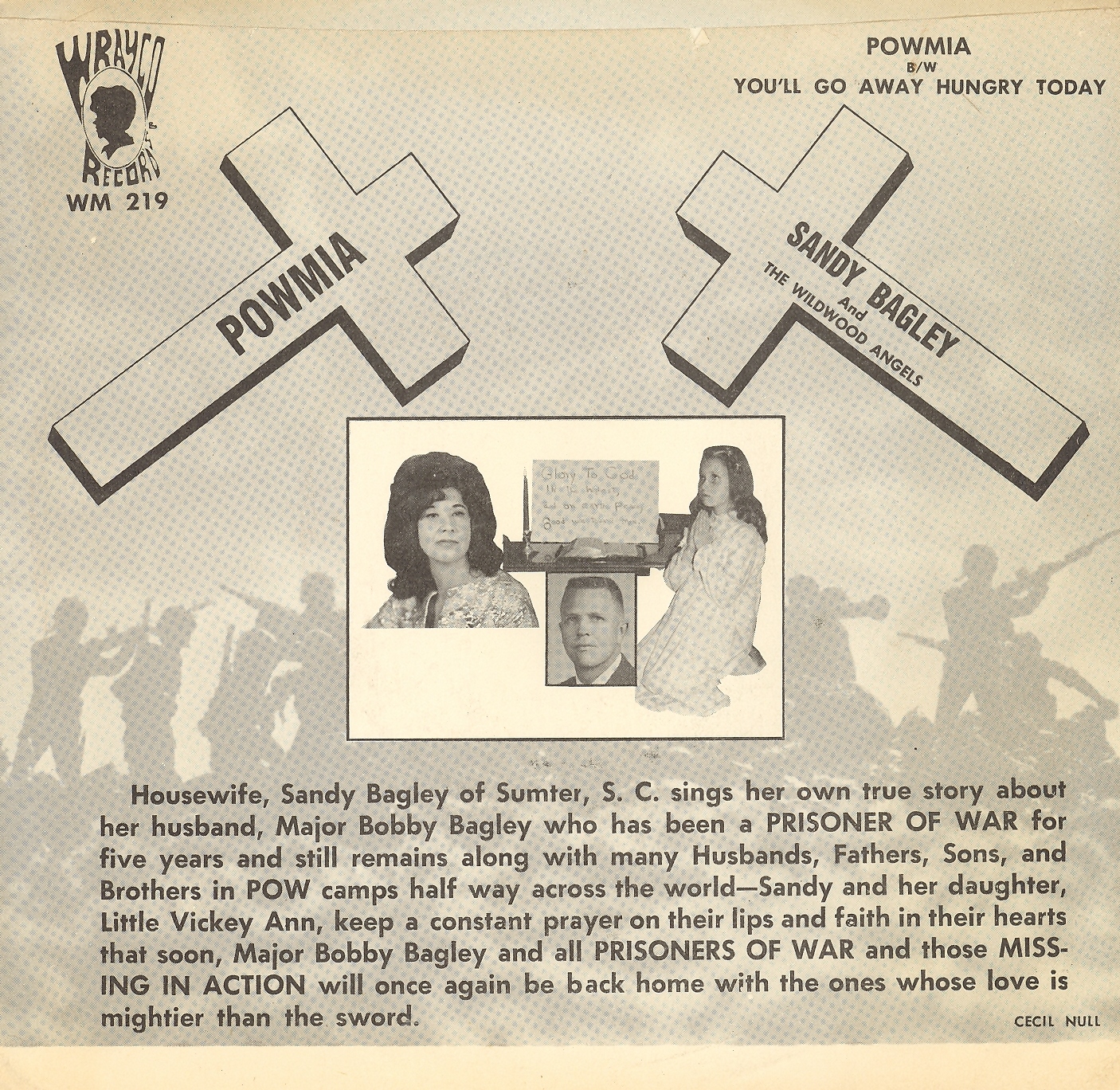
The picture sleeve front shows two crosses lettered "POWMIA" and "Sandy Bagley and The Wildwood Angels" over silhouetted soldiers, with photographs of Sandy Bagley, her husband and her daughter kneeling in prayer, and the text: "Housewife, Sandy Bagley of Sumter, S.C. sings her own true story about her husband, Major Bobby Bagley who has been a prisoner of war for five years", adding that she and her daughter Little Vickey Ann keep a constant prayer that he and all prisoners of war and those missing in action will be back home.
The back prints the full lyrics (chorus and three verses), "Words and Music by Cecil Null", © 1972 Maple Music, Inc.—ASCAP. [From the record sleeve and labels]
Also in 1971, he released the song "Sam Stone" , a cover of the John Prine song (found on his 1971 self-titled country album John Prine, Atlantic # SD 8296). This version was released on Cuffed, Collared and Tagged (Elektra Records # EKS 74089). The song told the plight of a Vietnam veteran returning home from the "conflict overseas" , who turned to drugs: "morphine eased his pain" . The song ended with his death: "Sam Stone was alone when he popped his last balloon" . Thus, this presented another Vietnam-Drugs representation. The song made a small reference to the Purple Heart - a US military decoration.
Country, soldier / sailor boy song
Indianapolis, Indiana, USA
Vietnam-era
Here to tell your daughter her man was shot down in the war.
Here's the ring you wouldn't let him give her.
Can I see the daughter you wouldn't let him see
- please come home daddy
- 3 years since you went away
- My mama don't understand, doing best she can
- It does not mention war, possibly Vietnam-related?
- Producers David Jordan, Patrick Adams; Written-By, Arranged By James Peterson. Published by Patrick Bradley Music Corp. (BMI); Record company Perception Ventures, Inc.; (P) Today Records, Inc. Matrix: T-1517A 11-22-72 / T-1517B 11-22-72.
Also track B5 on James & Lucky Peterson LP 'The Father The Son The Blues' (Today, 1972) per soulbluesmusic.com. Today Records T-1517-A, red and yellow peace-sign "Promotion Copy" label; Patrick Bradley Music Corp. (BMI), time 3:10; ℗ 1972 Today Records, Inc., a subsidiary of Perception Ventures Inc. [From the record label]
This song took an identical format, and mirrored the same story. A man walking through a "sleepy Southern town" saw a little boy whose "eyes were big and sad". The boy explained that his "daddy fights for freedom and keeps things safe for me". However the North Vietnamese "keep them locked up". So the boy took a political position on the objectives of the war, and thereby displayed an understanding of the conflict, not present in the previous version. The boy also explained how the situation affected the family: "my mummy is always crying". This song represented the plight of a P.O.W.'s family, especially on a young child, as well as containing some patriotic / pro-government sentiment. Released in Nashville, Tennessee, on Chuck Chellman's country label - he also produced the record.
Vocal pop, home from perspective, P.O.W. / M.I.A.
Child's father lost in a foreign land.
Bring him home!
Produced by Darío González; recorded at Discos Borinquen Studio; recording engineer Richard Stanley; photo by José M. Feliciano; pressed by Río Piedras Record Mfg.
The back-cover biography says Leavitt was born in Puerta de Tierra on 17 September 1948 and studied accordion at the academy of George Kudirka. "Soldado" was also issued as a single (b/w "Difícil de olvidar") on Borinquen D-382 in Puerto Rico, and in Panama on Istmo Pops DG-1829 (M-DG-1829-1), "bajo licencia Borinquen", made by Fonodiscos, credited to "Orquesta La Selecta", canta: Samy Marrero. [From the record sleeve and labels]
1973-1975: Paris Peace Accords to the Fall of Saigon
Between the Paris Peace Accords (27 January 1973) and the collapse of South Vietnam (30 April 1975). This marked the final end of the Vietnam War, with most American civilians and troops evacuated during the North Vietnamese invasion. The two halves of the country were reunified, and Saigon renamed Ho Chi Minh City, after the North Vietnamese leader Hồ Chí Minh.1973
Like other releases on MoWest, this track blended different genres - this had a smooth soul feel, with very upbeat jazz-funk horns, and it ended with a military drum beat, as the song celebrated the "happy days...good days" as the soldiers returned from Vietnam. The narrator said that now the war had ended, there would be "no more useless dying" and "senseless crying" , and nothing but "joy, joy, joy" .
Country - Atlanta, Georgia, USA.
Country, child, home front perspective, P.O.W.
Mississippi, USA.
Hello daddy, been so long since I've seen you.
Held in a prison camp in Vietnam
The song "Viet Nam" (Disques Alvarès # C 484) is a live cover of the Jean Arnulf song "Chante une femme" under a different title, released on the 1968 album Déjà l'automne. Marc Ogeret also covered the song, on the album Chansons de révolte et d'espoir.
1974
- Label: Command Performance Records # CP 244
- Songwriter: Mrs. Rose O. Stine
- Song poem, traditional pop
- Female singer (uncredited), not the usual "Tune-Timers" singers
- Home front perspective - "I'm a Navy wife", first person narration
- Hollywood, California
A-side: Jody theme - girl lonely, Jody will help.
B-side: think about the soldiers
Younger generation looking for a better way.
Civil Rights, poverty, moon race
Country / fanfare, toy soldier theme We won't let him play with guns Boys will grow up, they can't give up the game of war Please stay a toy soldier only [From Justin A. Brummer notes from RYM]
1975
- Label: Tin Pan Alley # TPA 80-711
- Songwriter: Ruth Isaacs
- Traditional pop
- Veteran, PTSD
- What happened when he came home from the war
- Mind wonders, he doesn't know she is there
- Help him forget the war he has left behind
- Tin Pan Alley Records, Tin Pan Alley, Inc., Sarasota, Florida 33578, TPA 80-711B, light-blue label; "My Man, I Love Him So" (Ruth Isaacs), Juke Box Alley, ASCAP; Mike Thomas. The label carries a rubber-stamped date "Jul 31 1975". [From the record sleeve and labels]
2018
Unknown date
- 1 Song Poem Music ↩
- 2 Song Poem Music ↩
- Label: Preview Records # 1563
- Songwriter: Mary Emily Brink
- My man is so far away, fighting for the U.S.A.
- I pray to god, don't forget my man
- Your wing will mend, while my heart is falling apart, I'll wait for you
- Home front perspective
On the b-side of this single, the song "Santa Bring My Daddy for Christmas" dealt with the Vietnam War, Christmas, and the P.O.W. theme. A spoken-word track, it is split into two narratives. The first one, narrated by the female vocalist Marty Lizabeth, recalled seeing a boy at a shopping mall asking Santa to bring home his father from Vietnam. He explained: "my daddy is a prisoner of war" . In the second narration by Johnny Price, the boy's father (the soldier) spoke from Vietnam, saying that Santa may be too busy to get him home in time for Christmas, although "dreams do come true" . Composed by Sandy Bagley and Johnny Price.&
- Send a letter to the soldiers over there
- Tin Pan Alley Records TPA 50-536B, light blue label; "Letters From Home" (Ruth G. Jenkins), 1:57, Juke Box Alley (ASCAP); Mike Thomas; Tin Pan Alley, Inc., Lake Grove, New York 11755. [From the record sleeve and labels]
- From Miami, Florida area
- Soldier boy theme, I'll be there for you
- Home front perspective
- MEW 102-A (pink label), 45 RPM; "Don't Cry Soldier" (Gary Stites), published by Iluvlori, BMI, 2:01. [From the record sleeve and labels]
- Potential song poem
- Portrait Records 706-0 (0476), 45 RPM; "Oriental Moon of Vietnam" (Jane Abbott and Lola Creal Abbott), time 2:34, Standley Music, ASCAP; Kathy Dunn. [From the record sleeve and labels]
Spending Christmas alone
Brief Historical Tribute to Richard Milhous Nixon (Pastuck, Buddy)
A-side: Country, Nixon, anti-war, P.O.W., home front perspective
You've been gone for 10 years - bloody war in Vietnam separated us.
Hope you come back soon - I've not received letters from you.
Then - letter arrived: I've been shot, communist say I will live (P.O.W.)
Nixon has brought peace
B-side: Nixon tribute. Review of his political career under Ike, 1960 election against JFK.
As president, he opened China, visited Russia, stopped 30 year war in Vietnam.
Helped rescue the P.O.W.s, took responsibility for Watergate for good of country.
Country. Home front perspective, religion.
Mother - son's off to war. She remembers birth, boyhood days.
But he is grown and fighting. The rest is up to god
Child narration. Pop, home front perspective. Released New York.
Dear god - bring my daddy home from Vietnam
- Label: Tin Pan Alley # TPA 30-459
- Songwriter: Franklin D. Kinman
- Song poem, Christmas, traditional pop
- Soldier's perspective
- All day long I cried
- Captain said don't be sad, you'll be home in 16 months
- Work over here will soon be done
- Tin Pan Alley Records TPA 30-459A, Tin Pan Alley, Inc., 1650 Broadway, New York, N.Y. 10019; Juke Box Alley (ASCAP); "Christmas in the Army" (Franklin D. Kinman), 2:39; rubber-stamped date "Jun 3" on the label. [From the record sleeve and labels]
Traditional pop.
Drums of war are beating again.
Why couldn't I tell my son what I thought.
Vietnam-era rendition of Danny Boy.
Teen pop, home front perspective
Soldier boy went to Vietnam
Have to wait for marriage
But letter came from the president - KIA
Received a Purple Heart medal and his dog tags
Released around 1972-73.
Son home from the war for 6 months now but I don't know him.
What have they done to my son? Wakes up everynight screaming
Seen so many die. Early reference to PTSD.
Brief Historical Tribute to Richard Milhous Nixon (Pastuck, Buddy)
A-side: Country, Nixon, anti-war, P.O.W., home front perspective
You've been gone for 10 years - bloody war in Vietnam separated us.
Hope you come back soon - I've not received letters from you.
Then - letter arrived: I've been shot, communist say I will live (P.O.W.)
Nixon has brought peace
B-side: Nixon tribute. Review of his political career under Ike, 1960 election against JFK.
As president, he opened China, visited Russia, stopped 30 year war in Vietnam.
Helped rescue the P.O.W.s, took responsibility for Watergate for good of country.
Country, home front perspective, Christmas
Child asks Santa: please take my daddy's place overseas
Country novelty - cover of Hank Penny
Man writes letter to friend fighting in Vietnam
Your girl has been spending your money, having parties, ruined your car
And hanging out with Clive!
Whisperin' Bill (Wills, Chill)
Country, home front perspective. From Texas, USA
A-side: relationship started going wrong when they lost their son (in the war?) Refer to b-side.
B-side: Son shot in the head by the Viet Cong - disabled.
He volunteered to help his country.
Country, home front perspective. Johnson City, Tennessee, USA.
Many going to Vietnam - now my husband. Why? I don't know
How to raise my children without a father
Waiting for him to return
But knock on the door - your husband was KIA
Traditional pop, P.O.W. / M.I.A. song. Post-war, 80s.
Born in 1945, but now mother cries - bring him back, don't forget my son.
Back in 1968 he married and had two children - now they cry.1
The picture sleeve front shows "MIA" in pink over a photo of a smiling young airman in a flight jacket with a "Wild Weasel" patch, captioned "Mike Bosiljevac".
The back states that Captain Mike Bosiljevac, USAF, of Omaha, Nebraska, attended the Air Force Academy and was shot down over North Vietnam near the Son Tay prison compound when the F-105 he was in was struck by a SAM, that the pilot was released in 1973, and that "the Vietnamese authorities have refused to tell us what has happened to Mike".
Credits: piano Chuck Penington, drums Subby Anzaldo Jr., guitar Ron Cooley, bass Brian Sampson, voices Denise Fackler and Sara Flackjaw, engineer Fenton Isaacson, producer Chuck Penington; acknowledgements to Subby Anzaldo Entertainment Agency and Shorty Vest, Omaha Musicians Association, Local 70-558; Croat Records, PO Box 1496, Omaha, NE 68101. [From the record sleeve and labels]
County, home front perspective.
Soldier marches off to war - KIA.
Mother cries. Victory is sweet - but what a price.
Easy listening, home front perspective. Religion.
Bellingham, Washington, USA.
Soldier boy: I'll always be here, true to you.
Please god take care of him
Home front perspective - Santa don't forget my mummy
She's been crying since the mailman brought a letter with medals (K.I.A.)
Sons Last Call From Seattle (Coffey, Willie)
Contemporary folk, Missing in action (MIA)
A-side: soldier's perspective. I've fallen in battle.
Thinking of mum baking, saying prayers and reading the bible.
B-side: mum's perspective - misses son, MIA according to Uncle Sam.
Label based in Muskogee, Oklahoma.
County. Impact of war: at home. Woman in US misses her sweetheart who died in Vietnam.
Teen pop, home front perspective, child
14 year old
You're not the same - because of war?
Whisperin' Bill (Wills, Chill)
Country, home front perspective. From Texas, USA
A-side: relationship started going wrong when they lost their son (in the war?) Refer to b-side.
B-side: Son shot in the head by the Viet Cong - disabled.
He volunteered to help his country.
You'll Agree (Susan and the Shannons)
Folk rock, home front perspective. Omaha, Nebraska
A-side: sweetheart is away at war. Only have memories. Soldier shoots to kill
B-side: we are apart - I miss and love you.
- Dear Mr. President (Jones, Dave)
- A-side: country, patriotic, My Lai / Calley
- War is hell, women and children killed at My Lai
- Soldier's taught to kill - how do they know the enemy?
- Who is to blame? Is this what we stand for?
- Orders came down, sense of reason was lost
- Lets not condemn or condone.
- God stands in judgement
- B-side: six months ago I send a letter to the president - please don't take my son away
I remember him with his toy soldiers. But K.I.A. I'll gladly give my life for the flag and freedom.
- B-side of W-1002. Not a My Lai song: a father's letter to the president about his drafted son, who is then killed in action. Waxwing W-1002, 45 RPM, yellow label with red bird logo, "A Production of Waxwing Sound and Recording"; "The Ballad of My Lai" (D. Jones), 3:08, and "Dear Mr. President" (D. Jones), 2:48, Waxwing Music, BMI; produced by Barlow - Pope. [From the record sleeve and labels]
- Label: Bang Bang Records # FM 4103
- Songwriter: D. Fitzgerald
- song poem, traditional pop,
- home front perspective, patriotic
- Since you sailed away, I promised I would not cry
- In Vietnam, our boys are brave
- So we can stay free, devotion to god and country
- Washington D.C.
- Bang Bang Records FM 4103 (ZTSP 124103), Washington, D.C. 20009, purple label; "We Won't Say Goodbye" (D. Fitzgerald), 2:48, Fitzgerald's Music, BMI; produced by David Fitzgerald. [From the record sleeve and labels]
- Label: Jay-Bee # 38903
- Songwriter: L. Stanton
- Traditional pop
- Home front perspective - I see Silver Wings on his chest. A Green Beret
- God end this war today (religion, anti-war)
- A can't explain where his father's gone
- He knows you were a fighting man, but he's only 3
- Note: MP3 only
- Jay-Bee Records, yellow label, "Reg. No 38903", Side 1; "A Mother's Letter To Viet Nam" (L. Stanton), sung by Damita. [From the record sleeve and labels]
- Performer: Gloria Weston
- Label: Tornado Records
- Songwriter: David L. Perkins
- Traditional pop
- P.O.W., M.I.A. issue
- Letter from the War Dept, husband is missing in action in Vietnam
- Gave is for freedom and country
- Home front perspective as well
- Does not mention P.O.W.s
- Track B1 of the 4-track EP 'Hot Game of Dice' (Tornado T-107); A-side tracks by Rod Rodgers, B2 by Kenny Craft. Tornado Records, Record T-107, extended play, 45 RPM, gold label, matrix S4KB-1942; "Missing in Action" (in Viet Nam) (David L. Perkins) (Robert (Bob) Pine), featuring Gloria Weston, 3:28; "What a Fool Am I" (David L. Perkins) (Lula F. DeBoard), featuring Kenny Craft, 2:25; Cedarlane Music (BMI), Ramrod Music. [From the record sleeve and labels]
- Label: Halmark # 22784
- Songwriter: Emile Favron
- Artist: uncredited female artist
- Credited: Bob Storm, music director
- Home front perspective
- Sweetheart fighting night and day
- All I can do is pray
- Fights for me. Come home free
- "Halmark" "Sound of Excellence" 22784, 45 RPM, unbreakable, high fidelity; "My Love Is in Viet Nam" (Isabel Daigle); Bob Storm, musical director Jerry Dee. [From the record sleeve and labels]
- Label: Preview Records # 1720
- Songwriter: Alice Anderson
- Traditional pop, home front perspective
- Song poem, mother signing about son in Vietnam
- My son left the army after two tours of Vietnam
- People told you I'm not around, but I'm still your mother
- Preview Records, 6311 Yucca, Hollywood, 1720-2; "A Forgotten Mother" (Alice Anderson), 2:25, Arthur Music, A.S.C.A.P.; Barbara Foster. [From the record sleeve and labels]
- Label: Tin Pan Alley # TPA 10-377
- Songwriter: Tagliente, Dienna
- Song poem, traditional pop, home front perspective
- Will my man come back from overseas?
- Pray that peace will come soon.
- Is he in Vietnam? Will he stay? Is he well?
- Tin Pan Alley Records TPA 10-377A, 45 RPM, "Mfg. by Tin Pan Alley, Inc., 1650 Broadway, N.Y.C."; "Come Home to Me" (Tagliente, Dienna), time 2:49, Juke Box Alley (ASCAP); Cathy Mills. [From the record sleeve and labels]
- Label: Preview Records # 2901
- Songwriter: Chris Washington
- Traditional pop, home front perspective - concern for the soldier. Religion referenced
- Preview Records, 6311 Yucca, Hollywood, 2901-2; "The Lonely Soldier" (Chris Washington), 2:40, Arthur Music, A.S.C.A.P.; Gene Marshall. [From the record sleeve and labels]
- Label: Halmark # 8695
- Artist: unknown, attribute to Bob Storm, but that's incorrect. Female singer
- Songwriter: Karen Davis, Jerry Dee
- Musical director: Bob Storm
- Traditional pop, home front perspective
- They sent you away from me
- Expected to survive the jungle, I suffer too
- You've been wounded, fighting for something you think was a good cause
- You're half a man
- Memories of Vietnam are in your eyes (direct mention), PTSD
- What was it all for? (fighting for?)
- The hell of war, leans anti-war
- Halmark "Sound of Excellence", LH-8695, 45 RPM, High Fidelity; two songs on the side: "Unapproachable" (Lee Clark - Jerry Dee) and "The Suffering of a Serviceman's Wife" (Karen Davis - Jerry Dee); Bob Storm; musical director Jerry Dee. [From the record sleeve and labels]
- Label: Air Records # S-1539
- Songwriter: Ethel Clevenger (both songs)
- Need songs, need images
- Miami, Florida, USA
- "First My Husband, Now My Son
- Artist: Mary Kay
- Label: Recap # 43138
- Songwriter: Opal Skaggs1
- Note: need label, need song
- Probably home front perspective
- 1 Song Poem Music ↩
Another Mother's Baby Soul
- Seeing the job done in Vietnam
- But how do they sleep at night with the threat of death
- Pray that god will help these people in Vietnam
- Soldier's + home front perspective
- B-side. Discogs describes Gospel Sound (6) as a 1970s gospel label from Nashville, Tennessee – label city only, not confirmed as the group's base. Justin owns a copy (Gospel Sound 1010; his sheet titles it 'Lord, Help Viet Nam'). Gospel Sound Record No. 1010 (1010-B), pale blue label; time 3:10; written by Willie Moon. [From the record label]
"This modern sleigh is not only a joy to choir girls as Santa steps out but us a joy to the boys in Vietnam when help comes when peace is absent. This modern sleigh will not bring Santa to the boys in Vietnam but it will bring a gift from home and the memory of Christmas tide and carols"
Picture sleeve: front "Come Caroling With Us", Texas Girls' Choir, Shirley Carter, founder and director, with Santa Claus and a Bell Helicopter. Back: side I — I'm Dreaming of a White Christmas (Berlin), Carol of the Drum (Davis), Silent Night (Gruber), We Wish You a Merry Christmas; side II — Jingle Bells (Pierpoint), Up on the House Top (Hanby), Here We Come A Caroling, O Come All Ye Faithful (Ann Everard, TGC Piano Contest winner), Christmas Eve (Grofe). Headquarters in Fort Worth, Texas (staff: Shirley Carter, Elizabeth Barney, Beverly Thompson, Beth Henry); "In co-operation with Leonards"; Century Custom Recording. [From the record sleeve]
Country. Soldier's and home front perspective. M.I.A. Patriotic
Label: Glendale, California, USA
Family only son goes M.I.A. in the war. He is found by his buddy who is severely wounded.
Soldier's family does not want to take care of his buddy
A-side: Made in the U.S.A.: anti-foreign goods from Japan, Germany etc.
Reference to fighting overseas in Asia
Country, patriotic, anti-protest, home front perspective, K.I.A.
Baltimore, Maryland, USA
Died for you and me, at the age of 21. At 19, he answered his country's call
Glad he died fighting for freedom rather than demonstrating
Wedge Records SR-1028-B, 2:05; (Robert L. Spiller); Big Wedge Music Pub., BMI. [From the record label]
Country, home front perspective, patriotic, religion
Peoria, Illinois, USA.
Son fighting in a war, doing a job to keep us free
He'll be home soon.
Country, patriotic, home front perspective, religion
So lonely since our son left.
Hope this letter finds you well
Try not to fell depressed in the war
We still care, we pray for you
Proud that you volunteered.
Boy at train station watched as soldier's came home from Vietnam.
Waiting for daddy. But he returned in a casket wrapped in flag.
He died for you and me.
Top Cat Record 967-A, 2:49; (K. Fred Newton); Twenty Grand Music (BMI); produced at D'Arcy Sound Studios. [From the record label]
Missing my marine, I'm devoted to you.
High taxes, space race, millions of dollars spent in Vietnam
Ollie, By Gollie (Top Secret) Country novelty about Oliver North. American hero (Vietnam not mentioned) [From Justin A. Brummer notes from RYM]
Ballad of the Subic Bay (Oldies But Goodies Band) Novelty, fanfare - to the tune of Sadler's "Ballad of the Green Berets". Narrator joined the navy. Subic Bay - naval base in Philippines very active during Vietnam War, for the 7th fleet to repair and replenishment. [From Justin A. Brummer notes from RYM]
Lyric theme data
Lyric content themes tagged on the songs in this collection — parent themes with their sub-themes (number of records). Click a theme for its definition and all records carrying it.
Show all 32 themes ▾Key stats
420 songs · 405 releases · 379 artists · 315 labels · 1956–1975 · 5 more list entries have no record page yet and are not counted here
- 1966 is the peak year, with 47 songs.
- 1966–69 holds 158 of the 305 dated songs — more than half in four years.
- 418 of the 420 were released during the war years. Only two come after: Pepe Pena, “Carta de un soldado” and Pepe Pena, “padre del soldado”.
- 115 records are undated.
- 379 artists for 420 songs — almost every act appears exactly once. The most represented is Various Artists, with twelve.
- 180 of the artists are still unidentified beyond the record: no line-up, no biography.
- Twelve are credited to various artists — compilations and cast recordings.
- Songwriter gender is recorded for 214 of the 420 songs: 166 by men, 36 by women and twelve by mixed teams — women wrote 17% of those.
- By performer: 225 men, 145 women, 33 not identified and 16 mixed groups (recorded for 419).
- 440 named songwriters. The most often credited is Hank Penny, with five.
- 262 of the 315 labels appear exactly once; Decca has the most, with eleven.
- 88 sit on a major or well-known imprint — Decca, Columbia, Scepter, Capitol, Dot, MGM, Reprise, Atlantic. The other 332 are on independent, regional or private labels.
- Six are private pressings with no label at all.
- Eleven 45s put both of their sides into this list.
- 408 of the 420 are American. New York leads with 49, then California 27 and Tennessee 26.
- New York City accounts for 48 records, more than any other city; Nashville has 18, Chicago 16.
- Twelve come from outside the US: four Canadian, three Puerto Rican, two British, one Belgian, one French, one Japanese.
- By perspective: 378 home front or soldier's perspective; 23 patriotic, pro-government or anti-protest; 17 peace, protest and anti-war; two post-war.
- 104 distinct sub-themes across 420 songs.
- Home Front Perspective is the single biggest subject — 244 songs, more than half.
- Next come Soldier's Perspective (101), K.I.A. (57), Religion (56) and Soldier Boy (52).
- Three are answer records, most of them to “Ruby”.