Collections › My Lai & Lt. William Calley Songs
My Lai & Lt. William Calley Songs
292 songs · chronological · A–Z by artist
Annotations and notes by Justin A. Brummer
Exhibition Song My: a gallery tour of this collection →Entries are numbered (#1, #2 …) for reference on this page; the numbers shift when entries are added or split.
“My Lai Massacre Scene” — bodies of women and children on the road leading from the village of My Lai, South Vietnam, 16 March 1968. Associated Press wire print of the photograph by Ronald L. Haeberle (b. 1940), then a US Army sergeant, from Life, © 1969. National Gallery of Art, 2018.177.582 Source ↗
A collection of songs and spoken-word recordings referencing Lt. William Calley and the My Lai Massacre
This forms part of the larger Vietnam War Song Project, an interpretive examination of over 6,500 Vietnam War songs identified, revealing how the war's significance is represented through music. The project also collects spoken-word recordings about the conflict. This unique collection of voices advances scholarship by providing insights into people’s views about the war over time as represented in music, looking at diverse communities and vibrant music scenes. It is crucial in developing our knowledge of the war and the humanities, through the use of a digital research platform.Note: The VWSP has identified, to date, 290+ songs about or referencing the My Lai Massacre and Lt. William Calley.
YouTube playlist: Lt. William Calley & My Lai songs
Citation: Justin A. Brummer, Vietnam War Song Project (VWSP) — My Lai & Lt. William Calley Songs, vietnamwarsongproject.com/list/my-lai-lt-william-calley-songs, accessed 12 November 2026
Historical Context
One of the most controversial events of the war was the My Lai Massacre, which inspired 290+ songs.
Beyond My Lai and Anti-Calley, the songs in this collection most often also deal with: Anti-War, Pro-Soldier, Patriotic, Calley-Order.
1 of 6
1 of 2
The first reports of an incident were reported in the US, on 5 September 1969, from the press information office of Fort Benning. On September 10, NBC's Huntley-Brinkley Report mentioned that Lt. Calley had been accused of murdering South Vietnamese civilians. In October 1969, investigative journalist Seymour M. Hersh started looking into the story, based on a tip from Geoffrey Cowen, a part-time journalist at the Village Voice. Hersh's report was published in several newspapers on 13 November. On 20 November, the Cleveland Plain Dealer published photographs of the massacre taken by Ronald L. Haeberle.67
Billboard magazine reported on 17 April 1971 that a "Calley Disk Stirs Market; Supply Runs Behind Demand". It went on to report that: "Plantation Records' Battle Hymn of Lt. Calley has become the nation's hottest single property, but pressing is running far behind the demand. It takes a stroke of luck for dealers to get copies..Some stores are ordering 2,500 copies a week. ABC here, which supplies both Sears and Woolworth has ordered 30,000 copies".8
Most of the songs released from 1969-1971 supported Calley, as reflected in public opinion polls, showing that people were protective of soldiers and veterans during war time. One of the most interesting of these was “Thank God Calley Wasn’t Black” (1973) by R&B artist James Armstrong, which defended the actions of Calley, but pondered what his fate may have been if he was an African-American. The most well-known song, as mentioned above, was “Battle Hymn of Lt. Calley” (1971), by C Company Featuring Terry Nelson, which sold over 1 million singles. Calley and the massacre also became symbols of an unjust war. Calypso singer The Shah, from Trinidad & Tobago, discussed in “The My Lai Incident” (1970) the "atrocity" by the "biggest democracy" and cried "pull your troops out of Vietnam". Meanwhile, Yoko Ono’s “Now or Never” (1972) featured the horrific photograph of bodies in a ditch taken by US army photographer Ronald L. Haeberle, one of the most graphic images to appear on a Vietnam War record.
Further reading: Jones, Howard, My Lai: Vietnam, 1968, and the Descent into Darkness (Oxford University Press, 2017).
Sources
- 1 The My Lai Massacre in American History and Memory (Kendrick Oliver, 2006) ↩
- 2 My Lai: An American Atrocity in the Vietnam War (William Thomas Allison, 2012) ↩
- 3 The Uncensored War: The Media and Vietnam (Daniel C. Hallin, 1989) ↩
- 4 pbs.org: Mylai massacre ↩
- 5 Famous Trials (UMKC Law) ↩
- 6 jfki.fu-berlin.de: Handout Meigs September 16 Toppe ↩
- 7 California Law Review (Berkeley Law) ↩
- 8 Billboard, 17 April 1971 ↩
War Years (1969-1972)
In the case of this list, the time period of course starts in 1968 when the massacre happened, although the first song does not appear until 1969 - the songs need to mention My Lai, Lt. Calley or other individuals involved, or reference massacres that imply reference to My Lai.
Key Events:
- 16 March 1968: My Lai Massacre led by Lt. William Calley [not released to public]
- 5 September 1969: Lt. Calley charged with murder over My Lai Massacre
- 13 November 1969: Seymour Hersh article, through 'Dispatch News Service' circulates in 30+ publications, 'Lieutenant accused of murdering 109 civilians'
- 20 November 1969: The Plain Dealer publishes photos of Mỹ Lai, taken by Ronald Haeberle
- 12 November 1970: Trial of Lt. William Calley began
- 29 March 1971: Lt. Calley found guilty of My Lai murders
- 1 April 1971: Nixon transfers Calley from prison to house arrest, at Fort Benning
- 20 August 1971: the military reduced Calley's sentence to 20 years
- 22 September 1971: Captain Medina acquitted over My Lai massacre
1969
- 25 January: Peace talks in Paris begin
- 17 March: Operation Menu - bombing of Cambodia
- 10-20 May: Battle at Hamburger Hill
- 14 May: Nixon announces Vietnamisation plan
- 8 July: The first US troop withdrawals, starting with 800 men
- 2 September: Ho Chi Minh dies
- 5 September: Lt. Calley charged with murder over My Lai Massacre
- 15 October: Moratorium to End the War in Vietnam
1969
#1 Big Bill Johnson Set Lt. Calley Free 1969 · Single · Set Lt. Calley Free / Pitchin' Woo · REM # 45-467 · USA
Annotation
In the country song "Set Lt. Calley Free" (REM Records # REM 45-467), released in 1969, the narrator declared that "we're a sick society" , as the US had "crucified" and "nailed Lt. Calley to a tree" - presenting Calley as a sort of Jesus figure, wrongly accused and charged. The narrator wanted to free Lt. Calley because "he carried out his orders" i.e. Calley did his duty, and so not to blame for the massacre. The narrator questioned who would stand trial for the American soldiers killed in Vietnam. The narrator also indicated some resentment towards the lengthy war: "we Americans are tired of a war that can't be won" - which in the country music genre, usually featuring strong pro-government sentiments, represented a somewhat anti-war statement. Therefore, the song criticised the military establishment and government policy, while showing support for the soldier. The record label was founded in Lexington, Kentucky, then moved to Nashville, Tennessee, where this song was recorded. Big Bill Johnson, born William Joseph Johnson on 3 May 1927 in Louisville, Kentucky, later moved to Texas. He died in Greenville, Texas, on 2 December 2006. He also had the nickname "The Tall Kentuckian", and wrote several songs about Louisville.12Sources
Annotation by Justin A. Brummer
Notes
REM 45-467 (9116), red label, 1006 Main St., Nashville, Tenn.; "Set Lt. Calley Free" (Big Bill Johnson), 2:47, Fayette BMI; produced by Bob Mooney. [From the record sleeve and labels]Lyrics
English
We're a sick, sick society, we've nailed Lt. Calley to a tree...
We Americans are tired of a war that can't be won
Where a soldier is charged with murder if he uses his gun
We never want to see another soldier crucified...
We're a...sick society if we don't set Lt. Calley free
They sent Lt. Calley to the village of My Lai
He carried out his orders and never asked why
He was treated like a criminal...
Brought to trial, the jury found him guilty and the country went wild...
What about the Americans who died in Vietnam
Who's the military going to charge for murdering them, for somebody is responsible for taking their lives...
Prayers brokenhearted mothers and wives
Genre: ♪ Country
#2 Tom Parrott The Massacres of My Lai (Song My) and Truong An 1969 · Unreleased · Unreleased · Not On Label · USA
Annotation
Artist background
Tom Parrott, born in Washington D.C., USA, in 1944, a prominent member of the contemporary folk scene in the 1960s, wrote many political songs addressing the Vietnam War, such as the song"The Freedoms We've Been Fighting For" (1967), the song"Hole in the Ground" (1968), and two songs about the My Lai massacre: "The Massacres of My Lai (Song My) and Truong An" (1969) and "Pinkville Helicopter" (1971). He frequently appeared in Broadside, with eleven songs published.1 This was a mimeographed publication founded in 1962 by Sis Cunningham and Gordon Friesen, that promoted contemporary folk and protest songs. It also had a music label: Broadside Records. It usually published both lyrics and notations of songs, as well as articles and interviews about folk music, and newspaper clippings of current events. While many of the songs would have been played at the folk clubs and festivals, not all of them were recorded.Sources
Annotation by Justin A. Brummer
Notes
Unreleased: featured in Broadside # 103, December 1969Lyrics
English
We went out on a mission, we were told search and destroy
Hunting for the Viet Cong, a task we don't enjoy...
Late in the day we came upon a village made of straw
Our officers had told us they were VC one and all
We didn't hear no shooting, though we fired off our guns
So we moved into the village like the big brass would have done
Well we never saw young men, we supposed that they were hid
So we rounded up all the old folks, all the women, all the kids
And we laughed as they were begging us, we were really having fun
And orders came down from the brass for everything we done
We slaughtered all the old folks, all the women, all the kids
And then we burned their houses down, and we're proud wf what we did
For we did it for America, for our wives, and folks, and sons...
The battle was a safe one, and none of our boys died...
This story that I've told you really happened, you can bet it was in the village of My Lai or Troung An
I forget for we liberated both those towns with our freedom loving guns in the name of god and country, for our wives...sons
Genres: ♪ FolkContemporary Folk
#3 Baba Scholae Song My (My Lai) 1969 · Archival · Baba Scholae · Ad Vitam # AV 120920 · France
Themes: My Lai Anti-Calley
Genres: ♪ RockProgressive Rock
#4 Abbie Hoffman The Drug Company 1969 · Album · Wake Up America! · Big Toe # Big Toe 1 · USA
Annotation: see “Song My (My Lai)” above (same release).
Lyrics
English
Caller:
"Mr. Hoffman...I just want to say...you have myopic point of view...
You have no conception of what life is all about
I accuse you of being a fraud, you're an exhibitionist...
If this country were run by people like you...
Society couldn't exist with creatures like you
You show your ignorance of what American is about
Your constant criticism, you wouldn't exist in Russian for five minutes
You'd be on the firing line...
The people in power made this country what it is"
Hoffman:
"You damn right they did! What the hell is it man?
I mean we killed a million people in Vietnam, don't you think that is damaging the public image of the country?
They killed a million people, what do you think My Lai was
What do you think My Lai was, a god damn Connie Island trip
Genres: ♪ Spoken WordComedy
#5 Abbie Hoffman Our National Anthem 1969 · Album · Wake Up America! · Big Toe # Big Toe 1 · USA
Annotation
The album Wake Up, America (Big Toe Records # 1) contained several references to Vietnam, such as the tracks "Our National Anthem" , "Chicago", and "The Drug Company" . On the track "Texas Tweezers" Hoffman took a phone call on a radio show. The caller attacked Hoffman for being ignorant, an exhibitionist, and for criticising the country, which, according to the caller, would have got him killed in Russia. Hoffman responded by arguing that the US "killed a million people in Vietnam" which damaged her reputation. He then rhetorically ask the caller "what do you think My Lai was, a god damn Connie Island trip" .Annotation by Justin A. Brummer
Notes
Big Toe Records BIG TOE 1, stereo, pink labels, "Big Toe Records, Flat Edward, New York • Made in America", "Music by The Joint Chiefs of Staff".Side 1: Our Nat'l Anthem / Malachy's Bar & Grill / Texas Tweezers / The Drug Co. / Ave Maria / Jesus (total time 25:30);
Side 2: Rubin / Flush Cool Water for Nixon / Chicago / Washington at Valley Forge / Religion of Sorts / Out of Doors / God Bless America / The Only Dope Worth Shooting (total time 25:04).
The cover, "Abbie Hoffman sings on his friends The Joint Chiefs of Staff...", is a comic-strip drawing signed "p bramley": Hoffman in a stars-and-stripes shirt juggling a top-hatted baby, ringed by panels of a smog-choked city, an astronaut planting a flag on the moon, Uncle Sam with a hippie ("Lids?"), a haloed figure fleeing a boat ("Hey! Hippie!"), a fife-and-drum trio and the Statue of Liberty with a raised fist and a women's symbol.
The back repeats the art in black and white with a quote "sez Abbie" ("I feel like a famous Indian Chief of the Fagowee Nation ... 'Where the f... are we?'"), special thanks to Malachy McCourt, Bob Fass, Alex Bennett, WGSU-FM, Geneseo, N.Y., and KUT-FM, Austin, Texas, and "Recorded in Texas, N.Y., Philadelphia, Canada, and ZBS"; credits: Engineer: Virgil Snakeskin; Artwork: Peter Bramley; Stuck together: Bob Booger; Music: The Joint Chiefs of Staff. [From the record sleeve and labels]
Theme: Anti-War
1970
- 21 February: Kissinger talks with Le Duc Tho begin
- 30 April: Nixon announces the incursion into Cambodia
- 1 May: Nixon calls protesters "bums"
- 4 May: 4 Student killed at Kent State Ohio, by National Guardsmen
- 24 June: Congress repeals the Gulf of Tonkin Resolution
- 12 November: Trial of Lt. William Calley began
- 22 December: Cooper-Church Amendment
1970
#6 Tom Parrott Pinkville Helicopter 1970 · Compilation · Broadside Ballads Vol. 5: Time Is Running Out · Broadside # FW05312 · USA
Annotation
Artist background
Tom Parrott, born in Washington D.C., USA, in 1944, a prominent member of the contemporary folk scene in the 1960s, wrote many political songs addressing the Vietnam War, such as the song"The Freedoms We've Been Fighting For" (1967), the song"Hole in the Ground" (1968), and two songs about the My Lai massacre: "The Massacres of My Lai (Song My) and Truong An" (1969) and "Pinkville Helicopter" (1971). He frequently appeared in Broadside, with eleven songs published.1 This was a mimeographed publication founded in 1962 by Sis Cunningham and Gordon Friesen, that promoted contemporary folk and protest songs. It also had a music label: Broadside Records. It usually published both lyrics and notations of songs, as well as articles and interviews about folk music, and newspaper clippings of current events. While many of the songs would have been played at the folk clubs and festivals, not all of them were recorded.Sources
Annotation by Justin A. Brummer
Lyrics
English
As they flew over Pinkville, the choppers could see
The slaughter going on below them and they radioed the dying of the women and kids so that general headquarters would know them
Then one circled down to a place on the ground where there were children who were wounded and crying
Took them in the chopper to fly them out...
They were on their way out when below them they saw a little two year old baby
So they went down again and the pilot got out muttering
'The world had gone crazy'
The baby was cradled in the pilot's arms, wounded and crying and bloody
When a Lieutenant came up and said 'put the kid down, get your chopper on out of here, buddy'
The pilot looked down at the Lieutenant's gun, it was smoky and hot from the killing
He said 'if I have to give my life for this child, then, by God, you know that I'm willing'...
So they flew the kids out to the medics, who said, 'war is hell, even babies get wounded'
The pilot just looked at his gunner and shook
Said 'to kill them was what was intended'
The things that we've seen up in Pinkville today, we won't even try to describe them
But this wasn't war, it was a pack of mad dogs just killing to see people dying
Genres: ♪ FolkContemporary Folk
#7 Mike Millius Ballad of Song My 1970 · Unreleased · Unreleased · Not On Label · USA
Annotation
Mike Millius came out of the New York contemporary folk scene, like Phil Ochs and Tom Parrott, although probably less successful and less well-known than those two, only releasing one album during the 60s/70s period: Desperado (1969). He had nine songs published in Broadside, including the "Ballad of Song My" , appearing in # 105 (March 1970).1 It was not recorded. The lyrics and notations featured alongside a newspaper article, which had the headline "Calley Meets With Wallace and Received Sympathy"- a reference to George C. Wallace, the Governor of Alabama. The lyrics criticised the actions of the soldiers, asking "why GI's even killed the children there" . It then accused the politicians of misleading the people: "the president is lying to you on TV" . The lyrics went on to make some general anti-war comments, such as about the military-industrial complex, which President Eisenhower warned about during his farewell address on 17 January 1961: "we'll make a war and sell lots of bullets" .2 It referenced the number of American deaths in Vietnam and the impact it had on families: "do you know forty thousand young men died?...Left their...loves alone" . It also suggested that "there's forty thousand more in Canada" - meaning those who dodged the draft by leaving the country.Sources
Annotation by Justin A. Brummer
Notes
Unreleased - lyrics and notation appeared in Broadside Magazine # 105 (March 1970), featured alongside a newspaper article, which had the headline "Calley Meets With Wallace and Received Sympathy"- a reference to George C. Wallace, the Governor of Alabama.Lyrics
English
Can you sing of Song My and can you tell me why they murdered all the people there?
Was it only Song My and can you tell me why GI's even killed the children there?
Well you'd know why if you were there on that day
Oh the leaders and the fathers of our country did say
They said ythere's just too many young people here
We got to send them somewhere to die
We'll make a war and sell lots of bullets young soldiers have to buy
And if the people say we lost our way'...they'll say 'have faith in you Uncle Sam'
Then they'll wrap up in a flag
Well you don't even have to go out of your house to see the president is lying to you on TV
Do you know forty thousand young men died?
Left their lives and loves alone and there's forty thousand more in Canada
And they're gonna make some trouble when they come home
Genres: ♪ FolkContemporary Folk
#8 Gary Davis My Lai (In Remembrance of Polynices) 1970 · Single · Janis and Jimi / My Lai (In Remembrance of Polynices) · Pearce # 5837 · USA
Notes
- My Lai (In Remembrance of Polynices) (Davis, Gary)- Calley / My Lai song. Folk rock. Anti-war. Anti-Calley
- From Independence, Missouri
- Pearce (# 5837). Sub-label of Cavern Records
- Pearce No. 5837, Side Two, orange and olive label; "My Lai (In Remembrance of Polynices)" (G. Davis), time 1:33, Limestone Pub. Co., BMI; "A Division of Cavern Sound Corp., 16400 E. Truman Rd., Indep., Mo." [From the record sleeve and labels]
Lyrics
English
Sure good to see, glad to have you back from the war
But do you hold life as sacred as you held it before
Did the smell and death change your life in any way
Or are you the boy I knew yesterday
Don't let them justify it, you heard their cries
A smile can't erase what's there in your eyes
And compassion for man, how absurd it all seems
To have taken a life and still be in your teens
It sad you discovered another horrible truth
Yet lucky you found it so early in youth
A war to end war, though it really can't be
True peace is a dream the world shall never see
And now that you killed a man do you give a damn
#9 Matt McKinney Ballad of My Lai 1970 · Single · Ballad of My Lai / Hungry Road · Danrite # DR-115 · USA
Annotation
Released in 1970, the country song "Ballad of My Lai" (Danrite Records # DR-115), released on a Dallas, Texas based label. Composed by Thurman McKinney and Donald Peck, produced by Chas Wright. The narrator blamed the massacre of women and children on the politicians and military, not on Calley, because they had "placed the gun in his hand" . This song also noted that Vietnam was a "war we could never win" - perhaps indicating that the war had been a mistake, a view in line with public opinion polls.1 It does not really fit into either the "anti-war" or "patriotic" song category. It largely dealt with how the war affected soldiers and civilians.Annotation by Justin A. Brummer
Notes
Danrite Records DR-115 (SON 93751); "Ballad of My Lai" (Thurman McKinney – Donald Peck), time 3:30, "Mod Country"; Danrite Music BMI; producer Chas. Wright; "Natl. Dist. F.E.I. Sales – P.O. Box 701, Nashville, Tenn. 37202". Turquoise label. [From the record sleeve and labels]Lyrics
English
There once was an army Lieutenant, handsome dashing, and gay...
One day at the start of a battle near a village in South Vietnam, people were running and hiding...
Women and children alike...
In a ditch they were found, their blood stained the ground...
Now who will stand in the judgement...
We sent him into the battle
A war we could never win
We placed the gun in his hand and sent him to that foreign land...
Now the judgement is in the higher hands
Genre: ♪ Country
#10 Billy Starr A Letter From Vietnam 1970 · Single · A Letter From Vietnam / The Ode to Ira Louvin · Starjo # 1709 · USA
Annotation
Billy Starr (1913-1981) - traditional country singer, born James William Stallard in Kentucky, USA.12 He released the track "A Letter From Vietnam" (Starjo Records # 1709) in 1970, narrated from the perspective of a soldier writing to his mother, feeling regret that he had committed murder in Vietnam. However, he reported that the next day the platoon were going to "a place called My Lai" , where his life might be threatened by the Vietcong: "there might not be a tomorrow if something should go wrong" - and thus it sought to defend the position of Calley. The narrator also took a patriotic, pro-government position, arguing that the war would "make the world a better place for everyone to live" .Sources
Annotation by Justin A. Brummer
Notes
StarJo Records, record no. 1709 (PRP-38601), 45 RPM, white "D.J. Copy" label; "A Letter From Vietnam" (Billy Starr, Aileen Starr, Jody Starr, Gloria Blaylock), 2:30, StarJo Music, BMI; Sales & Distribution, Inc., 413 Cloud Springs Rd., Rossville, Ga. 30741. [From the record sleeve and labels]Lyrics
English
Mom, when you read this note from me please pray that I'm not wrong for a took a man's life today
He was Vietcong, that is what they call them over here
In this distance jungle land, I'd rather be most anywhere than here in Vietnam
Tonight we're dug in near a village mom, a place called My Lai...
And may god in heaven guide us while we search for the Vietcong
For there might not be a tomorrow if something should go wrong...
Although I was sent here for my country I tell myself it was for you, mom and dad
To make the world a better place for everyone to live...
For this my life I'd gladly give
Genre: ♪ Country
#11 T.P. and the Indians Ally or Enemy 1970 · Single · Goodbye Good Times / Ally or Enemy · Dellwood # 3239 · USA
Notes
- Potential My Lai - reference to a massacre- Leans patriotic / pro-Calley
- Garage rock
- Saddle Brook, New Jersey
- Dellwood Records 3239 AA, yellow label, "saddle brook, n.j. (201) 843-3239"; "Ally or Enemy" (Stepo-Carpenter), 2:15, Dellwood Pub. ASCAP; T.P. and the Indians; "Produced by Woody Gardella". [From the record sleeve and labels]
Genre: ♪ Garage Rock
#12–17 Rosko Massacre at My Lai 1970 · Album · Flying Dutchman # FDS-118 · USA
All 6 songs from this album in the archive are in this collection
Annotation
A spoken word release (Flying Dutchman # FDS-118) in which Rosko narrated the newspaper articles of Pete Hamill - an American journalist who in the 1960s wrote for the New York Post, reporting from Vietnam.1 It took a highly critical view of the Vietnam War, the military, and the politicians of the era, such as President Eisenhower and President Nixon. Produced by Bob Thiele, founder of Flying Dutchman, it featured background music from Ron Carter (bass) and James Spaulding (flute). Nat Hentoff, music critic and historian, wrote the linear notes to the record. Hamill also wrote the words for the 1970 record Murder at Kent State University (Flying Dutchman # FDS-127).Billboard noted the album on 28 February 1970, saying that "Bob Thiele's Flying Dutchman label again collaborated with WNEW-FM's Rosko...to spotlight writer Peter Hamill's description of the alleged 'Massacre at My Lai' in Vietnam. A dramatic contribution to anti-war literature...a followup to Robert Scheer's A Night at Santa Rita, another attempt at creative criticism against US militarism and censorship".2 Hamill argued that while "poor, dumb Calley, will be court martialed" the politicians would be able to write their memoirs, and the military leaders would be free. But Hamill also said that following orders was not an acceptable excuse to commit a massacre. In the first track, "The War Crimes" , he described the war as "the obscene slime of Asia" .
Sources
Annotation by Justin A. Brummer
#12 The War Crimes #13 The Deserters #14 In Memoriam #15 The Killers #16 Letter From a Soldier #17 The War
Show the full entries ▾ · Release page →
#12 Rosko The War Crimes 1970 · Album · Massacre at My Lai · Flying Dutchman # FDS-118 · USA
Credited on the record as Pete Hamill, narrated by Rosko.
Annotation
A spoken word release (Flying Dutchman # FDS-118) in which Rosko narrated the newspaper articles of Pete Hamill - an American journalist who in the 1960s wrote for the New York Post, reporting from Vietnam.1 It took a highly critical view of the Vietnam War, the military, and the politicians of the era, such as President Eisenhower and President Nixon. Produced by Bob Thiele, founder of Flying Dutchman, it featured background music from Ron Carter (bass) and James Spaulding (flute). Nat Hentoff, music critic and historian, wrote the linear notes to the record. Hamill also wrote the words for the 1970 record Murder at Kent State University (Flying Dutchman # FDS-127).Billboard noted the album on 28 February 1970, saying that "Bob Thiele's Flying Dutchman label again collaborated with WNEW-FM's Rosko...to spotlight writer Peter Hamill's description of the alleged 'Massacre at My Lai' in Vietnam. A dramatic contribution to anti-war literature...a followup to Robert Scheer's A Night at Santa Rita, another attempt at creative criticism against US militarism and censorship".2 Hamill argued that while "poor, dumb Calley, will be court martialed" the politicians would be able to write their memoirs, and the military leaders would be free. But Hamill also said that following orders was not an acceptable excuse to commit a massacre. In the first track, "The War Crimes" , he described the war as "the obscene slime of Asia" .
Sources
Annotation by Justin A. Brummer
Lyrics
English
Poor, lost America, clean, honorable, decent, even naive
Now wallowing in the obscene slime of Asia
In the 50s the Republicans got away with everything because they had a war hero heading the cast
Now we are paying for all of it
It was Eisenhower who made Nixon respectable....
It was Eisenhower who allowed John Foster Dulles to indulge his missionary brand of foreign policy
Nixon went on T.V. to tell of the communist massacres
Massacres that cannot be justified...
But he only sends his press secretary to talk about Song My...
Lt. Calley, who was just another digit in a military system that has been morally corrupted
Poor, dumb Calley, will be court martialed
Genres: ♪ JazzSpoken Word
Also in: ▤ Jazz Songs▤ Peace, Protest, & Anti-War Songs [War Years] ▤ Spoken Word & Field Records
#13 Rosko The Deserters 1970 · Album · Massacre at My Lai · Flying Dutchman # FDS-118 · USA
Credited on the record as Pete Hamill, narrated by Rosko.
Annotation: see “The War Crimes” above (same release).
Genres: ♪ JazzSpoken Word
#14 Rosko In Memoriam 1970 · Album · Massacre at My Lai · Flying Dutchman # FDS-118 · USA
Credited on the record as Pete Hamill, narrated by Rosko.
Annotation: see “The War Crimes” above (same release).
Genres: ♪ JazzSpoken Word
#15 Rosko The Killers 1970 · Album · Massacre at My Lai · Flying Dutchman # FDS-118 · USA
Credited on the record as Pete Hamill, narrated by Rosko.
Annotation
In the track "The Killers" , Hamill suggested that all Americans "share in mass murder" . He referenced Ronald L. Haeberle - a United States Army photographer who took the photographs of the My Lai Massacre in March 1968. He sold his private photographs to The Plain Dealer, which published them on 20 November 1969.34Sources
Annotation by Justin A. Brummer
Lyrics
English
All of us must sleep tonight in the knowledge that we share
In mass murder, can we look deep into the photographs by Ronald L. Haeberle and deny what they tell us?
That girl...she is about 10 and terrified
Hiding behind a shrunken woman
In a moment she is about to be liberated forever by the guns of Americans
We don't know her name...we will never know
Genres: ♪ JazzSpoken Word
#16 Rosko Letter From a Soldier 1970 · Album · Massacre at My Lai · Flying Dutchman # FDS-118 · USA
Credited on the record as Pete Hamill, narrated by Rosko.
Annotation: see “The Killers” above (same release).
Genres: ♪ JazzSpoken Word
#17 Rosko The War 1970 · Album · Massacre at My Lai · Flying Dutchman # FDS-118 · USA
Credited on the record as Pete Hamill, narrated by Rosko.
Annotation: see “The Killers” above (same release).
Genres: ♪ JazzSpoken Word
#18 Various Artists 1970 - A Record of the Year 1970
Notes
- Vietnam, P.O.W., Nixon, Agnew, Chicago 7, Kent State shooting, My Lai massacre, Cambodia incursion. Also Civil Rights, Space Race, Middle East, ecology, Edward Heath (UK) #19 Louis Calabro Latitude 15.09°N (Longitude 108.5°E) 1970 · Album · Century # 39359 · USA
Annotation
Recorded in Bennington, Vermont, on 25 May 1970, the title "Latitude 15.09°N (Longitude 108.5°E)" referred to the geographical location of My Lai, as indicated on the map on the front cover of this LP. Written and conducted by Louis Calabro, born 1 November 1926, in Brooklyn, New York. He died on 21 October 1991 in Bennington, Vermont. The lyrics reflected the well-known photographs of the massacre, taking an anti-war perspective: "deep in the red mud...yellow eye rolled out...dead children" . The back of record said: "the oratorio was written in reaction to the incident at My Lai. My first thoughts on seeing the pictures of the 'alleged' massacre were of sheer horror and disbelief. I was appalled by the naivete and shallowness of all political systems, and by their instability to cope humanely and compassionately with the problems and conflicts which confront us. As with all victims in all massacres, the My Lai people will be outrageously forgotten and, as usual, man will have learned little or nothing. This work is no more than a simple bouquet in dedication to a people I have never known and yet have known all my life". Annotation by Justin A. Brummer
Notes
Title referred to the geographical location of My Lai, as indicated on the map on the front cover of this LP Century 39359, stereo, "mfg. by Century Records"; both labels read "Latitude 15.09°N (Longitude 108.5°E), an oratorio by Louis Calabro", "Premiere Performance", Bennington Community Orchestra and Chorus, narrator Frank Baker, soloist Kimball Wheeler, recording engineer E. F. Auchter (Side 1 and Side 2).The front cover is a line map of Indochina with My Lai marked on the coast of South Vietnam.
The back prints the oratorio's seven-part text by Louis Calabro, beginning "The blood flowed like a flood" and ending "So let us sing Kyrie eleison", alongside a photograph of the conductor before the chorus. In his note Calabro writes that the oratorio was written in reaction to the incident at My Lai, that "the My Lai people will be outrageously forgotten", and that the work is "a simple bouquet in dedication to a people I have never known and yet have known all my life."
The recording was made from the premiere performance in Bennington, Vermont, on May 25, 1970, with a chorus of one hundred and an orchestra of eighty-five, mostly residents of Bennington and nearby communities, including students from Mount Anthony High School, the Hoosac School, the Buxton School, Williams College and Bennington College; it was the final work of a multi-media program on the theme of War sponsored by the Mayfest Committee of Bennington.
Cover sketch: Sarah Cook; photo: Greg Guma; jacket design: Christine Graham. [From the record sleeve and labels]
Lyrics
English
The blood flowed like a flood, the light carved from the night, deep in the red mud
Asleep like the new bug, the yellow eye rolled out of sight
My lie laments a lullabye, dead children listen quietly, piously, as flies ooze from their eyes, and die
The dark earth quakes, her breath is fouled, the dead moon beams, all disemboweled
My lie is a lifesong born from wakes, the bright light heralds my fears
I dream in slow motion, the dollchild dreading his tears
My song is my lie, red ants fall from his ears, then die
The earth lies in a martian wake, and mothers also listen, as they watch for the mellow sky
While heaven rolls her last mistake, at the cry of the yellow eye
Dead shadows limp from fear, a dirge for the crimson ear, are striped with barbed wire
The amber eye, seared by the fire, no longer cares to cry, so let us sing Kyrie eleison, glory to God on high
The nights too long to sigh, Kyrie Eleison, Kyrie, this is my song, my lie
Themes: My Lai Anti-Calley
#20 The Shah The My Lai Incident 1970 · Single · The My Lai Incident / Introduction to a Calypsonian · Telco # TW-3427 · Trinidad & Tobago
Credited on the record as The Shah acc. by Telco All Stars Recording Orch..
Annotation
The calypso song "The My Lai Incident" (Telco # TW-3427) by the Shah came out of Trinidad & Tobago in the Carribean, dealing with the My Lai Massacre, one of the most controversial events of the war, which inspired 290+ songs. This was the mass murder of between 300-500 civilians in the South Vietnamese villages of My Lai and Song My by US forces on 16 March 1968, led by platoon leader Second Lieutenant William Calley. Most of the songs released from 1969-1971, which came out of the US, supported Calley, as reflected in public opinion polls, showing that people were protective of soldiers and veterans during war time. This song took an anti-Calley position, calling it a "sordid atorcity" , which is similar to most My Lai songs released outside of the US. He pleaded: "draw the line Uncle Sam, take your troops out of Vietnam" , saying that the world's eyes were on the US. He also called out President Nixon for hypocrisy: "Nixon, is it peace and love that you preach" . Also note the reference to Ernest Medina, who was a commanding officer of the platoon - he was court-martialed, but found not guilty at trial. The song was released in Port of Spain, Trinidad and Tobago. Annotation by Justin A. Brummer
Notes
Telco TW-3427 (SP-10864), 45 RPM; "The My Lai Incident" (S. Mohammed), Witelco Music Co.; The Shah accompanied by the Telco All Stars Recording Orchestra led by Richard "Boyie" Lewis; Telco Record Division, W.I.T.&E. Co. Ltd., Trinidad, W.I. Telco company sleeve: "Product of Telco Record Division, W.I. Telecommunications & Electronics Company Ltd.", P.O. Box 890, Port-of-Spain. [From the record sleeve and labels]Lyrics
English
On the 20th of November, at the My Lai slaughter
So many people dead, a mass including civilians
And it was done by nobody but Americans
Just imagine this sordid atorcity by the biggest democracy
The eagle has spoiled your image...
What is an eye for and eye, and a tooth for tooth really your policy
Tell me whether it is peace and love, justice, and liberty...
Really can't take any more, I say stop, draw the line Uncle Sam
Take your troops out of Vietnam
The commander gave orders that were very wrong
He said all in the village were Viet Cong
And a little boy that could be anybody's son was shot down by Medina
A platoon led by Lt. L. Calley
And they shot and killed anybody...
Cease this fighting in Vietnam
Well we know that you suffer many deaths too
We can't deny any part of this is true
But remember that the eyes of the world is on you
And you always got to watch what you do...
I'm begging you...for punishment give to all thos involved...
Tell me Nixon, is it peace and love that you preach universally...
I say stop...who will be the nex Vietnam?
Genre: ♪ Calypso
#21 Maxima Four Dead in Ohio 1970 · Single · Together Again / Four Dead in Ohio · GWS # TRG-42 · USA
Annotation
The psychedelic garage rock song "Four Dead in Ohio" (GWS # TRG-42), released in 1970, covered the well-known Crosby, Stills, Nash & Young song "Ohio" composed by Neil Young: "Nixon's coming...I here the drumming, four dead in Ohio" . This version started out with a spoken-word anti-war, revolutionary narrative. The speaker refused to "watch as a tide of apathy" took over. He declared that if the authorities wanted war, then "the revolution is what they will have" . It also contained a possible reference to the My Lai Massacre (March 1968), kept secret for over a year until reported in the US press between September and November 1969: "how dare they hope that genocides will slip by us unnoticed" . It could also refer to the indiscriminate bombing of Cambodia and the large number of Vietnamese deaths during the war. Released in Miami, Florida, Kevin McManus produced the record and Roger Hatfield worked on the arrangements. Annotation by Justin A. Brummer
Notes
GWS Recording Corp. of America, "World of Hits", 1175 N.E. 125th Street, Suite 413, North Miami, Florida; TRG-42 B; "Four Dead in Ohio", credited on the label to (Crosby, Stills, Nash & Young); produced by Kevin McManus and D. Hieronymus; arranged by Roger Hatfield. Yellow label with globe logo. [From the record sleeve and labels]Lyrics
English
No longer can I sit idly by why the heirs of outrageous indifference pierce the lungs of my brothers
Nor can I watch as a tide of apathy sweeps the ideas of a generation into the sea
How dare they think that fire will not be met with fire
How dare they hope that genocides will slip by us unnoticed
How dare they infect, and abduct, seduce and induce, hatred...
If it's peace they want, then they shall have it
But if war is what they want, the revolution is what they will have
#22 David Bowie Running Gun Blues 1970 · Album · The Man Who Sold The World · Mercury # 6338 041 · UK
Annotation
Iconic and influential musician, associated with Pop Rock, Glam Rock, Art Rock, Psychedelic Pop, and New Wave, born David Jones on 8 January 1947 in Brixton, London, UK. He died on 10 January 2016 in Manhattan, New York, USA. Bowie's use of the term "gook" is the give away: "I broke the gooks, I cracked their heads" . A derogatory term for Asians used by US soldiers, it became widely applied during the Vietnam conflict. The song "Running Gun Blues" (Mercury Records #6338 041) is about a soldier who has returned to the home front with a murderous streak and thus it is a comment on the negative effects of the war. The line "I'll plug a few civilians" may be a reference to the My Lai massacre or general indiscriminate killing during the Vietnam War. It leans towards the anti-war perspective.Annotation by Justin A. Brummer
Lyrics
English
I slash them cold, I kill them dead
I broke the gooks, I cracked their heads
I'll bomb them out from under the beds
But now Ive got the running gun blues
It seems the peacefuls stopped the war
Left generals squashed and stifled
But I'll slip out again tonight
Cause they havent taken back my rifle
For I promote oblivion, and I'll plug a few civilians
Themes: My Lai Anti-Calley
1971
- 30 January: Operation Lam Son - Laos incursion
- 29 March: Lt. Calley found guilty of My Lai murders
- 29 April: US death toll in Vietnam reaches 45,000
- May: Gallup reports 68% support for withdrawal from Vietnam
- 13 June: New York Times publishes Pentagon Papers
- 15 June: Nixon takes legal action against the NYT
- 18 June: Washington Post starts publishing Pentagon Papers
- 30 June: Supreme Court votes 6-3 in favour of NYT and WP
- 15 July: Nixon announces that he will visit China
- 17 July: Nixon established 'Plumbers' unit to stop leaks
- 18 August: Australia and New Zealand announce withdrawal from Vietnam
- 22 September: Captain Medina acquitted over My Lai massacre
- 31 December: US troop numbers drop to 156,000
1971
#23–25 Freddie Hubbard & Ilhan Mimaroglu Sing Me a Song of Songmy 1971 · Album · Atlantic # SD 1576 · USA
All 3 songs from this album in the archive are in this collection
Annotation
A very experimental jazz album (Atlantic # SD 1576) from Freddie Hubbard and Ilhan Mimaroglu, it tackled the themes of war, violence, and Civil Rights, and included spooky monologues and Vietnamese poetry recited by Fazıl Hüsnü Dağlarca. The title of the album referred to the mass killings of Vietnamese civilians in two hamlets in the village of Song My, known at the time as the Massacre at Songmy, currently called the My Lai massacre. The front cover is Pablo Picasso's painting "Massacre in Korea" (1951), which protested American involvement in that conflict and was a strong anti-war piece. Recorded September 14–16, 1971, at Regent Sound Studios, New York City. The song "What a Good Time for a Kent State" (Atlantic # SD 1576) began with sparse piano playing with a poem. Then the trumpets and saxophones entered with a bang, and a choir sung the names of those killed at the Kent State demonstration - as mentioned above, only a few other tracks did this.
Annotation by Justin A. Brummer
#23 What a Good Time for a Kent State #24 Sing Me a Song of Songmy, Part I #25 Sing Me a Song of Songmy, Part II
Show the full entries ▾ · Release page →
#23 Freddie Hubbard & Ilhan Mimaroglu What a Good Time for a Kent State 1971 · Album · Sing Me a Song of Songmy · Atlantic # SD 1576 · USA
Annotation
A very experimental jazz album (Atlantic # SD 1576) from Freddie Hubbard and Ilhan Mimaroglu, it tackled the themes of war, violence, and Civil Rights, and included spooky monologues and Vietnamese poetry recited by Fazıl Hüsnü Dağlarca. The title of the album referred to the mass killings of Vietnamese civilians in two hamlets in the village of Song My, known at the time as the Massacre at Songmy, currently called the My Lai massacre. The front cover is Pablo Picasso's painting "Massacre in Korea" (1951), which protested American involvement in that conflict and was a strong anti-war piece. Recorded September 14–16, 1971, at Regent Sound Studios, New York City. The song "What a Good Time for a Kent State" (Atlantic # SD 1576) began with sparse piano playing with a poem. Then the trumpets and saxophones entered with a bang, and a choir sung the names of those killed at the Kent State demonstration - as mentioned above, only a few other tracks did this.
Annotation by Justin A. Brummer
Notes
Section of the side-long "Sing Me a Song of Songmy" suite; a choir sings the names of the four Kent State dead. Recorded July-August 1970, Regent Sound Studios, New York.Lyrics
English
When you say two don't be so happy to exist by killing one time and again
William Knox Schroeder
Allison Krause
Jeffrey Glen Miller
Sandra Lee Scheuer
Words are better than bullets
Genre: ♪ Jazz
#24 Freddie Hubbard & Ilhan Mimaroglu Sing Me a Song of Songmy, Part I 1971 · Album · Sing Me a Song of Songmy · Atlantic # SD 1576 · USA
Annotation: see “What a Good Time for a Kent State” above (same release).
Genres: ♪ JazzAvant-Garde Jazz
#25 Freddie Hubbard & Ilhan Mimaroglu Sing Me a Song of Songmy, Part II 1971 · Album · Sing Me a Song of Songmy · Atlantic # SD 1576 · USA
Annotation: see “What a Good Time for a Kent State” above (same release).
Genres: ♪ JazzAvant-Garde Jazz
#26 Terry Nelson & 'C' Company Battle Hymn Of Lt. Calley 1971 · Single · Battle Hymn of Lt. Calley / Routine Patrol · Plantation # PL-73 · USA
Credited on the record as C Company featuring Terry Nelson.
Annotation
The track "Battle Hymn of Lt. Calley" (Plantation Records # PL-73), written by Julian Wilson and James M. Smith, defended the actions of Lt. William Calley. Set to the tune of "The Battle Hymn of the Republic", it is certainly the most well known song on this subject, receiving large coverage in Billboard magazine. The single, awarded a gold record for selling over 1 million records, featured on the 1971 flag-waving album Wake Up America (Plantation Records # PLP-15). In October 1972 the two writers filed suit against Singleton Music, seeking $110,000 in unpaid royalties.1As noted above, on 17 April 1971, a Billboard headline claimed that the "Calley Disk Stirs Market; Supply Runs Behind Demand" and that this single had "become the nation's hottest single property". The article went on to say that "it takes a stroke of luck for dealers to get copies. Gwen Kesler, singles sales manager at Southland Distributors in Atlanta, has 100,000 copies of the single on order and said 'if I can get them, they're sold'. As of late last week 10,000 were delivered and she was expecting another 10,000...the Calley disk is selling 'like a goldmine...at least in orders".2
However, the article also noted a degree of controversy surrounding this song, with the cancellation of a cover by the famous country singer Tex Ritter: "the controversy raging over the conviction of Lt. William Calley, which sparked three fast-selling releases within the past two weeks, has also resulted in the cancellation of the distribution of still another. The cancelled disk is Tex Ritter's version of "The Battle Hymn of Lt. Calley" on the Capitol Records label. Capitol Records president Stan Gortikov told Billboard that 'we stopped the release of the 'Calley' record because his case is still under judicial consideration. Furthermore , if we want to glorify a war hero, let's find someone other than Lt. Calley". On 19 June 1971, Billboard reported university jukebox programers were censoring controversial songs on campus: "Increasingly, jukebox programmer...must consider the sensitive nature of lyrics....the Battle Hymn of Lt. Calley is an example".3
The narrator started in the third person, in the old familiar "once upon a time" - telling the listener that a boy grew up wanting to "serve his country" . Then switching to the first person, the narrator said that "my name is William Calley" . He sought to justify the massacre in the following ways: the threat of death; the uncertainty of battle; following orders. On the first point, the narrator described the difficulties and horrors of war: "I've seen my buddies ambushed...youthful bodies riddled by...V.C. bullets" . On the second point, he argued that "all the rules are broken" during war, and that in the Vietnam jungles "it's hard to judge the enemy" . Finally, the narrator emphasised the importance of doing one's duty, and to be able to stand before god, and say that "I followed all my orders and I did the best I could" . The narrator also criticised the anti-war movement, claiming that those "marching in the street...were helping our defeat" .
Sources
Annotation by Justin A. Brummer
Notes
Plantation Records PL-73 (711-1466), green and gold label; "Battle Hymn of Lt. Calley" (Julian Wilson & James M. Smith), time 3:29, intro :13, Shelby Singleton Music, Inc. (BMI) and Quickit Pub. Co. (BMI); credited to C Company featuring Terry Nelson; produced by James M. Smith, recorded at Fame Recording Studio, Muscle Shoals, Alabama. Rim: "A Division of The Shelby Singleton Corp., Nashville, Tenn., U.S.A." [From the record sleeve and labels]Lyrics
English
Once upon a time there was a little boy who wanted to grow up and be a soldier
And serve his country in whatever way he could...
My name is William Calley, I'm a soldier of this land
I've tried to do my duty and to gain the upper hand...
I'm just another soldier from the shores of U.S.A.
Forgotten on a battle field ten thousand miles away
While life goes on as usual from New York to Santa Fe...
I've seen my buddies ambushed on the left and on the right
And their youthful bodies riddled by the bullets of the night
Where all the rules are broken and the only law is might...
While we're fighting in the jungles they were marching in the street
While we're dying in the rice fields they were helping our defeat
While we're facing V.C. bullets they were sounding a retreat...
When I reach my final campground in that land beyond the sun
And the great commander asks me, did you fight or did you run
I'll stand both straight and tall, stripped of medals, rank and gun
And this is what I'll say, sir, I followed all my orders and I did the best I could
It's hard to judge the enemy and hard to tell the good...
We took the jungle village exactly like they said
We responded to their rifle fire with everything we had
And when the smoke had cleared away a hundred souls lay dead...
When all the wars are over and the battle's finally won
Count me only as a soldier who never left his gun
With the right to serve my country as the only prize I've won
Genre: ♪ Country
#27 John Deer The Battle Hymn Of Lt. Calley 1971 · Single · The Battle Hymn of Lt. Calley / Sittin' in Atlanta Station · Royal American # RA-34 · USA
Annotation
The song "The Battle Hymn of Lt. Calley" (Royal American # RA-31), a cover of the track above, was one of three songs released in April 1971 about My Lai. As noted in Billboard on 17 April 1971, "three manufacturers of the record on release are claiming fast and surging disk jockey play and sales action....The second release is another version of Battle Hymn of Lt. Calley. This disk is by John Deer and is on the Dick Heard-owned Royal American. The single is a cut from the album bearing the same name".1 This single bubbled under the Hot 100 on 1 May 1971, at # 114.2Sources
Annotation by Justin A. Brummer
Notes
Royal American RA-34A, red, white and blue label with stars; "The Battle Hymn of Lt. Calley" (J. Wilson, J. M. Smith), time 3:05 (:17 fade), published by Shelby Singleton Music, Inc. & Quick-It, BMI; produced by Dick Heard; Royal American Records, Inc., 813 18th Avenue South, Nashville 37203. [From the record sleeve and labels] Genre: ♪ Country
#28 Various Artists The Battle Hymn of Lt. Calley and Other Hits 1971 · Compilation · Royal American # RAS 1006 · USA
Credited on the record as Various featuring John Deer.
Annotation
A compilation of artists signed to Royal American (# RAS 10060), taking its title from the John Deer song above - a case of the record label taking advantage of a popular issue and positive sales, to promote their other artists. The compilation also included the Vietnam-related track Dear Mr. President by Leroy Woods (unrelated to the My Lai issue).Annotation by Justin A. Brummer
Notes
Sleeve title on Discogs: The Battle Hymn Of Lt. Calley. Producer Dick Heard; A5 produced by Ray Griff. Artists: John Deer, Van Trevor, Leroy Woods, Lynda K. Lance, Ray Griff, Harvie June Van (credited as Fate, Fed, & Harvie June). [From Discogs] Royal American, 813 18th Avenue South, Nashville, Tennessee. [From the Rate Your Music label page] Theme: Patriotic
Genre: ♪ Country
#29 Jones Brothers & the Log Cabin Boys Battle Hymn of Lt. Calley 1971 · Single · Battle Hymn of Lt. Calley / This Land Is Your Land · Time # 28371 · USA
Annotation
Another cover of the track "Battle Hymn of Lt. Calley" (Time Records # 28371). Recorded in Charlotte, North Carolina. This promo copy had "July 1 1971" stamped on it.Annotation by Justin A. Brummer
Notes
Time Records, white label, PRP-28371; "Battle Hymn of Lt. Calley" (Julian Wilson-James M. Smith), time 3:29, Shelby Singleton Music Inc., BMI; "Recorded at Reflection Sound Studios, Charlotte, N.C."; telephone "A/C 704-375-5176" printed at the foot of the label. [From the record sleeve and labels] #30 Jimmy Gordon Battle Hymn of Lt. Calley 1971 · Single · Battle Hymn of Lieutenant Calley / Dream Baby (How Long Must I Dream) · Clan Celentano # BF.ES.121 · Italy
Annotation
- Cover song. Released in Italy
Annotation by Justin A. Brummer
Genre: ♪ Country
#31 Nelson Truehart Morning In My Lai 1971 · Single · Morning in My Lai / Letter Sealed with Tears · MGM # K14254 · USA
Annotation
Another song mentioned in Billboard - "Morning in My Lai" (MGM Records # K14254), on 17 April 1971: "recorded by Nelson Truehart at the Nuggett Studios here (Nashville). The Sound 70 Singers supply the background music. The ballad, according to a spokesman, is also selling very fast".1 Based in Nashville, Tennessee, Truehart also wrote a song dedicated the P.O.W.s in late 1971, recorded by his children The Truehart Kids - If Your Dad Were a Prisoner of War (Mallard Records Inc. # MR-4).2 The narrator defended Calley, arguing that he followed his "order...to destroy the town" . He asked people not to judge Calley and to back him up, because "after all he's fighting for you and me" , which displayed support for the soldier, although did not provide a strong leaning towards the anti-war or patriotic side. Sources
Annotation by Justin A. Brummer
Notes
Yellow MGM "Special Disc Jockey Record", "Not for Sale", K14254 (71N-51289), date-stamped Apr 30 1971; "Morning in My Lai" (Johnson), 3:08, Rondee Music, ASCAP; arranged by Dennis Burnside, produced by Terry Burnside & Jesse Tharp; MGM Records, a division of Metro-Goldwyn-Mayer Inc. In an MGM Records company sleeve ("The Greatest Name in Entertainment!") bearing a typed label "Nelson Truehart / Morning in My Lai / Letter Sealed with Tears". [From the record sleeve and labels]Lyrics
English
Up in the morning, soldiers all around
His only order was to destroy the town
Men and women, little girls and boys
Who was the enemy in his world?
His mind was so tired from fighting their way...
Listen people come to his plea
After all he's fighting for you and me
He's begging to someone please hear my cry...
How can judge a man when you don't know what went on?
Calley we're behind you, we want you to go on
Listen people, he played his part so well
Protecting others, now he will live through hell
Genre: ♪ Country
#32 Merritt Jordan Pardon This Soldier (And Set Him Free) 1971 · Single · Pardon This Soldier (And Set him Free) / I'll Still Call You Mine · Plaza # 45-108 · USA
Annotation
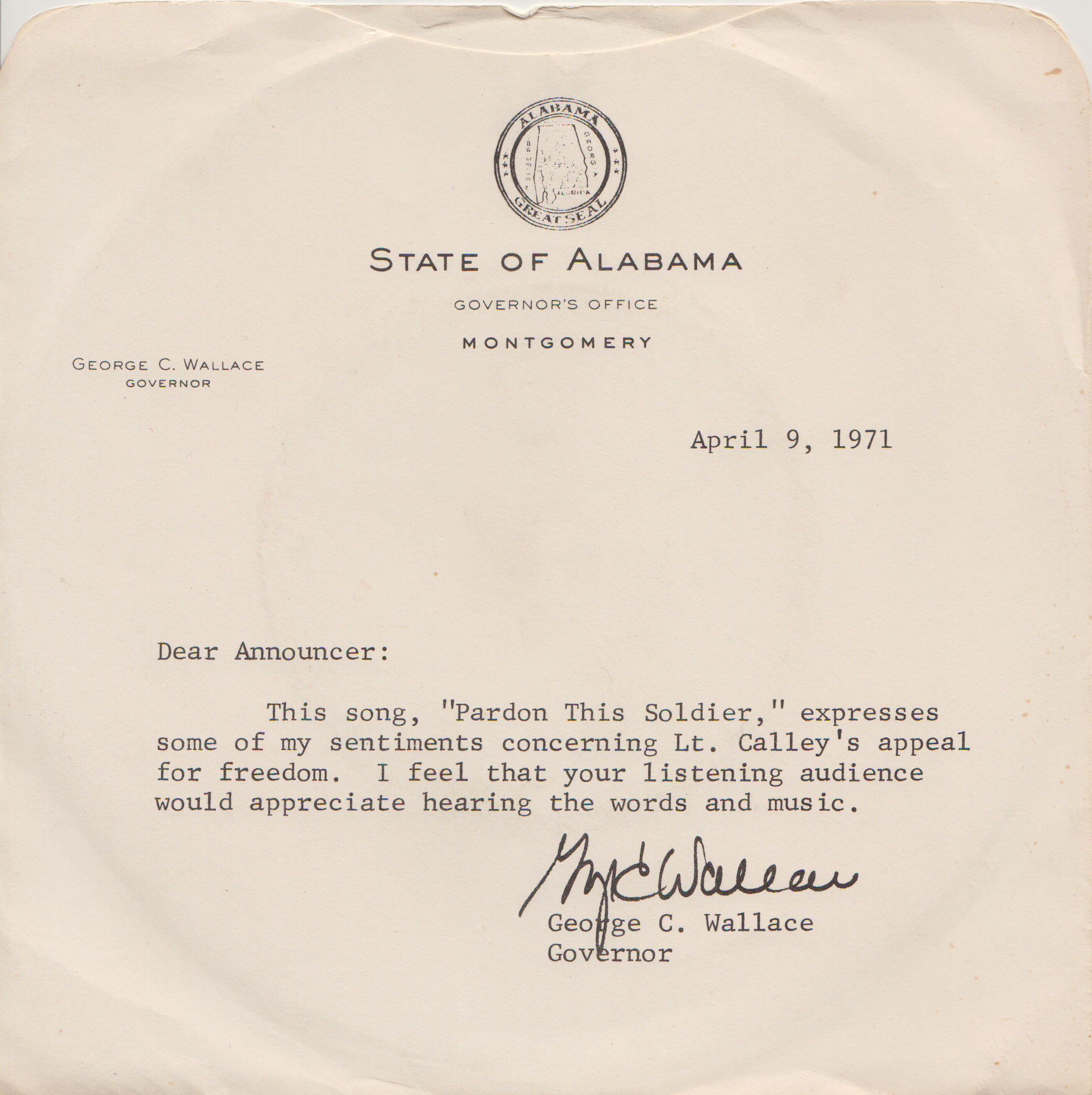
The song "Pardon This Soldier (And Set Him Free)" (Plaza # 45-108), released in Montgomery, Alabama, by country singer Merritt Jordan, received an endorsement from the state Governor George Wallace: "Dear Announcer: This song "Pardon This Soldier" expresses some of the sentiment concerning Lt. Calley's appeal for freedom. I feel that your listening audience would appreciate hearing the words and music. George C. Wallace, Governor". Dated 19 April 1971.1 So this song supported Calley, calling on President Nixon to set him free because he served his country: "oh Mr. President, won't you set him free, he was doing his job for you and for me" . This fitted in with a large degree of public support for Calley. According to Nixon's autobiography "The Memoirs of Richard Nixon" (New York: Grosset & Dunlap, 1978), p.500: "public reaction to this announcement was emotional and sharply divided. More than 5,000 telegrams arrived at the White House, running 100 to 1 in favor of clemency." Two days after the Calley conviction, on 1 April 1971, Nixon placed Calley under house arrest during his appeal. Jimmy Carter, governor of Georgia, and George Wallace backed the move. Nixon went on to claim that "the whole tragic episode was used by the media and the antiwar forces to chip away at our efforts to build public support for our Vietnam objectives".2
Sources
Annotation by Justin A. Brummer
Notes
endorsement from the state Governor George Wallace on the back of the picture sleeve: "Dear Announcer: This song "Pardon This Soldier" expresses some of my sentiments concerning Lt. Calley's appeal for freedom. I feel that your listening audience would appreciate hearing the words and music. George C. Wallace, Governor" Plaza 45-108 (9118), Side 1, mono, white "Radio Station Copy" label; "Pardon This Soldier (And Set Him Free)", written and sung by Merritt Jordan, 3:36, Acuff-Rose BMI; address 2832 Lansdowne Dr., Montgomery, Ala. 36111, phone 205-262-1560.The sleeve reproduces a letter on State of Alabama, Governor's Office, Montgomery letterhead dated April 9, 1971 and signed by George C. Wallace, Governor: "Dear Announcer: This song, 'Pardon This Soldier,' expresses some of my sentiments concerning Lt. Calley's appeal for freedom. I feel that your listening audience would appreciate hearing the words and music." [From the record sleeve and labels]
Lyrics
English
Oh Mr. President won't you set him free
He was doing his job for you and for me
He was fighting for our country, we can all plainly see
Won't you please pardon this soldier (and set him free)
It was the last day in March in 1971
A soldier was waiting for judgement for what he'd done
Why he loved his country and served best he knew how...
Standing there so straight and tall the verdict was read to him
'We the jury find you guilty of this crime and hereby sent you to prison'
To do hard labour until the end of his time
With tears in our eyes we watched them take him away
The soldier from our good old USA
Yes he was willing to die for our freedom
Genre: ♪ Country
#33 Mutt Cottingham Free Calley 1971 · Single · Free Calley / How Can It Be · Keepsake # KS1010 · USA
Annotation
The track "Free Calley" (Keepsake Records # KS1010) - the title obviously explained Cottingham's view. He defended Calley on the grounds that he followed orders, and claimed that "justice was shattered when this senseless trial begun" . It referenced Fort Benning - the base were Calley undertook combat training in Georgia, and later, on 1 April 1971, placed under house arrest by Richard Nixon. It started with a military marching drum. Released in San Angelo, Texas. Written by Jerry Mack. Produced by Gorman Maxwell and Jerry Mack.Annotation by Justin A. Brummer
Notes
Keepsake Records KS1010A, © Copyright 1971, P.O. Box 5200, San Angelo, Texas 76901, Ph. 915/655-4540; "Free Calley" (Jerry Mack), 2:55, Westex Music, BMI; produced by Gorman Maxwell and Jerry Mack. Black-and-white label with a globe design. [From the record sleeve and labels]Lyrics
English
The spirit of (17)76 went down in 71
Men hearts are stirred today but not by distant drums
A trial at Fort Benning has left our country numb
Justice was shattered when this senseless trial begun
A soldier from Florida, Calley is his name
Was trained to fight and kill in this war's deadly game
He did his best to do his part that was his only aim
For doing what he was told he suffered scorn and shame
America, America, what a mournful day
A boy who's fought to win this war returned with a price to war
Let's use the freedom we have left to say what must say
Free Calley, free Calley, it's not his price to pay
Genre: ♪ Country
#34 Smokey Harless Hang Lt. Calley 1971 · Single · Hang Lt. Calley / Six Days · Pabst # PA 71006 · Germany
Annotation
Country singer Smokey Harless sung for US military personnel stationed in Germany in the early 1970s, and he released a couple records on German based labels. This included the patriotic song "Men of Vietnam", and an anti-hippie track called "Place for Them Called Hell". The title of this song - "Hang Lt. Calley" (Pabst Music # PA 71006) - is misleading. It suggested that Calley should be punished for the massacre. But in fact Harless defended the actions of Calley, telling the government to "go ahead and hang Lt. Calley" , so that they will not "feel so ashamed" for training American boys to kill, and then sending them off to war - in others words, Harless suggested the government used Calley as a scapegoat, to cover-up their own responsibility. Like other Calley songs discussed above, he made a comparison to the death of Jesus: "they'll nail him to the cross" . The narrator also made a comparison on public attitudes towards indiscriminate killings - during the Second World War the US killed many civilians (men, woman, and children) when bombing Germany and Japan "at your applause and command" . But, the narrator suggested, in Vietnam, and the My Lai killings, people considered such actions to be a massacre.
Annotation by Justin A. Brummer
Notes
Performed to troops stationed in Germany, all records released in Germany Pabst Music PA 71006 A, 45 UpM, stereo, GEMA; "Hang Lt. Calley" (S. Harless/F. Kersten/S. Harless), 2'58"; Fred-Kersten-Produktion; "Made in Germany by Pabstmusic Tongesellschaft Ferdinand H. Keller KG, Kaiserslautern".The picture sleeve front, also naming "Six Days", shows a noose hanging from a wooden beam inside a cell with a barred window, with "Hang Lt. Calley" in dripping red lettering.
The back carries a note by producer Fred Kersten: on the day the Calley court-martial verdict was released Smokey sat down, drank a beer, got very angry and wrote the song "somewhere between the first and second beers", expressing the frustrations of the soldier "fighting in a no win war"; he is called "a true to life Nashville rebel".
The sleeve is signed in ink by Smokey Harless. [From the record sleeve and labels]
Lyrics
English
Well I heard them say today, they're going to hang him
It's either that or spend his life in jail
They taught him how to kill and how to hate his fellow man
They'll nail him to the cross because he obeyed their last command
I wonder if these people know what war is
I wonder if they every stop to think
You take a boy away from home and tell him he may die
He will do the best he can and never question why
So go ahead and hang Lt. Calley
Maybe then you won't feel so ashamed
A soldier has to fight and die or live and take the blame
I wonder if you folks can still remember the bombs we dropped on Germany and Japan
The woman and the children, the civilians young and old were blown to hell and back at your applause and command
And men will go on dying in the army
They will fight and die and never question why
Genre: ♪ Country
#35 Free Blue Set Calley Free Part I 1971 · Single · Set Calley Free Part I / Part II · Triangle Sound # TR 001 · USA
Annotation
The song "Set Calley Free Part I" (Triangle Sound Inc. # TR 001) - a pro-Calley track, which sounded like a presidential campaign song. Released by the obscure group Free Blue - unknown location and biography - the narrator argued that Calley "kills the way" the government / military "taught him" , yet they "call him a murderer" . At the end of the song, they posed the question: "is this the freedom we are all fighting for?" Thus it took the position that Calley did not bear responsibility for the massacre.Annotation by Justin A. Brummer
Notes
Triangle Sound Inc. TR 001, white label with microphone logo; Free Blue; Purple Rooster Music BMI; producer Bob Riley. Side A: "Set Calley Free Part I" (Dave Hall), 2:40. Side B: "Set Calley Free Part II" (Dave Hall - Robert Riley), 2:00. [From the record sleeve and labels]Lyrics
English
You sent him off to battle to take...a life
And the reason he don't understand
You take his life and use it as you want to
And you say that's the way its got to be
He kills the way you taught him
And you call him a murderer
You better stop and think and set him free
Set him free...
Remember he didn't start the war...
Is this the freedom we are all fighting for?
Genre: ♪ Easy Listening
#36 Free Blue Set Calley Free Part II 1971 · Single · Set Calley Free Part I / Part II · Triangle Sound # TR 001 · USA
Annotation
The B-side song "Set Calley Free Part II" , is very similar to the one above, but largely spoken word. Once again, the narrator compared Calley's situation to the story of Jesus: "crucified...nailed to a cross" . The lyrics also suggested that the conviction of Calley undermined the US democratic system.Annotation by Justin A. Brummer
Notes
Triangle Sound Inc. TR 001, white label with microphone logo; Free Blue; Purple Rooster Music BMI; producer Bob Riley. Side A: "Set Calley Free Part I" (Dave Hall), 2:40. Side B: "Set Calley Free Part II" (Dave Hall - Robert Riley), 2:00. [From the record sleeve and labels]Lyrics
English
This man has been crucified in a Columbus, Georgia army court room
Nailed to a cross of forgetfulness...
What did he do but obey as he should...
If this is the only wrong, then America, you have condemned..the entire system for democratic government, set him free
Genre: ♪ Easy Listening
#37 Rick Riddle Hang On Bill 1971 · Single · Hang on Bill / Sweet Lucy · Dixie # 107 · USA
Annotation
Rick Riddle, born Arvin Doyle Riddle in Rector, Arkansas, on 20 August 1920, built a career in western and country music in Detroit following the Second World War, during which he served with the US navy aboard the U.S.S. Adair in the Pacific Theatre.12 In 1971 he released the song "Hang on Bill" (Dixie Records # DR 107) which criticised the politicians for fighting a war which "we'll never win" . He warned that one day these leaders will have to "stand before god" . Riddle promised to fight the battle against "the enemy...cowards walking free in our land" , and pleaded with Calley to hang on while the campaign to set him free was in swing. Sources
Annotation by Justin A. Brummer
Notes
Arvin Doyle Riddle [birth name] Dixie Records DR #107; "Hang On Bill (A Tribute to Lt. Wm. Calley)" (Rick Riddle), time 2:10, Fred Henley Music, BMI, and Vogue Music, Inc., BMI; Rick Riddle. [From the record sleeve and labels] Dixie Records, P.O. Box 115, Madison, Tennessee. [From the Rate Your Music label page]Lyrics
English
Just hang on William Calley
Yes your defence was too weak
You say you followed orders then they sold you down the creek
Though we were rooting for you, we couldn't help you none
Now we've just begun to fight...
Just hang on Bill, we are trying son, to help you Bill
It seems the mighty leaders are walking hand in hand
The enemy are cowards walking free in our land
Some times we sit and wonder how this could ever be
And wonder how much longer our nation will be free...
They send our young boys off to war, it seems we'll never win
Four years we've been in conflict just killing precious men
Someday these mighty leaders will stand before god
Genre: ♪ Country
#38 Glenn Reifsteck The Fate of Lt. William Calley 1971 · Single · The Fate of Lt. William Calley / Spiders Web · Stars and Stripes # U.S.A. 001 · USA
Annotation
The country music song "The Fate of Lt. William Calley" (Stars and Stripes U.S.A. # 001) took an overall patriotic position, presenting the conflict in Vietnam as a fight to "keep you and me free" - in line with government rhetoric. Yet the narrator, unlike the US government and military, viewed the My Lai massacre as a case of self-defense, either "to kill or to be killed" , thus relieving Calley of responsibility for the incident. Released in 1971, in Arnold, Missouri.Annotation by Justin A. Brummer
Notes
Stars and Stripes U.S.A., 1939 Melody Lane, Arnold, Missouri 63010, 001-A, Side 1, yellow label; "The Fate of Lt. William Calley" (Reef-Stek), time 2:38, published by Reifco Music, BMI; Glenn Reifsteck. [From the record sleeve and labels]Lyrics
English
It's time to get together and praise our fighting men
They go through hell for us, say a little prayer for them
God bless all our soldier, all our men overseas
Calley was fighting to keep you and me free
They were scared beyond words, Calley led up the hill with his gun in his hand
He'd been taught to kill the enemy around him...
To kill or to be killed
He lay his life on the line
Genre: ♪ Country
#39 Roger McDowell A Tribute to Lt. William Calley 1971 · Single · America, Now Join Hands / A Tribute to Lt. William Calley · Freedom Ring # 618 · USA
Annotation
As the title suggested, the song "A Tribute to Lt. William Calley" (Freedom Ring # 618) supported Calley, arguing that he, and other soldiers "fought to keep us free" . The narrator expressed disgust that Calley sat in a prison, and said that he wanted to help him. "McDowell Enterprises", printed on the label, was based in Nashville, Tennessee.1 Produced by Lou Tillman.Sources
Annotation by Justin A. Brummer
Notes
Freedom Ring 618, "A Division of Tillman-McDowell Enterprises", stars-and-stripes label with Liberty Bell; F-618-1 "America, Now Join Hands" (Roger McDowell), McDowell Music, BMI, 5:49 (SON 95291); F-618-2 "A Tribute to Lt. William Calley" (Roger McDowell), McDowell Music, BMI, 2:41 (SON 95292); a Lou Tillman production, arranged by Roger McDowell. [From the record sleeve and labels]Lyrics
English
Many men have fought in wars, many men have died
Many men have lost their lives...
But what I talk about...a man who fought to keep us free...
A man just 27, what more can he do
Locked away behind closed doors...
We'd all like to help you son
I man who fought to keep us free is now locked up inside...
Why do things have to be like this...
Lets just thank god that someone gave his life for you and me
Let the bells of freedom ring far and wide
So Mr. Calley, I guess some things must be
We'd all like to thank you son for keeping us free
Genre: ♪ Country
#40 Roland Johnson William Calley 1971 · Single · William Calley / Fire in the Sky · Three Star # 9108 · USA
Annotation
Roland Johnson (1921-2007) - nicknamed "Racehorse" for doing a 100 yard dash in 10 seconds, while playing for the Brooklyn Dodgers Triple A team. After an injury he turned to music, and wrote a campaign song for George C. Wallace, Governor of Alabama, helping to raise funds. Note that Wallace supported the campaign to free Calley in 1971, as seen in his endorsement of the record "Pardon This Soldier (And Set Him Free)". Before that Roland Johnson supported Governor "Big Jim" Folsom.1 In 1964 Johnson became the Mayor of Garden City, Alabama. On 25 June 2001 the House of Representatives of the Legislature of Alabama paid tribute to his public service.2Johnson released the song "William Calley" (Three Star Records # 9108), arguing that "those above him" in the army had made a mistake, and that Calley "was made a scapegoat" . Johnson felt that the "guilty ones" were free while Calley, doing his duty, had lost his liberty. This did not take a strong pro-government or anti-war position, but focused on support for the soldier.
Sources
Annotation by Justin A. Brummer
Lyrics
English
Once they sent a brave young man to a foreign distant land
Where they thought he'd fight without his ammunition
Calley watched his buddies die and he knew the reasons why...
William Calley is a name, must his honor be defamed
Who corrected the sad mistakes of those above him
Must he loose his liberty and the guilty ones go free
While a hundred million hearts show how they love him....
William Calley did his best, under fire he stood the test
He was made a scapegoat
Genre: ♪ Country
#41 The Adams Brothers The U.S.A. Soldier 1971 · Single · The U.S.A. Soldier / Place No Roses on My Grave · Double Shot # 155 · USA
Annotation
The song "The U.S.A. Soldier" (Double Shot Records # 155) by the Adams Brothers, released in Hollywood, California, also viewed Calley as a scapegoat for the horrors of war: "a scapegoat to offer for a sacrifice" . The narrator argued that in "all wars...even innocent folks die" . The track started out with the story of Uncle Sam drafting a young man to fight in Vietnam. When he returned to the US, he faced criminal charges for the My Lai incident. Once again, the narrator compared the plight of Calley to the story of Jesus: "he took the blame, he took it for us all" . While the lyrics showed solidarity with the soldier, it did not take a strong pro-government / patriotic foreign policy position, or anti-war stance. Composed by Billy Adams, arranged and produced by Bur-K Studios Promotion in Motion Irwin Zucker.Annotation by Justin A. Brummer
Notes
Double Shot Records 155 (DS 354), 6565 Sunset Blvd., Hollywood, Calif. 90028; "The U.S.A. Soldier" (Billy Adams), time 3:00, Chett Publ./Hot Shot Music, BMI; arranged and produced by Bur-K Studios; promotion In Motion, Irwin Zucker. A Double Shot & Whiz Records "New Rush Release! Special!" promotional sheet, signed by Irwin Zucker, names the flip side "Place No Roses on My Grave", states that the record never mentions Lt. Calley's name but alludes to the episode and the Vietnam War, reports that it first broke with DJ John Elliott, WZKY, Louisa, Ky. ("phenomenal, unusual response"), and describes the Adams Brothers as well-known Evangelistic performers in the South, touring on behalf of the recording; it carries a photograph captioned "Fatigued G.I. at Lang Vei" and a red stamp "We're All Guilty!".A lyric sheet, "written & recorded by the Adams Brothers", Copyright 1971, published by Hot Shot/Chett Music, prints the full words, which refer to My Lai. [From the record sleeve and labels]
Lyrics
English
Now old Uncle Sam he just can't hardly wait to give a young fellow time to graduate
He calls him green when his life has just begun
There's a knock at his door: 'come here son'
I'm giving you a rifle, this here's your best friend, use it boy
The young lad, with a smile on his face sdays farewell to his old home place, his ma and his pa
He catches a big bird out to old My Lai
Yeah there is a war going on there...
The young lad, with his nerves of steal finds himself in the battle
And this time it's for real...
Then like all wars...even innocent folks die
The same man they sent away, they send him back to the USA to stand trial
They found him guilty too, gave him life
My mind goes back to the yesterdays when another man I know was treated this way
With a cross so heavy that it made him fall
He took the blame, he took it for us all...
He found a scapegoat to offer for a sacrifice...
Everyone of us should share this guilt
Take a long hard look at the thing that's been done
See if our hands don't fit those guns that fired the shots
That took the lives at old My Lai
Genre: ♪ Country
#42 Butch Christofer We Done Wrong! 1971 · Single · We Done Wrong! / We'll Have Fun · Chicken Row # CR-1002 · USA
Credited on the record as Butch Christofer (And The High Camp Society Band).
Annotation
The song "We Done Wrong!" (Chicken Row Records # CR-1002) can probably be classified as a song about My Lai and Calley - although it does not refer to either of those. Released by Butch Christofer and The High Camp Society Band, written by Arthur K. Weathers, and produced by Group V Productions. In the track, the first person narration starts off with a soldier heading to Vietnam with an open mind. However, the platoon encounters the Vietcong, which results in the killing of the enemy, as they were taught to do. They dumped the bodies in a pit: "we met old charlie, Vietcong, shot him dead... rolled him over in a open hole" . But someone stepped up to oppose the killings. Back in the US, with the support of the Congress, the soldiers are sentenced to life imprisonment by a jury, thus echoing the story of William Calley and the My Lai Massacre. The final line possibly made a reference to President Nixon.Annotation by Justin A. Brummer
Notes
Chicken Row Records CR-1002-A, Side 1, stereo, © 1971 GVP, green label with a rooster drawing; "We Done Wrong!" (Arthur K. Weathers), St. Elmo Music, BMI, time 2:29; produced by Group V Productions; Butch Christofer (And The High Camp Society Band). [From the record sleeve and labels]Lyrics
English
Left my home in New Orleans, stopped for a while in the Philippines
On my way to a place called Vietnam
Rats and snakes in the grass, crawling up to bite my leg
Got to be careful in place called Vietnam
We got there with an open mind
Everything was going fine until we met old charlie, Vietcong
Shot him dead like we'd been told
Rolled him over in a open hole and a man stepped up and told us 'You done wrong'...
Gonna have to send you off to jail
Got the Congress on my back....
Jury said we done wrong
Shooting all them Vietcong just as though we didn't give a damn...
We got life, complements of Uncle Sam...
I done wrong, we done wrong
Everybody's done wrong
Richard done wrong
Genres: ♪ CountryCountry Rock
#43 Johnny Nelms Lieutenant Calley 1971 · Single · Lieutenant Calley / Everything You Touch · Bagatelle # 4271 · USA
Credited on the record as Johnny Nelms (Texas State Rep.).
Annotation
Johnny Nelms, the former Texas State Representative from Pasadena, Harris County, condemned the conviction of Calley in 1971, during the 62nd regular session of the House of Representatives.1. On 8 May 1971 Billboard ran an article on the creation of a new record label, Bagatelle, in Houston, Texas, and the signing of Johnny Nelms. The three founders of the label, Byron Benton, Charles Benton, and Morris Sonny Hall received the writing and production credits on this record.2 Unsurprisingly, the song "Lieutenant Calley" (Bagatelle # 4271) offered sympathy towards Calley, and it called for his freedom: "Lt. Calley, free him, and let him go" . The song leaned toward the patriotic camp, although it did not take a political stance, but rather displayed support for the soldier.Annotation by Justin A. Brummer
Lyrics
English
He was born in the land of the brave and the free
Just another all American kid...
When they had a parade he was always there
How the boy loved a military band...
Lt. Calley, what have they done to you...
Lt. Calley, we will help see this through
Everybody knows the American way
Isn't perfect but its better then the rest...
Calley was duty bound to do his best...
When things got rough he was the kind of man that every foot soldier needs...
Lt. Calley, we'll not let them disgrace your name...
Lt. Calley, who wants a dead hero
Lt. Calley, free him, and let him go
Genres: ♪ CountryHonky Tonk
#44 The Senators War's Cross 1971 · Single · War's Cross / This Is Our Land · Skylite # SR-1105 · USA
Annotation
The pro-Calley song "War's Cross" (Skylite # SR-1105) by the Senators, of the country music genre, also compared Calley to the plight of Jesus, as seen on the 7" cover, which showed a soldier struggling to carry a wooden cross. Once again, like many of the songs above, it argued that Calley had only followed orders and therefore should not be held responsible for My Lai: "his order were to shoot on sight". While being a pro-soldier song, it did not take a pro-government foreign policy or anti-war position, but rather offered a US domestic perspective on the massacre. Released in Tennessee, United States; written by Jerry Free, Jack Rule, and Bettye Orr, and produced by Joel Gentry. The lyrics made an interesting reference to US soldiers being sent to Vietnam in 1954 - the First Indo-China War between the French and Vietnamese took place from around 1946 up to the Geneva Conference in 1954. From that point onwards the US Eisenhower administration attached American foreign policy to preserving the Southern part of Vietnam and so US involvement started from around 1954-1955.
Annotation by Justin A. Brummer
Notes
Skylite SR-1105, gold label, Side A; "War's Cross" (Jerry Free, Jack Rule, Bettye Orr), 2:34, Mt. Paran BMI; produced by Joel E. Gentry. The picture sleeve ("War's Cross / This Is Our Land", with "The Senators" in script) shows a line drawing, signed "Jud Phillips", of a helmeted soldier carrying a large wooden cross before a waving flag. [From the record sleeve and labels]Lyrics
English
Back in 1954, some of our soldiers went to war
Vietnam was the place...
Calley's fate was to be ? cross
Set him free
Must Calley bear war's cross alone...
No, there's a cross for everyone
And there's even one for me...
His order were to shoot on sight
And guard his men with all his might
Genres: ♪ CountryCountry Gospel
#45 Lee Ofman Young Bill Calley 1971 · Single · K.O. # PMI 102 · USA
Credited on the record as Lee Ofman with Wayne Chaney & Friends.
Annotation
The track "Young Bill Calley" (K.O. Records # PMI-102) argued that "Calley wasn't guilty all alone, he had help at hand" - this helping hand was the US government, yet to some extent that verse still recognised Calley's guilt over My Lai. The narrator said that Calley had been a "soldier by Uncle Sam" , who took "him away from his home" , putting a gun in his hand and sending him "down in Vietnam" . His purpose there was to fight, not to question "why or what for" . Therefore, the narrator suggested that the US government should bear some responsibility for the massacre. Composed by Lee Ofman, and accompanied by Wayne Chaney - who released his own version of the song: "Young Bill Calley" (K.O. Records # PMI-101). Lee Ofman later became famous for composing the "Miami Dolphins No.1" football song in 1972. Ofman, currently a lawyer based in Franklin, Tennessee, studied at the University of Houston in 1968, the location of K.O. Records.12
Sources
Annotation by Justin A. Brummer
Notes
K.O. Records PMI-102, 511 W. Alabama, Houston, Texas, 713/526 6397; "Young Bill Calley" (Lee Ofman), 3:15, LOSAC Music, BMI; Lee Ofman with Wayne Chaney & Friends; produced by Joe Ford & Lee Ofman. Red label. [From the record sleeve and labels]Lyrics
English
Call all him a hero, call him a villain
His name is William Calley and he's history
A man by the grace of god, a soldier by Uncle Sam
A second lieutenant, down in Vietnam
We took him away from his home USA
Gave him instructions with a gun in his hand
Said 'son this is war, it is up to you to survive
But nobody made exception to a place called My Lai
He understand and he took his riffle
Heading for a hill he had never known
He came to serve his country by fighting this war
He never hesitated, with a 'why or what for'
Young Bill Calley, Vietnam is your nation's story
We made you a soldier, a good one at heart
Them put you in prison....
Calley wasn't guilty all alone
He had help at hand
Genre: ♪ Garage Rock
#46 Wayne Chaney Young Bill Calley 1971 · Single · K.O. # PMI-101 · USA
Annotation
The song "Young Bill Calley" (K.O. Records # PMI-101) by Wayne Cheney had identical lyrics to the Lee Ofman track above - musically, this single was more uptempo, with a more garage rock feel. Released in Houston, Texas.Annotation by Justin A. Brummer
Notes
K.O. Records PMI-101, 511 W. Alabama, Houston, Texas, 713/526 6397; red label; "Young Bill Calley" (Lee Ofman), Losac Music, BMI, time 3:02; produced by Joe Ford & Wayne Chaney. [From the record sleeve and labels] Genre: ♪ Garage Rock
#47 Joe Watford Rally for Lt. Calley 1971 · Single · Rally for Lt. Calley / The Story of Ginny and Joe · Ginny & Joe # MW-222 · USA
Annotation
A short spoken word narrative song, against a jazz background, called "Rally for Lt. Calley" , which said that the government and army had made Calley a scapegoat for all the killings in Vietnam. The narrator warned that the trial of Calley would make himself and citizens "afraid of doing our patriotic duty" as they might also end up a scapegoat. The narrator put significant emphasis on serving the country and patriotism, and solidarity with the soldier without any moral position. At the same time, the narrator strongly criticised the actions of the government and military. Composed by Joe Watford and released on the obscure private label Ginny & Joe (# MW-222).Annotation by Justin A. Brummer
Notes
Ginny & Joe MW-222, Side 1 (PRP-29121), 45 rpm, yellow label; "Rally for Lt. Calley" (Joe Watford); music by The Ltd's Combo. No running time is printed on the label. [From the record sleeve and labels]Lyrics
English
This is my story, these are my feelings, this is my rally for Lieutenant Calley
A soldier you or I and hardly anyone had ever heard of until someone felt so guilty about Vietnam that they had to blame someone else for the fighting and killing...
So Lt. Calley...had a job to do, kill or be killed in doing his job
The US army thought it right to try him for murder...
Has the government fallen so low as to make Lt. Calley a scapegoat...
I know it all makes us wonder if we should serve our country
And be afraid of carrying out orders, afraid of doing our patriotic duty
Afraid of being a scapegoat and ending up like Lt. Calley
So I ask you all, mothers, fathers, wives, teenagers, and sweethearts
Lets join in one and all...for Lt. Calley
Genre: ♪ Country
#48 Gene Marshall The Ballad of Lt. William Calley 1971 · Single · The Ballad of Lt. William Calley / America Is My Country · Preview # 1907 · USA
Annotation
Gene Marshall (aka Gene Merlino & John Muir), born in San Francisco, California (and based in Hollywood), recorded over 10,000 song-poems - song lyrics, sent to specialist publishing and recoding companies, usually in response to an advertisement, that have been set to music for a fee (around $200-400).1 Hundreds of them dealt with political issues, including the Vietnam War. The song "The Ballad of Lt. William Calley" (Preview Records # 1952) defended Calley and argued for a presidential pardon: "you deserve a pardon Lt. Calley" . Strangely, the lyrics also declared Calley to be fit for presidential office: "Calley would have been a splendid president" . Once again, this was a Calley song that did not make a political statement about the Vietnam War, although this song does have the feel of blind patriotism, backing the soldier no-matter-what. Marshall also released the records "The Story of William Calley" (Preview # 2139) and "The Battle of Mai Lai" (Preview # 2182).
Sources
- 1 Song Poem Music ↩
Annotation by Justin A. Brummer
Notes
Preview Records, 6311 Yucca, Hollywood, blue and silver label; 1907-1 "The Ballad of Lt. William Calley" (John Montague), 2:00; flip 1907-2 "America Is My Country" (John Montague), 2:31; both Arthur Music A.S.C.A.P. [From the record sleeve and labels]Lyrics
English
Come all kind of folks to hear the Ballad of Lt. William Calley....
It's an unjust verdict for Lt. William Calley...
Listen to the ballad of Lt. William Calley
The trial took four months of time
The court did not believe his testimony wasn't true
We all know he is not guilty of the crime
Lt. Calley would have been a splendid president
For the wheels of justice sometimes run slow
Your good friends everywhere say you are innocent
You deserve a pardon Lt. Calley...
Onward Calley marching bravely onto war
Genre: ♪ Traditional Pop
#49 Gene Marshall The Ballad of Lt. William Calley 1971 · Single · The Ballad of Lt. William Calley / American Is My Country · Preview # 1952 · USA
Annotation
- Song poem, traditional pop- Hollywood, California
- Same title as above, but different lyrics
Annotation by Justin A. Brummer
Lyrics
English
Come all kind of folks to hear the Ballad of Lt. William Calley....
It's an unjust verdict for Lt. William Calley...
Listen to the ballad of Lt. William Calley
The trial took four months of time
The court did not believe his testimony wasn't true
We all know he is not guilty of the crime
Lt. Calley would have been a splendid president
For the wheels of justice sometimes run slow
Your good friends everywhere say you are innocent
You deserve a pardon Lt. Calley...
Onward Calley marching bravely onto war
Genre: ♪ Traditional Pop
#50 Gene Marshall The Battle of Mai Lai 1971 · Single · The Battle of Mai Lai / Children · Preview # 2182 · USA
Notes
- "The Battle of Mai Lai" - Label: Preview Records # 2182
- Songwriter: Don Whitmer
- Traditional pop
- My Lai Massacre - pro-Calley, followed order, scapegoat
- Led assault of the Vietcong, sent to Vietnam to fight for Vietnam
- Vicious death everywhere, Vietcong at night, Vietnamese by day (fog of war)
- Ordered to lead the charge and wipe My Lai from land
- Calley - hold your head up high, traitors told lies, you did what you were told
- If you killed civilians, they came from VC holes
- Sacrificial goat.
- It was an unfair trial, circus
- All your rifles were blazing, your men to defend, one GI is worth more than millions of Vietnamese (dangerous battle conditions)
- Reference to god, religion
- Ownership: vinyl
- Preview Records, 6311 Yucca, Hollywood; 2182-1; "The Battle of Mai Lai" (Don Whitmer), 2:45; Arthur Music A.S.C.A.P. Blue and silver label with spotlight and musical-note design. [From the record sleeve and labels]
Genre: ♪ Traditional Pop
#51 Henry Lewis Soldier's Prayer 1971 · Single · Soldier's Prayer / Living for Today (Hoping for Tomorrow) · LTD # 1001 · USA
Notes
- Soldier's Prayer (Lewis, Henry)- Song poem?
- Traditional pop. Springfield, New Jersey, USA.
- Lt. Calley / My Lai type massacre described.
- Soldier's perspective. Potential song poem.
- Love my country, went to war to help people be free.
- But I was misled. I'm in front of a prosecutor - accused of killing 20 civilians.
- Captain said shoot to kill. I followed orders.
- LTD Records 1001 (1001), green label, 26 Millburn Ave., Springfield, N.J., (201) 467-1177 and (201) 661-2702; "Soldier's Prayer" (Hank Lewis), 3:02, Henry Prods. Ltd., B.M.I.; vocal arrangement by Jeff Bleeke. [From the record sleeve and labels]
Genre: ♪ Traditional Pop
#52 Johnny Campbell Behold the Voice of the People 1971 · Single · Behold the Voice of the People / Vietnam · Prestige Productions # PP71-127 · USA
Annotation
Obscure traditional pop single, the song "Behold the Voice of the People" (Prestige Productions # PP71-127) by Johnny Campbell defended the actions of Calley. He recognised the killings that took place: "woman and children died" . However, the narrator thought that this "happened in every other war" , and that Calley had "carried out an order like a loyal soldier would" . While the narrator said that Calley "has done no wrong" , he then argued that "one man can't take the blame" - thus a contradiction, as the second phrase suggested that Calley had in fact done something wrong, but argued that he should not be a scapegoat and the only person held accountable for the atrocity. Campbell focused on the views of the public, who, according to the narrator, "cried loud and long" at the Calley verdict, and so demanded his freedom. Backing the soldier regardless of moral and ethical arguments, it displayed blind support and faith in the actions of the soldier.Annotation by Justin A. Brummer
Notes
Prestige Productions PP71-127, stereo, 45 RPM, red label, vocal; Side One (10439A): "Behold the Voice of the People" (J. Bowers – F. Winters), Johnny Campbell, 3:15; Side Two (10439B): "Viet Nam" (J. Bowers – F. Winters), Sid Linard, 1:41. [From the record sleeve and labels]Lyrics
English
He was a loyal soldier fighting in a war
He carried out his orders never asking anymore
He moved into the village, of little small My Lai
And when the fighting ended woman and children died, they brought him to the court room
They stripped him of his rank, said that the acts you have committed have brought our country shame
Behold the voice of the people...free Mr. Calley, he don't deserve to die
They gave him life in prison to try to ease the pain
Behold the voice of the people, it was heard again
Behold the voice of the people, they cried loud and long
Free Mr. Calley, for he has done no wrong...
All the acts and killings and happenings at My Lai...
All these things have happened in every other war...
Behold the voice of the people, one man can't take the blame
He carried out an order like a loyal soldier would
Behold the voice of the people
Genre: ♪ Country
#53 Carlyle Hughey The Voice From Beyond the Grave 1971 · Single · The Voice From Beyond the Grave / Mark in the Sand · Chart # 5127 · USA
Annotation
In the song "The Voice From Beyond the Grave" (Chart Records # 5127), the narrator took on the perspective of the long-dead John Paul Jones, a US navy captain during the American revolution. The old, dead military leader expressed surprise at the treatment of Calley, who in the past would have been "a big hero" , receiving "a big parade" . The narrator then told the listener that in war "it's either you kill me pal, or I'll kill you" , and "that's the name of the game" . Therefore, this track backed-up Calley and excused the mass murder of civilians on the grounds that sometimes indiscriminate killings took place during war time. The narrator also might be implying that in the fog of war (i.e. uncertainty of battle), and with the threat of death, killings took place, and that civilian society "ain't got no right in casting judgement" on the justification, or proportionality of the deaths - kill first, to be safe. This single came out of Nashville, Tennessee, with the spoken-word narration backed by a traditional country tune. Produced by Slim Williamson.Annotation by Justin A. Brummer
Notes
Green-and-yellow Chart label, CH-5127 (CH-1071), stereo, "806 16th Ave., S., Nashville, Tennessee 37203"; "The Voice From Beyond the Grave" (Jack Tullas & Billy Smith), Sixteenth Avenue Music—BMI, time 2:15; produced by Slim Williamson. [From the record sleeve and labels]Lyrics
English
You know I was just thinking about this thing they're calling My Lai
And I cant help but be a little puzzled about the who's what's and why's
I mean you take this kid now, it seems like he is taking an awful fall
For simple doing the things they taught him to do when he answered his country's call
In other wars this country has had, this kid would have had it made
They would have made a big hero out him, even giving him a big parade
But they're calling this kid a murdered now and that's what's kind of got me snowed
This country is running on a different set of rules, it's heading down a long dark road
Now I ain't saying that killing is good, but in war that's the name of the game
It's either you kill me pal, or I'll kill you and the rules of killing stay the same
And until the time comes a knocking when people live like decent people should
Then we ain't got no right in casting judgement on deciding on whether killing is bad or good
If we are going to play the almighty, lets go back and do things up-round
Let's make heroes out of the guys at Nuremberg and tear the unknown soldier's tomb down...
By the way, my names Jones, John Paul Jones, I'm the voice from beyond the grave
Genre: ♪ Country
#54 Bill Bailey Indictment of a Nation 1971 · Single · Indictment of a Nation / My Friend A Man · Westpark # 6980 · USA
Credited on the record as Bill Bailey and the Paul Butts Assembly.
Annotation
Out of Houston, Texas, came the song "Indictment of the Nation" (Westpark Records # 6980), which protested against the conviction of Lt. William Calley. Bill Bailey, born Milton Odom Stanley, was a constable from Harris County, Texas, in the United States. He took up radio broadcasting soon after high school in 1957, and hosted programs on major Houston radio stations. The Texas Senate paid tribute to him in 2005.1The spoken-word track argued that Calley did his duty, even though "he didn't like the win-less war" - interesting that by 1971 the 'win-less war' view was becoming more widespread, even in the largely pro-government country music genre. The narrator argued that Calley should not shoulder the blame for the atrocities committed, strongly criticising the role of politicians who sent men to war: "while politicians laughed and talked the soldier took a stand" . And therefore, he concluded: "indict the nation, we all must share the shame" - so the track did not dismiss the unlawful killings, but excused the role of the soldier. Also note the disapproval of the anti-war movement and draft dodgers: "Bill Calley didn't wait around, dodge, and protest" . Once again, this song did not neatly fit into the "patriotic" or "anti-war" camp, although it did have a strong anti-protest message, and blind support for the soldier.
The distribution company, Rack Jobbers, ran a full page advert in Billboard on 17 April 1971, that sought to drum up sales and highlight the record's newsworthy theme, claiming that "it is the record most in touch with the current national mood". It said: "Important Notice: First, it is not customary for us to run simple, plain-type ads, but due to the urgency of this message we have no choice. Last week, immediately following the Calley conviction verdict, a group of concerned citizens wrote "Indictment of a Nation". In it they expressed their opinion that the United States of America shares in the shame. Westpark Records released "Indictment of a Nation" by Bill Bailey April 7, 1971. The response was immediate and phenomenal. Heavy airplay, major markets. Sales action approaches the unbelievable. Westpark Record # 6980, "Indictment of a Nation" is the most timely and current record. It is the record most in touch with the current national mood. If you have not yet received shipment, you may expect it immediately as our presses are running 24 hours to meet the demand".2
Sources
Annotation by Justin A. Brummer
Notes
Westpark Records 6980, black "D. J. Copy" label; "Indictment of a Nation" (B. Bailey-R. Dobbyn-A. Yancey), Soundville Music (BMI), 3:15; Bill Bailey and the Paul Butts Assembly, produced by Eddie Kilroy; "A Division of Jimmy Duncan Productions, Inc." [From the record sleeve and labels]Lyrics
English
I don't know how it started, the years have dulled my mind
His friends all called him Rusty so long ago in time
Bill Calley didn't wait around, dodge, and protest
He didn't like the win-less war, but said sir I'll do my best
Bill's mum and dad both said goodbye full knowing his destination
Thinking that when he returned there would be a grateful nation
He took his basic training...they put him through the mill
They taught him how to survive, and they taught him how to kill
While politicians laughed and talked the soldier took a stand
Up through the ranks and to the front Bill Calley took command...
He saw his troops fall right and left, killed by faceless foe
He saw men killed and watch them die....
His orders were to take this zone no matter what the cost...
And so they sat in judgement, he fought to clear his name
Then came the verdict: 'Guilty' - his pleas had been in vain
But is Bill Calley guilty, must he bear all the blame
I say, indict the nation, we all must share the shame
And if Uncle Sam looks sadder now and weaker from this test
For one, I'll never let it down, Sir, I'll do my best
Genre: ♪ Narration
#55 Jimy Sims Ode to Vietnam 1971 · Single · Ode to Vietnam / Big Ole Teardrops · Music by Mark # 1-2003 · USA
Notes
Ode to Vietnam (Sims, Jimy)- Country. Longview, Texas, USA. My Lai / Calley. Patriotic, anti-war.
- 'I won't go to Vietnam' - people say, Uncle Sam will put them in prison.
- Then Calley follows orders at My Lai, he is in prison.
- So who is the enemy? VC women and children carry guns
- Set Calley free and stop the war in Vietnam
- Music by Mark 1-2003, 45 RPM, side 1003 B, dark-blue label, Longview, Texas, Copyright 1971; "Ode to Vietnam", words and music by R. Rouse, 2:00, BMI. [From the record sleeve and labels]
Lyrics
English
How many times have you heard a man say I won't go to Vietnam
I won't kill those people no matter what you say
And they'll go to jail thanks to Uncle Sam
And then there are people like Lt. Calley who fight and never ask why
But when their job is done and by carrying out their orders
They're told what's been done is not right
So please tell me this, is this land really his?
This land of the brave and the free
Won't you please tell me if you can, just who is our enemy
A VC woman and her children carry guns
And that doesn't make then a friend
So in there you go, destroy the folk
They must die by your own hand
A child needs a father like Lt. Calley
A woman needs her man
So please hear my plea, set William Calley free
And stop the whole war in Vietnam
Please stop the whole war in Vietnam".
Genre: ♪ Country
#56 Ronnie Thompson Rusty the Soldier (Part 1) 1971 · Single · Rusty the Soldier (Part 1) / Rusty the Soldier (Part 2) · Boblo # 310 · USA
Notes
- Rusty the Soldier (Thompson, Ronnie) - My Lai / Lt. Calley, defends Calley, country
- It's a no win war, in Vietnam for you and for me.
- Followed order, My Lai to take.
- Vietcong everywhere, set Calley free.
- Media have tarnished his name
- He's a scapegoat.
- Record World, 1 May 1971, by Lee Barry.
An original tune written on a big silver bird winging its way to a White House meeting with President Richard Nixon...that's the story of the latest composition from Macon's budding tunesmith Ronnie Thompson. After a 40-minute visit with imprisoned Army Lt. William Calley, Macon Mayor Ronnie Thompson became so overwhelmed with Calley's situation that he felt inspired to write a song about his friend, "Rusty the Soldier." The Mayor, a longtime friend of the Georgia recording industry, has just completed recording the tune with Bobby Smith in the big swivel producer's chair at the Starday-King studio.
In an interview prior to his recording session, Thompson asserted that he intended to donate all proceeds from the Federal label release to "Rusty's" defense fund. Present plans call for His Honor to personally deliver the first copy of "Rusty the Soldier" to Lt. Calley. By the way, Thompson had an army backing his session instrumentally in the rackin' person of Cold Water Army. Quite appropriately a "coming soon" LP from Cold Water Army is entitled "Peace!".
- Record World announced a Federal release; the record appeared on Boblo 310 (Bobby Smith Productions, Macon), dated 1973. Boblo Records 310 A/B, cream label, matrix 1459-45-310-A/B; "Rusty the Soldier (Part 1)", 3:11, and "Rusty the Soldier (Part 2)", 2:14, both (Ronnie Thompson), Jupace Music (BMI); produced by Bobby Smith; Bobby Smith Productions, 3035 Millerfield Rd., Macon, Ga. [From the record sleeve and labels]
Genres: ♪ CountryCountry Gospel
#57 Ronnie Thompson Rusty the Soldier (Part 2) 1971 · Single · Rusty the Soldier (Part 1) / Rusty the Soldier (Part 2) · Boblo # 310 · USA
Annotation: see “Rusty the Soldier (Part 1)” above (same release).
Genres: ♪ CountryCountry Gospel
#58 John D. Loudermilk Lord Have Mercy 1971 · Single · Lord Have Mercy / When I Was Nine · Warner Bros. # 7489 · USA
Notes
- Lord Have Mercy (Loudermilk, John D.)- Folk rock, protest against govt., patriotic.
- Born Durham, North Carolina, USA. Died Nashville, Tennessee, USA.
- War heroes in prison (reference to My Lai and Calley?)
- Cold War reference - moon race and aliens.
- Warner Bros. Records 7489 (PTN0025), white promotional label, "Promotion — Not for Sale"; "Lord Have Mercy" (John D. Loudermilk), Acuff-Rose Pub. - BMI, 2:56, intro :07; produced by Don Gant; "Warner Bros. Records Inc., a subsidiary and licensee of Warner Bros. Inc.", made in U.S.A. Issued in a green Warner Bros. company sleeve. [From the record sleeve and labels]
#59 Dale Neal The Story of Lt. Calley as Sung for Gov. Wallace 1971 · Single · The Story of Lt. Calley as Sung for Gov. Wallace / Calley Was on the Ball · Globe [Smithville] · USA
Notes
- Country- Smithville, Tennessee.
- Calley, My Lai massacre, Gov. George Wallace
- No catalogue number printed; only pressing-plant numbers PRP-28271/28272. Published by Smart-Brown Pub. Co. B-side "Calley Was on the Ball" (2:51) also by Robert Gunter. Location is the Globe label's (210 E. Broad, Smithville, TN).
Genre: ♪ Country
#60 Chuck Newton Ode to Lt. Calley 1971 · Single · Aster # NR-1285 · USA
Credited on the record as Chuck Newton With The 36.
Notes
- Military march / fanfare, Pro-Calley, patriotic- He answered call to Vietnam for you and me
- Was it different to WW2, we dropped bomb on innocent?
- Free Calley
- Billed "Chuck Newton With The 36" on the label. Spoken word over "America the Beautiful". Promo with the same side both ways; the label copy prints "Jim Baker". Mastered at Nashville Record Productions. Aster NR-1285, D.J. copy, white label with orange star-strip logo; "Ode to Lt. Calley", 3:07, with "Jim Baker" printed beneath the title; produced by Creative Production Co.; directed by Larry Hartgrove; the BMI credit is blacked out on the label; billed Chuck Newton with The "36". [From the record sleeve and labels]
Genres: ♪ FanfareSpoken Word
#61 Ivan Lee The Cry of My Lai 1971 · Single · The Cry of My Lai / It Makes No Difference · Standard # GS-310 · USA
Annotation
The traditional country song "The Cry of My Lai" (Gold Standard Records # GS-310) - one of the few songs that condemns the massacre, with the narrator telling Calley that "the devil possesses your soul" , against the background sound-effect of an infant crying. He asked: "hey lieutenant, can you still hear the small babies cry?" . He also wondered if Calley had acted as if in a childhood game: "did the frightened child remind you of a smiling boy, who plays war at home and the gun is only a toy" . Released in Nashville, Tennessee, written by Johnny Adams and Ivan Meece.Annotation by Justin A. Brummer
Notes
Standard Records, "Record Row", Nashville, Tenn.; Record Number GS-310-A, gold label with shield logo; "The Cry of 'My Lai'" (Johnny Adams & Ivan Meece), sung by Ivan Lee, 2:50, Junellin Music Co., BMI. [From the record sleeve and labels]Lyrics
English
There in a ditch in My Lai, a small baby cried
Any man that would do this is bound to be possessed by the devil himself in disguise
They may set him free, but he'll still hear that small baby cry
Hey lieutenant, you're not god, don't you know
You're just a lieutenant, and the devil possesses your soul
Did the frightened child remind you of a smiling boy
Who plays war at home and the gun is only a toy
Did anyone pray to god that day, was he old enough to ask why
Hey lieutenant, can you still hear the small babies cry...
Has god grown weak and the devil grown strong in a man...
Hey lieutenant, will death set you free from My Lai
Genre: ♪ Country
#62 Sylvia Robinson Lieutenant (Had Any Lately?) 1971 · Single · "Lieutenant" (Had Any Lately?) · Stang # ST-5027 · USA
Credited on the record as Mother of Three.
Annotation
The soulful track "Lieutenant (Had Any Lately?)" (Stang Records # ST-5027), out of New Jersey, took an anti-war line and condemned Calley - one of the few to do so. This record is performed by Sylvia Robinson. A year earlier she released the single "Have You Had Any Lately" (Stang # 5015) - the same melody and with almost identical lyrics, without the Calley references, written by Robinson.1 Robinson did in fact have three children.2 The song later appeared on the 1973 album Pillow Talk (Vibration Records # VI-126). The structure of the verses, formed by repeating questions ('how long' and 'how many') took a similarly effective approach to Bob Dylan's "Blowin' in the Wind" - the narrator wanted to know "how many children did you kill" and "how much...of their blood did you spill" . She declared that Calley's actions made him "inhuman" and "not fit for society" , thus taking a strong moral position, in opposition to the war and the indiscriminate killings by a soldier despite orders.Annotation by Justin A. Brummer
Notes
Stang Records, "a div. of All Platinum Enterprises", ST-5027-A (ST-12011-GM-RE), 45 rpm; "'Lieutenant' (Had Any Lately?)" (Mother), 2:58, published by Gambi Music (BMI); credited to "Mother Of Three"; "Produced by: Mother". [From the record sleeve and labels]Lyrics
English
How long has it been lieutenant since you made a friend
How long will it be lieutenant till they set you free
How long will it take lieutenant for the world to see
That you are inhuman, you are not fit for society
I want to know, have you had any lately?
I'm talking about peace, peace, peace
How many children did you kill lieutenant
How many gallons of their blood did you spill
How many mothers laid down in that lonely ditch
Now they call you a hero
Genre: ♪ Rock
#63 Pete Seeger Last Train to Nuremberg 1971 · Single · My Rainbow Race / Last Train to Nuremberg · Columbia # 4-45398 · USA
Annotation
Seeger's 1971 anti-war song "Last Train to Nuremberg" (Columbia Records # 4-45398) condemned the My Lai massacre and pointed the finger at several layers of society that had "blood upon" their "hands" . Nuremberg referred to the location of the criminal trials that took place after the Second World War. Therefore, in the lyrics, Seeger imagined those responsible for the My Lai atrocities to be together on a train, to face justice for their crimes. Firstly, it named two of the soldiers involved - the well-known William Calley, and Captain Medina (a commanding officer of the platoon in question - is this the only song to mention him)? He faced court-martial for war crimes, but was acquitted in 1971.1 Seeger then moved on to the politicians, referring to Richard Nixon and "both houses of Congress" - wanting to know "who gave the orders?" and "planned the campaign" (which could have meant either the politicians or the military establishment). Seeger then turned his attention to the military-industrial complex, asking the question: "who manufactured the bullet" . Finally, Seeger took his analysis a step further, pointing the finger at all Americans, singing: "do I see the voters, me and you...who paid the taxes? Tell me, is that blood upon my hands?" . It featured as the opening track on the 1971 album Rainbow Race (Columbia # C 30739). The lyrics and notations appeared in Broadside magazine, # 104, January 1970. Sources
Annotation by Justin A. Brummer
Notes
Columbia 4-45398 (JZSS 154256), turquoise promotional label marked "Not for resale" and "Radio station copy", 45 RPM, stereo; "Last Train to Nuremberg" (P. Seeger), intro :10, 2:40, publisher Sanga Music, Inc. (BMI); produced by Bob Johnston. [From the record sleeve and labels]Lyrics
English
Last train to Nuremberg, all on board
Do I see Lieutenant Calley?
Do I see Captain Medina?
Do I see Gen'ral Koster and all his crew?
Do I see President Nixon
Do I see both houses of Congress?
Do I see the voters, me and you?
Who held the rifle?
Who gave the orders?
Who planned the campaign to lay waste the land?
Who manufactured the bullet?
Who paid the taxes?
Tell me is that blood upon my hands?
If five hundred thousand mothers went to Washington snd said, 'Bring all of our boys home without delay' would the man they came to see, say he was too busy?
Would he say he had to watch a football game?
Genres: ♪ FolkContemporary Folk
#64 Pete Seeger Everybody Has the Right to Live 1971 · Unreleased · Unreleased · Not On Label · USA
Annotation
The song "Everybody Has the Right to Live" - originally by Rev. Frederick Douglass Kirkpatrick, on the 1968 album Everybody's Got a Right to Live (which featured several references to the Vietnam War) - was updated in 1971. In the May/June 1971 edition of Broadside Magazine, Pete Seeger wrote a letter, with rewritten lyrics, referencing the My Lai massacre: "can't you hear the women and children over in My Lai, Lt. Wm Calley, why do we have to die?" . Seeger's letter said: "Dear Sis and Gordon: There was much music in D.C. May 1-5 as well as April 24. Enclosed are some of the new verses Rev. Kirkpatrick and I made up for 'Everyone Has the Right to Live'."1"Sis and Gordon" referred to Sis Cunningham and Gordon Friesen - who founded the mimeographed publication Broadside, in 1962, to promote contemporary folk and protest songs. It also had a music label: Broadside Records. It usually published both lyrics and notations of songs, as well as articles and interviews about folk music, and newspaper clippings of current events. While many of the songs would have been played at the folk clubs and festivals, not all of the artist recorded the songs.
Sources
Annotation by Justin A. Brummer
Notes
Updated lyrics for the My Lai massacre published in Broadside Magazine #113, unrecordedLyrics
English
We are down in Washington fighting an old-age sin
Nothing but mass murder done by old-age men
Everybody's got a right to live
And before this campaign fails
We'll all go down in jail
Everybody's got a right to live
Can't you hear the women and children over in My Lai
Lt. Wm Calley, why do we have to die?
Our brothers and sisters are demanding that we share
Soil, rocks, minerals, the oceans and the air
No more will some be rich while others born to die
All around this old world, you can hear people cry
Here we are in Washington, we've come in hope and pain
To see if some folk will listen
Or will they turn their heads again
We haven't got much time left, the sands are running out
Peace, freedom, justice, you can hear the whole world shout
Genres: ♪ FolkContemporary Folk
#65 The Anonymous Soldier The Coward (?) of My Lai 1971 · Single · Produced For Peace # PC-101 · USA
Notes
- Coward of My Lai (Anonymous Soldier, The)- Billboard 5 June 1971
- song
- Peace, anti-war, anti-Calley
- Psychedelic Rock
- Noted on record: "Produced for Peace. Artist Royalties from this record are payable to The Southeastn Fund for World Peace"
- Unknown artist, unknown location
- PC-101, "Produced For Peace (Artist Royalties from this record payable to The Southeastern Fund for World Peace)", cream label with peace symbol; "The Coward (?) of My Lai" (Lewis-Cason), Buzz Cason Publications, Inc., ASCAP, recorded at Creative Workshop; credited "Another Side of the Story by The Anonymous Soldier". Issued with both a mono label (time 3:06) and a stereo label (time 3:17). [From the record sleeve and labels]
Genres: ♪ PsychedeliaPsychedelic Rock
#66 Abbie Hoffman Texas Tweezers 1971 · Album · Wake Up America! · Big Toe # Big Toe 1 · USA
Annotation
On the track "Texas Tweezers" , from the album Wake Up, America (Big Toe Records # 1), Hoffman took a phone call on a radio show. The caller attacked Hoffman for being ignorant, an exhibitionist, and for criticising the country, which, according to the caller, would have got him killed in Russia. Hoffman responded by arguing that the US "killed a million people in Vietnam" , which damaged its reputation. He then rhetorically asked the caller "what do you think My Lai was, a god damn Coney Island trip" .Annotation by Justin A. Brummer
Notes
Big Toe Records BIG TOE 1, stereo, pink labels, "Big Toe Records, Flat Edward, New York • Made in America", "Music by The Joint Chiefs of Staff".Side 1: Our Nat'l Anthem / Malachy's Bar & Grill / Texas Tweezers / The Drug Co. / Ave Maria / Jesus (total time 25:30);
Side 2: Rubin / Flush Cool Water for Nixon / Chicago / Washington at Valley Forge / Religion of Sorts / Out of Doors / God Bless America / The Only Dope Worth Shooting (total time 25:04).
The cover, "Abbie Hoffman sings on his friends The Joint Chiefs of Staff...", is a comic-strip drawing signed "p bramley": Hoffman in a stars-and-stripes shirt juggling a top-hatted baby, ringed by panels of a smog-choked city, an astronaut planting a flag on the moon, Uncle Sam with a hippie ("Lids?"), a haloed figure fleeing a boat ("Hey! Hippie!"), a fife-and-drum trio and the Statue of Liberty with a raised fist and a women's symbol.
The back repeats the art in black and white with a quote "sez Abbie" ("I feel like a famous Indian Chief of the Fagowee Nation ... 'Where the f... are we?'"), special thanks to Malachy McCourt, Bob Fass, Alex Bennett, WGSU-FM, Geneseo, N.Y., and KUT-FM, Austin, Texas, and "Recorded in Texas, N.Y., Philadelphia, Canada, and ZBS"; credits: Engineer: Virgil Snakeskin; Artwork: Peter Bramley; Stuck together: Bob Booger; Music: The Joint Chiefs of Staff. [From the record sleeve and labels]
Lyrics
English
Caller:
"Mr. Hoffman...I just want to say...you have myopic point of view...
You have no conception of what life is all about
I accuse you of being a fraud, you're an exhibitionist...
If this country were run by people like you...
Society couldn't exist with creatures like you
You show your ignorance of what American is about
Your constant criticism, you wouldn't exist in Russian for five minutes
You'd be on the firing line...
The people in power made this country what it is"
Hoffman:
"You damn right they did! What the hell is it man?
I mean we killed a million people in Vietnam, don't you think that is damaging the public image of the country?
They killed a million people, what do you think My Lai was
What do you think My Lai was, a god damn Connie Island trip
Also in: ▤ 1968 Chicago Seven / Eight Songs▤ Peace, Protest, & Anti-War Songs [War Years] ▤ Spoken Word & Field Records
#67 Asylum Choir Ballad for a Soldier 1971 · Album · Asylum Choir II · Shelter # SW-8910 · USA
Annotation
Asylum Choir - featuring Leon Russell (keyboards) and Marc Benno (guitar) - released the track "Ballad for a Soldier" (Shelter Records # SW-8910), which drew comparisons between the idea of being a war hero as seen in films and the actual reality of warfare. It did not mention Calley or My Lai directly, but, the narrator (in the Calley role), told the listener that he did not know "how many babies I had killed that night" , until he saw the "color photographs inside of a magazine" - a clear reference to the Ronald L. Haeberle photographs, originally published in black & white in the Plain Dealer on 20 November 1969, and a couple weeks later, in Life Magazine, which printed them in colour, on 5 December 1969. Overall this track took an anti-war position, criticising the actions of Calley.Annotation by Justin A. Brummer
Notes
Shelter Records SW-8910 (SW 2-8910), stereo, orange label, "Distributed by Capitol Records, Inc."; label credits "The Asylum Choir", cover credits "Leon Russell & Marc Benno"; "Ballad for a Soldier" (Leon Russell), 4:24, side 2 track 4, all selections BMI.Back cover: produced by Leon Russell & Marc Benno, April 1969; recorded at Skyhill Studios, Los Angeles; "Hello, Little Friend" Cordell-Russell Music Co., all other songs Skyhill Publishing Co., Inc. (BMI); cover illustration Gagliano, liner photograph Carl Radle, photographics Ed Caraeff, design Wayne Kimbell; Shelter Recording Co. Inc., 5112 Hollywood Blvd., Los Angeles.
The front cover is a pale airbrushed double portrait of the two musicians; the back shows them at the studio mixing desk. [From the record sleeve and labels]
Lyrics
English
When I was just a young boy I played with swords and guns
And I dreamed of the day I'd become a soldier...
The general gave the order, gladly I obeyed...
And now I stand alone with the charges made
Nowhere to run, not a place to hide...
It's just another ballad for a soldier
I had no understanding 'till I saw my mother cry
When they told how many babies I had killed that night
A dozen color photographs inside of a magazine told the morbid story like a movie screen
But I was not the hero I thought myself to be
Movies are much different than reality...
We're all little children playing grown-up games
There are no more ballads for the soldiers
#68 Slumstormerne Hvordan er dine drømme, Nixon? 1971 · Album · Det kan blive bedre kammerat · Demos # Demos 4 · Denmark
Annotation
Danish political / musical collective, formed in 1971. The name of the group, Slumstormerne, is taken from the term used to describe those who occupied empty and condemned properties from the 1960s to the early 1970s in Denmark.12 This album contained the song "Hvordan er dine drømme, Nixon?" ( "How Are Your Dreams, Nixon?" ) (Demos # Demos 4), which took an anti-war perspective, condemning the actions of the US president Richard Nixon. The opening line references the My Lai Massacre: "do they mark the stench of corpses from Mai Lai" .Sources
Annotation by Justin A. Brummer
Notes
"How Are Your Dreams, Nixon?" Opening line references the corpses of My Lai. Collective writing credit.Lyrics
English
Do they notice the stench of corpses from My Lai
Do they remember the bombs on the people's road
In your head the sound of the 1000 migate
How are your dreams, Nixon?...
Vietnam becomes Vietnamese
How are your dreams, Nixon?
Do you know what you are shooting
It's all about to collapse
Everywhere you are...
Danish
Marker de stanken af lig fra Mai Lai
Husker de bomberne pd folkets vej
I dit hoved Lyden of 1000 migaten
Hvordan er dine drømme, Nixon?...
Vietnam bliver vietnamsik
Hvordan er dine drømme, Nixon?
Ved du hvai du skud
Det hele er ved at ramle
Overalt du ver...
Genres: ♪ RockPolitical Rock
#69 Gisela May & Orchestra Henry Krtschil So nah ist dieses Land 1971 · Compilation · ETERNA # 8 15 063 · Germany
Credited on the record as Gisela May, Orchester Henry Krtschil.
Notes
- GDR, East German various artists compilation- Europe
- Gisela May - "Die USA-Kompanie von Son My"
- Anti-war, anti-Calley
- Song also featured on Schützt diese Welt - Lieder und Chansons
- Also on 1971 compilation "Schützt diese Welt - Lieder und Chansons" [NOVA / 8 85 009] ETERNA 8 15 063, stereo, AWA, VEB Deutsche Schallplatten Berlin DDR; black ETERNA labels. Various East German performers (Gisela May, Gerry Wolff, Horst Schulze, Angelica Domröse); unless otherwise noted, arrangements by Gerd Natschinski, accompanied by the Orchester Gerd Natschinski.
Credits on the back: "So nah ist dieses Land" (Komposition und Arrangement: Wolfram Heicking; Text: Hans Krause), Gisela May with Orchester Henry Krtschil; "Wenn dieser Morgen kommt" (Komposition und Text: Dieter Süverkrüp; Arrangement: Henry Krtschil), Gisela May und das Ensemble Henry Krtschil; "Vier Studenten aus Kent" (Komposition und Arrangement: Manfred Schmitz; Text: Chris Hornbogen), Gisela May with Orchester Henry Krtschil; "Die USA-Kompanie von Son My" (Komposition und musikalische Einrichtung: Paul Dessau; Text: Horst Heitzenröther), Gisela May with Walter Olbertz, piano, and Wolfgang Preissler, drums.
Other Vietnam songs include "Dschungellied", "Saigoner Kinder" (Malvina Reynolds), "Mekong-Ballade", "Vietnamesisches Liebeslied" and "Reisbauern, Kämpfer, Genossen". Design by Rudolf Grüttner; cover photo by Thomas Billhardt of a Vietnamese mother in a conical hat holding a small boy.
Sleeve print code "Ag 511/01/72"; price 12.10 M. [From the record sleeve and labels]
Theme: Anti-War
Genres: ♪ FolkContemporary Folk
#70–75 South Viet Nam Liberation Radio Orchestra Airs de Vọng Cổ 1971 · Album · Dihavina # 7103 · Vietnam
All 6 songs from this album in the archive are in this collection
#70 Sơn Mỹ crie vengeance #71 Le cordon de guérilla #72 L'agent de liaison #73 Aujourd'hui nous faisons route vers le front #74 Nguyễn Văn Trỗi #75 Ce matin, tu montes la garde
Show the full entries ▾ · Release page →
#70 South Viet Nam Liberation Radio Orchestra Sơn Mỹ crie vengeance 1971 · Album · Airs de Vọng Cổ · Dihavina # 7103 · Vietnam
Credited on the record as Ngọc Hoa et Thanh Hùng, Orchestre des Instruments traditionnels de la Radio de Libération du Sud Viet Nam.
Notes
Track A3.The album is credited to Ngọc Hoa, Thanh Hùng and the Orchestre des Instruments Traditionnels de la Radio de Libération du Sud Viet Nam; the per-track singer is not stated. "Sơn Mỹ cries for vengeance." Dihavina 7103, 33 rpm, orange labels printed "Hanoi Vietnam", Face A. 7103 / Face B. 7103; "Airs de Vọng Cổ diffusés par la Radio de Libération du Sud Viet Nam"; Interprétation: Ngọc Hoa et Thanh Hùng, Orchestre des Instruments traditionnels de la Radio de Libération du Sud Viet Nam; Distributeur général: Xunhasaba, 32 Hai Bà Trưng, Hanoi — R.D. Viet Nam.
The front cover is a stylised drawing in orange and white on pink and brown bands of a coconut palm, a figure in a boat and a man crossing a monkey bridge with a rifle on his shoulder. Face A: "Le cordon de guérilla" (Du kích vành đai), paroles Xuân Phát; "L'agent de liaison" (Người giao liên), paroles Trần Nam Dân; "Sơn Mỹ crie vengeance" (Mối thù Sơn Mỹ khắc sâu), paroles Hoàng Hưng.
Face B: "Aujourd'hui nous faisons route vers le front" (Đường ra trận hôm nay), paroles Thanh Hiền; "Nguyễn Văn Trỗi", paroles Nguyễn Trường Hùng; "Ce matin, tu montes la garde" (Sáng nay anh đứng gác), poème de Lê Giang, adapté par Phương Diệp. The French sleeve note explains that the vọng cổ ("le regret du passé") sung on Radio Saigon in the occupied zones is a plaintive music of lost loves, whereas the vọng cổ of the Liberation Radio, sung in the liberated zones, is a fighting song denouncing the crimes of the Americans and their puppets, and that "the only regret is to see one's native land ravaged by the enemy, or rather not to have punished the invaders more". [From the record sleeve and labels]
Genres: ♪ Vietnamese MusicVọng cổ
Also in: ▤ North Vietnamese Songs
#71 South Viet Nam Liberation Radio Orchestra Le cordon de guérilla 1971 · Album · Airs de Vọng Cổ · Dihavina # 7103 · Vietnam
Credited on the record as Ngọc Hoa et Thanh Hùng, Orchestre des Instruments traditionnels de la Radio de Libération du Sud Viet Nam.
Annotation: see “Sơn Mỹ crie vengeance” above (same release).
Genres: ♪ Vietnamese MusicVọng cổ
Also in: ▤ North Vietnamese Songs
#72 South Viet Nam Liberation Radio Orchestra L'agent de liaison 1971 · Album · Airs de Vọng Cổ · Dihavina # 7103 · Vietnam
Credited on the record as Ngọc Hoa et Thanh Hùng, Orchestre des Instruments traditionnels de la Radio de Libération du Sud Viet Nam.
Annotation: see “Sơn Mỹ crie vengeance” above (same release).
Genres: ♪ Vietnamese MusicVọng cổ
Also in: ▤ North Vietnamese Songs
#73 South Viet Nam Liberation Radio Orchestra Aujourd'hui nous faisons route vers le front 1971 · Album · Airs de Vọng Cổ · Dihavina # 7103 · Vietnam
Credited on the record as Ngọc Hoa et Thanh Hùng, Orchestre des Instruments traditionnels de la Radio de Libération du Sud Viet Nam.
Annotation: see “Sơn Mỹ crie vengeance” above (same release).
Genres: ♪ Vietnamese MusicVọng cổ
Also in: ▤ North Vietnamese Songs
#74 South Viet Nam Liberation Radio Orchestra Nguyễn Văn Trỗi 1971 · Album · Airs de Vọng Cổ · Dihavina # 7103 · Vietnam
Credited on the record as Ngọc Hoa et Thanh Hùng, Orchestre des Instruments traditionnels de la Radio de Libération du Sud Viet Nam.
Annotation: see “Sơn Mỹ crie vengeance” above (same release).
Genres: ♪ Vietnamese MusicVọng cổ
Also in: ▤ North Vietnamese Songs
#75 South Viet Nam Liberation Radio Orchestra Ce matin, tu montes la garde 1971 · Album · Airs de Vọng Cổ · Dihavina # 7103 · Vietnam
Credited on the record as Ngọc Hoa et Thanh Hùng, Orchestre des Instruments traditionnels de la Radio de Libération du Sud Viet Nam.
Annotation: see “Sơn Mỹ crie vengeance” above (same release).
Genres: ♪ Vietnamese MusicVọng cổ
Also in: ▤ North Vietnamese Songs
#76 Birth Control The Work Is Done 1971 · Album · Operation · Ohr # OMM 56015 · Germany
Annotation
Birth Control, a German progressive rock band formed in 1968 in West Berlin, released the song "The Work Is Done" narrated in the first person, which focused on the indiscriminate killing of a child in Vietnam: "I just killed a child, you know down in Vietnam" . Due to the theme and time period, this may have been influenced by the My Lai massacre, although it is not mentioned and no further information is known on the specific inspiration for the song. Annotation by Justin A. Brummer
Lyrics
English
The work is done, the work is done
The work is done I have just killed a child
You know down in Vietnam
It needs no father, it needs no mother
It needs no parents anymore, cause you know
'Cause you know the work is done
So gimme shelter, so gimme shelter
So gimme shelter Uncle Sam, I'm a lonely boy
I have just killed someone
So gimme shelter Uncle Sam, I'm a lonely boy
I have just killed someone
I love the peace, I love the peace
I love the peace and if I killed the enemy they said
I have done nothing wrong
Do me a favour, do me a favour
Do me a favour just believe that I feel what I say
Life is hard enough
So gimme shelter, so gimme shelter
So gimme shelter Uncle Sam, I'm a lonely boy
I have just killed someone
So gimme shelter Uncle Sam, I'm a lonely boy
I have just killed someone
#77 Dale Neal Calley Was on the Ball 1971 · Single · The Story of Lt. Calley as Sung for Gov. Wallace / Calley Was on the Ball · Globe [Smithville] · USA
Notes
B-side of the Globe 45 (A-side "The Story of Lt. Calley as Sung for Gov. Wallace"). Written by Robert Gunter; no catalogue number printed (pressing-plant numbers PRP-28271/28272 only). Location is the Globe label's (Smithville, TN). Genre: ♪ Country
#78 Det kan blive bedre kammerat Hvordan er dine drømme, Nixon? [How Are Your Dreams, Nixon?] 1971 · Album · Slumstormerne · Demos # Dem 4 · Denmark
Notes
The name of the group, Slumstormerne, is taken from the term used to describe those who occupied empty and condemned properties from the 1960s to the early 1970s in Denmark. Genre: ♪ Rock
#79 Gene Marshall The Story of William Calley 1971 · Single · The Story of William Calley / President Richard Nixon · Preview # 2139 · USA
Annotation
Notes
- "The Story of William Calley" - "President Richard Nixon"
- Label Preview Records # 2139
- Songwriter: John Montague (both songs)
- Assume Patriotic for both. Pro-Calley
- Need songs, labels
- Need confirming1
Sources
Annotation by Justin A. Brummer
Genre: ♪ Traditional Pop
#80 Gisela May Die USA-Kompanie von Son My 1971 · Compilation · So nah ist dieses Land · ETERNA # 8 15 063 · Germany
Credited on the record as Gisela May, Walter Olbertz (Klavier), Wolfgang Preissler (Schlagzeug).
Notes
Also on 1971 compilation "Schützt diese Welt - Lieder und Chansons" [NOVA / 8 85 009] ETERNA 8 15 063, stereo, AWA, VEB Deutsche Schallplatten Berlin DDR; black ETERNA labels. Various East German performers (Gisela May, Gerry Wolff, Horst Schulze, Angelica Domröse); unless otherwise noted, arrangements by Gerd Natschinski, accompanied by the Orchester Gerd Natschinski.Credits on the back: "So nah ist dieses Land" (Komposition und Arrangement: Wolfram Heicking; Text: Hans Krause), Gisela May with Orchester Henry Krtschil; "Wenn dieser Morgen kommt" (Komposition und Text: Dieter Süverkrüp; Arrangement: Henry Krtschil), Gisela May und das Ensemble Henry Krtschil; "Vier Studenten aus Kent" (Komposition und Arrangement: Manfred Schmitz; Text: Chris Hornbogen), Gisela May with Orchester Henry Krtschil; "Die USA-Kompanie von Son My" (Komposition und musikalische Einrichtung: Paul Dessau; Text: Horst Heitzenröther), Gisela May with Walter Olbertz, piano, and Wolfgang Preissler, drums.
Other Vietnam songs include "Dschungellied", "Saigoner Kinder" (Malvina Reynolds), "Mekong-Ballade", "Vietnamesisches Liebeslied" and "Reisbauern, Kämpfer, Genossen". Design by Rudolf Grüttner; cover photo by Thomas Billhardt of a Vietnamese mother in a conical hat holding a small boy.
Sleeve print code "Ag 511/01/72"; price 12.10 M. [From the record sleeve and labels]
Genres: ♪ FolkContemporary Folk
#81 Gisela May Die USA-Kompanie von Son My 1971 · Compilation · Schützt diese Welt - Lieder und Chansons · NOVA # 8 85 009 · Germany
Credited on the record as Various Artists.
Notes
NOVA 8 85 009 (VEB Deutsche Schallplatten Berlin), stereo LP, 1971 (Ag 511/01/71); Musikregie Dagmar Vorwerk; sleeve essay by Helge Jung (1971); design Gerd Semder, photo H. Hoffmann; full lyrics printed on the inner sleeve.Also on the LP: "Willst du, daß wir weinen" (Asriel/Kahlau, Gisela May) — the 1967 Kämpfendes Vietnam song. Walter Olbertz, piano; Wolfgang Preissler, percussion. A recitative setting of a television interview with the My Lai company. GDR compilation of political songs/chansons. Design Gerd Semder; Tonregie Eberhard Richter, Horst Kunze; Musikregie Dagmar Vorwerk. Print code Ag 511/01/71; retail 10.10 M; printed VEB Gotha-Druck; rights AWA. My Lai (Son My) massacre.
Track B1 of the compilation. Song about the US company at Son My (My Lai), from the GDR compilation Schützt diese Welt - Lieder und Chansons. [From the record sleeve and labels]
Lyrics
English
The total number of dead? Around three hundred and seventy!
No, not from resistance—the company remained unharmed.
German
Die Gesamtzahl der Toten? Dreihundertsiebzig rund!
Nein, Widerstand nicht – Kompanie blieb gesund.
1972
- 10 March: 101st Airbourne division withdrawn from Vietnam
- March: North Vietnamese launch Eastertide Offensive
- 4 April: "Freedom Train" begins - major US bombing of North Vietnam
- 15 April: US Bombing of Hanoi and Haiphong harbour
- 9 May: Beginning of Operation Linebacker: mass bombing of North Vietnam
- 22 May: Nixon meets Brezhnev in Russia
- 17 June: Watergate break-in
- 14 July: George McGovern becomes Democratic presidential nominee
- 7 November: Richard Nixon re-elected US president
- 23 August: Last US combat troops leave Vietnam
- 18 December: Operation Linebacker II ("Christmas Bombings")
1972
#82–85 Denny Guy Denny Guy 1972 · Album · Daybreak # DR 2008 · USA
All 4 songs from this album in the archive are in this collection
Annotation
The song "My Lai Lad" (Daybreak Records # DR 2008) displayed sympathy with Calley, portraying him as a scapegoat, which somewhat conflicts with other songs on the album, which largely promoted peace. Denny Guy, a singer/songwriter born in Nebraska, based his career in Hawaii. This debut album received some coverage in Billboard, which wrote on 26 February 1972: "a strong bid for radio and chart action in this his album debut...Guy has the sound that could easily catch on the first time out".1 However, this album failed to chart, and this appears to also be his last album. Audio magazine also reviewed the album, and praised the political material: "highlights are an anti-war treatise, Marching Song and a pro-humanity, anti-scapegoat piece, My Lai Lad".2 The song "Trouble Maker" also commented on the war, demonstrations, and the counter-culture, while the final album track, "Country Ballad" , commented that "the war has ended in Vietnam, we're bringing our boys back home" . Back to the My Lai song, the narrator presented Calley as a scapegoat for "the politician man" , whom had "put a gun into his hand" . Like many other songs, it compared him to the story of Jesus: "they're trying to crucify" . Instead, the narrator believed that "the whole world is to blame" . It contained several religious, Christian references. A strange mix of anti-war sentiment, with patriotic, pro-soldier content, it perhaps provided a representation of those in 1972 who did not have a strong role in the protest movement, but could see that the war was winding down. Yet the blind defence of Calley seemed to contradict with the narrator's Christian / religious sentiment found throughout the record.
Sources
Annotation by Justin A. Brummer
Show the full entries ▾ · Release page →
#82 Denny Guy My Lai Lad 1972 · Album · Denny Guy · Daybreak # DR 2008 · USA
Annotation
The song "My Lai Lad" (Daybreak Records # DR 2008) displayed sympathy with Calley, portraying him as a scapegoat, which somewhat conflicts with other songs on the album, which largely promoted peace. Denny Guy, a singer/songwriter born in Nebraska, based his career in Hawaii. This debut album received some coverage in Billboard, which wrote on 26 February 1972: "a strong bid for radio and chart action in this his album debut...Guy has the sound that could easily catch on the first time out".1 However, this album failed to chart, and this appears to also be his last album. Audio magazine also reviewed the album, and praised the political material: "highlights are an anti-war treatise, Marching Song and a pro-humanity, anti-scapegoat piece, My Lai Lad".2 The song "Trouble Maker" also commented on the war, demonstrations, and the counter-culture, while the final album track, "Country Ballad" , commented that "the war has ended in Vietnam, we're bringing our boys back home" . Back to the My Lai song, the narrator presented Calley as a scapegoat for "the politician man" , whom had "put a gun into his hand" . Like many other songs, it compared him to the story of Jesus: "they're trying to crucify" . Instead, the narrator believed that "the whole world is to blame" . It contained several religious, Christian references. A strange mix of anti-war sentiment, with patriotic, pro-soldier content, it perhaps provided a representation of those in 1972 who did not have a strong role in the protest movement, but could see that the war was winding down. Yet the blind defence of Calley seemed to contradict with the narrator's Christian / religious sentiment found throughout the record.
Sources
Annotation by Justin A. Brummer
Lyrics
English
For the people of this land, why can't you understand
While you sit there convicting the My Lai lad
You're losing the race of man
You put a gun into his hand, saying use it when you can
Just be careful not to jeopardize the politician man
Jesus open their eyes, make them realize
That the man they're trying to crucify was doing what he thought was right
There were 101 that day, that slept in shallow graves
But only one man pays the penalty
While the whole world is to blame
Christ please call his name, and relieve him of his pain
Sing for him your sympathy, and I'll sing for him the same
For the people of this land, why can't you understand
Why you sit there convicting the My Lai lad
You're losing the race of man
Genre: ♪ Singer Songwriter
#83 Denny Guy Country Ballad 1972 · Album · Denny Guy · Daybreak # DR 2008 · USA
Annotation: see “My Lai Lad” above (same release).
Theme: Soldier's Perspective
Genre: ♪ Singer Songwriter
#84 Denny Guy Marching Song 1972 · Album · Denny Guy · Daybreak # DR 2008 · USA
Annotation: see “My Lai Lad” above (same release).
Genre: ♪ Singer Songwriter
#85 Denny Guy The Trouble Maker 1972 · Album · Denny Guy · Daybreak # DR 2008 · USA
Annotation: see “My Lai Lad” above (same release).
Genre: ♪ Singer Songwriter
#86 Mason Proffit Were You There 1972 · Album · Rockfish Crossing · Warner Bros. # BS 2657 · USA
Annotation
The country rock band Mason Proffit formed in 1968 in Indianapolis, Indiana, led by The Talbot Brothers - John Michael Talbot and Terry Talbot. While their two previous records made the charts, this one failed commercially. The song "Were You There" (Warner Bros. Records # BS 2657) contained socially conscience lyrics, running through several injustices throughout history - from slavery, to the Holocaust: "you cried when Hitler killed the Jews" . It then moved to Vietnam, posing the question "were you there at My Lai?" , and then entering into a plea for people to protest: "come all of you, it's time to take a stand" . Annotation by Justin A. Brummer
Lyrics
English
You said something should be done
The way your slaves were shot and hung
You said all men should be free...
Were you there at Wounded Knee?
You were living in '42
You cried when Hitler killed the Jews
You said that no race should have to die
Were you there at My Lai?
Come all of you, it's time to take a stand
You have salvation in your hand
We you need your words, we need your minds
Genres: ♪ CountryCountry Rock
#87 Yoko Ono Now or Never 1972 · Single · Now or Never / Move on Fast · Apple # 1853 · USA
Annotation
The picture sleeve of the single "Now or Never" (Apple Records # 1853) featured a photo of the well-known and horrific photo of the My Lai massacre, taken by the US army photographer Ronald L. Haeberle, which must be one the most graphic images to appear on a Vietnam War single / album (it is also seen on Pete Hamill's Massacre at My Lai).12 Released in 1972 by Yoko Ono, a Japanese born artist who lived in New York, she married John Lennon (1969-1980), performing with him in the groups Plastic Ono Band and John Lennon & Yoko Ono. The lyrics revolved around a series of questions, beginning with "are we gonna keep" , and with each verse ending with "people of America, when will we stop?" . The second verse below drew attention to Uncle Sam "sending our youths to war" . She also observed the "scaring of rice fields and infants" , and "watching dead bodies over dinner" (on TV or in the papers), presumably referring to My Lai and the Vietnam conflict. Sources
Annotation by Justin A. Brummer
Lyrics
English
Are we gonna keep sending our youths to war?
Are we gonna keep scaring rice fields and infants?
Are we gonna keep watching dead bodies over dinner?
Are we gonna be known as the century that kills?
People of America, when will we stop?
It's no or never, there's no time to waste
Are we gonna keep pretending things are alright?
Are we gonna keep our mouths closed just in case? /Are we gonna keep putting off until it's too late?
Are we gonna be known as the century of fear?
People of America, when will we see?
It's now or never, we've no time to lose
#88 Clive Brandy Sam, You Made the War Too Long 1972 · Single · Suffer the Children / Sam, You Made the War Too Long · Polydor # 2079 014 · Australia
Annotation
The song "Sam, You Made the War Too Long" (Polydor # 2079 014) - adult contemporary / easy listening, Australian, anti-war song, referencing the My Lai Massacre and Kent State shooting. The narrator said the US had it all after World War II, strong dollar etc. But got stuck in Asia, then Kent State at home, and the My Lai massacre in Vietnam.Annotation by Justin A. Brummer
Notes
B-side (A-side "Suffer the Children"). Label: written by Garrick, produced and arranged by Sandy Garrick; publisher Mountain Music; (P) 1972; distributed by Phonogram Recordings Pty Limited, made in Australia. Polydor 2079 014 (side 2079 014 B), 45 R.P.M., red label; "Sam, You Made the War Too Long" (Garrick), 2:42, Mountain Music; produced and arranged by Sandy Garrick; ℗ 1972; distributed by Phonogram Recordings Pty Limited, made in Australia. [From the record sleeve and labels] Genre: ♪ Easy Listening
#89 Eva Kostolányiová Pieseň o Vietname 1972 · Single · Angela / Uspávanka matky z My Lai · Opus [Bratislava] # 90 33 0053 · Slovakia
Annotation
Eva Kostolányiová, a Slovak singer, dancer, actor, born on 02 November 1942 in Trnava Region, "Slovak Republic" (1939 - 1945) (then occupied by Nazi Germany, thus a satellite state), and died on 03 October 1975, in Bratislava, former Czechoslovakia - both these location are now in the contemporary country Slovakia.123 She started her career at v Slovenskom ľudovom umeleckom kolektíve–SĽUKu (The Slovak Folk Art Collective or SĽUK).4 This is a split release single, with three different artists. Kostolányiová recorded two of the songs, both of which dealt with the Vietnam War. The song "Pieseň o Vietname" (Opus # 90 33 0053) looked at the personal impact of the war: "voice of bombs... children dream of peace" , while other "talk about the law to whom belongs Vietnam" . The other song "Uspávanka matky z My Lai" focused on the My Lai Massacre. This took an interesting approach, with the narrator comparing their situation to those in My Lai: "my baby is already sleeping... My Lai are silent... hard to forget tonight" .Sources
Annotation by Justin A. Brummer
Lyrics
English
I sing a painful song
Their land is sprinkled with blood
Before the sun rises
Lava burns in the heart
The children dream of peace
She waits for the dawn
A mother so worn down by weariness
Reads only those wrinkles
A greeting full of love
Vietnam knows what help means
Hearts will not be convinced
By the voice of bombs
Of lying words
Long tried is the small land
Until the day soon steps in
The voice of bombs will lower its eyes
Let us all say: "I want to help"
The land breathes with that echo
Which will strengthen every voice of ours
Then bold faces
Speak of the right
Of who Vietnam belongs to, the beautiful land
Hearts will not be convinced by the voice of bombs, of lying words
Long tried is the small land
When the day soon steps in
The voice of bombs will lower its eyes
Let us all say: "I want to help"
I sing a painful song
Their land is sprinkled with blood
Before the sun rises
Lava burns in the heart
The children dream of peace
Slovak
Spievam pieseň boľavú
krvou skropená je tá ich zem
skôr kým slnko vstáva
v srdci horí láva
o mieri sa deťom sníva sen
Čaká, kým sa rozvidní
matka únavou tak strápená
číta len tie vrásky
pozdrav plný lásky
Vietnam vie, čo pomoc znamená
Srdcia nepresvedčí
hlas bômb
lživých rečí
dlho skúšaná je malá zem
kým deň skoro vkročí
hlas bômb sklopí oči
povedzme si všetci: „Pomáhať ja chcem“
Dýcha kraj tou ozvenou
ktorá zosilí každý náš hlas
potom smelé tváre
hovoria o práve
komu patrí Vietnam, krásna zem
Srdcia nepresvedčí hlas bômb, lživých rečí
dlho skúšaná je malá zem
keď deň skoro vkročí
hlas bômb sklopí oči
povedzme si všetci: „Pomáhať ja chcem“
Spievam pieseň boľavú
krvou skropená je tá ich zem
skôr kým slnko vstáva
v srdci horí láva
o mieri sa deťom sníva sen
Theme: Anti-War
Genres: ♪ FolkContemporary Folk
#90 The Covered Wagon Musicians The Rodeway Nine 1972 · Album · We Say No to Your War! · Paredon # P-1015 · USA
Annotation
A "GI movement" anti-war record (Paredon Records # P-1015), released on the label founded by Barbara Dane and Irwin Silber in 1969, whose objective was to "seek out the music and speech, documentary or dialogue, that spring from the conscious artist who relates to people's movements, and which pour from all people in struggle". All the songs on this album were written and sung by active-duty GIs at the Mountain Home Air Force Base, Idaho. The group, formed in the spring of 1971, started their own publication called "Helping Hand".1The song "The Rodeway Nine" referenced the My Lai Massacre, Lyndon B. Johnson (LBJ), and General Westmoreland. Composed by Mark Lane and Jim Shaffer, the record booklet said the following about this song: "outside the Rodeway Inn where the Boise Chamber of Commerce were honoring General Westmoreland in August in 1971. Nine Covered Wagon members were arrested for 'disturbing the peace' and three others with 'interfering with the police'. This song played an important part in the state-wide campaign to win an acquittal for them. After the charges were finally dropped, some of the defendants filed charges against the policy on behalf of the Covered Wagon". So in the lyrics a group of Vietnam veterans confront Westmoreland - commander of US forces in Vietnam, 1964-1968 - holding him responsible for the massacre: "we pointed to the general, take him before others die, he was in charge of Johnson's My Lai" .
Sources
Annotation by Justin A. Brummer
Notes
Paredon P-1015; the front cover reads "Songs written and sung by the Covered Wagon Musicians, active-duty Air Force people, Mountain Home AFB, Idaho" over a photograph of marchers in the desert carrying banners reading "We are taking the GI out of genocide" and "Bring 'em home" (the booklet states the cover photo was taken during the forty-mile march from Mountain Home AFB to Boise in August 1971, on the anniversary of Hiroshima and Nagasaki).The 16-page booklet lists the members alphabetically (A1C John Carson, A1C Dave Davis, Sgt. Tom Derreck, Sgt. Patrick Henry, A1C George Herkert, A1C Al Kramer, A1C Joe Massaro, Carolyn Mugar, Vic Pacania, Airman Penny Rand, A1C Jim Schaffer, A1C Tom Spaulding) and opens with an introduction calling it the first GI anti-war project to produce its own record, urging listeners to write to the group and subscribe to its paper, The Helping Hand, Box 729, Mountain Home, Idaho 83647.
"The Covered Wagon: Finding the Power to Affect Our Destinies", notes by Mark Lane, recounts the founding of the Covered Wagon GI project and coffeehouse in spring 1971, the burning of the first coffeehouse in November 1971, the arrest of nine members outside the Rodeway Inn in Boise at a dinner honouring General William Westmoreland in August 1971, the group's conscientious-objector counselling (68 honourable C.O. discharges in a year), and profiles of members including Tom Spalding, Steve Hawkins, Tom Mason, Jim Schaffer, Steve Miller, Gary Aker, Tom Tierney, Penny Rand and John O'Connor.
Each song is printed with full lyrics, credits, time and a short introduction; photographs show the Helping Hand committee, the "March Against Genocide", Moratorium Day banners at the 391st TAC Fighter Wing barracks on October 13, 1971, and the original Covered Wagon coffeehouse with a GI-painted copy of Picasso's "Guernica".
Recorded at the Covered Wagon; mixing and re-engineering by Jonathan Thayer, A-1 Sound Studio; booklet edited by Barbara Dane; photographs by Carolyn Mugar and Covered Wagon; booklet production by Collective Graphics Workshop; printing by Faculty Press; production supervised by Barbara Dane. [From the record sleeve and labels]
Lyrics
English
What do we want? Peace, when do we want it?
Now...Boise's biggest, Boise's best, the place to dine, the place to rest...
One day in August in '71, businessmen met, businessmen fun, Westmoreland was their honored guest...
The wine they sipped, the general's brand turned into blood on foreign lands...
From mountain home, 40 miles or more, said we don't want your fucking war
The guest were simply horrified with the chants - not genocide...
They came to seize the criminal, we pointed to the general, take him before others die
He was in charge of Johnson's My Lai
They came with chains to end the song
But chains could never right the wrong
Nor jail cells, change their stand, while children die in other lands
Genres: ♪ CountryContemporary Folk
#91 Gore Vidal A Foot in the Mouth Trilogy: Mai Lai / Kent State / Manson 1972 · Album · An Evening With Richard Nixon · Ode # SP-77015 · USA
Notes
Original cast recording of Vidal's play (Shubert Theatre, 30 April-13 May 1972), Nixon played by George S. Irving; cast includes Susan Sarandon. Segment timings: Mai Lai 2:00 / Kent State 2:37 / Manson 2:01. "Mai Lai" spelling as printed.Lyrics
English
- Foot In The Mouth Trilogy: Mai Lai
Kent State
Manson, A (Vidal, Gore)
- Comedy
- My Lai
Calley. Kent State, Ohio shooting
Genre: ♪ Spoken Word
#92 Captain Foam Will There Ever Be a Time 1972 · Single · No Reason / Will There Ever Be a Time? · Bold [Massillon] # 377 / 358 · USA
Annotation
The song "Will There Ever Be a Time?" (Bold Records # 377 / 358), released in 1972 by Captain Foam, an obscure psychedelic folk group, based in Ohio, took a general anti-war position, while referencing the My Lai massacre. Written and sung by Richard Bertram, produced by Nick Boldi, and engineered by Gary Rhamy, the song was recorded in Peppermint Productions Studios, in Youngstown, Ohio.1 Firstly, it expressed opposition to war, counting the dead, and questioning why they had to "see them fall" . The narrator accused presidents of "trying to play god" . He then called for the "money that they spend to build the guns and bombs" , to be redirected towards clearing the "world of hunger" , which would contribute towards "peace and equality" . Then onto the subject of Calley and the massacre, the narrator argued that the "guns of...My Lai" represented a "curse upon the world" . Note the reference to the "end of the world" - the type of language found in Barry McGuire's "Eve of Destruction", and typical of songs about the Cold War and fears of nuclear annihilation. Sources
- 1 45cat ↩
Annotation by Justin A. Brummer
Notes
Bold 377 (A) / 358 (B); runouts #1140-BR-359A / 359B. Produced by Nick R. Boldi for NRB Productions; engineer Gary Rhamy; recorded at Peppermint Productions (Youngstown, Ohio); published by Bolnic Music. On the 45 Bertram was joined by his brother Vince and drummer Mike McFadden. Date: Discogs 1972; Buckeye Beat gives 1971 (recorded c. 1970-71).Lyrics
English
Will there ever be a time, a time so real...
Is to two, is it four, is it six or is it eight
Is it all of the little children standing inside the gate
Count then five, count them ten
Count them twenty, count them all
How many times do I have to see them fall
Is it true what I hear, is it true what they say
The end of the world is getting nearer everyday
Let's not search for the reason that's spinning in my head
Let's not search for the answer that I suppress...
The sound of the guns of the My Lai massacre are ringing in my ears
That there's a curse upon the world...
Presidents and kings are trying to play god...
The money that they spend to build the guns and bombs
Will clear the world of hunger and take mankind along
Long way towards peace and equality
Genres: ♪ FolkPsychedelic Folk
1973-1975: Paris Peace Accords to the Fall of Saigon
- 23 January 1973: Nixon announces peace agreement: 'peace with honor'.
- 27 January 1973: Paris Peace Accords signed.
- 27 January 1973: Draft official ended in favour of voluntary enlistment.
- 12 February 1973: Operation Homecoming.
- 29 March 1973: Final US troops leave Vietnam.
- 30 April 1973: Halderman and Ehrlichman resign over Watergate.
- 19 June 1973: Case-Church Amendment.
- 14 August 1973: Cambodia bombing halted, in compliance with Congressional ban.
- 7 November 1973: Congress passed War Powers Act.
- 9 August 1974: Richard Nixon's resigns as president. Gerald Ford takes over.
- 13 December 1974: North Vietnam violates peace agreement.
- 10 March 1975: North Vietnamese offensive on South.
- 30 April 1975: US Embassy in Saigon fully evacuated.
1973
#93 Pete Atkin All the Dead Were Strangers 1973 · Album · A King at Nightfall · Philips # 6308070 · UK
Annotation
Pete Atkin, a British singer/songwriter, performed the song "All the Dead Were Strangers" (RCA Victor # SF8336), written by Clive James, which provided an account of US soldiers in conversation after taking part in a massacre at a Vietnamese village, a reference to the My Lai killings. The soldiers brutally and graphically observed that "just lying there were ladies so old they hardly bled, thin kids who never needed a red hole in the head" . The soldiers found some comfort ( "helps you to remember or forget" ), that those killed were strangers, while they "were all in this together, we were friends" . As a helicopter took the soldiers away, and torched the village, the narrator cried out "why bother all the dead?" It took an anti-war position, by its brutal depiction of the massacre and its impact on the perpetrators. Atkin also released a Vietnam track in 1971 - Driving Through Mythical America, about the Kent State shootings.12Sources
Annotation by Justin A. Brummer
Lyrics
English
I met my buddy Kovacs stripping down his M-16
He said 'I think the barrel got hot - know what I mean?'
And his smiling mouth looked friendly
But his eyes, like all the dead, were strangers
All the dead were strangers
Just lying there were ladies so old they hardly bled
Thin kids who never needed a red hole in the head
We were all in this together, we were friends
But all the dead were strangers, all the dead were strangers...
It's a bad day when a king-hit of grass won't calm your guts
But it helps you to remember or forget
That all the dead were strangers
The birds that lift us in here lift us out through the same sky
And the gunships hose the ruins for reasons hell knows why
And I can only yell, why bother!
Why bother all the dead?
Genre: ♪ Singer Songwriter
#94 Marie Rottrová Květy od My-lai 1973 · Single · Perpetuum mobile / Květy od My-lai · Supraphon # 0 43 1445 · Czech Republic
Annotation
Czech artist Marie Rottrová, born 13 November 1941 in Ostrava - Hrušov, then part of the Protectorate of Bohemia and Moravia (1939-1945), under Nazi German occupation. It subsequently became part of Czechoslovakia. Rottrová is currently based in Prague, Czech Republic. She released the song "Květy od My-lai" ( "Flowers From My Lai" ) (Supraphon # 0 43 1445) about the My Lai Massacre. This one used poetic language to describe hearing the news of the massacre: "tell me why the telegraph bring me sad news... where the sun went to sleep... it doesn't shine this morning" . Transciption provided by Stanislava Sebkova1Sources
- 1 Antiwar Songs ↩
Annotation by Justin A. Brummer
Notes
Supraphon 0 43 1445 h, 45 rpm, matrix D 04856, ℗ 1972, OSA; "Květy od My-lai" (R. Kovalčík/V. Čort), Marie Rottrová with Flamingo, "Produkce F. Řebíček"; label rim reads "Made in Czechoslovakia" with the Czech rights-reserved notice.The picture sleeve front, headed "marie rottrová" in green on purple, lists "Perpetuum mobile" and "Květy od My-lai" over a colour photograph of the singer, long dark hair and patterned scarf, standing between tree trunks; the back shows her leaning against a tree in a dark top and red brocade waistcoat, credited "cover © stanislav dvorský – photography © jaroslav kubec 1971". [From the record sleeve and labels]
Lyrics
English
Tell me where the sun went to sleep
That it doesn't shine this morning
And why the trees in the crowns
The shadow lies down
Tell me why he doesn't want to play me
The wind of the noon song
And why the pilgrim who comes to us
Has crying in his eyes
Tell me why his ashes fall from his hair
Grey ashes to the ground
From where he returns himself
That he must not stand
Tell me why the telegraph
Sad news brings me
About women who only have
Their empty lap
Listen to the grass went through the world region
Bring flowers from My Lai
Pilgrim who was looking for paradise
Comes to us from a distance
His face is out of stone
Smile doesn't shine on her
Now you know where the sun went to sleep
That it doesn't shine this morning
And why the trees in the crowns
The shadow lies down
Now you know why his ashes fall from his hair
Grey ashes to the ground
Where he returns from
That he must not stand
Now you know why the telegraph
Sad news brings me
About women who only have
Their empty wedge
Listen to the grass
The pilgrim told it
Who passed through the world region
Brought flowers from My Lai
The pilgrim who sought paradise
To us from a distance is coming
A pilgrim who was looking for paradise
Is coming to us from a distance
Czech
Řekni, kam šlo slunce spát
že dnes ráno nesvítí
a proč stromům v korunách
uléhá stín
Řekni, proč mi nechce hrát
vítr písně polední
a proč poutník, co jde k nám
má v očích pláč
Řekni, proč mu z vlasů pad´
na zem popel šedivý
odkud sám se navrací
že nesmí stát
Řekni, proč mi telegraf
smutnou zprávu přináší
o ženách, co mají jen
svůj prázdný klín
Řeči trávy naslouchej
poutník ji vyprávěl
který prošel světa kraj
přines´ květy od My Lai
Poutník, který hledal ráj
k nám z dálky přichází
z kamene je jeho tvář
úsměv na ní nezáří
Teď víš, kam šlo slunce spát
že dnes ráno nesvítí
a proč stromům v korunách
uléhá stín
Teď víš, proč mu z vlasů pad´
na zem popel šedivý
odkud sám se navrací
že nesmí stát
Teď víš, proč mi telegraf
smutnou zprávu přináší
o ženách, co mají jen
svůj prázdný klín
Řeči trávy naslouchej
poutník ji vyprávěl
který prošel světa kraj
přines´ květy od My Lai
Poutník, který hledal ráj
k nám z dálky přichází
poutník, který hledal ráj
k nám z dálky přichází...
Genres: ♪ FolkContemporary Folk
#95 David Frye Dick Nixon's Solid Gold 1973 · Single · Nixon Meets the Godfather / Dick Nixon's Solid Gold · Buddah # DUAL 45 · USA
Notes
- Comedy, excerpt from 1973 album Richard Nixon: A Fantasy- B-side: reference to troops in Cambodia and protests, Indochina
- Saigon, My Lai, and Da Nang
- B-side; promo excerpt from the 1973 Buddah LP "Richard Nixon: A Fantasy" (Buddah 1600). D.J. copy, not for sale, "DUAL 45", stereo, (378SB), plain white label; "Dick Nixon's Solid Gold", 2:27, published by Dafrye Leisure Enterprises Ltd.; produced by Joe Lauer and David Frye; "From the LP 'Richard Nixon: A Fantasy' 1600"; ℗ 1973, Buddah Records, Inc. [From the record sleeve and labels]
#96 Adrienne Rich The Phenomenology of Anger 1973 · Album · Reading at Stanford · Stanford Program for Recordings in Sound # CFS-3311 · USA
Notes
- Phenomenology of Anger, The (Rich, Andrienne)- Poem in 9 parts. Part 4 references the My Lai massacre.
- Poem in nine parts; part 4 references the killing of the babies at My Lai and the "factory of facts" computing body counts.
Track B6, read live at Stanford (introduced by Barbara Gelpi). Spoken-word poem. CFS-3311, 33 1/3 RPM, stereo, ℗ 1973 by The Stanford Program for Recordings in Sound; Side 2, track 6: "The Phenomenology of Anger" (7:18).
The front cover is a black-and-white woodcut-style print of a woman with a bird, fish and hanging corn on a teal ground; the back says the cover includes the print "It Will Be Alright" (1970) by Sally Stillman, and carries a portrait of Rich by photographer Sissy Krook.
The sleeve states the poems were read at Stanford in January 1973, that Side 1 opens with an introduction by Barbara Gelpi, and that "this recording contains a valuable commentary on the American bombing of North Vietnam, occasioned by spray-paint inscriptions on campus buildings during her visit"; the recording was produced by students and staff in Branner Hall, Stanford University (Michael B. Stillman, Director, c/o The Branner Hall Office, Stanford, California 94305), with poems used by permission of W. W. Norton and Company.
Albert J. Gelpi's sleeve essay quotes Rich on "breaking down the artificial barriers between private and public, between Vietnam and the lovers' bed", and says poems like "The Phenomenology of Anger" "flare with frustrated rage at the armed waste-land men have made". [From the record sleeve and labels]
Lyrics
English
4. Madness. Suicide. Murder
Is there no way out but these?
The enemy, always just out of sight
Snowshoeing the next forest, shrouded in a snowy blur, abominable snowman
At once the most destructive and the most elusive being gunning down the babies at My Lai vanishing in the face of confrontation
The prince of air and darkness computing body counts, masturbating in the factory of facts
Genres: ♪ Spoken WordPoetry
#97 Richard Ryan From My Lai The Thunder Went West 1973 · Album · Ravenswood Poems · CRD # CRD 1005 · Republic of Ireland
Annotation
Sources
Annotation by Justin A. Brummer
Notes
One of 18 poems read by the poet; gatefold LP (UK). Spoken-word poem. Genres: ♪ Spoken WordPoetry
#98 James Armstrong Thank God, Calley Wasn't Black 1973 · Single · Thank God, Calley Wasn't Black / Big Four · CMC # CM-1013-1015 · USA
Annotation
The song "Thank God, Calley Wasn't Black" (CMC # CM-1015) was a fascinating track that combined the issues of race / Civil Rights and Vietnam. Sung by an African-American bluesy / soul artist, James Armstrong, the track defended Calley - "we are fighting here to kill or be killed" - and the narrator suggested that if Calley was black then his situation could be a lot worse than just house arrest - so this is also a reflection of 1960s / 70s race relations, as well as a Vietnam War song.Annotation by Justin A. Brummer
Notes
CMC CM-1015, teal label, 1119 E. Broadway, West Memphis, Ark.; "'Thank God, Calley Wasn't Black'" (Clide Fleming), E and M Publishing Co., BMI, time 2:43; arranged by Truitt & Porter, produced by Craft. [From the record sleeve and labels] Split single: A 'Big Four' by Sonny Blake (CM-1013), B 'Thank God, Calley Wasn't Black' by James Armstrong (CM-1015).B-side arranged by David Porter and Paul Truitt. Producer Craft (Dan Craft). Published by E. & M. Publishers (BMI). A white-label variant exists (Discogs 11066939).
Lyrics
English
There was a young man named Calley
Trying to make the army ?
Over there fighting and suffering
We are fighting here to kill or be killed
While people over here trying to make a stand
Calley is being judged...
Thank god Calley wasn't black...
He's got a small chance of being free
Thank god he is not black like me...
I wonder what the outcome will be
If I was in Calley's place
Would the world be concerned about me
Or would they just turn there face?
#99 Various Artists Missing in Action 1973 · Single · Missing in Action / Air War - Winter Soldier II (Vietnam Veteran Testimony) · Rounder # 4505 · USA
Genres: ♪ JazzSpoken Word
#100 Karl Heinz (Karl-Heinz Ocasek) Letzter Zug Nach Nürnberg 1973 · Album · He hör mal zu! · AMIGA (VEB Deutsche Schallplatten Berlin) # 8 55 317 · Germany
Notes
LP of German-language versions of US protest songs.Liner notes (1973): H. P. Hofmann. Engineer: Siegbert Schneider; music director: Karl Heinz Ocasek. Orchestras: Günter Hauk (B5, B6), Martin Hoffmann (A2, A4, B1, B3), Walter Kubiczeck (A1, A6, B2, B7), Rainer Bloß Combo (A3, A5, A7, B4).
Pressed by VEB Deutsche Schallplatten Potsdam-Babelsberg. A cassette edition exists.
Track A7 of the compilation. German-language version of Pete Seeger's My Lai song 'Last Train to Nuremberg', from an LP of German versions of US protest songs.
Cover of Last Train to Nuremberg – Pete Seeger.
Genres: ♪ FolkContemporary Folk
1974
#101 Elmer Bernstein My Lai 1974 · Soundtrack · The Trial of Billy Jack · ABC # 853 · USA
Annotation
The soundtrack to Tom Laughlin's 1974 sequel The Trial of Billy Jack contained the instrumental song "My Lai Massacre" , composed by Elmer Bernstein. The other films in the series were The Born Losers (1967), Billy Jack (1971), and Billy Jack Goes to Washington (1977). The main character, Billy Jack (with a native American heritage), fought with the Green Berets in Vietnam. In the second film Billy Jack, he defended a hippie themed freedom school from people who did not like those influenced by the counter-culture. After the son of a corrupt police officer raped his girlfriend, and murdered an Indian student, Billy Jack kills him, resulting in his arrest. The story thus continued in The Trial of Billy Jack - which contained two scenes similar to contemporary events related to the Vietnam War. Firstly, during Billy Jack's trial, he mentioned the My Lai massacre, and then recalled witnessing a similar incident - a flashback showed the killing of Vietnamese civilians. Secondly, students hold a parade, protesting about native rights and child abuse. The Governor called up the National Guard, who shot and killed four of the students - thus reminiscent of the Kent State killings. The New Yorker magazine reviewed the film 25 November 1974:
Liner notes
"Billy Jack was the only counter-culture movie to provide a positive hero. Billy Jack was a counterculture savior, a mystical, selfless protector who, coming to the aid of children and Indians, personified the good. Billy Jack tapped an emerging mood - the transition of the flower children into the Jesus people. And now, in The Trial of Billy Jack, the Laughlins...have gone all the way into messianic, tent show movie-making. This film probably represents the most extraordinary display of sanctimonious self-aggrandizement the screen has ever known...A Vietnam veteran, Billy Jack is the man who blew the lid off My Lai". (1)Annotation by Justin A. Brummer
Theme: My Lai
Genre: ♪ Jazz
#102 Chet D'Elia, Eugene Moose, Danny Taylor, Jim Litten, Tom Tofel, Jo Speros, and Eddie Mekka We've Chosen You, Lieutenant/The Star of This War 1974 · Musical · The Lieutenant (A Rock Opera In 2-Acts) · Not On Label · USA
Annotation
Notes
Broadway musical from 1975 (the cast double LP is © 1974), only lasted 7 days on the stage.123456
Sources
- 1 castalbums.org ↩
- 2 BroadwayWorld forum: The Lieutenant (1975 Original Broadway Cast Recording) — thought to be lost ↩
- 3 Wikipedia: The Lieutenant (musical) ↩
- 4 Playbill: The Lieutenant (Broadway, Lyceum Theatre, 1975) ↩
- 5 The New York Times: Lieutenant musical with something worth singing ↩
- 6 Library of Congress ↩
Annotation by Justin A. Brummer
Notes
Broadway musical Double LP on plain light-green labels headed "The Lieutenant" with a drawing of an army helmet bearing a lieutenant's bar, © 1974, each side marked "Not for sale".Side 1: "Overture/Indictment", "Join the Army", "Look for the Men with Potential" / "Kill", "I Don't Want to Go Over to Vietnam" / "Eulogy" / "At 0700 Tomorrow".
Side 2: "Quiet Village" / "The Attack" / "The Orders" / "The Massacre" / "Something's Gone Wrong", "Twenty-Eight".
Side 3: "Let's Believe in the Captain" / "Final Report" / "I Will Make Things Happen", "He Wants to Put the Army in Jail" / "There's No Other Solution" / "I'm Going Home", "We've Chosen You Lieutenant" / "The Star of This War" / "Here I Am on Trial for My Life".
Side 4: "The Conscience of a Nation", "Damned No Matter How He Turned" / "I Won't Beg" / "The Verdict", "Finale", "Curtain", "The Star of This War - 2nd Version".
The plain cream front cover reads "The Lieutenant — Original Broadway Cast".
Pasted on the back is a printed page (p. 44) giving the Lyceum Theatre production: opened Sunday, March 9, 1975, presented by Joseph S. Kutrzeba and Spofford J. Beadle, "By Gene Curty, Nitra Scharfman, Chuck Strand"; director William Martin; choreography Dennis Dennehy; musical direction Chuck Strand; music arranged by Chuck Strand and Gus Montero; Eddie Mekka as the Lieutenant with Gene Curty, Joel Powers, Chet D'Elia, Eugene Moose, Danny Taylor, Don McGrath, Walt Hunter, Jim Litten, Burt Rodriguez, Gordon Grody, Alan K. Siegel, Jo Speros and Tom Tofel.
It describes "A Rock Opera in Two acts. The action alternates between Vietnam and the United States over a three-year period", notes the show "Closed March 16, 1975 after 9 performances and 7 previews", and carries Bert Andrews stage photos of Burt Rodriguez, Eddie Mekka, Jim Litten, Tom Tofel and Jo Speros. [From the record sleeve and labels]
#103 Gene Curty, Eddie Mekka, and Company Overture/Indictment 1974 · Musical · The Lieutenant (A Rock Opera In 2-Acts) · Not On Label · USA
Notes
Broadway musical Double LP on plain light-green labels headed "The Lieutenant" with a drawing of an army helmet bearing a lieutenant's bar, © 1974, each side marked "Not for sale".Side 1: "Overture/Indictment", "Join the Army", "Look for the Men with Potential" / "Kill", "I Don't Want to Go Over to Vietnam" / "Eulogy" / "At 0700 Tomorrow".
Side 2: "Quiet Village" / "The Attack" / "The Orders" / "The Massacre" / "Something's Gone Wrong", "Twenty-Eight".
Side 3: "Let's Believe in the Captain" / "Final Report" / "I Will Make Things Happen", "He Wants to Put the Army in Jail" / "There's No Other Solution" / "I'm Going Home", "We've Chosen You Lieutenant" / "The Star of This War" / "Here I Am on Trial for My Life".
Side 4: "The Conscience of a Nation", "Damned No Matter How He Turned" / "I Won't Beg" / "The Verdict", "Finale", "Curtain", "The Star of This War - 2nd Version".
The plain cream front cover reads "The Lieutenant — Original Broadway Cast".
Pasted on the back is a printed page (p. 44) giving the Lyceum Theatre production: opened Sunday, March 9, 1975, presented by Joseph S. Kutrzeba and Spofford J. Beadle, "By Gene Curty, Nitra Scharfman, Chuck Strand"; director William Martin; choreography Dennis Dennehy; musical direction Chuck Strand; music arranged by Chuck Strand and Gus Montero; Eddie Mekka as the Lieutenant with Gene Curty, Joel Powers, Chet D'Elia, Eugene Moose, Danny Taylor, Don McGrath, Walt Hunter, Jim Litten, Burt Rodriguez, Gordon Grody, Alan K. Siegel, Jo Speros and Tom Tofel.
It describes "A Rock Opera in Two acts. The action alternates between Vietnam and the United States over a three-year period", notes the show "Closed March 16, 1975 after 9 performances and 7 previews", and carries Bert Andrews stage photos of Burt Rodriguez, Eddie Mekka, Jim Litten, Tom Tofel and Jo Speros. [From the record sleeve and labels]
#104 Eddie Mekka, Joel Powers, Steven Boockvor, Clark James, Jim Litten, Jim-Patrick McMahon, Joseph Pugliese, Burt Rodriguez, and Tom Tofel Join the Army 1974 · Musical · The Lieutenant (A Rock Opera In 2-Acts) · Not On Label · USA
Notes
Broadway musical Double LP on plain light-green labels headed "The Lieutenant" with a drawing of an army helmet bearing a lieutenant's bar, © 1974, each side marked "Not for sale".Side 1: "Overture/Indictment", "Join the Army", "Look for the Men with Potential" / "Kill", "I Don't Want to Go Over to Vietnam" / "Eulogy" / "At 0700 Tomorrow".
Side 2: "Quiet Village" / "The Attack" / "The Orders" / "The Massacre" / "Something's Gone Wrong", "Twenty-Eight".
Side 3: "Let's Believe in the Captain" / "Final Report" / "I Will Make Things Happen", "He Wants to Put the Army in Jail" / "There's No Other Solution" / "I'm Going Home", "We've Chosen You Lieutenant" / "The Star of This War" / "Here I Am on Trial for My Life".
Side 4: "The Conscience of a Nation", "Damned No Matter How He Turned" / "I Won't Beg" / "The Verdict", "Finale", "Curtain", "The Star of This War - 2nd Version".
The plain cream front cover reads "The Lieutenant — Original Broadway Cast".
Pasted on the back is a printed page (p. 44) giving the Lyceum Theatre production: opened Sunday, March 9, 1975, presented by Joseph S. Kutrzeba and Spofford J. Beadle, "By Gene Curty, Nitra Scharfman, Chuck Strand"; director William Martin; choreography Dennis Dennehy; musical direction Chuck Strand; music arranged by Chuck Strand and Gus Montero; Eddie Mekka as the Lieutenant with Gene Curty, Joel Powers, Chet D'Elia, Eugene Moose, Danny Taylor, Don McGrath, Walt Hunter, Jim Litten, Burt Rodriguez, Gordon Grody, Alan K. Siegel, Jo Speros and Tom Tofel.
It describes "A Rock Opera in Two acts. The action alternates between Vietnam and the United States over a three-year period", notes the show "Closed March 16, 1975 after 9 performances and 7 previews", and carries Bert Andrews stage photos of Burt Rodriguez, Eddie Mekka, Jim Litten, Tom Tofel and Jo Speros. [From the record sleeve and labels]
#105 Chet D'Elia, Eugene Moose, Danny Taylor, and Gene Curty Look for the Men With Potential/Kill 1974 · Musical · The Lieutenant (A Rock Opera In 2-Acts) · Not On Label · USA
Notes
Broadway musical Double LP on plain light-green labels headed "The Lieutenant" with a drawing of an army helmet bearing a lieutenant's bar, © 1974, each side marked "Not for sale".Side 1: "Overture/Indictment", "Join the Army", "Look for the Men with Potential" / "Kill", "I Don't Want to Go Over to Vietnam" / "Eulogy" / "At 0700 Tomorrow".
Side 2: "Quiet Village" / "The Attack" / "The Orders" / "The Massacre" / "Something's Gone Wrong", "Twenty-Eight".
Side 3: "Let's Believe in the Captain" / "Final Report" / "I Will Make Things Happen", "He Wants to Put the Army in Jail" / "There's No Other Solution" / "I'm Going Home", "We've Chosen You Lieutenant" / "The Star of This War" / "Here I Am on Trial for My Life".
Side 4: "The Conscience of a Nation", "Damned No Matter How He Turned" / "I Won't Beg" / "The Verdict", "Finale", "Curtain", "The Star of This War - 2nd Version".
The plain cream front cover reads "The Lieutenant — Original Broadway Cast".
Pasted on the back is a printed page (p. 44) giving the Lyceum Theatre production: opened Sunday, March 9, 1975, presented by Joseph S. Kutrzeba and Spofford J. Beadle, "By Gene Curty, Nitra Scharfman, Chuck Strand"; director William Martin; choreography Dennis Dennehy; musical direction Chuck Strand; music arranged by Chuck Strand and Gus Montero; Eddie Mekka as the Lieutenant with Gene Curty, Joel Powers, Chet D'Elia, Eugene Moose, Danny Taylor, Don McGrath, Walt Hunter, Jim Litten, Burt Rodriguez, Gordon Grody, Alan K. Siegel, Jo Speros and Tom Tofel.
It describes "A Rock Opera in Two acts. The action alternates between Vietnam and the United States over a three-year period", notes the show "Closed March 16, 1975 after 9 performances and 7 previews", and carries Bert Andrews stage photos of Burt Rodriguez, Eddie Mekka, Jim Litten, Tom Tofel and Jo Speros. [From the record sleeve and labels]
#106 Eddie Mekka, Steven Boockvor, Clark James, Jim Litten, Jim-Patrick McMahon, Joseph Pugliese, Burt Rodriguez, and Tom Tofel I Don't Want to Go Over to Vietnam 1974 · Musical · The Lieutenant (A Rock Opera In 2-Acts) · Not On Label · USA
Notes
Broadway musical Double LP on plain light-green labels headed "The Lieutenant" with a drawing of an army helmet bearing a lieutenant's bar, © 1974, each side marked "Not for sale".Side 1: "Overture/Indictment", "Join the Army", "Look for the Men with Potential" / "Kill", "I Don't Want to Go Over to Vietnam" / "Eulogy" / "At 0700 Tomorrow".
Side 2: "Quiet Village" / "The Attack" / "The Orders" / "The Massacre" / "Something's Gone Wrong", "Twenty-Eight".
Side 3: "Let's Believe in the Captain" / "Final Report" / "I Will Make Things Happen", "He Wants to Put the Army in Jail" / "There's No Other Solution" / "I'm Going Home", "We've Chosen You Lieutenant" / "The Star of This War" / "Here I Am on Trial for My Life".
Side 4: "The Conscience of a Nation", "Damned No Matter How He Turned" / "I Won't Beg" / "The Verdict", "Finale", "Curtain", "The Star of This War - 2nd Version".
The plain cream front cover reads "The Lieutenant — Original Broadway Cast".
Pasted on the back is a printed page (p. 44) giving the Lyceum Theatre production: opened Sunday, March 9, 1975, presented by Joseph S. Kutrzeba and Spofford J. Beadle, "By Gene Curty, Nitra Scharfman, Chuck Strand"; director William Martin; choreography Dennis Dennehy; musical direction Chuck Strand; music arranged by Chuck Strand and Gus Montero; Eddie Mekka as the Lieutenant with Gene Curty, Joel Powers, Chet D'Elia, Eugene Moose, Danny Taylor, Don McGrath, Walt Hunter, Jim Litten, Burt Rodriguez, Gordon Grody, Alan K. Siegel, Jo Speros and Tom Tofel.
It describes "A Rock Opera in Two acts. The action alternates between Vietnam and the United States over a three-year period", notes the show "Closed March 16, 1975 after 9 performances and 7 previews", and carries Bert Andrews stage photos of Burt Rodriguez, Eddie Mekka, Jim Litten, Tom Tofel and Jo Speros. [From the record sleeve and labels]
#107 Donald Rayson McGrath, Walt Hunter, Steven Boockvor, Clark James, Jim Litten, Jim-Patrick McMahon, Joseph Pugliese, Burt Rodriguez, and Tom Tofel Eulogy/At 0700 Tomorrow 1974 · Musical · The Lieutenant (A Rock Opera In 2-Acts) · Not On Label · USA
Notes
Broadway musical Double LP on plain light-green labels headed "The Lieutenant" with a drawing of an army helmet bearing a lieutenant's bar, © 1974, each side marked "Not for sale".Side 1: "Overture/Indictment", "Join the Army", "Look for the Men with Potential" / "Kill", "I Don't Want to Go Over to Vietnam" / "Eulogy" / "At 0700 Tomorrow".
Side 2: "Quiet Village" / "The Attack" / "The Orders" / "The Massacre" / "Something's Gone Wrong", "Twenty-Eight".
Side 3: "Let's Believe in the Captain" / "Final Report" / "I Will Make Things Happen", "He Wants to Put the Army in Jail" / "There's No Other Solution" / "I'm Going Home", "We've Chosen You Lieutenant" / "The Star of This War" / "Here I Am on Trial for My Life".
Side 4: "The Conscience of a Nation", "Damned No Matter How He Turned" / "I Won't Beg" / "The Verdict", "Finale", "Curtain", "The Star of This War - 2nd Version".
The plain cream front cover reads "The Lieutenant — Original Broadway Cast".
Pasted on the back is a printed page (p. 44) giving the Lyceum Theatre production: opened Sunday, March 9, 1975, presented by Joseph S. Kutrzeba and Spofford J. Beadle, "By Gene Curty, Nitra Scharfman, Chuck Strand"; director William Martin; choreography Dennis Dennehy; musical direction Chuck Strand; music arranged by Chuck Strand and Gus Montero; Eddie Mekka as the Lieutenant with Gene Curty, Joel Powers, Chet D'Elia, Eugene Moose, Danny Taylor, Don McGrath, Walt Hunter, Jim Litten, Burt Rodriguez, Gordon Grody, Alan K. Siegel, Jo Speros and Tom Tofel.
It describes "A Rock Opera in Two acts. The action alternates between Vietnam and the United States over a three-year period", notes the show "Closed March 16, 1975 after 9 performances and 7 previews", and carries Bert Andrews stage photos of Burt Rodriguez, Eddie Mekka, Jim Litten, Tom Tofel and Jo Speros. [From the record sleeve and labels]
#108 Jo Speros, Walt Hunter, Steven Boockvor, Clark James, Jim Litten, Jim-Patrick McMahon, Joseph Pugliese, Burt Rodriguez, and Tom Tofel The Quiet Village/The Attack/The Orders/The Massacre/Something's Gone Wrong 1974 · Musical · The Lieutenant (A Rock Opera In 2-Acts) · Not On Label · USA
Notes
Broadway musical Double LP on plain light-green labels headed "The Lieutenant" with a drawing of an army helmet bearing a lieutenant's bar, © 1974, each side marked "Not for sale".Side 1: "Overture/Indictment", "Join the Army", "Look for the Men with Potential" / "Kill", "I Don't Want to Go Over to Vietnam" / "Eulogy" / "At 0700 Tomorrow".
Side 2: "Quiet Village" / "The Attack" / "The Orders" / "The Massacre" / "Something's Gone Wrong", "Twenty-Eight".
Side 3: "Let's Believe in the Captain" / "Final Report" / "I Will Make Things Happen", "He Wants to Put the Army in Jail" / "There's No Other Solution" / "I'm Going Home", "We've Chosen You Lieutenant" / "The Star of This War" / "Here I Am on Trial for My Life".
Side 4: "The Conscience of a Nation", "Damned No Matter How He Turned" / "I Won't Beg" / "The Verdict", "Finale", "Curtain", "The Star of This War - 2nd Version".
The plain cream front cover reads "The Lieutenant — Original Broadway Cast".
Pasted on the back is a printed page (p. 44) giving the Lyceum Theatre production: opened Sunday, March 9, 1975, presented by Joseph S. Kutrzeba and Spofford J. Beadle, "By Gene Curty, Nitra Scharfman, Chuck Strand"; director William Martin; choreography Dennis Dennehy; musical direction Chuck Strand; music arranged by Chuck Strand and Gus Montero; Eddie Mekka as the Lieutenant with Gene Curty, Joel Powers, Chet D'Elia, Eugene Moose, Danny Taylor, Don McGrath, Walt Hunter, Jim Litten, Burt Rodriguez, Gordon Grody, Alan K. Siegel, Jo Speros and Tom Tofel.
It describes "A Rock Opera in Two acts. The action alternates between Vietnam and the United States over a three-year period", notes the show "Closed March 16, 1975 after 9 performances and 7 previews", and carries Bert Andrews stage photos of Burt Rodriguez, Eddie Mekka, Jim Litten, Tom Tofel and Jo Speros. [From the record sleeve and labels]
#109 Chet D'Elia, Walt Hunter, Eddie Mekka, Eugene Moose, and Danny Taylor Twenty-Eight 1974 · Musical · The Lieutenant (A Rock Opera In 2-Acts) · Not On Label · USA
Notes
Broadway musical Double LP on plain light-green labels headed "The Lieutenant" with a drawing of an army helmet bearing a lieutenant's bar, © 1974, each side marked "Not for sale".Side 1: "Overture/Indictment", "Join the Army", "Look for the Men with Potential" / "Kill", "I Don't Want to Go Over to Vietnam" / "Eulogy" / "At 0700 Tomorrow".
Side 2: "Quiet Village" / "The Attack" / "The Orders" / "The Massacre" / "Something's Gone Wrong", "Twenty-Eight".
Side 3: "Let's Believe in the Captain" / "Final Report" / "I Will Make Things Happen", "He Wants to Put the Army in Jail" / "There's No Other Solution" / "I'm Going Home", "We've Chosen You Lieutenant" / "The Star of This War" / "Here I Am on Trial for My Life".
Side 4: "The Conscience of a Nation", "Damned No Matter How He Turned" / "I Won't Beg" / "The Verdict", "Finale", "Curtain", "The Star of This War - 2nd Version".
The plain cream front cover reads "The Lieutenant — Original Broadway Cast".
Pasted on the back is a printed page (p. 44) giving the Lyceum Theatre production: opened Sunday, March 9, 1975, presented by Joseph S. Kutrzeba and Spofford J. Beadle, "By Gene Curty, Nitra Scharfman, Chuck Strand"; director William Martin; choreography Dennis Dennehy; musical direction Chuck Strand; music arranged by Chuck Strand and Gus Montero; Eddie Mekka as the Lieutenant with Gene Curty, Joel Powers, Chet D'Elia, Eugene Moose, Danny Taylor, Don McGrath, Walt Hunter, Jim Litten, Burt Rodriguez, Gordon Grody, Alan K. Siegel, Jo Speros and Tom Tofel.
It describes "A Rock Opera in Two acts. The action alternates between Vietnam and the United States over a three-year period", notes the show "Closed March 16, 1975 after 9 performances and 7 previews", and carries Bert Andrews stage photos of Burt Rodriguez, Eddie Mekka, Jim Litten, Tom Tofel and Jo Speros. [From the record sleeve and labels]
#110 Chet D'Elia, Eugene Moose, Danny Taylor, and Tom Tofel Let's Believe in the Captain/Final Report/I Will Make Things Happen 1974 · Musical · The Lieutenant (A Rock Opera In 2-Acts) · Not On Label · USA
Notes
Broadway musical Double LP on plain light-green labels headed "The Lieutenant" with a drawing of an army helmet bearing a lieutenant's bar, © 1974, each side marked "Not for sale".Side 1: "Overture/Indictment", "Join the Army", "Look for the Men with Potential" / "Kill", "I Don't Want to Go Over to Vietnam" / "Eulogy" / "At 0700 Tomorrow".
Side 2: "Quiet Village" / "The Attack" / "The Orders" / "The Massacre" / "Something's Gone Wrong", "Twenty-Eight".
Side 3: "Let's Believe in the Captain" / "Final Report" / "I Will Make Things Happen", "He Wants to Put the Army in Jail" / "There's No Other Solution" / "I'm Going Home", "We've Chosen You Lieutenant" / "The Star of This War" / "Here I Am on Trial for My Life".
Side 4: "The Conscience of a Nation", "Damned No Matter How He Turned" / "I Won't Beg" / "The Verdict", "Finale", "Curtain", "The Star of This War - 2nd Version".
The plain cream front cover reads "The Lieutenant — Original Broadway Cast".
Pasted on the back is a printed page (p. 44) giving the Lyceum Theatre production: opened Sunday, March 9, 1975, presented by Joseph S. Kutrzeba and Spofford J. Beadle, "By Gene Curty, Nitra Scharfman, Chuck Strand"; director William Martin; choreography Dennis Dennehy; musical direction Chuck Strand; music arranged by Chuck Strand and Gus Montero; Eddie Mekka as the Lieutenant with Gene Curty, Joel Powers, Chet D'Elia, Eugene Moose, Danny Taylor, Don McGrath, Walt Hunter, Jim Litten, Burt Rodriguez, Gordon Grody, Alan K. Siegel, Jo Speros and Tom Tofel.
It describes "A Rock Opera in Two acts. The action alternates between Vietnam and the United States over a three-year period", notes the show "Closed March 16, 1975 after 9 performances and 7 previews", and carries Bert Andrews stage photos of Burt Rodriguez, Eddie Mekka, Jim Litten, Tom Tofel and Jo Speros. [From the record sleeve and labels]
#111 Joel Powers, Don McGrath, Burt Rodriguez, and Jim Litten He Wants to Put the Army in Jail 1974 · Musical · The Lieutenant (A Rock Opera In 2-Acts) · Not On Label · USA
Notes
Broadway musical Double LP on plain light-green labels headed "The Lieutenant" with a drawing of an army helmet bearing a lieutenant's bar, © 1974, each side marked "Not for sale".Side 1: "Overture/Indictment", "Join the Army", "Look for the Men with Potential" / "Kill", "I Don't Want to Go Over to Vietnam" / "Eulogy" / "At 0700 Tomorrow".
Side 2: "Quiet Village" / "The Attack" / "The Orders" / "The Massacre" / "Something's Gone Wrong", "Twenty-Eight".
Side 3: "Let's Believe in the Captain" / "Final Report" / "I Will Make Things Happen", "He Wants to Put the Army in Jail" / "There's No Other Solution" / "I'm Going Home", "We've Chosen You Lieutenant" / "The Star of This War" / "Here I Am on Trial for My Life".
Side 4: "The Conscience of a Nation", "Damned No Matter How He Turned" / "I Won't Beg" / "The Verdict", "Finale", "Curtain", "The Star of This War - 2nd Version".
The plain cream front cover reads "The Lieutenant — Original Broadway Cast".
Pasted on the back is a printed page (p. 44) giving the Lyceum Theatre production: opened Sunday, March 9, 1975, presented by Joseph S. Kutrzeba and Spofford J. Beadle, "By Gene Curty, Nitra Scharfman, Chuck Strand"; director William Martin; choreography Dennis Dennehy; musical direction Chuck Strand; music arranged by Chuck Strand and Gus Montero; Eddie Mekka as the Lieutenant with Gene Curty, Joel Powers, Chet D'Elia, Eugene Moose, Danny Taylor, Don McGrath, Walt Hunter, Jim Litten, Burt Rodriguez, Gordon Grody, Alan K. Siegel, Jo Speros and Tom Tofel.
It describes "A Rock Opera in Two acts. The action alternates between Vietnam and the United States over a three-year period", notes the show "Closed March 16, 1975 after 9 performances and 7 previews", and carries Bert Andrews stage photos of Burt Rodriguez, Eddie Mekka, Jim Litten, Tom Tofel and Jo Speros. [From the record sleeve and labels]
#112 Chet D'Elia, Eugene Moose, Danny Taylor, Eddie Mekka, Steven Boockvor, Clark James, Jim Litten, Jim-Patrick McMahon, Joseph Pugliese, Burt Rodriguez, and Tom Tofel There's No Other Solution/I'm Going Home 1974 · Musical · The Lieutenant (A Rock Opera In 2-Acts) · Not On Label · USA
Notes
Broadway musical Double LP on plain light-green labels headed "The Lieutenant" with a drawing of an army helmet bearing a lieutenant's bar, © 1974, each side marked "Not for sale".Side 1: "Overture/Indictment", "Join the Army", "Look for the Men with Potential" / "Kill", "I Don't Want to Go Over to Vietnam" / "Eulogy" / "At 0700 Tomorrow".
Side 2: "Quiet Village" / "The Attack" / "The Orders" / "The Massacre" / "Something's Gone Wrong", "Twenty-Eight".
Side 3: "Let's Believe in the Captain" / "Final Report" / "I Will Make Things Happen", "He Wants to Put the Army in Jail" / "There's No Other Solution" / "I'm Going Home", "We've Chosen You Lieutenant" / "The Star of This War" / "Here I Am on Trial for My Life".
Side 4: "The Conscience of a Nation", "Damned No Matter How He Turned" / "I Won't Beg" / "The Verdict", "Finale", "Curtain", "The Star of This War - 2nd Version".
The plain cream front cover reads "The Lieutenant — Original Broadway Cast".
Pasted on the back is a printed page (p. 44) giving the Lyceum Theatre production: opened Sunday, March 9, 1975, presented by Joseph S. Kutrzeba and Spofford J. Beadle, "By Gene Curty, Nitra Scharfman, Chuck Strand"; director William Martin; choreography Dennis Dennehy; musical direction Chuck Strand; music arranged by Chuck Strand and Gus Montero; Eddie Mekka as the Lieutenant with Gene Curty, Joel Powers, Chet D'Elia, Eugene Moose, Danny Taylor, Don McGrath, Walt Hunter, Jim Litten, Burt Rodriguez, Gordon Grody, Alan K. Siegel, Jo Speros and Tom Tofel.
It describes "A Rock Opera in Two acts. The action alternates between Vietnam and the United States over a three-year period", notes the show "Closed March 16, 1975 after 9 performances and 7 previews", and carries Bert Andrews stage photos of Burt Rodriguez, Eddie Mekka, Jim Litten, Tom Tofel and Jo Speros. [From the record sleeve and labels]
#113 Eddie Mekka Here I Am On Trial for My Life 1974 · Musical · The Lieutenant (A Rock Opera In 2-Acts) · Not On Label · USA
Notes
Broadway musical Double LP on plain light-green labels headed "The Lieutenant" with a drawing of an army helmet bearing a lieutenant's bar, © 1974, each side marked "Not for sale".Side 1: "Overture/Indictment", "Join the Army", "Look for the Men with Potential" / "Kill", "I Don't Want to Go Over to Vietnam" / "Eulogy" / "At 0700 Tomorrow".
Side 2: "Quiet Village" / "The Attack" / "The Orders" / "The Massacre" / "Something's Gone Wrong", "Twenty-Eight".
Side 3: "Let's Believe in the Captain" / "Final Report" / "I Will Make Things Happen", "He Wants to Put the Army in Jail" / "There's No Other Solution" / "I'm Going Home", "We've Chosen You Lieutenant" / "The Star of This War" / "Here I Am on Trial for My Life".
Side 4: "The Conscience of a Nation", "Damned No Matter How He Turned" / "I Won't Beg" / "The Verdict", "Finale", "Curtain", "The Star of This War - 2nd Version".
The plain cream front cover reads "The Lieutenant — Original Broadway Cast".
Pasted on the back is a printed page (p. 44) giving the Lyceum Theatre production: opened Sunday, March 9, 1975, presented by Joseph S. Kutrzeba and Spofford J. Beadle, "By Gene Curty, Nitra Scharfman, Chuck Strand"; director William Martin; choreography Dennis Dennehy; musical direction Chuck Strand; music arranged by Chuck Strand and Gus Montero; Eddie Mekka as the Lieutenant with Gene Curty, Joel Powers, Chet D'Elia, Eugene Moose, Danny Taylor, Don McGrath, Walt Hunter, Jim Litten, Burt Rodriguez, Gordon Grody, Alan K. Siegel, Jo Speros and Tom Tofel.
It describes "A Rock Opera in Two acts. The action alternates between Vietnam and the United States over a three-year period", notes the show "Closed March 16, 1975 after 9 performances and 7 previews", and carries Bert Andrews stage photos of Burt Rodriguez, Eddie Mekka, Jim Litten, Tom Tofel and Jo Speros. [From the record sleeve and labels]
#114 Burt Rodriguez The Conscience of a Nation 1974 · Musical · The Lieutenant (A Rock Opera In 2-Acts) · Not On Label · USA
Notes
Broadway musical Double LP on plain light-green labels headed "The Lieutenant" with a drawing of an army helmet bearing a lieutenant's bar, © 1974, each side marked "Not for sale".Side 1: "Overture/Indictment", "Join the Army", "Look for the Men with Potential" / "Kill", "I Don't Want to Go Over to Vietnam" / "Eulogy" / "At 0700 Tomorrow".
Side 2: "Quiet Village" / "The Attack" / "The Orders" / "The Massacre" / "Something's Gone Wrong", "Twenty-Eight".
Side 3: "Let's Believe in the Captain" / "Final Report" / "I Will Make Things Happen", "He Wants to Put the Army in Jail" / "There's No Other Solution" / "I'm Going Home", "We've Chosen You Lieutenant" / "The Star of This War" / "Here I Am on Trial for My Life".
Side 4: "The Conscience of a Nation", "Damned No Matter How He Turned" / "I Won't Beg" / "The Verdict", "Finale", "Curtain", "The Star of This War - 2nd Version".
The plain cream front cover reads "The Lieutenant — Original Broadway Cast".
Pasted on the back is a printed page (p. 44) giving the Lyceum Theatre production: opened Sunday, March 9, 1975, presented by Joseph S. Kutrzeba and Spofford J. Beadle, "By Gene Curty, Nitra Scharfman, Chuck Strand"; director William Martin; choreography Dennis Dennehy; musical direction Chuck Strand; music arranged by Chuck Strand and Gus Montero; Eddie Mekka as the Lieutenant with Gene Curty, Joel Powers, Chet D'Elia, Eugene Moose, Danny Taylor, Don McGrath, Walt Hunter, Jim Litten, Burt Rodriguez, Gordon Grody, Alan K. Siegel, Jo Speros and Tom Tofel.
It describes "A Rock Opera in Two acts. The action alternates between Vietnam and the United States over a three-year period", notes the show "Closed March 16, 1975 after 9 performances and 7 previews", and carries Bert Andrews stage photos of Burt Rodriguez, Eddie Mekka, Jim Litten, Tom Tofel and Jo Speros. [From the record sleeve and labels]
#115 Gordon Grody and Eddie Mekka Damned No Matter How He Turned/I Won't Beg 1974 · Musical · The Lieutenant (A Rock Opera In 2-Acts) · Not On Label · USA
Notes
Broadway musical Double LP on plain light-green labels headed "The Lieutenant" with a drawing of an army helmet bearing a lieutenant's bar, © 1974, each side marked "Not for sale".Side 1: "Overture/Indictment", "Join the Army", "Look for the Men with Potential" / "Kill", "I Don't Want to Go Over to Vietnam" / "Eulogy" / "At 0700 Tomorrow".
Side 2: "Quiet Village" / "The Attack" / "The Orders" / "The Massacre" / "Something's Gone Wrong", "Twenty-Eight".
Side 3: "Let's Believe in the Captain" / "Final Report" / "I Will Make Things Happen", "He Wants to Put the Army in Jail" / "There's No Other Solution" / "I'm Going Home", "We've Chosen You Lieutenant" / "The Star of This War" / "Here I Am on Trial for My Life".
Side 4: "The Conscience of a Nation", "Damned No Matter How He Turned" / "I Won't Beg" / "The Verdict", "Finale", "Curtain", "The Star of This War - 2nd Version".
The plain cream front cover reads "The Lieutenant — Original Broadway Cast".
Pasted on the back is a printed page (p. 44) giving the Lyceum Theatre production: opened Sunday, March 9, 1975, presented by Joseph S. Kutrzeba and Spofford J. Beadle, "By Gene Curty, Nitra Scharfman, Chuck Strand"; director William Martin; choreography Dennis Dennehy; musical direction Chuck Strand; music arranged by Chuck Strand and Gus Montero; Eddie Mekka as the Lieutenant with Gene Curty, Joel Powers, Chet D'Elia, Eugene Moose, Danny Taylor, Don McGrath, Walt Hunter, Jim Litten, Burt Rodriguez, Gordon Grody, Alan K. Siegel, Jo Speros and Tom Tofel.
It describes "A Rock Opera in Two acts. The action alternates between Vietnam and the United States over a three-year period", notes the show "Closed March 16, 1975 after 9 performances and 7 previews", and carries Bert Andrews stage photos of Burt Rodriguez, Eddie Mekka, Jim Litten, Tom Tofel and Jo Speros. [From the record sleeve and labels]
#116 Gene Curty and Company The Verdict 1974 · Musical · The Lieutenant (A Rock Opera In 2-Acts) · Not On Label · USA
Notes
Broadway musical Double LP on plain light-green labels headed "The Lieutenant" with a drawing of an army helmet bearing a lieutenant's bar, © 1974, each side marked "Not for sale".Side 1: "Overture/Indictment", "Join the Army", "Look for the Men with Potential" / "Kill", "I Don't Want to Go Over to Vietnam" / "Eulogy" / "At 0700 Tomorrow".
Side 2: "Quiet Village" / "The Attack" / "The Orders" / "The Massacre" / "Something's Gone Wrong", "Twenty-Eight".
Side 3: "Let's Believe in the Captain" / "Final Report" / "I Will Make Things Happen", "He Wants to Put the Army in Jail" / "There's No Other Solution" / "I'm Going Home", "We've Chosen You Lieutenant" / "The Star of This War" / "Here I Am on Trial for My Life".
Side 4: "The Conscience of a Nation", "Damned No Matter How He Turned" / "I Won't Beg" / "The Verdict", "Finale", "Curtain", "The Star of This War - 2nd Version".
The plain cream front cover reads "The Lieutenant — Original Broadway Cast".
Pasted on the back is a printed page (p. 44) giving the Lyceum Theatre production: opened Sunday, March 9, 1975, presented by Joseph S. Kutrzeba and Spofford J. Beadle, "By Gene Curty, Nitra Scharfman, Chuck Strand"; director William Martin; choreography Dennis Dennehy; musical direction Chuck Strand; music arranged by Chuck Strand and Gus Montero; Eddie Mekka as the Lieutenant with Gene Curty, Joel Powers, Chet D'Elia, Eugene Moose, Danny Taylor, Don McGrath, Walt Hunter, Jim Litten, Burt Rodriguez, Gordon Grody, Alan K. Siegel, Jo Speros and Tom Tofel.
It describes "A Rock Opera in Two acts. The action alternates between Vietnam and the United States over a three-year period", notes the show "Closed March 16, 1975 after 9 performances and 7 previews", and carries Bert Andrews stage photos of Burt Rodriguez, Eddie Mekka, Jim Litten, Tom Tofel and Jo Speros. [From the record sleeve and labels]
#117 Alan K. Siegel, Joel Powers, and Company Finale 1974 · Musical · The Lieutenant (A Rock Opera In 2-Acts) · Not On Label · USA
Notes
Broadway musical Double LP on plain light-green labels headed "The Lieutenant" with a drawing of an army helmet bearing a lieutenant's bar, © 1974, each side marked "Not for sale".Side 1: "Overture/Indictment", "Join the Army", "Look for the Men with Potential" / "Kill", "I Don't Want to Go Over to Vietnam" / "Eulogy" / "At 0700 Tomorrow".
Side 2: "Quiet Village" / "The Attack" / "The Orders" / "The Massacre" / "Something's Gone Wrong", "Twenty-Eight".
Side 3: "Let's Believe in the Captain" / "Final Report" / "I Will Make Things Happen", "He Wants to Put the Army in Jail" / "There's No Other Solution" / "I'm Going Home", "We've Chosen You Lieutenant" / "The Star of This War" / "Here I Am on Trial for My Life".
Side 4: "The Conscience of a Nation", "Damned No Matter How He Turned" / "I Won't Beg" / "The Verdict", "Finale", "Curtain", "The Star of This War - 2nd Version".
The plain cream front cover reads "The Lieutenant — Original Broadway Cast".
Pasted on the back is a printed page (p. 44) giving the Lyceum Theatre production: opened Sunday, March 9, 1975, presented by Joseph S. Kutrzeba and Spofford J. Beadle, "By Gene Curty, Nitra Scharfman, Chuck Strand"; director William Martin; choreography Dennis Dennehy; musical direction Chuck Strand; music arranged by Chuck Strand and Gus Montero; Eddie Mekka as the Lieutenant with Gene Curty, Joel Powers, Chet D'Elia, Eugene Moose, Danny Taylor, Don McGrath, Walt Hunter, Jim Litten, Burt Rodriguez, Gordon Grody, Alan K. Siegel, Jo Speros and Tom Tofel.
It describes "A Rock Opera in Two acts. The action alternates between Vietnam and the United States over a three-year period", notes the show "Closed March 16, 1975 after 9 performances and 7 previews", and carries Bert Andrews stage photos of Burt Rodriguez, Eddie Mekka, Jim Litten, Tom Tofel and Jo Speros. [From the record sleeve and labels]
#118 The Band Curtain 1974 · Musical · The Lieutenant (A Rock Opera In 2-Acts) · Not On Label · USA
Notes
Broadway musical Double LP on plain light-green labels headed "The Lieutenant" with a drawing of an army helmet bearing a lieutenant's bar, © 1974, each side marked "Not for sale".Side 1: "Overture/Indictment", "Join the Army", "Look for the Men with Potential" / "Kill", "I Don't Want to Go Over to Vietnam" / "Eulogy" / "At 0700 Tomorrow".
Side 2: "Quiet Village" / "The Attack" / "The Orders" / "The Massacre" / "Something's Gone Wrong", "Twenty-Eight".
Side 3: "Let's Believe in the Captain" / "Final Report" / "I Will Make Things Happen", "He Wants to Put the Army in Jail" / "There's No Other Solution" / "I'm Going Home", "We've Chosen You Lieutenant" / "The Star of This War" / "Here I Am on Trial for My Life".
Side 4: "The Conscience of a Nation", "Damned No Matter How He Turned" / "I Won't Beg" / "The Verdict", "Finale", "Curtain", "The Star of This War - 2nd Version".
The plain cream front cover reads "The Lieutenant — Original Broadway Cast".
Pasted on the back is a printed page (p. 44) giving the Lyceum Theatre production: opened Sunday, March 9, 1975, presented by Joseph S. Kutrzeba and Spofford J. Beadle, "By Gene Curty, Nitra Scharfman, Chuck Strand"; director William Martin; choreography Dennis Dennehy; musical direction Chuck Strand; music arranged by Chuck Strand and Gus Montero; Eddie Mekka as the Lieutenant with Gene Curty, Joel Powers, Chet D'Elia, Eugene Moose, Danny Taylor, Don McGrath, Walt Hunter, Jim Litten, Burt Rodriguez, Gordon Grody, Alan K. Siegel, Jo Speros and Tom Tofel.
It describes "A Rock Opera in Two acts. The action alternates between Vietnam and the United States over a three-year period", notes the show "Closed March 16, 1975 after 9 performances and 7 previews", and carries Bert Andrews stage photos of Burt Rodriguez, Eddie Mekka, Jim Litten, Tom Tofel and Jo Speros. [From the record sleeve and labels]
#119 Jim Litten, Tom Tofel, Jo Speros, and Eddie Mekka The Star of This War - 2nd Version 1974 · Musical · The Lieutenant (A Rock Opera In 2-Acts) · Not On Label · USA
Notes
Broadway musical Double LP on plain light-green labels headed "The Lieutenant" with a drawing of an army helmet bearing a lieutenant's bar, © 1974, each side marked "Not for sale".Side 1: "Overture/Indictment", "Join the Army", "Look for the Men with Potential" / "Kill", "I Don't Want to Go Over to Vietnam" / "Eulogy" / "At 0700 Tomorrow".
Side 2: "Quiet Village" / "The Attack" / "The Orders" / "The Massacre" / "Something's Gone Wrong", "Twenty-Eight".
Side 3: "Let's Believe in the Captain" / "Final Report" / "I Will Make Things Happen", "He Wants to Put the Army in Jail" / "There's No Other Solution" / "I'm Going Home", "We've Chosen You Lieutenant" / "The Star of This War" / "Here I Am on Trial for My Life".
Side 4: "The Conscience of a Nation", "Damned No Matter How He Turned" / "I Won't Beg" / "The Verdict", "Finale", "Curtain", "The Star of This War - 2nd Version".
The plain cream front cover reads "The Lieutenant — Original Broadway Cast".
Pasted on the back is a printed page (p. 44) giving the Lyceum Theatre production: opened Sunday, March 9, 1975, presented by Joseph S. Kutrzeba and Spofford J. Beadle, "By Gene Curty, Nitra Scharfman, Chuck Strand"; director William Martin; choreography Dennis Dennehy; musical direction Chuck Strand; music arranged by Chuck Strand and Gus Montero; Eddie Mekka as the Lieutenant with Gene Curty, Joel Powers, Chet D'Elia, Eugene Moose, Danny Taylor, Don McGrath, Walt Hunter, Jim Litten, Burt Rodriguez, Gordon Grody, Alan K. Siegel, Jo Speros and Tom Tofel.
It describes "A Rock Opera in Two acts. The action alternates between Vietnam and the United States over a three-year period", notes the show "Closed March 16, 1975 after 9 performances and 7 previews", and carries Bert Andrews stage photos of Burt Rodriguez, Eddie Mekka, Jim Litten, Tom Tofel and Jo Speros. [From the record sleeve and labels]
#120 Jerry Taylor Amnesty From America 1974 · Single · World International # WI-1002 · USA
Notes
- 1974- Country, patriotic, My Lai, M.I.A., draft dodgers, Nixon, Watergate, Ford.
- People fought to keep America free, times have changed.
- Welfare on the rise, busing children (anti-Civil Rights), communists, protestors
- Nixon resigned, Ford gave him amnesty
- Amnesty also for draft dodgers - but what about the M.I.A. in Vietnam?
- What about Lt. Calley, put on trial and in prison for doing his duty?
- Promo with the same song both sides (mono/stereo); distributed by IRDA (IRDA 009); lacquer cut by Mack Evans at Masterfonics, Nashville. Location is the label's (5023 Temple Rd., Nashville). World International WI-1002-A (IRDA 009), D.J. copy, white label with globe design; "Amnesty From America" (Jerry Taylor), 3:40; produced by Jim Baker; distributed by International Record Distributing Assoc., 911 17th Ave. South, Nashville, Tn. 37212. [From the record sleeve and labels]
Genres: ♪ CountrySpoken Word
#121 Gil Scott-Heron & Brian Jackson H20 Gate Blues 1974 · Album · Winter in America · Strata-East # SES-19742 · USA
Annotation
The track "H20 Gate Blues" (Strata-East Records # SES-19742) took an 8 minute plus look at social / political issues in Nixon's America, especially regarding the Watergate scandal as suggested in the title. It also addressed the Vietnam War, arguing that it was an unjustified conflict against a "people determined to be free" , involving the unnecessary destruction of the land, and causing starvation amongst the population. He questioned why the US, a nuclear power, was "afraid of shoeless, undernourished Cambodians" , and why the US sought to hide "the economics of war" as a motivator. Scott-Heron then referred to several specific episodes. This included the shootings at the Kent and Jackson State protests in May 1970, the bombing of North Vietnam, and the "chaining and gagging" of Bobby Seale (one of the Chicago Eight, arrested outside the Democratic National Convention in Chicago, 1968). Finally, he asked the listener to remember the My Lai massacre: "just how blind America...remember...William Calley's executive interference" - referring to Nixon's presidential pardon.Annotation by Justin A. Brummer
Lyrics
English
Just how blind, America?
Just as Vietnam exploded in the rice, snap, crackle, and pop (Uh Oh!)
Could not stop people determined to be free
Just how blind will America be? (Yes Sir!)
The shock of a Vietnam defeat sent Republican donkeys scurrying down on Wall Street...
Ask them what we're fighting for and they never mention the economics of war
Ecological Warfare! Above all else destroy the land!
If we can't break the Asian will we'll bomb the dykes and starve the man!...
Plundering the Asian countryside...
Afraid of shoeless, undernourished Cambodians
While we strike big wheat bargains with Russia, our nuclear enemy
Just how blind America?...
Remember...William Calley's executive interference...
Kent State, Jackson State, Southern Louisiana
Hundreds of unauthorized bombing raids
The chaining and gagging of Bobby Seale...
Richard Daley, imperial Napoleonic Mayor of Chicago, who took over from Al Capone
#122 David Mitchell My Lai/ Remuera/ Ponsonby 1974 · Compilation · New Zealand Poets Read Their Works · Waiata # NZPRW R 1 · New Zealand
Notes
- David Mitchell – My Lai/ Remuera/ Ponsonby- New Zealand, poetry. My Lai massacre.
- From "Pipe Dreams in Ponsonby" (1972); recorded within a 6:53 Mitchell segment (D3) on the 2-LP anthology; reissued on "Classic New Zealand Poets in Performance" (2006). Primary location is Auckland (based), birthplace Wellington.
Lyrics
English
She holds the mirror to her eye
Whole villages burn
2 million years have proved nothing
She
Did not already know
The lines on hr hand
Speak out clear & serene
Also those beneath her eyes
& in between
She sits in the kitchen
‘ Boiling an egg ’
She inverts the tiny 'hourglass ’ &
30 seconds pass & she contemplates the sand & she holds a hand over each dark eye
In turn & children burn
Genres: ♪ Spoken WordPoetry
#123 Storm Lt. Calley bjuder upp 1974 · Album · Stormvarning · Harvest # 4E 062-35010 · Sweden
Notes
- Lt. Calley bjuder upp- Swedish prog rock
- My Lai massacre
- Opening track (A1); "Lt. Calley asks you to dance". Lyrics Werup/Sersam, music Karlberg. Recorded Take 3 Studios, Åkarp, May-June 1974.
Themes: My Lai Anti-Calley
Genres: ♪ RockProgressive Rock
1975
#124 Gil Scott-Heron & Brian Jackson Pardon Our Analysis (We Beg Your Pardon) 1975 · Album · The First Minute Of New Day (Midnight Band) · Arista # A 4030 · USA
Annotation
The Scott-Heron track "Pardon Our Analysis (We Beg Your Pardon)" (Arista Records # A 4030), featuring his long-term collaborator Brian Jackson, attacked President Ford for pardoning Nixon after his resignation in 1974. While those who "get caught with a nickel bag...will do big Ben" (i.e. those caught with cannabis will go to jail for ten years), the politician who "tried to fix America" received no prison sentence. He then went on to list others, who Scott-Hero thought were unjustifiably pardoned: "they pardoned William Calley, 22 dead, and America in shock" .Annotation by Justin A. Brummer
Lyrics
English
We beg your pardon because the pardon you gave wasn't yours to give
They call it due process and some people are overdue
The man who tried to steal America is not in jail
Get caught with a nickel bag, you will do big Ben
But the man who tried to fix America will not do time
Pardon brother Frank Willis, the Watergate security guard...
Pardon H. Rap Brown, it was only burglary
Pardon Robert Vesco, it was only embezzlement
Pardon Charles Manson, it was only mass murder
And pardon us while we get sick
Because they pardoned William Calley
22 dead, and America in shock
Genres: ♪ Soul, Gospel & FunkSoul Jazz
#125 The Tune-Timers In Defense Of 1975 · Single · In Defense Of / She's a Marriage Breaker · Command Performance # CP 252 · USA
Notes
- Song poem- Hollywood, California, USA
- Traditional pop.
- "In Defense of" - Lt. Calley and the My Lai Massacre
- Command Performance Records, 6000 Sunset Blvd, Suite 209, Hollywood, California 90028, CP 252-A, 45 RPM, ℗ 1975 Command Performance Records, gold label; "In Defense Of" (Alfred King), 2:35, published by Dart Music (BMI). [From the record sleeve and labels]
Genre: ♪ Traditional Pop
#126 Gil Scott-Heron We Beg Your Pardon America (Promo) 1975 · Single · We Beg Your Pardon America / Superman (Ain't No Such Thing As) · Arista # AS-0117 · USA
Notes
We Beg Your Pardon America (Scott-Heron, Gil) Political commentary, mainly about Watergate.
Reference to My Lai and Lt. William Calley.
Vietnam War: My Lai & Lt. William Calley Songs
Notes
Arista Records AS-0117-DJB (2118-S-BW), stereo, white label marked "Promotional Copy"; "We Beg Your Pardon America" (Scott-Heron-B. Jackson), 5:17, Brouhaha Music, Inc., ASCAP, ℗ 1975 Arista Records, Inc.; produced by Perpis-Fall Music, Inc.; Arista Records Inc., 1776 Broadway, New York, New York 10019. In an Arista company sleeve. [From the record sleeve and labels] Genre: ♪ Narration
Post-War: 1976-present
Post-Vietnam War songs tend to focus on Vietnam veterans - highlighting particular stereotypes, such as psychological problems (for example, PTSD - post traumatic stress disorder), homelessness, drug addiction, and the struggle to re-adjust to society. Attention is also given to social division (between those who supported the war and not), and the lack of adequate government / institutional support for veterans.Other frequent topics include the Prisoner of War (P.O.W.) / Missing in Action (M.I.A.) issue, and Orange Agent, a defoliant dropped by the US on the South Vietnamese/Cambodian border (the "Ho Chi Minh Trail"), to destroy Vietcong cover (broad leaf plants etc). But the toxin had long term negative effects on those exposed (cancer & genetic defects). Several lawsuits were brought against the US government and chemical companies from the 1980s, therefore bringing greater attention in popular music to this issue.
Many song appeared in the immediate aftermath of the war, and then dipped in the mid-to late 70s. A revival occurred around the 1979 Iranian hostage crisis, which drove many comparisons to Vietnam and role of the US military in global affairs. A surge and revival of interest is seen in the 1980s Reagan era of seeking to overcome the 'Vietnam Syndrome'. In the 1990s, several songs compared the conflict to the First Gul War, and in 21st century, the Vietnam conflict has been used in song to reflect on current wars and problems, including the Afghanistan invasion and Iraq War.
1976
#127 Bill Oliver Fourth of July in Chu-Lai 1976 · Single · Fourth of July in Chu-Lai / Little Rocks and Big Holes · Dubious # 66x33 · USA
Notes
- Fourth of July in Chu-Lai- contemporary folk, released in Austin, Texas, USA, post-war, anti-war, protest
- Paints picture of US presence in Vietnam
- Reference to Vietnamese refugees in US.
- Also lists Vietnamese cities and areas, including My Lai
- "Little Rocks and Big Holes (In the Road)" is side A. Recorded at MacAdams Bros., Austin; Texas Deck Music (BMI); no printed writer credit. Dubious Records 66 x 33, Side 1, BMI, 4:23; "Fourth of July in Chu-Lai" by Bill Oliver, published by Texas Deck Music, ℗ 1976 Bill Oliver. Musicians: Bill Oliver (vocal, guitar, harmonica), Glen Waldeck (drums), Nancy Needles (viola), Rich Latimer (bass), David Dodson (electric guitar); engineers Alan MacAdams and Dick Snider.
The cream label shows a drawing of a farmer ploughing behind a draught animal, with the slogan "Speak for Themselves". [From the record sleeve and labels]
Genres: ♪ FolkContemporary Folk
#128 Holly Near & Jeff Langley Broken Promises 1976 · Album · You Can Know All I Am · Redwood # RR-3600 · USA
Credited on the record as Holly Near With Jeff Langley.
Notes
- Broken Promises- My Lai massacre and Vietnam
- Contemporary folk
- Sleeve billing "Holly Near With Jeff Langley". Words Holly Near, music Jeff Langley, (c) 1975; the insert note pairs the tactics used in Vietnam with those used against Native Americans (Amherst's smallpox blankets - "blankets and bombs") and calls for reparations. Personnel: Warren Bryant (percussion), Roy McCurdy (drums), Peter Marshall (acoustic bass), George Stavis (banjo), David Sherr (piccolo); string quartet Marcy Dicterow, Shari Zippart, Marilyn Baker, Judy Perett; supporting vocals Women's Choir, Friends of the Provisional Theater, Jeff Langley, Rob Moitoza.
Produced by Near, Langley and Julie Thompson. Redwood Records, 33.3 rpm, stereo, cream label with a redwood tree drawing; "Holly Near with Jeff Langley — You can know all I am (a collection of short plays)", ℗ 1976 Redwood Records, all selections copyright Hereford Music, ASCAP; Redwood Records, P.O. Box 996, Ukiah, California 95482.
Side 1 (Act One), track 6: "Broken Promises", 2:18, words by H. Near, music by J. Langley.
The front cover shows Holly Near against a brick wall; the back shows a smiling Jeff Langley.
Produced by Holly Near, Jeff Langley, Rob Moitoza and Julie Thompson; engineered by Jerry Hall; musical arrangements by Jeff Langley; recorded at the Upside Down studio, Hollywood, California; cover photo Julie Thompson, back cover photo Robert Kalkman, liner photos, layout and design Molly Rhodes; the album is dedicated to Connie Cox (1922-1975) "who was a great inspiration to many young musicians in Ukiah, California".
The lyric sheet's note for the song says "The war in Vietnam is not over and won't be until reconstruction, friendship and understanding heal the wounds", and the chorus links "Indians and Vietnam". [From the record sleeve and labels]
Lyrics
English
Wounded Knee play a drum
Men and women die, shift to My Lai
Broken Promises
Blankets and bombs
Indians and Vietnam
Also in: ▤ Vietnam as Comparison
1977
#129 Doonesbury's Jimmy Thudpucker Stop 1977 · Album · Greatest Hits With The Walden West Rhythm Section · Windsong # BXL1-2589 · USA
Notes
- "Stop" - Reference to My Lai massacre
- Soft rock
- Track A4. Writer credit on the record is simply "Thudpucker". Windsong was John Denver's RCA-distributed label.
Lyrics
English
Hello, yes it’s me
I heard you on the air
You spoke of foreign wars /And how you used to care
I wouldn’t want to hold you
To words of way back when
But now is not so very far from then
Stop, in the middle of your life for asking
Who came of age with youthful rage at My Lai
Stop, in the middle of your life
Take another look at the wayward fight
Stop and remember what the winds of change were like
1979
#130 Godley & Creme An Englishman in New York 1979 · Single · An Englishman in New York / Silent Running · Polydor # POSP 80 · UK
Notes
- "An Englishman in New York" - UK group
- Reference to My Lai
- Art pop
- Lead single from "Freeze Frame" (Polydor, November 1979); No. 17 in Australia, no UK chart entry. The Netherlands 7" carries a 3:52 edit.
Lyrics
English
Dismembered hopeful My Lai veterans queuing for sleaze
"Sorry, no dogs, no fags, no Shriners, and no amputees"
Sexual athlete applies for audition
Willing to make it in any position
Just one of the extras with blood on their faces
In "Snow White and the Seven Basket Cases"
I'm happy and dopey and dirty in places
Also in: ▤ European Songs
#131 Thomas Kylau My-Lai 1979 · Album · Sagt mir wie ich meine sprache find' · KHP # KHP 1001 · Germany
Notes
- My-Lai- West German - born in then German port town of Memel, now Klaipėda in Lithuania
- Chanson
- Track B1. Sleeve: text Thomas Kylau, music Kylau and Uli Harmssen, arrangement Harmssen; recorded 20 June and 21 August 1979 at FDT-Studio, Bremen; produced by Harmssen and Kylau; KHP-Records c/o Harmssen, Bremen (label-derived city). Kylau vocals, Harmssen guitar/Polymoog, Siegmar Fetter flute; label credit "Thomas Kylau & Uli Harmssen". The song is a parable of a mandarin and the emperor's tailor; My Lai is named only in the closing line as the land the legend comes from.
Theme: My Lai
Genre: ♪ Chanson
Also in: ▤ European Songs
1980
#132 Cold Warrior and the Mercenary Band Vietnam 1980 · EP · Extended Play · t.m.i. # 807-63 · USA
Annotation
The art punk / post-punk group Cold Warrior and the Mercenary Band, out of Pittsburgh, Pennsylvania, released the song "Vietnam" (t.m.i. Products # 807-63) on their 1980 EP, which took an anti-war position. Showing concern for the possibility of "another military adventure" , the narrator asked the listener to "remember Vietnam, Lt. Calley, and the My Lai massacre...the invasion of Cambodia and Laos" . The lyrics also focused on the military-industrial complex, as mentioned by President Eisenhower during his farewell address on 17 January 1961: "in Washington, the Pentagon war machine is getting...tanks into production, along with cruise missiles" .1 The narrator suggested that instead of spending money on weapons, the funds should go towards "education, housing...a national health insurance" . Finally, the lyrics scornfully remarked that Henry Kissinger received a Nobel Peace Prize in 1973, despite his role in the controversial Christmas bombings over Hanoi and Haiphong in 1972 (Operation Linebacker II).Annotation by Justin A. Brummer
Notes
t.m.i. products 807-63, Side one, stereo, a 45 R.P.M. stereo "Extended Play" with three tracks: Side One "Jean-Paul Sartre Is Dead" (3:12) and "Vietnam" (1:59), Side Two "Beatsickness" (3:12), all by F. Lackey and the Mercenary Band, © 1980.The back of the sleeve credits Francis J. Lackey (Cold Warrior) on vocals and the Mercenary Band: Joe Bloggs (electric guitar), Dennis J. Childers (drums), Hans (organ), Christopher Koenigs Berg (fretless bass), Reid Paley (alto sax) and Stephen A. Sciulli (synthesizer); recorded at Sound Seven Studios (engineer Lee Hollihan) and The Sound Castle Studios (engineer Michael Mazzei); special thanks to Susan K. Bidish, Jim Laugelli, Judy Von Hofen and Stacy Weiss; cover photo by Stacy Weiss, graphic design by Magna Graphics Inc., "A T.M.I. Product".
The front-cover photograph shows the group gathered on the steps outside a Rockwell International building, most of them hiding their faces behind open pamphlets. [From the record sleeve and labels]
Lyrics
English
Do you remember Vietnam, Lt. Calley, and the My Lai massacre?
Do you remember the invasion of Cambodia and Laos
The Pentagon says America is ready for another military adventure...
When the United States bombed North Vietnam in December of 1972 do you know what Henry Kissinger received?
The Nobel Prize for Peace
In Washington the Pentagon war machine is getting the ? tanks into production
Along with cruise missiles, index missiles, neutron bombs, nerve gas
When will America learn?
Let's spend our funds on education, housing full employment, a national health insurance program
Also in: ▤ Punk Songs
1983
#133 Arthur B. Rubinstein Sunrise at Pinkville 1983 · Soundtrack · Blue Thunder · MCA # 6122 · USA
Annotation
The soundtrack to John Badham's 1983 Vietnam War film Blue Thunder, about a Vietnam veteran (helicopter pilot) with Post Traumatic Stress Disorder (PTSD), contained the song "Sunrise at Pinkville" (MCA Records # MCA 6122), a reference to My Lai. The 1997 CD reissue also had the additional track "Pinkville Strafing Run" (Super Tracks Music Group # ARCD 01). In an interview with Randall D. Larson in CinemaScore, # 13/14, 1985, Rubinstein spoke about the soundtrack: Quote
"John wanted to get away from the whole idea that this is a neurotic guy who has these flashbacks about Vietnam....The thematic material in Blue Thunder is absolutely simple. The entire score, as a matter of fact, is based on just two pieces of music...it's just two notes, really, it goes BUH-BUH-baaa, Duh Duh-da-da-daaa. What is complicated is the moment to moment working out of rhythms and tempos and sounds". (1)Annotation by Justin A. Brummer
Lyrics
English
John wanted to get away from the whole idea that this is a neurotic guy who has these flashbacks about Vietnam....The thematic material in Blue Thunder is absolutely simple. The entire score, as a matter of fact, is based on just two pieces of music...it's just two notes, really, it goes BUH-BUH-baaa, Duh Duh-da-da-daaa. What is complicated is the moment to moment working out of rhythms and tempos and sounds". (1)
Theme: My Lai
Genres: ♪ ElectronicClassical
#134 Arthur B. Rubinstein Pinkville Strafing Run 1983 · Soundtrack · Blue Thunder · MCA # 6122 · USA
Annotation: see “Sunrise at Pinkville” above (same release).
Lyrics
English
John wanted to get away from the whole idea that this is a neurotic guy who has these flashbacks about Vietnam....The thematic material in Blue Thunder is absolutely simple. The entire score, as a matter of fact, is based on just two pieces of music...it's just two notes, really, it goes BUH-BUH-baaa, Duh Duh-da-da-daaa. What is complicated is the moment to moment working out of rhythms and tempos and sounds". (1)
Theme: My Lai
Genres: ♪ ElectronicClassical
1984
#135 The Pogues Boys From the County Hell 1984 · Album · Red Roses for Me · Stiff # SEEZ55 · UK
Lyrics
English
The boys and me are drunk and looking for you
We'll eat your frigging entrails and we won't give a damn
Me daddy was a blue shirt and my mother a madam
And my brother earned his medals at My Lai in Vietnam
Genres: ♪ RockCeltic Rock
#136 BAP Drei Wünsch frei 1984 · Album · Zwesche Salzjebäck un Bier · Musikant # 1C 066 1469141 · Germany
Notes
- "Drei Wünsch frei". - Deutschrock from Cologne, Germany.
- Reference to My Lai massacre
"Wo sind die Schlachten an der Marne? Wo ist My Lai, Hiroshima"
______________
"Where are the battles of the Marne? Where is My Lai, Hiroshima"
- Sung in Kölsch (Cologne dialect). Released 25 May 1984 (EMI Electrola / Musikant); album No. 1 in Germany. Lyrics Niedecken, music BAP.
Genres: ♪ RockDeutschrock
1986
#137 Bill McKenna Vietnam: Still Part Of Who I Am 1986 · Album · Vietnam: Still Part of Who I Am · FPOSF # 1102108 · USA
Annotation
Bill McKenna served with the marines in Vietnam, and returned to the US disabled. He became a regular performer at the Skidmore Freedom Fest. He died in Atlanta, Georgia, in 1995. The title on the front cover, "F.P.O San Francisco" , referred to the US military postal system, either known as APO (Army Post Office) or FPO (Fleet Post Office). The San Francisco gateway dealt with overseas mail to Vietnam.12 He released this Vietnam-themed LP in the rock-pop genre in 1986, in New Smyrna Beach, Florida. The title song "Vietnam: Still Part of Who I Am" (FPOSF # 1102108) looked at a Vietnam veterans attempt to find his place in society - which had labelled Vietnam a failure and a mistake. It can be viewed as part of a 1980s, Reagan-era trend of nationalism, or attempt to overcome the "Vietnam Syndrome" - the perception that domestic controversies over the war led to the US taking a less interventionist position in US foreign affairs. This term also applied to veterans, who may have felt guilt or shame about the war, influenced by the domestic climate they returned to in the US.3Ronald Reagan spoke about this on 18 August 1980: "for too long, we have lived with the Vietnam Syndrome....As the years dragged on, we were told that peace would come if we would simply stop interfering and go home....We dishonor the memory of 50,000 young Americans who died...we give way to feelings of guilt as if we were doing something shameful, and we have been shabby in our treatment of those who returned. They fought as well and as bravely as any Americans have ever fought in any war. They deserve our gratitude, our respect, and our continuing concern".4 Many war films of the period fitted into this climate of trying to overcome the Vietnam Syndrome, such First Blood [Rambo] (1982), Uncommon Valor (1983), and Missing in Action (1984).
So narrated in the first person, the veteran said that originally he did not want to go to Vietnam, but the experience and memories had helped to define him. But when he returned he "found the country in flames" , and the government "were freeing draft dodgers while holding Calley to blame" - which indicated sympathy for the plight of Calley, and of course, criticism of those who avoided the draft, and possibly the anti-war movement. He concluded that the veterans had "come of age" and were no longer "naive" , and thus they could "be proud of Vietnam" and "love" the "country" .
Sources
Annotation by Justin A. Brummer
Notes
Front cover "F.P.O. San Francisco / Vietnam / Still Part Of Who I Am", with a map of South Vietnam marked with the four Corps areas and Highway One, surrounded by snapshots of a young Marine in Vietnam; jacket made in Canada.The back carries McKenna's note, signed "Bill McKenna, 'Wild Willie', 233-4008": his tour of duty changed him forever, the 22 months "in-country" and the condemnation he met on returning home, and his offering of these memories so that veterans "may share again the pride in each other that only we can know". Service printed: '68–'69, 7th Engineer Battalion, 1st Mar. Div., I Corps; '69, 3rd Amtrac Bat., 3rd Mar.
Div., I Corps. Dedicated "to all my brothers who served, especially to Animal, Doc, Lee, Freddie, Sonny, Mavrellis, Savo, Turk, Crazy Paul Harrington, Jim Mason, Matey and the more than 58,000 who were left behind." Tracks: side one Vietnam: Still Part of Who I Am, Billy's Friend, Kentucky Boy, The Veteran; side two R & R Woman, Vietnam Memories, Flashback, Không biết, America, Jake's Song. [From the record sleeve and labels]
Lyrics
English
Didn't want to be in Vietnam, didn't want to see those things...
But I got home safe from Vietnam, but I couldn't tell the people what was really going on
Vietnam, it's part of who I am
Like memories of those first days that are spent in Da Nang
Vietnam, It's part of who I am
I source of pride
I felt the need to hide inside
When I got home safe from Vietnam, I found that the people hadn't noticed that I'd gone
Back here in the world I found the country in flames
They were freeing draft dodgers while holding Calley to blame
And all my brothers who fought in this war we've now come of age
Were not naive anymore
We all love our country that's why we went to Vietnam...
I'm trying to stay, start today, be proud of Vietnam
Genres: ♪ Singer SongwriterPop Rock
#138 Obsession My Lai 31568/Take No Prisoners 1986 · Album · Scarred For Life · Enigma # 3212-1 · USA
Annotation
Heavy Metal / Power Metal band formed in 1983, in New Haven, Connecticut, USA, led by the vocalist Michael Vescera, released the song "My Lai 31568 / Take No Prisoners" (Enigma Records # 3212-1) in which, after a lengthy guitar intro, entered the familiar sound-effects of helicopter propellers spinning round and round, dealt with the My Lai Massacre, although in the song title, the band incorrectly put the date as 15 March. The narrator presented a stark and vivid portrayal of the massacre, re-imaging the scene of destruction and mass murder, starting with drawing the line between "good and evil...heaven or hell" . Then it moved onto the platoon with "weapons all loaded" , claiming "the order's been given" - which they must follow - "our hearts say its wrong, but we have no choice" . The soldiers then proceeded with the mass murder of civilians: "woman and children, no all them dead... mission complete" . It noted the "terror stricken on every ones face" . Annotation by Justin A. Brummer
Lyrics
English
Good and evil, they have no face
Heaven or hell, what should we call this place
Weapons all loaded, for the village we head
The order's been given
By a cold faceless voice
Our hearts say it's wrong
But we have no choice
No plan of attack, they all must lie dead
Take no prisoners
Take no prisoners
Opening fire, we know the disgrace
Terror stricken on every ones face
The strike must continue, a few still remain
Women and children, now all of them dead
Our mission complete, we must now move ahead
Has the bloodshed and screaming driven all us insane
Take no prisoners, take no prisoners...
Themes: My Lai Anti-Calley
Genres: ♪ MetalHeavy Metal
Also in: ▤ Metal Songs
1987
#139 Impetigo My Lai 1987 · Album · All We Need is Cheez · Not On Label · USA
Annotation
Impetigo, a death metal band from Bloomington, Illinois, released this live demo cassette in 1987, which included the Vietnam War song "My Lai" . It featured as a bonus track on the 1990 album Ultimo mondo cannibale (Wild Rags Records # WRR-020). This EP was reissued on CD in 1999 (Bizarre Leprous Production # BLP 019). The band featured Stevo Dobbins (vocals, bass), Mark Sawickis (guitar), Scott Bross (guitar), Dan Malin (drums). The lyrics leaned towards protesting the actions of Calley, who had killed "some reds...like your daddy said" - thus placing it within the context of the Cold War and the 1950s/60s fear of communism. Annotation by Justin A. Brummer
Lyrics
English
Lt. Calley is my man, Lt. Calley, Viet Nam
Lt. Calley kill some reds, do it like your daddy said...
Lt. Calley and his friends, bring your world to an end
Lt. Calley with his bombs, Lt. Calley killed your mom
Themes: My Lai Anti-Calley
Also in: ▤ Metal Songs
1989
#140 Grinder Agent Orange 1989 · Album · Dead End · No Remorse # NRR 1007 · Germany
Annotation
Thrash Metal group, formed in 1984, in Frankfurt, Germany, and disbanded in 1991. Members included Adrian Hahn (vocals, bass), Andy Ergün (guitar), Lario (guitar), Stefan Arnold (drums), Andi Reichert (bass) David Hoffman (bass, guitar). The song "Agent Orange" (No Remorse Records # NRR 1007) combined the issues of the the defoliant / herbicide used by U.S. forces during the Vietnam War, which had long tern negative health effects, and the My Lai massacre - the mass murder of between 300-500 civilians in the South Vietnamese area known as "Pinkville", containing the hamlets, known as My Lai 4 and My Khe 4, and throughout the area of Song My, by US forces on 16 March 1968. The vivid lyrics conjured the familiar images used to portray the Vietnam conflict, including the helicopters and jungles: "caged into the chopper, crossing the green" . It recalled the reasons for fighting: "patriotic to fight for stars and stripes, heroic left his home to invade a land" . However, there are no more "war games" , as they are in the "hell of Vietnam" . The soldier is then "trying to forget Operation My Lai" , and noted "it's been hard to watch 'em die" , also the narrator also expressed a cold side: "didn't really mind to hear some Viet Cong's women cry" . Back in the US, the veteran cannot hide from the crimes committed: "cruelties censored, war can't be ignored" . He wanted to be "out of sight again... where mortality's unseen" .
Annotation by Justin A. Brummer
Lyrics
English
Caged into the chopper
Crossing the green
Camouflage confusing his eyes
His company down under
Shots from nowhere
Loyalty'll be denied in time
Followed the call of pride
Patriotic to fight for stars and stripes
Heroic left his home
To invade a land
Where he doesn't belong
Agent orange cleared his sight now
A different face stared at him somehow
Gas changed the conflict
Sort of deranged
Hope and honour
Have fallen with the green
Deprived of the green filter
No more cruelties censored
War can't be ignored any longer
Wishes he was out of sight again
The green is gone
Shelter's slain
The hidden heroes
Delivered to the pain
It's in his face
Where they run, where they fall
It's in his mind
Unable to close the scar
Heroic image uncovered
Escaping from it's challenging disguise
Into the green
Into the green
Where mortality's unseen
Into the green
Where war games are so
Easy to play
Soon it was done
The hell of Vietnam
Unveiled it's violated grace
His company down under
Strategic demands
Raged like a tropic disease
It's been hard to watch 'em die
Trying to forget Operation My Lai
Though he didn't really mind
To hear some Viet Cong's women cry
Agent orange cleared his sight now
Loyalty was kicked away somehow
Turned the chopper
Left the violence
Into the green
Where war is as once
Deprived of the green filter
No more cruelties censored
War can't be ignored any longer
Wishes he was out of sight again
Into the green
Into the green
Where mortality's unseen
Into the green
Where bravery's what it means
Invisible, in the green
Genres: ♪ MetalThrash Metal
Also in: ▤ European Songs▤ Metal Songs
1991
#141 Jewel The Vietnam Requiem 1991 · Album · Revolution in Heaven · Classic Trash # CTRCD 9101 · Netherlands
Annotation
Heavy Metal band, formed in 1986, Haarlem, Netherlands, and disbanded in 1992, shortly after this, their only album. The final song "The Vietnam Requiem" was split into eight parts, which included documentary clips, included quoting Lyndon B. Johnson, US president (1962-1968). It referenced many well-known themes and episodes, including combat conditions, search and destroy, the Tet Offensive, the My Lai massacre, missing in action (M.I.A.), killed in action (K.I.A.), medals (the Purple Heart and Silver Star), and the treatment and impact on the veteran. Sections 1-6 focused on the combat zone: "Hueys sliding up to combat zone... lock and load and on patrol" . Sections 7-8 focused on the post-war negative impact of the war, on those that fought: "it’s all over now...our youth was blown away" . It also contained descriptions of Post Traumatic Stress Disorder (PTSD) - frequently referenced in post-war 1980s songs about US veterans, often connected in songs to stress, shell shock, flashbacks, nostalgia, and feelings and dreams related to an event: "it left scars in their minds... back home, still in the jungle"
The veteran also recalled various place names, familiar sayings, and infamous events: "Khe Sanh, My lai, didi mow" - Khe Sanh was a reference to an area of Vietnam that played a critical role in the war, including The Battle of Khe Sanh, and the US Khe Sanh Combat Base - the city and province are frequently referenced in song, most famously by Australian band Cold Chisel, with the song "Khe Sanh" (1978). My Lai was a reference to the massacre - the mass murder of between 300-500 civilians in the South Vietnamese area known as "Pinkville", containing the hamlets, known as My Lai 4 and My Khe 4, and throughout the area of Song My, by US forces on 16 March 1968. "Didi mow" - this was a phrase adopted by US military personnel during the Vietnam War, from the Vietnamese "đi đi mau" ("get lost") - popularised in the movie The Deer Hunter (1978).1 The song concluded with another reference to a Vietnam War film - Good Morning, Vietnam (1987) - once again showing the huge impact of films on culture.
Sources
Annotation by Justin A. Brummer
Lyrics
English
I. The arrival: Da Nang 1965…. 365 and a wake up
II. Ignorance and heavy combat
Fear expressions, 19 here in Nam
I don’t know where I belong and don’t even know where I am
New guy, madcap, steppin’ on a booby-trap
Yelled it out, we shut him down, he couldn’t take the pain
Left out in the jungle, to serve the U.S.A.
We sang 'God bless America' and shot our hope away
III. Second tour:
Saigon ‘66, ready for take off
Hueys sliding up to combat zone
Basically grunts digging foxholes
Lock and load and on patrol
Into the bush we gotta lose some of the best of our platoon
P.F.C.’s face shot off during the monsoon rain
The dead will be anonymous to us in memory
We’ll settin’ up an ambush and waitin all to see
Bang, Victor Charlie
It seems we’re gone lose our minds
Slowly running out of ammo, right behind the enemy line
We fought to survive… and prayed to stay alive
IV. Tunnel warfare:
Fire in the hole
I’m down in the dark with a tunnel rats mark
A flashlight and a gun aside
Slide through the mud and gather my guts
Thinkin’ it’s gonna be alright
But the feeling is gone, I am afraid and alone
And think about home
Cu chi ‘67, the other side of heaven
The start of 'Cedar falls'
To drive the Viet Cong to the walls
Down it’s hot and sweaty, dangerous and tricky
Vermin on the floor… and bamboo behind the door
Crawling like a madman, soon maybe a dead man and I’m afraid
That’s what I’m gonna be
My bloods running fast and the pumpin’ sound of my heartbeat is loud
Like there’s yellin’ a crowd
V. Search and destroy mission:
Out from the ground, into villages around
Search and destroy, look for decoy
Zippo raid, ace of spades, cover your back, air attack
Left out in the jungle, inside the enemy’s mouth
The N.V.A. is marching, he chews and spits us out
VI. Tet offensive: (instrumental)
VII. The disillusion:
Vietnam, after 1972
It’s all over now and put back behind
For those who fought there it left scars in their minds
Khe Sanh, My lai, didi mow, get away
Silver star, purple heart, body-bag or M.I.A
Back home, still in the jungle, we’ve served the U.S.A.
We sing 'God bless America'
Our youth has blown away
VIII. The awakening: Good morning Vietnam
Genres: ♪ MetalHeavy Metal
#142 The September When Not Impressed 1991 · Album · Mother, I've Been Kissed · WEA # 9031-73588-1 · Norway
Notes
- Norwegian pop rock. - "Not Impressed" - Reference to My Lai
- LP, CD and cassette all 1991 (vinyl wins). Collective band writing credit.
Lyrics
English
I'm working with my bare hands
I'm gonna be a rich man
I think I could dive 50 feet down
I'll do anything when you're around
I've sailed with a ship on the sea
Three times 'round the world it took me
I've been drunk in the port of Shanghai
And I've seen what is left of My-Lai
Theme: My Lai
Also in: ▤ European Songs
1993
#143 Shock Treatment My Lai 1993 · Album · Media Distortion · A-Wat # 015 · UK
Notes
- My Lai- Punk
- Bristol, UK
Lyrics
English
Sent over to Vietnam to fight for Uncle Sam
Recruits looking for a thrill
Brainwashed daily to kill
My Lai Massacre
Those G.I.s went insane
Taking sick pleasure
Inflicting such pain
Ordered to kill Viet Cong
They knew the order were wrong
In Belson pits they were bound
Lined them up and shot them down
My Lai Massacre...
They tortured, raped, and killed
Taking sculps and souvenirs
Then their own men turned on them
And brought the slaughter to an end
My Lai Massacre...
Thirty years have come and gone
But the memory still lingers on
For the few who survived
That bloody brutal genocide
My Lai Massacre...
Genre: ♪ Punk
Also in: ▤ European Songs▤ Punk Songs
#144 Screeching Weasel El Mozote 1993 · EP · El Mozote / Janelle · Lookout # Lookout 73 · USA
Lyrics
English
Somewhere in El Salvador
There's a grave for seven hundred
Pits full of guts
And kids who were tortured and hunted
By death squad soldiers
Who won't ever be purged or punished
Paid for by a government
That our tax dollars funded...
But that was so long ago
And our officials have retired
And once the stench is gone
It's easier to forgive the liars
There's so many atrocities
This nation's since acquired
And a Mỹ Lai doesn't mean much
With the papers stayin' quiet
Genres: ♪ PunkHardcore Punk
Also in: ▤ Vietnam as Comparison▤ Punk Songs
1994
#145 Dog Faced Hermans Calley 1994 · Album · Those Deep Buds · Alternative Tentacles # VIRUS 151CD · UK
Annotation
Dog Faced Hermans formed in Edinburgh, UK, in 1986, and played post-punk noise rock, incorporating folk influences and experimental instrumentation. The band consisted of Marion Coutts (vocals, trumpet, bells, tuba), Colin McLean (bass, guitar, steel drum), Wilf Plum (drums, percussion, saxophone, bells, foghorn), and Andy Moor (guitar, viola, tube).1 In 1994 they released the album Those Deep Buds which included the startling song "Calley" (Konkurrel # K155c), that recalled the horror of the My Lai Massacre. The narrator imagined turning up at Calley's place of work, a jewelry store in Columbus, Georgia (which he did in fact work since 1975, called V.V. Vick). She wanted to question him on what happened: "oh Mr Calley...a moment of your time about My Lai" . At which point the music intensified and increased in volume, as the narrator then imagined herself running from the scene of the massacre: "choking on the smoke...I was running from the...heavy men behind me...in uniform with implements" . She described the killing as "easy work" and that the soldiers had "no need for caution, no opposition, no defending" .
Sources
Annotation by Justin A. Brummer
Notes
Also issued in the Netherlands on Konkurrel (K155c).Lyrics
English
In my dream I went into Columbus, Columbus, Georgia, through the rain
Seemed only like I knew where I was going, to a store, Bill Calley
Something, supplies, the name is hazy, inside the place was lit against the darkness
Dull, silver, sharp and shiny things like jewels or tools, I can't remember
I see my man, he stands behind the counter, his face set all uneven
Fairly fit still, the ex-marine, and now I'm here, I have my question ready...
'Oh Mr Calley, please, a moment of your time about My Lai'
Suddenly I couldn't see for running and I'm in a space that's screaming
And could say no more for choking on the smoke which came smoking
Which came pouring from the the clearing and I knew why I was running
From the cracking of the branches, from the heavy men behind me
Bulk and sweat in uniform with implements and running clumsy
Knowing that there was no need for caution, no opposition, no defending, easy work
And one I saw his face he'd turned towards me, his face set all uneven
Like a, like a young man who'd had a stroke at twenty-one
His face he turned towards me and he hisses
'Get out, get out, get out, this my place of business'
Themes: My Lai Anti-Calley
Also in: ▤ European Songs▤ Punk Songs
#146 Aardvarks My Lai 1994 · EP · Eyes · Not On Label · Germany
Notes
- Mi Lai- Thrash metal
- Germany, Europe
Theme: My Lai
Also in: ▤ European Songs▤ Metal Songs
1995
#147 My-Laï My-Laï 1995 · Album · Attila's Horses · Not On Label # REF 7778777.2 · France
Annotation
Heavy Metal group, formed in 1991, Reims, France, slow the music up for the song "My-Laï" (# REF 7778777.2) - also the name of the band - in which the lyrics recalled the event of the My Lai massacre - the mass murder of between 300-500 civilians in the South Vietnamese area known as "Pinkville", containing the hamlets, known as My Lai 4 and My Khe 4, and throughout the area of Song My, by US forces on 16 March 1968 - "it was in 1968...in a Sunday morning...let us put a life away" . The narrated "wanted to know the truth" of why Calley committed the crime.Annotation by Justin A. Brummer
Lyrics
English
It was in 1968
Half seven, in a Sunday morning
Let us put a life away... near the end
My Lai... faces proud, tell me why...
I can tell who is right...
They came away...
Started to fire...
Started to shout, to kill...
The murderous Calley had a right to plea insanity...
I want to know the truth...
Genres: ♪ MetalHeavy Metal
Also in: ▤ European Songs▤ Metal Songs
#148 Jara My Own Private Lieutenant Calley 1995 · EP · Still Life / Jara · The Sunflower Tribe # sfl001 · USA
Notes
Jara - My Own Private Lieutenant CalleyNotes
Split 12" (four tracks per band); this is B2. Recorded at Sleepless Nights (Madison, WI) and The Living Room (Goleta, CA). Theme: My Lai
Also in: ▤ Punk Songs
1997
#149 The Seahorses Sale of the Century 1997 · Single · Love Is the Law · Geffen # GFSTD 22243 · UK
Notes
- "Sale of the Century"- Britpop
- My Lai
- Track 3 of the UK CD single (28 April 1997); not on the 7" or cassette, so CD is the format for this song.
Lyrics
English
Step right up now, hurry, hurry, hurry
Come on down and play
Take your seats for the sale of the century
Anything you want we've got it here today
We've got the My Lai Massacre, E-Type Jaguar
Barbie, Ken and Christy Brown
Anne Frank's Diary, DC's Library
And a chunk of the Berlin Wall
Themes: My Lai My Lai Analogy
#150 Art Studio My Lai 1997 · Album · Off Limits · Splasc(h) # CDH 656.2 · Italy
Notes
- My Lai (Art Studio)- Jazz
- Italy
- Recorded 10-11 December 1997, Colori Studio Sound, Lessolo; the CD dates from 1997.
Theme: My Lai
Genres: ♪ JazzAvant-Garde Jazz
Also in: ▤ European Songs▤ Jazz Songs
#151–154 My Lai 3.16.68 1997 · EP · Divot # DVT007 · USA
All 4 songs from this ep in the archive are in this collection
Show the full entries ▾ · Release page →
#151 My Lai Ruthless 1997 · EP · 3.16.68 · Divot # DVT007 · USA
Notes
A2 of the "3.16.68" 7" EP (Divot DVT007), a My Lai-themed EP, 1997. Theme: My Lai
Also in: ▤ Metal Songs
#152 My Lai 15 Minutes 1997 · EP · 3.16.68 · Divot # DVT007 · USA
Notes
B1 of the "3.16.68" 7" EP (Divot DVT007, 1997), a My Lai-themed EP. Theme: My Lai
Also in: ▤ Metal Songs
#153 My Lai Short Horn Champion 1997 · EP · 3.16.68 · Divot # DVT007 · USA
Notes
B2 of the "3.16.68" 7" EP (Divot DVT007, 1997), a My Lai-themed EP. Theme: My Lai
Also in: ▤ Metal Songs
#154 My Lai 3.16.68 1997 · EP · Divot # DVT007 · USA
Themes: My Lai Anti-Calley
Also in: ▤ Metal Songs
1998
#155 David Rovics Song for Hugh Thompson 1998 · Album · We Just Want the World · Liberation · USA
Annotation
David Rovics, a contemporary folk singer born in 1967, in New York, is currently based in Portland, Oregon. He has written and recorded dozens of songs on various wars, such as Vietnam, Iraq, Afghanistan, and the Arab-Israeli dispute, and on other political, social, and environmental issues.1 On this album, self-released, featured the track "Song for Hugh Thompson" , which paid tribute to Hugh Thompson Jr. - a US army helicopter pilot, who tried to stop the My Lai massacre, reported the incident over the radio, and later to his superiors. He received the Soldier's Medal in 1998.2 The lyrics told a version of his story, in the third person. It set the scene, with Thompson in Vietnam "fighting for old glory on a far off foreign shore" , just like many other soldiers. He then came across the unlawful killing of civilians, and Thompson "decided at that moment to fight for what was right" . In doing so, he "served his country well" and "saved the lives of a dozen kids" . Sources
Annotation by Justin A. Brummer
Lyrics
English
Hugh Thompson was a pilot, just like many more
Fighting for Old Glory on a far off, foreign shore
He was on a lethal mission, only one of many
Following his orders to kill the enemy, to kill the enemy
He flew low above the village, searching for the foe
When he saw a wounded child on the path below
He thought this to be a sure sign that the enemy was near
So he radioed for back up and more choppers did appear...
'Help the wounded' he cried out, and beware of an attack
And then the child died by a bullet through her back
And when he looked around for the culprits of the scene
It was a company of men in U.S. military green, U.S. military green
The dead were in the hundreds, strewn all around
In this place called My Lai, which once had been a town
There was a hut of huddled children, soldiers had them in their sights
Hugh decided at that moment to fight for what was right...
'Train your weapons on the G.I.'s' and his 'copter crews obeyed
And stood among the children, tattered and afraid
The whole town had been murdered, but for some kids and widowed wives
And Hugh Thompson made sure that those remaining would survive...
It was a fifteen minute stand-off in a knee-deep sea of red
Amidst the moaning of the dying and the silence of the dead
Hugh Thompson was a soldier and he served his country well
On the day he saved the lives of a dozen kids in hell
Genres: ♪ CountryCountry Pop
1999
#156 John York My Lai 1999 · Album · Claremont Dragon · Taxim # TX 2038 · Germany
Annotation
The song "My Lai" (Taxim Records # TX 2038) by John York, a American singer/songwriter based in California, focused on the life of a Vietnamese child, called My Lai, born to an American serviceman who fought in Vietnam. The child lived in poverty, on the streets of Vietnam: "young girl dreaming under cardboard sheets" . Meanwhile, her father watched the "sun...sinking over Palm Beach" . The Vietnamese mother waited for a "letter from the States" to save them from destitution and provide then with a new life. But the father had "left you alone, My Lai, without a home" . York named the child My Lai as a symbol of an American destroying, or abandoning, a child's life. The album notes said that this song "tells of a child born of the union between a Vietnamese woman and an American airman during the height of the war. As the child's hope of a better life in America proves forlorn, she is consigned to a life of poverty and despair. The girl's very name recalls the outrage in March 1968 that brought an end to the innocence in us all".1 The music contained oriental instrumentation (sounding a cross between Vietnamese and Chinese music), such as a guzheng (an 18 strings or more zither), dumbek (goblet drum), and xiao flute.
Sources
Annotation by Justin A. Brummer
Lyrics
English
Such a young girl dreaming under cardboard sheets
Their precious little hair banned to the streets
Nobodies caring if you love or die
I love you My Lai, yes I do, My Lai
Daddy never said much about your rules
The only thing he left you was a better?
Mummy once told you he was from the sky
But he left you alone, My Lai, without a home
Mamma's just a ghost who sits there and waits
Praying every minute for that letter from the States...
It's life and death, My Lai, don't hold you breath My Lai
As the sun goes sinking over Palm Beach
You watch the birds of freedom beyond your reach
Oh how I wish you could fly, straight to me My Lai
Across the sea, My Lai, wild and free, My Lai
Also in: ▤ European Songs
#157 Shed, Inc. My Lai 1999 · Album · Other · Discorporate Tape # DT997 · USA
Annotation
Notes
- My Lai- Indie folk
- Portland, Oregon1
Sources
- 1 Bandcamp: My lai ↩
Annotation by Justin A. Brummer
Notes
Credited to "Shed Incorporated"; release date 17 October 2000 against the 1999 in the title. Theme: My Lai
Genres: ♪ FolkIndie Folk
#158 JxTx Massacre at My Lai in a Classroom 1999 · Compilation · We Will Not Obey · Achieve # ACH002 · USA
Notes
- Massacre at My Lai in a Classroom (JxTx) (aka Jorge Anthony Tapia)- Free The P.O.W.'s (Anarcho-Acoustico)
- Acoustic punk
Genre: ♪ Punk
Also in: ▤ Vietnam as Comparison▤ Punk Songs
2000
#159 Various Artists Wizards of Gore: A Tribute to Impetigo 2000
Annotation
Multiple covers of "My Lai" by Impetigo
Annotation by Justin A. Brummer
#160 Rodney Oakes Threnody for the Victims of My Lai 2000 · Album · Music for Midi Trombone · Innova # innova 542 · USA
Notes
- Threnody for the Victims of My Lai- Electronic jazz / classical composer
- Composed 1999 for MIDI trombone; the liner notes say it commemorates the killing of Vietnamese civilians on 16 March 1968 and reflects on how young men are trained for such violence. Released 1 October 2000.
Themes: My Lai Civilian Casualties
Also in: ▤ Jazz Songs
#161–163 Various Artists Wizards of Gore: A Tribute to Impetigo 2000 · Album · Razorback # RR06 · Brazil
3 of the 4 songs from this album in the archive are in this collection
Show the full entries ▾ · Release page →
#161 Lymphatic Phlegm My Lai 2000 · Album · Wizards of Gore: A Tribute to Impetigo · Razorback # RR06 · Brazil
Themes: My Lai Anti-Calley
Also in: ▤ Metal Songs
#162 Morgue My Lai 2000 · Album · Wizards of Gore: A Tribute to Impetigo · Razorback # RR06 · France
Themes: My Lai Anti-Calley
Also in: ▤ European Songs▤ Metal Songs
#163 Demisor My Lai 2000 · Album · Wizards of Gore: A Tribute to Impetigo · Razorback # RR06 · Singapore
Themes: My Lai Anti-Calley
Also in: ▤ Metal Songs
2002
#164 Louie Logic Trail of Tears 2002 · Compilation · Debacle in a Bottle: A Not Album · Pot to Piss In · USA
Annotation
Obscure East Coast Hip Hop artist, born Louis Dorley in Brooklyn, New York, USA. The song "Trail of Tears" (Pot to Piss In) - the title of course referred to the forced displacement of Native Americans by the United States government (1830-1850), featured in the later part of the song. This track also contained a verse about the Vietnam war, recalling the draft and referencing the US president Lyndon B. Johnson: "nineteen sixty-five, after the draft captured a class... Johnson ships our young men" . It then moved onto the My Lai Massacre - the mass murder of between 300-500 civilians in the South Vietnamese area known as "Pinkville", containing the hamlets, known as My Lai 4 and My Khe 4, and throughout the area of Song My, by US forces on 16 March 1968: "countless Vietnamese died at Lieutenant William Calley's cold order" . It noted the indiscriminate killing: "both daughters and sons killed and carried to mass graves" .Annotation by Justin A. Brummer
Lyrics
English
In this the year of our lord, nineteen sixty-five A.D
After the draft captured a class of every guy eighteen and beyond
To free Vietnam's warring provinces from the devious arms
And the fear of the horde of horrid communists
Johnson ships our young men to Da Nang, barely trained
He really sent them to hang, mostly too scared to aim
And there to claim vengeance against the senseless killing tally
Countless Vietnamese died at Lieutenant William Calley's cold order
Both daughters and sons killed and carried to mass graves
They sprayed a cascade of mortar from guns
And when the horror was done, the same folks who sent
All of our sons to execute their souls ordered them hung
Genres: ♪ Hip HopEast Coast Hip Hop
Also in: ▤ Draft Songs▤ Rap / Hip Hop Songs
2003
#165 Carlo Actis Dato Quartet My Lai 2003 · Album · Swingin' Hanoi · Splasc(h) # CDH907.2 · Italy
Notes
- My Lai- Carlo Actis Dato Quartet
- Jazz, Italy
- Credited on the sleeve as "Actis Dato Quartet". Recorded 12-13 January 2003; the CD dates from 2004.
Theme: My Lai
Genres: ♪ JazzAvant-Garde Jazz
Also in: ▤ European Songs▤ Jazz Songs
#166 Witek Kornacki, Felix Huber & Lech Wieleba My Lai 2003 · Album · East-West Inspiration · Documents # 221862-311 · Switzerland
Notes
"My Lai"by Witek Kornacki, Felix Huber & Lech Wieleba. Klezmer group based in Switzerland, artists from Poland and Switzerland.
Notes
2xCD on Documents (Membran, Germany); "My Lai" is CD2 track 9. Theme: My Lai
Also in: ▤ European Songs▤ Jazz Songs
2004
#167 Magrudergrind My Lai Massacre 2004 · EP · Owned!! · Punks Before Profits # PBP017 · USA
Annotation
Grindcore group, formed in September 2002, in Washington, DC, USA, and currently based in Brooklyn, New York, USA, its original line-up included Avi Kulawy (vocals), Chris Moore (drums), Marc Levin (guitar), and Mourice Alvarado (guitar, backing vocals). They released the song "My Lai Massacre" (Punks Before Profits Records # PBP017) - the lyrics are difficult to decipher, but presumably it's a reference to My Lai Massacre - the mass murder of between 300-500 civilians in the South Vietnamese area known as "Pinkville", containing the hamlets, known as My Lai 4 and My Khe 4, and throughout the area of Song My, by US forces on 16 March 1968.Annotation by Justin A. Brummer
Theme: My Lai
Also in: ▤ Metal Songs
#168 Rabid My Lai 2004 · Insance for Brains! · Not On Label · USA
Annotation
Rabid, Death Metal group formed in Moravia, New York, USA. They released the track "My Lai" - a cover of the Impetigo song, from the 1987 EP "All We Need Is Cheez", about the My Lai Massacre. As noted under that listing, the lyrics leaned towards protesting the actions of Calley, who had killed "some reds...like your daddy said" - thus placing it within the context of the Cold War and the 1950s/60s fear of communism.Annotation by Justin A. Brummer
Lyrics
English
Lt. Calley is my man, Lt. Calley, Viet Nam
Lt. Calley kill some reds, do it like your daddy said...
Lt. Calley and his friends, bring your world to an end
Lt. Calley with his bombs, Lt. Calley killed your mom
Themes: My Lai Anti-Calley
Genres: ♪ MetalDeath Metal
Also in: ▤ Metal Songs
2005
#169 Embrace The End Fathers Right Hand (My Lai) 2005 · Album · Counting Hallways to the Left · Abacus # CR13 · USA
Annotation
Released in 2005, the hardcore metal song "The Fathers Right Hand (My Lai)" (Abacus Recordings # CR13) told the story, through violent lyrics, of a Vietnam veteran suffering from Post Traumatic Stress Disorder (PTSD): "reliving the horror each night, a victim lost forever" - possibly of My Lai, based on the song title. It also alluded to drugs use: "Even through morphine eyes...now carry this addiction" . Both drugs and PTSD are themes frequently found in post-Vietnam War songs. Annotation by Justin A. Brummer
Lyrics
English
Through every star-spangled eye the line becomes blurred
With finger on the trigger reliving the horror each night
A victim lost forever, a burning effigy of who you once were
Quench this ineffable thirst to be whole again
Blind leading the blind, raped and castrated
The blind leading the betrayed, the pain of chasing phantom limbs
Even through morphine eyes you can still see what's inside
Now carry this addiction, a monument to a heroic heart
To be whole again, all this time...bleed me of this agony
Also in: ▤ Metal Songs▤ PTSD Songs
#170 Janus Kadaverstern 2005 · Album · Nachtmahr · Trisol # TRI 255 CD · Germany
Annotation
Gothic Metal group, formed in 1995 in Rödermark, Hessen, Germany. It members were: Dirk Riegert [aka Rig] (vocals), and Tobias Hahn [aka Toby] (programming, piano). Note: this group is different from the more well-known progressive rock group Janus, also based in Germany, but from the UK, who also released a Vietnam War song ("Napalm Sticks to Kids"). The song "Kadaverstern" (Trisol Music Group # TRI 255 CD) referenced the My Lai massacre while recalling "Treblinka", a Nazi extermination camp: "Treblinka is daily for me, Soweto and My Lai... the war is never over" . Annotation by Justin A. Brummer
Lyrics
English
I died for you
And must rise again in every cage
My eyes shone
And no one looked
At that moment
I died for you
Very slowly, but the chimney
Smoked only briefly
No moon to cry
I just hissed at naked neon tubes
Treblinka is daily for me
Soweto and My Lai
Golgotha is daily for me
And the war is never over
And the war is never over...
I died for you
So that you survive your sick life
How can you bear
That you gave me
No chance from birth?
German
Für euch bin ich gestorben
Und muss in jedem Käfig
Wieder auferstehen
Mein Auge hat geleuchtet
Und keiner hat
In dem Moment hineingesehen
Für euch bin ich gestorben
Ganz langsam, doch der Schornstein
Hat nur kurz geraucht
Kein Mond um dran zu heulen
Ich hab nur
Nackte Neonröhren angefaucht
Für mich ist täglich Treblinka
Soweto und My Lai
Für mich ist täglich Golgatha
Und nie der Krieg vorbei
Und nie der Krieg vorbei...
Für euch bin ich gestorben
Damit ihr euer krankes Leben
Überlebt
Wie könnt ihr bloß ertragen
Daß ihr mir von Geburt an
Keine Chance gebt?
Genres: ♪ MetalGothic Metal
Also in: ▤ European Songs▤ Metal Songs
2006
#171 Misery Index Unmarked Graves 2006 · Album · Discordia · Relapse # RR 6675 · USA
Annotation
Death Metal band, formed in 2001 in Baltimore, Maryland, USA, with a revolving line-up, lead by Jason Netherton. The song "Unmarked Graves" (Relapse Records # RR 6675) referenced multiple conflicts and war crimes / massacres, including the My Lai Massacre: "From Nanking to Mỹ Lai, from Srebrenica to Algiers... their spirit lives in defiance of it all" . It also referred to multiple genocides throughout history, such as Wounded Knee Massacre (1890) in North America, the Srebrenica massacre (1995), part of the Bosnian War, and The Darfur genocide (2003-present), part of the War in Darfur. Annotation by Justin A. Brummer
Lyrics
English
From El Mozote to Amritsar
From Nanking to Mỹ Lai
From Srebrenica to Algiers
From Wounded Knee to Sabra-Shatila
From Tiananmen to East Timor
From Warsaw to Darfur
From Guernica to Halabja
Their spirit lives in defiance of it all
Genres: ♪ MetalDeath Metal
Also in: ▤ Metal Songs▤ Vietnam as Comparison
#172 Proudflesh My Lai My Love 2006 · Album · Proudflesh · Wired Gnome # WG2 · USA
Themes: My Lai My Lai Analogy
Genres: ♪ PunkMelodic Hardcore
Also in: ▤ Vietnam as Comparison▤ Punk Songs
2007
#173 The OaKs For Hugh Thompson, Who Stood Alone. My Lai Massacre, Vietnam, 1968 2007 · Our Fathers And The Things They Left Behind · Not On Label · USA
Annotation
American rock / alternative folk band The Oaks, formed in Orlando Florida, led by Ryan Costello, released this anti-war, politically infused album in 2005, as the US continued to be involved in conflicts in Iraq and Afghanistan. Costello spent two years in the latter battle zone, working with refugees. This provided the inspiration for many of the songs contained on this album.1 In the track "For Hugh Thompson, Who Stood Alone. My Lai Massacre, Vietnam, 1968" , the group looked back to the Vietnam War, by praising Hugh Thompson Jr. - a US army helicopter pilot, who tried to stop the My Lai massacre, reported the incident over the radio, and later to his superiors. He received the Soldier's Medal in 1998.2 The lyrics told of Thompson stepping out of the helicopter with "the eyes of the village" fixed on him. At which point he attempted to stop the massacre. The narrated posed the question: "did justice plant herself as an anchor in you mind?" Sources
- 1 AllMusic ↩
- 2 The Guardian ↩
Annotation by Justin A. Brummer
Lyrics
English
The helicopter blades spun behind you
And all the eyes of the village were fixed on you
As you stabbed your foot down into the jungle grass...
In the line of fire you raised your hands
As the silence slowly descended between infamy and fame
Your name was on the lips of both angels and demons
Did justice plant herself as an anchor in you mind?
Did the words speak themselves like they were spoken before time?
Did the blood pound in your chest as you face the sergeant down?
Did you feel the power of God surging all around you?
#174 The OaKs Hugh Thompson, The Aftermath 2007 · Our Fathers And The Things They Left Behind · Not On Label · USA
Annotation
At the end of the album, the song "Hugh Thompson, the Aftermath" imagined Thompson in Vietnam after the incident: "as you lay in your bunk that night" , contemplating the "sorrow of the world found...in a jungle village" . The lyrics also considered how Thompson's actions would be received within the army ranks. Annotation by Justin A. Brummer
Lyrics
English
As you walked away you felt the weight heavy on your shoulders
The sorrows of the world found their voice in a jungle village....
The silence still remained as you lay in your bunk that night
As your friends prepared to make of you a sacrifice...
You gave yourself, you gave yourself away
#175 Revolution 9 My Lai 2007 · Album · Music by Numbers · Scarab # ABJKMN 3 · USA
Notes
- My Lai- Electronic
- Indianapolis, Indiana, USA
- AllMusic describes "My Lai" as a moody, politically pointed instrumental.
Theme: My Lai
Genres: ♪ ElectronicSynthpop
2008
#176 Carne Humana My Lai 2008 · EP · Intracorporal Exposiciòn · Costa Rica
Themes: My Lai Anti-Calley
Also in: ▤ Metal Songs
#177 Alistair Cooke My Lai 2008 · Compilation · The Essential Letters From America: The 1960s · BBC Audio # 9781405677776 · USA
Notes
- "My Lai Home Service, 9 June 1968".- Spoken-word, radio broadcast. BBC
- Final track of disc 2 of a 2CD BBC Audio selection of 1960s Letters, linked by Matt Frei.
Theme: My Lai
Genres: ♪ Spoken WordRadio Broadcast
#178 The Reel Banditos Narration: Wars Back Home / My Lai 2008 · Album · Indochina · Not On Label · Germany
Annotation
Notes
concept album. instrumental. need to catalogue songs
1
Annotation by Justin A. Brummer
Genres: ♪ ElectronicTrip-Hop
Also in: ▤ European Songs
2010
#179 Christian Bland & The Revelators Ho Chi Minh 2010 · The Lost Album · The Reverberation Appreciation Society # RAS-001 · USA
Notes
- Murder At My Lai- Formed Austin, Texas, United States
- Psychedelic Rock, Neo-Psychedelia
Theme: Ho Chi Minh
Genres: ♪ RockPsychedelic Rock
#180 Christian Bland & The Revelators Murder at My Lai 2010 · Album · The Lost Album · The Reverberation Appreciation Society # RAS-001 · USA
Annotation: see “Ho Chi Minh” above (same release).
Theme: My Lai
Genres: ♪ RockPsychedelic Rock
#181–205 Enrico Sabena My Lai Four 2010 · Soundtrack · Not On Label · Italy
All 24 songs from this soundtrack in the archive are in this collection
Notes
- film score, 24 tracks, classical- Itanlian composer
- My Lai massacre related
01 My Lai Four Intro
02 That's the Way It Is
03 My Lai Four Main Theme
04 Mother and Son
05 Soldiers
06 My Lai's Village
07 Minefield
08 My Lai Sunset
09 The Soldier's Pain
10 Serenity in My Lai
11 Life in My Lai
12 Sad
13 The Grandmother
14 Mother and Daughter
15 The Two Girl
16 Presentiments
17 The Attack
18 The Cages
19 The Suicide
20 Crazy Soldiers
21 Soldiers Vs Soldiers
22 Hopeless
23 The Mausoleum
24 Where Are You
#181 My Lai Four Intro #183 That's The Way It Is #184 My Lai Four Main Theme #185 Mother And Son #186 Soldiers #187 My Lai's Village #188 Minefield #189 My Lai Sunset #190 The Soldier's Pain #191 Serenity In My Lai #192 Life In My Lai #193 Sad #194 The Grandmother #195 Mother And Daughter #196 The Two Girl #197 Presentiments #198 The Attack #199 The Cages #200 The Suicide #201 Crazy Soldiers #202 Soldiers Vs Soldiers #203 Hopeless #204 The Mausoleum #205 Where Are You
Show the full entries ▾ · Release page →
#181 Enrico Sabena My Lai Four Intro 2010 · Soundtrack · My Lai Four · Not On Label · Italy
Notes
- film score, 24 tracks, classical- Itanlian composer
- My Lai massacre related
01 My Lai Four Intro
02 That's the Way It Is
03 My Lai Four Main Theme
04 Mother and Son
05 Soldiers
06 My Lai's Village
07 Minefield
08 My Lai Sunset
09 The Soldier's Pain
10 Serenity in My Lai
11 Life in My Lai
12 Sad
13 The Grandmother
14 Mother and Daughter
15 The Two Girl
16 Presentiments
17 The Attack
18 The Cages
19 The Suicide
20 Crazy Soldiers
21 Soldiers Vs Soldiers
22 Hopeless
23 The Mausoleum
24 Where Are You
- Score to Paolo Bertola's film "My Lai Four" (2010): 24 cues, 53 minutes, released 1 December 2010, self-released. Tracks: My Lai Four Intro; That's the Way It Is; My Lai Four Main Theme; Mother and Son; Soldiers; My Lai's Village; Minefield; My Lai Sunset; The Soldier's Pain; Serenity in My Lai; Life in My Lai; Sad; The Grandmother; Mother and Daughter; The Two Girl; Presentiments; The Attack; The Cages; The Suicide; Crazy Soldiers; Soldiers Vs Soldiers; Hopeless; The Mausoleum; Where Are You.
Theme: My Lai
Also in: ▤ European Songs
#183 Enrico Sabena That's The Way It Is 2010 · Soundtrack · My Lai Four · Not On Label · Italy
Notes
Cue 02 of 24 of Enrico Sabena's score to Paolo Bertola's film "My Lai Four" (2010); self-released CD ES01 (Italy) and digital, 1 December 2010. Theme: My Lai
Also in: ▤ European Songs
#184 Enrico Sabena My Lai Four Main Theme 2010 · Soundtrack · My Lai Four · Not On Label · Italy
Notes
Cue 03 of 24 of Enrico Sabena's score to Paolo Bertola's film "My Lai Four" (2010); self-released CD ES01 (Italy) and digital, 1 December 2010. Theme: My Lai
Also in: ▤ European Songs
#185 Enrico Sabena Mother And Son 2010 · Soundtrack · My Lai Four · Not On Label · Italy
Notes
Cue 04 of 24 of Enrico Sabena's score to Paolo Bertola's film "My Lai Four" (2010); self-released CD ES01 (Italy) and digital, 1 December 2010. Theme: My Lai
Also in: ▤ European Songs
#186 Enrico Sabena Soldiers 2010 · Soundtrack · My Lai Four · Not On Label · Italy
Notes
Cue 05 of 24 of Enrico Sabena's score to Paolo Bertola's film "My Lai Four" (2010); self-released CD ES01 (Italy) and digital, 1 December 2010. Theme: My Lai
Also in: ▤ European Songs
#187 Enrico Sabena My Lai's Village 2010 · Soundtrack · My Lai Four · Not On Label · Italy
Notes
Cue 06 of 24 of Enrico Sabena's score to Paolo Bertola's film "My Lai Four" (2010); self-released CD ES01 (Italy) and digital, 1 December 2010. Theme: My Lai
Also in: ▤ European Songs
#188 Enrico Sabena Minefield 2010 · Soundtrack · My Lai Four · Not On Label · Italy
Notes
Cue 07 of 24 of Enrico Sabena's score to Paolo Bertola's film "My Lai Four" (2010); self-released CD ES01 (Italy) and digital, 1 December 2010. Theme: My Lai
Also in: ▤ European Songs
#189 Enrico Sabena My Lai Sunset 2010 · Soundtrack · My Lai Four · Not On Label · Italy
Notes
Cue 08 of 24 of Enrico Sabena's score to Paolo Bertola's film "My Lai Four" (2010); self-released CD ES01 (Italy) and digital, 1 December 2010. Theme: My Lai
Also in: ▤ European Songs
#190 Enrico Sabena The Soldier's Pain 2010 · Soundtrack · My Lai Four · Not On Label · Italy
Notes
Cue 09 of 24 of Enrico Sabena's score to Paolo Bertola's film "My Lai Four" (2010); self-released CD ES01 (Italy) and digital, 1 December 2010. Theme: My Lai
Also in: ▤ European Songs
#191 Enrico Sabena Serenity In My Lai 2010 · Soundtrack · My Lai Four · Not On Label · Italy
Notes
Cue 10 of 24 of Enrico Sabena's score to Paolo Bertola's film "My Lai Four" (2010); self-released CD ES01 (Italy) and digital, 1 December 2010. Theme: My Lai
Also in: ▤ European Songs
#192 Enrico Sabena Life In My Lai 2010 · Soundtrack · My Lai Four · Not On Label · Italy
Notes
Cue 11 of 24 of Enrico Sabena's score to Paolo Bertola's film "My Lai Four" (2010); self-released CD ES01 (Italy) and digital, 1 December 2010. Theme: My Lai
Also in: ▤ European Songs
#193 Enrico Sabena Sad 2010 · Soundtrack · My Lai Four · Not On Label · Italy
Notes
Cue 12 of 24 of Enrico Sabena's score to Paolo Bertola's film "My Lai Four" (2010); self-released CD ES01 (Italy) and digital, 1 December 2010. Theme: My Lai
Also in: ▤ European Songs
#194 Enrico Sabena The Grandmother 2010 · Soundtrack · My Lai Four · Not On Label · Italy
Notes
Cue 13 of 24 of Enrico Sabena's score to Paolo Bertola's film "My Lai Four" (2010); self-released CD ES01 (Italy) and digital, 1 December 2010. Theme: My Lai
Also in: ▤ European Songs
#195 Enrico Sabena Mother And Daughter 2010 · Soundtrack · My Lai Four · Not On Label · Italy
Notes
Cue 14 of 24 of Enrico Sabena's score to Paolo Bertola's film "My Lai Four" (2010); self-released CD ES01 (Italy) and digital, 1 December 2010. Theme: My Lai
Also in: ▤ European Songs
#196 Enrico Sabena The Two Girl 2010 · Soundtrack · My Lai Four · Not On Label · Italy
Notes
Cue 15 of 24 of Enrico Sabena's score to Paolo Bertola's film "My Lai Four" (2010); self-released CD ES01 (Italy) and digital, 1 December 2010. Theme: My Lai
Also in: ▤ European Songs
#197 Enrico Sabena Presentiments 2010 · Soundtrack · My Lai Four · Not On Label · Italy
Notes
Cue 16 of 24 of Enrico Sabena's score to Paolo Bertola's film "My Lai Four" (2010); self-released CD ES01 (Italy) and digital, 1 December 2010. Theme: My Lai
Also in: ▤ European Songs
#198 Enrico Sabena The Attack 2010 · Soundtrack · My Lai Four · Not On Label · Italy
Notes
Cue 17 of 24 of Enrico Sabena's score to Paolo Bertola's film "My Lai Four" (2010); self-released CD ES01 (Italy) and digital, 1 December 2010. Theme: My Lai
Also in: ▤ European Songs
#199 Enrico Sabena The Cages 2010 · Soundtrack · My Lai Four · Not On Label · Italy
Notes
Cue 18 of 24 of Enrico Sabena's score to Paolo Bertola's film "My Lai Four" (2010); self-released CD ES01 (Italy) and digital, 1 December 2010. Theme: My Lai
Also in: ▤ European Songs
#200 Enrico Sabena The Suicide 2010 · Soundtrack · My Lai Four · Not On Label · Italy
Notes
Cue 19 of 24 of Enrico Sabena's score to Paolo Bertola's film "My Lai Four" (2010); self-released CD ES01 (Italy) and digital, 1 December 2010. Theme: My Lai
Also in: ▤ European Songs
#201 Enrico Sabena Crazy Soldiers 2010 · Soundtrack · My Lai Four · Not On Label · Italy
Notes
Cue 20 of 24 of Enrico Sabena's score to Paolo Bertola's film "My Lai Four" (2010); self-released CD ES01 (Italy) and digital, 1 December 2010. Theme: My Lai
Also in: ▤ European Songs
#202 Enrico Sabena Soldiers Vs Soldiers 2010 · Soundtrack · My Lai Four · Not On Label · Italy
Notes
Cue 21 of 24 of Enrico Sabena's score to Paolo Bertola's film "My Lai Four" (2010); self-released CD ES01 (Italy) and digital, 1 December 2010. Theme: My Lai
Also in: ▤ European Songs
#203 Enrico Sabena Hopeless 2010 · Soundtrack · My Lai Four · Not On Label · Italy
Notes
Cue 22 of 24 of Enrico Sabena's score to Paolo Bertola's film "My Lai Four" (2010); self-released CD ES01 (Italy) and digital, 1 December 2010. Theme: My Lai
Also in: ▤ European Songs
#204 Enrico Sabena The Mausoleum 2010 · Soundtrack · My Lai Four · Not On Label · Italy
Notes
Cue 23 of 24 of Enrico Sabena's score to Paolo Bertola's film "My Lai Four" (2010); self-released CD ES01 (Italy) and digital, 1 December 2010. Theme: My Lai
Also in: ▤ European Songs
#205 Enrico Sabena Where Are You 2010 · Soundtrack · My Lai Four · Not On Label · Italy
Notes
Cue 24 of 24 of Enrico Sabena's score to Paolo Bertola's film "My Lai Four" (2010); self-released CD ES01 (Italy) and digital, 1 December 2010. Theme: My Lai
Also in: ▤ European Songs
#182 Slaughter-Fetus My Lai 2010 · Album · II · Human Ignorance # HI-02 · USA
Notes
- Texas Industrial noise- My Lai
- Entire album focused on war crimes
- Every track on the tape is named for an atrocity (Nagasaki, My Lai, Abu Ghraib, Military Rape Massacre, Hiroshima).
Theme: My Lai
2011
#206 Sic Alps My My Lai 2011 · Napa Asylum · Drag City # DC455 · USA
Annotation
Notes
- My My Lai (Sic Alps)- Formed 2004, San Francisco, California, USA
- Slacker Rock, Psychedelic Pop, Garage Psych
12345
Sources
Annotation by Justin A. Brummer
Themes: My Lai Anti-Calley
#207 Dead City Ruins My Lai Massacre 2011 · Album · Midnight Killer · Impedance # IMP028 · Australia
Notes
- My Lai Massacre- Hard rock / heavy metal
- Formed UK
- Based in Australia
- The CD is dated 6 May 2011.
Theme: My Lai
2012
#208 Baba Scholae 69 2012
Notes
- Song My (My Lai) (Baba Scholae)- French, Europe. Progressive rock
- William Calley, My Lai song
#209 Tom Flannery My Lai 2012 · Love and Streets · Not On Label · USA
Lyrics
English
I've gone 60 but feel much older now, youth passes like a novel's page
I watched my buddies dying, and my heart turned stone with rage
War makes sinning easy, and with orders you must comply
So I became just what they wanted, on that morning in My Lai
Came home to a farm that looked different, from when I left to go to war
The drought had left it only brown, where there'd been green before
So I took my medals and struck out, and went searching for a home
And the faces all came with me, like a greaser and his comb
My Lai My Lai My Lai My Lai....
I looked up some boys who came back
But it all seemed different now, all we knew to talk about was to ask each other how....
I've buried wives and children
And memories in the ground....would things have turned out different
If I never went to war?....
Preacher says my soul's on fire
And only God can douse the flame, but I remember when I did my killing
That I did it in his name....
I'm too old for forgiveness
Can't undo what I've done....
I remember the little children and the women who held them tight
And the smoke rising from the village
That turned morning into night
My eyes just rolled back in my head
And with all that that implies
I too was KIA....
That morning in My Lai
Genre: ♪ Singer Songwriter
#210 Vinnie Paz And Your Blood Will Blot Out the Sun 2012 · Album · God of the Serengeti · Enemy Soil # ES-CD-1201 · USA
Annotation
Artist background
Vinnie Paz, East Coast Hip Hop / Hardcore Hip Hop artist, born on 5 October 1977 in Sicilia, Italy, and soon after moved to Philadelphia, Pennsylvania, USA. He was member of the group Jedi Mind Tricks. His solo songs referencing the Vietnam War included: "And Your Blood Will Blot Out the Sun" (2012), "You Can’t Be Neutral on a Moving Train" (2012), "God Bless" (2013), "Writings on Disobedience and Democracy" (2016), "Ninety Three" (2016), and "Pray for Sleep"(2018). His group, Jedi Mind Tricks, also released a bunch of Vietnam War-related songs: "I Against I" (2000), "The Wolf" (2003), "And So It Burns" (2004), and "Uncommon Valor: A Vietnam Story" (2006) (with R.A. the Rugged Man).Annotation by Justin A. Brummer
Lyrics
English
And then, not long after that, was World War II. And then soon the United States was waging war in Korea, and then Vietnam. If you study history, what you learn is that wars are always accompanied by lies. Wars are always accompanied by deception
#211 Vinnie Paz You Can't Be Neutral on a Moving Train 2012 · Album · God of the Serengeti · Enemy Soil # ES-CD-1201 · USA
Annotation: see “And Your Blood Will Blot Out the Sun” above (same release).
Lyrics
English
And then, not long after that, was World War II. And then soon the United States was waging war in Korea, and then Vietnam. If you study history, what you learn is that wars are always accompanied by lies. Wars are always accompanied by deception
#212 Just Nick Semi-revolutionary 2012
Notes
- "Frame 313". - LBJ, JFK, RFK, Nixon, Watergate, My Lai massacre
- Folk punk, singer/songwriter
- Santa Cruz, California, USA
Lyrics
English
Don’t worry boys, Richard ain’t an amateur
He’s written up a doctrine to justify a war
Mỹ Lai wasn’t mass murder, my lie hasn’t finished yet
You know it’s 30 days past New Year’s but we’ll still celebrate Tet
And now where’s Bobby?
They also shot him dead
It’s party time let’s break into the DNC instead
Wiretap their phones, photocopy all their books
I ain’t got an excuse, but hey it ain’t like I’m a crook
From the marine corps, Diem’s murder, no process for a shorter war
Now I know they’re up to something
From Watergate, to Robert’s fate, have David Frost interrogate
Now I know they’re up to something
#213 Elvis Depressedly My Lai (Amy's Version) 2012 · Album · Mickey's Dead · Orchid Tapes # OCT042 · USA
Notes
- "My Lai (Amy's Version)"- Reference to My Lai massacre
- Group formed 2011, Columbia, SC, United States
- Currently Asheville, NC, United States
- Bedroom Pop, Slacker Rock, India Folk
- Digital 1 July 2012 and Orchid Tapes cassette, both 2012. Primary location is the current base (Asheville); formed Columbia, SC.
Lyrics
English
I ain't never gonna learn to swim
So when the water rises to my mouth
I'm just gonna breathe right through my smile
And be happy to drown
This planet is a torturer
Nature gets off on pain
From My Lai to your wife's black eye
From genocide to tooth decay
I ain't never gonna learn to run
So when the walls come tumbling down
I'm just gonna stay where I always been
I wanna die hanging around
This planet is a torturer
Nature gets off on pain
From My Lai to your wife's black eye
From genocide to tooth decay
Also in: ▤ Vietnam as Comparison
#214 Carter Burwell My Lai 2012 · Soundtrack · Seven Psychopaths · Lakeshore · USA
Annotation
Notes
- Carter Burwell - My Lai - Classical music, short track for film
- "fourth psychopath: a former Viet Cong fighter who travels to the U.S. dressed as a priest, to take revenge on the soldiers responsible for killing his family in the My Lai massacre".1
Sources
Annotation by Justin A. Brummer
Notes
Score cue from Martin McDonagh's "Seven Psychopaths" (2012); the film's fourth psychopath is a former Viet Cong fighter avenging his family, killed at My Lai. Digital 23 October 2012 preceded the CD (Lakeshore LKS343072, 20 November 2012). Theme: My Lai
2013
#215–223 Anonymous My Lai 2013 · Album · Victimology # 022 · Serbia
All 8 songs from this album in the archive are in this collection
Annotation
- Electronic, noise- My Lai themed - self-released
- "done by a 10+ year veteran of the noise scene, this European HNW project draws inspiration from historic battles and war atrocities"1
Sources
Annotation by Justin A. Brummer
#215 My Lai #217 March 16th 1968 #218 Charlie Company #219 Pinkville #220 Son My Village #221 My Khe #222 Women, Children #223 ...And Babies
Show the full entries ▾ · Release page →
#215 Anonymous My Lai 2013 · Album · Victimology # 022 · Serbia
Annotation
- Electronic, noise- My Lai themed - self-released
- "done by a 10+ year veteran of the noise scene, this European HNW project draws inspiration from historic battles and war atrocities"1
Sources
Annotation by Justin A. Brummer
Notes
4xCDr album of eight 30:00 pieces (March 16th 1968; Charlie Company; Pinkville; Son My Village; My Lai; My Khe; Women, Children; ...And Babies); "My Lai" is disc 3 track 1. Released 16 March 2013, 15 copies, DVD case with 20-page booklet. Country is the label's (Serbia). Theme: My Lai
Genres: ♪ ElectronicHarsh Noise Wall
Also in: ▤ European Songs
#217 Anonymous March 16th 1968 2013 · Album · My Lai · Victimology # 022 · Serbia
Notes
Disc/track 1-1 of the 4xCDr album "My Lai" (Victimology Rec. 022, Serbia; released 16 March 2013, 15 copies): eight 30:00 harsh-noise-wall pieces, each titled after an element of the massacre. Country is the label's. Theme: My Lai
Genres: ♪ ElectronicHarsh Noise Wall
Also in: ▤ European Songs
#218 Anonymous Charlie Company 2013 · Album · My Lai · Victimology # 022 · Serbia
Notes
Disc/track 1-2 of the 4xCDr album "My Lai" (Victimology Rec. 022, Serbia; released 16 March 2013, 15 copies): eight 30:00 harsh-noise-wall pieces, each titled after an element of the massacre. Country is the label's. Theme: My Lai
Genres: ♪ ElectronicHarsh Noise Wall
Also in: ▤ European Songs
#219 Anonymous Pinkville 2013 · Album · My Lai · Victimology # 022 · Serbia
Notes
Disc/track 2-1 of the 4xCDr album "My Lai" (Victimology Rec. 022, Serbia; released 16 March 2013, 15 copies): eight 30:00 harsh-noise-wall pieces, each titled after an element of the massacre. Country is the label's. Theme: My Lai
Genres: ♪ ElectronicHarsh Noise Wall
Also in: ▤ European Songs
#220 Anonymous Son My Village 2013 · Album · My Lai · Victimology # 022 · Serbia
Notes
Disc/track 2-2 of the 4xCDr album "My Lai" (Victimology Rec. 022, Serbia; released 16 March 2013, 15 copies): eight 30:00 harsh-noise-wall pieces, each titled after an element of the massacre. Country is the label's. Theme: My Lai
Genres: ♪ ElectronicHarsh Noise Wall
Also in: ▤ European Songs
#221 Anonymous My Khe 2013 · Album · My Lai · Victimology # 022 · Serbia
Notes
Disc/track 3-2 of the 4xCDr album "My Lai" (Victimology Rec. 022, Serbia; released 16 March 2013, 15 copies): eight 30:00 harsh-noise-wall pieces, each titled after an element of the massacre. Country is the label's. Theme: My Lai
Genres: ♪ ElectronicHarsh Noise Wall
Also in: ▤ European Songs
#222 Anonymous Women, Children 2013 · Album · My Lai · Victimology # 022 · Serbia
Notes
Disc/track 4-1 of the 4xCDr album "My Lai" (Victimology Rec. 022, Serbia; released 16 March 2013, 15 copies): eight 30:00 harsh-noise-wall pieces, each titled after an element of the massacre. Country is the label's. Themes: My Lai Civilian Casualties
Genres: ♪ ElectronicHarsh Noise Wall
Also in: ▤ European Songs
#223 Anonymous ...And Babies 2013 · Album · My Lai · Victimology # 022 · Serbia
Notes
Disc/track 4-2 of the 4xCDr album "My Lai" (Victimology Rec. 022, Serbia; released 16 March 2013, 15 copies): eight 30:00 harsh-noise-wall pieces, each titled after an element of the massacre. Country is the label's. Themes: My Lai Civilian Casualties
Genres: ♪ ElectronicHarsh Noise Wall
Also in: ▤ European Songs
#216 Black Spring Monolith My Lai 2013 · EP · Rebirthing the Goat · Germany
Theme: My Lai
Genres: ♪ MetalBlack Metal
Also in: ▤ European Songs▤ Metal Songs
2014
#224 Sgt. Rock My Lai 2014 · Compilation · Demos Cassette Collection 1987 · NoVisible Scars # Scar 037 · USA
Notes
My Lai - thrash, metal Theme: My Lai
Also in: ▤ Metal Songs
#225 Cranial Crusher My Lai 2014 · Album · Cranial Attack · Obskure Chaos Distro · Brazil
Notes
- Cranial Crusher - My lai- Thrash metal
- Brazil
Theme: My Lai
2015
#226 Michael Nhat Jesus Was A Gook 2015 · Album · Heads on Sticks · Not On Label · USA
Annotation
Artist background
Experimental Hip Hop artist, born 12 November 1974 in Vietnam, and currently based in Los Angeles, California, USA. In the song "Jesus Was A Gook" , he turned his attention to the My Lai Massacre - the mass murder of between 300-500 civilians in the South Vietnamese area known as "Pinkville", containing the hamlets, known as My Lai 4 and My Khe 4, and throughout the area of Song My, by US forces on 16 March 1968. He started, noting that some people focused on the patriotic exploits of John Wayne (who starred in the 1968 flag-waving Vietnam film The Green Berets), while his was Ron Ridenhour, a US soldier who helped uncover the massacre: "some people’s hero’s John Wayne, mine’s Ron Ridenhour, the man who found the power in himself to report the cowards" - possibly the only Vietnam War song to reference him.1 He sought to raise attention to the massacre because "nobody gives a fuck because they’re Vietnamese" . The lyrics went on to recall "the most shocking event in Vietnam" in which US soldiers "pushed us in a ditch while moms cried 'No VC'... shielding in their arms their kids" . It referred to the massacre as a "genocide by lies enforced" .
Sources
Annotation by Justin A. Brummer
Lyrics
English
Some people’s hero’s John Wayne, mine’s Ron Ridenhour
The man who found the power in himself to report the cowards
Showered the Congress with letters about a Massacre
In My Lai, if you haven’t heard of the
1968 mass murder by whom?
The United States of America Calley and his troops
Who came to murder 3 hundred and forty seven
Unarmed civilians mostly women and children
Living in poverty – such an atrocity
But nobody gives a fuck because they’re Vietnamese
And these culprits won’t admit their racist
They were taught to kill gooks back in basic training
This was fifty years ago, some of them are still alive
You might also like
The Music Industry Hasn’t Changed
Michael Nhat
Area Codes
Kali
M.P.L
Toni Fowler
I got a right to be hostile Violent and blind
By the hate your kind enclose and you
Can’t fucking bury me like Dick Ho...
Jesus was a gook and an activist
Going up against the more popular dominant
They want us dead that’s all that’s it
If we Get in Caesars way – Get in Caesar’s Way!...
I’ll never support your troops
It doesn’t have a meaning if it does, what? Kill gooks?
No thank you – I’m sleeping with the enemy
If I was alive then I’d support VC
Victor Charlie motherfucker I said it
You want us to forget it cause you hate to admit it’s
The most shocking event in Vietnam
Where your G.I. Joe’s came along
Pushed us in a ditch while moms
Cried “No VC” while shielding in their arms
Their kids of course, but your task force was attempting genocide by lies enforced
Bringing your worst with a thirst for routine
Ongoing brutality all we see
Is a cover-up – to the world of
American Soldiers raping a Vietnamese Girl...
Jesus was a gook and an activist
Going up against the more popular dominant
They want us dead that’s all that’s it
If we Get in Caesars way – Get in Caesar’s Way
Genres: ♪ Hip HopExperimental Hip Hop
#227 Jasons Thåm Sát Mÿ Lai 2015 · Album · Inferno · Mob Rules # MR-2 · Japan
Notes
- Thåm Sát Mÿ Lai- Japanese metal
Theme: My Lai
Also in: ▤ Japanese Songs▤ Metal Songs
#228 Chadwick Stokes Our Lives Our Time 2015 · Album · The Horse Comanche · Ruff Shod # RS20151 · USA
Notes
- "Our Lives Our Time"- Singer/songwriter.
- Reference to My Lai massacre and Hugh Thompson.
- Stokes describes the song as a protest at contemporary US politics (AllMusic).
Lyrics
English
It was fight night and the price fighter got cut like in a knife fight
It was all over the highlights 'cuz he got hit by a hard right /Saw stars like light bright, couldn't see any sight line, started this sky dive from the high life like Pele playing jai-lai
Shouted mayday, it was hay-day in the pell-mell of the melee
His coroner was getting' a pay day, needed Thompson from My Lai, turned his guns on his own guys, but it wasn't Molotovs and mai-tais, just AKs and white lies
Genres: ♪ Singer SongwriterFolk Rock
Also in: ▤ Vietnam as Comparison
#229 The Reel Banditos My Lai (String Version) 2015 · Album · Indochina (2015 Expanded Edition) · Not On Label · Germany
Theme: My Lai
Genres: ♪ ElectronicTrip-Hop
Also in: ▤ European Songs
2016
#230 The SlayerKing My Lai 2016 · Album · Sanatana Dharma · Finisterian Dead End # FDE008 · Greece
Annotation
Doom Metal group, formed in 2013 in Athens, Attica, Greece, with the members Efthimis K (vocals, bass), Kostas K (guitar), and Anna E (drums). The song "My Lai" (Finisterian Dead End # FDE008) is presumably referencing the My Lai Massacre - the mass murder of between 300-500 civilians in the South Vietnamese area known as "Pinkville", containing the hamlets, known as My Lai 4 and My Khe 4, and throughout the area of Song My, by US forces on 16 March 1968 - although the lyrics do not appear to be specifically about that, more being used as a comparison. Annotation by Justin A. Brummer
Lyrics
English
Forever and a day
It takes to come to me
And I keep tell myself
You are my destiny
My Lai
I wonder if I am wrong
A Pyrrhic victory
But all that hope sustains
The man I’ve always been
My Lai
Theme: My Lai
Genres: ♪ MetalDoom Metal
Also in: ▤ European Songs▤ Metal Songs
#231 Ephelant The New Scum 2016 · Album · How to Sew Wounds with Words · Dirty Laboratory · USA
Lyrics
English
Bombing hospitals in Palestine
Babies in the rubble, hope went blind
My Lai Laos still got bombs going off
The leaves fall off with an agent orange cough
Genres: ♪ Hip HopPolitical Hip Hop
2017
#232 Devil's Witches Black Cauldron 2017 · Album · Velvet Magic · Forbidden Place # FPR019 · UK
Annotation
Devil's Witches, aka James Abilene, Heavy Psych / Doom Metal artist, based in Glasgow, Scotland, UK, released the song "Black Cauldron" (Forbidden Place Records # FPR019), which included the line "My Lai massacre only 9 years old, just a victim of the war you sold" - a reference to My Lai Massacre - the mass murder of between 300-500 civilians in the South Vietnamese area known as "Pinkville", containing the hamlets, known as My Lai 4 and My Khe 4, and throughout the area of Song My, by US forces on 16 March 1968.Annotation by Justin A. Brummer
Lyrics
English
Guns shot by your hands making bodies cold
My Lai massacre only 9 years old
Just a victim of the war you sold
Come close see my body alive with flame
Promises you will never kill again
Come gaze into my black cauldron
Also in: ▤ European Songs▤ Metal Songs
#233 Human Fault My Lai 2017 · Album · Poslední propadne peklu · Cecek # CR 191 · Czech Republic
Notes
- "My Lai"- Hardcore punk
- Czech Republic
- Recorded at Davos Records studio, Vyškov; CD with lyric booklet.
Theme: My Lai
Genres: ♪ PunkHardcore Punk
Also in: ▤ European Songs▤ Punk Songs
2018
#234 Lt. Prelude Thảm sát Mỹ Lai 2018 · Album · Harsh Noise War · Italy
Notes
Two tracks, both 19:55: the title track and an Alternative Version. The notes cite the 16 March 1968 massacre and that only one of 26 soldiers charged was convicted. Released 6 February 2018. Theme: My Lai
Genres: ♪ ElectronicHarsh Noise Wall
Also in: ▤ European Songs
#235 Lil Keed Ain't Seen My Face 2018 · Mixtape · Keed Talk to 'Em · Young Stoner Life · USA
Annotation
Lil Keed, Pop Rap / Trap artist born Raqhid Jevon Render on 16 March 1998 in Atlanta, Georgia, USA. The song "Ain’t Seen My Face" (Young Stoner Life) contained a small reference to the My Lai massacre as a comparison to violence in the US: "chopper send a nigga sky-high... niggas burnt out, call 'em My Lai" - this was a disproportionate comparison, as the My Lai Massacre involved the mass murder of between 300-500 civilians in the South Vietnamese area known as "Pinkville", containing the hamlets, known as My Lai 4 and My Khe 4, and throughout the area of Song My, by US forces on 16 March 1968.Annotation by Justin A. Brummer
Lyrics
English
Chopper send a nigga sky-high
I'm geeked out, eatin' Five Guys
Bad bitch gotta be wine fine
Get a nigga whacked from the blindside
I'm smokin' super strong, call it Popeye
If that stick talk, bet they all die
Niggas burnt out, call 'em My Lai
In the sky, high, on a private flight
#236 Yakisoba My Lai 2018 · Album · Yakisoba / Botched Anastomosis J-Pouch · Gorenoise Shit · Italy
Notes
Yakisoba - My Lai (Impetigo Cover) Themes: My Lai Anti-Calley
Also in: ▤ European Songs▤ Metal Songs
#237 Ölü Körpe My Lai, 1968 2018 · EP · Vol. 2 - Mira, la bruja no esta quemada · Watch Pineapple Press # WAC10 · Indonesia
Notes
- My Lai, 1968- Electronic, ambient
- Indonesia
- Creative Commons release, February 2018; the EP notes speak of "massacre and cover-ups". Composer from the archive.org creator field.
Theme: My Lai
#238 Lt. Prelude Thảm sát Mỹ Lai (Alternative Version) 2018 · Album · Thảm sát Mỹ Lai · Harsh Noise War · Italy
Notes
Track 2 of the digital album: the alternative version of the title track, also 19:55. Released 6 February 2018 on the Italian netlabel Harsh Noise War. Theme: My Lai
Genres: ♪ ElectronicHarsh Noise Wall
Also in: ▤ European Songs
2019
#239 Yung Dmize Death Toll 2019 · EP · Doomshop · USA
Annotation
Memphis Rap collaboration, featuring the song "Death Toll" (Doomshop Records) which used Vietnam as a metaphor for violence, noting "lyrical bullets guerrilla rap game Vietcong" . It referenced chemical weapon Napalm B - a jellied gasoline mixture, with polystyrene, benzene, and gasoline. Declared a war-crime since 1980, the US government extensively used this weapon during the Vietnam conflict, dropping 388,000 tons on Indochina between 1963 and 1973123: "drowning you in napalm" . It also referenced the My Lai Massacre - the mass murder of between 300-500 civilians in the South Vietnamese area known as "Pinkville", containing the hamlets, known as My Lai 4 and My Khe 4, and throughout the area of Song My, by US forces on 16 March 1968: "fuckin with war crimes, massacre your people like the village of My Lai" .Sources
Annotation by Justin A. Brummer
Notes
Title track (1) of the 4-track EP Death Toll by Yung Dmize & DJ Akoza (Doomshop, 14 April 2019; DJ Akoza producer). [From Rate Your Music]Lyrics
English
Deadly verses this that deadly Mothafuckin song
Spraying lyrical bullets guerrilla rap game Vietcong
Drowning you in napalm, fuckin with war crimes
Massacre your people like the village of My Lai
Spit up on your grave then I throw up a peace sign
Giving these Mothafuckas widespread panic that's me time
And in the meantime, increasing the murder rate
Bucking Foos down like the U.S. in '68
Genres: ♪ Hip HopMemphis Rap
2020
#240 Horresque My Lai '68 2020 · Album · Chasms Pt. I - Avarice and Retribution · The Crawling Chaos # TCCR-027 · Germany
Annotation
Black Metal group, formed in 2015 in Mainz, Rheinland-Pfalz, Germany. Members included: M.R. [Marco Reitz] (vocals), S.D. [Stefan Dietz] (guitar), R.P. [Rüdiger Plein] (guitar), M.H. [Matthias Hoffmann] (drums, 2015-17), and T.S. (bass, 2016-present). The song "My Lai '68" (The Crawling Chaos # TCCR-027), originally released on the 2016 demo EP "Demo 2016", was another metal track dealing with the My Lai Massacre. The narrator provided a description of the day of the massacre: "Saturday morning, darn muggy... gearing up to kill" . It then quoted the excuses later given by the perpetrators of the massacre: "I simply did my job, we didn’t know at all, they should not have been there" , as well as doing the killings for "the fallen comrades" . The song concluded with a vivid account of the actual killings: "Herding... mocking... spreading their entrails" , noting that they were civilians: "piles of mutilated corpses solely elderly, women and children" . This song provided a brutal and stark representation of the massacre.Annotation by Justin A. Brummer
Lyrics
English
Saturday morning
Darn muggy as usual
Orders are clear
Ransack and cleanse
Gearing up to kill
Obliterate for the just cause
Finally wreaking vengeance
For all the fallen comrades
“I simply did my job”
“We didn’t know at all”
“They should not have been there”
Herding them together in groups
Forcing them to get rid of both: All dignity and their clothes
To start the degrading shows
Humiliation, Dehumanization
Mocking before murder
Spreading their entrails all over the place
Without making a difference between adult and infant
The trophies of their glorious victory
Several hundred dead
Piles of mutilated corpses solely elderly, women and children
Genres: ♪ MetalBlack Metal
Also in: ▤ European Songs▤ Metal Songs
#241 Striations Vietnamization Mixtape 2020 · Mixtape
Annotation
Contain My Lai songs on
Annotation by Justin A. Brummer
#242 Flying Circus My Lai 2020 · Album · 1968 · Fastball # FB1 9L2679 · Germany
Notes
- "My Lai". - Progressive rock
- Formed 1990, Grevenbroich, Nordrhein-Westfalen, Germany
- Concept album on the events of 1968, each track named for a place. Released 27 March 2020.
Theme: My Lai
Genres: ♪ RockProgressive Rock
Also in: ▤ European Songs
#243 Junta Cadre New Era of Global Dominance 2020 · Album · Vietnam Forever · No Rent # NRR141 · USA
Genres: ♪ ElectronicHarsh Noise Wall
#244 Junta Cadre New Era of Global Dominance 2020 · Album · Vietnam Forever · No Rent # NRR141 · USA
Notes
Track A1 of the cassette Vietnam Forever (No Rent NRR141). [From the cassette and lyric sheet] Genres: ♪ ElectronicHarsh Noise Wall
2021
#245 Ideation Mỹ Lai Amusement Park 2021 · EP · Blunt Instrument · Dynastic Yellow Star # STAR-004 · USA
Lyrics
English
How many people get to die
At the amusement park in My Lai
Will there be another day
For all the children to laugh and play
Will there be another time
For all the mothers at My Lai
To hold their daughters in the sun
Dancing and singing to the song of the gun
Does it matter what they even say
In a different language
In a foreign tongue
The only truth now is the one written in blood
Screaming and falling down /Holding hands on the ground
Red ribbon and firе across the town
Does it really havе to end?
Genres: ♪ PunkHardcore Punk
Also in: ▤ Vietnam as Comparison▤ Punk Songs
2022
#246–254 Kronos Quartet Mỹ Lai 2022 · Album · Smithsonian Folkways # SFW40251 · USA
All 8 songs from this album in the archive are in this collection
Annotation
Notes
My Lai massacre / Calley. Protest, anti-war. Post-war, 2022"On March 16, 1968, the United States Army killed over 500 unarmed civilians in the hamlet of Mỹ Lai, Vietnam. The unimaginable brutality of the event impacted all those who witnessed it firsthand, including helicopter pilot Hugh Thompson, who, against orders, intervened to save Vietnamese lives. Thompson’s story is the basis of the opera Mỹ Lai, composed by Jonathan Berger (music) and Harriet Scott Chessman (libretto) for Kronos Quartet, Vietnamese multi-instrumentalist Vân-Ánh Vanessa Võ, and vocalist Rinde Eckert. This definitive recording of Mỹ Lai captures the visceral, phantasmal depictions of Thompson’s grief, horror, and guilt as he is haunted by persistent memories of that cataclysmic day, half a world and nearly four decades away. Tense and unforgiving, Mỹ Lai is “a gripping affair, beginning to end” (New York Times). Presented here alongside recollections by Vietnamese survivor Trần Văn Đức, it is a memorial to all the Mỹ Lai villagers killed on that grim day"1
Annotation by Justin A. Brummer
#246 Mỹ Lai Lullaby #248 First Landing: Flight #249 First Landing: Descent #250 First Landing: The Ditch #251 Second Landing: Hovering #252 Second Landing: Bunker #253 Third Landing: Postcard #254 Third Landing: Fishing
Show the full entries ▾ · Release page →
#246 Kronos Quartet Mỹ Lai Lullaby 2022 · Album · Mỹ Lai · Smithsonian Folkways # SFW40251 · USA
Annotation
Notes
My Lai massacre / Calley. Protest, anti-war. Post-war, 2022"On March 16, 1968, the United States Army killed over 500 unarmed civilians in the hamlet of Mỹ Lai, Vietnam. The unimaginable brutality of the event impacted all those who witnessed it firsthand, including helicopter pilot Hugh Thompson, who, against orders, intervened to save Vietnamese lives. Thompson’s story is the basis of the opera Mỹ Lai, composed by Jonathan Berger (music) and Harriet Scott Chessman (libretto) for Kronos Quartet, Vietnamese multi-instrumentalist Vân-Ánh Vanessa Võ, and vocalist Rinde Eckert. This definitive recording of Mỹ Lai captures the visceral, phantasmal depictions of Thompson’s grief, horror, and guilt as he is haunted by persistent memories of that cataclysmic day, half a world and nearly four decades away. Tense and unforgiving, Mỹ Lai is “a gripping affair, beginning to end” (New York Times). Presented here alongside recollections by Vietnamese survivor Trần Văn Đức, it is a memorial to all the Mỹ Lai villagers killed on that grim day"1
Annotation by Justin A. Brummer
Notes
Premiered Chicago, 29 January 2016; recording released 20 May 2022 as 2LP/CD/digital. Eight tracks: Mỹ Lai Lullaby 7:55; First Landing: Flight 9:37; Descent 7:04; The Ditch 14:14; Second Landing: Hovering 8:29; Bunker 12:32; Third Landing: Postcard 5:16; Fishing 5:39. Also in: ▤ Other Vietnamese Songs
#248 Kronos Quartet First Landing: Flight 2022 · Album · Mỹ Lai · Smithsonian Folkways # SFW40251 · USA
Notes
Track 2 of eight of the chamber opera "Mỹ Lai" (Jonathan Berger, music; Harriet Scott Chessman, libretto) for Kronos Quartet, Vân-Ánh Vanessa Võ and Rinde Eckert, on Hugh Thompson at Mỹ Lai; Smithsonian Folkways SFW40251, released 20 May 2022 (2LP/CD/digital), with recollections by survivor Trần Văn Đức. Also in: ▤ Other Vietnamese Songs
#249 Kronos Quartet First Landing: Descent 2022 · Album · Mỹ Lai · Smithsonian Folkways # SFW40251 · USA
Notes
Track 3 of eight of the chamber opera "Mỹ Lai" (Jonathan Berger, music; Harriet Scott Chessman, libretto) for Kronos Quartet, Vân-Ánh Vanessa Võ and Rinde Eckert, on Hugh Thompson at Mỹ Lai; Smithsonian Folkways SFW40251, released 20 May 2022 (2LP/CD/digital), with recollections by survivor Trần Văn Đức. Also in: ▤ Other Vietnamese Songs
#250 Kronos Quartet First Landing: The Ditch 2022 · Album · Mỹ Lai · Smithsonian Folkways # SFW40251 · USA
Notes
Track 4 of eight of the chamber opera "Mỹ Lai" (Jonathan Berger, music; Harriet Scott Chessman, libretto) for Kronos Quartet, Vân-Ánh Vanessa Võ and Rinde Eckert, on Hugh Thompson at Mỹ Lai; Smithsonian Folkways SFW40251, released 20 May 2022 (2LP/CD/digital), with recollections by survivor Trần Văn Đức. Also in: ▤ Other Vietnamese Songs
#251 Kronos Quartet Second Landing: Hovering 2022 · Album · Mỹ Lai · Smithsonian Folkways # SFW40251 · USA
Notes
Track 5 of eight of the chamber opera "Mỹ Lai" (Jonathan Berger, music; Harriet Scott Chessman, libretto) for Kronos Quartet, Vân-Ánh Vanessa Võ and Rinde Eckert, on Hugh Thompson at Mỹ Lai; Smithsonian Folkways SFW40251, released 20 May 2022 (2LP/CD/digital), with recollections by survivor Trần Văn Đức. Also in: ▤ Other Vietnamese Songs
#252 Kronos Quartet Second Landing: Bunker 2022 · Album · Mỹ Lai · Smithsonian Folkways # SFW40251 · USA
Notes
Track 6 of eight of the chamber opera "Mỹ Lai" (Jonathan Berger, music; Harriet Scott Chessman, libretto) for Kronos Quartet, Vân-Ánh Vanessa Võ and Rinde Eckert, on Hugh Thompson at Mỹ Lai; Smithsonian Folkways SFW40251, released 20 May 2022 (2LP/CD/digital), with recollections by survivor Trần Văn Đức. Also in: ▤ Other Vietnamese Songs
#253 Kronos Quartet Third Landing: Postcard 2022 · Album · Mỹ Lai · Smithsonian Folkways # SFW40251 · USA
Notes
Track 7 of eight of the chamber opera "Mỹ Lai" (Jonathan Berger, music; Harriet Scott Chessman, libretto) for Kronos Quartet, Vân-Ánh Vanessa Võ and Rinde Eckert, on Hugh Thompson at Mỹ Lai; Smithsonian Folkways SFW40251, released 20 May 2022 (2LP/CD/digital), with recollections by survivor Trần Văn Đức. Also in: ▤ Other Vietnamese Songs
#254 Kronos Quartet Third Landing: Fishing 2022 · Album · Mỹ Lai · Smithsonian Folkways # SFW40251 · USA
Notes
Track 8 of eight of the chamber opera "Mỹ Lai" (Jonathan Berger, music; Harriet Scott Chessman, libretto) for Kronos Quartet, Vân-Ánh Vanessa Võ and Rinde Eckert, on Hugh Thompson at Mỹ Lai; Smithsonian Folkways SFW40251, released 20 May 2022 (2LP/CD/digital), with recollections by survivor Trần Văn Đức. Also in: ▤ Other Vietnamese Songs
#247 Dżamble Słońce nad My-Lai 2022 · Archival · W noc i w dzień (Radio & TV Sessions 1969-1972) · Kameleon # KAMLP 33 · Poland
Notes
"The Sun Over My Lai". Recorded 1971 for Polish Radio; first issued on the Kameleon LP "W noc i w dzień (Radio & TV Sessions 1969-1972)" KAMLP 33 (2022); this 3CD set (23 February 2024) has it at disc 2 track 3. Music Marian Pawlik, lyricist not credited. Also in: ▤ European Songs▤ Jazz Songs
2023
#255 Panzerkrieg 666 My Lai Massacre 2023 · EP · Wolfpack · Not On Label · Germany
Annotation
Black Metal band formed in December 2021 in Nordrhein-Westfalen, Germany, comprised of HvS [Chris Neumann] (all instruments), and MvM [Daniel-Sebastian Meisen] (vocals). The song "My Lai Massacre" (digital, self-release) was another metal song to look at the My Lai Massacre - the mass murder of between 300-500 civilians in the South Vietnamese area known as "Pinkville", containing the hamlets, known as My Lai 4 and My Khe 4, and throughout the area of Song My, by US forces on 16 March 1968. It took the perspective of a soldier: "we take orders" . It described in blunt, brutal words the massacre: "kill and rape" , and the indiscriminate killings: "infants, women and men" . It described the massacre as a "play area for madmen" , but that in war "we all behave like swine" .Annotation by Justin A. Brummer
Lyrics
English
We take the orders, it's me or them
Trained to kill and rape
They all look the same
Pinkville massacre
Infants, women and men
Play area for madmen
An exercise and game
Rape and murder
A massacre untold
In these proxy wars we all behave like swine
Such a satisfaction
It really makes me smile
What a contradiction
In the greenest hell
Ineffable perversion
What are we fighting for
Helicopter landing
It's just search and destroy
It's just search and destroy
Rape and murder
A massacre untold
In these proxy wars
We all behave like swine
We salute with honor and pride
Rape and murder....
Genres: ♪ MetalBlack Metal
Also in: ▤ European Songs▤ Metal Songs
#256 Wizard Cage Operation Medina 2023 · EP · Wizard Cage · Not On Label · USA
Lyrics
English
Children clutching guns
God what have we done
Mothers stripped from sons
Killer dead at 21
Born injected hate
Now it's too late
War pig's dead end fate
Torture and annihilate
Heart filled with napalm
Human soul is gone
Worshipping the bomb
Sayin' "Take me to Vietnam"
Found your way this far
A silver star align
Burning gas wound scar
Operation Medina
Oh you're so cold
You believed everything they told
You sold your soul
Tortured mothers for a medal of gold
Oh no
Murder for the name
And Murder for the sport
Now you know the game
21 but not a name
500 unarmed
Babies' heads are torn
Murder is the law
God bless America
Poisoned children's minds
Living filth of human kind
You've lost your mind
Villages for an M-1 carbine yeah
Bush wack no fighting back
Spill blood all on the track
Gotta get up gotta gotta get up
Your time has come
Maimed bodies on the blood stained streets
One breath and our guns you will meet
Gotta get up gotta gotta get up
Your time has come
I Know, You Know, it's so futile
Your time has come
Your time has come
War torn mothers
Of army dreamers
Grieve for the pleasure
Of our leaders
Themes: Operation Medina Marines
Also in: ▤ Metal Songs
#257 Wizard Cage Take Me to Vietnam 2023 · EP · Wizard Cage · Not On Label · USA
Annotation: see “Operation Medina” above (same release).
Theme: Themes Pending
Also in: ▤ Metal Songs
#258 Sarcoptes Massacre at My Lai 2023 · Album · Prayers to Oblivion · Transcending Obscurity # TOR163 · USA
Annotation
Symphonic Black Metal group, formed in 2005 in Sacramento, California, USA, featuring Garret Garvey (vocals, drums), Sean Zimmerman (guitar, bass, keyboard), and Steven B. (guitar, vocals). The song "Massacre at My Lai" (Transcending Obscurity Records # TOR163) took an anti-war position, through the recalling of the My Lai Massacre: "just another footnote in the history of man’s crimes" - this was the mass murder of between 300-500 civilians in the South Vietnamese area known as "Pinkville", containing the hamlets, known as My Lai 4 and My Khe 4, and throughout the area of Song My, by US forces on 16 March 1968. It provided a detailed description of the event: "the command was simple, leave none alive" and the killing of civilians: "screams... endless, children cried, herded for slaughter... new born and the elders" . The second section told the story of Varnado Simpson (7 October 1948 – 4 May 1997), who admitted to murdering around 10-20 people, including women and children at My Lai, although in various interviews he gave a slightly different account on the numbers. In 1977 his son was accidentally killed by a stray bullet. Simpson said: "I looked at him, his face was like the same face of the child that I had killed...this is punishment". He said that he suffered greatly from PTSD, and in 1997, he committed suicide.123 So, in the lyrics, the narrator considered the guilt and thoughts of Simpson, with a description of Post Traumatic Stress Disorder (PTSD) - frequently referenced in post-war 1980s songs about US veterans, often connected in songs to stress, shell shock, flashbacks, nostalgia, and feelings and dreams related to an event: "nights are without rest... drugs won’t stop the nightmares... unpunished by the laws of men, yet imprisoned in your mind" . It noted the death of his son: "a stray bullet... are the sins of the father visited upon the son" . It concluded with his suicide: "you pulled the trigger and none mourned your death" .
Sources
Annotation by Justin A. Brummer
Lyrics
English
At the break of dawn
Fires rained from the sky
The command was simple
Leave none alive
The screams seemed endless
As the children cried
Herded for slaughter
They watched their mothers die
Whence comes this madness
Born of impotent rage
The daughters ravaged
And the monk was slain
What devilry
Works in the hearts of men
To twist their minds towards evil
In so short a span
Horror on hell’s doorstep
Massacre at My Lai
In a hail of gunfire
Bodies trampled in the mud
Beneath the weight of the dying
Suffocating on blood
With sordid pleasure
They struck down all in their path
The newborn and the elders
None exempt from their wrath
The soldiers took turns
But not content with violations
With knives and bayonets
They worked ghastly mutilations
The homes were turned to cinders
The animals lay still
Only a remnant of mourners
For the five hundred that were killed
You might also like
Tet
Sarcoptes
The Fall of Constantinople
Sarcoptes
The Alcott
The National
Returning from the war
A withered shadow of a man
You live upon regret
The actions were so simple
The training came to fore
As your “mind just went”
Faces of the dead
Staring in the dark
Fingers clawing at your flesh
Everyday seems endless
The years just melt away
The nights are without rest
Unpunished by the laws of men
Yet imprisoned in your mind
When you took the lives of the innocent
Was it your own self that died
The drugs won’t stop the nightmares
Your pleas can’t stifle the screams
“These are the photos of those I’ve killed
On display as tokens of my guilt”
When the fifes and drums are played
And the calls for war begin
Know that this has happened once
And will happen yet again
Just another footnote
In the history of man’s crimes
Nineteen hundred and sixty eight
In the village of My Lai
Returning from the war
A withered shadow of a man
You live upon regret
The actions were so simple
The training came to fore
As your “mind just went”
Faces of the dead
Staring in the dark
Fingers clawing at your flesh
Everyday seems endless
The years just melt away
The nights are without rest
A stray bullet
Or the hand of God
Are the sins of the father
Visited upon the son
Shuttered in the dark
Far from the haunt of men
You pulled the trigger
And none mourned your death
At the break of dawn
Fires rained from the sky
They did their duty
And left none alive
What devilry
Works in the hearts of men
To twist their minds towards evil
Since the world began
Horror on hell’s doorstep
Massacre at My Lai
Genres: ♪ MetalSymphonic Black Metal
Also in: ▤ Metal Songs▤ PTSD Songs
#259 The Uncouth My Lai 2023 · Album · The Uncouth · Insurgence / Contra # IRLP067 / CR 390 · USA
Notes
- My Lai- Oi punk from Kansas City, USA
Theme: My Lai
Also in: ▤ Punk Songs
#260 Devo Midget / My Lai Mama (Kent Kove 74) 2023 · Archival · Art Devo: 1973-1977 [Akron Gold] · Futurismo # FTRSMO37 · USA
Notes
Live medley recorded at the Kent Kove bar, Kent, Ohio, in 1974; Earliest issue the September 2023 3LP+7" box (FTRSMO37); 2CD (FTRSMO48) November 2023. Album-level credit "Written-By - Devo".Lyrics
English
Mỹ Lai ma-ma don't you lie to me tell me your tale of misery
Mỹ Lai ma-ma layin’ cold and still
Oh, babe you give me such a chill
Lieutenant Calley didn’t mean to do it
But when he saw you running, well, he just had to shoot it
Shoot Mỹ Lai ma-ma (shoot Mỹ Lai ma-ma) [repeat]
2024
#261 Dżamble Słońce Nad My-Lai (The Sun Over My Lai) 2024 · Compilation · W noc i dzień, Nagrania archiwalne z lat 1969-1972 · Kameleon Records (3) # KAMCD 127 / 128 / 129 · Poland
Notes
Archival compilation of 1969-1972 Polish Radio/TV recordings. Issued in 8-panel digipak with 20-page booklet. Compiled/mixed/mastered by Paweł Nawara; supervised by Marek Trepko. Band: Andrzej Zaucha (vocals), Jerzy Horwath (piano, harpsichord, organ), Marian Pawlik (bass), Benedykt Radecki / Jerzy Bezucha (drums). A 2022 LP version 'W Noc I W Dzień (Radio & TV Sessions 1969-1972)' also exists (release 24629963) – not checked whether it includes Słońce Nad My-Lai.Styles: Prog Rock, Jazz-Rock, R&B. radio/TV recording 1970-72; vocals Andrzej Zaucha; drums Jerzy Bezucha; bass Marian Pawlik; keys Jerzy Horwath The Sun Over My Lai, an archival Polish Radio/TV recording from 1969-1972 issued on the 2024 compilation W noc i dzień.
Format: 3xCD.
Also in: ▤ European Songs▤ Jazz Songs
#262 Trencheard Welcome to My Lai 2024 · EP · Nāve Zinātnes Vārdā · Not On Label · Latvia
Notes
- Welcome to My Lai- Black metal from Latvia
- Digital, self release on bandcamp
Lyrics
English
I killed a son in front of his father
Beginning this absolute slaughter
The captain said "shoot the enemy"
The captain said "show no empathy"
The captain said "go fire away"
The captain said /Gangraping women, burying their infants
Burning their village, earased from existence
The captain said "shoot the enemy"
The captain said "show no empathy"
The captain said "go fire away"/ The captain said "welcome to My Lai"
What have I done
I question myself
Massacred hundreds
For the red, white and blue
Blood soils the earth, the bodies have bled
Corpses in ditches, hundreds lay dead
The captain said "shoot the enemy"
The captain said "show no empathy"
The captain said "go fire away"
The captain said "welcome to My Lai
Theme: My Lai
Genres: ♪ MetalDeath Metal
Also in: ▤ European Songs▤ Metal Songs
#263 Just Urbain My Love My Lai 2024 · Compilation · Raw & Alive 78 - 81 · Shake # SM10 · Australia
Notes
- My Love My Lai- Australian punk, Brisbane
- Archival, recorded 1978-81, but only released in 2024
Themes: My Lai My Lai Analogy
#264 Just Urbain My Love My Lai (Studio Coda) 2024 · Compilation · Raw & Alive 78 - 81 · Shake # SM10 · Australia
Annotation: see “My Love My Lai” above (same release).
Themes: My Lai My Lai Analogy
#265 Tituba My Lai 2024 · EP · Enjoy the Landscape · Araki # Araki 166 · France
Notes
- My Lai- French noise rock
- Released 6 September 2024, CD and digital.
Theme: My Lai
Genres: ♪ RockNoise Rock
Also in: ▤ European Songs
#266 London Philharmonic Orchestra A My Lai Elegy, Op. 51 2024 · Album · Orchestral Music, Volume Four · Toccata Classics # TOCC 0710 · UK
Notes
A My Lai Elegy, Op. 51 (1971; Rev. 1993)Notes
Single-movement symphonic poem composed 1971, revised 1993; conducted by Nick Palmer; released 16 February 2024. Also in: ▤ European Songs
2025
#267 Gabrielle de Val The Ghosts of My Lai 2025 · Album · I Am the Hammer · Pride & Joy # PJM14276 · Spain
Notes
- Spanish, hard rock- "The Ghosts of My Lai "
- Released 27 June 2025 (Pride & Joy Music, Germany). Label copy says Bruce Mee and de Val wrote nearly all tracks, but no per-track credit for this one.
Theme: My Lai
Genres: ♪ RockMelodic Hard Rock
Also in: ▤ European Songs
#268 Star Matriarch Mỹ Lai to Rafah 2025 · Album · Red Ship · Exotic Fever · USA
Annotation
“My Lai to Rafah”also cover of Trinh Cong Son’s anti-war song “Xin Cho Tôi”.
From interview in Punk News
" My parents were refugees from the Vietnam War, aka the American War. Out of all the ongoing atrocities caused by the US foreign policy of my lifetime, Palestine feels the most personal, and I wanted to explore why - why have my intergenerational wounds been feeling that much more acute ever since October 7th? Aside from the fact that this latest round has been the most public, the most blatant acts of unapologetic genocide, aside from the fact that as a mother it should not be mere privilege to witness my kids grow while their peers across the globe live under such horrific violence.
This song taps into sacred rage, an indictment of the Eurocentric cultural norms, the resource-grabbing, manifest destiny BS that allows for this violence. Musically, it revolves around my interpretation of the nawari rhythm, which I was introduced to when studying Dabke, a traditional dance popular in the Levant region, including Palestine. Watching people dabke collectively, in community, and in this geopolitical context, is incredibly life-affirming to witness.
Annotation by Justin A. Brummer
Notes
Bui's track-by-track (Punknews) links her parents' refugee experience to Rafah; built on a nawari rhythm learned from dabke. The album's cover of Trịnh Công Sơn's "Xin Cho Tôi" is a separate track. Digital June 2025; vinyl January 2026. Exotic Fever Records, P.O. Box 297, College Park, Maryland. [From the Rate Your Music label page]Lyrics
English
That night I dreamt of a violent sky
Of our ancestors’ grieving faces
In a cloud of smoke and debris
Helplessly watching their babies bleed
Their bones dry beneath my feet
My cries carried by a cinnamon haze
Their bones embraced by the earth and we’re one, so we move
Oh the moon was our witness /Oh ooh the moon our star witness
You trying to fight me in my own jungle?
It’s not a maze in your sweet little pumpkin patch
So you Set fire to fields you’re too weak to work
Bomb mountains you’re just too weak to climb
Set fire to fields you’re too weak to work
To the stone age, back to the stone age?
Fuck your empire, fuck your weapons
Fuck your uninspired prayers
Fuck your family, cuz where’s my family, my whole family, family, family…
Oooh, the moon, is she your witness?
Oh the moon’s our star witness
Oh who gave you the right?
Oh the moon bless our sacred revenge
Fuck your money, fuck your currency
Fuck your agents named after the rainbow
Fuck your technology, your “innovations”
Fuck your Roman script, we have our own
Fuck your canonical works of whatever
Fuck your canonical works of whatever
Fuck your canonical works of whatever
Whatever whatever, whatever, whatever, ever ever ever
But From Mỹ Lai to Rafah,
We live and love harder than you’ll ever know
From Sand Creek to Rafah
We live and love harder than you’ll ever know
Batangas to Rafah
We live and love harder than you’ll ever know
Port Âu Prince to Rafah
We live and love live and love
2026
#269 Maya Shenfeld My Lai 2026 · Soundtrack · Cover-Up (Soundtrack From the Netflix Film) · Thrill Jockey # Thrill-656 · Germany
Notes
- "My Lai"- electronic, ambient
- artist: Born Jerusalem, Israel. Currently Berlin, Germany.
- documentary film, Cover-Up, about Seymour Hersh
- Cue from the score to the Netflix documentary on Seymour Hersh, who broke the My Lai story; released 15 January 2026, digital only. Primary location is the base (Berlin).
Theme: My Lai
Genres: ♪ ElectronicFilm Score
Also in: ▤ European Songs
Unknown date
#270 Johnny Price The Lieutenant's Last Salute Single · The Lieutenant's Last Salute / Marijuana, The Devil Flower · Rexell # 45-106 · USA
Notes
Rexell Record No. 45-106 (SON 95161), black label with silver print, P. O. Box 7431, Nashville, Tenn.; "The Lieutenant's Last Salute" (Johnny Price), Rayrex Music, BMI, time 3:00. [From the record sleeve and labels] Genre: ♪ Country
#271 Lucky Clark My Lai Single · My Lai / The More You See Me Less · Dee-Jay # DJ-1045 · USA
Annotation
Probably released around 1971, the country track "My Lai" (Dee-Jay Records # DJ-1045), described by the narrator as a "commie infested village" , defended the actions of Calley, and suggested that in order to survive war "the enemy must die" . The lyrics also argued that Calley faced a 'catch-22' - by following orders in My Lai the soldiers faced condemnation. But, if they did not follow orders, then they would face a court-martial. Co-written by Curtis Wayne and H. Caudill, and performed by Lucky Clark, out of Oklahoma City. Annotation by Justin A. Brummer
Notes
Dee-Jay Records DJ-1045 A, Side 1, Okla. City, Okla., telephone 405/631-2055 and 405/248-3715; blue label; "My Lai" (C. Wayne - H. Caudill), Love Bug Pub., BMI (2:55); producer Curtis Wayne; Lucky Clark. [From the record sleeve and labels]Lyrics
English
If we can't stand by our fighting men, what our country coming to?
Now the service took some boys and turned them into men...
Now war is hell, where if you want to live the enemy must die
Like the commie infested village, the town they call My Lai
Where one day a young lieutenant and company of fine young men
Were giving orders that would bring dishonor and prison in the end
Now these were good Americans and never thought to wonder why
They were sent to fight the enemy in a village called My Lai
If they had not done what they were told, they would have faced court-martial...
Dishonor if you don't listen, if you do, there is no way to win, either way to loose
Genre: ♪ Country
#272 Beverly Bixler A Plea for Calley Single · A Plea for Calley / Welcome to My World · Boss # SPS-231 · USA
Annotation
Beverly Bixler, another obscure country artist, recorded the song "A Plea for Calley" (Boss Records # SPS-231) at the Benson Sound Studio, in Oklahoma City, OK (founded in 1968 by Larry Benson, and still running today).1 The narrator took a sympathetic view towards the plight of Calley, arguing that soldiers should not be judged for their actions in war: "who are we to judge a man's action under the stress and strain of battle" . The track also said that all of society should share the guilt for training and sending US troops to fight in Vietnam (a similar point made by Pete Seeger in the anti-war song "Last Train to Nuremburg"): "if there is a guilt, we must all share" . So this track did not take an anti-war or pro-government / patriotic stance, but pro-soldier, and provided a representation of the US domestic scene, post-Calley trial. No date is on record, but it referred to the Calley trial and his imprisonment, so probably released around or after 1971. Sources
Annotation by Justin A. Brummer
Notes
Boss Records SPS-231-A, yellow label, stereo; "A Plea for Calley" (Bixler), Okie Pub. Co., BMI, time 2:13; recorded by Benson Sound Studio, Okla. City, Okla. [From the record sleeve and labels]Lyrics
English
In every war there's always a situation that causes much controversy
Who are we to judge a man's action under the stress and strain of battle
The court room is now open and Calley is on trial for doing what his country asked of him
Vietnam is no nice place, there is no one there you can really trust
In My Lai he took his troops to meet the enemy, never knowing who the enemy might be
How many men have died, who trusted young and old, and the women in the village of My Lai...
Now if there is a guilt, we must all share...
The fact that he was trained to kill or die
Our nation is in an uproar for the burden he must bear, together we can free our man Calley
#273 David Daniels III Boots That Calley Wore Single · Boots That Calley Wore / In the Service of My Queen · Ranger # 470 · USA
Annotation
Released in Clio, Michigan, by David Daniels III, the track "Boots That Calley Wore" (Ranger # 470), expressed a degree of sympathy with Calley, by blaming society and the government for the My Lai incident. The narrator argued that the US trained the soldiers to kill at a young age, and supplied then with weapons: "just eighteen...refine him militarily...then send him off to hell" . The lyrics also mentioned that the US continued "dropping bombs" and wanting to "bring them home" , but then questioned whether this would disrespect those that had already given their lives in Vietnam, and thus this song leans towards the patriotic camp. Annotation by Justin A. Brummer
Notes
Ranger 470, Side 1, yellow and green label with pine trees; "Boots That Calley Wore" (D. Daniel III), time 3:55, Big Willie Music, BMI; a Forrest Green Studio Production; P.O. Box 97, Clio, Michigan 48420. [From the record sleeve and labels]Lyrics
English
They take a boy who is just eighteen
And give him opportunity to be a killer
They fill his head with strategy, refine him militarily
And then send him off to hell and wish him well
Now the greatest sound that is going all around
Is coming from the boots that Calley wore
This country made its shirt on Calley's back
And it made his hat and tie and his slacks
And the gun that fired the bullets made by man to fight a war
All go with the boots that Calley wore
Still they keep on dropping bombs and talking about time to come to bring them home...
But what of those whose lives were lost
Genre: ♪ Easy Listening
#274 Jamie Reeves A Mother's Salute to Lt. Calley Single · A Mother's Salute to Lt. Calley / I'll Wait · Colony "13" # CSP 45-2580 · USA
Annotation
Similar to the single above, the song "A Mother's Salute to Lt. Calley" (Colony "13" Records # CSP 45-2580) blamed the government and society for sending Calley to war. Released by Jamie Reeves, in Nashville, Tennessee, she narrated the track from the perspective of an American mother who wanted to voice her opinion. She noted that Uncle Sam took young teenage men and "put a gun in their hands" and sent "them to Vietnam" . She argued that the army trained the soldiers to "shoot to kill, fire at will" and "blindly obey orders" . Thus, she declared Calley a "real soldier...brave and true" , who did his duty in the correct way. She sent a message to Calley: "we, the mothers of this great land, we salute you" . The track also expressed patriotic and pro-government sentiments, describing the Vietnam conflict as "fighting for the freedom of our land" . Yet, it also strongly criticised the government for its treatment of Calley: "they blackened your name and they stripped you of your pride" . At the end of the track, Reeves stated her belief that the real judge would be god, whom she petitioned to "set him free" . Annotation by Justin A. Brummer
Lyrics
English
As the mother of two teenage boys I'd like this land of ours to hear a mother's voice
They take our boys that are not even grown and put a gun in their hands and send them to Vietnam
They give them orders, shoot to kill, fire at will...
I wonder how we'd measure up would we blindly obey orders and fire that gun or like a coward turn and run?
From the time they take them they teach them to fight and first of all obey orders...
And so Lt. Calley, as a mother who loves his sons, a salute you for what you've done...
They tell you that you are fighting for the freedom of our land and then they take away your freedom...
They blackened your name and they stripped you of your pride, but we mothers are on your side
I know it wasn't easy to do what you had to do but like a real soldier you stand brave and true
And there is a greater judge...a mightier judge...and we petition him, dear god set him free
So Lt. Calley, we the mothers of this great land, we salute you
Genre: ♪ Easy Listening
#275 Pat Ryan Calley's Cry Single · Griffin # R13226 · USA
Annotation
The track "Calley's Cry" (Griffin Records # R13226) - unknown location or date, by the obscure country artist Pat Ryan. Narrated from the perspective of Calley, he defended his actions, believing that he fulfilled his role: "I only did a soldier's duty there" . It went further. The narrator argued that he had "no choice, no way around it, I had to kill" . The lyrics also took a pro-government line, with regards to the objectives of the war: "I only fought to keep us free" and "to fight in freedom's name" . Annotation by Justin A. Brummer
Notes
Griffin Records, Side One, RI3226A, 45 RPM; "Calley's Cry" (Pat Ryan), 3:25, vocal, Pakar Music (BMI); produced and arranged by Pat Ryan. [From the record sleeve and labels]Lyrics
English
I'm just a poor and frightened soldier boy
You sent me to a strange strange land...
But I must wear the killers brand
You stripped me of my only honor...
Do what you will, god knows the truth of it
I only fought to keep us free
The only duty of a soldier boy...
Is to protect and save his country first
To keep it free and make it last
If I must die at the My Lai village
Here at home it is all the same
I only did a soldier's duty there...
There was no choice, no way around it
I had to kill...I gave all I had to give
Genre: ♪ Easy Listening
#276 Norm Burns The Babies of My Lai Single · Sterling # S-547 · USA
Credited on the record as Norm Burns & the Satelites.
Annotation
Another song-poem about My Lai, released in Boston, Massachusetts - these are song lyrics, sent to specialist publishing and recoding companies, usually in response to an advertisement, that have been set to music for a fee (around $200-400).1 Composed by Ann Parks and Lew Tobin (he co-founded the label with Shelley Stuart, and he presumably took the writing credit for the music side). Performed by Norm Burns & The Satelites. The track, called "The Babies of My Lai" (Sterling Records # S-547), probably released in either late 1971 or early 1972 (based on the label discography), focused on the death of the children at the massacre. The narrator sarcastically said that "a little baby raised it gun" and so a soldier "raised his weapon in defense" . The narrator mourned the deaths: "sleep baby sleep" , and declared to "never forget what has been done" . The lyrics did not mention or comment on William Calley's trial, but it leaned towards criticising his actions, and therefore it fell into the anti-Calley camp. Sources
- 1 Song Poem Music ↩
Annotation by Justin A. Brummer
Notes
Blue Sterling Records label, S-547, matrix 28133, 45 rpm, ASCAP; "The Babies of My Lai" (Ann Parks and Lew Tobin), time 2:45; arranger Roger Baker; credited to Norm Burns & the Satelites; "Ace Distrib., Box 64, Boston, Mass." [From the record sleeve and labels]Lyrics
English
Sleep baby sleep, sleep baby sleep
A little baby raised its gun, a soldier was in danger
He raised his weapon in defense and emptied all the guns contents
Sleep baby sleep, eternal watch will keep
You were the babies of My Lai, you weren't supposed to die...
We'll never forgot what has been done
So sleep poor baby, sleep, sleep baby sleep
Genres: ♪ Traditional PopEasy Listening
#277 Lorenzo Martinez A Sigh for My Lai Single · A Sigh for My Lai / I Am a chicano · MORE [Albuquerque] # 45-8017 · USA
Annotation
The Mexican-American / Chicano song "A Sigh for My Lai" (MORE Records # 45-8017) by Lorenzo Martinez focused its attention on the My Lai Massacre and Lt. William Calley - the mass murder of between 300-500 civilians in the South Vietnamese villages of My Lai and Song My by US forces on 16 March 1968. Probably released early 1970s, in Albuquerque, New Mexico. This song criticised the massacre, one of the few records in the war period to do so (most were released in the post-war years), with the line: "the world wrapped in gloom...pray for the victims of My Lai" . But at the end of the song, the narrator suggested that "we're all victims of My Lai" , and that putting Calley on trial may not be necessary, expressing religious sentiment, that God will judge the perpetrators: "no need to...penalize, there is a god up in the sky" . This song was composed by the singer's father Roberto Martinez123 He released Vietnam War single about the Mexican-American soldier Danny Fernandez: El corrido de Daniel Fernandez / The Ballad of Dan Fernandez.Sources
Annotation by Justin A. Brummer
Notes
M·O·R·E ("minority owned record enterprises"), 1205 Lester, N.E., Albuquerque, N.M. 87112; 45-8017; "A Sigh for My Lai" (Roberto Martinez), time 1:59; recorded at Alta Vista Studio. [From the record sleeve and labels]Lyrics
English
There are dark clouds in the sky
There are tears in our eye
Songs are trying to justify the massacre at My Lai
Cherry blossoms are in bloom
While the world is wrapped in gloom
Say a pray, and give a sigh
For the victims of My Lai
Some of them are already dead
Some of us are still alive
Yet one way or another we're all victims of My Lai
No need to rationalise or to try to penalise
There is a god up in the sky who will judge us by and by
Genres: ♪ FolkContemporary Folk
#278 Larry Williams I Salute You Sir Single · I Salute You Sir / Julie Clay · Mark I # 110 · USA
Annotation
Released in Dry Branch, Georgia, the country song "I Salute You Sir" (Mark I Records # 45-110) by Larry Williams, supported Calley and expressed patriotic sentiment. It praised his efforts in the war zone, describing him as "an American fighting man" , who had "defended this great land of ours" , and therefore he saluted him. It did not mention the massacre or the Vietnamese killed, just that "Vietnam, a place next to hell" , was where "American boys have...died" - which emphasized the argument that the US soldier faced a threat and that they needed to protect themselves. Annotation by Justin A. Brummer
Notes
Mark I Records, Dry Branch, Ga., 45-110 (matrix 1455-45-110 A), blue label; "I Salute You Sir" (L. Williams-L. Tynes), 2:17, Jupace Music (BMI). [From the record sleeve and labels]Lyrics
English
I salute you sir, I'll do the best I can
These were the words of an American fighting man
William Calley he fought for this land...
After the trial was over, after they led him away after defended this great land of ours
William Calley, they say you must pay
I salute you sir, I'll do the best I can
Yes Vietnam, a place next to hell
Were American boys have fought and died
Genre: ♪ Country
#279 Joe Shinall What Would You Do? Single · What Would You Do (In My Lai) / Loneliness · Peon # P-911 · USA
Notes
- What Would You Do? (In My Lai) (Shinall, Joe)- My Lai, William Calley song. Country
- Peon Productions # P-911
- Marietta, Georgia, USA
- Peon Productions P-911-A, 1810 S. Roswell Rd., Marietta, Ga.; "What Would You Do? (In My Lai)" (Shinall - Black), 2:32, Shinall-Chastain Publishing, BMI; produced by Joe Sicurella. [From the record sleeve and labels]
Lyrics
English
I'm just an average America boy
I don't claim to be real bright
But this talk ? their fighting in has really got me uptight
This was in Vietnam they fought for quite a while
And their award when they come home, we have for them a trial
What would you do if you're in their shoes, and it was you instead of them
It's easy to sit back and watch the news on TV
And everything that we see we don't always agree
An unknown mother told her son to be a patriot
And now she's all confused and she don't know, what's wrong from right
What would you do if you're in their shoes, and it was you instead of them
We train the soldier to kill Charlie, but make sure that they're right
But how do you pick the enemy out when they all look just alike
When they raise their weapons to fire you know they thought a while
Over there they get a Purple Heart, back home they get a trial
What would you do if you're in their shoes, and it was you instead of them
Genre: ♪ Country
#280 Big Tom The Mai Lai Incident Single · The Mai Lai Incident / The Fort Stewart Soldier · Deep South # 1009 · USA
Credited on the record as Big Tom (Thomas Bowen).
Notes
- Mai Lai Incident, The (Big Tom)- Fort Stewart Soldier (Big Tom)
- Country. My Lai. Pro-Calley.
- A-side: soldier's followed orders. Mission accomplished.
- Who could tell the VC from the civilians? Fighting for their land.
- Calley a scapegoat. President - let Calley go free.
- B-side: Soldier's training in Georgia
- Deep South #1009, brown and yellow labels, "Deep South Record's, Box 3625, Savannah, Ga. 31404"; recorded by Big Tom (Thomas Bowen), credited as composer of the poem, music by Herb River Boy's; producer Reuben Ware. "The Mai Lai Incident", (Deep South) SESAC, time 3:00, PRP-28341; flip side "The Fort Stewart Soldier", SESAC, time 2:30, PRP-28342.
The picture sleeve, headed "Big Tom Bowen and The Herb River Boy's", shows a photograph of the six-piece band with guitars, drums, saxophone and banjo, and reads "Recording Artist for Deep South Recording Co., Box 3625 Savannah, Georgia 31404. Latest Recording – The Mai Lai Incident and The Fort Stewart Soldier". [From the record sleeve and labels]
Genre: ♪ Country
#281 Big Tom The Fort Stewart Soldier Single · The Mai Lai Incident / The Fort Stewart Soldier · Deep South # 1009 · USA
Credited on the record as Big Tom (Thomas Bowen).
Annotation: see “The Mai Lai Incident” above (same release).
Theme: Soldier's Perspective
Genre: ♪ Country
#282 Lillie Bates Dilemma Single · A Man Named Wallace / Dilemma · American # 28395 6 · USA
Credited on the record as Lillie Bates, Marc Lewis and The Counts.
Notes
- Dilemma (Bates, Lillie)- A-side: vote Wallace in '72.
- B-side: communist slaughtering our boys in Vietnam.
- Lt. Calley is a scapegoat, he followed orders.
- Must stop the war.
- Elect Wallace and get rid of the rats in the White House
- Reference to Nixon
- Broadway musical American Records, Side 2, 28396, white label with red outer band and blue centre ring; "Dilemma" (Lillie Bates), Pinpoint Pub., BMI; credited to Lillie Bates with Marc Lewis and The Counts. [From the record sleeve and labels]
#283 Billie Cee Ecology Thing Single · World of Wine / Ecology Thing · Super Country # 503 · USA
Notes
- Ecology Thing (Cee, Billie)- Country novelty. Anti-protest, anti-hippie, patriotic. Possible Calley reference
- Don't bother me about the environment.
- Don't send me to prison because I killed some Vietcong (Lt. Calley??)
- Youth - can't tell difference between man and woman
- Can't fight communists wearing a peace sign
- Want to bring the boys home? Then they'll be fighting here at home (domino theory)
- Super Country 503 (103-B), mono; Ronsong Publishing, Inc., BMI, 660 Jefferson Ave., Memphis, Tenn. 38105; "Ecology Thing" (Billie Cee), 2:07; producer Butch Huffman. [From the record sleeve and labels]
Genre: ♪ Country
#284 Howard Chandler For All the Soldiers Single · For All the Soldiers / Little Boy From Missouri · Marble Hill # 318 · USA
Notes
- For All the Soldiers (Chandler, Howard)- Country. Early 1970s?
- Letter to Congressman to back the boys in Vietnam.
- Stand by the president (Nixon?), and help him bring peace to Vietnam.
- He wanted to keep the soldiers away from trial and prison - a subtle reference to My Lai and Lt. William Calley??
- Marble Hill 318 (PRP-28591), white label with red and brown hill logo, Marble Hill, 3291 Park, Memphis, Tenn.; "For All the Soldiers" (W. J. Moore), 3:05, John Cook Music, BMI. [From the record sleeve and labels]
Genre: ♪ Country
#285 Ray Sharp Many a Man Single · Many a Man / I'm Gonna Stay · Avis # 1002 · USA
Notes
- Soul, anti-war, My Lai- Starts with 'When Johnny Comes Marching Home' theme
- Man gave life for cause, for war - but I don't want to go
- My Lai blew my mind. Many will blame the war on my company
- Avis 1001 (The Ebonys) is dated 1968, so c. 1969-71. Producer Lou Tubman. Avis Records 1002-A, orange label with an open-mouth drawing, Avis Records, 1291 McMahan Dr., Vineland, N.J.; "Many a Man" (Ray Sharp), 2:17, published by Raypro Music, Inc., BMI; produced by Lou Tubman. [From the record sleeve and labels]
Genres: ♪ Soul, Gospel & FunkSoul
#286 Curt Curtis Mr. President - Free Lt. Calley Single · Mr. President - Free Lt. Calley / My Foolish Heart · K-Ark # K#1073 · USA
Notes
- My Lai, Lt. Calley, Nixon- Country. Nashville, Tennessee, USA
- Producer John Capps; Stringtown Music (BMI). Curtis also cut "Rochester, Minnesota" (Lynn, 1968) as Curt Curtis and the Rochester All-Stars.
Genre: ♪ Country
#287 Rev. C. M. King Requiem to Lt. Calley Single · I Am So Glad I Am Here / Requiem to Lt. Calley · Mark I # 45-111 · USA
Notes
- Gospel- My Lai / Calley.
- Dry Branch, Georgia, USA
- B-side; the flip "I Am So Glad I Am Here" (3:29) is credited to Rev. C. M. King, the Requiem carries no writer credit. Jupace Music (BMI), pressed by Royal Plastics - the same publisher and plant as Ronnie Thompson's Boblo 310. Mark I 45-110 is Larry Williams' "I Salute You Sir".
Genres: ♪ Soul, Gospel & FunkGospel
#288 Dave Jones The Ballad of My Lai Single · The Ballad of My Lai / Dear Mr. President · Waxwing # W-1002 · USA
Notes
- Ballad of My Lai, The (Jones, Dave)- Dear Mr. President (Jones, Dave)
- A-side: country, patriotic, My Lai / Calley
- War is hell, women and children killed at My Lai
- Soldier's taught to kill - how do they know the enemy?
- Who is to blame? Is this what we stand for?
- Orders came down, sense of reason was lost
- Lets not condemn or condone.
- God stands in judgement
- B-side: six months ago I send a letter to the president - please don't take my son away
I remember him with his toy soldiers. But K.I.A. I'll gladly give my life for the flag and freedom.
- Producers Mel Barlow and Phil Pope; Waxwing Music (BMI). Waxwing W-1039 = 1973 and W-1044 = 1974, so early 1970s. Waxwing W-1002, 45 RPM, yellow label with red bird logo, "A Production of Waxwing Sound and Recording"; "The Ballad of My Lai" (D. Jones), 3:08, and "Dear Mr. President" (D. Jones), 2:48, Waxwing Music, BMI; produced by Barlow - Pope. [From the record sleeve and labels]
Genre: ♪ Country
#289 Dave Jones Dear Mr. President Single · The Ballad of My Lai / Dear Mr. President · Waxwing # W-1002 · USA
Annotation: see “The Ballad of My Lai” above (same release).
Genre: ♪ Country
#290 Garland Jones Set Him Free Single · Set Him Free / Life Her Way · Carrier # C-101 · USA
Notes
- Set Him Free (Jones, Garland)- Fanfare pop. My Lai, pro-Calley.
- Battle confusion - enemy attacked, needed to protect his soldiers.
- Crime was a mistake. Set him free - he's a scapegoat.
- Carrier Records C-101 (F-1100), yellow label marked "Promotion Copy" and "Not for Sale"; "Set Him Free" (Robert E. Dix), 3:56, Sildix Music Co. (ASCAP) & Hoover Pub. Co. (ASCAP); produced by Bob Dix, arranged by Delton Kacher—California Recorders. [From the record sleeve and labels]
Lyrics
English
Set him free, set him free, it's the cry across the nation
We'll have a celebration when they open up the gates and set him free
He was just a smart young soldier, and he grew a little older
When he took command of boys still in their teens
He must show them he's the man, and do everything he can
When all around bombs and bullets start to scream
It was early in that morning and without a word of warning
The enemy came shelling all around
He could hear the frightful groaning, he could hear his soldier's moaning
He could see the dead and dying on the ground
It was not retaliation, nor act of devastation
That caused the weak and guilty to reply
It was young Lt. Calley, against whose name they tallied
The death of all civilians at My Lai
In a court before his peers, he awaits with hopes and fears
A verdict of a crime that has arisen
And they sentenced him to jail...
/ He was told he must spend his life in prison
Set him free, set him free, hear the cry across the nation
We'll have a celebration when they open up the gates and set him free...
The don't place the blood and guilt on the soldier in the field
Whose fighting in a war undeclared
All the people in the land have made a solid stand
They swore to band together one and all
They will make their voices heard, as they all shout out the word
That the guilty made the soldier take the fall
They say justice will prevail, yet the soldier was assailed
Still he told them I'll do the best I can
Our country can be proud, and tell the world aloud
For the grace of god their goes a man
And its time that all his pears take the cotton from their ears
And listen to all the voices of democracy
From high up in the steeples come the voices of the people
Give him back his honor, set young Calley free
Genre: ♪ Fanfare
#291 Isbie My Laï Single · Loreleï / My Laï · Not On Label # ISB 001 · France
Notes
- My Laï- French new wave, no date on record
- Post-war
- B-side (A-side "Loreleï" 4:50).
Theme: My Lai
Also in: ▤ European Songs
#292 Steve Holtje My Lai Album · Satori / Bystander · Not On Label · USA
Notes
- My Lai - Avant-garde jazz
- USA
- "My Lai" is part of "Bystander", a suite named for atrocities and moral witness (Opening, Eichmann, Head Wound, My Lai, Rwanda, End) for piano, cello and violin, paired with the Zen cycle "Satori". Self-released CDr, no date.
Also in: ▤ Jazz Songs
Lyric theme data
Lyric content themes tagged on the songs in this collection — parent themes with their sub-themes (number of records). Click a theme for its definition and all records carrying it.
Show all 39 themes ▾Key stats
287 songs · 217 releases · 207 artists · 165 labels · 1969–2026 · 5 more list entries have no record page yet and are not counted here
Time period
- 1971 is the peak year, with 59 songs.
- 1971–74 holds 101 of the 264 dated songs — nearly one in three in four years.
- 146 were released during the war years (to 1975); 141 came after.
- 23 records are undated.
Artists
- 207 artists for 287 songs. The most represented is Enrico Sabena, with 24.
- 45 of the artists are still unidentified beyond the record: no line-up, no biography.
- Two are credited to various artists — compilations and cast recordings.
Songwriters
- Songwriter gender is recorded for 161 of the 287 songs: 128 by men, 29 by mixed teams and four by women — women wrote 2% of those.
- By performer: 222 men, 41 mixed groups, 14 women and ten not identified (recorded for 287).
- 165 named songwriters. The most often credited is Enrico Sabena, with 24.
Labels
- 135 of the 165 labels appear exactly once; Smithsonian Folkways has the most, with eight.
- 25 sit on a major or well-known imprint — Atlantic, Arista, MCA, Polydor, Warner Bros., ABC, Alternative Tentacles, Apple. The other 262 are on independent, regional or private labels.
- 61 are private pressings with no label at all.
- Five 45s put both of their sides into this list.
Locations
- 183 of the 287 are American. New York leads with 37, then California 25 and Tennessee 13.
- New York City accounts for 35 records, more than any other city; Cuneo has 24, Hollywood eight.
- 104 come from outside the US: 30 Italian, 19 German, nine British, eight from Serbia, six Vietnamese, five French, and others.
Themes
- By perspective: 141 post-war; 85 peace, protest and anti-war; 52 patriotic, pro-government or anti-protest; six Vietnamese patriotic.
- 140 distinct sub-themes across 287 songs.
- Anti-War is the single biggest subject — 104 songs, nearly one in three.
- Next come Anti-Calley (93), Pro-Calley (59), Pro-Soldier (59) and Patriotic (53).