Credited on the record as Bill Bailey and the Paul Butts Assembly.
Indictment of a Nation
1971 · Westpark 6980 · Houston, Texas
- Artist
- Bill Bailey
- Credited on the record as
- Bill Bailey and the Paul Butts Assembly
- Title
- Indictment of a Nation
- Release
- Indictment of a Nation / My Friend A Man
- Year
- 1971
- Label
- Westpark # 6980
- Format
- 7" · Single
- Language
- English
- Country
- Houston, Texas, USA
- Songwriter
- B. Bailey, R. Dobbyn, A. Yancey
- Genre
- Narration · Narration
- Primary theme
- US 'Patriotic' / Pro-Government / Anti-Protest Songs
Annotation
Out of Houston, Texas, came the song "Indictment of the Nation" (Westpark Records # 6980), which protested against the conviction of Lt. William Calley. Bill Bailey, born Milton Odom Stanley, was a constable from Harris County, Texas, in the United States. He took up radio broadcasting soon after high school in 1957, and hosted programs on major Houston radio stations. The Texas Senate paid tribute to him in 2005.1 The spoken-word track argued that Calley did his duty, even though "he didn't like the win-less war" - interesting that by 1971 the 'win-less war' view was becoming more widespread, even in the largely pro-government country music genre. The narrator argued that Calley should not shoulder the blame for the atrocities committed, strongly criticising the role of politicians who sent men to war: "while politicians laughed and talked the soldier took a stand". And therefore, he concluded: "indict the nation, we all must share the shame" - so the track did not dismiss the unlawful killings, but excused the role of the soldier. Also note the disapproval of the anti-war movement and draft dodgers: "Bill Calley didn't wait around, dodge, and protest". Once again, this song did not neatly fit into the "patriotic" or "anti-war" camp, although it did have a strong anti-protest message, and blind support for the soldier. The distribution company, Rack Jobbers, ran a full page advert in Billboard on 17 April 1971, that sought to drum up sales and highlight the record's newsworthy theme, claiming that "it is the record most in touch with the current national mood". It said: "Important Notice: First, it is not customary for us to run simple, plain-type ads, but due to the urgency of this message we have no choice. Last week, immediately following the Calley conviction verdict, a group of concerned citizens wrote "Indictment of a Nation". In it they expressed their opinion that the United States of America shares in the shame. Westpark Records released "Indictment of a Nation" by Bill Bailey April 7, 1971. The response was immediate and phenomenal. Heavy airplay, major markets. Sales action approaches the unbelievable. Westpark Record # 6980, "Indictment of a Nation" is the most timely and current record. It is the record most in touch with the current national mood. If you have not yet received shipment, you may expect it immediately as our presses are running 24 hours to meet the demand".2Sources1Congressional Record, V. 151, Pt. 6, April 21, 2005 to May 5, 2005 (Congress (U.S.), 2009)↩2Billboard, 17 April 1971↩
Annotation by Justin A. Brummer
Annotation — My Lai & Lt. William Calley Songs
Out of Houston, Texas, came the song "Indictment of the Nation" (Westpark Records # 6980), which protested against the conviction of Lt. William Calley. Bill Bailey, born Milton Odom Stanley, was a constable from Harris County, Texas, in the United States. He took up radio broadcasting soon after high school in 1957, and hosted programs on major Houston radio stations. The Texas Senate paid tribute to him in 2005.1 The spoken-word track argued that Calley did his duty, even though "he didn't like the win-less war" - interesting that by 1971 the 'win-less war' view was becoming more widespread, even in the largely pro-government country music genre. The narrator argued that Calley should not shoulder the blame for the atrocities committed, strongly criticising the role of politicians who sent men to war: "while politicians laughed and talked the soldier took a stand". And therefore, he concluded: "indict the nation, we all must share the shame" - so the track did not dismiss the unlawful killings, but excused the role of the soldier. Also note the disapproval of the anti-war movement and draft dodgers: "Bill Calley didn't wait around, dodge, and protest". Once again, this song did not neatly fit into the "patriotic" or "anti-war" camp, although it did have a strong anti-protest message, and blind support for the soldier. The distribution company, Rack Jobbers, ran a full page advert in Billboard on 17 April 1971, that sought to drum up sales and highlight the record's newsworthy theme, claiming that "it is the record most in touch with the current national mood". It said: "Important Notice: First, it is not customary for us to run simple, plain-type ads, but due to the urgency of this message we have no choice. Last week, immediately following the Calley conviction verdict, a group of concerned citizens wrote "Indictment of a Nation". In it they expressed their opinion that the United States of America shares in the shame. Westpark Records released "Indictment of a Nation" by Bill Bailey April 7, 1971. The response was immediate and phenomenal. Heavy airplay, major markets. Sales action approaches the unbelievable. Westpark Record # 6980, "Indictment of a Nation" is the most timely and current record. It is the record most in touch with the current national mood. If you have not yet received shipment, you may expect it immediately as our presses are running 24 hours to meet the demand".2 Sources1Congressional Record, V. 151, Pt. 6, April 21, 2005 to May 5, 2005 (Congress (U.S.), 2009)↩2Billboard, 17 April 1971↩
Annotation by Justin A. Brummer
Lyrics
English: I don't know how it started, the years have dulled my mind / His friends all called him Rusty so long ago in time / Bill Calley didn't wait around, dodge, and protest / He didn't like the win-less war, but said sir I'll do my best / Bill's mum and dad both said goodbye full knowing his destination / Thinking that when he returned there would be a grateful nation / He took his basic training...they put him through the mill / They taught him how to survive, and they taught him how to kill / While politicians laughed and talked the soldier took a stand / Up through the ranks and to the front Bill Calley took command... / He saw his troops fall right and left, killed by faceless foe / He saw men killed and watch them die.... / His orders were to take this zone no matter what the cost... / And so they sat in judgement, he fought to clear his name / Then came the verdict: 'Guilty' - his pleas had been in vain / But is Bill Calley guilty, must he bear all the blame / I say, indict the nation, we all must share the shame / And if Uncle Sam looks sadder now and weaker from this test / For one, I'll never let it down, Sir, I'll do my best
Notes
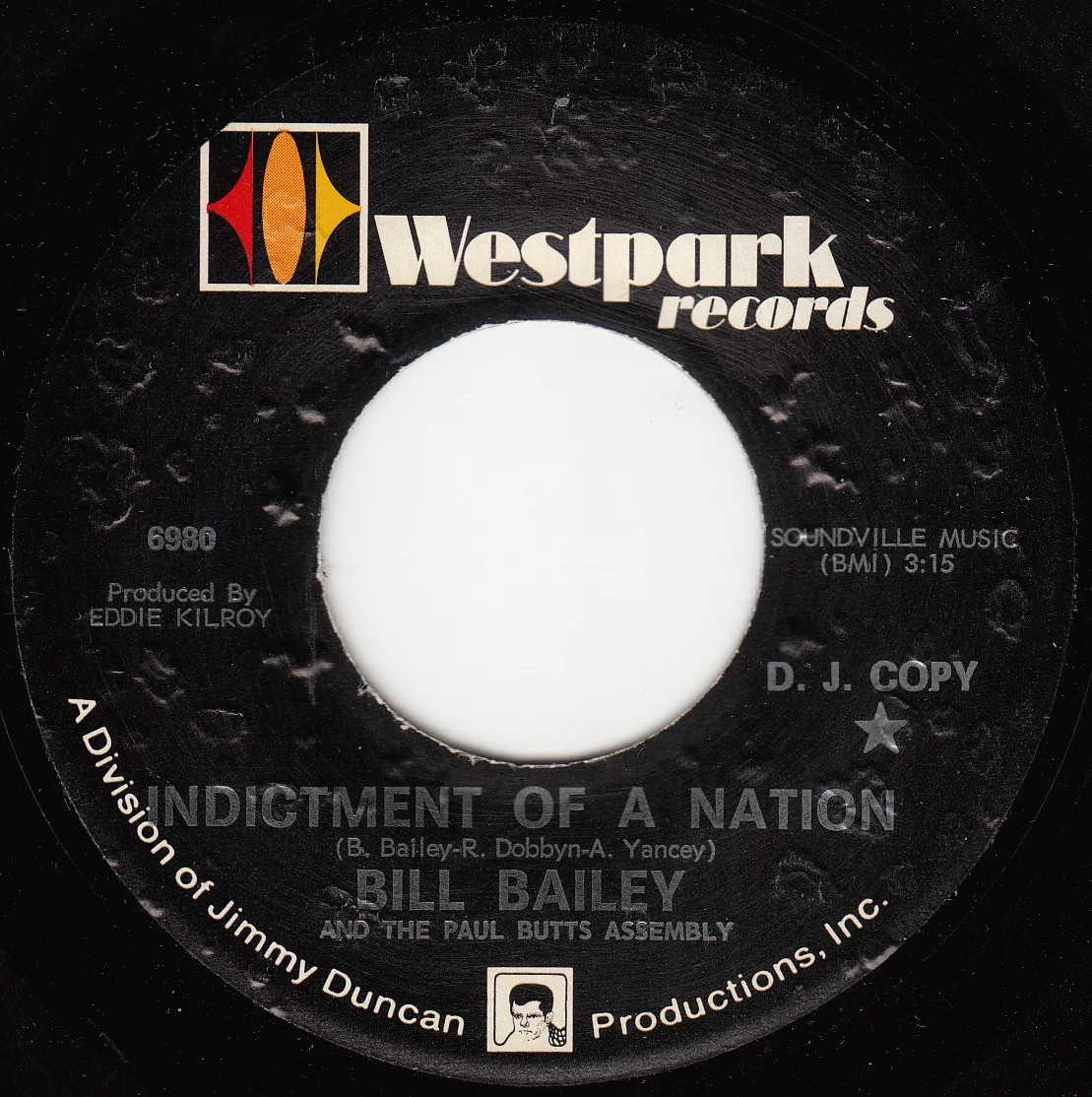
Westpark Records 6980, black "D. J. Copy" label; "Indictment of a Nation" (B. Bailey-R. Dobbyn-A. Yancey), Soundville Music (BMI), 3:15; Bill Bailey and the Paul Butts Assembly, produced by Eddie Kilroy; "A Division of Jimmy Duncan Productions, Inc." [From the record sleeve and labels]
Themes
My Lai · Draft Dodger · Anti-Protest · Pro-Calley · Anti-Government · Calley-Order · Anti-War · Calley-Danger · Calley-Chaos · Calley-Justice · Draft · Pro-Soldier
In collections
Draft Songs · My Lai & Lt. William Calley Songs · US 'Patriotic' / Pro-Government / Anti-Protest Songs [War Years]