Collections › Japanese Songs
Japanese Songs
130 songs · chronological · A–Z by artist
Annotations and notes by Justin A. Brummer
Entries are numbered (#1, #2 …) for reference on this page; the numbers shift when entries are added or split.
横井久美子 [Kumiko Yokoi] — ハノイにうたう [Singing in Hanoi], LP, 1974 (LRS-371)
A collection of Vietnam War songs released in Japan
Beyond Vietnamese Perspective, the songs in this collection most often also deal with: Anti-War, Vietnamese Patriotic, Peace, Ho Chi Minh.
1 of 3
Note: The VWSP has identified, to date, 130+ songs from Japan.
YouTube playlist: Japanese Songs
Citation: Justin A. Brummer, Vietnam War Song Project (VWSP) — Japanese Songs, vietnamwarsongproject.com/list/japanese-songs, accessed 12 November 2026
1964
#1 Central Choir 自由ベトナム行進曲 [Free Vietnam March] 1964 · EP · 平和のうたごえを1000万人にひろげよう 9 [Let's Spread the Voice of Peace to 10 Million People 9] · Center [Tokyo] # Sonopiece 9 · Japan
Credited on the record as 中央合唱団.
Notes
Center Sonopiece series No. 9, "平和のうたごえを1000万人にひろげよう" (Let's spread the voice of peace to 10 million people), red flexi-disc, 33⅓ rpm, labels headed "1964年日本のうたごえ祭典記念" (commemorating the 1964 Japan Singing Voice Festival), "音楽センター制作"; side A: 自由ヴェトナム行進曲, 春の声, 幸福河大合唱 (第6章), chorus 中央合唱団, conductors 関鑑子 and 井上頼豊; side B: 私のインドネシア, つばめ, soloists 柴田泰子 and 里館良子, accordion 中山英雄.The front shows a young Vietnamese woman with a rifle and a pagoda pavilion on a lake with dancers; the back lists the Center Sonopiece series Nos. 1–14 (¥200 each) and Ongaku Center, 西大久保3-67, 新宿区, Tokyo. The lyric sheet credits 自由ヴェトナム行進曲 to ドアン・クワンハイ (music), 関忠亮 (Japanese words and arrangement), sung by 中央合唱団 with accompaniment by 中山英雄; the notes describe it as the song of the Vietnamese Liberation Army fighting directly to rid Asia of colonies for independence and peace.
Score sheets print the melody with Japanese words and chords for all five songs. The lyrics call on young Vietnamese to fight for the people, drive out the occupiers and win their country's liberation, answering Ho Chi Minh's call. [From the record sleeve and labels]
Lyrics
Japanese
若いわれら人民のため
希望のみちひらく
自由のくにとり返すまで
強く斗うわれら
Genres: ♪ Vietnamese MusicNhạc đỏ
Also in: ▤ North Vietnamese Songs
1965
#2 三船和子 (Kazuko Mifune) ベトナムの赤い月 1965 · Single · ベトナムの赤い月 (The Red Moon of Vietnam) / 世界連邦・太平音頭 · Minoruphone # MA-1 · Japan
Annotation
The anti-war / peace song "トナムの赤い月" ( "The Red Moon of Vietnam" ) (Minoruphone Records # MA-1) by 三船和子 [Kazuko Mifune], which featured in the 1965 Japanese Vietnam War movie 動乱のベトナム [Vietnam in Turmoil]. Composed by 遠藤実 [Minoru Endo]. Lyrics by Masao Nakayama, which referenced Buddhist monks dying by self-immolation, the most well-known case being that of Thích Quảng Đức on 11 June 1963, one of the key images of the Vietnam War: "the monk earnest wish to save Vietnam and he prays that he should stop burning himself" . Annotation by Justin A. Brummer
Notes
Featured in the 1965 Japanese Vietnam War movie 動乱のベトナム [Vietnam in Turmoil] Minoru Phone MA 001 (PS-0002), stereo, 33⅓ rpm, "聴いて楽しい・歌って楽しい・伴奏つきレコード" (a record with backing track, fun to hear and fun to sing), "Mfd. by Minoruphone Co., Ltd., Tokyo, Japan"; "ベトナムの赤い月" (The Red Moon of Vietnam), from the Shin Riken film 「動乱のベトナム」, words 中山正男 [Masao Nakayama], music 遠藤実 [Minoru Endo], sung by 三船和子 with the Minoruphone Chorus (ミノルフォン合唱団) and Minoruphone Orchestra.The picture sleeve (¥330) shows a young woman in an áo dài with a flower in her hair, hands clasped, under the English title "The Red Moon of Vietnam".
The insert (太平グループ ミノルフォンレコード MA-001) prints four verses (the fourth not recorded), a melody line, playing times of 4:12 (vocal) and 4:10 (orchestra), a note that "ライツァライファ" is Vietnamese for "prayer", and a profile of the singer: born Ichinomiya, Aichi, 1 September 1947 (Showa 22), educated at Imaise Junior High School and a pupil of Minoru Endo. The lyrics are a prayer asking the world to watch Vietnam under a dark sun and red moon, recalling a monk's burning protest and hoping for peace for mothers and children. [From the record sleeve and labels]
Lyrics
English
Look at me
Vietnam Terrace
The sun is black
The sun is black
Everyone's hearts are black
The sky of the southern sea is a golden yellow
Shining brightly against the greenery
When will it come back
When will it come back
Ah, look at me Vietnam
The monk earnest wish to save Vietnam
And he prays that he should stop burning himself
And the flowers are laid in praise
When will he be able to visit the temple of God?
Dark red and red, the flames of the war are blazing
The wind that scorches the sky is scorching
The southern cross is under the stars of the south
When will that girl sing?
When will she be able to hear it?" [auto-translation used]
Japanese
ライツァ ライファ ああ みておくれ ベトナムの ベトナムてらす お日ひさま黒くろい みんなの胸むねが まっくらだから きらきらと 緑みどりに映はえる金色きんいろの 南みなみの空そらは いつ もどる いつ もどる ああみておくれ ベトナムの ベトナム救すくう 僧侶そうりょの悲願ひがん いくさ やめよと 身みを焼やく祈いのり花はなささげ たたえる 彌陀みだの信心しんじんの お寺てらまいりは いつ できる いつ できる ライツァ ライファ ああ みておくれ ベトナムの ベトナムつつむ 月つきかげ赤あかい戦火せんかの炎ほのお 天てんまで焦こがす風かぜかおる 南十字みなみじゅうじの星ほしのもと あの娘この歌うたは いつ きける いつ きける
Genres: ♪ Japanese MusicEnka
#3 浦島みつ子 [Mitsuko Urashima] ベトナム哀歌 (Vietnamese Lament) 1965 · Single · ベトナム哀歌 / 悲恋街道 · Teichiku # SN-259 · Japan
Credited on the record as 浦島みつ子.
Annotation
Mitsuko Urashima, also known as Sugata Noriko, born 16 October 1946 in Tokyo, Japan, released her debut single "ベトナム哀歌" ( "Vietnamese Lament" ) (Teichiku Records # SN-259), an anti-war / peace song, which noted the tragedy of Vietnam's decent into war: "the nostalgic Mekong, now it's a quagmire, a muddy jungle... only the shadows of war in the North and South" .Annotation by Justin A. Brummer
Lyrics
English
Like predicting tomorrow's fate
The moon shines through rows of palm trees
An endless, aimless night of war
A sad Vietnamese lament plays
When I carried away my dreams and flowed away
The nostalgic Mekong
Now it's a quagmire, a muddy jungle
Vietnam's wandering lament
Love is scattered, my hometown is still here
Only the shadows of war in the North and South
A mourning of peace
Praying and singing a Vietnamese lament" [auto-translation used]
Themes: Anti-War Mekong Delta
Genres: ♪ Japanese MusicEnka
#4–10 Central Choir 平和のうたごえを1000万人にひろげよう 15 ベトナム特集 [Let's Spread the Voice of Peace to 10 Million People 15 – Vietnam Special] 1965 · EP · Center [Tokyo] # Sonopiece 15 · Japan
All 4 songs from this ep in the archive are in this collection
Annotation
This is a different series to above, which translates as "Let's Spread the Song of Peace to 10 million People", with this one focused on Vietnam, with the subtitle "ベトナム特集" ("Special feature on Vietnam") (Center Record # ARI-337). .Notes
A1| 自由ベトナム行進曲 ("Free Vietnam March")A2| 南ベトナムを解放しよう("Let's Liberate South Vietnam")
A3| われらの行手に勝利あり("Victor Is On Our Way")
B1| ベトナムの乙女たち ("Vietnamese Maidens")
B2| 作業場の休憩 ("Work Place Break")
B3| おい仲間たち ("Hey Friends")
Annotation by Justin A. Brummer
#4 自由ヴェトナム行進曲 [Free Vietnam March] #5 南ベトナムを解放しよう [Let's Liberate South Vietnam] #6 ベトナムの乙女たち [The Maidens of Vietnam] #10 我らの行く手に勝利あり [Victory Lies Ahead of Us]
Show the full entries ▾ · Release page →
#4 Central Choir 自由ヴェトナム行進曲 [Free Vietnam March] 1965 · EP · 平和のうたごえを1000万人にひろげよう 15 ベトナム特集 [Let's Spread the Voice of Peace to 10 Million People 15 – Vietnam Special] · Center [Tokyo] # Sonopiece 15 · Japan
Credited on the record as 中央合唱団.
Annotation
This is a different series to above, which translates as "Let's Spread the Song of Peace to 10 million People", with this one focused on Vietnam, with the subtitle "ベトナム特集" ("Special feature on Vietnam") (Center Record # ARI-337). .Notes
A1| 自由ベトナム行進曲 ("Free Vietnam March")A2| 南ベトナムを解放しよう("Let's Liberate South Vietnam")
A3| われらの行手に勝利あり("Victor Is On Our Way")
B1| ベトナムの乙女たち ("Vietnamese Maidens")
B2| 作業場の休憩 ("Work Place Break")
B3| おい仲間たち ("Hey Friends")
Annotation by Justin A. Brummer
Notes
Center Sonopiece series No. 15, "ベトナム特集" (Vietnam Special), red flexi-disc, 33⅓ rpm, "音楽センター制作"; side A: 自由ベトナム行進曲, 南ベトナムを解放しよう, われらの行手に勝利あり; side B: ベトナムの乙女たち, 作業場の休憩, おい仲間達; chorus 中央合唱団, conductors 関鑑子 and 井上頼豊.The front is a colour photograph of a Vietnamese women's march with flags, raised fists and placards reading "Đế quốc Mỹ cút khỏi miền Nam Việt Nam"; the back lists the Center Sonopiece series Nos. 1–15 (¥200) and Ongaku Center, 西大久保3-67, 新宿区, Tokyo. The lyric sheet, printed over a photograph of a mass rally, gives 南ベトナムを解放しよう as "南ベトナム解放歌" with Japanese words by 関鑑子 and accompaniment by the Center Ensemble, and ベトナムの乙女たち as a "ベトナム歌曲" translated by 関鑑子, accompaniment 松永勇次, conductor 関鑑子.
The notes say 南ベトナムを解放しよう is, with 自由ベトナム行進曲, among the most sung songs of North and South; われらの行手に勝利あり is one of some ten solidarity songs written in Japan in 1965, words by a Nagoya Dentsu worker and music by an Osaka newspaper worker, accompanied by 木下 and 松永 (accordion); ベトナムの乙女たち came on tape with messages from the South Vietnam National Liberation Front to the 1964 Japan Singing Voice Festival.
Score sheets print melodies with Japanese words for all six songs. The lyrics call on Vietnam's young people to fight to drive out the occupiers, win back freedom and answer Ho Chi Minh's call for liberation. [From the record sleeve and labels]
Lyrics
Japanese
若いわれら人民のため
希望のみちひらく
自由のくにとり返すまで
強く斗うわれら
Genres: ♪ Vietnamese MusicNhạc đỏ
Also in: ▤ North Vietnamese Songs
#5 Central Choir 南ベトナムを解放しよう [Let's Liberate South Vietnam] 1965 · EP · 平和のうたごえを1000万人にひろげよう 15 ベトナム特集 [Let's Spread the Voice of Peace to 10 Million People 15 – Vietnam Special] · Center [Tokyo] # Sonopiece 15 · Japan
Credited on the record as 中央合唱団.
Notes
Center Sonopiece series No. 15, "ベトナム特集" (Vietnam Special), red flexi-disc, 33⅓ rpm, "音楽センター制作"; side A: 自由ベトナム行進曲, 南ベトナムを解放しよう, われらの行手に勝利あり; side B: ベトナムの乙女たち, 作業場の休憩, おい仲間達; chorus 中央合唱団, conductors 関鑑子 and 井上頼豊.The front is a colour photograph of a Vietnamese women's march with flags, raised fists and placards reading "Đế quốc Mỹ cút khỏi miền Nam Việt Nam"; the back lists the Center Sonopiece series Nos. 1–15 (¥200) and Ongaku Center, 西大久保3-67, 新宿区, Tokyo. The lyric sheet, printed over a photograph of a mass rally, gives 南ベトナムを解放しよう as "南ベトナム解放歌" with Japanese words by 関鑑子 and accompaniment by the Center Ensemble, and ベトナムの乙女たち as a "ベトナム歌曲" translated by 関鑑子, accompaniment 松永勇次, conductor 関鑑子.
The notes say 南ベトナムを解放しよう is, with 自由ベトナム行進曲, among the most sung songs of North and South; われらの行手に勝利あり is one of some ten solidarity songs written in Japan in 1965, words by a Nagoya Dentsu worker and music by an Osaka newspaper worker, accompanied by 木下 and 松永 (accordion); ベトナムの乙女たち came on tape with messages from the South Vietnam National Liberation Front to the 1964 Japan Singing Voice Festival.
Score sheets print melodies with Japanese words for all six songs. The lyrics call on South Vietnamese to rise up resolutely under the liberation flag, take up arms, defeat America and its collaborators, and defend the homeland from the Mekong to the Truong Son mountains. [From the record sleeve and labels]
Lyrics
Japanese
たてベトナム決意固く
たたき出せ 売国奴
うちくだけアメリカ
わが祖国守れ
Themes: Vietnamese Perspective Vietnamese Patriotic Mekong Delta Ho Chi Minh Trail NLF Anti-American
Genres: ♪ Vietnamese MusicNhạc đỏ
Also in: ▤ North Vietnamese Songs
#6 Central Choir ベトナムの乙女たち [The Maidens of Vietnam] 1965 · EP · 平和のうたごえを1000万人にひろげよう 15 ベトナム特集 [Let's Spread the Voice of Peace to 10 Million People 15 – Vietnam Special] · Center [Tokyo] # Sonopiece 15 · Japan
Credited on the record as 中央合唱団.
Notes
Center Sonopiece series No. 15, "ベトナム特集" (Vietnam Special), red flexi-disc, 33⅓ rpm, "音楽センター制作"; side A: 自由ベトナム行進曲, 南ベトナムを解放しよう, われらの行手に勝利あり; side B: ベトナムの乙女たち, 作業場の休憩, おい仲間達; chorus 中央合唱団, conductors 関鑑子 and 井上頼豊.The front is a colour photograph of a Vietnamese women's march with flags, raised fists and placards reading "Đế quốc Mỹ cút khỏi miền Nam Việt Nam"; the back lists the Center Sonopiece series Nos. 1–15 (¥200) and Ongaku Center, 西大久保3-67, 新宿区, Tokyo. The lyric sheet, printed over a photograph of a mass rally, gives 南ベトナムを解放しよう as "南ベトナム解放歌" with Japanese words by 関鑑子 and accompaniment by the Center Ensemble, and ベトナムの乙女たち as a "ベトナム歌曲" translated by 関鑑子, accompaniment 松永勇次, conductor 関鑑子.
The notes say 南ベトナムを解放しよう is, with 自由ベトナム行進曲, among the most sung songs of North and South; われらの行手に勝利あり is one of some ten solidarity songs written in Japan in 1965, words by a Nagoya Dentsu worker and music by an Osaka newspaper worker, accompanied by 木下 and 松永 (accordion); ベトナムの乙女たち came on tape with messages from the South Vietnam National Liberation Front to the 1964 Japan Singing Voice Festival.
Score sheets print melodies with Japanese words for all six songs. The lyrics praise Vietnamese young women who support the liberation war from the rear, planting rice, working in factories and sewing uniforms for soldiers. [From the record sleeve and labels]
Lyrics
Japanese
雨降る夜も 晴の日も
斗い続く 解放戦
後方を守る 乙女たち
Genres: ♪ Vietnamese MusicNhạc đỏ
Also in: ▤ North Vietnamese Songs
#10 Central Choir 我らの行く手に勝利あり [Victory Lies Ahead of Us] 1965 · EP · 平和のうたごえを1000万人にひろげよう 15 ベトナム特集 [Let's Spread the Voice of Peace to 10 Million People 15 – Vietnam Special] · Center [Tokyo] # Sonopiece 15 · Japan
Credited on the record as 中央合唱団.
Notes
A3. 1965 Japanese solidarity song with Vietnam (Nagoya Dentsu poet, Osaka newspaper-worker composer): rain on Vietnam, poison gas, bombing of the North; also Congo, Seoul Center Sonopiece series No. 15, "ベトナム特集" (Vietnam Special), red flexi-disc, 33⅓ rpm, "音楽センター制作"; side A: 自由ベトナム行進曲, 南ベトナムを解放しよう, われらの行手に勝利あり; side B: ベトナムの乙女たち, 作業場の休憩, おい仲間達; chorus 中央合唱団, conductors 関鑑子 and 井上頼豊.The front is a colour photograph of a Vietnamese women's march with flags, raised fists and placards reading "Đế quốc Mỹ cút khỏi miền Nam Việt Nam"; the back lists the Center Sonopiece series Nos. 1–15 (¥200) and Ongaku Center, 西大久保3-67, 新宿区, Tokyo. The lyric sheet, printed over a photograph of a mass rally, gives 南ベトナムを解放しよう as "南ベトナム解放歌" with Japanese words by 関鑑子 and accompaniment by the Center Ensemble, and ベトナムの乙女たち as a "ベトナム歌曲" translated by 関鑑子, accompaniment 松永勇次, conductor 関鑑子.
The notes say 南ベトナムを解放しよう is, with 自由ベトナム行進曲, among the most sung songs of North and South; われらの行手に勝利あり is one of some ten solidarity songs written in Japan in 1965, words by a Nagoya Dentsu worker and music by an Osaka newspaper worker, accompanied by 木下 and 松永 (accordion); ベトナムの乙女たち came on tape with messages from the South Vietnam National Liberation Front to the 1964 Japan Singing Voice Festival.
Score sheets print melodies with Japanese words for all six songs. The lyrics link Vietnam's fight with struggles in the Congo, Seoul and Japanese factories, condemning poison gas and the bombing of the north, and calling Asia and Africa to drive out the Yankees. [From the record sleeve and labels]
Lyrics
Japanese
雨しぶきわたるベトナムに
夜明けの火もえるコンゴの森に
にくいにくい弾丸がとぶ
毒ガス北爆許さず
#7–9 毎日放送ベトナム特別取材班 [Mainichi Broadcasting Vietnam Special Reporting Team] 月刊朝日ソノラマ 1965年5月号 特集/ベトナムの戦乱 [Asahi Sonorama No. 65, May 1965 – Special: War in Vietnam] 1965 · Compilation · Asahi Sonorama # 65 · Japan
All 3 songs from this compilation in the archive are in this collection
#7 ベトナム共和国国歌 [National Anthem of the Republic of Vietnam] (Tiếng gọi công dân) #8 ベトナムの戦乱 (1A) [War in Vietnam] – サイゴン・クーデター実況 [Saigon coup, live] #9 ベトナムの戦乱 (1B) [War in Vietnam] – 韓国支援軍のサイゴン到着 [Korean support troops arrive in Saigon]
Show the full entries ▾ · Release page →
#7 毎日放送ベトナム特別取材班 [Mainichi Broadcasting Vietnam Special Reporting Team] ベトナム共和国国歌 [National Anthem of the Republic of Vietnam] (Tiếng gọi công dân) 1965 · Compilation · 月刊朝日ソノラマ 1965年5月号 特集/ベトナムの戦乱 [Asahi Sonorama No. 65, May 1965 – Special: War in Vietnam] · Asahi Sonorama # 65 · Japan
Credited on the record as 毎日放送ベトナム特別取材班.
Notes
月刊朝日ソノラマ (Asahi Sonorama) No. 65, May 1965, 280円, with blue flexi-sheet 1, 33⅓ rpm, labelled "毎日放送ベトナム特別取材班による実況音 ベトナムの戦乱" (live sound recorded by the Mainichi Broadcasting Vietnam special reporting team); side 1A: the Saigon coup live, press conferences of Col. ファン・ゴクタオ and 第1軍団司令官 グエン・チャンチ, and an exclusive interview with South Vietnamese Prime Minister ファン・フィ・クワット; side 1B: the live handover ceremony of 3軍総司令官 グエン・カーン and the arrival of the South Korean support force in Saigon, with the Korean national anthem and the anthem of the Republic of Vietnam.The front cover shows a soldier and a peasant mother holding a child before burning houses ("家や作物を焼かれ、ボンヤリたたずむ農民の母子", WWP); the back cover shows Col. ファン・ゴク・タオ directing the 19 February coup from a tank, captioned that the coup failed within a day. The feature pages open with Saigon street scenes of tanks and barbed wire, and include the article "ベトナムの"20年戦争"" by 森恭三 (Asahi Shimbun chief editorial writer) with maps of Indochina, and photographs of the coup, a press conference of グエン・バン・チュ, グエン・チャンチ and グエン・カオキ, a strategic hamlet, Ambassador Taylor at Da Nang, and the first Korean troops in Saigon.
A note on p. 9 says the sheet was made from live recordings by the Mainichi Broadcasting team (news bureau head 真崎貞夫, a member of the social-education department, and cameraman 平敷安常), who were in Vietnam for about a month from 18 February. Sheet 2 carries Soviet and US space recordings and a children's music competition. [From the record sleeve and labels]
Genre: ♪ Fanfare
Also in: ▤ Other Vietnamese Songs
#8 毎日放送ベトナム特別取材班 [Mainichi Broadcasting Vietnam Special Reporting Team] ベトナムの戦乱 (1A) [War in Vietnam] – サイゴン・クーデター実況 [Saigon coup, live] 1965 · Compilation · 月刊朝日ソノラマ 1965年5月号 特集/ベトナムの戦乱 [Asahi Sonorama No. 65, May 1965 – Special: War in Vietnam] · Asahi Sonorama # 65 · Japan
Credited on the record as 毎日放送ベトナム特別取材班.
Notes
1A. 19 Feb 1965 Saigon coup live; press conferences of Col. Phạm Ngọc Thảo and Gen. Nguyễn Chánh Thi; exclusive interview with PM Phan Huy Quát 月刊朝日ソノラマ (Asahi Sonorama) No. 65, May 1965, 280円, with blue flexi-sheet 1, 33⅓ rpm, labelled "毎日放送ベトナム特別取材班による実況音 ベトナムの戦乱" (live sound recorded by the Mainichi Broadcasting Vietnam special reporting team); side 1A: the Saigon coup live, press conferences of Col. ファン・ゴクタオ and 第1軍団司令官 グエン・チャンチ, and an exclusive interview with South Vietnamese Prime Minister ファン・フィ・クワット; side 1B: the live handover ceremony of 3軍総司令官 グエン・カーン and the arrival of the South Korean support force in Saigon, with the Korean national anthem and the anthem of the Republic of Vietnam.The front cover shows a soldier and a peasant mother holding a child before burning houses ("家や作物を焼かれ、ボンヤリたたずむ農民の母子", WWP); the back cover shows Col. ファン・ゴク・タオ directing the 19 February coup from a tank, captioned that the coup failed within a day. The feature pages open with Saigon street scenes of tanks and barbed wire, and include the article "ベトナムの"20年戦争"" by 森恭三 (Asahi Shimbun chief editorial writer) with maps of Indochina, and photographs of the coup, a press conference of グエン・バン・チュ, グエン・チャンチ and グエン・カオキ, a strategic hamlet, Ambassador Taylor at Da Nang, and the first Korean troops in Saigon.
A note on p. 9 says the sheet was made from live recordings by the Mainichi Broadcasting team (news bureau head 真崎貞夫, a member of the social-education department, and cameraman 平敷安常), who were in Vietnam for about a month from 18 February. Sheet 2 carries Soviet and US space recordings and a children's music competition. [From the record sleeve and labels]
Theme: Saigon
Genres: ♪ Spoken WordField Recordings
#9 毎日放送ベトナム特別取材班 [Mainichi Broadcasting Vietnam Special Reporting Team] ベトナムの戦乱 (1B) [War in Vietnam] – 韓国支援軍のサイゴン到着 [Korean support troops arrive in Saigon] 1965 · Compilation · 月刊朝日ソノラマ 1965年5月号 特集/ベトナムの戦乱 [Asahi Sonorama No. 65, May 1965 – Special: War in Vietnam] · Asahi Sonorama # 65 · Japan
Credited on the record as 毎日放送ベトナム特別取材班.
Notes
1B. Gen. Nguyễn Khánh's handover ceremony as armed-forces commander (live); arrival of the South Korean support force in Saigon (live) with the Korean and RVN anthems 月刊朝日ソノラマ (Asahi Sonorama) No. 65, May 1965, 280円, with blue flexi-sheet 1, 33⅓ rpm, labelled "毎日放送ベトナム特別取材班による実況音 ベトナムの戦乱" (live sound recorded by the Mainichi Broadcasting Vietnam special reporting team); side 1A: the Saigon coup live, press conferences of Col. ファン・ゴクタオ and 第1軍団司令官 グエン・チャンチ, and an exclusive interview with South Vietnamese Prime Minister ファン・フィ・クワット; side 1B: the live handover ceremony of 3軍総司令官 グエン・カーン and the arrival of the South Korean support force in Saigon, with the Korean national anthem and the anthem of the Republic of Vietnam.The front cover shows a soldier and a peasant mother holding a child before burning houses ("家や作物を焼かれ、ボンヤリたたずむ農民の母子", WWP); the back cover shows Col. ファン・ゴク・タオ directing the 19 February coup from a tank, captioned that the coup failed within a day. The feature pages open with Saigon street scenes of tanks and barbed wire, and include the article "ベトナムの"20年戦争"" by 森恭三 (Asahi Shimbun chief editorial writer) with maps of Indochina, and photographs of the coup, a press conference of グエン・バン・チュ, グエン・チャンチ and グエン・カオキ, a strategic hamlet, Ambassador Taylor at Da Nang, and the first Korean troops in Saigon.
A note on p. 9 says the sheet was made from live recordings by the Mainichi Broadcasting team (news bureau head 真崎貞夫, a member of the social-education department, and cameraman 平敷安常), who were in Vietnam for about a month from 18 February. Sheet 2 carries Soviet and US space recordings and a children's music competition. [From the record sleeve and labels]
Genres: ♪ Spoken WordField Recordings
#11 毎日放送ベトナム特別取材班 [Mainichi Broadcasting Vietnam Special Reporting Team] ベトナム戦線を行く (1A) [Going to the Vietnam Front] – サイゴン大学学生自治会と仏教徒の抗議集会/17度線(ベン・ハイ河)の実況 1965 · Compilation · 月刊朝日ソノラマ 1965年6月号 特集/ベトナム戦線を行く [Asahi Sonorama No. 66, June 1965 – Special: Going to the Vietnam Front] · Asahi Sonorama # 66 · Japan
Credited on the record as 毎日放送ベトナム特別取材班.
Notes
1A. Live sound: Saigon University student union and Buddhist protest rally; the 17th parallel at the Bến Hải river 月刊朝日ソノラマ 6月号 No. 66 ("Asahi Sonorama No. 66 June 1965"), price 280円, published 1 June 1965 (昭和40年6月1日発行); cover feature 特集/ベトナム戦線を行く, also 4月のニュースダイジェスト and 第8回大阪国際フェスティバル開幕. Blue flexi sheet, 33⅓, label "月刊朝日ソノラマ 1965 6月号": "ベトナム戦線を行く" 《続・MBSベトナム特別取材班による実況音》; side 1A: サイゴン大学学生自治会と仏教徒の抗議集会/17度線(ベン・ハイ河)の実況; side 1B: ベトコン掃討戦従軍の実況.The front cover photo shows a kneeling prisoner before South Vietnamese soldiers in gas masks; the back cover shows weeping women in conical hats. The feature introduces the recordings as the continuation of the previous issue's Mainichi Broadcasting (MBS) special reporting team's live sound, made in the hope of an early end to the fighting; inside are "ベトナム取材班のメモ" by 真崎貞夫 (Sadao Masaki, MBS news bureau chief) on "ベトナム人の印象" and the strange "expulsion" of peace-movement figures to the North across the Hiền Lương bridge on the Bến Hải river, by 森田泰正 (Yasumasa Morita) on "ある作戦", a Viet Cong sweep from Camp Suối Đá near the Cambodian border on 9 March, recorded on tape as he marched, and "十七度線への旅", a drive from Da Nang to the 17th parallel (MBS social education department).
Photographs credited to WWP, an MBS cameraman and 秋元啓一 (Asahi Shimbun publishing photo department). [From the record sleeve and labels]
Genres: ♪ Spoken WordField Recordings
#12 毎日放送ベトナム特別取材班 [Mainichi Broadcasting Vietnam Special Reporting Team] ベトナム戦線を行く (1B) [Going to the Vietnam Front] – ベトコン掃討戦従軍の実況 1965 · Compilation · 月刊朝日ソノラマ 1965年6月号 特集/ベトナム戦線を行く [Asahi Sonorama No. 66, June 1965 – Special: Going to the Vietnam Front] · Asahi Sonorama # 66 · Japan
Credited on the record as 毎日放送ベトナム特別取材班.
Notes
1B. Live sound embedded with ARVN and US advisers on a Viet Cong sweep (Tây Ninh, Mar 1965) 月刊朝日ソノラマ 6月号 No. 66 ("Asahi Sonorama No. 66 June 1965"), price 280円, published 1 June 1965 (昭和40年6月1日発行); cover feature 特集/ベトナム戦線を行く, also 4月のニュースダイジェスト and 第8回大阪国際フェスティバル開幕. Blue flexi sheet, 33⅓, label "月刊朝日ソノラマ 1965 6月号": "ベトナム戦線を行く" 《続・MBSベトナム特別取材班による実況音》; side 1A: サイゴン大学学生自治会と仏教徒の抗議集会/17度線(ベン・ハイ河)の実況; side 1B: ベトコン掃討戦従軍の実況.The front cover photo shows a kneeling prisoner before South Vietnamese soldiers in gas masks; the back cover shows weeping women in conical hats. The feature introduces the recordings as the continuation of the previous issue's Mainichi Broadcasting (MBS) special reporting team's live sound, made in the hope of an early end to the fighting; inside are "ベトナム取材班のメモ" by 真崎貞夫 (Sadao Masaki, MBS news bureau chief) on "ベトナム人の印象" and the strange "expulsion" of peace-movement figures to the North across the Hiền Lương bridge on the Bến Hải river, by 森田泰正 (Yasumasa Morita) on "ある作戦", a Viet Cong sweep from Camp Suối Đá near the Cambodian border on 9 March, recorded on tape as he marched, and "十七度線への旅", a drive from Da Nang to the 17th parallel (MBS social education department).
Photographs credited to WWP, an MBS cameraman and 秋元啓一 (Asahi Shimbun publishing photo department). [From the record sleeve and labels]
Themes: Helicopter Vietnamese Perspective
Genres: ♪ Spoken WordField Recordings
1966
#13 マイク眞木 [Mike Maki] ベトナムの空 (Vietnam Sky) 1966 · Single · 波と木彫りのクマ / ベトナムの空 · Philips # SFL-1051 · Japan
Credited on the record as マイク眞木.
Annotation
Anti-war song "ベトナムの空" ( "Vietnam Sky" ) (Philips # SFL-1051), composed by songwriter 日高義 (Yoshi Hidaka), and here performed by Mike Maki, born on 27 April 1944 in Tokyo, Japan. The song also featured on his 1966 album Folk Album No. 2. Also note the more well-known version of this song, released in 1969 by 高石ともや [Tomoya Takaishi] on the single ホー・チ・ミンのバラード / ベトナムの空 (discussed below). The song focused on capturing the sounds and images of combat, from helicopters to burning villages and water buffalos, all familiar perceptions associated with the Vietnam War: "helicopter flew away... water buffalo echoed in the Mekong River... burnt-out village... blood everywhere" . Annotation by Justin A. Brummer
Notes
Philips SFL-1051, Hi-Fi Stereo 45, side 2 (JWM-5003), manufactured by Victor Company of Japan, Yokohama; "ベトナムの空" (words and music 日高義 [Yoshi Hidaka]), 2:49, sung with guitar by マイク真木; A-side "波と木彫りのクマ" (words and music マイク真木).The picture sleeve (¥370, released by 日本ビクター) bills it as "心を打つ感動の歌 日本のモダン・フォーク!" and shows the young singer in a striped shirt looking upward.
The back sleeve prints both lyrics and notes: for "ベトナムの空" the singer writes that great sacrifice may be needed to win freedom and peace but he hates killing, and that he sings praying that the senseless war now going on in a corner of Asia will end soon; a profile gives his birth as 27 April 1944 (Showa 19), a student in the Nihon University art department, founder of the Modern Folk Quartet, invited by MRA to a folk festival on Mackinac Island, a month in Ceylon in January 1966, the Philips album "バラが咲いた / マイク真木フォーク・アルバム" (SFL-7290), and his instruments (guitar, banjo, 12-string guitar, autoharp, harmonica, jew's harp and Indian esraj).
Housed in a Philips company sleeve. The lyrics describe a wounded soldier dying alone, thinking of home, under a blood-red Vietnamese sky of helicopters, gunfire and burned villages, the same sky as Hanoi, Saigon and Tokyo. [From the record sleeve and labels]
Lyrics
English
There was a wounded soldier just looking up at the Vietnamese sky
The sky was as red as blood
And the helicopter flew away, and the gunshots stopped
The voice of the water buffalo echoed in the Mekong River
The sky was as red as blood, and he was watching
A burnt-down village and forest where no one dies alone
The sky is hazy with smoke and is red like blood everywhere
Holding a gun in my weakening hand, I remember my hometown
Leaving behind the smile of my mother
Why did I go out into the wild
The sky is as red as blood
The helicopter flies away, and the sound of gunfire stops
It echoes in the Mekong River
The skies of Vietnam are getting dark again today
Hanoi and Saigon are all the same sky
The sky is blood red everywhere
The helicopter flies away, the sound of gunfire ceases
It echoes in the Mekong River" [auto-translation used]
Japanese
ベトナムの空を ただ見上げている
傷ついた兵隊が 一人いた
空はどこまでも
血のように赤い
ヘリコプターが飛び去り
砲声が途絶えて
メコン川にこだまする
水牛の声
空はどこまでも
血のように赤い
見守る誰もなく
一人死んでゆく
焼き払われた村や森
煙にかすむ
空はどこまでも
血のように赤い
弱まる手に銃を抱き
思い出す故郷(こきょう)
母の微笑み残して
何故いくさに出た
空はどこまでも
血のように赤い
ヘリコプターが飛び去り
砲声が途絶えて
メコン川にこだまする
ベトナムの空は
今日も暮れてゆく
ハノイやサイゴン深浦も
みんな同じ空
空はどこまでも
血のように赤い
ヘリコプターが飛び去り
砲声が途絶えて
メコン川にこだまする
#14 北山和子 [Kazuko Kitayama] 一本の針 [Needle] 1966 · Single · 一本の針 / メコン河も泣いている · Minoruphone # KA-58 · Japan
Credited on the record as 北山和子.
Annotation
Double-sided anti-war Vietnam single. The first song "本の針" ( "Needle" ) (Minoruphone Records # KA-58) was performed by 北山和子 [Kazuko Kitayama] in the Kayōkyoku genre - "a Western-influenced vocal Pop music which was popular in Japan during the latter period of the Shōwa era, approximately from the 1950s to the late 1980s". The record label ran an advert promoting the single, under the headline: "A dark-skinned mixed race female singer... appeals for peace in Vietnam". It went on to say "a black -skinned girl born to a Japanese woman affected by war, is one such child of mixed race, and will make her debut... with a social song... a prayer for peace in Vietnam... it is a heartfelt song expressing a wish for peace, saying that Vietnam is now a hell of a mountain of pins and needles".1 The song noted "Vietnam is now feeling the hell of pain of needles" . It questioned the point of the war: "what are we fighting about? Ideology is nothing more than human beings" . It concluded that "everyone's wish is to stop the war" . It also contained a few specific references to Japan: "the pain that Japan felt at that time on that day" , presumably a reference to the atomic bomb during WW2, and "listen to the appeal of Japan" , arguing that the country was against the war.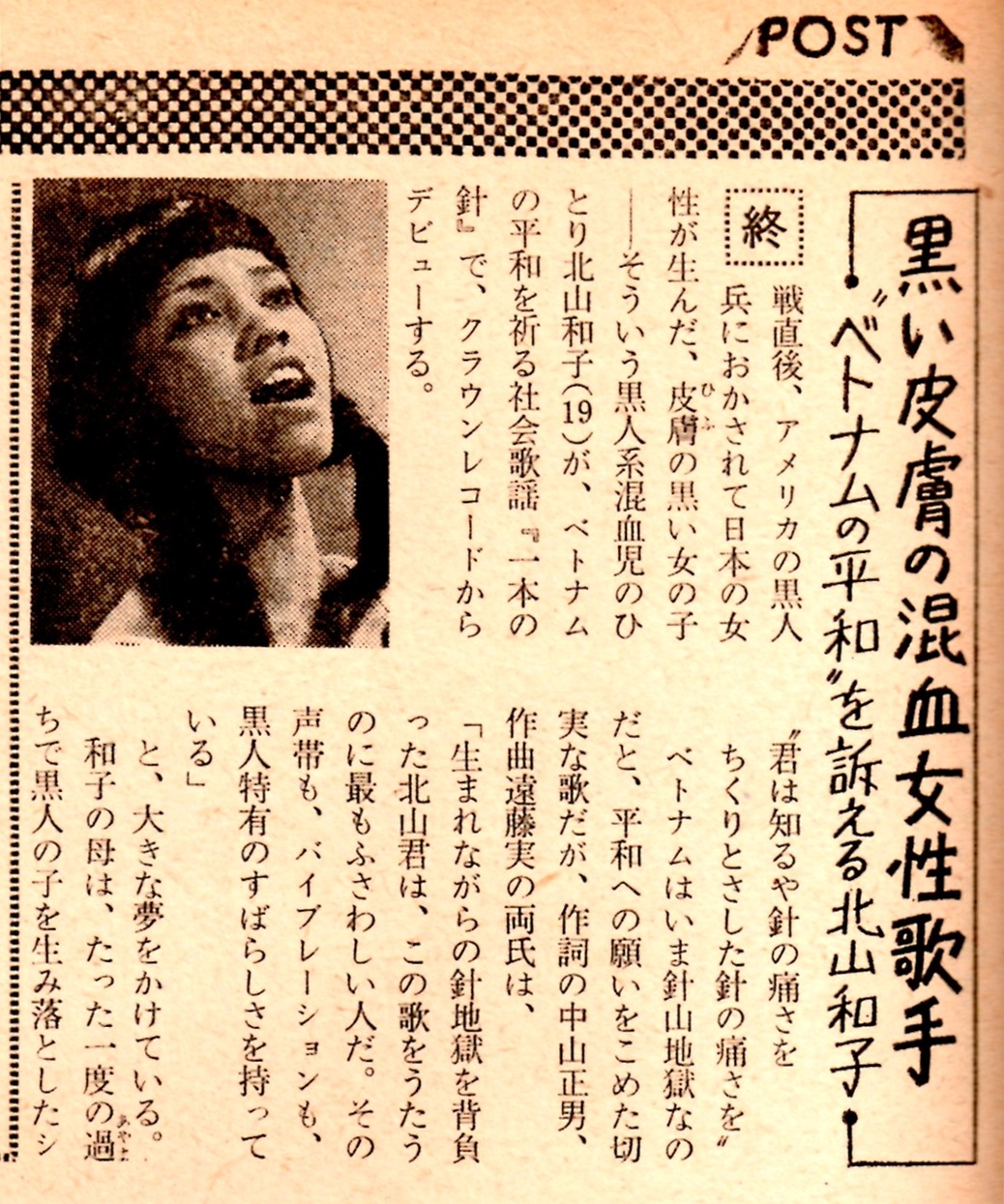
Annotation by Justin A. Brummer
Lyrics
English
Do you know the pain of a needle?
The pain of a needle prickling you
Everyone knows that pain of a needle
Vietnam is now feeling the hell of pain of needles
Our Asian friends
Imagine the pain of needles for ourselves
The pain that Japan felt at that time on that day
The wheat grows towards the sky
The flowing river is lower
South and North are on the map
Human feelings never change
What are we fighting about?
Ideology is nothing more than human beings
Needles hurt, even in America
Staring intently at his wife and child's sleeping face
Living in peace under the lamp
Everyone's wish is to stop the war
And with prayers for the pain of the needle
Listen to the appeal of Japan
Ah, a bright morning in Vietnam
Let the bells rings, let them ring" [auto-translation used]
#15 芥川隆行 [Takayuki Akutagawa] メコン河も泣いている [The Mekong River Is Crying] 1966 · Single · 一本の針 / メコン河も泣いている · Minoruphone # KA-58 · Japan
Credited on the record as 芥川隆行.
Annotation
The B-side, "メコン河も泣いている" ( "The Mekong River Is Crying" ) was a narration with background music, from 芥川隆行 [Takayuki Akutagawa], a well-known radio announcer in Japan. It presented the Vietnamese perspective under war: "sky is constantly roaring... bombardment was so intense" . It argued "we are all human... we Vietnamese are the same ethnic group" .Annotation by Justin A. Brummer
Notes
a well-known radio announcer in Japan Minoru Phone KA-58, stereo, 45 rpm, red label, "Mfd. by Minoruphone Co., Ltd., Tokyo, Japan"; side PS-0145 ©'66 "一本の針" (words 中山正男 [Masao Nakayama], music 遠藤実 [Minoru Endo]), 4:00, sung by 北山和子 with the Minoruphone Orchestra; side PS-0146 ©'66 "メコン河も泣いている" (poem by 中山正男), 4:10, recited by 芥川隆行.The picture sleeve (¥330), headed "民族の歌声", shows the young singer with her head tilted back.
The back sleeve (太平グループ ミノルフォンレコード) prints three verses of "一本の針" (the second not sung) with a melody line, and the full text of the recited poem with a photograph of the reciter; the poem speaks of Saigon, Hanoi, the Mekong and the bombing, ending "ガメロン鳴らして、躍る月夜が". A newspaper clipping shown with the record, headed "黒い皮膚の混血女性歌手 'ベトナムの平和'を訴える北山和子", describes her as a 19-year-old mixed-race singer making her debut with this social song praying for peace in Vietnam, quoting Nakayama and Endo.
The lyrics are a spoken monologue by a Vietnamese villager describing bombing, terror in Saigon, rising prices and a people split between North and South, and begging for the fighting to stop. [From the record sleeve and labels]
Lyrics
English
We are not stone Buddhas or iron robots
We are alive, we are human beings with blood and souls
Even a thorn of a millimeter stuck in our finger hurts
Swells and causes suffering
I can't stand it anymore
The sky is constantly roaring
The roads, the bridges, the rice fields, the jungle, even the Mekong River
The bombardment was so intense that I was crying out in pain
Why do I have to cry so much?...
We are all human being living in one earthly home
Moreover, we Vietnamese are the same ethnic group
I saw a Chinese drama in Cho Long with my Uncle who lives in Hanoi
My cousin who is in Viet Cong guerilla army
It was a fun day when we caught shrimp of the coast of Saint-Jacques
Now the streets of Saigon are like bayonet forts
Terror attack, monk self-immolation...
Furthermore he was separated from his wife and children...
Enough already, enough already...
Know the pain of a needle
Pain in the flesh and the aching heart..." [auto-translation used]
#16–22 Central Choir 平和のうたごえを1000万人にひろげよう 18 ベトナム特集 NO.2 [Let's Spread the Voice of Peace to 10 Million People 18 – Vietnam Special No. 2] 1966 · EP · Center [Tokyo] # Sonopiece 18 · Japan
All 7 songs from this ep in the archive are in this collection
Annotation
As above, this one is part of the series "Let's Spread the Song of Peace to 10 million People", with the subtitle "ベトナム特集 No.2" ("Vietnam Special Feature No. 2") (Center Record # ARI-3575). .Notes
A1| 日本-ベトナム ("Japan-Vietnam")A2| 大行軍の歌 ("Great March Song")
A3| ベトナム叙事詩 ("Vietnam Epic")
A4| ディエン・ビエンの勝利 ("Dien Bien Victory")
B1| 統一ベトナム ("Unified Vietnam")
B2| ベトナム解放区の春 ("Spring in the Liberated Areas of Vietnam")
B3| 南ベトナムからの手紙 ("Letter From South Vietnam")
Annotation by Justin A. Brummer
#16 大行軍の歌 [Song of the Great March] #17 ベトナム叙事詩 [Vietnam Epic] #18 ディエン・ビエンの勝利 [Victory at Điện Biên] #19 統一ベトナム [Unified Vietnam] #20 ベトナム解放区の春 [Spring in the Liberated Zone of Vietnam] #21 日本―ベトナム [Japan–Vietnam] (日本・ベトナム友好大衆歌曲) #22 南ベトナムからの手紙 [Letter From South Vietnam]
Show the full entries ▾ · Release page →
#16 Central Choir 大行軍の歌 [Song of the Great March] 1966 · EP · 平和のうたごえを1000万人にひろげよう 18 ベトナム特集 NO.2 [Let's Spread the Voice of Peace to 10 Million People 18 – Vietnam Special No. 2] · Center [Tokyo] # Sonopiece 18 · Japan
Credited on the record as 中央合唱団.
Annotation
As above, this one is part of the series "Let's Spread the Song of Peace to 10 million People", with the subtitle "ベトナム特集 No.2" ("Vietnam Special Feature No. 2") (Center Record # ARI-3575). .Notes
A1| 日本-ベトナム ("Japan-Vietnam")A2| 大行軍の歌 ("Great March Song")
A3| ベトナム叙事詩 ("Vietnam Epic")
A4| ディエン・ビエンの勝利 ("Dien Bien Victory")
B1| 統一ベトナム ("Unified Vietnam")
B2| ベトナム解放区の春 ("Spring in the Liberated Areas of Vietnam")
B3| 南ベトナムからの手紙 ("Letter From South Vietnam")
Annotation by Justin A. Brummer
Notes
Center Sonopiece series No. 18, "ベトナム特集 NO.2", ¥300, dark red flexi-disc, 33⅓ rpm, "音楽センター制作"; No. 18A: 日本・ベトナム, 大行軍の歌, ベトナム叙事詩, ディエンビエンの勝利; No. 18B: 統一ベトナム, ベトナム開放区 [sic], 南ベトナムからの手紙; chorus 中央合唱団, piano 田村慧子, accordion 松永 and 木下, conductor 井上頼豊; the lyric sheet gives side timings A 8:14 and B 8:02.The front is a colour photograph of a smiling young Vietnamese woman in a conical hat with workers building behind her; the back lists the Center Sonopiece series (Nos. 6, 10 and 11 marked as missing numbers) and Ongaku Center, 西大久保3-67, 新宿区, Tokyo. The lyric sheet is printed over photographs of a fisherman with nets and a soldier in a conical hat with rifle. The notes say 日本―ベトナム won first place (from 107 lyrics and 93 tunes) in the Japan–Vietnam friendship song contest for the visit of the Vietnam Central Song and Dance Ensemble; 大行軍の歌 is by ドゥ・ニュアン, secretary-general of the DRV Composers' Union, premiered by 中央合唱団 in 1966; ベトナム叙事詩 was sent by the DRV Composers' Union to the 1st Concert Against the American Aggression in Vietnam and premiered at the 2nd in November 1965; ディエンビエンの勝利 (1965) was sent to the 4th concert; 統一ベトナム was premiered at the 1965 Kanto Singing Voice Festival; ベトナム解放区の春 at the 1966 Japan Singing Voice Festival. 南ベトナムからの手紙 was set by 寺原伸夫, composer of the suite "日本の夜明け", while studying in the Soviet Union, and completed after the 1st Concert Against the Aggression in Vietnam in summer 1965.
Score sheets print all seven songs. The lyrics describe marching a long, hard road to defend the homeland, vowing to pursue the invaders day and night and advance until liberation. [From the record sleeve and labels]
Format: 8" flexi.
Lyrics
Japanese
道遠く苦難こえ
汗にまみれ進む
怒り火ともえ
ふるさとまもる
Genres: ♪ Vietnamese MusicNhạc đỏ
Also in: ▤ North Vietnamese Songs
#17 Central Choir ベトナム叙事詩 [Vietnam Epic] 1966 · EP · 平和のうたごえを1000万人にひろげよう 18 ベトナム特集 NO.2 [Let's Spread the Voice of Peace to 10 Million People 18 – Vietnam Special No. 2] · Center [Tokyo] # Sonopiece 18 · Japan
Credited on the record as 中央合唱団.
Notes
Center Sonopiece series No. 18, "ベトナム特集 NO.2", ¥300, dark red flexi-disc, 33⅓ rpm, "音楽センター制作"; No. 18A: 日本・ベトナム, 大行軍の歌, ベトナム叙事詩, ディエンビエンの勝利; No. 18B: 統一ベトナム, ベトナム開放区 [sic], 南ベトナムからの手紙; chorus 中央合唱団, piano 田村慧子, accordion 松永 and 木下, conductor 井上頼豊; the lyric sheet gives side timings A 8:14 and B 8:02.The front is a colour photograph of a smiling young Vietnamese woman in a conical hat with workers building behind her; the back lists the Center Sonopiece series (Nos. 6, 10 and 11 marked as missing numbers) and Ongaku Center, 西大久保3-67, 新宿区, Tokyo. The lyric sheet is printed over photographs of a fisherman with nets and a soldier in a conical hat with rifle. The notes say 日本―ベトナム won first place (from 107 lyrics and 93 tunes) in the Japan–Vietnam friendship song contest for the visit of the Vietnam Central Song and Dance Ensemble; 大行軍の歌 is by ドゥ・ニュアン, secretary-general of the DRV Composers' Union, premiered by 中央合唱団 in 1966; ベトナム叙事詩 was sent by the DRV Composers' Union to the 1st Concert Against the American Aggression in Vietnam and premiered at the 2nd in November 1965; ディエンビエンの勝利 (1965) was sent to the 4th concert; 統一ベトナム was premiered at the 1965 Kanto Singing Voice Festival; ベトナム解放区の春 at the 1966 Japan Singing Voice Festival. 南ベトナムからの手紙 was set by 寺原伸夫, composer of the suite "日本の夜明け", while studying in the Soviet Union, and completed after the 1st Concert Against the Aggression in Vietnam in summer 1965.
Score sheets print all seven songs. The lyrics praise Vietnam as a heroic nation, with people in the south rising in arms and the north farming and working, all fighting to drive out the American aggressors and reunify the country. [From the record sleeve and labels]
Format: 8" flexi.
Lyrics
Japanese
ベトナム 波わきたつ英雄の国
アジアの海のかたえにたち
生きゆくために闘いぬく
Themes: Vietnamese Perspective Vietnamese Patriotic Mekong Delta Ho Chi Minh Trail Reunification Anti-American
Genres: ♪ Vietnamese MusicNhạc đỏ
Also in: ▤ North Vietnamese Songs
#18 Central Choir ディエン・ビエンの勝利 [Victory at Điện Biên] 1966 · EP · 平和のうたごえを1000万人にひろげよう 18 ベトナム特集 NO.2 [Let's Spread the Voice of Peace to 10 Million People 18 – Vietnam Special No. 2] · Center [Tokyo] # Sonopiece 18 · Japan
Credited on the record as 中央合唱団.
Notes
Center Sonopiece series No. 18, "ベトナム特集 NO.2", ¥300, dark red flexi-disc, 33⅓ rpm, "音楽センター制作"; No. 18A: 日本・ベトナム, 大行軍の歌, ベトナム叙事詩, ディエンビエンの勝利; No. 18B: 統一ベトナム, ベトナム開放区 [sic], 南ベトナムからの手紙; chorus 中央合唱団, piano 田村慧子, accordion 松永 and 木下, conductor 井上頼豊; the lyric sheet gives side timings A 8:14 and B 8:02.The front is a colour photograph of a smiling young Vietnamese woman in a conical hat with workers building behind her; the back lists the Center Sonopiece series (Nos. 6, 10 and 11 marked as missing numbers) and Ongaku Center, 西大久保3-67, 新宿区, Tokyo. The lyric sheet is printed over photographs of a fisherman with nets and a soldier in a conical hat with rifle. The notes say 日本―ベトナム won first place (from 107 lyrics and 93 tunes) in the Japan–Vietnam friendship song contest for the visit of the Vietnam Central Song and Dance Ensemble; 大行軍の歌 is by ドゥ・ニュアン, secretary-general of the DRV Composers' Union, premiered by 中央合唱団 in 1966; ベトナム叙事詩 was sent by the DRV Composers' Union to the 1st Concert Against the American Aggression in Vietnam and premiered at the 2nd in November 1965; ディエンビエンの勝利 (1965) was sent to the 4th concert; 統一ベトナム was premiered at the 1965 Kanto Singing Voice Festival; ベトナム解放区の春 at the 1966 Japan Singing Voice Festival. 南ベトナムからの手紙 was set by 寺原伸夫, composer of the suite "日本の夜明け", while studying in the Soviet Union, and completed after the 1st Concert Against the Aggression in Vietnam in summer 1965.
Score sheets print all seven songs. The lyrics celebrate liberation troops returning victorious from Điện Biên to a joyful countryside, with the victory flag flying and the whole world hailing the win. [From the record sleeve and labels]
Format: 8" flexi.
Lyrics
Japanese
わがディエン・ビエン解放部隊
ふるさとさして帰りゆく
早苗はあおあおと
子供らよろこびむかえ
Genres: ♪ Vietnamese MusicNhạc đỏ
Also in: ▤ North Vietnamese Songs
#19 Central Choir 統一ベトナム [Unified Vietnam] 1966 · EP · 平和のうたごえを1000万人にひろげよう 18 ベトナム特集 NO.2 [Let's Spread the Voice of Peace to 10 Million People 18 – Vietnam Special No. 2] · Center [Tokyo] # Sonopiece 18 · Japan
Credited on the record as 中央合唱団.
Notes
Center Sonopiece series No. 18, "ベトナム特集 NO.2", ¥300, dark red flexi-disc, 33⅓ rpm, "音楽センター制作"; No. 18A: 日本・ベトナム, 大行軍の歌, ベトナム叙事詩, ディエンビエンの勝利; No. 18B: 統一ベトナム, ベトナム開放区 [sic], 南ベトナムからの手紙; chorus 中央合唱団, piano 田村慧子, accordion 松永 and 木下, conductor 井上頼豊; the lyric sheet gives side timings A 8:14 and B 8:02.The front is a colour photograph of a smiling young Vietnamese woman in a conical hat with workers building behind her; the back lists the Center Sonopiece series (Nos. 6, 10 and 11 marked as missing numbers) and Ongaku Center, 西大久保3-67, 新宿区, Tokyo. The lyric sheet is printed over photographs of a fisherman with nets and a soldier in a conical hat with rifle. The notes say 日本―ベトナム won first place (from 107 lyrics and 93 tunes) in the Japan–Vietnam friendship song contest for the visit of the Vietnam Central Song and Dance Ensemble; 大行軍の歌 is by ドゥ・ニュアン, secretary-general of the DRV Composers' Union, premiered by 中央合唱団 in 1966; ベトナム叙事詩 was sent by the DRV Composers' Union to the 1st Concert Against the American Aggression in Vietnam and premiered at the 2nd in November 1965; ディエンビエンの勝利 (1965) was sent to the 4th concert; 統一ベトナム was premiered at the 1965 Kanto Singing Voice Festival; ベトナム解放区の春 at the 1966 Japan Singing Voice Festival. 南ベトナムからの手紙 was set by 寺原伸夫, composer of the suite "日本の夜明け", while studying in the Soviet Union, and completed after the 1st Concert Against the Aggression in Vietnam in summer 1965.
Score sheets print all seven songs. The lyrics mourn a Vietnam torn in two and urge comrades, as Ho Chi Minh's sons, to fight day and night until the country is united in lasting peace. [From the record sleeve and labels]
Format: 8" flexi.
Lyrics
Japanese
いざ共に今こそ
同志の誓い固く今こそ
引き裂かれ
怒り悲しベトナム
Genres: ♪ Vietnamese MusicNhạc đỏ
Also in: ▤ North Vietnamese Songs
#20 Central Choir ベトナム解放区の春 [Spring in the Liberated Zone of Vietnam] 1966 · EP · 平和のうたごえを1000万人にひろげよう 18 ベトナム特集 NO.2 [Let's Spread the Voice of Peace to 10 Million People 18 – Vietnam Special No. 2] · Center [Tokyo] # Sonopiece 18 · Japan
Credited on the record as 中央合唱団.
Notes
Center Sonopiece series No. 18, "ベトナム特集 NO.2", ¥300, dark red flexi-disc, 33⅓ rpm, "音楽センター制作"; No. 18A: 日本・ベトナム, 大行軍の歌, ベトナム叙事詩, ディエンビエンの勝利; No. 18B: 統一ベトナム, ベトナム開放区 [sic], 南ベトナムからの手紙; chorus 中央合唱団, piano 田村慧子, accordion 松永 and 木下, conductor 井上頼豊; the lyric sheet gives side timings A 8:14 and B 8:02.The front is a colour photograph of a smiling young Vietnamese woman in a conical hat with workers building behind her; the back lists the Center Sonopiece series (Nos. 6, 10 and 11 marked as missing numbers) and Ongaku Center, 西大久保3-67, 新宿区, Tokyo. The lyric sheet is printed over photographs of a fisherman with nets and a soldier in a conical hat with rifle. The notes say 日本―ベトナム won first place (from 107 lyrics and 93 tunes) in the Japan–Vietnam friendship song contest for the visit of the Vietnam Central Song and Dance Ensemble; 大行軍の歌 is by ドゥ・ニュアン, secretary-general of the DRV Composers' Union, premiered by 中央合唱団 in 1966; ベトナム叙事詩 was sent by the DRV Composers' Union to the 1st Concert Against the American Aggression in Vietnam and premiered at the 2nd in November 1965; ディエンビエンの勝利 (1965) was sent to the 4th concert; 統一ベトナム was premiered at the 1965 Kanto Singing Voice Festival; ベトナム解放区の春 at the 1966 Japan Singing Voice Festival. 南ベトナムからの手紙 was set by 寺原伸夫, composer of the suite "日本の夜明け", while studying in the Soviet Union, and completed after the 1st Concert Against the Aggression in Vietnam in summer 1965.
Score sheets print all seven songs. The lyrics celebrate spring returning to Vietnam's liberated zone, with birds, flowers and joyful returning fighters, a heroic people driving out the enemy and a rich homeland at lasting peace. [From the record sleeve and labels]
Format: 8" flexi.
Lyrics
Japanese
勝利の解放区に
野の鳥 春をつげ
木々はささやき 花はひらく
Genres: ♪ Vietnamese MusicNhạc đỏ
Also in: ▤ North Vietnamese Songs
#21 Central Choir 日本―ベトナム [Japan–Vietnam] (日本・ベトナム友好大衆歌曲) 1966 · EP · 平和のうたごえを1000万人にひろげよう 18 ベトナム特集 NO.2 [Let's Spread the Voice of Peace to 10 Million People 18 – Vietnam Special No. 2] · Center [Tokyo] # Sonopiece 18 · Japan
Credited on the record as 中央合唱団.
Notes
A1. 1st prize (from 107 lyrics, 93 tunes) in the Japan–Vietnam friendship song contest held for the Vietnam Central Song and Dance Ensemble's visit; "drive out the aggressors… bind Japan and Vietnam" Center Sonopiece series No. 18, "ベトナム特集 NO.2", ¥300, dark red flexi-disc, 33⅓ rpm, "音楽センター制作"; No. 18A: 日本・ベトナム, 大行軍の歌, ベトナム叙事詩, ディエンビエンの勝利; No. 18B: 統一ベトナム, ベトナム開放区 [sic], 南ベトナムからの手紙; chorus 中央合唱団, piano 田村慧子, accordion 松永 and 木下, conductor 井上頼豊; the lyric sheet gives side timings A 8:14 and B 8:02.The front is a colour photograph of a smiling young Vietnamese woman in a conical hat with workers building behind her; the back lists the Center Sonopiece series (Nos. 6, 10 and 11 marked as missing numbers) and Ongaku Center, 西大久保3-67, 新宿区, Tokyo. The lyric sheet is printed over photographs of a fisherman with nets and a soldier in a conical hat with rifle. The notes say 日本―ベトナム won first place (from 107 lyrics and 93 tunes) in the Japan–Vietnam friendship song contest for the visit of the Vietnam Central Song and Dance Ensemble; 大行軍の歌 is by ドゥ・ニュアン, secretary-general of the DRV Composers' Union, premiered by 中央合唱団 in 1966; ベトナム叙事詩 was sent by the DRV Composers' Union to the 1st Concert Against the American Aggression in Vietnam and premiered at the 2nd in November 1965; ディエンビエンの勝利 (1965) was sent to the 4th concert; 統一ベトナム was premiered at the 1965 Kanto Singing Voice Festival; ベトナム解放区の春 at the 1966 Japan Singing Voice Festival. 南ベトナムからの手紙 was set by 寺原伸夫, composer of the suite "日本の夜明け", while studying in the Soviet Union, and completed after the 1st Concert Against the Aggression in Vietnam in summer 1965.
Score sheets print all seven songs. The lyrics salute Vietnamese comrades fighting for freedom and liberation as Asian brothers, pledging that Japan and Vietnam will join firmly in lasting friendship against invaders. [From the record sleeve and labels]
Format: 8" flexi.
Lyrics
Japanese
自由と解放のため
たたかう友よ
未来をきりひらく
アジアの兄弟よ
#22 Central Choir 南ベトナムからの手紙 [Letter From South Vietnam] 1966 · EP · 平和のうたごえを1000万人にひろげよう 18 ベトナム特集 NO.2 [Let's Spread the Voice of Peace to 10 Million People 18 – Vietnam Special No. 2] · Center [Tokyo] # Sonopiece 18 · Japan
Credited on the record as 中央合唱団.
Notes
B3. A young South Vietnamese fighter writes to his mother: "drive out the pack of wolves, beat back the American soldiers".Written summer 1965 for the 1st Concert Against the Aggression in Vietnam Center Sonopiece series No. 18, "ベトナム特集 NO.2", ¥300, dark red flexi-disc, 33⅓ rpm, "音楽センター制作"; No. 18A: 日本・ベトナム, 大行軍の歌, ベトナム叙事詩, ディエンビエンの勝利; No. 18B: 統一ベトナム, ベトナム開放区 [sic], 南ベトナムからの手紙; chorus 中央合唱団, piano 田村慧子, accordion 松永 and 木下, conductor 井上頼豊; the lyric sheet gives side timings A 8:14 and B 8:02.
The front is a colour photograph of a smiling young Vietnamese woman in a conical hat with workers building behind her; the back lists the Center Sonopiece series (Nos. 6, 10 and 11 marked as missing numbers) and Ongaku Center, 西大久保3-67, 新宿区, Tokyo. The lyric sheet is printed over photographs of a fisherman with nets and a soldier in a conical hat with rifle. The notes say 日本―ベトナム won first place (from 107 lyrics and 93 tunes) in the Japan–Vietnam friendship song contest for the visit of the Vietnam Central Song and Dance Ensemble; 大行軍の歌 is by ドゥ・ニュアン, secretary-general of the DRV Composers' Union, premiered by 中央合唱団 in 1966; ベトナム叙事詩 was sent by the DRV Composers' Union to the 1st Concert Against the American Aggression in Vietnam and premiered at the 2nd in November 1965; ディエンビエンの勝利 (1965) was sent to the 4th concert; 統一ベトナム was premiered at the 1965 Kanto Singing Voice Festival; ベトナム解放区の春 at the 1966 Japan Singing Voice Festival. 南ベトナムからの手紙 was set by 寺原伸夫, composer of the suite "日本の夜明け", while studying in the Soviet Union, and completed after the 1st Concert Against the Aggression in Vietnam in summer 1965.
Score sheets print all seven songs. The lyrics are a young southern fighter's letter to his mother and sweetheart, telling them he is leaving to fight American troops for the day of reunification. [From the record sleeve and labels]
Format: 8" flexi.
Lyrics
Japanese
母さん母さん元気ですか
銃声とだえた夜明け前
北を見つめて心に誓う
狼の群を追いはらう
1968
#23 Various Artists 空襲下の北ベトナム (Side A) 1968 · Album · 空襲下の北ベトナム [North Vietnam Under the Air-Raid] · Columbia # JX(M)-1004 · Japan
Credited on the record as No Artist.
Annotation
The LP "空襲下の北ベトナム" ("North Vietnam Under the Air-Raid") (Columbia Records # JX(M)-1004) - a spoken word, field recording release.Annotation by Justin A. Brummer
Genres: ♪ Spoken WordField Recordings
#24 Various Artists 空襲下の北ベトナム (Side B) 1968 · Album · 空襲下の北ベトナム [North Vietnam Under the Air-Raid] · Columbia # JX(M)-1004 · Japan
Credited on the record as No Artist.
Annotation: see “空襲下の北ベトナム (Side A)” above (same release).
Genres: ♪ Spoken WordField Recordings
#25 マリオ清藤 [Mario Kiyofuji] ユエの流れに [The Moonlight in Hue] 1968 · Single · ユエの流れに / 別れたって 別れたって [The Moonlight in Hue] · Express # EP-1115 · Japan
Credited on the record as マリオ清藤.
Annotation
The song "ユエの流れに (The Moonlight in Hue)" (Express # EP-1115), a Japanese pop song set during the Vietnam War based around the city of Hue - narrated from the domestic perspective, as a woman longs for her partner to return from the war: "I long for that person's heart... the sound of drums resonated in the distance". As can be seen on the front cover, a soldier stands in front of a bombed building.Annotation by Justin A. Brummer
Notes
A. A Hue woman waits for her lover gone to war Express EP-1115 (EP-1115-A), stereo, 45 R.P.M., JASRAC, "Mfd. by Toshiba Musical Industries Ltd. in Japan"; "ユエの流れ / The Moonlight in Hue" (Yujiro Kiri, Yosaku Suma, Kenji Igarashi; arranged by Kenji Igarashi), 3'56"; B side "別れたって別れたって / Wakaretatte, Wakaretatte" (中村のりみつ words, 五十嵐謙二 music and arr.), 4'04".The front shows Mario Kiyofuji in sunglasses beside a photograph of a damaged palace building in Hue; ¥400; the back prints both lyrics.
The insert carries a profile of the singer and an essay by 桐雄二郎 (stated to be a pen name of the writer 秩父重剛): he says the song was made in Saint-Jacques (サンジャック), south of Saigon, the year after the war ended, for a troupe entertaining Japanese soldiers, with music by bandmaster 須摩洋朔 built on a fragment of a local tune; he resolved to issue it after seeing magazine photographs of Hue's ruined citadel as the Vietnam War intensified.
Toshiba Records company sleeve. The lyrics describe a woman waiting by the moonlit river in Hue for a lover who never comes, then returning home alone in sorrow. [From the record sleeve and labels]
Lyrics
English
The flow sparkles with the moon, memories sway on the waves
I long for that person's heart, a loving kiss swirling
My black hair is fragrant, my lips redder than a flower
I put on makeup and wait, but he won't come
The sound of drums resonates in the distance
The melody of parting brings tears to my eyes
Oh mother Hue's flow, please protect our love
On the night of the festival, when fires are lit, a bittersweet love burns
The moon tilts beneath the treetops, the ruins of the ruined castle are sad
The stars are erased by my tears and he won't come
Why, why won't my beloved come
I go home alone, lonely" [auto-translation used]
Japanese
流れは月にきらめき 憶いは波にゆらめく
恋しやあの人の胸 くるめく愛のくちづけ
黒髪匂いをこめて 唇花より紅く
粧(よそお)いこらして待てど あの人は来ない
遥かにひびく 太鼓の音は
涙をそそる 別離の調べ
母なるユエの流れよ 愛をば守らせ給え
火を焚く祭りの夜に 燃え立つ切ない恋よ
梢に月はかたむき 崩れた城跡悲し
涙で星影消えて あの人は来ない
愛しい人は 何故何故来ない
わたしは独り 淋しく帰る
Genres: ♪ Japanese MusicKayōkyoku
#26–28 Various Artists '68日本のうたごえ祭典《抜粋》 [Record of the '68 Singing Voice Festival of Japan] 1968 · Live · Center [Tokyo] # TLS-3002 / TLS-3003 · Japan
All 3 songs from this live in the archive are in this collection
#26 メコン河の子守唄 [Mekong River Lullaby] #27 ベトナム参戦国の母や妻たちへ [To the Mothers and Wives of the Nations Fighting in Vietnam] #28 行動の時 [Time for Action (Giờ Hành Động)]
Show the full entries ▾ · Release page →
#26 自治体東京のうたごえ [Jichitai Tokyo no Utagoe] メコン河の子守唄 [Mekong River Lullaby] 1968 · Live · '68日本のうたごえ祭典《抜粋》 [Record of the '68 Singing Voice Festival of Japan] · Center [Tokyo] # TLS-3002 / TLS-3003 · Japan
Credited on the record as 自治体東京のうたごえ.
Notes
創作発表会 (new compositions) section, recorded live at the '68 Japan Utagoe Festival, Tokyo, 21-24 November 1968 (TLS-3002 Side B). 2LP festival excerpts set, general director Seki Akiko (Music Center). Same festival programme includes a greeting by the Vietnam Central Song and Dance Ensemble's leader and a 'Vietnamese children resident in Japan with full-assembly chorus' item on TLS-3003. #27 宮城のうたごえ [Miyagi no Utagoe] ベトナム参戦国の母や妻たちへ [To the Mothers and Wives of the Nations Fighting in Vietnam] 1968 · Live · '68日本のうたごえ祭典《抜粋》 [Record of the '68 Singing Voice Festival of Japan] · Center [Tokyo] # TLS-3002 / TLS-3003 · Japan
Credited on the record as 宮城のうたごえ.
Notes
創作発表会 (new compositions) section, recorded live at the '68 Japan Utagoe Festival, Tokyo, 21-24 November 1968 (TLS-3002 Side B). Addressed to the mothers and wives of the countries fighting in Vietnam. Composer 高平続之. #28 東京のうたごえ [Tokyo no Utagoe] 行動の時 [Time for Action (Giờ Hành Động)] 1968 · Live · '68日本のうたごえ祭典《抜粋》 [Record of the '68 Singing Voice Festival of Japan] · Center [Tokyo] # TLS-3002 / TLS-3003 · Japan
Credited on the record as 東京のうたごえ.
Notes
大音楽会 (Grand Concert) closing section, recorded live at the '68 Japan Utagoe Festival, Tokyo, 21-24 November 1968 (TLS-3003 Side B); credited as ベトナム歌曲 (Vietnamese song), sung in Vietnamese. The same side carries the ベトナム中央歌舞団長挨拶 greeting. Genres: ♪ Vietnamese MusicNhạc đỏ
Also in: ▤ North Vietnamese Songs
#29–44 Various Artists 戦場の村 [Battlefield Village] (本多勝一 / 宇野重吉) 1968 · Album · Victor World # SJET-8095 · Japan
All 12 songs from this album in the archive are in this collection
Annotation
Vietnam War-themed spoken-word LP, titled "戦場の村" ("Battlefield Village") (Victor World # SJET-8095). The A-side has the subtitle "A Voice From the Village", and the B-side "The National Liberation Front" - the track titles were provided in both Japanese and English. This is the recitation of reports and literature about Vietnam, although it's hard to track down the exact sources that make up this compilation. It involved prominent Japanese journalist Katsuichi Honda (born 28 January 1932), a war correspondent in Vietnam from 1966 to 1968 - he published the book Vietnam War: A Report through Asian Eyes in 1972, in addition to narration from Japanese actor 宇野重吉 [Jukichi Uno].1 The booklet attached to this LP said "this is only a record of the Vietnam War in 1967... but this is not a historical document that ages with the passage of time... it is more than just a record of facts - it is personal... it is the courage of [those] who testified to humanity's deepest suffering".Track listing
A Voice From the VillageA1| 戦車と農民 (With the APC Tank Company)
A2| 家宅捜査 (Search of Houses)|
A3| 戦闘 (In the Fighting)
A4| 故郷への手紙 (A Letter From Home)
A5| 廃墟の老婆 (An Old Woman in the Ruins)
A6| 緑の故郷 (Green Native Land)
The National Liberation Front
B1| 解放軍中隊との出会い (Our Meeting With the Leader)
B2| 紹介状第一号 (Letter of Introduction No. 1)
B3| (A Message to Prime Minister Sato)
B4| 解放戦線の歌 (The Songs of NFL)
B5| ヘリコプターの恐怖 (Terror From Helicopters)|
B6| 脱出 (Escape From the Area)
Sources
Annotation by Justin A. Brummer
#29 解放戦線の歌 [The Songs of the NLF] #34 戦車と農民 (With the APC Tank Company) #35 家宅捜査 (Search of Houses) #36 戦闘 (In the Fighting) #37 故郷への手紙 #38 廃墟の老婆 (An Old Woman in the Ruins) #39 緑の故郷 (Green Native Land) #40 解放軍中隊長との出会い #41 紹介状第一号 (Letter of Introduction No. 1) #42 佐藤首相への伝言 #43 ヘリコプターの恐怖 (Terror From Helicopters) #44 脱出 (Escape From the Area)
Show the full entries ▾ · Release page →
#29 Various Artists 解放戦線の歌 [The Songs of the NLF] 1968 · Album · 戦場の村 [Battlefield Village] (本多勝一 / 宇野重吉) · Victor World # SJET-8095 · Japan
Annotation
Vietnam War-themed spoken-word LP, titled "戦場の村" ("Battlefield Village") (Victor World # SJET-8095). The A-side has the subtitle "A Voice From the Village", and the B-side "The National Liberation Front" - the track titles were provided in both Japanese and English. This is the recitation of reports and literature about Vietnam, although it's hard to track down the exact sources that make up this compilation. It involved prominent Japanese journalist Katsuichi Honda (born 28 January 1932), a war correspondent in Vietnam from 1966 to 1968 - he published the book Vietnam War: A Report through Asian Eyes in 1972, in addition to narration from Japanese actor 宇野重吉 [Jukichi Uno].1 The booklet attached to this LP said "this is only a record of the Vietnam War in 1967... but this is not a historical document that ages with the passage of time... it is more than just a record of facts - it is personal... it is the courage of [those] who testified to humanity's deepest suffering".Track listing
A Voice From the VillageA1| 戦車と農民 (With the APC Tank Company)
A2| 家宅捜査 (Search of Houses)|
A3| 戦闘 (In the Fighting)
A4| 故郷への手紙 (A Letter From Home)
A5| 廃墟の老婆 (An Old Woman in the Ruins)
A6| 緑の故郷 (Green Native Land)
The National Liberation Front
B1| 解放軍中隊との出会い (Our Meeting With the Leader)
B2| 紹介状第一号 (Letter of Introduction No. 1)
B3| (A Message to Prime Minister Sato)
B4| 解放戦線の歌 (The Songs of NFL)
B5| ヘリコプターの恐怖 (Terror From Helicopters)|
B6| 脱出 (Escape From the Area)
Sources
Annotation by Justin A. Brummer
Notes
Victor World Group SJET-8095 (M), mono, 33⅓ RPM, made in Japan, manufactured by Victor Company of Japan, Ltd.; label matrix numbers SVIR-7010-A and SVIR-7010-B. The green labels credit Katsuichi Honda and "宇野重吉 (Jyukichi Uno, narrator)", titling side 1 "A Voice from the Village" and side 2 "The National Liberation Front" (both 本多勝一「戦場の村」), with Japanese and English track titles.The front cover shows a grainy photograph of Vietnamese women and a child huddled together under the brush-lettered title 戦場の村, with "本多勝一 / 朗読 宇野重吉"; the obi reads "謙虚な精神の記録、日本が生んだルポルタージュの傑作" (a record of a humble spirit, a masterpiece of Japanese reportage), lists highlights including 解放戦線の歌, and is priced ¥1,750; the back sleeve is a photograph of Uno reading at a microphone, "発売元・日本ビクター株式会社".
The six-page insert opens with Honda's "レコードをきく前に" (Before listening to the record), explaining that the reading is drawn from his book 戦場の村 (Asahi Shimbun), an expansion of his "戦争と民衆" series serialised in the Asahi from May to December 1967, using parts 5 (戦場の村, on side A, set in Quảng Ngãi and Bình Định provinces with a US Army APC unit) and 6 (解放戦線, on side B, in an NLF-held area of the Mekong Delta), and that the songs and voices on side B were recorded on location with a small tape recorder; he lists the passages chosen, including 連行, 最前線ゲリラ and メコン川のホタル, which do not appear on the label tracklist.
A second essay, "謙虚な精神の記録" by 日野啓三 [Keizō Hino], literary critic and former Yomiuri Shimbun Saigon correspondent, praises the book as a record that keeps its honesty without falling into detachment.
The insert carries fifteen numbered photographs with captions quoted from the book (APC tanks crossing rice fields, villagers, a wounded boy prisoner, NLF soldiers, the handwritten Vietnamese letter of introduction "Giấy giới thiệu số 1", a farewell photograph, a sampan), credited to 藤木高嶺 [Takane Fujiki] (jacket front and asterisked photos) and Honda (unmarked), plus maps of South Vietnam, Quảng Ngãi and Bình Định.
Credits: producer A. Torio, director K. Ichikawa, engineer T. Sekiguchi; recording dates 1968 Sep. 24, 28 and Oct. 1; jacket design S. Yaguchi. [From the record sleeve and labels]
Also in: ▤ North Vietnamese Songs
#34 本多勝一 [Katsuichi Honda] & 宇野重吉 [Jūkichi Uno] 戦車と農民 (With the APC Tank Company) 1968 · Album · 戦場の村 [Battlefield Village] (本多勝一 / 宇野重吉) · Victor World # SJET-8095 · Japan
Credited on the record as 本多勝一, 宇野重吉.
Notes
Victor World Group SJET-8095 (M), mono, 33⅓ RPM, made in Japan, manufactured by Victor Company of Japan, Ltd.; label matrix numbers SVIR-7010-A and SVIR-7010-B. The green labels credit Katsuichi Honda and "宇野重吉 (Jyukichi Uno, narrator)", titling side 1 "A Voice from the Village" and side 2 "The National Liberation Front" (both 本多勝一「戦場の村」), with Japanese and English track titles.The front cover shows a grainy photograph of Vietnamese women and a child huddled together under the brush-lettered title 戦場の村, with "本多勝一 / 朗読 宇野重吉"; the obi reads "謙虚な精神の記録、日本が生んだルポルタージュの傑作" (a record of a humble spirit, a masterpiece of Japanese reportage), lists highlights including 解放戦線の歌, and is priced ¥1,750; the back sleeve is a photograph of Uno reading at a microphone, "発売元・日本ビクター株式会社".
The six-page insert opens with Honda's "レコードをきく前に" (Before listening to the record), explaining that the reading is drawn from his book 戦場の村 (Asahi Shimbun), an expansion of his "戦争と民衆" series serialised in the Asahi from May to December 1967, using parts 5 (戦場の村, on side A, set in Quảng Ngãi and Bình Định provinces with a US Army APC unit) and 6 (解放戦線, on side B, in an NLF-held area of the Mekong Delta), and that the songs and voices on side B were recorded on location with a small tape recorder; he lists the passages chosen, including 連行, 最前線ゲリラ and メコン川のホタル, which do not appear on the label tracklist.
A second essay, "謙虚な精神の記録" by 日野啓三 [Keizō Hino], literary critic and former Yomiuri Shimbun Saigon correspondent, praises the book as a record that keeps its honesty without falling into detachment.
The insert carries fifteen numbered photographs with captions quoted from the book (APC tanks crossing rice fields, villagers, a wounded boy prisoner, NLF soldiers, the handwritten Vietnamese letter of introduction "Giấy giới thiệu số 1", a farewell photograph, a sampan), credited to 藤木高嶺 [Takane Fujiki] (jacket front and asterisked photos) and Honda (unmarked), plus maps of South Vietnam, Quảng Ngãi and Bình Định.
Credits: producer A. Torio, director K. Ichikawa, engineer T. Sekiguchi; recording dates 1968 Sep. 24, 28 and Oct. 1; jacket design S. Yaguchi. [From the record sleeve and labels]
Theme: Vietnamese Perspective
Genre: ♪ Spoken Word
#35 本多勝一 [Katsuichi Honda] & 宇野重吉 [Jūkichi Uno] 家宅捜査 (Search of Houses) 1968 · Album · 戦場の村 [Battlefield Village] (本多勝一 / 宇野重吉) · Victor World # SJET-8095 · Japan
Credited on the record as 本多勝一, 宇野重吉.
Notes
Victor World Group SJET-8095 (M), mono, 33⅓ RPM, made in Japan, manufactured by Victor Company of Japan, Ltd.; label matrix numbers SVIR-7010-A and SVIR-7010-B. The green labels credit Katsuichi Honda and "宇野重吉 (Jyukichi Uno, narrator)", titling side 1 "A Voice from the Village" and side 2 "The National Liberation Front" (both 本多勝一「戦場の村」), with Japanese and English track titles.The front cover shows a grainy photograph of Vietnamese women and a child huddled together under the brush-lettered title 戦場の村, with "本多勝一 / 朗読 宇野重吉"; the obi reads "謙虚な精神の記録、日本が生んだルポルタージュの傑作" (a record of a humble spirit, a masterpiece of Japanese reportage), lists highlights including 解放戦線の歌, and is priced ¥1,750; the back sleeve is a photograph of Uno reading at a microphone, "発売元・日本ビクター株式会社".
The six-page insert opens with Honda's "レコードをきく前に" (Before listening to the record), explaining that the reading is drawn from his book 戦場の村 (Asahi Shimbun), an expansion of his "戦争と民衆" series serialised in the Asahi from May to December 1967, using parts 5 (戦場の村, on side A, set in Quảng Ngãi and Bình Định provinces with a US Army APC unit) and 6 (解放戦線, on side B, in an NLF-held area of the Mekong Delta), and that the songs and voices on side B were recorded on location with a small tape recorder; he lists the passages chosen, including 連行, 最前線ゲリラ and メコン川のホタル, which do not appear on the label tracklist.
A second essay, "謙虚な精神の記録" by 日野啓三 [Keizō Hino], literary critic and former Yomiuri Shimbun Saigon correspondent, praises the book as a record that keeps its honesty without falling into detachment.
The insert carries fifteen numbered photographs with captions quoted from the book (APC tanks crossing rice fields, villagers, a wounded boy prisoner, NLF soldiers, the handwritten Vietnamese letter of introduction "Giấy giới thiệu số 1", a farewell photograph, a sampan), credited to 藤木高嶺 [Takane Fujiki] (jacket front and asterisked photos) and Honda (unmarked), plus maps of South Vietnam, Quảng Ngãi and Bình Định.
Credits: producer A. Torio, director K. Ichikawa, engineer T. Sekiguchi; recording dates 1968 Sep. 24, 28 and Oct. 1; jacket design S. Yaguchi. [From the record sleeve and labels]
Theme: Vietnamese Perspective
Genre: ♪ Spoken Word
#36 本多勝一 [Katsuichi Honda] & 宇野重吉 [Jūkichi Uno] 戦闘 (In the Fighting) 1968 · Album · 戦場の村 [Battlefield Village] (本多勝一 / 宇野重吉) · Victor World # SJET-8095 · Japan
Credited on the record as 本多勝一, 宇野重吉.
Notes
Victor World Group SJET-8095 (M), mono, 33⅓ RPM, made in Japan, manufactured by Victor Company of Japan, Ltd.; label matrix numbers SVIR-7010-A and SVIR-7010-B. The green labels credit Katsuichi Honda and "宇野重吉 (Jyukichi Uno, narrator)", titling side 1 "A Voice from the Village" and side 2 "The National Liberation Front" (both 本多勝一「戦場の村」), with Japanese and English track titles.The front cover shows a grainy photograph of Vietnamese women and a child huddled together under the brush-lettered title 戦場の村, with "本多勝一 / 朗読 宇野重吉"; the obi reads "謙虚な精神の記録、日本が生んだルポルタージュの傑作" (a record of a humble spirit, a masterpiece of Japanese reportage), lists highlights including 解放戦線の歌, and is priced ¥1,750; the back sleeve is a photograph of Uno reading at a microphone, "発売元・日本ビクター株式会社".
The six-page insert opens with Honda's "レコードをきく前に" (Before listening to the record), explaining that the reading is drawn from his book 戦場の村 (Asahi Shimbun), an expansion of his "戦争と民衆" series serialised in the Asahi from May to December 1967, using parts 5 (戦場の村, on side A, set in Quảng Ngãi and Bình Định provinces with a US Army APC unit) and 6 (解放戦線, on side B, in an NLF-held area of the Mekong Delta), and that the songs and voices on side B were recorded on location with a small tape recorder; he lists the passages chosen, including 連行, 最前線ゲリラ and メコン川のホタル, which do not appear on the label tracklist.
A second essay, "謙虚な精神の記録" by 日野啓三 [Keizō Hino], literary critic and former Yomiuri Shimbun Saigon correspondent, praises the book as a record that keeps its honesty without falling into detachment.
The insert carries fifteen numbered photographs with captions quoted from the book (APC tanks crossing rice fields, villagers, a wounded boy prisoner, NLF soldiers, the handwritten Vietnamese letter of introduction "Giấy giới thiệu số 1", a farewell photograph, a sampan), credited to 藤木高嶺 [Takane Fujiki] (jacket front and asterisked photos) and Honda (unmarked), plus maps of South Vietnam, Quảng Ngãi and Bình Định.
Credits: producer A. Torio, director K. Ichikawa, engineer T. Sekiguchi; recording dates 1968 Sep. 24, 28 and Oct. 1; jacket design S. Yaguchi. [From the record sleeve and labels]
Theme: Vietnamese Perspective
Genre: ♪ Spoken Word
#37 本多勝一 [Katsuichi Honda] & 宇野重吉 [Jūkichi Uno] 故郷への手紙 1968 · Album · 戦場の村 [Battlefield Village] (本多勝一 / 宇野重吉) · Victor World # SJET-8095 · Japan
Credited on the record as 本多勝一, 宇野重吉.
Notes
Victor World Group SJET-8095 (M), mono, 33⅓ RPM, made in Japan, manufactured by Victor Company of Japan, Ltd.; label matrix numbers SVIR-7010-A and SVIR-7010-B. The green labels credit Katsuichi Honda and "宇野重吉 (Jyukichi Uno, narrator)", titling side 1 "A Voice from the Village" and side 2 "The National Liberation Front" (both 本多勝一「戦場の村」), with Japanese and English track titles.The front cover shows a grainy photograph of Vietnamese women and a child huddled together under the brush-lettered title 戦場の村, with "本多勝一 / 朗読 宇野重吉"; the obi reads "謙虚な精神の記録、日本が生んだルポルタージュの傑作" (a record of a humble spirit, a masterpiece of Japanese reportage), lists highlights including 解放戦線の歌, and is priced ¥1,750; the back sleeve is a photograph of Uno reading at a microphone, "発売元・日本ビクター株式会社".
The six-page insert opens with Honda's "レコードをきく前に" (Before listening to the record), explaining that the reading is drawn from his book 戦場の村 (Asahi Shimbun), an expansion of his "戦争と民衆" series serialised in the Asahi from May to December 1967, using parts 5 (戦場の村, on side A, set in Quảng Ngãi and Bình Định provinces with a US Army APC unit) and 6 (解放戦線, on side B, in an NLF-held area of the Mekong Delta), and that the songs and voices on side B were recorded on location with a small tape recorder; he lists the passages chosen, including 連行, 最前線ゲリラ and メコン川のホタル, which do not appear on the label tracklist.
A second essay, "謙虚な精神の記録" by 日野啓三 [Keizō Hino], literary critic and former Yomiuri Shimbun Saigon correspondent, praises the book as a record that keeps its honesty without falling into detachment.
The insert carries fifteen numbered photographs with captions quoted from the book (APC tanks crossing rice fields, villagers, a wounded boy prisoner, NLF soldiers, the handwritten Vietnamese letter of introduction "Giấy giới thiệu số 1", a farewell photograph, a sampan), credited to 藤木高嶺 [Takane Fujiki] (jacket front and asterisked photos) and Honda (unmarked), plus maps of South Vietnam, Quảng Ngãi and Bình Định.
Credits: producer A. Torio, director K. Ichikawa, engineer T. Sekiguchi; recording dates 1968 Sep. 24, 28 and Oct. 1; jacket design S. Yaguchi. [From the record sleeve and labels]
Theme: Vietnamese Perspective
Genre: ♪ Spoken Word
#38 本多勝一 [Katsuichi Honda] & 宇野重吉 [Jūkichi Uno] 廃墟の老婆 (An Old Woman in the Ruins) 1968 · Album · 戦場の村 [Battlefield Village] (本多勝一 / 宇野重吉) · Victor World # SJET-8095 · Japan
Credited on the record as 本多勝一, 宇野重吉.
Notes
Victor World Group SJET-8095 (M), mono, 33⅓ RPM, made in Japan, manufactured by Victor Company of Japan, Ltd.; label matrix numbers SVIR-7010-A and SVIR-7010-B. The green labels credit Katsuichi Honda and "宇野重吉 (Jyukichi Uno, narrator)", titling side 1 "A Voice from the Village" and side 2 "The National Liberation Front" (both 本多勝一「戦場の村」), with Japanese and English track titles.The front cover shows a grainy photograph of Vietnamese women and a child huddled together under the brush-lettered title 戦場の村, with "本多勝一 / 朗読 宇野重吉"; the obi reads "謙虚な精神の記録、日本が生んだルポルタージュの傑作" (a record of a humble spirit, a masterpiece of Japanese reportage), lists highlights including 解放戦線の歌, and is priced ¥1,750; the back sleeve is a photograph of Uno reading at a microphone, "発売元・日本ビクター株式会社".
The six-page insert opens with Honda's "レコードをきく前に" (Before listening to the record), explaining that the reading is drawn from his book 戦場の村 (Asahi Shimbun), an expansion of his "戦争と民衆" series serialised in the Asahi from May to December 1967, using parts 5 (戦場の村, on side A, set in Quảng Ngãi and Bình Định provinces with a US Army APC unit) and 6 (解放戦線, on side B, in an NLF-held area of the Mekong Delta), and that the songs and voices on side B were recorded on location with a small tape recorder; he lists the passages chosen, including 連行, 最前線ゲリラ and メコン川のホタル, which do not appear on the label tracklist.
A second essay, "謙虚な精神の記録" by 日野啓三 [Keizō Hino], literary critic and former Yomiuri Shimbun Saigon correspondent, praises the book as a record that keeps its honesty without falling into detachment.
The insert carries fifteen numbered photographs with captions quoted from the book (APC tanks crossing rice fields, villagers, a wounded boy prisoner, NLF soldiers, the handwritten Vietnamese letter of introduction "Giấy giới thiệu số 1", a farewell photograph, a sampan), credited to 藤木高嶺 [Takane Fujiki] (jacket front and asterisked photos) and Honda (unmarked), plus maps of South Vietnam, Quảng Ngãi and Bình Định.
Credits: producer A. Torio, director K. Ichikawa, engineer T. Sekiguchi; recording dates 1968 Sep. 24, 28 and Oct. 1; jacket design S. Yaguchi. [From the record sleeve and labels]
Theme: Vietnamese Perspective
Genre: ♪ Spoken Word
#39 本多勝一 [Katsuichi Honda] & 宇野重吉 [Jūkichi Uno] 緑の故郷 (Green Native Land) 1968 · Album · 戦場の村 [Battlefield Village] (本多勝一 / 宇野重吉) · Victor World # SJET-8095 · Japan
Credited on the record as 本多勝一, 宇野重吉.
Notes
Victor World Group SJET-8095 (M), mono, 33⅓ RPM, made in Japan, manufactured by Victor Company of Japan, Ltd.; label matrix numbers SVIR-7010-A and SVIR-7010-B. The green labels credit Katsuichi Honda and "宇野重吉 (Jyukichi Uno, narrator)", titling side 1 "A Voice from the Village" and side 2 "The National Liberation Front" (both 本多勝一「戦場の村」), with Japanese and English track titles.The front cover shows a grainy photograph of Vietnamese women and a child huddled together under the brush-lettered title 戦場の村, with "本多勝一 / 朗読 宇野重吉"; the obi reads "謙虚な精神の記録、日本が生んだルポルタージュの傑作" (a record of a humble spirit, a masterpiece of Japanese reportage), lists highlights including 解放戦線の歌, and is priced ¥1,750; the back sleeve is a photograph of Uno reading at a microphone, "発売元・日本ビクター株式会社".
The six-page insert opens with Honda's "レコードをきく前に" (Before listening to the record), explaining that the reading is drawn from his book 戦場の村 (Asahi Shimbun), an expansion of his "戦争と民衆" series serialised in the Asahi from May to December 1967, using parts 5 (戦場の村, on side A, set in Quảng Ngãi and Bình Định provinces with a US Army APC unit) and 6 (解放戦線, on side B, in an NLF-held area of the Mekong Delta), and that the songs and voices on side B were recorded on location with a small tape recorder; he lists the passages chosen, including 連行, 最前線ゲリラ and メコン川のホタル, which do not appear on the label tracklist.
A second essay, "謙虚な精神の記録" by 日野啓三 [Keizō Hino], literary critic and former Yomiuri Shimbun Saigon correspondent, praises the book as a record that keeps its honesty without falling into detachment.
The insert carries fifteen numbered photographs with captions quoted from the book (APC tanks crossing rice fields, villagers, a wounded boy prisoner, NLF soldiers, the handwritten Vietnamese letter of introduction "Giấy giới thiệu số 1", a farewell photograph, a sampan), credited to 藤木高嶺 [Takane Fujiki] (jacket front and asterisked photos) and Honda (unmarked), plus maps of South Vietnam, Quảng Ngãi and Bình Định.
Credits: producer A. Torio, director K. Ichikawa, engineer T. Sekiguchi; recording dates 1968 Sep. 24, 28 and Oct. 1; jacket design S. Yaguchi. [From the record sleeve and labels]
Theme: Vietnamese Perspective
Genre: ♪ Spoken Word
#40 本多勝一 [Katsuichi Honda] & 宇野重吉 [Jūkichi Uno] 解放軍中隊長との出会い 1968 · Album · 戦場の村 [Battlefield Village] (本多勝一 / 宇野重吉) · Victor World # SJET-8095 · Japan
Credited on the record as 本多勝一, 宇野重吉.
Notes
Victor World Group SJET-8095 (M), mono, 33⅓ RPM, made in Japan, manufactured by Victor Company of Japan, Ltd.; label matrix numbers SVIR-7010-A and SVIR-7010-B. The green labels credit Katsuichi Honda and "宇野重吉 (Jyukichi Uno, narrator)", titling side 1 "A Voice from the Village" and side 2 "The National Liberation Front" (both 本多勝一「戦場の村」), with Japanese and English track titles.The front cover shows a grainy photograph of Vietnamese women and a child huddled together under the brush-lettered title 戦場の村, with "本多勝一 / 朗読 宇野重吉"; the obi reads "謙虚な精神の記録、日本が生んだルポルタージュの傑作" (a record of a humble spirit, a masterpiece of Japanese reportage), lists highlights including 解放戦線の歌, and is priced ¥1,750; the back sleeve is a photograph of Uno reading at a microphone, "発売元・日本ビクター株式会社".
The six-page insert opens with Honda's "レコードをきく前に" (Before listening to the record), explaining that the reading is drawn from his book 戦場の村 (Asahi Shimbun), an expansion of his "戦争と民衆" series serialised in the Asahi from May to December 1967, using parts 5 (戦場の村, on side A, set in Quảng Ngãi and Bình Định provinces with a US Army APC unit) and 6 (解放戦線, on side B, in an NLF-held area of the Mekong Delta), and that the songs and voices on side B were recorded on location with a small tape recorder; he lists the passages chosen, including 連行, 最前線ゲリラ and メコン川のホタル, which do not appear on the label tracklist.
A second essay, "謙虚な精神の記録" by 日野啓三 [Keizō Hino], literary critic and former Yomiuri Shimbun Saigon correspondent, praises the book as a record that keeps its honesty without falling into detachment.
The insert carries fifteen numbered photographs with captions quoted from the book (APC tanks crossing rice fields, villagers, a wounded boy prisoner, NLF soldiers, the handwritten Vietnamese letter of introduction "Giấy giới thiệu số 1", a farewell photograph, a sampan), credited to 藤木高嶺 [Takane Fujiki] (jacket front and asterisked photos) and Honda (unmarked), plus maps of South Vietnam, Quảng Ngãi and Bình Định.
Credits: producer A. Torio, director K. Ichikawa, engineer T. Sekiguchi; recording dates 1968 Sep. 24, 28 and Oct. 1; jacket design S. Yaguchi. [From the record sleeve and labels]
Genre: ♪ Spoken Word
#41 本多勝一 [Katsuichi Honda] & 宇野重吉 [Jūkichi Uno] 紹介状第一号 (Letter of Introduction No. 1) 1968 · Album · 戦場の村 [Battlefield Village] (本多勝一 / 宇野重吉) · Victor World # SJET-8095 · Japan
Credited on the record as 本多勝一, 宇野重吉.
Notes
Victor World Group SJET-8095 (M), mono, 33⅓ RPM, made in Japan, manufactured by Victor Company of Japan, Ltd.; label matrix numbers SVIR-7010-A and SVIR-7010-B. The green labels credit Katsuichi Honda and "宇野重吉 (Jyukichi Uno, narrator)", titling side 1 "A Voice from the Village" and side 2 "The National Liberation Front" (both 本多勝一「戦場の村」), with Japanese and English track titles.The front cover shows a grainy photograph of Vietnamese women and a child huddled together under the brush-lettered title 戦場の村, with "本多勝一 / 朗読 宇野重吉"; the obi reads "謙虚な精神の記録、日本が生んだルポルタージュの傑作" (a record of a humble spirit, a masterpiece of Japanese reportage), lists highlights including 解放戦線の歌, and is priced ¥1,750; the back sleeve is a photograph of Uno reading at a microphone, "発売元・日本ビクター株式会社".
The six-page insert opens with Honda's "レコードをきく前に" (Before listening to the record), explaining that the reading is drawn from his book 戦場の村 (Asahi Shimbun), an expansion of his "戦争と民衆" series serialised in the Asahi from May to December 1967, using parts 5 (戦場の村, on side A, set in Quảng Ngãi and Bình Định provinces with a US Army APC unit) and 6 (解放戦線, on side B, in an NLF-held area of the Mekong Delta), and that the songs and voices on side B were recorded on location with a small tape recorder; he lists the passages chosen, including 連行, 最前線ゲリラ and メコン川のホタル, which do not appear on the label tracklist.
A second essay, "謙虚な精神の記録" by 日野啓三 [Keizō Hino], literary critic and former Yomiuri Shimbun Saigon correspondent, praises the book as a record that keeps its honesty without falling into detachment.
The insert carries fifteen numbered photographs with captions quoted from the book (APC tanks crossing rice fields, villagers, a wounded boy prisoner, NLF soldiers, the handwritten Vietnamese letter of introduction "Giấy giới thiệu số 1", a farewell photograph, a sampan), credited to 藤木高嶺 [Takane Fujiki] (jacket front and asterisked photos) and Honda (unmarked), plus maps of South Vietnam, Quảng Ngãi and Bình Định.
Credits: producer A. Torio, director K. Ichikawa, engineer T. Sekiguchi; recording dates 1968 Sep. 24, 28 and Oct. 1; jacket design S. Yaguchi. [From the record sleeve and labels]
Theme: Vietnamese Perspective
Genre: ♪ Spoken Word
#42 本多勝一 [Katsuichi Honda] & 宇野重吉 [Jūkichi Uno] 佐藤首相への伝言 1968 · Album · 戦場の村 [Battlefield Village] (本多勝一 / 宇野重吉) · Victor World # SJET-8095 · Japan
Credited on the record as 本多勝一, 宇野重吉.
Notes
B3. NLF message to PM Satō Eisaku Victor World Group SJET-8095 (M), mono, 33⅓ RPM, made in Japan, manufactured by Victor Company of Japan, Ltd.; label matrix numbers SVIR-7010-A and SVIR-7010-B. The green labels credit Katsuichi Honda and "宇野重吉 (Jyukichi Uno, narrator)", titling side 1 "A Voice from the Village" and side 2 "The National Liberation Front" (both 本多勝一「戦場の村」), with Japanese and English track titles.The front cover shows a grainy photograph of Vietnamese women and a child huddled together under the brush-lettered title 戦場の村, with "本多勝一 / 朗読 宇野重吉"; the obi reads "謙虚な精神の記録、日本が生んだルポルタージュの傑作" (a record of a humble spirit, a masterpiece of Japanese reportage), lists highlights including 解放戦線の歌, and is priced ¥1,750; the back sleeve is a photograph of Uno reading at a microphone, "発売元・日本ビクター株式会社".
The six-page insert opens with Honda's "レコードをきく前に" (Before listening to the record), explaining that the reading is drawn from his book 戦場の村 (Asahi Shimbun), an expansion of his "戦争と民衆" series serialised in the Asahi from May to December 1967, using parts 5 (戦場の村, on side A, set in Quảng Ngãi and Bình Định provinces with a US Army APC unit) and 6 (解放戦線, on side B, in an NLF-held area of the Mekong Delta), and that the songs and voices on side B were recorded on location with a small tape recorder; he lists the passages chosen, including 連行, 最前線ゲリラ and メコン川のホタル, which do not appear on the label tracklist.
A second essay, "謙虚な精神の記録" by 日野啓三 [Keizō Hino], literary critic and former Yomiuri Shimbun Saigon correspondent, praises the book as a record that keeps its honesty without falling into detachment.
The insert carries fifteen numbered photographs with captions quoted from the book (APC tanks crossing rice fields, villagers, a wounded boy prisoner, NLF soldiers, the handwritten Vietnamese letter of introduction "Giấy giới thiệu số 1", a farewell photograph, a sampan), credited to 藤木高嶺 [Takane Fujiki] (jacket front and asterisked photos) and Honda (unmarked), plus maps of South Vietnam, Quảng Ngãi and Bình Định.
Credits: producer A. Torio, director K. Ichikawa, engineer T. Sekiguchi; recording dates 1968 Sep. 24, 28 and Oct. 1; jacket design S. Yaguchi. [From the record sleeve and labels]
Themes: Vietnamese Perspective Japan
Genre: ♪ Spoken Word
#43 本多勝一 [Katsuichi Honda] & 宇野重吉 [Jūkichi Uno] ヘリコプターの恐怖 (Terror From Helicopters) 1968 · Album · 戦場の村 [Battlefield Village] (本多勝一 / 宇野重吉) · Victor World # SJET-8095 · Japan
Credited on the record as 本多勝一, 宇野重吉.
Notes
Victor World Group SJET-8095 (M), mono, 33⅓ RPM, made in Japan, manufactured by Victor Company of Japan, Ltd.; label matrix numbers SVIR-7010-A and SVIR-7010-B. The green labels credit Katsuichi Honda and "宇野重吉 (Jyukichi Uno, narrator)", titling side 1 "A Voice from the Village" and side 2 "The National Liberation Front" (both 本多勝一「戦場の村」), with Japanese and English track titles.The front cover shows a grainy photograph of Vietnamese women and a child huddled together under the brush-lettered title 戦場の村, with "本多勝一 / 朗読 宇野重吉"; the obi reads "謙虚な精神の記録、日本が生んだルポルタージュの傑作" (a record of a humble spirit, a masterpiece of Japanese reportage), lists highlights including 解放戦線の歌, and is priced ¥1,750; the back sleeve is a photograph of Uno reading at a microphone, "発売元・日本ビクター株式会社".
The six-page insert opens with Honda's "レコードをきく前に" (Before listening to the record), explaining that the reading is drawn from his book 戦場の村 (Asahi Shimbun), an expansion of his "戦争と民衆" series serialised in the Asahi from May to December 1967, using parts 5 (戦場の村, on side A, set in Quảng Ngãi and Bình Định provinces with a US Army APC unit) and 6 (解放戦線, on side B, in an NLF-held area of the Mekong Delta), and that the songs and voices on side B were recorded on location with a small tape recorder; he lists the passages chosen, including 連行, 最前線ゲリラ and メコン川のホタル, which do not appear on the label tracklist.
A second essay, "謙虚な精神の記録" by 日野啓三 [Keizō Hino], literary critic and former Yomiuri Shimbun Saigon correspondent, praises the book as a record that keeps its honesty without falling into detachment.
The insert carries fifteen numbered photographs with captions quoted from the book (APC tanks crossing rice fields, villagers, a wounded boy prisoner, NLF soldiers, the handwritten Vietnamese letter of introduction "Giấy giới thiệu số 1", a farewell photograph, a sampan), credited to 藤木高嶺 [Takane Fujiki] (jacket front and asterisked photos) and Honda (unmarked), plus maps of South Vietnam, Quảng Ngãi and Bình Định.
Credits: producer A. Torio, director K. Ichikawa, engineer T. Sekiguchi; recording dates 1968 Sep. 24, 28 and Oct. 1; jacket design S. Yaguchi. [From the record sleeve and labels]
Themes: Vietnamese Perspective Helicopter
Genre: ♪ Spoken Word
#44 本多勝一 [Katsuichi Honda] & 宇野重吉 [Jūkichi Uno] 脱出 (Escape From the Area) 1968 · Album · 戦場の村 [Battlefield Village] (本多勝一 / 宇野重吉) · Victor World # SJET-8095 · Japan
Credited on the record as 本多勝一, 宇野重吉.
Notes
Victor World Group SJET-8095 (M), mono, 33⅓ RPM, made in Japan, manufactured by Victor Company of Japan, Ltd.; label matrix numbers SVIR-7010-A and SVIR-7010-B. The green labels credit Katsuichi Honda and "宇野重吉 (Jyukichi Uno, narrator)", titling side 1 "A Voice from the Village" and side 2 "The National Liberation Front" (both 本多勝一「戦場の村」), with Japanese and English track titles.The front cover shows a grainy photograph of Vietnamese women and a child huddled together under the brush-lettered title 戦場の村, with "本多勝一 / 朗読 宇野重吉"; the obi reads "謙虚な精神の記録、日本が生んだルポルタージュの傑作" (a record of a humble spirit, a masterpiece of Japanese reportage), lists highlights including 解放戦線の歌, and is priced ¥1,750; the back sleeve is a photograph of Uno reading at a microphone, "発売元・日本ビクター株式会社".
The six-page insert opens with Honda's "レコードをきく前に" (Before listening to the record), explaining that the reading is drawn from his book 戦場の村 (Asahi Shimbun), an expansion of his "戦争と民衆" series serialised in the Asahi from May to December 1967, using parts 5 (戦場の村, on side A, set in Quảng Ngãi and Bình Định provinces with a US Army APC unit) and 6 (解放戦線, on side B, in an NLF-held area of the Mekong Delta), and that the songs and voices on side B were recorded on location with a small tape recorder; he lists the passages chosen, including 連行, 最前線ゲリラ and メコン川のホタル, which do not appear on the label tracklist.
A second essay, "謙虚な精神の記録" by 日野啓三 [Keizō Hino], literary critic and former Yomiuri Shimbun Saigon correspondent, praises the book as a record that keeps its honesty without falling into detachment.
The insert carries fifteen numbered photographs with captions quoted from the book (APC tanks crossing rice fields, villagers, a wounded boy prisoner, NLF soldiers, the handwritten Vietnamese letter of introduction "Giấy giới thiệu số 1", a farewell photograph, a sampan), credited to 藤木高嶺 [Takane Fujiki] (jacket front and asterisked photos) and Honda (unmarked), plus maps of South Vietnam, Quảng Ngãi and Bình Định.
Credits: producer A. Torio, director K. Ichikawa, engineer T. Sekiguchi; recording dates 1968 Sep. 24, 28 and Oct. 1; jacket design S. Yaguchi. [From the record sleeve and labels]
Theme: Vietnamese Perspective
Genre: ♪ Spoken Word
#30–46 Various Artists 朝日ソノラマ 1968年1月号 No. 97 [Asahi Sonorama, January 1968] 1968 · Compilation · Asahi Sonorama # 97 · Japan
All 4 songs from this compilation in the archive are in this collection
#30 佐藤首相へのメッセージ [Message to Prime Minister Satō] – 南ベトナム民族解放戦線 [South Vietnam NLF] #31 南方の解放 [Giải phóng miền Nam] – 解放戦線歌 [NLF song] #45 1968年の世界展望 —激動の1967年— [World Outlook for 1968 – The Turbulent Year 1967] #46 1968年の世界展望 – 北ベトナム報告 [Report From North Vietnam]
Show the full entries ▾ · Release page →
#30 グエン・バン・キイ [Nguyễn Văn Kỳ?] (NLF political committee member, 23) 佐藤首相へのメッセージ [Message to Prime Minister Satō] – 南ベトナム民族解放戦線 [South Vietnam NLF] 1968 · Compilation · 朝日ソノラマ 1968年1月号 No. 97 [Asahi Sonorama, January 1968] · Asahi Sonorama # 97 · Japan
Notes
Asahi Sonorama No. 97, '68 1月号 (INDEX no. 97), price 300円, "Printed in Japan"; red flexi sheet, 33⅓ R.P.M., silver label with "1968 1月号 朝日ソノラマ" and a rim reading "Speeches Sciences Cultures Religions Internationals Sports Economics Arts Politics Socials".Side 1A: "1968年の世界展望" — 激動の1967年 — 中東戦争/中ソ対立/ベトナム戦争/革命50周年のモスクワ他 [Middle East war / Sino-Soviet split / Vietnam War / Moscow at the 50th anniversary of the Revolution, etc.]; side 1B: "1968年の世界展望" — 北ベトナム報告・田英夫 [Report from North Vietnam, Hideo Den], and "佐藤首相へのメッセージ" — 南ベトナム民族解放戦線・本多勝一 [Message to Prime Minister Satō — South Vietnam NLF, Katsuichi Honda].
The front cover photo shows President Johnson and Prime Minister Satō (WWP) with the banner "ベトナム解放戦線より佐藤首相への手紙" [A letter to Prime Minister Satō from the Vietnam Liberation Front]; the back cover lists the contents over a photo of a soldier, and the index lists sheet 1A·B as 録音構成「一九六八年の世界展望」 including ルポ・ベトナム民族解放戦線より佐藤首相へ and the song 「南方の解放」. Katsuichi Honda's article "ベトナム民族解放戦線 — 解放戦線から佐藤首相へ" (pp. 5–6, Asahi Shimbun Tokyo head office, society desk) describes a month in a Mekong Delta liberated zone, where at S village a 23-year-old political committee member, グエン・バン・キイ, recorded on tape a message asking him to convey their feelings to Prime Minister Satō; the message printed in bold (recorded on sheet 1B) addresses the Japanese people as brothers, says Satō is deceived by the US imperialism Johnson represents, and calls for the return of Okinawa and the removal of US bases.
The article adds that the fighters then sang, ending with 「南方の解放」 (フィン・ミン・シェン作詞作曲 [words and music by Huỳnh Minh Siêng]), described as the NLF's national anthem and used as Liberation Radio's news theme, with its Japanese meaning printed. Photographs on pp. 4–6 by cameraman 藤木高嶺 (Takane Fujiki); sheet 1AB produced with the cooperation of Tokyo Broadcasting (TBS) news bureau, Radio Moscow and VOA. [From the record sleeve and labels]
Genres: ♪ Spoken WordSpeech
Also in: ▤ North Vietnamese Songs
#31 NLF fighters of S village (sung in chorus) 南方の解放 [Giải phóng miền Nam] – 解放戦線歌 [NLF song] 1968 · Compilation · 朝日ソノラマ 1968年1月号 No. 97 [Asahi Sonorama, January 1968] · Asahi Sonorama # 97 · Japan
Notes
Asahi Sonorama No. 97, '68 1月号 (INDEX no. 97), price 300円, "Printed in Japan"; red flexi sheet, 33⅓ R.P.M., silver label with "1968 1月号 朝日ソノラマ" and a rim reading "Speeches Sciences Cultures Religions Internationals Sports Economics Arts Politics Socials".Side 1A: "1968年の世界展望" — 激動の1967年 — 中東戦争/中ソ対立/ベトナム戦争/革命50周年のモスクワ他 [Middle East war / Sino-Soviet split / Vietnam War / Moscow at the 50th anniversary of the Revolution, etc.]; side 1B: "1968年の世界展望" — 北ベトナム報告・田英夫 [Report from North Vietnam, Hideo Den], and "佐藤首相へのメッセージ" — 南ベトナム民族解放戦線・本多勝一 [Message to Prime Minister Satō — South Vietnam NLF, Katsuichi Honda].
The front cover photo shows President Johnson and Prime Minister Satō (WWP) with the banner "ベトナム解放戦線より佐藤首相への手紙" [A letter to Prime Minister Satō from the Vietnam Liberation Front]; the back cover lists the contents over a photo of a soldier, and the index lists sheet 1A·B as 録音構成「一九六八年の世界展望」 including ルポ・ベトナム民族解放戦線より佐藤首相へ and the song 「南方の解放」. Katsuichi Honda's article "ベトナム民族解放戦線 — 解放戦線から佐藤首相へ" (pp. 5–6, Asahi Shimbun Tokyo head office, society desk) describes a month in a Mekong Delta liberated zone, where at S village a 23-year-old political committee member, グエン・バン・キイ, recorded on tape a message asking him to convey their feelings to Prime Minister Satō; the message printed in bold (recorded on sheet 1B) addresses the Japanese people as brothers, says Satō is deceived by the US imperialism Johnson represents, and calls for the return of Okinawa and the removal of US bases.
The article adds that the fighters then sang, ending with 「南方の解放」 (フィン・ミン・シェン作詞作曲 [words and music by Huỳnh Minh Siêng]), described as the NLF's national anthem and used as Liberation Radio's news theme, with its Japanese meaning printed. Photographs on pp. 4–6 by cameraman 藤木高嶺 (Takane Fujiki); sheet 1AB produced with the cooperation of Tokyo Broadcasting (TBS) news bureau, Radio Moscow and VOA.
The lyrics call on southern Vietnamese to unite under the liberation flag, overthrow American imperialism and its collaborators, and fight to free the divided homeland. [From the record sleeve and labels]
Lyrics
Japanese
南部解放のため われらは団結して進む
米帝国主義をほろぼし 売国奴の一味を打ち倒すために
Genres: ♪ Vietnamese MusicNhạc đỏ
Also in: ▤ North Vietnamese Songs
#45 Various Artists 1968年の世界展望 —激動の1967年— [World Outlook for 1968 – The Turbulent Year 1967] 1968 · Compilation · 朝日ソノラマ 1968年1月号 No. 97 [Asahi Sonorama, January 1968] · Asahi Sonorama # 97 · Japan
Notes
1A. Sound montage: Middle East war, Sino-Soviet split, Vietnam War, 50th anniversary of the Revolution in Moscow Asahi Sonorama No. 97, '68 1月号 (INDEX no. 97), price 300円, "Printed in Japan"; red flexi sheet, 33⅓ R.P.M., silver label with "1968 1月号 朝日ソノラマ" and a rim reading "Speeches Sciences Cultures Religions Internationals Sports Economics Arts Politics Socials".Side 1A: "1968年の世界展望" — 激動の1967年 — 中東戦争/中ソ対立/ベトナム戦争/革命50周年のモスクワ他 [Middle East war / Sino-Soviet split / Vietnam War / Moscow at the 50th anniversary of the Revolution, etc.]; side 1B: "1968年の世界展望" — 北ベトナム報告・田英夫 [Report from North Vietnam, Hideo Den], and "佐藤首相へのメッセージ" — 南ベトナム民族解放戦線・本多勝一 [Message to Prime Minister Satō — South Vietnam NLF, Katsuichi Honda].
The front cover photo shows President Johnson and Prime Minister Satō (WWP) with the banner "ベトナム解放戦線より佐藤首相への手紙" [A letter to Prime Minister Satō from the Vietnam Liberation Front]; the back cover lists the contents over a photo of a soldier, and the index lists sheet 1A·B as 録音構成「一九六八年の世界展望」 including ルポ・ベトナム民族解放戦線より佐藤首相へ and the song 「南方の解放」. Katsuichi Honda's article "ベトナム民族解放戦線 — 解放戦線から佐藤首相へ" (pp. 5–6, Asahi Shimbun Tokyo head office, society desk) describes a month in a Mekong Delta liberated zone, where at S village a 23-year-old political committee member, グエン・バン・キイ, recorded on tape a message asking him to convey their feelings to Prime Minister Satō; the message printed in bold (recorded on sheet 1B) addresses the Japanese people as brothers, says Satō is deceived by the US imperialism Johnson represents, and calls for the return of Okinawa and the removal of US bases.
The article adds that the fighters then sang, ending with 「南方の解放」 (フィン・ミン・シェン作詞作曲 [words and music by Huỳnh Minh Siêng]), described as the NLF's national anthem and used as Liberation Radio's news theme, with its Japanese meaning printed. Photographs on pp. 4–6 by cameraman 藤木高嶺 (Takane Fujiki); sheet 1AB produced with the cooperation of Tokyo Broadcasting (TBS) news bureau, Radio Moscow and VOA. [From the record sleeve and labels]
Themes: Anti-War Demonstration
Genres: ♪ Spoken WordField Recordings
#46 田英夫 [Hideo Den] 1968年の世界展望 – 北ベトナム報告 [Report From North Vietnam] 1968 · Compilation · 朝日ソノラマ 1968年1月号 No. 97 [Asahi Sonorama, January 1968] · Asahi Sonorama # 97 · Japan
Credited on the record as 田英夫.
Notes
1B-a. TBS newscaster Den Hideo's report from North Vietnam (1967) Asahi Sonorama No. 97, '68 1月号 (INDEX no. 97), price 300円, "Printed in Japan"; red flexi sheet, 33⅓ R.P.M., silver label with "1968 1月号 朝日ソノラマ" and a rim reading "Speeches Sciences Cultures Religions Internationals Sports Economics Arts Politics Socials".Side 1A: "1968年の世界展望" — 激動の1967年 — 中東戦争/中ソ対立/ベトナム戦争/革命50周年のモスクワ他 [Middle East war / Sino-Soviet split / Vietnam War / Moscow at the 50th anniversary of the Revolution, etc.]; side 1B: "1968年の世界展望" — 北ベトナム報告・田英夫 [Report from North Vietnam, Hideo Den], and "佐藤首相へのメッセージ" — 南ベトナム民族解放戦線・本多勝一 [Message to Prime Minister Satō — South Vietnam NLF, Katsuichi Honda].
The front cover photo shows President Johnson and Prime Minister Satō (WWP) with the banner "ベトナム解放戦線より佐藤首相への手紙" [A letter to Prime Minister Satō from the Vietnam Liberation Front]; the back cover lists the contents over a photo of a soldier, and the index lists sheet 1A·B as 録音構成「一九六八年の世界展望」 including ルポ・ベトナム民族解放戦線より佐藤首相へ and the song 「南方の解放」. Katsuichi Honda's article "ベトナム民族解放戦線 — 解放戦線から佐藤首相へ" (pp. 5–6, Asahi Shimbun Tokyo head office, society desk) describes a month in a Mekong Delta liberated zone, where at S village a 23-year-old political committee member, グエン・バン・キイ, recorded on tape a message asking him to convey their feelings to Prime Minister Satō; the message printed in bold (recorded on sheet 1B) addresses the Japanese people as brothers, says Satō is deceived by the US imperialism Johnson represents, and calls for the return of Okinawa and the removal of US bases.
The article adds that the fighters then sang, ending with 「南方の解放」 (フィン・ミン・シェン作詞作曲 [words and music by Huỳnh Minh Siêng]), described as the NLF's national anthem and used as Liberation Radio's news theme, with its Japanese meaning printed. Photographs on pp. 4–6 by cameraman 藤木高嶺 (Takane Fujiki); sheet 1AB produced with the cooperation of Tokyo Broadcasting (TBS) news bureau, Radio Moscow and VOA. [From the record sleeve and labels]
Themes: Vietnamese Perspective Air War
Genres: ♪ Spoken WordField Recordings
#32 Central Choir この手をつないで [Join These Hands] 1968 · EP · LPステレオセンターレコード6 · Center [Tokyo] # CLS-6 · Japan
Credited on the record as 中央合唱団.
Notes
B1.Written for the 9th Japan Mothers' Convention, Aug 1967; verse 3 "to the mothers and children of Vietnam, peace and happiness" Center Record CLS-6 (CLS-6-A / CLS-6-B), LP stereo, 33⅓ RPM, "Made by Ongaku Center", 制作=音楽センター, 東京都新宿区西大久保3-67, ¥400; 合唱=中央合唱団, 伴奏=センターオーケストラ, 指揮=井上頼豊, 編曲=多泉和人, piano 田村慧子, accordion 松永勇次・木下そんき.
Side A: "明日を呼ぼう" (池田ふじ子 words, 寺原伸夫 music), 3'10"; "ふりそそげ春の陽" (新宿合唱団 words, 関忠亮 music), 2'55".
Side B: "この手をつないで" (門倉訣 words, 清村杜夫 music), 2'56"; "あかつきの空に" (大西進 words and music), 3'05".
The front shows smiling schoolchildren and mothers in a street.
The back-sleeve notes say "この手をつないで" was written for the 9th Japan Mothers' Convention (第九回日本母親大会) in August 1967, and that "あかつきの空に" was written after the December 1967 victory of the Kin (喜屋武) land struggle against US base expansion in Okinawa linked to the war in Vietnam, and spread by the 5th Utagoe delegation to Okinawa from New Year 1968.
The insert prints scores and lyrics of all four songs, and a catalogue of Center Record releases that includes "ベトナムの母さんへ" (CLS-3) and "自由ベトナム行進曲" (MLS-1003). The lyrics call for people to join hands and walk together for children's future, for Okinawa's return and Japanese independence, and for peace and happiness for Vietnam's mothers and children. [From the record sleeve and labels]
Lyrics
Japanese
この手をつないで 歩いていこう
ベトナムの母と子供らに
誰もが平和としあわせを
#33 Central Choir あかつきの空に [In the Dawn Sky] 1968 · EP · LPステレオセンターレコード6 · Center [Tokyo] # CLS-6 · Japan
Credited on the record as 中央合唱団.
Notes
B2. Okinawa farmers resisting US base expansion for the Vietnam war (Kin land struggle, Dec 1967); "Vietnam and Sunagawa" — solidarity with Vietnam, bombers overhead Center Record CLS-6 (CLS-6-A / CLS-6-B), LP stereo, 33⅓ RPM, "Made by Ongaku Center", 制作=音楽センター, 東京都新宿区西大久保3-67, ¥400; 合唱=中央合唱団, 伴奏=センターオーケストラ, 指揮=井上頼豊, 編曲=多泉和人, piano 田村慧子, accordion 松永勇次・木下そんき.Side A: "明日を呼ぼう" (池田ふじ子 words, 寺原伸夫 music), 3'10"; "ふりそそげ春の陽" (新宿合唱団 words, 関忠亮 music), 2'55".
Side B: "この手をつないで" (門倉訣 words, 清村杜夫 music), 2'56"; "あかつきの空に" (大西進 words and music), 3'05".
The front shows smiling schoolchildren and mothers in a street.
The back-sleeve notes say "この手をつないで" was written for the 9th Japan Mothers' Convention (第九回日本母親大会) in August 1967, and that "あかつきの空に" was written after the December 1967 victory of the Kin (喜屋武) land struggle against US base expansion in Okinawa linked to the war in Vietnam, and spread by the 5th Utagoe delegation to Okinawa from New Year 1968.
The insert prints scores and lyrics of all four songs, and a catalogue of Center Record releases that includes "ベトナムの母さんへ" (CLS-3) and "自由ベトナム行進曲" (MLS-1003). The lyrics use Okinawa's red deigo flower to link Okinawan and Sunagawa resistance to US bases with Vietnam's struggle, vowing to defend the land together. [From the record sleeve and labels]
Lyrics
Japanese
あかつきの空に 芽を育て
ベトナムに 思いこめ
爆音にたじろがず 命かけ 土守る
1969
#47 マイケルズ [Michaels] 坊や大きくならないで (Sleep Softly, My Boy) 1969 · Single · 坊や大きくならないで / 君に歌を [Sleep Softly, My Boy / I'll Sing a Song for You] · Denon # CD-17 · Japan
Credited on the record as マイケルズ.
Annotation
The contemporary folk protest song "坊や大きくならないで" ( "Sleep Softly, My Boy" ) (Denon Records # CD-17) is a Japanese adaptation of the song "Ngủ Đi Con" ("Go to Sleep Baby") by prominent and influential Vietnamese songwriter Trịnh Công Sơn (born 28 February 1939 in Buôn Ma Thuột, Đắk Lắk, Vietnam, he died on 1 April 2001, in Hồ Chí Minh City, Vietnam).1. It mournfully hopes a child will sleep peacefully: "don't grow up, sleep peacefully" , but ominously warns that when grown up, they might "be stained with blood" .Sources
Annotation by Justin A. Brummer
Lyrics
English
Sleep quietly, my boy
His life continues day after day
Boy, don't grow up
Sleep peacefully
When you grow up, he'll go somewhere
I'm sure it will be stained with blood someday
Boy, don't grow up
Sleep peacefully
Birds flying in the blue sky, you are free
One day, little boy, peace will come
Boy, don't grow up
Sleep peacefully
Boy, don't grow up
Sleep peacefully
Sleep, sleep" [auto-translation used]
Japanese
坊や静かにおやすみ 私の坊や
来る日も来る日も いくさが続く
坊や大きくならないで
そっと眠りなさい
お前が大きくなると いくさに行くの
いつかはきっと 血に染まるだろう
坊や大きくならないで
そっと眠りなさい
青空とびかう鳥よ お前は自由
いつかは坊や
平和が来るわ
坊や大きくならないで
そっと眠りなさい
坊や大きくならないで
そっと眠りなさい
眠りなさい 眠りなさい
#48 高石ともや [Tomoya Takaishi] ホー・チ・ミンのバラード (Ballad of Ho Chi Minh) 1969 · Single · ホー・チ・ミンのバラード / ベトナムの空 · URC # URS-0014 · Japan
Credited on the record as 高石ともや.
Annotation
Double-sided Vietnam War single (URC # 0014) by Tomoya Takaishi, born on 9 December 1941 in Uryu, Hokkaido, Japan. The first song "ホー・チ・ミンのバラード" ( "Ballad of Ho Chi Minh" ) was a Japanese adapted version of the well-known and widely covered song by Ewan MacColl. Japanese lyrics by Hidaka Yoshi. It praised the development of the North Vietnamese army to resist occupation, with an emphasis on its farm worker composition: "The Liberation Army was born... trained, a hoe in the evening, a rifle in the morning... the soldiers are all peasants" .Annotation by Justin A. Brummer
Lyrics
English
Far across the sea
Across the eastern sea
Called the father of Indo-China
That man's name is Ho Chi Minh
In the mountains, in the delta
Young and old alike
Fight for freedom
Together with Ho Chi Minh
Young Ho Chi Minh
Boarded a ship and crossed the sea
What he learned after leaving his country
Decided his future too
When he came back
What he saw there
Was hunger, poverty and foreign soldiers
The heavy tramp of boots echoing
Calling out to the people
He climbed into the mountains
The Liberation Army was born there
He was tempered
In the evening holding a hoe
In the morning a rifle
The soldiers are all peasants
Those are Ho Chi Minh's soldiers
On the plains, in the jungle
In the mountains and on the seashore
The soldiers of Indo-China advance
Men and women advance
Peace and freedom
And Ho Chi Minh
Waving the flag of Indo-China
The Viet Minh soldiers advance
Japanese
とおい海のむこう
東の海のむこう
インド・シナの父とよばれる
その人の名はホーチミン
山に デルタに
若者も年よりも
自由のためにたたかう
ホーチミンとともに
わかいホーチミン
船に乗り海をこえ
国をでてまなんだことが
彼も未来をきめた
彼が帰ってきて
そこに見たものは
うえと貧乏と他国の兵士
おもい靴音ひびく
ひとに呼びかけて
山にのぼった
解放軍がそこにうまれた
彼はきたえられた
夕べにくわをもち
朝にはライフル
兵士たちはみんな百姓
それがホーチミンの兵士
平野にジャングルに
山にも海辺にも
インド・シナの兵士はすすむ
男も女もすすむ
平和と自由と
そしてホーチミン
インド・シナの旗をなびかせ
ベトミンの兵士はすすむ
#49 高石ともや [Tomoya Takaishi] 坊や大きくならないで (Sleep Softly, My Boy) 1969 · Single · 坊や大きくならないで / もしも平和になったなら · Victor # SV-810 · Japan
Credited on the record as 高石友也.
Annotation
Another doubled-sided Vietnam War record (Victor # SV-810) from 高石ともや [Tomoya Takaishi], born on 9 December 1941 in Uryu, Hokkaido, Japan. Both songs were composed by prominent and influential Vietnamese songwriter Trịnh Công Sơn (born 28 February 1939 in Buôn Ma Thuột, Đắk Lắk, Vietnam, he died on 1 April 2001, in Hồ Chí Minh City, Vietnam). They both featured on the 1969 album 高石友也フォーク・アルバム (第3集) [Tomoya Takaishi's Folk Songs Vol. 3] (Victor # SJV-405). The first song, "坊や大きくならないで" ( "Sleep Softly, My Boy" ) mournfully hopes a child will sleep peacefully: "don't grow up, sleep peacefully" , but ominously warns that when grown up, they might "be stained with blood"
Annotation by Justin A. Brummer
Lyrics
Japanese
坊や ア…ア… お寝みなさい
草も木も緑も 街も村も消えてゆく
坊や大きくならないで
そっとお寝み しずかに
#50 高石ともや [Tomoya Takaishi] 死んだ男の残したものは [What the Dead Man Left Behind (Part 1) 1969 · Single · 死んだ男の残したものは · Victor # SV-1055 · Japan
Credited on the record as 高石友也.
#51–55 ベトナム中央歌舞団 [Vietnam Central Song and Dance Ensemble] 日本のベトナム中央歌舞団 —日本公演実況録音— [Vietnam Central Song and Dance Ensemble in Japan - Live Recording of the Japan Performance] 1969 · EP · Nippon Columbia # BSS-38 · Japan
All 4 songs from this ep in the archive are in this collection
#51 クワンビンわが故郷 [Quang Binh, My Homeland (Quảng Bình Quê Ta Ơi)] #52 南を想う [Thinking of the South] #53 タルーのひびき [Sound of the Ta Lư (Tiếng Đàn Ta Lư)] #55 原爆を許すまじ [Never Forgive the Atomic Bomb]
Show the full entries ▾ · Release page →
#51 ベトナム中央歌舞団 [Vietnam Central Song and Dance Ensemble] クワンビンわが故郷 [Quang Binh, My Homeland (Quảng Bình Quê Ta Ơi)] 1969 · EP · 日本のベトナム中央歌舞団 —日本公演実況録音— [Vietnam Central Song and Dance Ensemble in Japan - Live Recording of the Japan Performance] · Nippon Columbia # BSS-38 · Japan
Credited on the record as ベトナム中央歌舞団.
Notes
A1. Female chorus with 16-string zither (đàn tranh). Sleeve notes: Quang Binh is the province bordering the demarcation line, under daily US bombing; based on the region's folk music. Same song as Kim Oanh's 1966 recording and a 1966 Chinese release. Recorded live 25 December 1968, Bunkyo Kokaido, Tokyo. Genres: ♪ Vietnamese MusicNhạc đỏ
Also in: ▤ North Vietnamese Songs
#52 ベトナム中央歌舞団 [Vietnam Central Song and Dance Ensemble] 南を想う [Thinking of the South] 1969 · EP · 日本のベトナム中央歌舞団 —日本公演実況録音— [Vietnam Central Song and Dance Ensemble in Japan - Live Recording of the Japan Performance] · Nippon Columbia # BSS-38 · Japan
Credited on the record as ベトナム中央歌舞団.
Notes
A2. Flute solo by Đinh Thìn (デイン・テイン). Sleeve notes: composed from central-Vietnamese classical melodies, expressing the longing for North-South reunification ('Vietnam is one'). Genres: ♪ Vietnamese MusicNhạc đỏ
Also in: ▤ North Vietnamese Songs
#53 ベトナム中央歌舞団 [Vietnam Central Song and Dance Ensemble] タルーのひびき [Sound of the Ta Lư (Tiếng Đàn Ta Lư)] 1969 · EP · 日本のベトナム中央歌舞団 —日本公演実況録音— [Vietnam Central Song and Dance Ensemble in Japan - Live Recording of the Japan Performance] · Nippon Columbia # BSS-38 · Japan
Credited on the record as ベトナム中央歌舞団.
Notes
B1. Female choir with t'rưng (bamboo xylophone). Sleeve notes: the song of girls celebrating the victory at Khe Sanh. Genres: ♪ Vietnamese MusicNhạc đỏ
Also in: ▤ North Vietnamese Songs
#55 ベトナム中央歌舞団 [Vietnam Central Song and Dance Ensemble] 原爆を許すまじ [Never Forgive the Atomic Bomb] 1969 · EP · 日本のベトナム中央歌舞団 —日本公演実況録音— [Vietnam Central Song and Dance Ensemble in Japan - Live Recording of the Japan Performance] · Nippon Columbia # BSS-38 · Japan
Credited on the record as ベトナム中央歌舞団.
Notes
B3. The Japanese anti-nuclear anthem (lyrics 浅田石二 / Ishiji Asada), sung in Japanese as a bass solo by ensemble member チャン・チュン・ヒイウ (Trần Trung Hiếu) at the 25 December 1968 Tokyo concert. Not a Vietnam War song in content; included as a North Vietnamese ensemble's performance at a Vietnam-solidarity concert. #54 高橋俊行 [Toshiyuki Takahashi] なんにもしねえのによ [Though We Didn't Do Anything] 1969 · Single · なんにもしねえのによ / 廃虚のひかり · CBS/Sony # SONA 86071 · Japan
Credited on the record as 高橋俊行.
Notes
Sung in rough rural dialect from a Vietnamese child's perspective: village burned in the evening, parents killed before his eyes 'though we didn't do anything'; flees with his little sister along the Mekong, both starving; refuses to cry 'because I'm a man'; final verse (printed but not sung on the record, per sleeve) addresses his dead parents - 'if there'd been no war, the four of us could have lived together'.Full lyrics and lead sheets on back cover. Arranged by 土田啓四郎 (Keishiro Tsuchida). (C)1969 Far East Music Publisher.
#56 高橋俊行 [Toshiyuki Takahashi] 廃虚のひかり [Light of the Ruins] 1969 · Single · なんにもしねえのによ / 廃虚のひかり · CBS/Sony # SONA 86071 · Japan
Credited on the record as 高橋俊行.
Notes
B-side of なんにもしねえのによ, same writers. The curtain falls on battle; the devastated land, wrapped in morning mist, comes back to life with buds of grass; a 'song of love' pours down on hearts that lost everything. Vietnam not named - companion piece to the A-side's Mekong narrative. Arranged by 土田啓四郎 (Keishiro Tsuchida). #57–63 Various Artists 朝日ソノラマ 1969年12月号 No. 120 [Asahi Sonorama, December 1969] 1969 · Compilation · Asahi Sonorama # 120 · Japan
All 3 songs from this compilation in the archive are in this collection
#57 ホー・チ・ミン大統領の演説「社会主義をめざして」(1A) [President Ho Chi Minh's speech "Toward Socialism"] #58 ホー・チ・ミン大統領の演説「社会主義をめざして」(1B) #63 10・21「新宿広場」—1969年国際反戦デーの記録— [10.21 "Shinjuku Plaza" – Record of the 1969 International Anti-War Day]
Show the full entries ▾ · Release page →
#57 Hồ Chí Minh ホー・チ・ミン大統領の演説「社会主義をめざして」(1A) [President Ho Chi Minh's speech "Toward Socialism"] 1969 · Compilation · 朝日ソノラマ 1969年12月号 No. 120 [Asahi Sonorama, December 1969] · Asahi Sonorama # 120 · Japan
Credited on the record as ホー・チ・ミン.
Notes
朝日ソノラマ (Asahi Sonorama) No. 120, December 1969, "音の雑誌", A44-12, 350円; red flexi-sheets, 33⅓ rpm, labels ringed "Asahi Sonorama – Speeches, Socials, Polics [sic], Arts, Economics, Sports, Internationals, Religions, Cultures, Sciences"; sheet 1A and 1B: "☆ベトナムの星 ホー・チ・ミン大統領の演説「社会主義をめざして」"; sheet 2B: "10・21「新宿広場」—1969年国際反戦デーの記録—".The front cover shows Hồ Chí Minh embracing a schoolgirl with the banner "ホー・チ・ミン大統領の演説"; the back cover is a night photograph of riot police with shields at the 10.21 Shinjuku clashes and lists the contents, including the record of Hiroshima Second Middle School "碑" read by 杉村春子 and articles by 坂本徳松, 斉藤吉史 and 井沢淳. The Japanese translation of the speech (pp. 8–9, translated by 中本信幸) states it was given by Hồ Chí Minh as chairman of the Central Committee of the Vietnam Workers' Party and President of the Democratic Republic of Vietnam at the 22nd Congress of the CPSU in Moscow on 21 October 1961, opening in Russian before switching to Vietnamese, and closing again in Russian. [From the record sleeve and labels]
Genres: ♪ Spoken WordSpeech
Also in: ▤ North Vietnamese Songs
#58 Hồ Chí Minh ホー・チ・ミン大統領の演説「社会主義をめざして」(1B) 1969 · Compilation · 朝日ソノラマ 1969年12月号 No. 120 [Asahi Sonorama, December 1969] · Asahi Sonorama # 120 · Japan
Credited on the record as ホー・チ・ミン.
Notes
朝日ソノラマ (Asahi Sonorama) No. 120, December 1969, "音の雑誌", A44-12, 350円; red flexi-sheets, 33⅓ rpm, labels ringed "Asahi Sonorama – Speeches, Socials, Polics [sic], Arts, Economics, Sports, Internationals, Religions, Cultures, Sciences"; sheet 1A and 1B: "☆ベトナムの星 ホー・チ・ミン大統領の演説「社会主義をめざして」"; sheet 2B: "10・21「新宿広場」—1969年国際反戦デーの記録—".The front cover shows Hồ Chí Minh embracing a schoolgirl with the banner "ホー・チ・ミン大統領の演説"; the back cover is a night photograph of riot police with shields at the 10.21 Shinjuku clashes and lists the contents, including the record of Hiroshima Second Middle School "碑" read by 杉村春子 and articles by 坂本徳松, 斉藤吉史 and 井沢淳. The Japanese translation of the speech (pp. 8–9, translated by 中本信幸) states it was given by Hồ Chí Minh as chairman of the Central Committee of the Vietnam Workers' Party and President of the Democratic Republic of Vietnam at the 22nd Congress of the CPSU in Moscow on 21 October 1961, opening in Russian before switching to Vietnamese, and closing again in Russian. [From the record sleeve and labels]
Genres: ♪ Spoken WordSpeech
Also in: ▤ North Vietnamese Songs
#63 Various Artists 10・21「新宿広場」—1969年国際反戦デーの記録— [10.21 "Shinjuku Plaza" – Record of the 1969 International Anti-War Day] 1969 · Compilation · 朝日ソノラマ 1969年12月号 No. 120 [Asahi Sonorama, December 1969] · Asahi Sonorama # 120 · Japan
Notes
2B. Live sound of the 21 Oct 1969 International Anti-War Day clashes at Shinjuku (riot police on the back cover) 朝日ソノラマ (Asahi Sonorama) No. 120, December 1969, "音の雑誌", A44-12, 350円; red flexi-sheets, 33⅓ rpm, labels ringed "Asahi Sonorama – Speeches, Socials, Polics [sic], Arts, Economics, Sports, Internationals, Religions, Cultures, Sciences"; sheet 1A and 1B: "☆ベトナムの星 ホー・チ・ミン大統領の演説「社会主義をめざして」"; sheet 2B: "10・21「新宿広場」—1969年国際反戦デーの記録—".The front cover shows Hồ Chí Minh embracing a schoolgirl with the banner "ホー・チ・ミン大統領の演説"; the back cover is a night photograph of riot police with shields at the 10.21 Shinjuku clashes and lists the contents, including the record of Hiroshima Second Middle School "碑" read by 杉村春子 and articles by 坂本徳松, 斉藤吉史 and 井沢淳. The Japanese translation of the speech (pp. 8–9, translated by 中本信幸) states it was given by Hồ Chí Minh as chairman of the Central Committee of the Vietnam Workers' Party and President of the Democratic Republic of Vietnam at the 22nd Congress of the CPSU in Moscow on 21 October 1961, opening in Russian before switching to Vietnamese, and closing again in Russian. [From the record sleeve and labels]
Genres: ♪ Spoken WordField Recordings
#59 Trịnh Công Sơn 坊や大きくならないで [Sleep Softly, My Boy] (Ngủ đi con) 1969 · Single · 坊や大きくならないで / もしも平和になったなら · URC # URS-0002 · Japan
Credited on the record as トリン・コーン・ソン.
Notes
URC URS-0002, monaural, 45 rpm, "Made by Un-der-ground Records Club Japan"; side 1 "坊や大きくならないで", time 4'28"; side 2 "もしも平和になったなら", time 3'38"; both 作詩・曲 and 歌 トリン コーン ソン.The front of the sleeve shows a man covering his face with his hands, overprinted with a large red brushed X, and is credited "詞・曲・歌/トリン・コーン・ソン"; front and back both state "MBS報道部の南ベトナムでの取材テープによる。" (from tapes recorded in South Vietnam by the MBS news department).
The back shows a torn-paper collage of a photograph of a boy amid ruins, with "写真提供 べ平連" (photograph supplied by Beheiren); design by 広野勝. [From the record sleeve and labels]
#60 Trịnh Công Sơn もしも平和になったなら [If Peace Comes] 1969 · Single · 坊や大きくならないで / もしも平和になったなら · URC # URS-0002 · Japan
Credited on the record as トリン・コーン・ソン.
Notes
URC URS-0002, monaural, 45 rpm, "Made by Un-der-ground Records Club Japan"; side 1 "坊や大きくならないで", time 4'28"; side 2 "もしも平和になったなら", time 3'38"; both 作詩・曲 and 歌 トリン コーン ソン.The front of the sleeve shows a man covering his face with his hands, overprinted with a large red brushed X, and is credited "詞・曲・歌/トリン・コーン・ソン"; front and back both state "MBS報道部の南ベトナムでの取材テープによる。" (from tapes recorded in South Vietnam by the MBS news department).
The back shows a torn-paper collage of a photograph of a boy amid ruins, with "写真提供 べ平連" (photograph supplied by Beheiren); design by 広野勝. [From the record sleeve and labels]
#61 高石ともや [Tomoya Takaishi] 死んだ男の残したものは [What the Dead Man Left Behind (Part 2) 1969 · Single · 死んだ男の残したものは · Victor # SV-1055 · Japan
Credited on the record as 高石友也.
#62 斎藤安弘 [Yasuhiro Saitō] '69 新宿広場の青春 [Youth of Shinjuku Plaza '69] 1969 · Single · Asahi Sonorama · Japan
Credited on the record as 斎藤安弘.
Notes
Asahi Sonorama (朝日ソノラマ) black flexi sheet, 33⅓回転, "特別付録/女友シート": "'69 新宿広場の青春", レポーター 斎藤安弘; issued as a supplement to the girls' magazine 女学生の友 (Jogakusei no Tomo), October 1969 issue (vol. 20 no. 7), published 1 October 1969 (昭和44年10月1日発行).The front of the sleeve has a colour drawing of a crowd of singing young people signed M. Okazaki, with "レポーター 斎藤安弘 新宿広場の青春"; the back has photographs captioned "'69 Shinjuku" of a guitar-playing crowd singing in the station concourse, police in white caps restraining a schoolgirl, and young people linking arms, with a portrait of the reporter captioned "Anko Saito" and "女学生の友 10月号付録". [From the record sleeve and labels]
Themes: Demonstration Anti-War
Genres: ♪ Spoken WordField Recordings
1970
#64 高石ともや [Tomoya Takaishi] ベトナムの空 (Vietnam Sky) 1970 · Single · ホー・チ・ミンのバラード / ベトナムの空 · URC # URS-0014 · Japan
Credited on the record as 高石ともや.
Annotation
The song "ベトナムの空" ( "Vietnam Sky" ) composed by songwriter 日高義 (Yoshi Hidaka), the same as discussed above, released by マイク眞木 [Mike Maki] in 1966: 波と木彫りのクマ / ベトナムの空. As mentioned, it captured the sounds and images of combat, from helicopters to burning villages and water buffalos, all familiar perceptions associated with the Vietnam War: "helicopter flew away... water buffalo echoed in the Mekong River... burnt-out village... blood everywhere" .Annotation by Justin A. Brummer
Notes
composed by songwriter 日高義 (Yoshi Hidaka), the same as the song released by マイク眞木 [Mike Maki] in 1966: 波と木彫りのクマ / ベトナムの空. URC URS-0014, monaural, 45 rpm, black-and-silver URC label; side 1 (44-1200M-881S) "ホー・チ・ミンのバラード", 3:50, words and music イワン・マッコール [Ewan MacColl], Japanese translation and vocal 高石ともや; side 2 (44-1200M-882S) "ベトナムの空", 2:50, words and music 日高義 [Yoshi Hidaka], sung by 高石ともや.The picture sleeve (¥370) is a collage of Ho Chi Minh in cap and glasses with two smiling men, clapping children and silhouetted figures carrying rifles and foliage. The notes insert says "ホー・チ・ミンのバラード" was recorded live on 6 September 1969 at Osaka Festival Hall (Osaka Rōon), with banjo by 岩井宏, and "ベトナムの空" live on 24 December 1968 at Osaka Sankei Hall at Takaishi's third recital; jacket design 河村要助, photographs courtesy of the Japan-Vietnam Friendship Association, producer 秦政明.
It also pays tribute to Ho Chi Minh and notes that MacColl, Scottish-born and married to Peggy Seeger, sang the song at the August 1967 protest song festival in Cuba, that it spread among European students, and that it reached Japan via Sing Out. The lyric insert prints eight verses of the ballad (translation 高石友也) and "ベトナムの空" with chords (© 1966 Shinko Music Pub.), with URC's addresses in Osaka (兎我野町, 山安ビル) and Tokyo (神宮前); plain red URC company sleeve.
The lyrics describe a wounded soldier dying alone under a blood-red Vietnamese sky amid helicopters and burned villages, noting the same sky stretches over Hanoi, Saigon and Osaka. [From the record sleeve and labels]
Lyrics
English
There was a wounded soldier just looking up at the Vietnamese sky
The sky was as red as blood
And the helicopter flew away, and the gunshots stopped
The voice of the water buffalo echoed in the Mekong River
The sky was as red as blood, and he was watching
A burnt-down village and forest where no one dies alone
The sky is hazy with smoke and is red like blood everywhere
Holding a gun in my weakening hand, I remember my hometown
Leaving behind the smile of my mother
Why did I go out into the wild
The sky is as red as blood
The helicopter flies away, and the sound of gunfire stops
It echoes in the Mekong River
The skies of Vietnam are getting dark again today
Hanoi and Saigon Deep are all the same sky
The sky is blood red everywhere
The helicopter flies away, the sound of gunfire ceases
It echoes in the Mekong River" [auto-translation used]
Japanese
ベトナムの空を ただ見上げている
傷ついた兵隊が 一人いた
空はどこまでも
血のように赤い
ヘリコプターが飛び去り
砲声が途絶えて
メコン川にこだまする
水牛の声
空はどこまでも
血のように赤い
見守る誰もなく
一人死んでゆく
焼き払われた村や森
煙にかすむ
空はどこまでも
血のように赤い
弱まる手に銃を抱き
思い出す故郷(こきょう)
母の微笑み残して
何故いくさに出た
空はどこまでも
血のように赤い
ヘリコプターが飛び去り
砲声が途絶えて
メコン川にこだまする
ベトナムの空は
今日も暮れてゆく
ハノイやサイゴン深浦も
みんな同じ空
空はどこまでも
血のように赤い
ヘリコプターが飛び去り
砲声が途絶えて
メコン川にこだまする
#65 高石ともや [Tomoya Takaishi] もしも平和になったなら (If Peace Comes) 1970 · Single · 坊や大きくならないで / もしも平和になったなら · Victor # SV-810 · Japan
Credited on the record as 高石友也.
Annotation
Another doubled-sided Vietnam War record (Victor # SV-810) from 高石ともや [Tomoya Takaishi], born on 9 December 1941 in Uryu, Hokkaido, Japan. Both songs were composed by prominent and influential Vietnamese songwriter Trịnh Công Sơn (born 28 February 1939 in Buôn Ma Thuột, Đắk Lắk, Vietnam, he died on 1 April 2001, in Hồ Chí Minh City, Vietnam). They both featured on the 1969 album 高石友也フォーク・アルバム (第3集) [Tomoya Takaishi's Folk Songs Vol. 3] (Victor # SJV-405). The first song, "坊や大きくならないで" ( "Sleep Softly, My Boy" ) mournfully hopes a child will sleep peacefully: "don't grow up, sleep peacefully" , but ominously warns that when grown up, they might "be stained with blood"
Annotation by Justin A. Brummer
Lyrics
Japanese
もしも平和に なったなら
旅に出よう 山の向うへ
静かな森で 小鳥がさえずる
#66 Khánh Ly 雨に消えたあなた [Diễm xưa] 1970 · Single · 雨に消えたあなた / ユエの子守歌 [Diễm xưa / Ca dao mẹ] · Denon # CD-98 · Japan
Credited on the record as カーン・リー.
Annotation
This release (Denon Records # CD-98) is actually by a well-known Vietnamese artist, Khánh Ly (also known as カーン・リー in Japanese), born on 6 March 1945, Hà Nội, Vietnam, which included two classic songs, both composed by Trịnh Công Sơn, a prominent Vietnamese songwriter (born 28 February 1939 in Buôn Ma Thuột, Đắk Lắk, Vietnam, died on 1 April 2001, Hồ Chí Minh City, Vietnam). Although not Japanese Vietnam War song, it's interesting to note its release in the country. The track titles are "雨に消えたあなた" ("Diem xua") and "ユエの子守歌" ("Ca dao me"). "Diem xua" became especially popular in Japan as it was used for the TV drama "サイゴンから来た妻と娘" ("Wife and Daughter From Saigon") based on a book of the same title - in which a Japanese newspaper reporter is working in Saigon during the Vietnam War. He married a Vietnamese woman, and they move to Japan after the fall of Saigon.12 Released in 1978.
Sources
- 1 nhk.or.jp ↩
- 2 Wikipedia: サイゴンから来た妻と娘 ↩
Annotation by Justin A. Brummer
Genres: ♪ Vietnamese MusicNhạc vàng
#67 Khánh Ly ユエの子守歌 [Ca dao mẹ] 1970 · Single · 雨に消えたあなた / ユエの子守歌 [Diễm xưa / Ca dao mẹ] · Denon # CD-98 · Japan
Credited on the record as カーン・リー.
Genres: ♪ Vietnamese MusicNhạc vàng
#68 オッコ [Okko] 戦いに散ったいのち [Lives Lost in Battle] 1970 · Single · 戦いに散ったいのち / へんね [Lives Lost in Battle] · King [Tokyo] # BS-1209 · Japan
Credited on the record as オッコ.
Notes
A. A young life lost in war, "never to return to his mother's breast" — Vietnam is named in the writer's sleeve note Themes: Anti-War Journalist
Genres: ♪ Japanese MusicFolk Pop
1971
#69 ジローズ [Jiro's] 戦争を知らない子供たち (Peace, Peace) [Children Who Don't Know About War (Peace, Peace)] 1971 · Single · 戦争を知らない子供たち (Peace, Peace) · Express # EP-1275 · Japan
Credited on the record as ジローズ.
Annotation
The song "戦争を知らない子供たち (Peace, Peace)" ( "Children Who Don't Know About War (Peace, Peace)" ) (Express # EP-1275) became a popular anti-war song during the Vietnam-era in Japan, with this single peaking at # 11 in the Japanese charts, selling over 300,000 copies.1 Lyrics by 北山修 [Osamu Kitayama], and music by 杉田二郎 [Jiro Sugita], which contained a generic peace message of the younger generation: "we grew up without knowing about war" , and as adults "we begin to walk while humming songs of peace" .Sources
Annotation by Justin A. Brummer
Notes
this single peaking at # 11 in the Japanese charts, selling over 300,000 copies Express EP-1275 (EP-1275-A), stereo, 45 rpm, JASRAC, "Mfd. by Toshiba Musical Industries Ltd. in Japan"; "戦争を知らない子供たち / Peace Peace" (Osamu Kitayama-Jiro Sugita), 3:01, arranged and conducted by Shunichi Makaino, sung by ジローズ (Jiro's); flip "愛とあなたのために / For the Love & You" (北山修, 杉田二郎, arr. 馬飼野俊一), 3:24.The picture sleeve (東芝音楽工業, ¥400) is a black-and-white photograph of the duo.
The back prints both lyrics, the melody of the A-side (© 1970 by Myrica Music Publishing Co., Ltd.) and a note that after the Schuberts broke up Jiro Sugita revived the name Jiro's from his amateur days for a new duo, with backing harmony by 森下次郎, a Kyoto folk musician who wrote Jun & Jun's debut "朝やけの空から". Housed in a Toshiba Records company sleeve. The lyrics speak for a postwar generation born after the war and raised without knowing it, who sing of peace and ask to be remembered despite being dismissed as young and long-haired. [From the record sleeve and labels]
Lyrics
English
The war ended, and we were born
Not knowing war, we grew up
Becoming adults, we start to walk
Humming songs of peace
We want you to remember our name
We're the children who don't know war
If we're not forgiven for being too young
If we're not forgiven for having long hair
All that's left for me now
Is to hold back my tears and sing
We want you to remember our name
We're the children who don't know war
If you love the blue sky, if you love flower petals
If you're a lovely person who always has a smile
Whoever you are, let's walk together
Down the little path where the beautiful sunset shines
We want you to remember our name
We're the children who don't know war
We're the children who don't know war
Japanese
戦争が終わって 僕らは生まれた
戦争を知らずに 僕らは育った
おとなになって 歩きはじめる
平和の歌を くちずさみながら
僕らの名前を 覚えてほしい
戦争を知らない 子供たちさ
若すぎるからと 許されないなら
髪の毛が長いと 許されないなら
今の私に 残っているの
涙をこらえて 歌うことだけさ
僕らの名前を 覚えてほしい
戦争を知らない 子供たちさ
青空が好きで 花びらが好きで
いつでも笑顔の すてきな人なら
誰でも一緒に 歩いてゆこうよ
きれいな夕陽が かがやく小道を
僕らの名前を 覚えてほしい
戦争を知らない 子供たちさ
戦争を知らない 子供たちさ
1972
#70 三文おぺら [Sanmon Opera] ハノイの恋人 [Lover of Hanoi] 1972 · Single · ハノイの恋人 / 思い出にさよなら [Lover of Hanoi] · Toshiba-EMI # 4Rs-518 · Japan
Credited on the record as 三文おぺら.
Annotation
The song "ハノイの恋人" ("Lover of Hanoi") (Toshiba-EMI # 4Rs-518), written and composed by Yuichi Tsuboi Osamu and Nakamura. This is the same song as released by 斎藤佳代 [Kayo Saito], unknown date, below: ハノイの恋人 / 紙飛行機. Here, this was a Nagauta folk group consisting of Osamu Nakamura, Yutaka Kato, and Yuichi Tsuboi. Guests include Nobuko Tanabe (piano), Kaoru Sugiura (cello), and Akira Wakasugi (5-string banjo). Nagauta is a type of Japanese Classical Music, in the form of dance theatre / drama. The song was a love story involving a disabled veteran of the war: "I can't stand in front of you, with both my legs ripped off by a bomb".Annotation by Justin A. Brummer
Notes
A. A woman whose legs were torn off by a bomb writes to her lover Toshiba-EMI 4Rs-518 (4Rs-518-A), stereo, 45 r.p.m., side 1, "Mfd. by Toshiba-EMI Ltd. in Japan"; "ハノイの恋人" (坪井雄一作詩, 中村治作曲, 松本三紀夫編曲), 4:00; B side "思い出にさようなら" (坪井雄一, 中村治), 2:06; 制作 三文ユニット, 発売元 音楽の店.The back sleeve prints both lyrics with chords and the players: guitar 中村治 and 加藤豊, wood bass 坪井雄一, piano 田辺のぶこ, cello 杉浦薫, 5-string banjo 若杉章, recorded at スタジオ90, engineer 川原正雄.
The front shows a woodcut-style picture of a figure among tall grasses; ¥600; Toshiba-EMI company sleeve. The lyrics are sung by a woman who lost both legs in a bombing and, even if peace comes to Hanoi, writes to release her lover by saying she will marry someone else. [From the record sleeve and labels]
Lyrics
English
Even if the war ends and he comes back
I can't marry him anymore
Even though we made a promise together
I can't stand in front of you
With both my legs ripped off by a bomb
Even if true peace were to come to the sky over Hanoi
I'm sure I'd never see him again
Even if he sees me like this, he's a kind person
So he'll hold me close to his heart and never let me go
So I'm writing a letter to him now
When I'm with someone who's much nicer than you
I can't stand being in front of you with my legs ripped off by a bomb
So I just wrote a letter to that person
I'm much nicer than you
When you're with someone" [auto-translation used]
Japanese
戦いが終わりあの人が
帰ってきたとしても
私はもう彼とは
結婚できません
胸を合わせて誓い合った
約束でしたのに
爆弾で両足を
もぎ取られた姿で
あなたの前に行くなんて
とてもできません
ハノイの空に本当の
平和が来たとしても
私はもう彼とは
きっと会わ
ないでしょう/ 私のこんな姿を見ても
優しい人だから
私を胸にいだき
離さないでしょう
だから今あの人に
手紙を書きました
あなたよりずっと素敵な
人と一緒になると
爆弾で両足を
もぎ取られた姿で
あなたの前に行くなんて
とてもできません
だから今あの人に
手紙を書きました
あなたよりずっと素敵な
人と一緒になると
Genres: ♪ Japanese MusicFolk Pop
#71–75 Various Artists 平和のための音楽会《3人の作曲家によるベトナムへの手紙》[Concert for Peace – Letters to Vietnam by Three Composers] 1972 · Live · U.S.B. # OG-565 · Japan
All 5 songs from this live in the archive are in this collection
#71 ピアノによるベトナム狂詩曲 [Vietnam Rhapsody for Piano] #72 戦場の村 [Battlefield Village] (ベトナム叙事詩曲・混声合唱曲) #73 東京―ハノイ [Tokyo–Hanoi] #74 獄中日記より8篇の歌 [Eight Songs from the Prison Diary] (ホーチミンの詩による歌曲集) #75 やがて雨のあがる朝にむかって [Toward the Morning When the Rain Stops] (混声合唱曲《ベトナムへの手紙》)
Show the full entries ▾ · Release page →
#71 北川暁子 [Akiko Kitagawa] ピアノによるベトナム狂詩曲 [Vietnam Rhapsody for Piano] 1972 · Live · 平和のための音楽会《3人の作曲家によるベトナムへの手紙》[Concert for Peace – Letters to Vietnam by Three Composers] · U.S.B. # OG-565 · Japan
Credited on the record as 北川暁子.
Notes
A1. Solo piano U.S.B. (Union Sound Business Recording Disc Co.) "Recording Disc" OG-565, stereo, 33⅓ rpm, black label.Recorded at the concert "平和のための音楽会 《3人の作曲家によるベトナムへの手紙》" (Concert for Peace – Letters to Vietnam by Three Composers), 東京文化会館小ホール (Tokyo Bunka Kaikan Small Hall), 1972.3.7.
Side 1: "ピアノによるベトナム狂詩曲" (music 黒髪芳光; piano 北川暁子); "戦場の村", a Vietnam epic for mixed chorus (words 佐山和子, music 熊沢勉), commissioned by 東部混声合唱団, with piano 安芸彊子, soprano 細田幸江, alto 蛎崎陽子; "東京―ハノイ" for mixed chorus (words 土田明子, music 黒髪芳光; chorus 東部混声合唱団, piano 安芸彊子).
Side 2: "獄中日記より8篇の歌", songs on poems by Ho Chi Minh (music 黒髪芳光; baritone 栗林義信, piano 安芸彊子); "やがて雨のあがる朝にむかって" from the mixed-chorus work 《ベトナムへの手紙》 (words 三浦錦, music 熊谷賢一; 東部混声合唱団 with soprano 細田幸江, alto 蛎崎陽子, baritone 庄司光郎). The plain grey sleeve credits the works to composers 熊沢勉, 熊谷賢一 and 黒髪芳光, conductor 熊沢勉, and production (製作) to USB. [From the record sleeve and labels]
Theme: Anti-War
#72 東部混声合唱団 [Tōbu Mixed Chorus] 戦場の村 [Battlefield Village] (ベトナム叙事詩曲・混声合唱曲) 1972 · Live · 平和のための音楽会《3人の作曲家によるベトナムへの手紙》[Concert for Peace – Letters to Vietnam by Three Composers] · U.S.B. # OG-565 · Japan
Credited on the record as 東部混声合唱団.
Notes
A2. Vietnam epic for mixed chorus; soprano 細田幸江, alto 蛎崎陽子, piano 安芸彊子; commissioned by the chorus. Title as Honda Katsuichi's reportage U.S.B. (Union Sound Business Recording Disc Co.) "Recording Disc" OG-565, stereo, 33⅓ rpm, black label.Recorded at the concert "平和のための音楽会 《3人の作曲家によるベトナムへの手紙》" (Concert for Peace – Letters to Vietnam by Three Composers), 東京文化会館小ホール (Tokyo Bunka Kaikan Small Hall), 1972.3.7.
Side 1: "ピアノによるベトナム狂詩曲" (music 黒髪芳光; piano 北川暁子); "戦場の村", a Vietnam epic for mixed chorus (words 佐山和子, music 熊沢勉), commissioned by 東部混声合唱団, with piano 安芸彊子, soprano 細田幸江, alto 蛎崎陽子; "東京―ハノイ" for mixed chorus (words 土田明子, music 黒髪芳光; chorus 東部混声合唱団, piano 安芸彊子).
Side 2: "獄中日記より8篇の歌", songs on poems by Ho Chi Minh (music 黒髪芳光; baritone 栗林義信, piano 安芸彊子); "やがて雨のあがる朝にむかって" from the mixed-chorus work 《ベトナムへの手紙》 (words 三浦錦, music 熊谷賢一; 東部混声合唱団 with soprano 細田幸江, alto 蛎崎陽子, baritone 庄司光郎). The plain grey sleeve credits the works to composers 熊沢勉, 熊谷賢一 and 黒髪芳光, conductor 熊沢勉, and production (製作) to USB. [From the record sleeve and labels]
Themes: Anti-War Vietnamese Perspective
Genres: ♪ Western Classical MusicChoral
#73 東部混声合唱団 [Tōbu Mixed Chorus] 東京―ハノイ [Tokyo–Hanoi] 1972 · Live · 平和のための音楽会《3人の作曲家によるベトナムへの手紙》[Concert for Peace – Letters to Vietnam by Three Composers] · U.S.B. # OG-565 · Japan
Credited on the record as 東部混声合唱団.
Notes
A3. Mixed chorus, piano 安芸彊子 U.S.B. (Union Sound Business Recording Disc Co.) "Recording Disc" OG-565, stereo, 33⅓ rpm, black label.Recorded at the concert "平和のための音楽会 《3人の作曲家によるベトナムへの手紙》" (Concert for Peace – Letters to Vietnam by Three Composers), 東京文化会館小ホール (Tokyo Bunka Kaikan Small Hall), 1972.3.7.
Side 1: "ピアノによるベトナム狂詩曲" (music 黒髪芳光; piano 北川暁子); "戦場の村", a Vietnam epic for mixed chorus (words 佐山和子, music 熊沢勉), commissioned by 東部混声合唱団, with piano 安芸彊子, soprano 細田幸江, alto 蛎崎陽子; "東京―ハノイ" for mixed chorus (words 土田明子, music 黒髪芳光; chorus 東部混声合唱団, piano 安芸彊子).
Side 2: "獄中日記より8篇の歌", songs on poems by Ho Chi Minh (music 黒髪芳光; baritone 栗林義信, piano 安芸彊子); "やがて雨のあがる朝にむかって" from the mixed-chorus work 《ベトナムへの手紙》 (words 三浦錦, music 熊谷賢一; 東部混声合唱団 with soprano 細田幸江, alto 蛎崎陽子, baritone 庄司光郎). The plain grey sleeve credits the works to composers 熊沢勉, 熊谷賢一 and 黒髪芳光, conductor 熊沢勉, and production (製作) to USB. [From the record sleeve and labels]
Genres: ♪ Western Classical MusicChoral
#74 栗林義信 [Yoshinobu Kuribayashi] 獄中日記より8篇の歌 [Eight Songs from the Prison Diary] (ホーチミンの詩による歌曲集) 1972 · Live · 平和のための音楽会《3人の作曲家によるベトナムへの手紙》[Concert for Peace – Letters to Vietnam by Three Composers] · U.S.B. # OG-565 · Japan
Credited on the record as 栗林義信.
Notes
U.S.B. (Union Sound Business Recording Disc Co.) "Recording Disc" OG-565, stereo, 33⅓ rpm, black label.Recorded at the concert "平和のための音楽会 《3人の作曲家によるベトナムへの手紙》" (Concert for Peace – Letters to Vietnam by Three Composers), 東京文化会館小ホール (Tokyo Bunka Kaikan Small Hall), 1972.3.7.
Side 1: "ピアノによるベトナム狂詩曲" (music 黒髪芳光; piano 北川暁子); "戦場の村", a Vietnam epic for mixed chorus (words 佐山和子, music 熊沢勉), commissioned by 東部混声合唱団, with piano 安芸彊子, soprano 細田幸江, alto 蛎崎陽子; "東京―ハノイ" for mixed chorus (words 土田明子, music 黒髪芳光; chorus 東部混声合唱団, piano 安芸彊子).
Side 2: "獄中日記より8篇の歌", songs on poems by Ho Chi Minh (music 黒髪芳光; baritone 栗林義信, piano 安芸彊子); "やがて雨のあがる朝にむかって" from the mixed-chorus work 《ベトナムへの手紙》 (words 三浦錦, music 熊谷賢一; 東部混声合唱団 with soprano 細田幸江, alto 蛎崎陽子, baritone 庄司光郎). The plain grey sleeve credits the works to composers 熊沢勉, 熊谷賢一 and 黒髪芳光, conductor 熊沢勉, and production (製作) to USB. [From the record sleeve and labels]
Themes: Vietnamese Perspective Ho Chi Minh
#75 東部混声合唱団 [Tōbu Mixed Chorus] やがて雨のあがる朝にむかって [Toward the Morning When the Rain Stops] (混声合唱曲《ベトナムへの手紙》) 1972 · Live · 平和のための音楽会《3人の作曲家によるベトナムへの手紙》[Concert for Peace – Letters to Vietnam by Three Composers] · U.S.B. # OG-565 · Japan
Credited on the record as 東部混声合唱団.
Notes
B2. "Letter to Vietnam" for mixed chorus; soprano 細田幸江, alto 蛎崎陽子, baritone 庄司光郎 U.S.B. (Union Sound Business Recording Disc Co.) "Recording Disc" OG-565, stereo, 33⅓ rpm, black label.Recorded at the concert "平和のための音楽会 《3人の作曲家によるベトナムへの手紙》" (Concert for Peace – Letters to Vietnam by Three Composers), 東京文化会館小ホール (Tokyo Bunka Kaikan Small Hall), 1972.3.7.
Side 1: "ピアノによるベトナム狂詩曲" (music 黒髪芳光; piano 北川暁子); "戦場の村", a Vietnam epic for mixed chorus (words 佐山和子, music 熊沢勉), commissioned by 東部混声合唱団, with piano 安芸彊子, soprano 細田幸江, alto 蛎崎陽子; "東京―ハノイ" for mixed chorus (words 土田明子, music 黒髪芳光; chorus 東部混声合唱団, piano 安芸彊子).
Side 2: "獄中日記より8篇の歌", songs on poems by Ho Chi Minh (music 黒髪芳光; baritone 栗林義信, piano 安芸彊子); "やがて雨のあがる朝にむかって" from the mixed-chorus work 《ベトナムへの手紙》 (words 三浦錦, music 熊谷賢一; 東部混声合唱団 with soprano 細田幸江, alto 蛎崎陽子, baritone 庄司光郎). The plain grey sleeve credits the works to composers 熊沢勉, 熊谷賢一 and 黒髪芳光, conductor 熊沢勉, and production (製作) to USB. [From the record sleeve and labels]
Theme: Anti-War
Genres: ♪ Western Classical MusicChoral
1973
#76 新谷のり子 [Noriko Shintani] 戦争は終ったけれど [Although the War Is Over] 1973 · Single · 戦争は終ったけれど / 私に勇気をくれるもの [Although the War Is Over] · Philips # FS-1751 · Japan
Credited on the record as 新谷のり子.
Annotation
Noriko Shintani, born on 3 October 1946 in Hokuto, Japan, released the peace / protest song "戦争は終わったけれど" ("Although the War Is Over") (Philips # FS-1751), largely considered to be part of the anti-Vietnam War movement in Japan, which looked at the aftermath of the conflict: "it's desolate... people still don't laugh... children are still hungry".Annotation by Justin A. Brummer
Notes
A. Charity campaign song for Vietnam's children after the Paris Peace Accords: "the war is over but my lover hasn't come home… the children are still hungry… when will peace come" Philips FS-1751 (JWM-5723), stereo, 45, side 1, manufactured by Nippon Phonogram Co. Ltd., Tokyo, ℗1973, © 1973 by All Staff Music Co., Ltd.; "戦争は終ったけれど" (いずみたく words, music and arrangement), 3:01; B side "私に勇気をくれるもの" (山川啓介 words, いずみたく music and arr.), 2:52; 唄 新谷のり子 (Noriko Shintani).The sleeve marks it as an entry in the radio campaign of the 日本民間放送連盟 (National Association of Commercial Broadcasters in Japan), "ベトナムの子らに愛の手を!" (a helping hand of love for Vietnam's children), with the campaign emblem; the red-tinted front shows the singer in a denim outfit standing in a field. ¥500.
The back prints both lyrics and a melody score; Philips/Nippon Phonogram company sleeve. The lyrics say that though the war is over, loved ones have not returned, towns lie in ruins, children go hungry and peace has still not come. [From the record sleeve and labels]
Lyrics
English
The war is over
My lover hasn't come home yet
The war is over
My sons haven't come home yet
Only the sunset in my hometown
I'm waiting for you to come home
The war is over
But the towns and villages are still here
It's desolate
The war is over
People still don't laugh
The cold rain
Only wets your grave
The war is over
The children are still hungry
The war is over
The white dove is still there It won't fly
The beautiful sky
I wonder when peace will come" [auto-translation used]
Japanese
戦争は終わったけれど
恋人はまだ帰らない
戦争は終わったけれど
息子達はまだ帰らな
故郷の夕焼けだけが
お前の帰りを待つのに
戦争は終わったけれど
町や村はまだ荒れ果てて
戦争は終わったけれど
人々はまだ笑わない
冷たい雨が
お前の墓を濡らすだけ
戦争は終わったけれど
子ども達はまだ飢えている
戦争は終わったけれど
白い鳩はまだ飛んで来ない
美しい空が
平和はいつ来るのだろう
#77–80 Unknown Artist 闘争の詩 "Who Is a Leader?" 1973 · Compilation · Elec # LP-1004 · Japan
All 4 songs from this compilation in the archive are in this collection
Annotation
Spoken-word LP, with clips from around the world, including North and South Vietnam (Elec Records # LP-1004).Annotation by Justin A. Brummer
#77 ザイマリー(南ベトナム)[Zai Mari (South Vietnam)] #78 東チョンソン・西チョンソン(北ベトナム)[Trường Sơn Đông, Trường Sơn Tây] #79 コロンビア大学バリケード内コンサート [Concert Inside the Columbia University Barricades] #80 新宿駅西口の模様(日本)[Scene at Shinjuku Station West Exit]
Show the full entries ▾ · Release page →
#77 Unknown Artist ザイマリー(南ベトナム)[Zai Mari (South Vietnam)] 1973 · Compilation · 闘争の詩 "Who Is a Leader?" · Elec # LP-1004 · Japan
Annotation
Spoken-word LP, with clips from around the world, including North and South Vietnam (Elec Records # LP-1004).Annotation by Justin A. Brummer
Also in: ▤ North Vietnamese Songs
#78 Unknown Artist 東チョンソン・西チョンソン(北ベトナム)[Trường Sơn Đông, Trường Sơn Tây] 1973 · Compilation · 闘争の詩 "Who Is a Leader?" · Elec # LP-1004 · Japan
Also in: ▤ North Vietnamese Songs
#79 Unknown Artist コロンビア大学バリケード内コンサート [Concert Inside the Columbia University Barricades] 1973 · Compilation · 闘争の詩 "Who Is a Leader?" · Elec # LP-1004 · Japan
Notes
A3. 1968 Columbia occupation — partly against the university's war research Themes: Demonstration Anti-War
Genres: ♪ Spoken WordField Recordings
#80 Unknown Artist 新宿駅西口の模様(日本)[Scene at Shinjuku Station West Exit] 1973 · Compilation · 闘争の詩 "Who Is a Leader?" · Elec # LP-1004 · Japan
Notes
1969 West Exit anti-war folk gatherings Themes: Demonstration Anti-War
Genres: ♪ Spoken WordField Recordings
1974
#81–86 横井久美子 [Kumiko Yokoi] ハノイにうたう [Singing to Hanoi] 1974 · Album · むぎぶえレコード [Mugibue Records] # LRS-371 · Japan
All 5 songs from this album in the archive are in this collection
Annotation
LP titled "Singing to Hanoi" (EMI Music Japan # LRS-371), performed and recorded live in North Vietnam by Kumiko Yokoi (born 1944, in Nagoya, Aichi, Japan, and died on 14 January 2021 in Kunitachi, Tokyo, Japan), as seen on the front cover of the record. Contained a mixture of songs, including a couple specific peace songs about the Vietnam War. The first song "戦車は動けない" ("Tank Can't Move") noted the US presence: "point their muzzles into Vietnam, shoot at children", and then optimistically repeated "war won't pass, tanks can't move".The other song specifically addressing the Vietnam conflict was "ブーゲンビリア花咲くハノイよ" ("Hanoi Where Bougainvillea Flowers Bloom"), a pro-North patriotic track, which quoted the North Vietnamese leader: "love the motherland... more precious than life, Uncle Ho taught me".
Annotation by Justin A. Brummer
#81 戦車は動けない [Tanks Can't Move] #83 竹のように美しい [Beautiful Like Bamboo] #84 誰があいつを [Who Did It to Him] #85 ブーゲンビリア花咲くハノイよ [Hanoi Where the Bougainvillea Blooms] #86 母の願い [A Mother's Wish]
Show the full entries ▾ · Release page →
#81 横井久美子 [Kumiko Yokoi] 戦車は動けない [Tanks Can't Move] 1974 · Album · ハノイにうたう [Singing to Hanoi] · むぎぶえレコード [Mugibue Records] # LRS-371 · Japan
Credited on the record as 横井久美子.
Annotation
LP titled "Singing to Hanoi" (EMI Music Japan # LRS-371), performed and recorded live in North Vietnam by Kumiko Yokoi (born 1944, in Nagoya, Aichi, Japan, and died on 14 January 2021 in Kunitachi, Tokyo, Japan), as seen on the front cover of the record. Contained a mixture of songs, including a couple specific peace songs about the Vietnam War. The first song "戦車は動けない" ("Tank Can't Move") noted the US presence: "point their muzzles into Vietnam, shoot at children", and then optimistically repeated "war won't pass, tanks can't move".The other song specifically addressing the Vietnam conflict was "ブーゲンビリア花咲くハノイよ" ("Hanoi Where Bougainvillea Flowers Bloom"), a pro-North patriotic track, which quoted the North Vietnamese leader: "love the motherland... more precious than life, Uncle Ho taught me".
Annotation by Justin A. Brummer
Notes
A1. "Point their muzzles into Vietnam, shoot at children" — 1972 Sagamihara tank blockade むぎぶえレコード (Mugibue Records) LRS-371 (labels also LRS-370-A / LRS-370-B), stereo, 33⅓ rpm, ℗ 1974, "All rights reserved. Made by Mugibue no Kai"; manufactured (製作) by 東芝EMI株式会社, Made in Japan, price ¥2,200.The front cover shows Kumiko Yokoi playing acoustic guitar among applauding Vietnamese soldiers in pith helmets, with her signature added in marker. Recording venues printed: ハノイ市ホン・ハー劇場 (Hồng Hà Theatre, Hanoi), 1973/12/14; 立川社会教育会館, 1974/1/24; 足立文化会館, 1974/3/25. Musicians include 北市数幸, ダニー石尾 and 横井久美子 (folk guitar), 小林潔 (steel guitar), 江草進/有馬啓介 (piano), 宗台春男 (drums) and 川畑利文 (wood bass) with brass and strings; photographs by 宇崎真 (Quảng Bình anti-aircraft position) and 足立義峰, jacket design 浜田桂子; planned and produced by 麦笛の会, 東京都国立市東4-3-16.
Liner notes by poet 滝いく子 describe arriving at Hanoi's Gia Lâm airport on 28 November 1973 as one of a three-woman Japanese cultural delegation (with Yokoi and dancer 松山梨絵) invited by the North Vietnamese Ministry of Culture for three weeks, meeting South Vietnamese liberation artists, and Yokoi's guitar songs drawing crowds to sing along; the final performance at the Hanoi municipal theatre was filmed, one year after the 18 December 1972 bombing.
A second note by author 松本清張 recalls meeting Yokoi in Vietnam in November 1973 while leading an ancient-culture delegation that met Prime Minister Phạm Văn Đồng. [From the record sleeve and labels]
Lyrics
English
Tanks can't move
Cross this town's bridge
Point their muzzles into Vietnam
Shoot at children
War won't pass
Tanks can't move
Tanks can't move
Shaking the night of this town
The smell of blood into caterpillars
Shooting at Vietnam
War won't pass
Tanks can't move
Tanks can't move
Young people in this country
Separate their lovers
Shooting for peace
War won't pass
Tanks can't move I can't move
War won't pass
Tanks can't move." [auto-translation used]
Japanese
戦車は 動けない
この町の 橋を渡って
銃口を ベトナムに
子供らを 狙い撃つ
戦争は 通さない
戦車は 動けない
戦車は 動けない
この町の夜を 揺さぶり
血の臭いを キャタピラに
ベトナムを 狙い撃つ
戦争は 通さない
戦車は 動けない/
戦車は 動けない
この国の 若者たちは
恋人を ひきさいて
平和を 狙い撃つ
戦争は 通さない
戦車は 動けない
戦争は 通さない
戦車は 動けない
#83 横井久美子 [Kumiko Yokoi] 竹のように美しい [Beautiful Like Bamboo] 1974 · Album · ハノイにうたう [Singing to Hanoi] · むぎぶえレコード [Mugibue Records] # LRS-371 · Japan
Credited on the record as 横井久美子.
Notes
むぎぶえレコード (Mugibue Records) LRS-371 (labels also LRS-370-A / LRS-370-B), stereo, 33⅓ rpm, ℗ 1974, "All rights reserved. Made by Mugibue no Kai"; manufactured (製作) by 東芝EMI株式会社, Made in Japan, price ¥2,200.The front cover shows Kumiko Yokoi playing acoustic guitar among applauding Vietnamese soldiers in pith helmets, with her signature added in marker. Recording venues printed: ハノイ市ホン・ハー劇場 (Hồng Hà Theatre, Hanoi), 1973/12/14; 立川社会教育会館, 1974/1/24; 足立文化会館, 1974/3/25. Musicians include 北市数幸, ダニー石尾 and 横井久美子 (folk guitar), 小林潔 (steel guitar), 江草進/有馬啓介 (piano), 宗台春男 (drums) and 川畑利文 (wood bass) with brass and strings; photographs by 宇崎真 (Quảng Bình anti-aircraft position) and 足立義峰, jacket design 浜田桂子; planned and produced by 麦笛の会, 東京都国立市東4-3-16.
Liner notes by poet 滝いく子 describe arriving at Hanoi's Gia Lâm airport on 28 November 1973 as one of a three-woman Japanese cultural delegation (with Yokoi and dancer 松山梨絵) invited by the North Vietnamese Ministry of Culture for three weeks, meeting South Vietnamese liberation artists, and Yokoi's guitar songs drawing crowds to sing along; the final performance at the Hanoi municipal theatre was filmed, one year after the 18 December 1972 bombing.
A second note by author 松本清張 recalls meeting Yokoi in Vietnam in November 1973 while leading an ancient-culture delegation that met Prime Minister Phạm Văn Đồng. [From the record sleeve and labels]
Theme: Anti-War
#84 横井久美子 [Kumiko Yokoi] 誰があいつを [Who Did It to Him] 1974 · Album · ハノイにうたう [Singing to Hanoi] · むぎぶえレコード [Mugibue Records] # LRS-371 · Japan
Credited on the record as 横井久美子.
Notes
むぎぶえレコード (Mugibue Records) LRS-371 (labels also LRS-370-A / LRS-370-B), stereo, 33⅓ rpm, ℗ 1974, "All rights reserved. Made by Mugibue no Kai"; manufactured (製作) by 東芝EMI株式会社, Made in Japan, price ¥2,200.The front cover shows Kumiko Yokoi playing acoustic guitar among applauding Vietnamese soldiers in pith helmets, with her signature added in marker. Recording venues printed: ハノイ市ホン・ハー劇場 (Hồng Hà Theatre, Hanoi), 1973/12/14; 立川社会教育会館, 1974/1/24; 足立文化会館, 1974/3/25. Musicians include 北市数幸, ダニー石尾 and 横井久美子 (folk guitar), 小林潔 (steel guitar), 江草進/有馬啓介 (piano), 宗台春男 (drums) and 川畑利文 (wood bass) with brass and strings; photographs by 宇崎真 (Quảng Bình anti-aircraft position) and 足立義峰, jacket design 浜田桂子; planned and produced by 麦笛の会, 東京都国立市東4-3-16.
Liner notes by poet 滝いく子 describe arriving at Hanoi's Gia Lâm airport on 28 November 1973 as one of a three-woman Japanese cultural delegation (with Yokoi and dancer 松山梨絵) invited by the North Vietnamese Ministry of Culture for three weeks, meeting South Vietnamese liberation artists, and Yokoi's guitar songs drawing crowds to sing along; the final performance at the Hanoi municipal theatre was filmed, one year after the 18 December 1972 bombing.
A second note by author 松本清張 recalls meeting Yokoi in Vietnam in November 1973 while leading an ancient-culture delegation that met Prime Minister Phạm Văn Đồng. [From the record sleeve and labels]
Theme: Anti-War
#85 横井久美子 [Kumiko Yokoi] ブーゲンビリア花咲くハノイよ [Hanoi Where the Bougainvillea Blooms] 1974 · Album · ハノイにうたう [Singing to Hanoi] · むぎぶえレコード [Mugibue Records] # LRS-371 · Japan
Credited on the record as 横井久美子.
Notes
むぎぶえレコード (Mugibue Records) LRS-371 (labels also LRS-370-A / LRS-370-B), stereo, 33⅓ rpm, ℗ 1974, "All rights reserved. Made by Mugibue no Kai"; manufactured (製作) by 東芝EMI株式会社, Made in Japan, price ¥2,200.The front cover shows Kumiko Yokoi playing acoustic guitar among applauding Vietnamese soldiers in pith helmets, with her signature added in marker. Recording venues printed: ハノイ市ホン・ハー劇場 (Hồng Hà Theatre, Hanoi), 1973/12/14; 立川社会教育会館, 1974/1/24; 足立文化会館, 1974/3/25. Musicians include 北市数幸, ダニー石尾 and 横井久美子 (folk guitar), 小林潔 (steel guitar), 江草進/有馬啓介 (piano), 宗台春男 (drums) and 川畑利文 (wood bass) with brass and strings; photographs by 宇崎真 (Quảng Bình anti-aircraft position) and 足立義峰, jacket design 浜田桂子; planned and produced by 麦笛の会, 東京都国立市東4-3-16.
Liner notes by poet 滝いく子 describe arriving at Hanoi's Gia Lâm airport on 28 November 1973 as one of a three-woman Japanese cultural delegation (with Yokoi and dancer 松山梨絵) invited by the North Vietnamese Ministry of Culture for three weeks, meeting South Vietnamese liberation artists, and Yokoi's guitar songs drawing crowds to sing along; the final performance at the Hanoi municipal theatre was filmed, one year after the 18 December 1972 bombing.
A second note by author 松本清張 recalls meeting Yokoi in Vietnam in November 1973 while leading an ancient-culture delegation that met Prime Minister Phạm Văn Đồng. [From the record sleeve and labels]
Themes: Hanoi Vietnamese Perspective
#86 横井久美子 [Kumiko Yokoi] 母の願い [A Mother's Wish] 1974 · Album · ハノイにうたう [Singing to Hanoi] · むぎぶえレコード [Mugibue Records] # LRS-371 · Japan
Credited on the record as 横井久美子.
Notes
むぎぶえレコード (Mugibue Records) LRS-371 (labels also LRS-370-A / LRS-370-B), stereo, 33⅓ rpm, ℗ 1974, "All rights reserved. Made by Mugibue no Kai"; manufactured (製作) by 東芝EMI株式会社, Made in Japan, price ¥2,200.The front cover shows Kumiko Yokoi playing acoustic guitar among applauding Vietnamese soldiers in pith helmets, with her signature added in marker. Recording venues printed: ハノイ市ホン・ハー劇場 (Hồng Hà Theatre, Hanoi), 1973/12/14; 立川社会教育会館, 1974/1/24; 足立文化会館, 1974/3/25. Musicians include 北市数幸, ダニー石尾 and 横井久美子 (folk guitar), 小林潔 (steel guitar), 江草進/有馬啓介 (piano), 宗台春男 (drums) and 川畑利文 (wood bass) with brass and strings; photographs by 宇崎真 (Quảng Bình anti-aircraft position) and 足立義峰, jacket design 浜田桂子; planned and produced by 麦笛の会, 東京都国立市東4-3-16.
Liner notes by poet 滝いく子 describe arriving at Hanoi's Gia Lâm airport on 28 November 1973 as one of a three-woman Japanese cultural delegation (with Yokoi and dancer 松山梨絵) invited by the North Vietnamese Ministry of Culture for three weeks, meeting South Vietnamese liberation artists, and Yokoi's guitar songs drawing crowds to sing along; the final performance at the Hanoi municipal theatre was filmed, one year after the 18 December 1972 bombing.
A second note by author 松本清張 recalls meeting Yokoi in Vietnam in November 1973 while leading an ancient-culture delegation that met Prime Minister Phạm Văn Đồng. [From the record sleeve and labels]
Theme: Anti-War
#82 朝倉理恵 [Rie Asakura] ダーちゃんどこへ行く [Da-chan, Where Are You Going?] 1974 · Single · ダーちゃんどこへ行く / 鐘を鳴らすのはだれ · CBS/Sony # SOLB-167 · Japan
Credited on the record as 朝倉理恵.
Notes
Released 1 August 1974. Based on Katsumoto Saotome's children's book ベトナムのダーちゃん (Da-chan of Vietnam). Addressed to a Vietnamese war-orphan girl: barefoot and alone, dreaming of her homeland's blue sky; her mother 'became a star'; urged to endure poverty and walk on until she can return home, where the girls will one day make flowers bloom on the ravaged land. Lyrics 岩谷時子 (Tokiko Iwatani), arr. 青木望 (Nozomu Aoki). B-side 鐘を鳴らすのはだれ (same writers).1976
#87 斉藤佳代 [Kayo Saito] ハノイの恋人 [Lover of Hanoi] 1976 · Single · ハノイの恋人 / 紙飛行機 [Lover of Hanoi / Paper Airplane] · Toshiba-EMI # OCP-7603 · Japan
Credited on the record as 斉藤佳代.
Annotation
Another version of the song "ハノイの恋人" ("Lover of Hanoi") (EMI Music Japan # OCP-7603) written and composed by Yuichi Tsuboi Osamu and Nakamura, as immediately above. The song was a love story involving a disabled veteran of the war: "I can't stand in front of you, with both my legs ripped off by a bomb".Annotation by Justin A. Brummer
Notes
A. A Hanoi woman whose legs were blown off by a bomb writes to release her lover: "even if true peace comes to the sky over Hanoi…" Toshiba-EMI OCP-7603 (OCP-7603-A), stereo, side A, 45 r.p.m., "Mfd. by Toshiba-EMI Ltd. in Japan"; "ハノイの恋人" (坪井雄一 words, 中村治 music), 3'08"; 演奏 ログメイツ; 制作=大阪センタープロダクション, 大阪市北区木幡町45 アドビル402号; the label rim reads "生きることの美しさを歌う/斉藤佳代". B side "紙飛行機" (大西一志 words and music), 3'12".The front is a portrait of the singer with her signature "さいとう佳代" printed on it; ¥600.
The back prints both lyrics, a melody score of "ハノイの恋人", a profile of the singer and a photograph of the ログメイツ; Toshiba-EMI company sleeve. The lyrics are sung by a woman who lost both legs in a bombing and, even if peace comes to Hanoi, writes to release her lover by saying she will marry someone else. [From the record sleeve and labels]
Lyrics
English
Even if the war ends and he comes back
I can't marry him anymore
Even though we made a promise together
I can't stand in front of you
With both my legs ripped off by a bomb
Even if true peace were to come to the sky over Hanoi
I'm sure I'd never see him again
Even if he sees me like this, he's a kind person
So he'll hold me close to his heart and never let me go
So I'm writing a letter to him now
When I'm with someone who's much nicer than you
I can't stand being in front of you with my legs ripped off by a bomb
So I just wrote a letter to that person
I'm much nicer than you
When you're with someone" [auto-translation used]
Japanese
戦いが終わりあの人が
帰ってきたとしても
私はもう彼とは
結婚できません
胸を合わせて誓い合った
約束でしたのに
爆弾で両足を
もぎ取られた姿で
あなたの前に行くなんて
とてもできません
ハノイの空に本当の
平和が来たとしても
私はもう彼とは
きっと会わ
ないでしょう/ 私のこんな姿を見ても
優しい人だから
私を胸にいだき
離さないでしょう
だから今あの人に
手紙を書きました
あなたよりずっと素敵な
人と一緒になると
爆弾で両足を
もぎ取られた姿で
あなたの前に行くなんて
とてもできません
だから今あの人に
手紙を書きました
あなたよりずっと素敵な
人と一緒になると
Genres: ♪ Japanese MusicFolk Pop
1979
#88 Khánh Ly 美しい昔 [Diễm xưa] 1979 · Single · 美しい昔 / ユエの子守唄 [Diễm xưa / Ca dao mẹ] · Columbia # LK-126 · Japan
Credited on the record as カーン・リー.
Annotation
As discussed above, this featured well-known Vietnamese artist, Khánh Ly (also known as カーン・リー in Japanese), born on 6 March 1945, Hà Nội, Vietnam, which included two classic songs, both composed by Trịnh Công Sơn, a prominent Vietnamese songwriter (born 28 February 1939 in Buôn Ma Thuột, Đắk Lắk, Vietnam, died on 1 April 2001, Hồ Chí Minh City, Vietnam). The track titles are "雨に消えたあなた" ("Diem xua") and "ユエの子守歌" ("Ca dao me"). This version was released in Japan for the TV drama "サイゴンから来た妻と娘" ("Wife and Daughter From Saigon") based on a book of the same title - in which a Japanese newspaper reporter is working in Saigon during the Vietnam War. He married a Vietnamese woman, and they move to Japan after the fall of Saigon.12 Released in 1978.
Sources
- 1 nhk.or.jp ↩
- 2 Wikipedia: サイゴンから来た妻と娘 ↩
Annotation by Justin A. Brummer
Notes
Columbia LK-126 (LK-126-A / LK-126-B), stereo, 45, ℗ '79·12, JASRAC, "Made in Japan by Nippon Columbia Co., Ltd."; both songs are "トリン・コン・ソン作詩・作曲" with guitar by 福本憲 and the コロムビア・オーケストラ: side 1 "美しい昔" (DIEM XUA), Japanese words 高階真, 2:47; side 2 "ユエの子守唄" (CA DAO ME), Japanese words 浅川しげる, 3:01.Sleeve and side-1 label carry the line "NHKドラマ人間模様「サイゴンから来た妻と娘」から" (from the NHK drama series "The Wife and Daughter Who Came from Saigon"); the front shows a smiling man in a white suit with a woman and a girl, and the back a photograph of カーン・リー holding a flower, a melody score of "美しい昔", and the Japanese lyrics of both songs, with Vietnamese lines of "Diễm xưa" printed in handwriting. ¥600; Nippon Columbia company sleeve.
The lyrics recall a lost love who has disappeared into the rain at the edge of the world, leaving the singer longing for her. [From the record sleeve and labels]
Lyrics
English
This afternoon it is still raining – why don't you come?
If tomorrow we are lost in pain, how will we have each other?
Vietnamese
Chiều nay còn mưa sao em không lại
Nhỡ mai trong cơn đau vùi, làm sao có nhau
Genres: ♪ Vietnamese MusicNhạc vàng
Also in: ▤ Other Vietnamese Songs
#89 Khánh Ly ユエの子守唄 [Ca dao mẹ] 1979 · Single · 美しい昔 / ユエの子守唄 [Diễm xưa / Ca dao mẹ] · Columbia # LK-126 · Japan
Credited on the record as カーン・リー.
Notes
Columbia LK-126 (LK-126-A / LK-126-B), stereo, 45, ℗ '79·12, JASRAC, "Made in Japan by Nippon Columbia Co., Ltd."; both songs are "トリン・コン・ソン作詩・作曲" with guitar by 福本憲 and the コロムビア・オーケストラ: side 1 "美しい昔" (DIEM XUA), Japanese words 高階真, 2:47; side 2 "ユエの子守唄" (CA DAO ME), Japanese words 浅川しげる, 3:01.Sleeve and side-1 label carry the line "NHKドラマ人間模様「サイゴンから来た妻と娘」から" (from the NHK drama series "The Wife and Daughter Who Came from Saigon"); the front shows a smiling man in a white suit with a woman and a girl, and the back a photograph of カーン・リー holding a flower, a melody score of "美しい昔", and the Japanese lyrics of both songs, with Vietnamese lines of "Diễm xưa" printed in handwriting. ¥600; Nippon Columbia company sleeve.
The lyrics are a mother's lullaby soothing her baby to sleep, praying to a star to protect them on their wandering journey and hoping for peace someday. [From the record sleeve and labels]
Genres: ♪ Vietnamese MusicNhạc vàng
Also in: ▤ Other Vietnamese Songs
1980
#90 津和のり子 [Noriko Tsuwa] 美しい昔 [Diễm xưa] 1980 · Single · 美しい昔 / 春子 [Diễm xưa / Haruko] · Philips # FS-2170 · Japan
Credited on the record as 津和のり子.
Notes
Philips FS-2170 (FS-2170 A), stereo, 45, side 1, ℗1980, manufactured by Nippon Phonogram Co. Ltd., Tokyo; "美しい昔 DIEM XUA" (トリン・コン・ソン作詞・作曲/高階真訳詞/津和のり子補作詞/青木望編曲), 4:09; the B side is "春子" (津和のり子作詞・作曲), 4:52.The back sleeve carries the line "NHKドラマ人間模様「サイゴンから来た妻と娘」から", the Japanese lyrics of both songs with Vietnamese lines of "Diễm xưa" in handwriting, and advertisements for 津和のり子's albums 曼珠沙華 (S-7013) and 降りつむ (S-7055); the front is a black-and-white portrait of the singer (photo by Saichi Katoh). ¥600; Philips/Nippon Phonogram company sleeve. The lyrics mourn a lost love who faded away in the rain in a far-off red land, as endless rain falls on temple roofs and roads and flowers wilt. [From the record sleeve and labels]
Lyrics
English
This afternoon it is still raining – why don't you come?
If tomorrow we are lost in pain, how will we have each other?
Vietnamese
Chiều nay còn mưa sao em không lại
Nhỡ mai trong cơn đau vùi, làm sao có nhau
Also in: ▤ Other Vietnamese Songs
1981
#91 Khánh Ly 美しい昔 [Diễm xưa] 1981 · Album · 美しい昔 · Columbia # AF-7071 · Japan
Credited on the record as カーン・リー.
Annotation
Featuring songs both in Japanese and Vietnamese - this was another Japanese release featuring well-known Vietnamese artist, Khánh Ly (also known as カーン・リー in Japanese), born on 6 March 1945, Hà Nội, Vietnam, and including songs composed by Trịnh Công Sơn, a prominent Vietnamese songwriter (born 28 February 1939 in Buôn Ma Thuột, Đắk Lắk, Vietnam, died on 1 April 2001, Hồ Chí Minh City, Vietnam). As discussed above, although largely Vietnamese, interesting to note its circulation in Japan.Annotation by Justin A. Brummer
Genres: ♪ Vietnamese MusicNhạc vàng
Also in: ▤ Other Vietnamese Songs
#92 Khánh Ly ユエの子守唄 [Ca dao mẹ] 1981 · Album · 美しい昔 · Columbia # AF-7071 · Japan
Credited on the record as カーン・リー.
Genres: ♪ Vietnamese MusicNhạc vàng
Also in: ▤ Other Vietnamese Songs
1984
#93 Wednesday Vietnam 1984 · Present
Notes
The song "Vietnam" (PS 4052)Lyrics
English
When I was born, they say a silver jet plane was flying from this country to far away Indochina.
From its wings, the jet plane was heading
For the deep forests of South Vietnam.
It brought down a lot of rain many times.
The eyes of Vietnamese children were deep and beautiful, and they said that in that southern country, children were living with lives too big to bear
On their small shoulders.
Even now, there are no birds singing in the damaged jungle.
But still, life continues to be born
Japanese
私が生まれた頃 この国からはるかインドシナへ
銀色のジェット機が飛びたっていたという
ジェット機は翼から
南ベトナムの深い森に向け
何度もたくさんの雨を降らせたという
ベトナムの子供らの瞳は深い色をたたえ
語りつくせぬ思いひめた美しさだという
南のあの国では背負いきれないほどの人生を
小さな肩にのせた子らが生きているという
傷ついた密林に鳥のさえずりは今もないけれど
それでもまた命が生まれつづけてるという
1987
#94 Khánh Ly 望郷 (Lullaby of Đà Nẵng) 1987 · Single · 望郷 [Lullaby of Đà Nẵng] · Nippon Columbia # AH-434 · Japan
Credited on the record as カーン・リー.
Annotation
Notes
The song "望郷 (Lullaby of Đà Nẵng)" (Nippon Columbia # AH-434). Soundtrack to the film 投奔怒海 [Boat People], based on the aftermath of the fall of South Vietnam, with a Japanese journalist covering the story from Da Nang. The name of the film is a reference to the Vietnamese refugee crisis.123Sources
Annotation by Justin A. Brummer
Lyrics
English
Now, my love, please listen
I am sad, in my night
The old town is the first one to cover the sun
And right now is not my child
The life of the child is depressed
Where is tomorrow, we still have
This happy meeting has blown away
I have lost my heart
I am sorry
I am familiar with the planet
I am familiar with my father
The wine is flying now so good
She is busy. throng buy most
Vietnamese
Nay em yeu xin hay lang nghe
Tieng buon roi, trong dem toi
Pho xa tang thuong dau don che mat troi
Va ngay yen vui khong con throng toi
Giong song xua con nuoc van xuoi
Mai ve dau, rong reu co
Hoi canh chm vui nay da bay lac loai
Tim bay noi dau keu loi bi ai
Nhung buoc chan quen da quen con duong tinh
Chieu vang ve nghe ba hat hiu
chiec la ua bay von nay thiet tha
co dang em throng mua nhat nhoa
Genres: ♪ Vietnamese MusicNhạc vàng
1993
#95 横道坊主 [Odd-Bowz] Interlude: Vietnam 1993 · Album · 横道坊主 · Eastworld # TOCT-6993 · Japan
Credited on the record as 横道坊主.
Annotation
Punk band, formed on 1 April 1984 in Nagasaki, Japan. Featuring the songs "Interlude: Vietnam" and "Vietnam (Reprise)" (# TOCT-6993).Annotation by Justin A. Brummer
Also in: ▤ Punk Songs
#96 横道坊主 [Odd-Bowz] Vietnam (Reprise) 1993 · Album · 横道坊主 · Eastworld # TOCT-6993 · Japan
Credited on the record as 横道坊主.
Also in: ▤ Punk Songs
2001
#97 Sherbets Vietnam 1964 2001 · Sexy Stones # SSR-011 · Japan
Lyrics
English
Tell me more about what I have to see on my father’s final day (last day)
Have to try to keep a grip on the wheel on my father’s final day
Head-o-lights are shining n passing away on my father’s final day
Weathervane and air’s not moving at all on my father’s final day
All the fish in the lake have fallen asleep on my father’s final day
Like a dream I saw a long time ago on my father’s final day
And I stood up, and I stood up, all the grass was soft and under my step...
And my feet were bare and walking away, on my father’s final day
And I stood up, and I stood up, strawberry dream had a story for me
In the middle of a field sitting in the dirt I put my ear up close
I could smell it too as for you, my dear
The high blue sky above has a love for you, even in the rain
Or a cold and windy day it’s enough for you
Growing in the earth you can feel the heat and your memories...
Even in the night if you see the stars it’s enough for you
Little strawberry, you were born in dirt but you’re so colorful
Even in the dirt you’re still so beautiful, strawberry oh
What I often think the most important thing is seeing your own dream
The place you want to go is a place where you should go
The most important thing is following your dream...
When all is wonderful I wish I could meet you
Genres: ♪ RockAlternative Rock
#98 Tranquilizer Vietnam 2001 · Bootleg / Unauthorized · Tranquilizar History Demos Flexis Live 1985-1987 · Hirokatsu Kinoshita Fanclub · Japan
Theme: Themes Pending
Genres: ♪ PunkHardcore Punk
Also in: ▤ Punk Songs
2015
#99 Jasons Thåm Sát Mÿ Lai 2015 · Album · Inferno · Mob Rules # MR-2 · Japan
Notes
- Thåm Sát Mÿ Lai- Japanese metal
Theme: My Lai
Unknown date
#100–104 Central Choir LPステレオセンターレコード11 EP · Center [Tokyo] # CLS-11 · Japan
All 5 songs from this ep in the archive are in this collection
Annotation
Japanese released record, split into two halves. The first side is North Vietnamese patriotic songs in the Nhạc đỏ ("Red Music") genre - which developed at the beginning of the 20th century, containing elements of Western Classical Music, while lyrically focusing on socialism and independence, as well as containing anti-imperialist / colonialist sentiment. It's also influenced by revolutionary music from China and the USSR. Some also contained elements of Vietnamese Folk Music. The 7" EP was part of series, with a few focused on Vietnam, including this (Center Record # CLS-11). The B-side featured Japanese songs about the Vietnam War.Notes
A1| 自由ベトナム行進曲 ("Free Vietnam March")A2| 南ベトナムを解放しよう ("Let's Liberate South Vietnam")
A3| 行動のとき ("When Taking Action")
B1| ベトナムの乙女たち ("Vietnamese Maidens")
B2| ベトナムへ送るまい ("Do Not Send to Vietnam")
Sources
- 1 Wikipedia: 関鑑子 ↩
Annotation by Justin A. Brummer
#100 ベトナムの乙女たち [Vietnamese Maidens] #101 自由ベトナム行進曲 [Free Vietnam March] #102 南ベトナムを解放しよう [Let's Liberate South Vietnam] #103 行動のとき [When Taking Action] #104 ベトナムへ送るまい [Do Not Send to Vietnam]
Show the full entries ▾ · Release page →
#100 Central Choir ベトナムの乙女たち [Vietnamese Maidens] EP · LPステレオセンターレコード11 · Center [Tokyo] # CLS-11 · Japan
Annotation
Japanese released record, split into two halves. The first side is North Vietnamese patriotic songs in the Nhạc đỏ ("Red Music") genre - which developed at the beginning of the 20th century, containing elements of Western Classical Music, while lyrically focusing on socialism and independence, as well as containing anti-imperialist / colonialist sentiment. It's also influenced by revolutionary music from China and the USSR. Some also contained elements of Vietnamese Folk Music. The 7" EP was part of series, with a few focused on Vietnam, including this (Center Record # CLS-11). The B-side featured Japanese songs about the Vietnam War.Notes
A1| 自由ベトナム行進曲 ("Free Vietnam March")A2| 南ベトナムを解放しよう ("Let's Liberate South Vietnam")
A3| 行動のとき ("When Taking Action")
B1| ベトナムの乙女たち ("Vietnamese Maidens")
B2| ベトナムへ送るまい ("Do Not Send to Vietnam")
Sources
- 1 Wikipedia: 関鑑子 ↩
Annotation by Justin A. Brummer
Notes
Center Record CLS-11, "LPステレオ", 7-inch, 33⅓ rpm, five songs, produced by 音楽センター (Ongaku Center), 東京都新宿区西大久保3-67, ¥500; conductor 井上頼豊 [Yoritoyo Inoue], chorus 中央合唱団 (Central Choir), accompaniment Center Orchestra, piano 田中園子 [Sonoko Tanaka], arrangements by 助川敏弥 [Toshiya Sukegawa], 伊藤辰雄 [Tatsuo Ito] and 安達元彦 [Motohiko Adachi].Side A: "自由ベトナム行進曲" (Japanese words 関忠亮, music Doãn Quang Khải), 1:47; "南ベトナムを解放しよう", 3:14; "行動のとき" (words タン・ハイ [Thanh Hải], music ル・グエン・ロン・フン), 2:07.
Side B: "ベトナムの乙女たち" (Vietnamese song, Japanese words 関鑑子 [Akiko Seki]), 3:25; "ベトナムへ送るまい" (original words ベトナム話し合いの会, adapted by 窪田亨 [Akira Kubota], music 大西進 [Susumu Onishi]), 3:41.
The front sleeve photo shows a boy in a large straw hat playing a bamboo flute.
The back-sleeve notes say "自由ベトナム行進曲" became a song of all the Vietnamese people in the 1949 struggle against French imperialism and was introduced to Japan in 1955; "南ベトナムを解放しよう" is the song of the South Vietnam National Liberation Front, sent to Japan through the Japan-Vietnam Friendship Association in 1964; "行動のとき" came from a 1967 songbook given to Seki by the Vietnamese composers' union and was first sung by the Central Choir in May 1968; "ベトナムの乙女たち" was among songs the NLF sent on tape to the 1964 Utagoe festival; and "ベトナムへ送るまい" sets a letter Japanese women wrote to women of countries fighting in Vietnam, and was presented by the Japanese delegation to Vietnamese and American delegates at the June 1968 Paris conference of women working to end the Vietnam War.
Four lyric sheets print words and melody for each song ("ベトナムへ送るまい" subtitled "ベトナム参戦国の母や妻たちへ ―日本の婦人より―", piano arrangement 松永勇次) and a list of Center Record releases. The lyrics describe young Vietnamese women working in the fields and factories behind the lines, supporting front-line soldiers and striving together for liberation. [From the record sleeve and labels]
Lyrics
English
On rainy nights and sunny days
The battle of liberation continues
Maidens protecting the rear
Pray with the hands holding the needle
Don't give in to the brave soldiers
Let's complete our production goals
Let's join forces
Let's finish
Let's all plant the seedlings together
Let's plant
Let's plant the seedlings straight
Maidens protecting the rear
Workers in factories
Liberation Army uniforms
Liberation Army uniforms
Let's join forces
Let's finish
The clothes are sewn, winter has come
Tomorrow these clothes will go to the front lines
From the maidens working in the rear
A heartfelt gift
It will reach the soldiers' hearts
It will reach the soldiers' hearts
Let's join forces
Let's finish it" [auto-translation used]
Japanese
雨降る夜も 晴れの日も
闘い続く 解放戦
後方守る 乙女たち
針持つ手に 祈りこめ
勇敢な兵士に 負けず
生産目標 仕上げよう /さあ力を 合わせ
仕上げよう
みんな揃って苗を植えよう
苗は真っ直ぐさあ植えよう
後方守る 乙女たち
工場に働く 労働者
解放軍の服 いそげ
解放軍の服 いそげ
さあ力を 合わせ
仕上げよう
服縫い上げた 冬が来た
明日はこの服 前線へ
後方に働く 乙女らの
心を込めた 贈り物
兵士の胸に届くでしょう
兵士の胸に届くでしょう
さあ力を 合わせ
仕上げよう
Themes: Vietnamese Patriotic Vietnamese Girls
Also in: ▤ North Vietnamese Songs
#101 Central Choir 自由ベトナム行進曲 [Free Vietnam March] EP · LPステレオセンターレコード11 · Center [Tokyo] # CLS-11 · Japan
Annotation: see “ベトナムの乙女たち [Vietnamese Maidens]” above (same release).
Lyrics
Japanese
若いわれら人民のため
希望のみちひらく
自由のくにとり返すまで
強く斗うわれら
Genres: ♪ Vietnamese MusicNhạc đỏ
Also in: ▤ North Vietnamese Songs
#102 Central Choir 南ベトナムを解放しよう [Let's Liberate South Vietnam] EP · LPステレオセンターレコード11 · Center [Tokyo] # CLS-11 · Japan
Annotation: see “ベトナムの乙女たち [Vietnamese Maidens]” above (same release).
Lyrics
Japanese
たてベトナム決意固く
たたき出せ 売国奴
うちくだけアメリカ
わが祖国守れ
Genres: ♪ Vietnamese MusicNhạc đỏ
Also in: ▤ North Vietnamese Songs
#103 Central Choir 行動のとき [When Taking Action] EP · LPステレオセンターレコード11 · Center [Tokyo] # CLS-11 · Japan
Annotation: see “ベトナムの乙女たち [Vietnamese Maidens]” above (same release).
Lyrics
Japanese
たたかいのときだ いざ
勝利は わが手に
Themes: Vietnamese Patriotic Solidarity
Genres: ♪ Vietnamese MusicNhạc đỏ
Also in: ▤ North Vietnamese Songs
#104 Central Choir ベトナムへ送るまい [Do Not Send to Vietnam] EP · LPステレオセンターレコード11 · Center [Tokyo] # CLS-11 · Japan
Annotation
The second of those track was "ベトナムへ送るまい" ( "Do Not Send to Vietnam" ) by 作詞 窪田 亨 (Toru Kubota) and 大西進 (Susumu Onishi), written from the perspective of a Japanese woman to the mothers and wives of those fighting in the Vietnam War, taking an anti-war position: "mothers who wish for peace should join hands" . It noted the protesters in the US: "young Americans burn their draft cards" , while referencing North Vietnamese nationalism: "Vietnamese mothers and children protect their homeland" . It called on countries to not supply weapons to the war: "let's stop the military transport that sends weapons to Vietnam" .Annotation by Justin A. Brummer
Notes
Center Record CLS-11, "LPステレオ", 7-inch, 33⅓ rpm, five songs, produced by 音楽センター (Ongaku Center), 東京都新宿区西大久保3-67, ¥500; conductor 井上頼豊 [Yoritoyo Inoue], chorus 中央合唱団 (Central Choir), accompaniment Center Orchestra, piano 田中園子 [Sonoko Tanaka], arrangements by 助川敏弥 [Toshiya Sukegawa], 伊藤辰雄 [Tatsuo Ito] and 安達元彦 [Motohiko Adachi].Side A: "自由ベトナム行進曲" (Japanese words 関忠亮, music Doãn Quang Khải), 1:47; "南ベトナムを解放しよう", 3:14; "行動のとき" (words タン・ハイ [Thanh Hải], music ル・グエン・ロン・フン), 2:07.
Side B: "ベトナムの乙女たち" (Vietnamese song, Japanese words 関鑑子 [Akiko Seki]), 3:25; "ベトナムへ送るまい" (original words ベトナム話し合いの会, adapted by 窪田亨 [Akira Kubota], music 大西進 [Susumu Onishi]), 3:41.
The front sleeve photo shows a boy in a large straw hat playing a bamboo flute.
The back-sleeve notes say "自由ベトナム行進曲" became a song of all the Vietnamese people in the 1949 struggle against French imperialism and was introduced to Japan in 1955; "南ベトナムを解放しよう" is the song of the South Vietnam National Liberation Front, sent to Japan through the Japan-Vietnam Friendship Association in 1964; "行動のとき" came from a 1967 songbook given to Seki by the Vietnamese composers' union and was first sung by the Central Choir in May 1968; "ベトナムの乙女たち" was among songs the NLF sent on tape to the 1964 Utagoe festival; and "ベトナムへ送るまい" sets a letter Japanese women wrote to women of countries fighting in Vietnam, and was presented by the Japanese delegation to Vietnamese and American delegates at the June 1968 Paris conference of women working to end the Vietnam War.
Four lyric sheets print words and melody for each song ("ベトナムへ送るまい" subtitled "ベトナム参戦国の母や妻たちへ ―日本の婦人より―", piano arrangement 松永勇次) and a list of Center Record releases. The lyrics are a message from Japanese women to the mothers and wives of countries at war, urging them to join hands, stop the killing and stop sending sons and weapons to Vietnam. [From the record sleeve and labels]
Lyrics
English
You will wait for news from your loved ones
You will wait for news from Saigon and Okinawa
Let's stop killing each other on the battlefields of faraway countries
Mothers who wish for peace should join hands
Beloved until the day we meet again
You will hear the voice of a wounded and fallen soldier
A voice will call you from inside the hospital or the base
Stop sending your beloved son to the battlefield
A mother who wishes for peace, let's join hands
Until we meet our loved ones again
Young Americans burn their draft cards
Vietnamese mothers and children protect their homeland
Let's stop the military transport that makes weapons to Vietnam
Peace Let's hold hands together, all the mothers who wish for this
Until the day we can meet our loved ones again." [auto-translation used]
Japanese
愛する人の便りを あなたは待つでしょう
サイゴンや沖縄からの便りを待つでしょう
遠い異国の戦場で 殺し合う事を止めさせましょう
平和を願う母親は 手を取り合いましょう
愛する人と再び 会える日が来るまで
傷つき倒れた兵士の 呼ぶ声がするでしょう
病院や基地の中から あなたを呼ぶ声が
愛する息子を戦場へ 送り出すことを止めさせましょう
平和を願う母親は 手を取り合いましょう
愛する人と再び 会える日が来るまで
アメリカの若者等が 徴兵カード焼き
ベトナムの母と子が 祖国を守る時
ベトナム行きの武器作り 軍事輸送を止めさせましょう
平和を願う母親は 手を取り合いましょう
愛する人と再び 会える日が来るまで
Also in: ▤ North Vietnamese Songs
#105 Various Artists LPステレオセンターレコード3
Annotation
Part of the same series above, this one contained two B-Side songs about Vietnam War (Center Record # CLS-3). .Notes
B1| わが人民はひとつ ("Our People Are One")B2| ベトナムお母さんへ ("To the Vietnamese Mother")
Annotation by Justin A. Brummer
#106 ボーイスカウト日本連盟所沢第一団 [Boy Scouts of Japan 1st Tokorozawa Group] 夜のこだま / 愛をもとう / 火のおどり
Annotation
Japanese boy scout choral group, date unknown - the songs are unrelated to the war, but it contained the following on the front picture sleeve: "募金 南北ベトナム民族解放戦線" - "donations to the National Liberation Front of Vietnam".Annotation by Justin A. Brummer
#107 Various Artists 斎藤安弘 - 新宿広場の青春
#108 Various Artists 平和のための 音楽会《3人の作曲家によるベトナムへの手紙》
#109 Various Artists LPステレオセンターレコード6
#110 ダーク・ダックス [Dark Ducks] ある報道カメラマンの死「彼はベトナムで死んだ」 [The Death of a News Cameraman: He Died in Vietnam] Album · 合唱組曲「山に祈る」 / ある報道カメラマンの死「彼はベトナムで死んだ」 · Polydor # MR 3045 · Japan
Credited on the record as ダーク・ダックス.
Notes
Side B of the LP: a narrated choral work on a Japanese press cameraman killed covering the Vietnam War. Side A is Osamu Shimizu's mountain-accident choral suite 山に祈る (narration: Shizue Natsukawa). Year not printed on label. Themes: Anti-War Journalist
Genres: ♪ Japanese MusicChoral
#111–113 ベトナム中央合唱団 [Vietnam Central Chorus] & 音楽歌舞団カチューシャ [Katyusha Music Song and Dance Troupe] 南ベトナム解放民族戦線のうた [Songs of the South Vietnam National Liberation Front] 1 EP · 日本ベトナム友好協会 Japan-Vietnam Friendship Association · Japan
All 3 songs from this ep in the archive are in this collection
Annotation
A flexi-disc single, titled "南ベトナム解放民族戦線のうた" - "Song of the National Liberation Front of South Vietnam" - produced by "日本ベトナム友好協会" ("Japan-Vietnam Friendship Association") (written on the back of the record).Annotation by Justin A. Brummer
#111 南ベトナムを解放しよう [Let's Liberate South Vietnam] #112 自由ベトナム行進曲 [Free Vietnam March] #113 進め南ベトナム青年 [Forward, Youth of South Vietnam]
Show the full entries ▾ · Release page →
#111 ベトナム中央合唱団 [Vietnam Central Chorus] & 音楽歌舞団カチューシャ [Katyusha Music Song and Dance Troupe] 南ベトナムを解放しよう [Let's Liberate South Vietnam] EP · 南ベトナム解放民族戦線のうた [Songs of the South Vietnam National Liberation Front] 1 · 日本ベトナム友好協会 Japan-Vietnam Friendship Association · Japan
Credited on the record as ベトナム中央合唱団 / 音楽歌舞団カチューシャ.
Annotation
A flexi-disc single, titled "南ベトナム解放民族戦線のうた" - "Song of the National Liberation Front of South Vietnam" - produced by "日本ベトナム友好協会" ("Japan-Vietnam Friendship Association") (written on the back of the record).Annotation by Justin A. Brummer
Genres: ♪ Vietnamese MusicNhạc đỏ
Also in: ▤ North Vietnamese Songs
#112 ベトナム中央合唱団 [Vietnam Central Chorus] & 音楽歌舞団カチューシャ [Katyusha Music Song and Dance Troupe] 自由ベトナム行進曲 [Free Vietnam March] EP · 南ベトナム解放民族戦線のうた [Songs of the South Vietnam National Liberation Front] 1 · 日本ベトナム友好協会 Japan-Vietnam Friendship Association · Japan
Credited on the record as ベトナム中央合唱団 / 音楽歌舞団カチューシャ.
Genres: ♪ Vietnamese MusicNhạc đỏ
Also in: ▤ North Vietnamese Songs
#113 ベトナム中央合唱団 [Vietnam Central Chorus] & 音楽歌舞団カチューシャ [Katyusha Music Song and Dance Troupe] 進め南ベトナム青年 [Forward, Youth of South Vietnam] EP · 南ベトナム解放民族戦線のうた [Songs of the South Vietnam National Liberation Front] 1 · 日本ベトナム友好協会 Japan-Vietnam Friendship Association · Japan
Credited on the record as ベトナム中央合唱団 / 音楽歌舞団カチューシャ.
Genres: ♪ Vietnamese MusicNhạc đỏ
Also in: ▤ North Vietnamese Songs
#114–127 Various Artists ベトナム解放のうた [Vietnam Liberation Songs] Compilation · CBS/Sony # SOLL 187 · Japan
All 14 songs from this compilation in the archive are in this collection
Annotation
The album "ベトナム解放のうた" ("Vietnam Liberation Songs") (CBS / Sony Records # SOLL 187) appears to be North Vietnamese patriotic songs in the Nhạc đỏ ("Red Music") genre - which developed at the beginning of the 20th century, containing elements of Western Classical Music, while lyrically focusing on socialism and independence, as well as containing anti-imperialist / colonialist sentiment. It's also influenced by revolutionary music from China and the USSR. Some also contained elements of Vietnamese Folk Music. See: Songs included paying tribute to the North Vietnamese leader: "ホーチミン讃歌" ("Ho Chi Minh Hymn"), as well as praising different elements fighting the war, including woman, often found in patriotic North Vietnamese music: "サイゴン女子挺身隊の歌" ("Saigon Women's Volunteer Corps Song" and "解放軍戦士に光栄あれ" ("Honor to the Liberation Army Fighters").
Annotation by Justin A. Brummer
#114 ハノイに軍歌はどよめく [Tiến về Hà Nội] #115 軍旗のもとに [Tiến bước dưới quân kỳ] #116 自由ベトナム行進曲 [Free Vietnam March] [Vì nhân dân quên mình] #117 チュオソン(長山山脈)の東 チュオソンの西 [Trường Sơn Đông, Trường Sơn Tây] #118 解放軍戦士に光栄あれ [Ta là chiến sĩ giải phóng quân] #119 ホーチミン讃歌 [Ca ngợi Hồ Chủ tịch] #120 山河慕情 [Longing for Mountains and Rivers] #121 森の歌声 [Song of the Forest] #122 チョイから降りておいでよ(エデ族の民謡)[Come Down From the Hut (Ê Đê folk song)] #123 なつかしの北部よ [Dear North] #124 月影は河の流氷に [Moonlight on the River] #125 解放の歓び [Joy of Liberation] #126 クワン・チの母 [Mother of Quảng Trị] #127 サイゴン女子挺身隊の歌 [Song of the Saigon Women's Volunteer Corps]
Show the full entries ▾ · Release page →
#114 Various Artists ハノイに軍歌はどよめく [Tiến về Hà Nội] Compilation · ベトナム解放のうた [Vietnam Liberation Songs] · CBS/Sony # SOLL 187 · Japan
Annotation
The album "ベトナム解放のうた" ("Vietnam Liberation Songs") (CBS / Sony Records # SOLL 187) appears to be North Vietnamese patriotic songs in the Nhạc đỏ ("Red Music") genre - which developed at the beginning of the 20th century, containing elements of Western Classical Music, while lyrically focusing on socialism and independence, as well as containing anti-imperialist / colonialist sentiment. It's also influenced by revolutionary music from China and the USSR. Some also contained elements of Vietnamese Folk Music. See: Songs included paying tribute to the North Vietnamese leader: "ホーチミン讃歌" ("Ho Chi Minh Hymn"), as well as praising different elements fighting the war, including woman, often found in patriotic North Vietnamese music: "サイゴン女子挺身隊の歌" ("Saigon Women's Volunteer Corps Song" and "解放軍戦士に光栄あれ" ("Honor to the Liberation Army Fighters").
Annotation by Justin A. Brummer
Genres: ♪ Vietnamese MusicNhạc đỏ
Also in: ▤ North Vietnamese Songs
#115 Various Artists 軍旗のもとに [Tiến bước dưới quân kỳ] Compilation · ベトナム解放のうた [Vietnam Liberation Songs] · CBS/Sony # SOLL 187 · Japan
Genres: ♪ Vietnamese MusicNhạc đỏ
Also in: ▤ North Vietnamese Songs
#116 Various Artists 自由ベトナム行進曲 [Free Vietnam March] [Vì nhân dân quên mình] Compilation · ベトナム解放のうた [Vietnam Liberation Songs] · CBS/Sony # SOLL 187 · Japan
Genres: ♪ Vietnamese MusicNhạc đỏ
Also in: ▤ North Vietnamese Songs
#117 Various Artists チュオソン(長山山脈)の東 チュオソンの西 [Trường Sơn Đông, Trường Sơn Tây] Compilation · ベトナム解放のうた [Vietnam Liberation Songs] · CBS/Sony # SOLL 187 · Japan
Genres: ♪ Vietnamese MusicNhạc đỏ
Also in: ▤ North Vietnamese Songs
#118 Various Artists 解放軍戦士に光栄あれ [Ta là chiến sĩ giải phóng quân] Compilation · ベトナム解放のうた [Vietnam Liberation Songs] · CBS/Sony # SOLL 187 · Japan
Genres: ♪ Vietnamese MusicNhạc đỏ
Also in: ▤ North Vietnamese Songs
#119 Various Artists ホーチミン讃歌 [Ca ngợi Hồ Chủ tịch] Compilation · ベトナム解放のうた [Vietnam Liberation Songs] · CBS/Sony # SOLL 187 · Japan
Genres: ♪ Vietnamese MusicNhạc đỏ
Also in: ▤ North Vietnamese Songs
#120 Various Artists 山河慕情 [Longing for Mountains and Rivers] Compilation · ベトナム解放のうた [Vietnam Liberation Songs] · CBS/Sony # SOLL 187 · Japan
Genres: ♪ Vietnamese MusicNhạc đỏ
Also in: ▤ North Vietnamese Songs
#121 Various Artists 森の歌声 [Song of the Forest] Compilation · ベトナム解放のうた [Vietnam Liberation Songs] · CBS/Sony # SOLL 187 · Japan
Genres: ♪ Vietnamese MusicNhạc đỏ
Also in: ▤ North Vietnamese Songs
#122 Various Artists チョイから降りておいでよ(エデ族の民謡)[Come Down From the Hut (Ê Đê folk song)] Compilation · ベトナム解放のうた [Vietnam Liberation Songs] · CBS/Sony # SOLL 187 · Japan
Genres: ♪ Vietnamese MusicNhạc đỏ
Also in: ▤ North Vietnamese Songs
#123 Various Artists なつかしの北部よ [Dear North] Compilation · ベトナム解放のうた [Vietnam Liberation Songs] · CBS/Sony # SOLL 187 · Japan
Genres: ♪ Vietnamese MusicNhạc đỏ
Also in: ▤ North Vietnamese Songs
#124 Various Artists 月影は河の流氷に [Moonlight on the River] Compilation · ベトナム解放のうた [Vietnam Liberation Songs] · CBS/Sony # SOLL 187 · Japan
Genres: ♪ Vietnamese MusicNhạc đỏ
Also in: ▤ North Vietnamese Songs
#125 Various Artists 解放の歓び [Joy of Liberation] Compilation · ベトナム解放のうた [Vietnam Liberation Songs] · CBS/Sony # SOLL 187 · Japan
Genres: ♪ Vietnamese MusicNhạc đỏ
Also in: ▤ North Vietnamese Songs
#126 Various Artists クワン・チの母 [Mother of Quảng Trị] Compilation · ベトナム解放のうた [Vietnam Liberation Songs] · CBS/Sony # SOLL 187 · Japan
Genres: ♪ Vietnamese MusicNhạc đỏ
Also in: ▤ North Vietnamese Songs
#127 Various Artists サイゴン女子挺身隊の歌 [Song of the Saigon Women's Volunteer Corps] Compilation · ベトナム解放のうた [Vietnam Liberation Songs] · CBS/Sony # SOLL 187 · Japan
Genres: ♪ Vietnamese MusicNhạc đỏ
Also in: ▤ North Vietnamese Songs
#128 Central Choir わが人民はひとつ [Our People Are One] EP · LPステレオセンターレコード3 · Center [Tokyo] # CLS-3 · Japan
Credited on the record as 中央合唱団.
Themes: Vietnamese Perspective Reunification
#129 Central Choir ベトナムの母さんへ [To the Mother of Vietnam] EP · LPステレオセンターレコード3 · Center [Tokyo] # CLS-3 · Japan
Credited on the record as 中央合唱団.
Themes: Anti-War Vietnamese Perspective
#130 ボーイスカウト日本連盟所沢第一団 [Boy Scouts of Japan, 1st Tokorozawa Troop] 愛をもとう [Let's Have Love] EP · 愛をもとう・火のおどり・夜のこだま · Nippon Crown # PRS-190 · Japan
Credited on the record as ボーイスカウト日本連盟所沢第一団.
Notes
Crown PRS-190, stereo (ステレオ), 45 RPM; "愛をもとう・火のおどり・夜のこだま", ボーイスカウト日本連盟所沢第一団.The front shows uniformed boy scouts clapping in a circle around a flag in a schoolyard, with the text "南北ベトナム民族解放戦線(ベトコン)の子供達への愛の街頭募金 十万円突破記念" (commemorating the street collection of love for the children of the National Liberation Front (Viet Cong) passing 100,000 yen).
The back prints an essay, "火と平和" by troop committee chairman 岡宏, contrasting fire as a gift for human happiness with weapons of mass killing, and ending "ぼくたちは火の正しい意味を悟り 平和のたいまつとなりたい". [From the record sleeve and labels]
Themes: Peace Vietnamese Children
Genres: ♪ Japanese MusicChoral
Lyric theme data
Lyric content themes tagged on the songs in this collection — parent themes with their sub-themes (number of records). Click a theme for its definition and all records carrying it.
Show all 25 themes ▾Key stats
124 songs · 58 releases · 43 artists · 25 labels · 1964–2015 · 6 more list entries have no record page yet and are not counted here
Time period
- 1968 is the peak year, with 24 songs.
- 1966–69 holds 51 of the 98 dated songs — more than half in four years.
- 112 were released during the war years (to 1975); twelve came after.
- 26 records are undated.
Artists
- 43 artists for 124 songs. The most represented is Central Choir, with 21.
- 20 of the artists are still unidentified beyond the record: no line-up, no biography.
- 19 are credited to various artists — compilations and cast recordings.
Songwriters
- Songwriter gender is recorded for 45 of the 124 songs: 40 by men, four by mixed teams and one by women — women wrote 2% of those.
- By performer: 37 men, 36 mixed groups, 31 not identified and 20 women (recorded for 124).
- 80 named songwriters. The most often credited is Trịnh Công Sơn, with ten.
Labels
- 7 of the 25 labels appear exactly once; Center [Tokyo] has the most, with 24.
- Eleven sit on a major or well-known imprint — Columbia, Philips, King [Tokyo], Polydor. The other 113 are on independent, regional or private labels.
- Six 45s put both of their sides into this list.
Locations
- All 124 are Japanese.
- Tokyo accounts for 106 records, more than any other city; Osaka has three, Nara one.
Themes
- By perspective: 47 peace, protest and anti-war; 44 Vietnamese patriotic; 21 home front or soldier's perspective; twelve post-war.
- 62 distinct sub-themes across 124 songs.
- Vietnamese Perspective is the single biggest subject — 78 songs, more than half.
- Next come Anti-War (43), Vietnamese Patriotic (41), Peace (15) and Hanoi (10).