Credited on the record as 北山和子.
一本の針 [Needle]
1966 · Minoruphone KA-58 · Japan
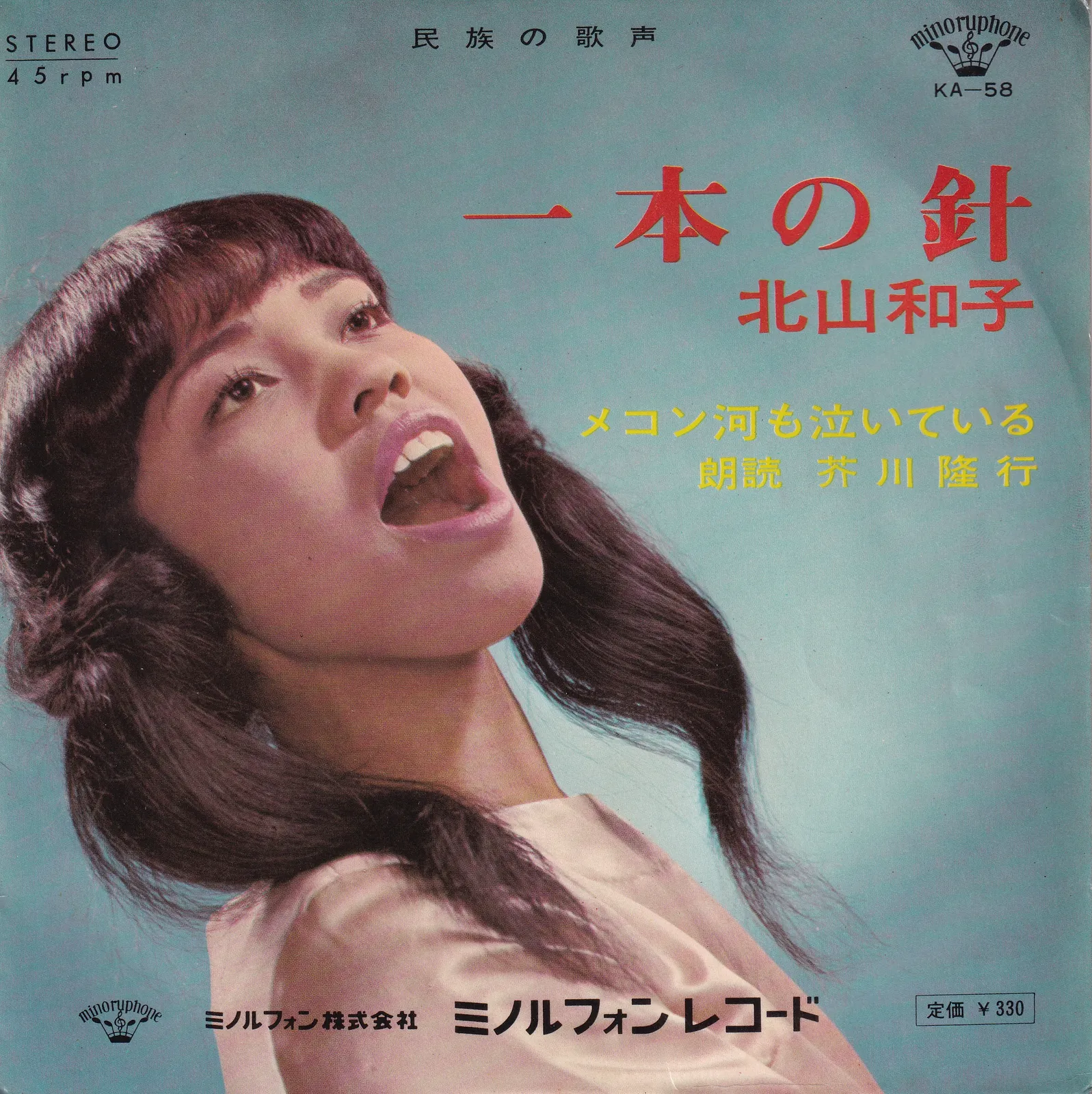
- Artist
- 北山和子 [Kazuko Kitayama]
- Credited on the record as
- 北山和子
- Title
- 一本の針 [Needle]
- Release
- 一本の針 / メコン河も泣いている
- Year
- 1966
- Label
- Minoruphone # KA-58
- Format
- 7" · Single
- Language
- Japanese
- Country
- Japan
- Songwriter
- 中山正男 [Masao Nakayama] (words), 遠藤実 [Minoru Endo] (music)
- Genre
- Japanese Music · Kayōkyoku · Pop
- Primary theme
- Peace, Protest & Anti-War
Annotation — Japanese Songs
Double-sided anti-war Vietnam single. The first song "本の針" ("Needle") (Minoruphone Records # KA-58) was performed by 北山和子 [Kazuko Kitayama] in the Kayōkyoku genre - "a Western-influenced vocal Pop music which was popular in Japan during the latter period of the Shōwa era, approximately from the 1950s to the late 1980s". The record label ran an advert promoting the single, under the headline: "A dark-skinned mixed race female singer... appeals for peace in Vietnam". It went on to say "a black -skinned girl born to a Japanese woman affected by war, is one such child of mixed race, and will make her debut... with a social song... a prayer for peace in Vietnam... it is a heartfelt song expressing a wish for peace, saying that Vietnam is now a hell of a mountain of pins and needles".1 The song noted "Vietnam is now feeling the hell of pain of needles". It questioned the point of the war: "what are we fighting about? Ideology is nothing more than human beings". It concluded that "everyone's wish is to stop the war". It also contained a few specific references to Japan: "the pain that Japan felt at that time on that day", presumably a reference to the atomic bomb during WW2, and "listen to the appeal of Japan", arguing that the country was against the war.Sources1本の針 & メコン河も泣いている (Needle & The Mekong Rive Is Crying (Kazuko Kitayama & Takayuki Akutagawa) (Newspaper Clip) (Japan)↩
Annotation by Justin A. Brummer
Lyrics
Japanese: 君は知るや 針の痛さを ちくりとさした 針の痛さを だれでも知ってる 針の痛さを いま、ベトナムは 針山地獄
Notes
The record label ran an advert promoting the single, under the headline: "A dark-skinned mixed race female singer... appeals for peace in Vietnam". It went on to say "a black -skinned girl born to a Japanese woman affected by war, is one such child of mixed race, and will make her debut... with a social song... a prayer for peace in Vietnam... it is a heartfelt song expressing a wish for peace, saying that Vietnam is now a hell of a mountain of pins and needles". Minoru Phone KA-58, stereo, 45 rpm, red label, "Mfd. by Minoruphone Co., Ltd., Tokyo, Japan"; side PS-0145 ©'66 "一本の針" (words 中山正男 [Masao Nakayama], music 遠藤実 [Minoru Endo]), 4:00, sung by 北山和子 with the Minoruphone Orchestra; side PS-0146 ©'66 "メコン河も泣いている" (poem by 中山正男), 4:10, recited by 芥川隆行. The picture sleeve (¥330), headed "民族の歌声", shows the young singer with her head tilted back. The back sleeve (太平グループ ミノルフォンレコード) prints…
About the artist
Kazuko Kitayama was a mid-1960s Minorphone Records artist, a labelmate of Kazuko Mifune, with four catalogued singles: "Asakaze to Watashi" (1966), "Ippon no Hari" ("A Single Needle", 1966), "Furusato wa Doko ni" (1967, a "Sometimes I Feel Like A Motherless Child" adaptation) and "Remi wa Hatachi" (1967). [Source: Discogs]
Themes
Anti-War · WW2 · Vietnamese Perspective · Peace · Japan
In collections
Japanese Songs · Peace, Protest, & Anti-War Songs [War Years]