PTSD Songs
Context
The National Vietnam Veterans Readjustment Study, commissioned by Congress, estimated in 1988 that around 15 per cent of male Vietnam theatre veterans then had PTSD, and around 30 per cent had had it at some point since the war. Popular culture also turned the traumatised veteran into a stereotype, the "crazed vet" of films and television, which many veterans resented.
Time Period & Criteria
Highlights
1968-1979: The War and Its Return
- 6 May 1972: Psychiatrist Chaim Shatan describes "post-Vietnam syndrome" in the New York Times
- 1973: Robert Jay Lifton publishes Home From the War, based on rap groups with veterans
- 1979: Congress establishes the Vet Centers' readjustment counselling programme
1968
Psychedelic folk rock, soldier's perspective, combat sound-effects, protest, anti-war
Men waking to hear helicopters, hold on boy, don't lose your mind
Making a man of me - see the eyes of the enemy
God protect us, victims of games people play
1971
Country-pop. Impact of war on soldier, PTSD. Title leans toward anti-war.
Military, in-country.
Recorded 1970
1
Side One: The Inventory 4:23, Jolly Green 2:44, Mighty Dust Off 1:57, Dear Ma'am 2:07, I Fly the Line 2:40, Crack Went the Rifle 3:57; Side Two: Da Nang Lullaby 2:52, Saigon Girls 2:17, Puff 3:26, Tchepone 4:04, Republics Ultra Hog 2:27, The Devil Clapped His Hands 3:05.
The front cover, "Bull Durham's Songs of S.E.A. – Twelve of the best songs to come out of South East Asia", has a bamboo frame, a colour photograph of Durham in a patched flight suit with an acoustic guitar, and a cartoon bull playing a guitar under palm trees; this copy is signed "Bull Durham" in marker. [From the record sleeve and labels]
1973
1974
1975
- Label: Tin Pan Alley # TPA 80-711
- Songwriter: Ruth Isaacs
- Traditional pop
- Veteran, PTSD
- What happened when he came home from the war
- Mind wonders, he doesn't know she is there
- Help him forget the war he has left behind
- Tin Pan Alley Records, Tin Pan Alley, Inc., Sarasota, Florida 33578, TPA 80-711B, light-blue label; "My Man, I Love Him So" (Ruth Isaacs), Juke Box Alley, ASCAP; Mike Thomas. The label carries a rubber-stamped date "Jul 31 1975". [From the record sleeve and labels]
1979
1980-1989: PTSD Named
- 1980: PTSD recognised in the American Psychiatric Association's DSM-III
- 13 November 1982: Vietnam Veterans Memorial dedicated in Washington, D.C.
- 1988: The National Vietnam Veterans Readjustment Study reports its findings to Congress
1980
1981
Reference to Agent Orange, PTSD, mistreatment of vets, and the draft
1982
Back cover: "Composed, arranged and produced by Rob Bolland & Ferdi Bolland", distribution Inelco, "© ℗ 1981", trademarks used under control of FFR Productions, marketed in The Netherlands by Inelco Records and Tapes bv, Aalsmeer, printed in The Netherlands; "Qcumber controlled" logo.
Side one: Ouverture / You're in the Army Now / The Dogs of War / Heart of Darkness / Cambodia Moon; side two: Heaven Can Wait / To the Battleground / Long Day's Journey into the Night / Let's Help A*R*Vi*N Out / Rendez-Vous with Radiation / Finale. The printed lyric insert carries full-face portraits of the two brothers and full lyrics, with credits: words and music by Rob Bolland and Ferdi Bolland; all songs published by Nada Music, Holland; recorded at Wisseloord Studios, Holland; engineers Ronald Prent and Jan-Fred Arendsen; executive producer Frits Hirschland; vocals, marimba, piano, spinet and celesta by Rob and Ferdi Bolland; synthesizers and keyboards Johan Timman; drums and percussion Ton Op 't Hof; guitars Johan Slager; bass guitar Jan Hollestelle and Okkie Huysdens; art direction and photography Govert de Roos and Ollie Sassen. [From the record sleeve and labels]
The picture sleeve front is a drawing of an American flag and a rose before a wall repeating "The Wall", captioned "A Salute to the Vietnam Veterans — by Festival".
The back gives the writers in full (Lyle Zoerb, Ray Roth, Britt Small; Dan Daley), the full lyric of "The Wall", and notes that Britt Small served as a paratrooper with the 173rd Airborne Brigade in South Vietnam in 1970, where he was awarded the Purple Heart and the Army Commendation Medal, and that Festival appeared at the National Salute to the Vietnam Veterans in Washington, D.C., in November 1982, singing at the Vietnam Memorial and giving a concert at the base of the Washington Monument.
Band line-up: Britt Small (lead vocal, bandleader), Mark Reinig (drums), Becky Reinig (keyboards), Ray Roth, Jr. (bass), Stan Funston and Dann Hohn (guitar), Don Struve and Les Wetzel (trumpet), Russ Wetzel (trombone), Curt Pottratz (tenor sax), John Hafner (bari sax), with "Taps" by Don Struve; produced by Britt Small; front cover design by Phillip Van Voorst; "Max Stout Records, A Division of Festival Family Enterprises, Ltd."
The sleeve is signed in ink by Britt Small. [From the record sleeve and labels]
Narrated in the first person, Daniels started the story with a boy drafted to Vietnam. He chose not to avoid the draft: "could have gone to Canada...could have stayed in school" . But he did not want to break the rules, and "I was brought up differently" - an interesting point, this is often found in the war-time patriotic / pro-government songs, in which the narrators claimed that those who avoided the draft did not do their duty. It then told of the difficulties out in Vietnam. Then the soldier returned home, suffering from PTSD, in which certain smells, sounds, and temperatures reminded him of the war: "every summer when it rains I smell the jungle, I hear the planes...I am still in Saigon in my mind" . People he encountered, including his family, viewed him differently, depending on their political and cultural beliefs: "my younger brother calls me a killer and my daddy calls me a vet" . This all had a negative impact on the veteran: "I feel ashamed" . Therefore, this song dealt with the veterans difficulty in re-adjusting to American society, their relationships with friends and family, and the psychological impact of the war.
On 1 May 1982, Billboard reported that: "Songwriter Dan Daley...discusses his current Charles Daniel Band cut, 'Still in Saigon', with Robert Muller, executive director of the Vietnam Veterans of America. Daley is donating part of the song's royalties to the organization".3 In a New York Times interview, published on 21 April 1982, Daley said that the song "grew out of my being a war-movie buff. But I was draft-age when Vietnam was going on, though fortunately I wasn't drafted, and I grew up at the dinner table with the TV on". As well as Charlie Daniels, he offered the song to Bruce Springsteen: "the two rock performers who have been most vocal in their support of the Vietnam Veterans of America". But Springsteen only recorded his own material.4 The song reached # 22 in the US Billboard Hot 100 and # 2 in the US Billboard Mainstream Rock chart. It featured on the 1982 album Windows (Epic # FE 37694). Produced by John Boylan.
Pop rock, 1980s post-war.
Vietnam veteran suffering from PTSD - both sides.
Back of picture sleeve said that "partial proceeds of the sale of this recording donated to the Pioneer Valley Vietnam Veterans, Inc."1
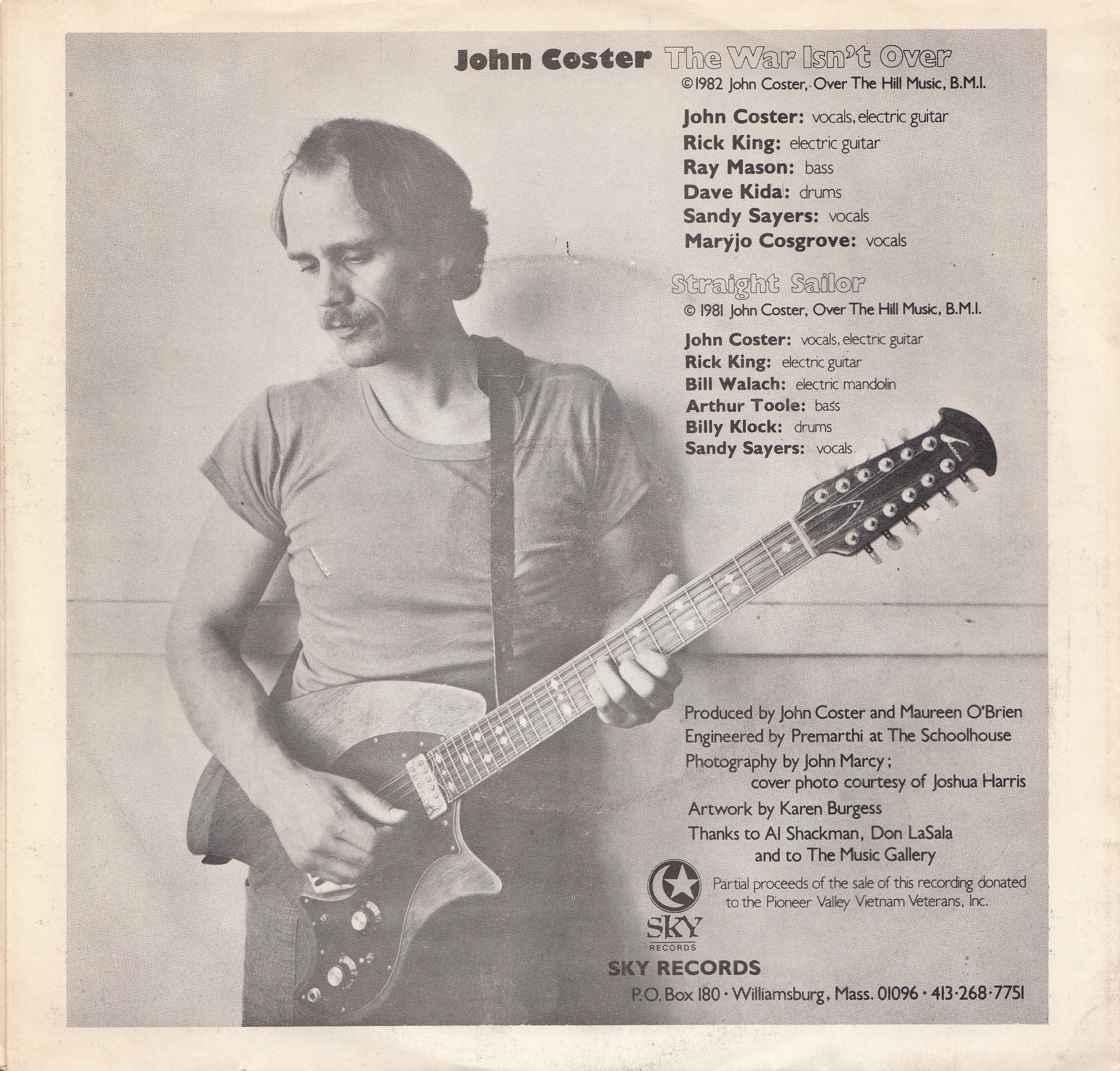
Picture sleeve front: photograph of a small boy in a helmet and camouflage "Special Forces" fatigues holding a toy gun in undergrowth. Back: photograph of Coster with a twelve-string guitar; "The War Isn't Over" © 1982 John Coster, Over The Hill Music, B.M.I. - John Coster (vocals, electric guitar), Rick King (electric guitar), Ray Mason (bass), Dave Kida (drums), Sandy Sayers and Maryjo Cosgrove (vocals); "Straight Sailor" © 1981 - Coster, King, Bill Walach (electric mandolin), Arthur Toole (bass), Billy Klock (drums), Sandy Sayers (vocals); produced by John Coster and Maureen O'Brien, engineered by Premarthi at The Schoolhouse; photography John Marcy, cover photo courtesy of Joshua Harris, artwork Karen Burgess.
"Partial proceeds of the sale of this recording donated to the Pioneer Valley Vietnam Veterans, Inc." [From the record sleeve and labels]
1983
Post-war 80s, pop rock.
Tribute to soldiers drafted to Vietnam.
War ended after the Paris Peace Accords.
Returned home - no parades and celebration - country divided.
Reference to agent orange and PTSD
John Schumann based it largely on the experiences of the Vietnam war veteran Mick Storen (his brother-in-law). Schumann noted as a teenager in the late 1960s his friends being drafted to fight the war: "They left as wide-eyed, grinning Australian lads, pushing and shoving and joking at their embarkation leave parties. They were returned to us as damaged goods - sullen, disconnected and with the trade-mark thousand yard stare". He soon developed an anti-war perspective in the early 1970s: "the popular movement against the Vietnam war gained traction. It wasn’t too long before a clear majority of Australians, including me, opposed it". But not into the late 1970s and early 1980s did attention grow to the plight of the veterans. At which point, Schumann said that "I entertained the idea of writing these blokes a song".2 The royalties of the song go to the Vietnam Veterans Association of Australia. The group also recorded a live version on the 1983 album Caught in the Act (Epic # ES 864).
Narrated in the first person, it started with a young, innocent nineteen year old taking part in a military march in Australia, just before being shipped to Vietnam, and then "in and out of choppers" across the land, where "each step could mean your last one on two legs" . This seemed a long way from the stories of the previous generations, who fought in the First and Second World Wars: "the Anzac legends didn't mention mud and blood" . So after the war, back in Australia, the veteran started to suffer from Post Traumatic Stress Disorder (PTSD), unable to sleep, thinking of the dark jungles and "barking M16... I can still hear... screaming in the jungle" . He also recalled drinking with his friend Frankie at the Grand Hotel in Vung Tau, a seaside city in South Vietnam during R&R, before being shot and killed in the jungle. There was also a reference to the use of Agent Orange: "Agent Orange sunset through the scrub" - the herbicide used by the US government, which had long-term negative health affects, an issue that gained more attention in the 1980s.
Other references to note: the line "parade at Puckapunyal... we did Canungra and Shoalwater before we left" - Puckapunyal is a training facility in Victoria, Canungra is a small town in Queensland, with a large military base, while Shoalwater is a bay, also in Queensland, a major military training area during Vietnam. The line "there's me in me slouch hat with me SLR" . A slouch hat, also known as Aussie bush hat is a distinctive Australian hat that has one side of the brim turned up or pinned to the side of the hat, often used in the military.3SLR was the L1A1 Self-Loading Rifle, used by Australian forces in Vietnam.4 The line "from Vung Tau to the dust at Nui Dat" - Nui Dat was where the 1st Australian Task Force (1 ATF) was based in South Vietnam, and Vung Tai was where the 1st Australian Logistics Support Group was headquartered, and popular for R&R.
This song provided an important representation of the loss of innocence for a nineteen year old, whose life changed because of the war. It brought attention to the plight of the Australian Vietnam veteran.
Military - veteran
Written and recorded by Navy pilot Ed Bankston
Pensacola, Florida, USA.1
A1 I Roll (Red Rippers, The)
A2 Soldier of Fortune
A3 Firefight
A4 Who Remembers
A5 Vietnam Blues
B1 The Dark and Bloody Road
B2 She’s Been Down
B3 Body Bag
B4 Over the Edge
The front sleeve has a blue-green blurred image with the band name in gothic letters; the back reproduces the "Animal Pleasure" album cover. [From the record sleeve and labels]
The song "Vietnamese Blues" (Clay Records # CLAY LP8) looked at the perspective of a veteran who "just got back from Vietnam" . This song referenced several issue often found in post-war songs about veterans. Firstly, it dealt with Post Traumatic Stress Disorder (PTSD), often connected in songs to stress, shell shock, flashbacks, nostalgia, and feelings and dreams related to an event: "My minds gone it's just not there" . Secondly, there is a possible reference to a disabled war veteran: "I got blown to bits by a bomb... I'm really only half a man" . Thirdly, it looked at the struggle of the returning veteran: "My wife's left...I got no money" . Also note the reference to the veteran receiving a medal: "I fought hard for my Purple Heart" - awarded by the US president to those wounded or KIA, an estimated 351,794 were awarded during the Vietnam War. Additionally, the song referenced the use of napalm: "I got addicted to napalm" - chemical weapon Napalm B - a jellied gasoline mixture, with polystyrene, benzene, and gasoline. Declared a war-crime since 1980, the US government extensively used this weapon during the Vietnam conflict, dropping 388,000 tons on Indochina between 1963 and 1973.123
Heavy Metal band Casey, which featured the members Scott [Stoney] Woodward (bass), Hardly Normal (drums), J. Carmen Dabella (guitar), Rick [Buwanna] Hopkins (vocals), only released one album, recorded in Binghamton, New York, USA. The song "Vietnam - No More Wars" (Unreel Records) focused on the impact of the war on a US Vietnam War veteran. It started out with the familiar helicopter sound-effects often heard in post-war songs, and Vietnam War films, followed by a crying baby. It contained various scenarios of Post Traumatic Stress Disorder (PTSD) - "the bad times that made you sweat... still makes you cry" - also frequently referenced in post-war 1980s songs about US veterans, often connected in songs to stress, shell shock, flashbacks, nostalgia, and feelings and dreams related to an event. The lyrics also address the mistreatment of Vietnam veterans, returning home, and not receiving a heroes welcome, having fought an unpopular war: "left the airport, no family or friends, you're a vet of a war nobody was winning" .
1984
Picture sleeve: cover photo Annie Leibovitz; art direction and design Andrea Klein. The back prints the lyrics of "Born in the U.S.A." and notes that "Shut Out the Light" does not appear on the Born in the U.S.A. album. A-side label: Stereo 4:39, taken from the Columbia LP QC 38653; produced by Bruce Springsteen, Jon Landau, Chuck Plotkin and Steve Van Zandt; recorded by Toby Scott; mixed by Bob Clearmountain. [From the record sleeve and label]
1985
1986
He released this Vietnam-themed LP in the rock-pop genre in 1986, in New Smyrna Beach, Florida. The title song "Vietnam: Still Part of Who I Am" (FPOSF # 1102108) looked at a Vietnam veterans attempt to find his place in society - which had labelled Vietnam a failure and a mistake. It can be viewed as part of a 1980s, Reagan-era trend of nationalism, or attempt to overcome the "Vietnam Syndrome". Narrated in the first person, the veteran said that originally he did not want to go to Vietnam, but the experience and memories had helped to define him. But when he returned he "found the country in flames" , and the government "were freeing draft dodgers while holding Calley to blame" - which indicated sympathy for the plight of Calley, and of course, criticism of those who avoided the draft, and possibly the anti-war movement. He concluded that the veterans had "come of age" and were no longer "naive" , and thus they could "be proud of Vietnam" and "love" the "country" .
Ronald Reagan spoke about this on 18 August 1980: "for too long, we have lived with the Vietnam Syndrome....As the years dragged on, we were told that peace would come if we would simply stop interfering and go home....We dishonor the memory of 50,000 young Americans who died...we give way to feelings of guilt as if we were doing something shameful, and we have been shabby in our treatment of those who returned. They fought as well and as bravely as any Americans have ever fought in any war. They deserve our gratitude, our respect, and our continuing concern".4 Many war films of the period fitted into this climate of trying to overcome the Vietnam Syndrome, such First Blood [Rambo] (1982), Uncommon Valor (1983), and Missing in Action (1984).
So narrated in the first person, the veteran said that originally he did not want to go to Vietnam, but the experience and memories had helped to define him. But when he returned he "found the country in flames" , and the government "were freeing draft dodgers while holding Calley to blame" - which indicated sympathy for the plight of Calley, and of course, criticism of those who avoided the draft, and possibly the anti-war movement. He concluded that the veterans had "come of age" and were no longer "naive" , and thus they could "be proud of Vietnam" and "love" the "country" .
The back carries McKenna's note, signed "Bill McKenna, 'Wild Willie', 233-4008": his tour of duty changed him forever, the 22 months "in-country" and the condemnation he met on returning home, and his offering of these memories so that veterans "may share again the pride in each other that only we can know". Service printed: '68–'69, 7th Engineer Battalion, 1st Mar. Div., I Corps; '69, 3rd Amtrac Bat., 3rd Mar.
Div., I Corps. Dedicated "to all my brothers who served, especially to Animal, Doc, Lee, Freddie, Sonny, Mavrellis, Savo, Turk, Crazy Paul Harrington, Jim Mason, Matey and the more than 58,000 who were left behind." Tracks: side one Vietnam: Still Part of Who I Am, Billy's Friend, Kentucky Boy, The Veteran; side two R & R Woman, Vietnam Memories, Flashback, Không biết, America, Jake's Song. [From the record sleeve and labels]
"these song were written to honor American soldiers whom names are on the Wall, to express concern for those who are still missing in action, and to say thank you to all who served our country during the Vietnam era...the lyrics were written on Christmas Eve as I thought of the many Americans whose Christmas would be saddened by memories of those whose names are on the Wall"
Post-war 80s. Pop rock. Sacramento, California.
Veteran still living with Vietnam - PTSD.
Reference to M.I.A.'s.
A war without reason - people who died were innocent.
Picture sleeve front: the title in red over blue, with the title repeated in white lines and stars across the sleeve.
Sleeve back: "Dedicated to all people affected by the Vietnam War"; words and music © Doug Ranno, copyright PA892369 1986, published BMI Ranno Records 1986; produced by Doug Ranno with special thanks to Mike Mallett and Tom Phillips; recorded at Harbor Studios, Sacramento, California; manufactured by Sonic Arts; design by Diane Brown; special thanks to Michael Kelley, Tony Allen and Mike Mallett.
Ranno Records, P.O. Box 221427, Sacramento, California 95822-8429. [From the record sleeve and labels]
Hardcore punk, post-war. Draft, combat, Napalm, Agent Orange
Impact on vet, PTSD
1987
Narrative, post-war 80s. Patriotic.
Walk proud - forget about Vietnam
You did your duty.
The sleeve is dedicated to Phillip Thomson O.A., national president of the Vietnam Veterans Association of Australia, who died on 23 November 1986. Promotional copy. CBS 651353 7, Side A, 45 R.P.M.; "Safe Behind the Wire" b/w "He's Got the Money", both (J. Schumann), published by Gilbey; mixed at Studios 301; "Australian Performance/Australian Composition"; ℗ 1987 CBS Productions Pty.
Limited, made in Australia by CBS Records Australia Limited.
The front sleeve shows a sepia photograph of a young soldier in a netted helmet behind strands of barbed wire, with the dedication ending "Phill was dusted off for the last time in the early hours of Sunday 23/11/86. A good mate and a great Australian... goodbye and God bless Phill..."; the back sleeve carries a "Promotion Only – Not for Sale" stamp. [From the record sleeve and labels]
1988
The front cover shows Bobby Ross in a cowboy hat beside the bronze figures of a soldiers' memorial; the back shows the inscription of the Vietnam Veterans Park memorial ("From 1961 to 1975, more than 49,000 Tennesseans served in Southeast Asia…") and a "Seal / LRRP / Big Red One" triangle emblem.
Credits: Don Hoffman, executive producer; Bobby Ross, producer and lead vocals; Mike Stidolph and Dick Bradley, associate producers; musicians include Eddie Bayers and Michael Young (drums), Mark O'Connor (fiddle, mandolin, mandola), Sonny Garrish (steel guitar, dobro), Bela Fleck (banjo), Terry Lee McMillan (harmonica), Reggie Young and Brent Rowan (guitars), Willie Rainsford (piano); background vocals include Stella Parton (courtesy of Airborne Records); photographer Mike Allen; engineer Jeff West.
Ross dedicates his performance to "the men of the Air-O-Rifle Platoon, 2/17 Cavalry, 101st Airborne Division, 1968, in I corps, South Vietnam", and the Nashville firms who helped make the album say to all Vietnam vets "At last, Welcome Home and God Bless". The lyric insert prints full lyrics with writer credits: Finally Welcomed Home (Don Hoffman, Judi Hoffman, Jeff Raymond), Back to Blue Jeans Again, Saigon State of Mind, Goodbye to West Virginia, The Reunion and The Voice of America (George Jeffrey), Too Close to the Line and The Home of Billy D. (George Jeffrey & Rick Cooper), Me and Oscar (Robert T. Alsterberg/Richard Helm), No Home for the Brave (In the Land of the Free) (George Jeffrey & Mel Besher); copyrights 1987, Too Close to the Line 1988. [From the record sleeve and labels]
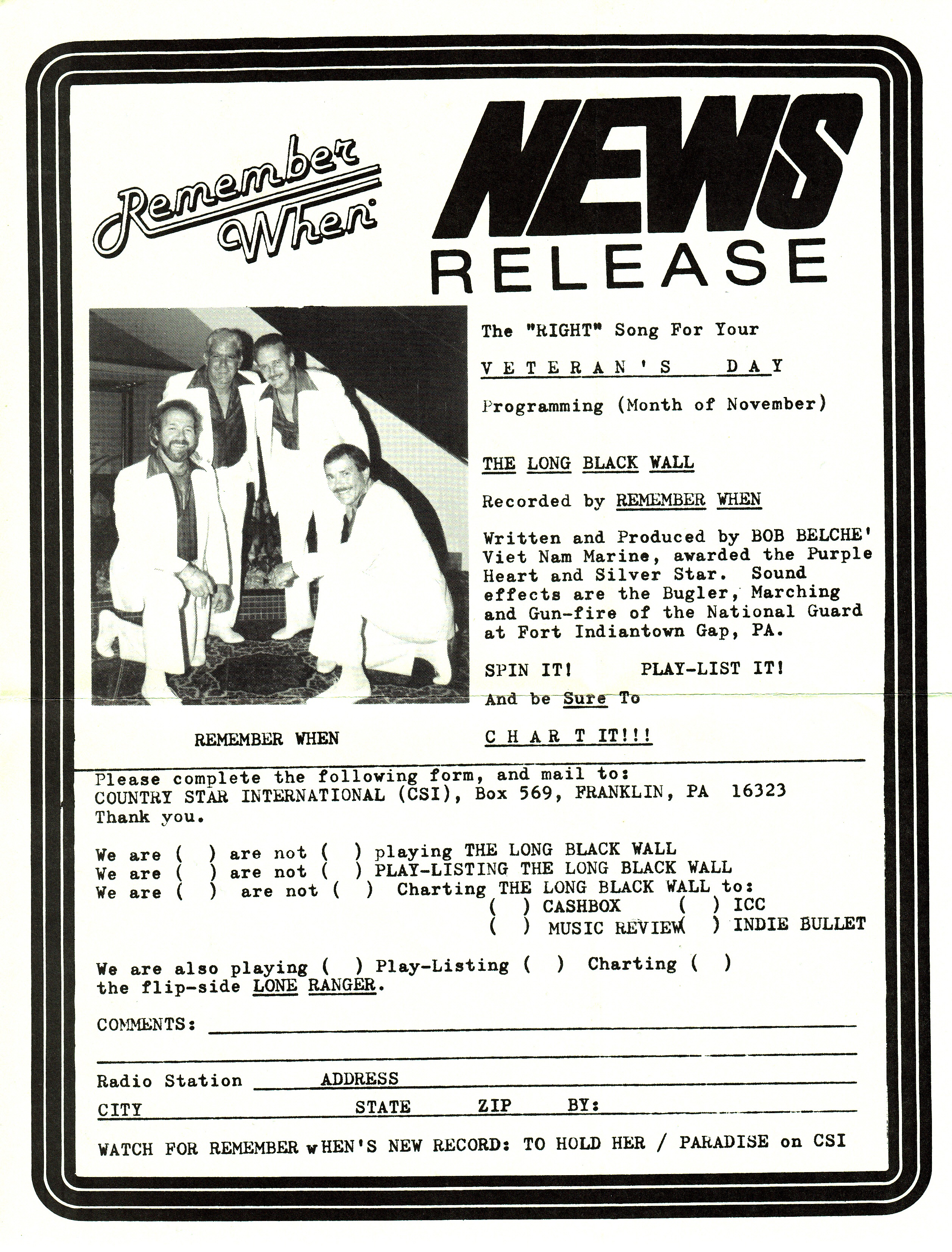
Punk rock, P.O.W., post-war 80s
15 years in a Vietcong cell, given up for dead
Starving, thinking of family everyday
But coming home to the land of the free
Suffering from PTSDf
The front of the picture sleeve has a black-and-white ink drawing with "I'm Coming Home +" in large hand lettering and the band name lower left.
The back lists the flip side "This Land Is Your Land" (Woody Guthrie), 3:29, TRO-Ludlow Music, Inc. (BMI); credits Eric Hayden for the front cover design, adds "Winslow Grumpitz – Helicopter on 'I'm Coming Home'", recording at Studio A Recording, West Chicago, IL, and engineering by Maurice Smeets; it states that "The proceeds generated by this recording are being given to: The National League of Families of American Prisoners and Missing in Southeast Asia", with further information from Wonder Pug Productions, P.O.
Box 1543, Elgin, IL 60120. [From the record sleeve and labels]
1989
1990-2009
1990
Post-war, 1990s. Vietnam veteran. PTSD, mistreatment of vet. Kills himself on Christmas eve.
Glam rock, power ballad.
Will I see him on the TV preachin' 'bout the promised land
He tells me to believe in Jesus, and steals the money from my hand
Some say he was a good man, but Lord I think he sinned, yeah
Twenty-two years of mental tears, cries a suicidal Vietnam vet
Who fought a losing war on a foreign shore
To find his country didn't want him back
Their bullets took his best friend in Saigon
Our lawyers took his wife and kids, no regrets
In a time I don't remember, in a war he can't forget
He cried "Forgive me for what I've done there
Cause I never meant the things I did"
And give me something to believe in if there's a Lord above
And give me something to believe in Oh, Lord arise
My best friend died a lonely man, in some Palm Springs hotel room
I got the call last Christmas Eve and they told me the news
I tried all night not to break down and cry
As the tears rolled down my face, I felt so cold and empty
Like a lost soul out of place
And the mirror mirror on the wall sees my smile it fades again
Sometimes I wish to God I didn't know now
The things I didn't know then road you gotta take me home
I drive by the homeless sleeping on a cold dark street
Like bodies in an open grave, underneath the broken old neon sign
That used to read JESUS SAVES, a mile away live the rich folks
And I see how they're living it up, while the poor they eat from hand to mouth
The rich is drinkin' from a golden cup
And it just makes me wonder why so many lose, so few win
You take the high road and I'll take the low road
Sometimes I wish to God I didn't know now
The things I didn't know then and give me something to believe in
1991
The front cover is a sepia photograph of the long-bearded Sarge Lintecum in sunglasses, superimposed over a young helmeted soldier aiming a rifle in the jungle, with names and service branches (USA, USMC, USN) from a memorial wall faintly visible behind; "Vietnam Blues" is stencilled in yellow and "Combat Tested Blues...For Peace" along the foot.
The back has a pencil drawing of Lintecum in army fatigues with 101st Airborne patch, sergeant's stripes, "Lintecum" and "U.S. Army" name tapes, arms folded, with a signature beneath, and lists 14 tracks: The Vietnam Blues; This Shirt of Mine; Into the Fire from the Fryin' Pan; Time Bomb in My Mind; Oh Shit; Sister Soldier; Veterans Wife; Blue Monsoon; Combat Fatigue; It Don't Mean Nothin'; Five Down; Saturday Morning Cartoons; Reunion at the Wall; Welcome Home. [From the record sleeve and labels]
Sections 7-8 focused on the post-war negative impact of the war, on those that fought: "it’s all over now...our youth was blown away" . It also contained descriptions of Post Traumatic Stress Disorder (PTSD) - frequently referenced in post-war 1980s songs about US veterans, often connected in songs to stress, shell shock, flashbacks, nostalgia, and feelings and dreams related to an event: "it left scars in their minds... back home, still in the jungle"
The veteran also recalled various place names, familiar sayings, and infamous events: "Khe Sanh, My lai, didi mow" - Khe Sanh was a reference to an area of Vietnam that played a critical role in the war, including The Battle of Khe Sanh, and the US Khe Sanh Combat Base - the city and province are frequently referenced in song, most famously by Australian band Cold Chisel, with the song "Khe Sanh" (1978). My Lai was a reference to the massacre - the mass murder of between 300-500 civilians in the South Vietnamese area known as "Pinkville", containing the hamlets, known as My Lai 4 and My Khe 4, and throughout the area of Song My, by US forces on 16 March 1968. "Didi mow" - this was a phrase adopted by US military personnel during the Vietnam War, from the Vietnamese "đi đi mau" ("get lost") - popularised in the movie The Deer Hunter (1978).1 The song concluded with another reference to a Vietnam War film - Good Morning, Vietnam (1987) - once again showing the huge impact of films on culture.
1992
The front sleeve, marked "3 Song EP", lists "Vietnam", "Elvira Gulch" and "My Prayer" over a drawing of a wide-eyed screaming soldier in a helmet.
The back credits production to Moral Disgust and Mark Hillstrom, mixing by Jeff Verner and Moral Disgust, recording at Garage In the Sky, Oshkosh, WI, engineered by Jeff Verner, artwork by Sal Serio and band photo by Boe DeGoey; it names the band as Chris Propp, Jeff DeGoey and Sal Serio, thanks past members ("we've finally got vinyl, mates!") and Wisconsin bands, and states "All songs copyright 1992, published by Guitarscum Lilypad Ltd." over a photo of the three members under a stone arch. [From the record sleeve and labels]
1994
The song "Remember" (Warner Bros. Records # 9 45595-2) released in 1994, referenced issues that frequently appeared in the post-war era (especially in the 1980s). Firstly, it sought to overcome the Vietnam syndrome. As suggested in the title, the narrated wanted people to remember those who "served in Vietnam" . He declared that "from our generation to you...respect is long overdue" to the Vietnam veterans. Secondly, the lyrics looked at the treatment of veterans back in the US: "they spit on you now, we'll spit back for you" . Thirdly, it turned to the psychological impact of war on the veterans - Post-Traumatic Stress Disorder (PTSD) - "explosions shake the dreams in your head at night in bed...he still sees blood...try to numb the pain" . Finally, the song also referenced prisoners of war, suggesting that they could still be in Vietnam, and that they have sadly missed out on their children growing up: "P.O.W-M.I.A., your kids are now full grown, with the love and pride you should have known" .
1995
The front sleeve, over an 18th-century engraving of a hospital scene, lists intro :20, "Viet Nam Vet" :34, "Kill for Fun" :17, "Fashion Sucks" :27, "Hidden Agenda" :25, "Your Profits" :47, "Chained" :09, "Govt. Sponsored Devastation" :35, "Refuse to Fight" :15, "In the Name of Christ" :25 and "Vilently Ill" :15.
The back prints all the lyrics; the insert, headed by a gas-mask photo and the "Slovenian proverb" "Speak the truth - but leave immediately thereafter", states that the Vilently Ill side was recorded in mono between August '94 and January '95 on cassette on a home stereo, thanks Pneumatic Values, Old Style Beer and Rattlehead Studios, and is signed "Vilently Ill - March 1995". [From the record sleeve and labels]
1997
2001
2005
2007
Normie Rowe, pop rock artist and Australian Vietnam War veteran, born 1 February 1947 in Melbourne, Victoria, Australia. He served in Vietnam from January 1969 to February 1970. Rowe was reported to have been the protaganist in the song " Smiley " by Ronnie Burns , conscripted to fight in the Vietnam War. Johnny Young , the songwriter, said on ABC-TV’s Love Is In The Air that "before he left, he was really happy-go-lucky, fun-filled young fella. When he came back, he changed" . Rowe released this collection of post-Vietnam songs, presenting the veteran / military soldier's perspective, which according to his website was "14 tracks relating to Normie’s experiences as a Vietnam war veteran" . This included a cover of "Smiley" , and a cover of "Still in Saigon" by The Charlie Daniels Band . The title song "Missing in Action" was about the impact of the war on a veteran back in Australia: "he's changed... he's not the same... thirty years have past" , probably containing some biographical elements.
2008
John Schumann, born in Adelaide, South Australia (18 May 1953), released this album which focused on war, containing First and Second World War songs, as well as some other well-known Vietnam tracks, including Schumann's famous composition " I Was Only 19 ", which he performed as a member of the group Redgum (1983). The album featured a cover of "Khe Sanh", originally by Cold Chisel. However, it was renamed "Long Tan Version", as the reference to Khe Sanh was historically inaccurate - Australian forces were not involved in that battle. Thus Schumann changed it to Long Tan, the site of the famous battle involving Australian and New Zealand forces on 18 August 1966. The composer of the song, Don Walker, said that: "he rang me up one day a long time ago and asked if I minded if he did that... I said not only was it absolutely okay with me but good on you". Also on the album were covers of "Mothers, Daughters, Wives" by Judy Small, "Band Played Waltzing Matilda" by Eric Bogle, and " Rachel " by Russell Morris. Other members of the Vagabond Crew are Hugh McDonald, Dave Folley, Kat Kraus, & Mark Kraus. The front cover featured a photo of an Australian First World War era soldier. Note that Schumann also released the Vietnam War song " Safe Behind the Wire " (1988) as a solo artist. While discussing this album, Schumann said that: We don't leave people behind. Dead or alive or injured, when it's home time, everybody gets on the chopper....We had 50,000 men and women who served in Vietnam and we had six MIAs. The Americans had thousands - what does that tell you?"
John Schumann, born in Adelaide, South Australia (18 May 1953), released this album which focused on war, containing First and Second World War songs, as well as some other well-known Vietnam tracks, including Schumann's famous composition " I Was Only 19 ", which he performed as a member of the group Redgum (1983). The album featured a cover of "Khe Sanh", originally by Cold Chisel. However, it was renamed "Long Tan Version", as the reference to Khe Sanh was historically inaccurate - Australian forces were not involved in that battle. Thus Schumann changed it to Long Tan, the site of the famous battle involving Australian and New Zealand forces on 18 August 1966. The composer of the song, Don Walker, said that: "he rang me up one day a long time ago and asked if I minded if he did that... I said not only was it absolutely okay with me but good on you". Also on the album were covers of "Mothers, Daughters, Wives" by Judy Small, "Band Played Waltzing Matilda" by Eric Bogle, and " Rachel " by Russell Morris. Other members of the Vagabond Crew are Hugh McDonald, Dave Folley, Kat Kraus, & Mark Kraus. The front cover featured a photo of an Australian First World War era soldier. Note that Schumann also released the Vietnam War song " Safe Behind the Wire " (1988) as a solo artist. While discussing this album, Schumann said that: We don't leave people behind. Dead or alive or injured, when it's home time, everybody gets on the chopper....We had 50,000 men and women who served in Vietnam and we had six MIAs. The Americans had thousands - what does that tell you?"
2009
2010-present
2012
2013
2014
2015
Country artist, born 15 April 1964 in Corryong, Victoria, Australia. He released this album ( ABC Music # 0602547172938) to mark the 100th anniversary of the ANZAC landing of Australian and New Zealand soldiers at Gallipoli during the First World War. It largely contained songs about the First World War and Second World War, but also Korea, Vietnam, and Afghanistan. The songs referencing the Vietnam conflict were "Spirit of the Anzacs", "Tell Carmelita", and "The Unbearable Price of War". The deluxe edition of the album came with a cover of " I Was Only 19 (A Walk in the Light Green) ", originally released by Redgum (1983), composed by John Schumann. For the title song "Spirit of the Anzacs", Kernaghan joined forces with Australian-based artists Guy Sebastian, Sheppard, Jon Stevens, Jessica Mauboy, Shannon Noll, and Meg Washington, for the release of a charity single. The song was a patriotic tribute which referenced several wars and roles. In the case of Vietnam, it focused on the nurses: "she's a nurse in Vietnam... she's all of them, she's one of us... the spirit of the Anzacs". The song "Tell Carmelita" was narrated from the perspective of a soldier in Vietnam, missing his sweetheart, centred around the famous and iconic Battle of Long Tan that took place on 18 August 1966. A small number, approximately 108 Australian and New Zealand servicemen, defended their position against a force of around 2,500 Viet Cong and North Vietnamese regulars, possibly preventing an attack against Nui Dat, the base of the 1st Australian Task Force : "you've already heard about Long Tan, we stumbled on some VC on patrol". During the attack he hoped that he would return to Australia: "I wish I was there, Camelita beside me. The song "The Unbearable Price of War", a duet with Lisa McCune, kicked-off with helicopter sound-effects, and a soldier writing to his parents from "Vung Tau, at the Australian field hospital", after his APC (a tank) drove over a mine: "I'm lucky to be alive". The narration then moved to a female working at the hospital writing to her parents that it's worse than she thought: "the triage, the chaos, the blood and khaki".
2016
Country musician from Queensland, Australia. Retiring as an ambulance driver in the 1990s, he turned to music, releasing dozens of country albums, with "Australia and Australians as the major themes for his ballads", and a focus on the "traditions cemented into our culture by the late Slim Dusty". The album "They Answered the Call" had a military / war theme, focused on Australia's role in World War One, World War Two, the Vietnam War, Afghanistan, amongst other conflicts. Specific Vietnam-related songs including a version of "The Battle of Long Tan" and "The Battle of Coral", discussed above, as well as "Missing in Action", and "Fifty Thousand Australian Sons". Several songs were about veterans, which did not reference a specific war. The song "Missing in Action" provided a post-war look at the impact of the war on a father whose son never returned from the Vietnam War, presumably killed in action (K.I.A.), or as the government / military informed him back then: "missing in action was all they would say... his number and name". The father was watching a parade, and when "the Vietnam veterans march by", the memories flooded back: "our young men where called to the 'Nam", with the narrator noting that "you can't begin to image the horrors of war". Also note the use of the term "diggers" - as discussed, a military slang term for soldiers from Australia and New Zealand, which came to prominence during World War One. The song "Fifty Thousand Australian Sons" focused on the treatment of Vietnam War veterans on their return to Australia, which noted the lack of cheers, and that the "bureaucratic speeches have a darkened sombre tone". Decades later, in 1987 at the Welcome Home Parade when it was "time to make amends", finally the "streamers and confetti came down". The title of the song was of course a reference to the number of Australian that served in the Vietnam conflict, although the number is thought to have been higher, at around 60,000+. The song also contained a reference to Post Traumatic Stress Disorder (PTSD), often connected in songs to stress, shell shock, flashbacks, nostalgia, and feelings and dreams related to an event: "the jungle vines in the.. heat of 'Nam weighed heavy on the minds".
2020
2022
2023
The second section told the story of Varnado Simpson (7 October 1948 – 4 May 1997), who admitted to murdering around 10-20 people, including women and children at My Lai, although in various interviews he gave a slightly different account on the numbers. In 1977 his son was accidentally killed by a stray bullet. Simpson said: "I looked at him, his face was like the same face of the child that I had killed...this is punishment". He said that he suffered greatly from PTSD, and in 1997, he committed suicide.123 So, in the lyrics, the narrator considered the guilt and thoughts of Simpson, with a description of Post Traumatic Stress Disorder (PTSD) - frequently referenced in post-war 1980s songs about US veterans, often connected in songs to stress, shell shock, flashbacks, nostalgia, and feelings and dreams related to an event: "nights are without rest... drugs won’t stop the nightmares... unpunished by the laws of men, yet imprisoned in your mind" . It noted the death of his son: "a stray bullet... are the sins of the father visited upon the son" . It concluded with his suicide: "you pulled the trigger and none mourned your death" .
2| Operation Arc Light
3| La Drang
4| A War Too Far
5| The Odyssey of Echo Company
6| The Gulf of Tonkin
7| We Few
8| Phase Line Green
9| When Sanity Cracks
2025
Unknown date
Released around 1972-73.
Son home from the war for 6 months now but I don't know him.
What have they done to my son? Wakes up everynight screaming
Seen so many die. Early reference to PTSD.
- Label: Halmark # 8695
- Artist: unknown, attribute to Bob Storm, but that's incorrect. Female singer
- Songwriter: Karen Davis, Jerry Dee
- Musical director: Bob Storm
- Traditional pop, home front perspective
- They sent you away from me
- Expected to survive the jungle, I suffer too
- You've been wounded, fighting for something you think was a good cause
- You're half a man
- Memories of Vietnam are in your eyes (direct mention), PTSD
- What was it all for? (fighting for?)
- The hell of war, leans anti-war
- Halmark "Sound of Excellence", LH-8695, 45 RPM, High Fidelity; two songs on the side: "Unapproachable" (Lee Clark - Jerry Dee) and "The Suffering of a Serviceman's Wife" (Karen Davis - Jerry Dee); Bob Storm; musical director Jerry Dee. [From the record sleeve and labels]
A-side: mistreatment of vets, PTSD, Agent Orange, helicopter sound-effects
Answered the call and fought for country. But spurned on return and lied to.
There's a monunent in DC, don't forget them.
B-side: Anti-war, memoriual wall in DC.
They bravely ansered the call, sent to die for reasons they did not understand.
Victims of the times. No more unjust wars, pray for peace
- A-side: So many died, no more war for our children
- Helicopter sound effects
- Agent Orange - still fighting the war
- B-side: we fought the war, let's talk
- Impact of PTSD, overcome Vietnam syndrome
- Olean Viet Nam Memorial Record WRA3-106, stereo, 45 RPM, made in Canada; A "No More Viet Nams" 2:55, B "No Use Pretending No More" 3:40; Viet Nam Vets Band: David R. Chapin (lead vocals, rhythm guitar), Frank J. Sisson (lead guitar/bass, vocals), Daniel B. Ganoung (drums, vocals), Frank Falkowski (keyboards, vocals), Dennis Chamberlain (bass/lead guitar, vocals). No date on the label. [From the record label]
Lyric theme data
Lyric content themes tagged on the songs in this collection — parent themes with their sub-themes (number of records). Click a theme for its definition and all records carrying it.
Show all 32 themes ▾Key stats
98 songs · 83 releases · 83 artists · 71 labels · 1968–2025
- 1986 is the peak year, with eleven songs.
- 1983–86 holds 24 of the 92 dated songs — one in four in four years.
- 10 were released during the war years (to 1975); 88 came after.
- Six records are undated.
- 83 artists for 98 songs. The most represented is Junta Cadre, with five.
- 13 of the artists are still unidentified beyond the record: no line-up, no biography.
- One is credited to various artists — compilations and cast recordings.
- Songwriter gender is recorded for 39 of the 98 songs: 34 by men, four by women and one by mixed teams — women wrote 10% of those.
- By performer: 83 men, seven women, six mixed groups and two not identified (recorded for 98).
- 63 named songwriters. The most often credited is John Schumann, with six.
- 60 of the 71 labels appear exactly once; No Rent has the most, with five.
- 16 sit on a major or well-known imprint — ABC [Australia], Epic, Columbia, Geffen, Alternative Tentacles, Asylum, Capitol, CBS. The other 82 are on independent, regional or private labels.
- Seven are private pressings with no label at all.
- 70 of the 98 are American. California leads with eleven, then New York nine and Florida six.
- Adelaide accounts for four records, more than any other city; Nashville has four, New York City four.
- 28 come from outside the US: 13 Australian, five British, three German, three Swedish, one Finnish, one Italian, and others.
- By perspective: 88 post-war; six home front or soldier's perspective; four peace, protest and anti-war.
- 96 distinct sub-themes across 98 songs.
- Military is the single biggest subject — 20 songs, one in five.
- Next come Soldier's Perspective (13), Mistreatment of Vet (11), Agent Orange (10) and Anti-War (10).