Australian & New Zealand Songs
Bibliography
- Collins, Carolyn, Save Our Sons: Women, Dissent and Conscription during the Vietnam War (Melbourne: Monash University Press, 2021).
- Dane, Barbara, & Irwin Sibler, eds., The Vietnam Songbook (New York: The Guardian, 1969).
- Fahey, Warren, Diggers' Songs: Songs of the Australians in Eleven Wars (Loftus, Australia: Australian Military History Publications, 1996).
- Fahey, Warren, Ratbags and Rabblerousers: A Century of Political Protest, Song, and Satire (Strawberry Hills, NSW: Currency Press, 2000).
- Gregory, Mark, Sixty Years of Australian Union Songs: The Australian Folk Revival and the Australian Labour Movement Since the Second World War, (MA diss, Macquarie University, 2007) (online).
- Grey, Jeffrey and Jeff Doyle, "Australia R&R: Representation and Reinterpretations of Australia's War in Vietnam," Vietnam Generation, Vol. 3, No. 2 (online).
- Mansell, Ken, "The Yeast Is Red: A History of the Bakery (Off-Campus Centre of the Monash University Club 1968-71)", Labour History Melbourne, April 1994 (online).
- Mansell, Ken, "Taking to the Streets against the Vietnam War: A Timeline History of Australian Protest 1962-1972", Labour History Melbourne, 8 May 2020 (online).
- National Film and Sound Archive of Australia, Canberra, ACT, Australia: Sound Recordings: Vietnam.
- National Library of Australia, Canberra, ACT, Australia: Vietnam War: Audio Recordings.
- Piccini, Jon, Evan Smith, & Matthew Worley, eds., The Far Left in Australia Since 1945 (Abingdon, Oxon: Rutledge, 2019).
- Saunders, M.J., "The Trade Unions in Australia and Opposition to Vietnam and Conscription: 1965-73", Labour History, No. 43 (Nov., 1982), pp. 64-82 (online).
- "Songs of the Vietnam War in the Rob and Olya Willis Folklore Collection", National Library of Australia, Canberra, ACT, Australia (online).
- Turnbull, Malcolm, J., "The Great Folk Revival: Some Issues, Debates, and Controversies", Warren Fahey's Australian Folklore Unit (online).
- York, Barry, "Music, protest and democracy", Museum of Australian Democracy, 4 March 2019 (online)
Historical Context
_________
More than 3,000 New Zealand military and civilian personnel served in Vietnam between 1963 and 1975. 37 men died, and 187 were wounded.56
Song Summary: Peace / Anti-War
Most Australian protest songs during the war years came out of the contemporary folk movement. The early songs were broad-ranging anti-war tracks, not specifically mentioning the Vietnam conflict, but a representation of the early 60s anti-war movement in Australia. This is seen with Don Henderson's "It's On", covered by Gary Shearston and Trevor Lucas, which looked at the futility of war: "reason and logic are gone, winning the fight won't prove that you're right", while Doug Ashdown covered the well-known peace / protest song "Universal Soldier" composed by Buffy Sainte-Marie.
As the Australian government expanded its war-effort from April 1965, and the introduction of military conscription, the protest songs took on a more specific, detailed nature. Possibly the earlier Australian song to specifically reference the Vietnam War was "Nasho Service" by The Norfolk Singers in which the narrator noted "it's hot in Vietnam.. with Viet Cong..", and considered ways the draft could have been avoided: "why didn't we go to uni?.. I wouldn't be here if I had a wife".
Draft songs continued with the true story of Sydney-based school teacher William "Bill" White, who defied the Australian draft, as a conscientious objector, arrested and jailed, inspired at least three anti-war songs. Willow Macky in "Ballad of William White" called him a "brave Australian boy, the hero of my song", while Glen Tomasetti, in "Ballad of Bill White noted that "violence leads to violence, and pain and useless tears". Meanwhile, Gary Shearston chose to focus on the draft, in both "Twenty Summers, and "The Conscription Romp", the latter of which he pondered why Australians must be sent to fight in a "foreign land not warring with Australia". Ken Mansell, in "The S.S. Vancouver", found inspiration from the arrival of the U.S.S. Vancouver in Australia in May 1965, having off-loaded marines in South Vietnam. He argued that "our army boys are used as pawns" and "foreign mercenaries". The song "Boonaroo by Don Henderson was about members of the Seamen's Union of Australia refusing to sail that vessel in 1966 in opposition to the war. Clem Parkinson's "Kevin Conway" was about the first Australian casualty in the Vietnam War, which told of the North Vietnamese side-of-the-story: "peasants fought for freedom".
Others, while not based on specific events, focused on the horrors of war and its impact on soldiers and civilians on both sides. Gary Shearston mourned the deaths in "this terrible war" in his song "The Lost Soldier", Mike Leyden's "Chessboard of Vietnam" noted that people were "caught up in this giant war machine", and Roger Thwaites"Child of Vietnam" described a child resting "on the bloody ground", and the "streets full of pain". Ronnie Burns' well-known song "Smiley", based on Vietnam War veteran Normie Rowe, looked at the negative impact of the war, containing anti-war sentiment: "when will they learn?". Eric Bogle's influential song "And the Band Played Waltzing Matilda" recalled the famous Gallipoli battle in the First World War. But the young, faced with the Vietnam War, "ask: what are they marching for?".
A few songs took a novelty / comedy approach. This is seen in Don Henderson's "I'm an Australian – 20 Years Old", in which the protagonist accidently burned his draft card, which was misinterpreted as a deliberate act, by both the anti-war movement and the hawks. "The Army's Appeal to Mothers" by Glen Tomasetti suggested mothers teach their children to "hate each foreign name, colour, race or tongue".
Also of particular interest are two songs in the country music genre, by New Zealand-born Tex Morton, based in Australia, which leaned toward the anti-war side, by presenting the devastating impact of the war back home in Australia. The song "21st Birthday" looked at the parents of a soldier killed in action (K.I.A.): "our boy full of love has died now of hate", while in the song "The Widow Next Door" (performed in collaboration with Sister Dorrie), we learn about the widow of a soldier, who pondered that "maybe those students were right after all" when they protested against the war.
Song Summary: "Patriotic" / Pro-Government / Anti-Protest
Country artist Reg Lindsay released one of the first songs, "Jungles of Vietnam", narrated from the perspective of a soldier wanting to "do my duty" for Australia. Previous conflicts were used as patriotic symbols as presented by The Thin Men in "The Sons of the Anzacs", which, as can be seen from the title, recalled the First World War Gallipoli campaign, while expressing the need to fight in the current conflict: "we're gonna fight for what is right.. freedom's fighting sons".
Contemporary folk group, The Twiliters released the song "With You All the Way, LBJ" in time for the US president Lyndon B. Johnson's visit to Australia in October 1965 - the song emphasised the alliance between Australia and the US, referencing the World War Two Battle of the Coral, and the current conflict, the Vietnam War: "at the Battle of the Coral Sea.. we've been there all the way", as well as "Vietnam today".
Anti-communism featured heavily in the track "Shadow Valley and Iron Triangles" by The Young Australians, which propagated the domino theory: "how long will Australia be free when the red cancer of communism is eaten through Asia". George Hill, in "To the Boys in Vietnam" remarked that the soldiers fighting "will keep all Aussie free". Digby Richards, in the "The Aussie Bush Hat" told of a "Viet Cong..trap" which resulted in a young South Vietnamese girl being killed, which was "why we have to be here" - to protect South Vietnam. Wally White also focused on the the justification for the war on his record "Home From Vietnam": "Aussie boys are fighting.. for our freedom".
Song Summary: Post-War
Very few songs were released in the mid-70s, in the aftermath of the war. One of those was the Skyhooks' "Whatever Happened to the Revolution", which lamented the lack of protest and contemporary apathy: "we all got stoned and it drifted away.. everyone's a bit older, we're gettin' richer".
The late 70s - 80s saw a revival of songs in Australia looking back at the Vietnam War. This trend coincided with the US, and with other cultural outcomes, especially in film, as seen with the first peak of Hollywood production of Vietnam War films, in 1978-1979 with The Deer Hunter (dir. Michael Cimino) and Apocalypse Now (dir. Francis Ford Coppola). These early films sought to understand the meaning and nature of war, while coming to terms with American involvement in Vietnam. Likewise this is seen in Australian film, with the release of The Odd Angry Shot in 1979.
One of the first song, as part of this wave, was Cold Chisel's "Khe Sanh" (1878), centred around the 1968 Battle of Khe Sanh between US Marines and the North Vietnamese Army. It looked at a disillusioned Australian veteran: "there were no V-day heroes in 1973". The vet suffered from Post Traumatic Stress Disorder (PTSD): "car parks make me jumpy, and I never stopped the dreams". A similar theme was found in Redgum's "I Was Only 19 (A Walk in the Light Green)" (1983), composed by John Schumann, who would go on to release several more Vietnam-related songs. It contained references to PTSD: "barking M16.. I can still hear.. screaming in the jungle". It recalled the previous generation, and the difference between nostalgia and the realities of war : "the Anzac legends didn't mention mud and blood".
The troubled Vietnam vet theme continued in the late 1980s and early 90s, featuring in a number of songs. This included "Safe Behind the Wire" by John Schumann: "living on your nerves". It also criticised the government treatment of vets, which would become more prominent in the 90s: "look back in sickness and anger, Australia didn’t honour her debt". Post-punk band The Mark of Cain released a couple songs, focused on the vet and PTSD. "Battlesick" (1989) noted a vet "torn apart inside", while in "Viet Vet" (1994), the protagonist "rides the subway, he's all alone".
Vietnam veteran Noel Watson recalled his own personal experience in the conflict, with the song "Vietnam" (1988): "bamboo houses burning" and "a wounded man.. screaming". Vietnam vet Normie Rowe also had a couple releases: "Somewhere Tonight" (1987), the picture sleeve of which had a picture of him in Vietnam, and the Vietnam-themed album containing 14 songs: "Missing in Action" (2002).
On the protest side, the post-war period saw several titles in the contemporary folk field. Phyl Lobl released "Seasons of War" (1980) (written during the war years): "glory gone", the "war is grey", and the soldier "wonders what he's won". Eric Bogle's "War Correspondent" (1980) took a critical look at the news industry: "objectively you watch the war.. not being paid to moralize". Eric Bogle also released "Welcome Home" (1993) which paid tribute to the veterans, while also criticising the war: "when a nation goes to war, everyone's a casualty". The song "F-111" (1983) by Lyell Sayer was satire / protest about the US-made F-111c fighter bomber, known to have technical problems: "it is a lovely plane.. it's a pity that it isn't safe to take it off the ground". Judy Small's "Mothers, Daughters, Wives" (1984) looked at the impact of the war on the home front, as men "marched away with drums and guns". Warren Fahey, Australian contemporary folk artist, folklore collector, and cultural historian, who founded the label Larrikin Records, played an important role in releasing many of these songs. He later released a compilation of 60 Australian war songs in the 1990s: Diggers - Songs of the Australians at War.
The late 2000s and into the 2010s saw another surge in songs, with the 100th anniversary of the Gallipoli campaign in 2015 reviving interest, with many artists returning to the theme of wars fought by people from Australia and New Zealand, including the Vietnam conflict. Classical composer Matthew Hindson focused on the impact of the war on the veterans, as well as the Vietnamese in his piece "A Symphony of Modern Objects: IV. Vietnam War Memorial". Country artist Graham Rodger focused on specific battles, containing patriotic sentiment: "The Battle of Coral" (2008) and "The Battle of Long Tan" (2012). His 2016 patriotic album "They Answered the Call" also contained the Vietnam songs "Missing in Action", and "Fifty Thousand Australian Sons". Lee Kernaghan's album "Spirit of the Anzac" also contained several Vietnam patriotic tributes.
A special song to note is "Man From Vietnam" (2015) by Dennis Marsh, a New Zealand artist, with Ngāpuhi and Ngati Hine iwi affiliations. The song contained several verses in the Māori language - the Eastern Polynesian language spoken by the Māori people, the indigenous population of New Zealand - the only Vietnam War song to do so.
War Years: 1964-1972
While the war goes back to the 1954 Geneva conference, following the Gulf of Tonkin incident (1964), the US significantly expanded its presence in the region and its defence of South Vietnam, and thus using this date as the beginning of the core war years. These run to the collapse of South Vietnam (30 April 1975), in two periods: (a) 1964-1972, the years of major US combat involvement, up to the peace agreement; (b) 1973-1975, from the Paris Peace Accords (27 January 1973), which brought US troops and prisoners of war home, to the collapse of South Vietnam.
As referenced above, to date, the VWSP has identified 69 songs from Australia and New Zealand released during the war years. Of these, 32 contained some anti-war / peace sentiment, 9 featured patriotic / pro-government views, while the others looked at the domestic and servicemen's perspective.
1964
On this single, featured the anti-war song "It's On" (CBS # BA-221124), composed by Don Henderson, who wrote many Vietnam War-related songs, discussed below. While the Vietnam conflict was well underway in 1964, very few Australians participated until the Menzies government upgraded its commitment in April 1965 - so this is more of a Vietnam-era protest song, not specifically mentioning the conflict, but a representation of the early 60s anti-war movement in Australia. The lyrics revolved around the absurdity of conflict as two people get into a fight: "reason and logic are gone, winning the fight won't prove that you're right" . The final verse criticised governments / politicians that "save on education and spend on defence" . Melbourne artist Trevor Lucas also recorded a version, on his 1966 album Overlander, and Raymond Crooke, on his YouTube channel.
1965
The song is referenced in the international edition of Billboard, on 27 February 1965, "In the local field, Sven Libaek has produced another up-to-date folk song by the Norfolk Singers, who have enjoyed tremendous success with their last single, 'The Opera House Is Falling Down'. The title of the new single is 'Nasho Service', which refers to all those young Australian's views about being called up for the National Army Training Service".123
- 1 Union Song ↩
So in this song the protagonist is walking down the street when a recruitment agent said the "government is in need of men" , and it "will be a fine vacation" . The protagonist wondered "if I'm old enough to carry a gun, am I old enough to vote" - representing draft inequality, a topic which often came up in North American songs as well. He also pondered if he would be sent to fight in a "foreign land not warring with Australia" - obviously a reference to Vietnam. Interestingly, the narrator said that "if Australian soil we must defend then lets all volunteer" - which is a similar message to the Pete Seeger song "Bring Them Home", thus not a pacifist, but saying that the Vietnam War was not justified.
The EP label prints the title as "Conscription Ramp", its sleeve as "The Conscription Camp". The pictures are of the UK four-track EP: CBS EP 6062, "Extended Play", 45, side B, April Music, production Sven E. Libaek, ℗ 1965, made in England; "Roar of the Crowd" (Dennis Kevans) / "Conscription Ramp" (Shearston); Gary Shearston, acc. Les Miller (banjo, 6 & 12 string guitar), Richard Brooks (harmonica).
The front cover, "Australian Broadside – Contemporary songs from the Australian Folk Song Revival", shows Shearston against a stone wall beside the title cut into a map of Australia.
The back lists Side 1: Sydney Town; Son of Mine, Side 2: Roar of the Crowd; Conscription Camp, with notes by Edgar Waters calling "The Conscription Camp" "Shearston's own comment on conscription"; its words owe something to the Irish song 'The Recruiting Sergeant', first heard from Declan Affley, and its tune to an Australian version of the English folk song 'The Derby Ram'. [From the record sleeve and labels]
Mansell composed the song "The S.S. Vancouver" , although no recording has been identified at the moment. The lyrics of this song featured in The Vietnam Songbook published in 1969, and compiled by Barbara Dane and Irwin Silber (founders of Paredon Records) - containing 100+ Vietnam War protest songs, 9 of which came from Australia & New Zealand.
According to the notes in the book: "this song was written in 1965 on the arrival of the U.S.S. Vancouver in Australia". The title dropped the "U", leaving just the "S.S.", a reference to the infamous Nazi paramilitary group. The U.S.S. Vancouver (LPD-2) was an amphibious transport dock, commissioned on 11 May 1963, and deployed at various point in the Vietnam War. In April, 1965, it departed Huế, South Vietnam, having off-loaded marines there.1 It arrived in Sydney on 1 May 1965, taking part in the The Battle of the Coral Sea commemoration, which recalled World War Two naval engagements off the north-east coast of Australia (4-8 May 1942), between the US and Australia, against the Japanese.2
The song took an anti-war position, arguing that "our army boys are used as pawns" and "foreign mercenaries". The lyrics noted the historical importance of the alliance during World War Two: "on our own we could not have saved the Coral Sea". However, the song-writer believed that the situation in Vietnam was "another kind of war". So, while the ship docked in Australia "to celebrate...this anniversary", people must "protest if you can", to stop "bombs...showered in our name".
1966
Red HMV company sleeve, its reverse "Made and distributed in Australia by E.M.I. (Australia) Limited" with advertisements for "Clendisc" record cleaner and "Fredorec" cleaning sponge. [From the record sleeve and labels]
Australian Women’s Weekly on 30 November 1966 discussed the song, with the headline 'On Way to Top with LBJ Pop', which wrote "Six months ago The Twiliters, a folk singing trio from Perth were almost unknown on the Sydney scene. However, after their voices were heard all over Australia singing 'We're With You All the Way, L.B.J.' they suddenly had many offers of jobs... The trio's luck changed last month when the youngest member, Kerry White, 19, received his National Service draft deferment... the recording company with which they have a contract asked them to record the LBJ song, which was being hurriedly rushed into production for President Johnson's visit".2
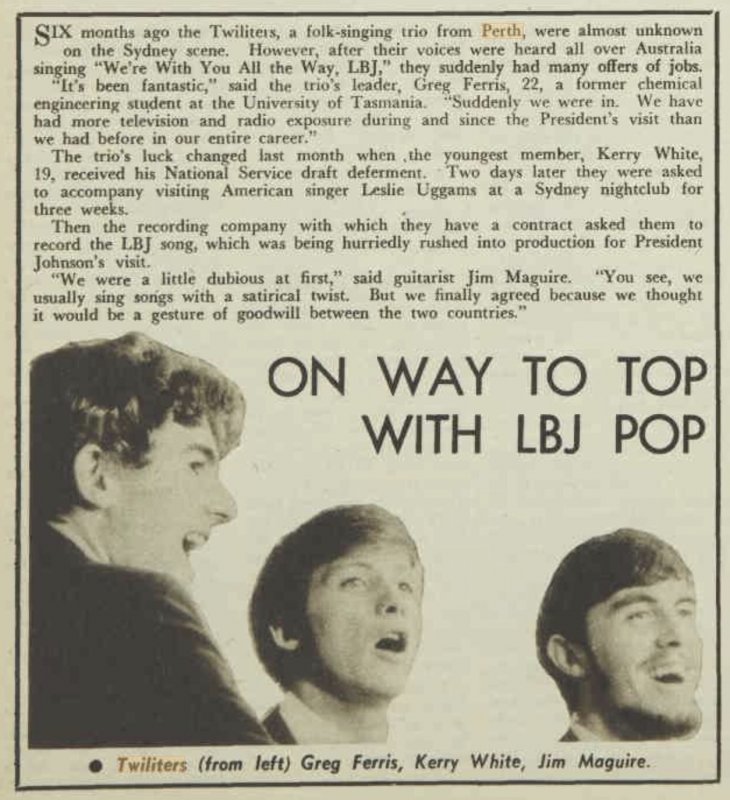
Recorded in Australia; Associated Music; matrix TPKM-1359. B side: "Waltzing Matilda". RCA 101735 (A), matrix TPKM-1359, "Popular 45 RPM", black label with the Associated Music Pty. Ltd. "am" logo; "Product of RCA of Australia Pty. Ltd. • Made from master recording of RCA"; "With You All the Way, L.B.J." (Bryan Conway), The Twiliters.
The picture sleeve ("RCA Records 101735") shows, on an orange ground, two clasping white hands, one sleeved in the Stars and Stripes and the other in the Australian flag; the back lists "With You All the Way L.B.J. * Waltzing Matilda" and advertises other RCA singles under "Have you got these other great RCA hit singles?", including three earlier Twiliters releases ("Where I'm Bound" / "This Little Light of Mine", 101641; "Creamsleeves" / "Dismal Currency", 101688; "Chilly Winds" / "Thanks for the Hand to Hold", 101703). [From the record sleeve and labels]
So the song told of a young man, recently married, being drafted to "that foreign land across the sea". However, his wife received a letter, informing her that her "soldier boy was in battle slain, oh in Vietnam in a field he died". It ended with an anti-war note, saying that he was not a violent man, and could not kill, and that he should never have fought "in this terrible war".
While the Vietnam conflict was well underway in 1964, very few Australians participated until the Menzies government upgraded its commitment in April 1965 - so this is more of a Vietnam-era protest song, not specifically mentioning the conflict, but a representation of the early 60s anti-war movement in Australia. The lyrics revolved around the absurdity of conflict as two people get into a fight: "reason and logic are gone, winning the fight won't prove that you're right" . The final verse criticised governments / politicians that "save on education and spend on defence" .
Songs about William White
- Willow Macky - "Ballad of William White" (1966)
- Glen Tomasetti - "The Ballad of Bill White" (1968)
- Don Henderson - "Bill White"
There is a recording of the song at the National Library of Australia, dated 1966, under the title: "Clem Parkinson sings his own contemporary folk songs in the Norm O'Connor folklore collection".4 The lyrics of this song featured in The Vietnam Songbook published in 1969, and compiled by Barbara Dane and Irwin Silber (founders of Paredon Records) - containing 100+ Vietnam War protest songs, 9 of which came from Australia & New Zealand. Notes in the book said "the first Australian casualty of the Vietnam War was a young warrant officer by the name of Kevin Conway. He was killed in July of 1966. About myself: I am 37 years of age, a member of the New Theatre Drama Group and also a member of the Victoria Folk Music Club in Melbourne". The book dated the lyrics "1968", while the National Library of Australia, as mentioned above, provided the date "1966", so there is a discrepancy.
This song, while reflecting on the first Australian death in the Vietnam War, took the opportunity to present a strong anti-war position, on the grounds that it was an unjust war: "he who dies for tyranny has thrown his life away" . Looking at the North Vietnamese side-of-the-story, the narrator noted that the "peasants fought for freedom" , and that "a hundred billion dollars" could not stop them. The US and its allies (such as Australia), may "call themselves advisors, but they're killers" . On Conway, the narrator pondered if he did "curse the men who sent him to meet his tragic death" .
1967
The narrator then criticised Australian apathy: "wake up Australia" - suggesting that people were either not patriotic, or ignorant of the threat posed by communism to free speech etc.
The monologue then spouted nationalistic rhetoric, using previous conflicts to stir patriotic feelings: "show the spirit of Gallipoli...and Korea, we must defend Australia" - of course, Gallipoli being a reference to the First World War battle involving Australia, and the US conflict in Korea, in which Australia also contributed.
The label credits the narration to Allen Stewart and Martin Christmas, with "Waltzing Matilda" (Cowan-Paterson) as background music; Alan's; matrix MX23179. Festival FK-1828, matrix MX23179, 45, white-and-turquoise Festival label with the Allan's logo; "*Shadow Valley and Iron Triangles", narration (Allen Stewart–Martin Christmas), background music "Waltzing Matilda" (Cowan–Paterson), 3.20, The Young Australians, "*All Rights Reserved"; "Made in Australia by Festival Records Pty.
Ltd." Supplied in a clear Festival Records company sleeve printed "Festival has the HITS!" with outline maps of Australia and New Zealand. [From the record sleeve and labels]
The song "To the Boys in Vietnam" was about an Australian entertainment group performing to Australian (and American) troops in Vietnam: "it was good to hear the Aussie slang all the time we roamed" . It took a patriotic, pro-government perspective, suggesting that Australia's involvement in Vietnam was keeping their country free: "the spirit of our fighting cause will keep all Aussie free" .
Produced for the Rotary Club of South Brisbane, which sold copies to pay for a concert tour entertaining Australian troops in Vietnam (The Rotarian, November 1969). This copy is inscribed on the label "Good luck fellows, from George Hill, 1968". AFS "Australian Forces Songs", 45 RPM microgroove, red labels marked "All Rights Reserved".
Side 1 "To the Boys in Vietnam" (G. Hill), 3.07, Control; side 2 "Our Boys Are Over There" (G. Hill), 2.28, Control; both credited to George Hill with Garry Maiden Trio and Don Lewers. [From the record sleeve and labels]
The song "Our Boys Are Over There" , tells of Australian battalions fighting the Vietcong: "a battalion from Australia, brave and strong... put an end to Charlie-cong" - of course a reference to the "VC", the National Liberation Front (NFL), the political and military resistance to the US and South Vietnamese government from within South Vietnam. The song noted that there is R&R: "there's rest and recreation, but only for a while" . The song referenced, and paid tribute to the nurses, doctors, and the Red Cross, not just the fighting soldier: "there's doctor and there's nurses, who have answered to the call, and the Red Cross" .
Also of note: is the line "in Nui Dat, our battalions from Australia" , where the 1st Australian Task Force (1 ATF) was based in South Vietnam, and "beaches of Long Hais" , a small township nearby. The hills by this beach would later be the scene of a major battle involving Australian and New Zealand troops versus the Vietcong in 1970, after this record was released.12 The song also referred to "a diggers slouch hat" . Digger is a military slang term for soldiers from Australia and New Zealand, which came to prominence during World War One, although some sources indicate it may have been used since the 1850s. Digger probably originally referred to a miner - extensive research has been conducted on the etymology of the term and its introduction into military terminology.34 A slouch hat, also known as Aussie bush hat is a distinctive Australian hat that has one side of the brim turned up or pinned to the side of the hat, often used in the military.5
Produced for the Rotary Club of South Brisbane, which sold copies to pay for a concert tour entertaining Australian troops in Vietnam (The Rotarian, November 1969). AFS "Australian Forces Songs", 45 RPM microgroove, red labels marked "All Rights Reserved".
Side 1 "To the Boys in Vietnam" (G. Hill), 3.07, Control; side 2 "Our Boys Are Over There" (G. Hill), 2.28, Control; both credited to George Hill with Garry Maiden Trio and Don Lewers. [From the record sleeve and labels]
The story told of a soldier who approached Dig Richards, and recalled how is friend died, while trying to help a child in a village, used as "Viet Cong bate" - referring to the "VC" - the National Liberation Front of South Vietnam (Vietnamese: Mặt trận Dân tộc Giải phóng Miền Nam Việt Nam) (NLFSV or NLF), the political and military resistance to the US and South Vietnamese government from within South Vietnam. He gave Dig Richard "his mate's bush hat" , to remind him of the "little girl and the soldier at Bar Ria" , and "why we have to be here" . Ba Ria was a reference to the base Nui Dat, by the city of Bar Ria, in Ba Ria–Vung Tau province, Vietnam, where the 1st Australian Task Force (1 ATF) were stationed.2
Note: the line "the digger told me" - Digger is a military slang term for soldiers from Australia and New Zealand, which came to prominence during World War One, although some sources indicate it may have been used since the 1850s. Digger probably originally referred to a miner - extensive research has been conducted on the etymology of the term and its introduction into military terminology.34
This song also appeared on a few compilations, such as Encores (1970) - the back of the sleeve, with regards to this song, said that: "I knew the people involved in this real life story. Like many country songs, it tells a story which is self-explanatory".1 Note that Tex Morton also released the Vietnam War song "The Widow Next Door" in collaboration with Sister Dorrie, discussed below. Thanks to Andrew Smith for the suggestion and providing a digital copy of the song.
The compilation included a few songs from Australia. One of those is particularly significant - "Saigon Warrior" performed by Maggie, an unknown Australian artist, recorded in-country during the war - one of the rare female performances from the Vietnam War. According to the article "Songs of the Vietnam War: An Occupational Folklore Tradition", by Dr. Les Cleveland (1986)1:
According to the 1991 compilation In Country: Folk Songs of Americans in the Vietnam War, compiled Lydia Fish, which featured a version by US veteran Saul Broudy:
1968
The second song "Do Not Sing the Old Songs" was a more generic protest songs, which contained some anti-war sentiment, regarding the old sending out the young to fight and die: "the young are still sent out to fight and die, for the lust and lies of the old, when the bodies lie stiffning, still the heroe's dreams grow cold" . The final song "The Army's Appeal to Mothers" took a comedy / novelty approach in presenting an anti-war position, in which the army appealed to mothers, to teach the children to "hate each foreign name, colour, race or tongue" , because it will make him a better soldier. The lyrics of this song also featured in The Vietnam Songbook published in 1969, and compiled by Barbara Dane and Irwin Silber (founders of Paredon Records) - containing 100+ Vietnam War protest songs, 9 of which came from Australia & New Zealand.Songs about William White
- Willow Macky - "Ballad of William White" (1966)
- Glen Tomasetti - "The Ballad of Bill White" (1968)
- Don Henderson - "Bill White"
This 1968 album featured the song "Boonaroo" , the title of which was a reference to the HMAS Boonaroo, an Australian National Line cargo vessel used to support Australian forces in Vietnam. In 1966, members of the Seamen's Union of Australia refused to sail the vessel in protest against the Vietnam War.3 In the lyrics, the narrator wondered "who will man the Boonaroo" , and then questioned the purpose of the ship, was there "medicine to heal...material to build" , or was there "grief and death untold" . The lyrics of this song also featured in The Vietnam Songbook published in 1969, and compiled by Barbara Dane and Irwin Silber (founders of Paredon Records) - containing 100+ Vietnam War protest songs, 9 of which came from Australia & New Zealand.4
The song "I'm an Australian – 20 Years Old" also featured in The Vietnam Songbook, although no recording from the time has been found yet. The song took a comedic approach to a 21 year old caught-up in major court case for resisting the draft. It started out with the man going down to the barracks, lighting a cigarette, and his "call-up papers accidently caught on fire" . Misinterpreted as a deliberate act, the "C.N.D. embraced me" - a reference to the protest group the Committee for Nuclear Disarmament, while the other side "called me a traitor" .
Soon he was all over the press, on the front page: "I read it in the papers so it must be true" . He ended-up in court, where the judge noted that the man would not "fight for queen and country" . The narrator noted that the "army wants to send me to jail" , while his girlfriend's father called him a "dirty communist" . A spokesman for the Returned Serviceman's League (R.S.L., similar to the American Legion), wanted him to be "horsewhipped and castrated, hanging is no good" . After all this, the man concluded that "Vietnam sounds like a good place to leave to Vietcong" , and that "three million bloody Frenchmen can't be all that wrong" .
1969
The theme, about the trauma of war, is typically found in post-Vietnam war songs. By looking at the negative effects of the war on veterans, it does suggest an anti-war stance, or at least provides a representation of disillusionment in Australia. It included anti-war sentiments, such as "when will they learn?" and "there is peace to bring" . However, it is more personal than political, dealing with the plight of the soldier / veteran, as a smiley young boy goes off to fight a war, no longer laughing, and radiating tension. As Ronnie Burns said, "it has a slight protest flavour about it, but it doesn't really have any social significance. Its really aimed at the mums - losing their sons to army conscription".4
The film was based on the 1947 novel of the same name, "You Can't See 'Round Corners", by Australian author, John Clearly, but updated to the Vietnam War.2 There was also a television version, broadcast in Australia, from 12 July 1967, also going by the same name, set during the Vietnam War.3 It tells the story of Frankie McCoy from Newtown, Sydney, drafted during the Vietnam War, and trying to sleep with his girlfriend before they are married. It included scenes of basic training at Kapooka, near Wagga Wagga. This album contained the songs "Army Training" and "Awol" (Festival Records # SFL-933,141).
- Featured Vietnamese children singing
- Christian in Vietnam, refugee team, medical work
- One-sided 33 rpm flexi disc issued by Australian Inter-Church Aid for the Christmas Bowl appeal as a Sunday School teachers' aid, bringing the comic strip "Vietnam Nurse" to life: Joan Davies talks about her work, and Vietnamese children sing folk songs and a Vietnamese Lord's Prayer. Manufactured by Ambassador Records, Sydney. Year from the sleeve text (she returned to Vietnam early in 1969; "she's still there today").
Australian Inter-Church Aid one-sided black flexi disc, speed 33⅓ r.p.m., "Manufactured in Australia by Ambassador Records, Sydney"; gatefold-style sleeve titled "Vietnam Voices — Sister Joan Davies and the children of Vietnam — A Sunday School Teachers' Aid", with the "Give to the Christmas Bowl" emblem (two hands holding a bowl) and photographs of Joan Davies tending a boy's eye and of four Vietnamese boys.
Inside, under "A Comic Strip Comes to Life", the text explains that this year's Christmas Bowl message reaches Sunday School children as the comic strip "Vietnam Nurse", the adventures of Sister Joan Davies in Vietnam, and that the record, used with the Christmas Bowl children's poster, has Joan herself talking about healing and caring in an active war zone, with Vietnamese children singing folk songs and a Vietnamese version of the Lord's Prayer; a comic panel shows her saying "Lie back now — we'll soon have you feeling better!" with the caption "But as soon as she was better, Joan went back to work.
She's still there today — helping and healing the people of war-torn Vietnam."
The back describes her as the widow of a Methodist minister and a nursing sister with an Asian Christian Service refugee team, wounded in a Viet Cong mortar raid in 1968 and back at work early in 1969, and says the Christmas Bowl supports agricultural, refugee resettlement, disaster relief and evangelistic projects in developing nations. [From the record sleeve and labels]
1970
Produced by Eric Dunn, musical direction Ron Martin; matrix YTX1223.
The sleeve note describes the song as the story of a little girl and a soldier in the land of tears. Columbia "Long Playing Microgroove" SOEX-9698, stereo, 33⅓ R.P.M., made in Australia by E.M.I. (Australia) Ltd., blue-green Magic Notes label with an orange "Sample – Not for Sale – Record" sticker; side 1 lists North by North West, Where Flies the Boomerang, Drums in My Heart, Child of Vietnam, The Wool Comes Rolling on Down and Why Can't We Find a Better Way, each published by Castle, "(All Composed by Roger Thwaites)".
The front cover shows an armillary sphere on a seahorse stand resting on an old map of Australia; the back carries a portrait photograph of Thwaites, his own note on each song ("Child Of Vietnam — is the story of a little girl and a soldier in the land of tears, your land, child of Vietnam"), side two (High Walls, Legend of the Quill, Henry Lawson, Norfolk Island, Eureka Stockade) and "Cover originated in Australia by E.M.I." [From the record sleeve and labels]
Recorded by Brian Callcott, 2TM, 18 April 1970; matrix Z4KB-0154. Four-track EP (Letter From Vietnam / Answer to Sweeney / Old Battered Rodeo Boots / Rock Miners in the Mountain); band: Des Whimen (bass), Barry Whimen (lead), Wally White (rhythm), Geoff Cuneo (drums), John Minson (harmonica). CM Twin City Country Sound CMEP-510, gold label, "Australian Made", Box 507, Dubbo and Box 41, West Tamworth; side 1: "Letter From Vietnam" (with Judy White) (W. White) (2.46) C.M.
Control and "Answer to Sweeney" (W. White) (2.34) C.M. Control.
The front cover, printed in green, reads "Presenting Wally White — Letter From Vietnam", with an inset portrait of White in a hat and a photograph of a Gibson guitar, a hat and riding boots on grass.
The back carries a cover note by Geoff Brown (RCA & Hadley Records), who calls this White's first release and says "A Letter From Vietnam" "tells the story of a home-sick soldier reminiscing for the happy days of home"; it also lists other CM records (Carrol County J. Heap CM001, John "Doc" Riley CMEP500, Alan Swanson CMEP501, John Riley CMEP502) and the addresses P.O. Box 41, West Tamworth 2340 and P.O. Box 507, Dubbo 2830. [From the record sleeve and labels]
1971
The title track "Life Won't Be the Same" does not mention war, but discusses the death of a man: "part of a game, life without him won't be the same" - in what could potentially be about war. It looked at the perspective of the man's sister: "why her brother isn't there to hold her hand" .
1972
Together, they released the song "The Widow Next Door" (RCA Victor # 102109), which started with a narrative from a widow, noting that "the fighting is over" and the "boys will be home... for Christmas" - and thus another song about the holiday season, see the list: . However, the narrator said that while "your boy will be home... not mine" , as her husband was killed in action (K.I.A.). The second part of the song took a strong anti-war position, criticising politicians for sending the young to war: "in Canberra... you make him a soldier, and send him to war" , where he died, and they send an "insult that you call the pension" . The narrator pondered that the anti-war movement may have been on the correct side: "maybe those students were right after all" , and she declared that "I'll never shall vote for no man evermore" . Thanks to Andrew Smith for the suggestion.
1973-1975: Paris Peace Accords to the Fall of Saigon
Between the Paris Peace Accords (27 January 1973) and the collapse of South Vietnam (30 April 1975). This marked the final end of the Vietnam War, with most American civilians and troops evacuated during the North Vietnamese invasion. The two halves of the country were reunified, and Saigon renamed Ho Chi Minh City, after the North Vietnamese leader Hồ Chí Minh.1974
1975
Aussie, patriotic, country music Old vet, drunk, died. Once a youthful soldier in WW1 and WW2, won the Victoria Cross (VC not the Vietcong)! Digger Aussie - now it's time we showed some pride. Old soldiers never die, simply fade away. Old soldiers never die, they simply fade away / But listen and I'll tell you, of one who died today / He was just the drunken wino that hung around our town, he had no one that ever loved him and I know that got him down / But he was once a youthful soldier, and he served in two world wars, he'd won a V.C. cross, that no one ever saw / He's a drunkerd he's a soap he's a boozer at his throat / But life for him hasn't always been this way / From the bottles then in the can he's a hard and lonely man, and its hard to find someone who'll understand / Although he served his country well, he's seen the other side of hell, and he lived through it here everyday / From the wineyard to the churchyard and scars upon his face he dreamed of mates he left asleep, in a far and foreign place / He's a digger of the old world, he's an Aussy through and through, now its time we show some pride in the things he had to do / And they called him V.C. Charlie and life's cross he has to bear, but now the lord has taken Charlie unto his loving care / He's a drunkerd he's a soap he's a boozer at his throat / But life for him hasn't always been this way / From the bottles then in the can he's a hard and lonely man, and its hard to find someone who'll understand / Although he served his country well, he's seen the other side of hell, and he lived through it here everyday / From the wineyard to the churchyard and scars upon his face he joined the mates he left asleep, in a far and foreign place / They were diggers of the old world, they were Aussy through and through, now its time we show some pride in the things they had to do / They were diggers of the old world, they were Aussy through and through, now its time we show some pride in the things they had to do / Well old soldiers never die, they simply fade away" [From Justin A. Brummer notes from RYM]
Post-War: 1976-present
The 1980s especially saw a revival of interest in the Vietnam War, which had subsided in the mid to late 70s following the US withdrawal. Both films and music sought to reflect on the impact the war had on society and to ask "why did the North win?"
1978
The song looked at a disillusioned Australian veteran, referencing several themes often found in post-war songs. It started with a soldier noting that they were not welcomed home, like the World War Two generation: "long forgotten dockside... there were no V-day heroes in 1973" . The vet struggled to find a job: "hours long, pay packets lean... held a job on an oil-rig, flying choppers when I could" . It noted drug addiction: "growing need for speed and novocaine" . The vet also suffered from Post Traumatic Stress Disorder (PTSD) - often connected in songs to stress, shell shock, flashbacks, nostalgia, and feelings and dreams related to an event: "car parks make me jumpy, and I never stopped the dreams" .
"Uncle Sam I’m in Vietnam
It’s a jungle it’s a prison, but here I am
Dreaming of the outside and freedom, planning my get away
Far away from this one ship bay
In the south-east tip of Asia. Where I lay
Dreaming of the outside and freedom, planning my getaway
Weapon drawn I got my web gear on,
I'm crawling on my belly near Khe Sanh
Dreaming of the outside and freedom planning my getaway
But there is a guard on the inside with a rifle in hand
And a guard on the outside on this government land
Uncle Sam I’m in Vietnam
It’s a jungle it’s a prison but here I am, here I am"
1979
It featured the song "Saigon" (Cleopatra Records # CLP 202) about a Vietnam veteran feeling nostalgic about the fun times in Saigon, possibly visiting prostitutes, although that's not explicitly stated: "girls with the slits... walk the bright streets at night in Saigon... everyone sinned in Saigon" . But now the war is over "nobody has any fun" . As time passed, the vet travelled the world from Paris, to Berlin, China, Egypt, and Afghanistan. He then tried to get back into Vietnam, noting that Saigon changed its name: "they say its called Ho Chi Minh City" , but they wouldn't let him in. The narrator also criticised the justification for the war: "so much for the Domino Theory" - that the collapse of South Vietnam into the control of the communist north would trigger the collapse of democracy in other countries and threaten the US - the idea of which came from President Eisenhower, during a press conferences on 7 April 1954.1
1980
Bogle's "And the Band Played Waltzing Matilda" centred around the 50,000 Australian troops, under ANZUS, who died fighting with the British at Gallipoli in the First World War. Many interpreted this as a parallel story to Vietnam. It protested the romanticism of war, and argued that the new generation, faced with Vietnam, viewed it from a new perspective. It began with a man carrying his pack in the bush when in "1915, my country...gave me a gun" , and "we sailed off for Gallipoli" . It then described the combat zone in brutal detail: "our blood stained the sand and water" , as Australians were "butchered like lambs" . The "crippled, the wounded, the maimed" were then shipped back home. The narrator then observed that every April, on ANZAC Day, the "old comrades... proudly... march" , with "old dreams of past glory" . However the young, faced with the Vietnam War, "ask" "what are they marching for?" . Note: Bogle also wrote and released the Vietnam song "The War Correspondent" on the 1980 album Now I'm Easy, discussed below.
The song used the seasons to describe the cycle of a youthful, innocent soldier off to war to fight for freedom, who becomes disenchanted after experiencing the horrors of war. Starting in Spring, the soldier "knows just what he's fighting for" , as he had been "told...many times" - it was "for his freedom" . By the summer, the soldier felt "pain and hate" . In Autumn, the "bombs rain down" , and "friends begin to fall" . By winter time, with "glory gone" , the "war is grey" , and the soldier "wonders what he's won" .
Also on this album was the track "The War Correspondent" (Larrikin Records # LRF 041) which looked at the perspective of an Australian war journalist. It started with the news anchor introduction: "our special correspondent in Saigon, says three Australian soldiers have died in Vietnam" . The lyrics were somewhat critical of the journalist for not taking a moral stand: "objectively you watch the war... not being paid to moralize" . Soldiers were dying, yet the newspersons were presenting a program: "see the show, T.V. soldiers in a row... watch them run, see them die" , as the reporter learned "how to live with death, suffering and fear" . But the narrator pondered on the actual impact: "the man that was before Vietnam can never be again" .
1981
1982
.
Produced by Ross McGregor and Anthony Vadala, musical arranger Anthony Vadala, recorded at Axent Studios, Kogarah, NSW; backing vocal Rita Scott. Axent YPRX 1929, 33⅓ rpm, yellow label marked "Side 1 AMCO", Made in Australia; "Vietnam (Ronnie Hughes)" is side 1 track 6, one of seven songs on the album marked "By Ronnie Hughes".
The front cover shows Hughes in a blue satin shirt and black waistcoat against a sunset over the sea. Back-cover band credits: keyboards Anthony Vadala and Ross McGregor, guitar Vince Lombardo, steel guitar Lance Clarke, trumpet Kevin Dubber, saxophone Mark Dennison, bass Roy Delfino, drums Jess Zappia; recording engineer Ross McGregor (Axent Studio Kogarah), photography Errol Pinkerton.
Hughes's sleeve note thanks his family, friends and the band, quotes his verse "We have all experienced sadness and fears, love and happiness and sometimes tears…", and dedicates the record to "my darling wife Shirley"; contact address 10 Willow Street, Labrador, Gold Coast 4215. [From the record sleeve and labels]
The other two tracks are poems, by Denis Kevans (15 January 1939–2005), from Canberra, Australia. The first was "The Great Prawn War" . The second title was the "Slouch of Vietnam" , said to have been published and set to music in 1962, before Australia's major troop commitment in 1965, according to Kevans. The poem was recited at anti-war demonstrations in the 1960s/70s.23 Both poems mentioned featured in his 1982 book The Great Prawn War and Other Poems. A slouch hat, also known as Aussie bush hat is a distinctive Australian hat that has one side of the brim turned up or pinned to the side of the hat, often used in the military.4
The poem recalled previous wars: "far-off fields of Flanders... brave Gallipoli" . However, these were different from the Vietnam conflict: "why should I share the napalm-guilt of blundering Uncle Sam" - a reference to chemical weapon Napalm B - a jellied gasoline mixture, with polystyrene, benzene, and gasoline. Declared a war-crime since 1980, the US government extensively used this weapon during the Vietnam conflict, dropping 388,000 tons on Indochina between 1963 and 1973.567 The narrator noted "peasant kids, who fight for rights and rice" , thus arguing that the war was unjustified, and that the North Vietnamese were fighting for independence. The poem also contained the line "blinded the diggers' eyes" . Digger is a military slang term for soldiers from Australia and New Zealand, which came to prominence during World War One, although some sources indicate it may have been used since the 1850s. Digger probably originally referred to a miner - extensive research has been conducted on the etymology of the term and its introduction into military terminology.89
- 1 theballadeers.com (archived copy) ↩
- 2 greenleft.org.au: Slouch vietnam 0 ↩
- 3 JSTOR article ↩
- 4 Wikipedia: Slouch hat ↩
- 5 Napalm: An American Biography (Robert M. Neer, 2013) ↩
- 6 Times Higher Education: Napalm an american biography by robert m neer ↩
- 7 Napalm, An American Biography (book website) ↩
- 8 Internet Archive (Wayback Machine) ↩
- 9 Wikipedia: Digger (soldier) ↩
Record one side one: Freedom on the Wallaby (Henry Lawson), Terania Creek (Kathy O'Sullivan), F111 and Life Wasn't Meant to Be Easy (both Lyell Sayer-Clem Parkinson) by The Larrikins, and Pot Pourri by Dennis Kevans, whose medley on the back cover includes "The Slouch of Vietnam"; side two is Red Gum, side three Dennis Kevans and John Dengate, side four Eric Bogle.
The front cover, red with a pattern of guitar-playing figures under a broken chain, reads "Rebel Chorus — A Concert of Contemporary Political Song — The Larrikins, John Dengate, Dennis Kevans, Redgum, Eric Bogle", recorded live at The Teacher's Federation Auditorium Sydney by The Amalgamated Metal Workers & Shipwrights Union, 136 Chalmers Street Surry Hills 2010.
The back-cover note "About Rebel Chorus" says the title comes from Lawson's poem "Freedom on the Wallaby" and hopes the songs become part of "a continuing tradition of working class music", quoting "Life wasn't meant to be easy … And that goes for Fraser as well" and Redgum's "Critique in G"; Larrikin Record Distributing Company sticker. [From the record sleeve and labels]
1983
Lyell Sayer wrote on the back of the LP: "One of my earliest songs, and certainly the most popular. My best claim to having written a 'folk' song as it has been recently collected from Vietnam veterans, by Graham Seal. The last two verses written later by Clem to keep the song current, are gratefully acknowledged".1 Released on Warren Fahey's record label, he wrote on the back of the LP: "Both Lyell and Clem enjoy taking the 'mickey' out of our politicians and why not! I have always felt that these contemporary folk songs play a real role in continuing the tradition of the folk song as the voice of the people. Long may the likes of Lyell Sayer and Clem Parkinson write and sing songs about us".
The song was a reference to the US-made F-111c fighter bomber. The Australian government ordered a number, for the Royal Australian Air Force (RAAF) in 1963.2 However, the final version of the aircraft were not delivered until 1973, because of technical problems, which included unexplained loses during its use in the Vietnam War in the late 60s and early 70s - or as said in the chorus of this song: "it is a lovely plane... it's a pity that it isn't safe to take it off the ground" . The narrator started with the Australian Prime Minister, Robert Menzies, pondering that "our Canberra bombers are...old as hell" . He called up "Uncle Sammy" to purchase planes, to "scare some Asians" . The narrator noted that the government "sent some off to Vietnam" to "wipe out all the Viet Cong" - a reference to the "VC" - the National Liberation Front of South Vietnam (Vietnamese: Mặt trận Dân tộc Giải phóng Miền Nam Việt Nam) (NLFSV or NLF), the political and military resistance to the US and South Vietnamese government from within South Vietnam. However the North Vietnamese leader Ho Chi Minh ordered his comrades not to waste bullets etc., because "these brand-new planes the Yankees have all fall down by themselves" .
The song had an alternative verse, used on some versions of this songs, such as by Johnny Lad.3 The narrator said here that the price of the aircraft keep increasing, and so suggested that if "Sir Robert was still here" , then "we'd make him pay the bill" . Continuing with the satire, the narrator also said that at "the present rate of accident" , Australia had about "a week's supply" of the aircraft.
John Schumann based it largely on the experiences of the Vietnam war veteran Mick Storen (his brother-in-law). Schumann noted as a teenager in the late 1960s his friends being drafted to fight the war: "They left as wide-eyed, grinning Australian lads, pushing and shoving and joking at their embarkation leave parties. They were returned to us as damaged goods - sullen, disconnected and with the trade-mark thousand yard stare". He soon developed an anti-war perspective in the early 1970s: "the popular movement against the Vietnam war gained traction. It wasn’t too long before a clear majority of Australians, including me, opposed it". But not into the late 1970s and early 1980s did attention grow to the plight of the veterans. At which point, Schumann said that "I entertained the idea of writing these blokes a song".2 The royalties of the song go to the Vietnam Veterans Association of Australia. The group also recorded a live version on the 1983 album Caught in the Act (Epic # ES 864).
Narrated in the first person, it started with a young, innocent nineteen year old taking part in a military march in Australia, just before being shipped to Vietnam, and then "in and out of choppers" across the land, where "each step could mean your last one on two legs" . This seemed a long way from the stories of the previous generations, who fought in the First and Second World Wars: "the Anzac legends didn't mention mud and blood" . So after the war, back in Australia, the veteran started to suffer from Post Traumatic Stress Disorder (PTSD), unable to sleep, thinking of the dark jungles and "barking M16... I can still hear... screaming in the jungle" . He also recalled drinking with his friend Frankie at the Grand Hotel in Vung Tau, a seaside city in South Vietnam during R&R, before being shot and killed in the jungle. There was also a reference to the use of Agent Orange: "Agent Orange sunset through the scrub" - the herbicide used by the US government, which had long-term negative health affects, an issue that gained more attention in the 1980s.
Other references to note: the line "parade at Puckapunyal... we did Canungra and Shoalwater before we left" - Puckapunyal is a training facility in Victoria, Canungra is a small town in Queensland, with a large military base, while Shoalwater is a bay, also in Queensland, a major military training area during Vietnam. The line "there's me in me slouch hat with me SLR" . A slouch hat, also known as Aussie bush hat is a distinctive Australian hat that has one side of the brim turned up or pinned to the side of the hat, often used in the military.3SLR was the L1A1 Self-Loading Rifle, used by Australian forces in Vietnam.4 The line "from Vung Tau to the dust at Nui Dat" - Nui Dat was where the 1st Australian Task Force (1 ATF) was based in South Vietnam, and Vung Tai was where the 1st Australian Logistics Support Group was headquartered, and popular for R&R.
This song provided an important representation of the loss of innocence for a nineteen year old, whose life changed because of the war. It brought attention to the plight of the Australian Vietnam veteran.
1984
The narrator first experienced war as a daughter, has her father went to war, and her mother scoured the "papers... and lists of dead" . Next, she had grown-up, and married, and it was her husband off to war. In the final section of the song, "daughters grew to women, and your little boys to men" , and they "bravely waved goodbye" , marching off to war. There are several cover versions of this song, including by John Schumann on the album Behind the Lines (2008), and by Danny Spooner on the album Emerging Tradition (2007).
1985
Label artwork shows pink capsule shapes over a desert grid; in a Festival "no. 1" company sleeve ("Give the gift of music"). [From the record sleeve and labels]
Lyell Sayer - "F111"
Phyl Lobl - "Seasons Of War"
Eric Bogle - "And the Band Played Waltzing Mathilda"
1987
The picture sleeve shows Rowe in Vietnam with the badge "Vietnam Veterans Parade, Sydney 1987, Australian Vietnam Forces"; the back has a contemporary portrait. Self-released, NOR001. NOR001 picture sleeve; the front shows a close-up photograph of Normie Rowe in a tank crewman's helmet with headset microphone, the name "Normie Rowe" running down the left edge, and the shield badge "Vietnam Veterans Parade, Sydney 1987 — Australian Vietnam Forces" (Australian flag, map of Australia, stars and medals).
The back has a smiling present-day portrait with Side One "Somewhere Tonight" (Bob Seger) and Side Two "Help Yourselves to Each Other" (Allen Reynolds & Bob McDill). [From the record sleeve and labels]
The sleeve is dedicated to Phillip Thomson O.A., national president of the Vietnam Veterans Association of Australia, who died on 23 November 1986. Promotional copy. CBS 651353 7, Side A, 45 R.P.M.; "Safe Behind the Wire" b/w "He's Got the Money", both (J. Schumann), published by Gilbey; mixed at Studios 301; "Australian Performance/Australian Composition"; ℗ 1987 CBS Productions Pty.
Limited, made in Australia by CBS Records Australia Limited.
The front sleeve shows a sepia photograph of a young soldier in a netted helmet behind strands of barbed wire, with the dedication ending "Phill was dusted off for the last time in the early hours of Sunday 23/11/86. A good mate and a great Australian... goodbye and God bless Phill..."; the back sleeve carries a "Promotion Only – Not for Sale" stamp. [From the record sleeve and labels]
1988
- 1 ABC (Australia) ↩
Produced by Kevin Kerr, recorded at Silkwood Sound Studios, North Fitzroy; July Music; signed copy. Big Time BTS 25 (BTS 25 B, Side 2), green label, ℗ 1988 Big Time Records (Australia) Pty. Ltd.; "Vietnam" (Watson) (July), 5:29, from the album "Noel Watson" BT 7087; recorded at Silkwood Sound Studios, North Fitzroy, for Opal Music/Vaec; manufactured for and distributed by BMG Arista/Ariola Limited in Australasia. [From the record sleeve and labels]
1989
The title of the song "Compulsary Hero" (Trafalgar Records # 7-257619), from the album ...ish (Trafalgar Records # 255968.2), was a reference to military conscription, reintroduced in 1964 by the Australian government, with 18-25 year old males eligible. The song started with children playing war games, when at the end of the day, everybody would go home safely: "we were kids playing war games in your yard... night would fall... all go home" . Then they were grown up, and "a man came on the TV, talking 'bout war" . The narrator said "its war without a choice" . The song recalled the previous generation: "Grandpa heard the call... a war to end all wars" - a reference to World War One. His "dad went off to do his bit" as well. Now it was "one more crazy war" . It leaned towards the anti-war side.
Limited; "Compulsory Hero" (G. Frost). Front sleeve: red-and-dark-teal artwork of silhouetted soldiers with packs and rifles walking past bare trees against a red splatter, titled "compulsory HERO" and "1927". Back sleeve: handwritten credits on torn lined paper for side 1 "Compulsory Hero" and side 2 "Propaganda Machine", both produced by Charles Fisher and engineered by Jim Bonnefond, with a "Not for Sale – Promotion Use Only" sticker. [From the record sleeve and labels]
1991
1993
On this album featured the song "Welcome Home" (Larrikin Records # LRF 282), which paid tribute to Vietnam War veterans, considered to have been neglected in Australian society and culture - the Australian Vietnam Forces National Memorial was only dedicated on 3 October 1992, commemorating the 60,000+ Australians who served in Vietnam, located on Anzac Parade, in Canberra. Bogle's other Vietnam songs are strongly anti-war, but this one is focused on the impact of war on soldiers and the home front, arguing that "when a nation goes to war, everyone's a casualty" . He also returned to the theme of "And the Band Played Waltzing Matilda", referencing an ANZAC parade: "on a sunny Sydney morning I... watched the boys come marching" . Previously, in the 1971 song, he remarked "what are they marching for?" . But in this song, he was focused on the welfare of the veterans, hoping that "the day helped to heal some wounds" , and "for them the war was over, at last" .
1994
Recorded August 1993 at Big Sound Studio, Adelaide, mixed by Darren McBain and David Lokan; ℗ 1993 The Mark of Cain, sleeve © 1994. Insipid Vinyl IV-27, 33⅓ rpm, red label marked "A (This Side)" and "B (Other Side)", ℗ & © 1993 The Mark of Cain; side A "Tell Me" (The Mark of Cain), 4:23; side B "Viet Vet" (Alan Vega), 7:53.
The front of the picture sleeve shows a pale, battered combat helmet against black under the band name in stencil lettering, with "Tell Me / Viet Vet".
The back credits words & music for each side, recording in August 1993 at Big Sound Studio Adelaide and mixing by Darren McBain and David Lokan, prints "© Control 1994" with the Insipid Vinyl logo, and gives management as In-Tense, PO Box 812, Newtown NSW 2042, Australia. [From the record sleeve and labels]
Digger, used in the title of the album, is a military slang term for soldiers from Australia and New Zealand, which came to prominence during World War One, although some sources indicate it may have been used since the 1850s. Digger probably originally referred to a miner - extensive research has been conducted on the etymology of the term and its introduction into military terminology.12 Fahey's notes on the album said that "Australians have fought in 11 wars... we have marched away to the sound of the bugle" . This included "the horrors of Vietnam" . Most of the songs on this compilation were relation to World War One and World War Two.
Compiled by Warren Fahey , Australian contemporary folk artist, folklore collector, and cultural historian, born 3 January 1946 in Sydney, NSW, Australia. He founded the label Larrikin Records , based in Paddington, NSW. He also established and runs the Australian Folklore Unit , and has released many books and albums regarding Australian folk music. This album is performed by Fahey in collaboration with Mic Conway , born 15 February 1951 in Melbourne, Victoria, Australia. This album contained 60 songs related to various wars ( Larrikin Records # CD LRF 344). Also see Vietnam War: Australian & New Zealand Songs . Digger , used in the title of the album, is a military slang term for soldiers from Australia and New Zealand, which came to prominence during World War One, although some sources indicate it may have been used since the 1850s. Digger probably originally referred to a miner - extensive research has been conducted on the etymology of the term and its introduction into military terminology. (1) (2) Fahey's notes on the album said that "Australians have fought in 11 wars... we have marched away to the sound of the bugle" . This included "the horrors of Vietnam" . Most of the songs on this compilation were relation to World War One and World War Two. "Down through the years the Australian soldier became respected as a reliable fighter, a mate when a mate was the difference between life and death and, above all, the Australian soldier was considered to be a ‘larrikin’ who saluted but would not doff his hat to no man. He was an Aussie, he was Cobber, he was Pongo, he was Curley and Bluey and he was Digger. Australians have fought in 11 wars. It seems incredible but 11 times we have marched away to the sound of the bugle and every time it was a call to join our allies and 'mates' at arms. We fought in the famed Maori Wars of Taranaki and the Waikato, a contingent of gallant lads travelled to the Sudan wars and then our Lighthorsemen galloped into the Orange Free State and the Boer War. Next came the so called 'Boxer Rebellion' and then the First and Second World Wars. We glibly believed that the Second World War was the 'war to end all wars' but we were wrong and our troops were once again called to battle in lands too close to the home front - Malaya, Malta, Korea and Indonesia and these were all followed by the horrors of Vietnam. As if to remind us that war is always 'just around the corner' our troops rallied in 1990 to confront the threat of yet another uprising in that war-torn zone known as the Middle East. 16 years later, they're there again. This recording is a unique oral history of the songs that the Australian soldiers sang. War is always a frustration and the songs, ditties, parodies, poetry and stories serve many well-earned roles as a morale booster to facilitate camaraderie, to educate and to assimilate 'new recruits' and to allow that necessary ongoing de-fusing of tension. As with other periods of history when all is not well, like times of economic recession and depression, the songs tend to be short and not so sweet, and, army songs being what they tend to be very much to the point - boots and all! This collection mainly comes from the First and Second World Wars however, there is no doubt that many of these same songs were sung by the 'Diggers' who marched away to Korea, Malaya and Indonesia. As our entertainment patterns changed so too have our soldier songs and the collected material from the Vietnam War tends to be songs about air fighter planes, raids and gas bombs. The later songs still use parodies however, they are chiefly American popular songs. Warfare has also changed dramatically and this might explain why there are so few songs from the Gulf War. I guess it's hard to sing when you're sitting alone in a computerised fighter plane with one finger cocked on a button"
1995
1998
2001
2002
2005
2007
2008
Also on the album were covers of "Mothers, Daughters, Wives" by Judy Small, "Band Played Waltzing Matilda" by Eric Bogle, and "Rachel" by Russell Morris. Other members of the Vagabond Crew are Hugh McDonald, Dave Folley, Kat Kraus, & Mark Kraus. The front cover featured a photo of an Australian First World War era soldier.1 Note that Schumann also released the Vietnam War song "Safe Behind the Wire" (1988) as a solo artist. While discussing this album, Schumann said that:
Also on the album were covers of "Mothers, Daughters, Wives" by Judy Small, "Band Played Waltzing Matilda" by Eric Bogle, and "Rachel" by Russell Morris. Other members of the Vagabond Crew are Hugh McDonald, Dave Folley, Kat Kraus, & Mark Kraus. The front cover featured a photo of an Australian First World War era soldier.1 Note that Schumann also released the Vietnam War song "Safe Behind the Wire" (1988) as a solo artist. While discussing this album, Schumann said that:
On this album featured the song "The Battle of Coral" (# AM005), about the Battle of Coral–Balmoral (12 May – 6 June 1968), fought between the 1st Australian Task Force (1 ATF) and the North Vietnamese 7th Division, and Viet Cong Main Force units, outside of Saigon in South Vietnam.2 This is not to be confused with the Battle of the Coral Sea which took place during World War Two. It described the battle in detail, starting with the mission objective: "block Charlie's retreat in and out of Saigon" . The North Vietnamese broke through the line, but the "overrun Aussie's dug in and fought back" , stopping the advance. The song recalled previous wars: "fought like the ANZAC's of old" . The narrator then paid tribute to those killed in action (K.I.A.): "25 diggers who gave up their lives" . As discussed above, the term Digger is a military slang term for soldiers from Australia and New Zealand, which came to prominence during World War One.34 Note: this album also featured the patriotic song "You Can't Take Australia From Me" which referenced soldiers and war, but it does not mention Vietnam or any other specific conflict.
2011
2012
On this album featured the song "The Battle of Long Tan" about the famous and iconic battle that took place on 18 August 1966. A small number, approximately 108 Australian and New Zealand servicemen, defended their position against a force of around 2,500 Viet Cong and North Vietnamese regulars, possibly preventing an attack against Nui Dat, the base of the 1st Australian Task Force.23 Note that other songs about this battle are the classical composition "The Battle of Long Tan" (2005) by Gary Nicholas and Phill Knight, the classical score to the motion picture Danger Close: The Battle of Long Tan, by Caitlin Yeo, and "Tell Carmelita" by Lee Kernaghan, discussed below.4
The song set-out the scene from the Australian perspective, with the Australian forces in 1966 new to the Nui Dat base, when "the VC decided...they'd humble the Aussies" . He noted that as the battle began on the rubber plantation "our blokes were outnumbered 30-1" . The lyrics provide some fairly accurate stats: "108 soldiers from Delta 6" , and "3000" from the other side. The narrator described the fierce combat, but "the Aussie held on, never giving an inch" . It presented the battle as a symbol of Australian national pride: "they fought for our country with honour and pride" . The song also provided a 1960s pro-government interpretation of the war, that Australia, and its ally the US, were defending an independent, non-communist South Vietnam that was fighting for freedom: "you were fighting for those who dared to be free" , thus ignoring the North Vietnamese perspective. This can be categorised under the 'patriotic' song theme.
- 1 Bandcamp ↩
2015
The song "Man From Vietnam" (Sony Music # 888750852328), opened and closed with helicopter sound-effects. It firstly contained lines about combat, looking at the soldier's perspective: "shots rang out in Saigon, smoke cloud... hiding in those foxhole" . Secondly, in featured patriotic sentiment: "fighting for his country... no matter what the cost" . Thirdly, the song was about preserving the memory of the conflict and those that died: "we will remember them... we salute the man from Vietnam" . This song is particularly significant as it included several verses in Māori language (subsequently translated into English, in blocks), the only Vietnam War song to do so.
For the title song "Spirit of the Anzacs" , Kernaghan joined forces with Australian-based artists Guy Sebastian, Sheppard, Jon Stevens, Jessica Mauboy, Shannon Noll, and Meg Washington, for the release of a charity single. The song was a patriotic tribute which referenced several wars and roles. In the case of Vietnam, it focused on the nurses: "she's a nurse in Vietnam... she's all of them, she's one of us... the spirit of the Anzacs" .
The song "Tell Carmelita" was narrated from the perspective of a soldier in Vietnam, missing his sweetheart, centred around the famous and iconic Battle of Long Tan that took place on 18 August 1966. A small number, approximately 108 Australian and New Zealand servicemen, defended their position against a force of around 2,500 Viet Cong and North Vietnamese regulars, possibly preventing an attack against Nui Dat, the base of the 1st Australian Task Force23: "you've already heard about Long Tan, we stumbled on some VC on patrol" . During the attack he hoped that he would return to Australia: "I wish I was there, Camelita beside me.
The song "The Unbearable Price of War" , a duet with Lisa McCune, kicked-off with helicopter sound-effects, and a soldier writing to his parents from "Vung Tau, at the Australian field hospital", after his APC (a tank) drove over a mine: "I'm lucky to be alive". The narration then moved to a female working at the hospital writing to her parents that it's worse than she thought: "the triage, the chaos, the blood and khaki".
2016
Diana Blom is Associate Professor, Music, in the School of Humanities and Communication Arts, at WSU, born in New Zealand, and currently based in Sydney, Australia. Her section of the album contained the song "Vietnam Diary: Great Bloody Xmas Break" (Wirripang # Wirr 074) which recites a 17 December 1969 letter from Australian soldier David Wilkins, fighting in the Vietnam War, over the Christmas period, thus presenting the real life experience of a soldier. Wilkins expressed anger and disappointed at spending Christmas in the jungle: "bloody Xmas... spending all the 'break' in the bush" . He noted that they were about to be sent out on a 7 week operation, writing that "man’s a bloody robot" .
The song "Missing in Action" provided a post-war look at the impact of the war on a father whose son never returned from the Vietnam War, presumably killed in action (K.I.A.), or as the government / military informed him back then: "missing in action was all they would say... his number and name" . The father was watching a parade, and when "the Vietnam veterans march by" , the memories flooded back: "our young men where called to the 'Nam" , with the narrator noting that "you can't begin to image the horrors of war" . Also note the use of the term "diggers" - as discussed, a military slang term for soldiers from Australia and New Zealand, which came to prominence during World War One.1
The song "Fifty Thousand Australian Sons" focused on the treatment of Vietnam War veterans on their return to Australia, which noted the lack of cheers, and that the "bureaucratic speeches have a darkened sombre tone" . Decades later, in 1987 at the Welcome Home Parade when it was "time to make amends" , finally the "streamers and confetti came down" . The title of the song was of course a reference to the number of Australian that served in the Vietnam conflict, although the number is thought to have been higher, at around 60,000+.2 The song also contained a reference to Post Traumatic Stress Disorder (PTSD), often connected in songs to stress, shell shock, flashbacks, nostalgia, and feelings and dreams related to an event: "the jungle vines in the.. heat of 'Nam weighed heavy on the minds" .3
2017
2018
2019
Other songs about the battle are "The Battle of Long Tan" by Graham Rodger (2012), and classical composition "The Battle of Long Tan" (2005) by Gary Nicholas and Phill Knight.3
2020
2024
- Australian punk, Brisbane
- Archival, recorded 1978-81, but only released in 2024
Unknown date
Control; 2. "The Grave Down by the River" (W. White), 2.47, CM Control, printed on a paste-over sticker.
The picture sleeve, "Wally White singing Return From Vietnam", shows a soldier in a slouch hat holding a small boy on a crowded wharf beside a ship, and lists "A Voice From the Town", "Hullo & Goodbye" and "Grave by the River". [From the record sleeve and labels]
This 1968 album featured the song "Boonaroo" , the title of which was a reference to the HMAS Boonaroo, an Australian National Line cargo vessel used to support Australian forces in Vietnam. In 1966, members of the Seamen's Union of Australia refused to sail the vessel in protest against the Vietnam War.3 In the lyrics, the narrator wondered "who will man the Boonaroo" , and then questioned the purpose of the ship, was there "medicine to heal...material to build" , or was there "grief and death untold" . The lyrics of this song also featured in The Vietnam Songbook published in 1969, and compiled by Barbara Dane and Irwin Silber (founders of Paredon Records) - containing 100+ Vietnam War protest songs, 9 of which came from Australia & New Zealand.
The song "I'm an Australian – 20 Years Old" also featured in The Vietnam Songbook, dated 1968, although no recording from the time has been found yet. The song took a comedic approach to a 21 year old caught-up in major court case for resisting the draft. It started out with the man going down to the barracks, lighting a cigarette, and his "call-up papers accidently caught on fire" . Misinterpreted as a deliberate act, the "C.N.D. embraced me" - a reference to the protest group the Committee for Nuclear Disarmament, while the other side "called me a traitor" .
Soon he was all over the press, on the front page: "I read it in the papers so it must be true" . He ended-up in court, where the judge noted that the man would not "fight for queen and country" . The narrator noted that the "army wants to send me to jail" , while his girlfriend's father called him a "dirty communist" . A spokesman for the Returned Serviceman's League (R.S.L., similar to the American Legion), wanted him to be "horsewhipped and castrated, hanging is no good" . After all this, the man concluded that "Vietnam sounds like a good place to leave to Vietcong" , and that "three million bloody Frenchmen can't be all that wrong" .
Lyric theme data
Lyric content themes tagged on the songs in this collection — parent themes with their sub-themes (number of records). Click a theme for its definition and all records carrying it.
Show all 35 themes ▾Key stats
158 songs · 114 releases · 98 artists · 64 labels · 1964–2024 · 2 more list entries have no record page yet and are not counted here
- 2007 is the peak year, with 14 songs.
- 1966–69 holds 31 of the 142 dated songs — one in five in four years.
- 69 were released during the war years (to 1975); 89 came after.
- 16 records are undated.
- 98 artists for 158 songs. The most represented is Normie Rowe, with 15.
- Five of the artists are still unidentified beyond the record: no line-up, no biography.
- Songwriter gender is recorded for 98 of the 158 songs: 81 by men, 16 by women and one by mixed teams — women wrote 16% of those.
- By performer: 123 men, 18 mixed groups, 14 women and three not identified (recorded for 158).
- 86 named songwriters. The most often credited is Don Henderson, with eleven.
- 48 of the 64 labels appear exactly once; ABC [Australia] has the most, with ten.
- 35 sit on a major or well-known imprint — ABC [Australia], CBS, ABC Classics, Columbia, EMI, Epic, Ode Ode, Polydor. The other 123 are on independent, regional or private labels.
- 44 are private pressings with no label at all.
- Three 45s put both of their sides into this list.
- 150 of the 158 are Australian.
- Melbourne accounts for 32 records, more than any other city; Sydney has 22, Adelaide ten.
- Eight come from outside Australia: six from New Zealand, two American.
- By perspective: 89 post-war; 49 peace, protest and anti-war; eleven patriotic, pro-government or anti-protest; nine home front or soldier's perspective.
- 97 distinct sub-themes across 158 songs.
- ANZUS is the single biggest subject — 85 songs, more than half.
- Next come Anti-War (55), Vet (38), Draft (27) and Soldier's Perspective (21).