Collections › Kent / Jackson State Songs

Kent / Jackson State Songs

123 songs · chronological · A–Z by artist
Annotations and notes by Justin A. Brummer
Exhibition Four Dead in Ohio: a gallery tour of this collection →
Entries are numbered (#1, #2 …) for reference on this page; the numbers shift when entries are added or split.
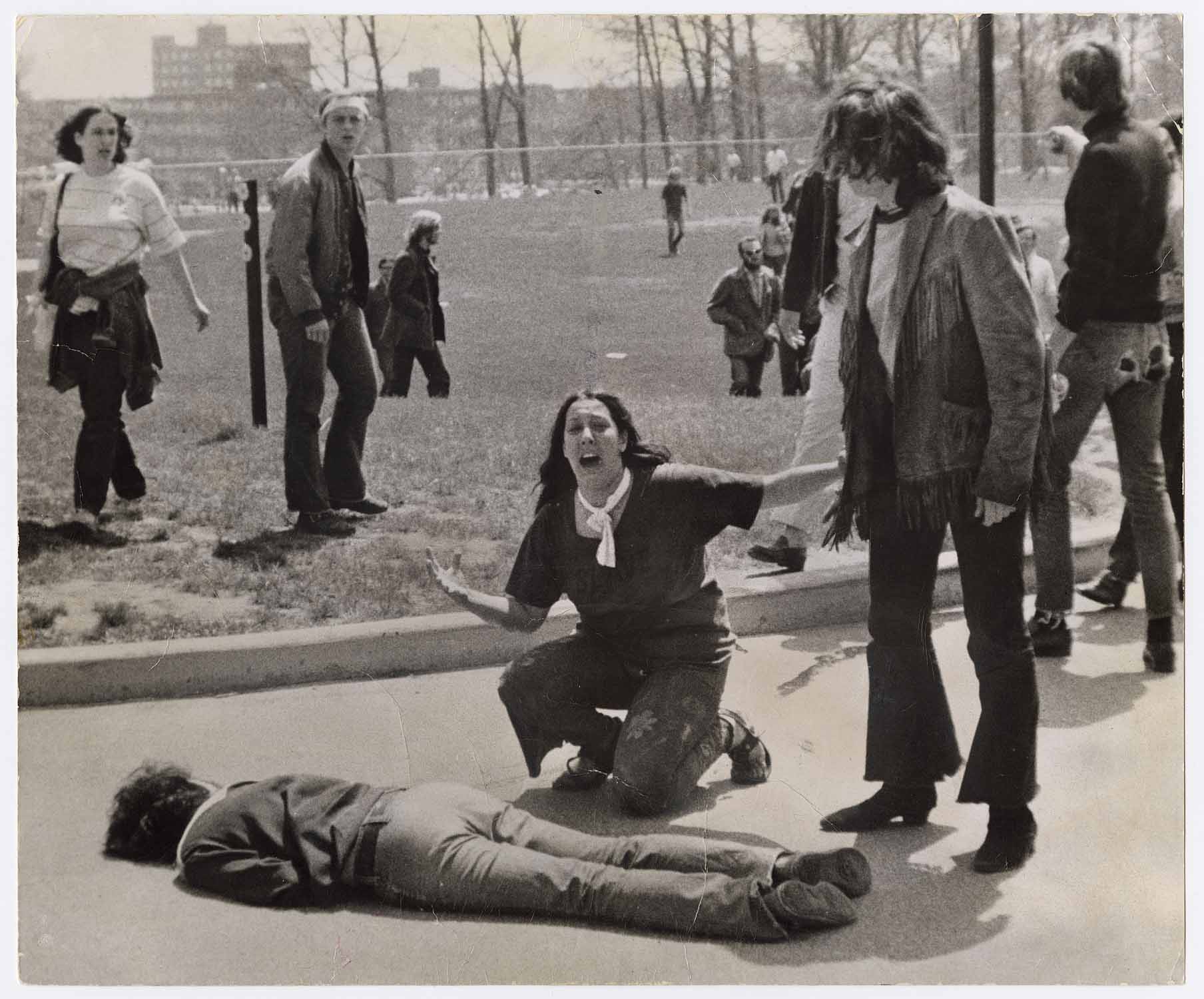
A student photographer, Jon Filo, captured on film the 14 year old Mary Ann Vecchio, kneeling over the body of the dead student Jeffrey Miller, 04 May 1970, the Kent State shooting - this image won a Pulitzer Prize
A collection of songs and spoken-word recordings referencing the Kent and Jackson State shootings
This forms part of the larger Vietnam War Song Project, an interpretive examination of over 6,500 Vietnam War songs identified, revealing how the war's significance is represented through music. The project also collects spoken-word recordings about the conflict. This unique collection of voices advances scholarship by providing insights into people’s views about the war over time as represented in music, looking at diverse communities and vibrant music scenes. It is crucial in developing our knowledge of the war and the humanities, through the use of a digital research platform.
Note: The VWSP has identified, to date, 120+ songs about the Kent State and Jackson State shootings of May 1970.
Citation: Justin A. Brummer, Vietnam War Song Project (VWSP) — Kent / Jackson State Songs, vietnamwarsongproject.com/list/kent-jackson-state-songs, accessed 12 November 2026

Historical Context

This instance of the war’s brutality being enacted on American soil shocked the nation, and within weeks "Ohio" was released by super group Crosby, Stills, Nash & Young, placing blame firmly with the government, just one of more than 120 songs released about Kent & Jackson State.
Beyond Kent State and Anti-War, the songs in this collection most often also deal with: Demonstration, Nixon, Civil Rights, My Lai.
1 of 12
Poster from New York University, calling for a demonstration to protest the "Kent State Massacre".12
The Kent State Shootings (or "Massacre") took place on May 4 1970, in Ohio, where members of the Ohio State Guard shot and killed four students. Two students were subsequently killed by Mississippi state and Jackson city police, at Jackson State college ("Jackson State Killings") on 15 May 1970.345

Soon after Richard Nixon’s inauguration in January 1969 he implemented a strategy of "Vietnamisation" - the gradual withdrawal of American forces and the strengthening of the Army of the Republic of Vietnam (ARVN), an element of the Nixon ‘Guam’ Doctrine, announced to reporters at Guam on 25 July 1969. However, Nixon’s strategy also involved the expansion of the war into Cambodia and Laos, and extensive bombing campaigns throughout Indochina and many people in the anti-war movement and in the Congress wanted an immediate and unilateral withdrawal.

Nixon publicly announced his Cambodia incursion on 30 April 1970. This led to a surge of demonstrations on university campuses, culminating in the vast outpouring seen at Kent and Jackson State. The four students killed at Kent were Allison Krause, Jeffrey Miller, Sandra Scheuer, and William Knox Schroeder. The two students killed at Jackson were Phillip Lafayette Gibbs and James Earl Green.

A student photographer, Jon Filo, captured on film the 14 year old Mary Ann Vecchio, kneeling over the body of the dead student Jeffrey Miller - this image won a Pulitzer Prize, and became one of the key images of the Vietnam anti-war movement (see image above, left).

War Years (1970-1972)

Richard Nixon announces the US incursion into Cambodia, an expansion of the war, 30 April 1970. This sparked major demonstrations across the US.
Key EventsOfficial peace talks continued in Paris, and Kissinger opened a secret channel with his North Vietnamese counterpart Le Duc Tho. Meanwhile, Nixon stunned Americans by announcing the US and South Vietnamese incursion into Cambodia, which sparked mass demonstrations in the US and firmly turned public opinion against the war in Vietnam. During the protest at Kent State University, Ohio, four students were shot and killed. The Congress also reacted to the Cambodia incursion, with a series of legislative restrictions on US operations in Cambodia, Laos, and Vietnam. Captain Medina was charged over the My Lai Massacre, and Lt. William Calley's trial began.
  • 21 February: Kissinger talks with Le Duc Tho begin
  • 30 April: Nixon announces the incursion into Cambodia
  • 1 May: Nixon calls protesters "bums"
  • 4 May: 4 Student killed at Kent State Ohio, by National Guardsmen
  • 24 June: Congress repeals the Gulf of Tonkin Resolution
  • 12 November: Trial of Lt. William Calley began
  • 22 December: Cooper-Church Amendment

1970

#1 Third Condition Monday In May (The Kent State Tragedy) 1970 · Single · Monday in May (The Kent State Tragedy) / Nickel · Sundi # SR-6815 · USA
Annotation
Third Condition were a garage rock band from Daytona Beach, Florida, popular on the local garage scene, featuring Charles "Chuck" Robinette (lead singer), Ralph Citrullo (bass), Chris Drake (vocals, guitar), Allen Dresser (guitar), Max Easom (drums, vocals), and Neil Haney (vocals, organ).

They released one of the first songs about the Kent State shootings on a Tampa label, with the original promo copy under the title Monday in May (A May Day of Hell), composed by Chuck Robinette. The label said "rush release" with a date stamp: "10 June 1970" . It received decent airplay and started to rise in the charts until the release of Ohio by Crosby, Stills, Nash & Young (below). We know that "Ohio" , composed by Neil Young, was recorded 21 May 1970, and it is reviewed as early as 20 June 1970 in Billboard, on p.54, described as rushed out with a "timely message" - that's 10 days after the Third Condition record.1"Ohio" charted on 27 June 1970, entering at # 58.2 Therefore, the Third Condition record would have got to stations before or at the same time as Neil Young’s "Ohio".

The song later appeared under the name "Monday in May (The Kent State Tragedy)" (Sundi Records # SR-6815). Third Condition’s record label promoted it heavily in Billboard in August. Billboard reported on 15 August 1970, p. 80, that Sundi had established a university scholarship in Tampa (called M.I.M - Monday in May), funded by 10% of net royalties earned on the single3 They followed this up with a full page advertisement on 29 August 1970, on p. 27 of Billboard.4 But the song had no further commercial impact. Distributed by Transglobal Distributing Corporation. Publisher: Candius Music. Performing Rights: BMI. The song called the event a "shame for the nation" and that "the screams of the dying are burned in their mind" .
Annotation by Justin A. Brummer
Notes
original promo copy under the title Monday in May (A May Day of Hell) - title then changed to "Monday in May (The Kent State Tragedy)" Sundi Records SR-6815, "A Gil Cabot Enterprises, Inc. Release", P.O. Box 7229, Tampa, Florida 33603. The first promotional pressing (white label, "Promotion Copy Not for Sale", stamped "Rush Release") titles the song "Monday in May" (A May Day of Hell) (C. Robinette), Candius Music (BMI), vocal, 3:14, produced by Gil Cabot, engineer Phil Kempin.

The later D.J. copy (white label with yellow flowers, "Not for Sale", SR-6815 A, 7856, "A Cabot Entertainment Companies Release", "Nationally distributed by Transglobal Distributing Corporation—USA") titles it "Monday in May (The Kent State Tragedy)" (C. Robinette), Candius Music BMI, 2:59, intro :12, with a handwritten date "9/10/70". [From the record sleeve and labels] Advertised in Billboard, 29 August 1970, as "Kent State Tragedy – Monday in May" by Third Condition, SR #6815, published by Candius Music (BMI); "A Cabot Entertainment Companies release", Sundi Records nationally distributed by Transglobal Distributing Corporation, 2223 S. Dale Mabry Hwy., Tampa, Florida 33609. [From the Billboard advertisement]
Lyrics
English
With humiliation and shame for the nation
We shared bitter tears for the deed that was done
When student dissension brought armed intervention
To Kent State Ohio with tear gas and guns...
Blood and confusion, dispelling illusion, Monday in May, a May day of hell
No longer concealing the anger they're feeling
They turn on the guardsmen with rocks in their hand...
Bullets were flying, students were crying...
Screams of the dying were burned in their mind...
A May Day in hell
#2 Crosby, Stills, Nash & Young Ohio 1970 · Single · Ohio / Find the Cost of Freedom · Atlantic # 45-2740 · USA
Annotation
Neil Young wrote the protest song "Ohio" (Atlantic # 2740), performed by Crosby, Stills, Nash and Young - a super-group, formed in 1969 in Bethel, New York, USA, featuring David Crosby (vocals, guitar), Stephen Stills (vocals, guitar, keyboards, bass), Graham Nash (vocals, guitar, keyboards), and Neil Young (vocals, guitar, keyboards, harmonica). The narrator lamented and warned that soldiers and Richard Nixon were coming and "cutting us down" . The line "what if you knew her and found her dead on the ground" brought to mind the John Filo photograph of Mary Ann Vecchio standing over the body of Jeffrey Miller after he was shot dead by the National Guard.1 In fact, Young wrote the song immediately after seeing the photo in a magazine. David Crosby said that he handed Young the magazine, who "looked at it, got out his guitar and wrote the song right there in front of me. On the porch in the sunlight. I called Nash - book the studio, now".2

The most popular of the songs dealing with the Kent State demonstration, the label rush released the single in early June 1970, having been recorded on 21 May 1970 at Record Plant Studio 3 in Hollywood (according to the linear notes of 2004's Greatest Hits). It has largely been considered the first record released about Kent State - but it's possible that Third Condition's Monday in May (The Kent State Tragedy) was released before or around the same time - discussed above. The single was reviewed as early as 20 June 1970 in Billboard, on p.54, described as rushed out with a "timely message" - that's 10 days after the Third Condition record.3 It peaked at # 14 in the Billboard Hot 100 (chart of 1 August 1970), was still at # 17 on 8 August, and was frequently played at anti-war rallies in the 1970s.4 Electric live versions featured on 4 Way Street and Journey Through the Past. Young recorded a solo acoustic version on Live at Massey Hall 1971. The B-Side "Find the Cost of Freedom", by Stephen Stills, has also been interpreted as an anti-Vietnam song.
Select covers
Maxima - Four Dead in Ohio (1970)
Coast - Why (A Peace Medley) (1970)
Isley Brothers - Ohio / Machine Gun (1970)
Jaramago - Ohio (1970)
C. D. K. & Company - Ohio (197?)
Toxic Reasons - Ohio (1988)
Dink - Ohio (1996)
Dala - Ohio (2008)
Darcie Miner - Ohio (2008)
Annotation by Justin A. Brummer
Notes
Atlantic 45-2740 (A-19330-PL), 45 rpm, vocal, "Mfg. by Atlantic Recording Corp., 1841 Broadway, New York, N.Y."; "Ohio" (Neil Young), 3:00, Cotillion/Broken Arrow (BMI); produced by Crosby, Stills, Nash & Young. The black picture sleeve prints the full lyrics of "Ohio" ("Neil Young – ©1970 Cotillion/Broken Arrow") and of the flip "Find the Cost of Freedom" ("Stephen Stills – ©1970 Goldhill Music"); the other side of the sleeve prints the preamble to the Bill of Rights and Article I (freedom of religion, speech and press, and the right of the people peaceably to assemble). [From the record sleeve and labels]
Lyrics
English
Tin soldiers and Nixon coming, we're finally on our own
This summer I hear the drumming, four dead in Ohio
Gotta get down to it, soldiers are cutting us down
Should have been done long ago
What if you knew her and found her dead on the ground
How can you run when you know?
Gotta get down to it, soldiers are cutting us down
Should have been done long ago
What if you knew her and found her dead on the ground
How can you run when you know?
Tin soldiers and Nixon coming
We're finally on our own
This summer I hear the drumming, four dead in Ohio..
How many more?
Show full lyrics (15 lines) ▾
#3 Evoloution Sandra Allison Jeffrey and Bill 1970 · Single · Sandra Allison Jeffrey and Bill / Straws in the Wind · Garlin # 107 · USA
Annotation
The song title "Sandra Allison Jeffrey and Bill" (Garlin Records # 107) referenced the four student killed at Kent State - which would seem to be one of the few songs about Kent State to actually mention the victims by name, and certainly the only song in the title - the others being "The Kent State Massacre" by Barbara Dane, "What a Good Time for a Kent State" by Freddie Hubbard & İlhan Mimaroğlu, "41,000 Plus 4" by Ruth Warrick, and "Kent" by Magpie. The song "Hey! Sandy" by Harvey Andrews referenced one of the victims, Sandra Lee Scheuer.

This song recalled those four students demonstrating and then being killed. The singer wanted to know "who is to blame" for the tragedy, and what happened, so that they could learn from the mistakes and ensure it "never happen again" . Released in Hollywood, California, written by Norm Pringle (the producer) and Virgil Stickney, and arranged by Ron Amerine. Publisher: Pringle Music Publication House. Performing Right: BMI.
Annotation by Justin A. Brummer
Notes
Garlin Records 107A, 11027 Blix Street, N. Hollywood, Calif. 91602; "Sandra Allison Jeffrey and Bill" (Norm Pringle - Virgil Stickney), Pringle Music Publication House, B.M.I., 3:18; produced by Norm Pringle, arrangement by Ron Amerine. [From the record sleeve and labels]
Lyrics
English
The shots of hate rang out at Kent State
And four young people, the voices are still
Sandra Allison Jeffrey and Bill, Jeffrey...
Stood up and protested what he thought was unfair
Sandra...had no time for hate, life was her passion, death was her fate
Bill was angry when the building was burnt...
Flowers are better than bullets, she said
Because of a bullet now Allison is dead
Who is to blame..for the hatred?
We've got to find out how this happened...
And make sure that it can never happen again
Genre: ♪ Pop
#4 Steve Miller Band Jackson-Kent Blues 1970 · Album · Number 5 · Capitol # SKAO 436 · USA
Annotation
The psychedelic rock track "Jackson-Kent Blues" (Capitol Records # SKAO-436) by the American group Steve Miller Band is one of the few songs to actually mention the killings of two African-American students at Jackson State College on 15 May 1970. Released on this album only, in July 1970, it reached # 23 in the Billboard chart.1 Most other songs on this list focused on Kent State - probably an accurate reflection of the media, political, and public attention received at the time, in which greater concern was shown for the white middle-class college students than for the African-Americans attending a community state college. Three African-American students killed earlier in 1968 at South Carolina State College (the "Orangeburg massacre"), during a demonstration against segregation, also received little attention.234

This song started with the narrator heading to Ohio for a demonstration "against the president's views" - that being a reference to President Nixon. So he tried to complain to his Congressman, who would not answer the phone because he / she was "worried about voters" . Then the narrator attacked Nixon's "silent majority" , referenced the students killed in Jackson State, and decided to march to Washington D.C. At the end of the track he declared his anti-war stance, saying that "nothing any good has ever come of a war" and that the country needed to "give peace a chance" .
Annotation by Justin A. Brummer
Lyrics
English
Headed for Ohio when I read the news about the people demonstrating against the president’s views
Four were shot down by the national guard troops
Just like Uncle Sam I put on my fighting shoes
With those low down, profound killin' four blues
Lookin' for my Congressman to make it all well known
But the politicians not in, won't answer his telephone
Making in his office while they're shooting kids down at home
Worried about the voters but he won't be there long
Silent majority still glued to the tube
Say CIA ain't lookin', FBI come unglued
Shot some more in Jackson
Just to show the world what they can do
While we're marching to D.C. cause there's too much to do
Nothing any good has ever come of a war
Got those low down,p rofound, killin' four blues
Give peace a chance, give peace a chance"
Songs referencing Jackson State shootings:
"Jackson-Kent Blues" (Steve Miller Band)
"Student Demonstration Time" (The Beach Boys)
"H20 Gate Blues" (Gil Scott-Heron & Brian Jackson)
"41,000 Plus 4" (Ruth Warrick)
"Kent" (Magpie)
"What I Know" (KRS-One) (Unreleased)Other Vietnam War references to police violence against African-Americans:
"Chicago Seven" (Memphis Slim)
"Black Soldier" (The Last Poets)
Show full lyrics (26 lines) ▾
#5 J.J. Light Kent State 1970 · Single · Kent State / Gallup, New Mexico · Liberty # 15 393 A · USA
Annotation
The song "Kent State" (Liberty Records # 15 393 A) by J.J. Light - otherwise known as Jimmy Stallings, a member of the country rock group Sir Douglas Quintet, based in Texas, USA. Originally from New Mexico, he grew up in the Navajo Nation. In an interview with Cult Scoop Magazine, he said: "I grew up in Farmington, New Mexico, born in 1942. I’m part Native American, Navajo".1

The song recalled the moments of the shooting, in a first person narrative, from the perspective of someone present at the incident: "woman is in the hot grass...the war on my back, the fire started...shooting" . The narrator called out to the National Guard "what you doing coming here...shooting at my friends" . At the end of the song, he sent a warning to the government, police, and the National Guard, that they "better stop pushing us around or we'll kick your brains out" i.e. they will retaliate.
Annotation by Justin A. Brummer
Notes
Liberty LB 15 393 A, black label with rainbow edge and Statue of Liberty logo, United Artists GmbH, GEMA, Liberty / UA GmbH, München; "Kent State" (J. J. Light), 2:11.

The picture sleeve front shows a colour photograph of J.J. Light standing by a tree with an acoustic guitar, titled "kent state / gallup, new mexico", catalogue 15 393; the back, headed "Musik '70", advertises Liberty LPs by Canned Heat, The Can, Amon Düül II, Paul Nero, Lester Wilson and Katja Ebstein, printed in Germany by C.v.d. Linnepe, Lüdenscheid. [From the record sleeve and labels]
Lyrics
English
Train on the track, on no we're about to be attacked
By now the whole woman is in the hot grass
Sitting low just waiting, a clock clock
Then the war on my back
The fire started while I was relaxing in bed almost asleep
Someone must be out of their head
What you doing coming here were I live
Getting me out of bed
Shooting at my friends, shooting, shooting, shooting
Burn down our cornfields, you''ll pulling the fish out of the water
You better stop pushing us around or we'll kick your brains out
#6 Barbara Dane Hallelujah, I'm a Bum 1970 · Album · FTA! Songs of the GI Resistance · Paredon # P-1003 · USA
Annotation
FTA!: Songs of the GI Resistance (Paredon Records (# P-1003), a collection of Vietnam War songs by Barbara Dane and GI's. Paredon released the record, founded by Barbara Dane and Irwin Silber in 1969, whose objective was to "seek out the music and speech, documentary or dialogue, that spring from the conscious artist who relates to people's movements, and which pour from all people in struggle".1 Dane was born on 12 May 1927 in Detroit, Michigan, USA. This album focused on the anti-war movement, in particular those who were members of the US armed forces. Recorded at Fort Hood (Texas), Fort Benning (Georgia), and Fort Bragg (North Carolina)

This collection included the song "Hallelujah, I'm a Bum" (Paredon Records # P-1003), which had the line "guards...on the campus at Kent" . This song responded to Nixon's comment on 30 April 1970 (just before the Kent State shooting) when he spoke at the Pentagon, saying "you see these bums, you know, blowing up the campuses". The Washington Post ran the headline "Nixon denounces campus 'bums' who burn books", while the New York Times declared that "Nixon puts 'bums' label on some college radicals". A father of one of those killed at Kent State later told a reporter that "my child was not a bum".2. This song also referenced the imprisonment of Bobby Seale and Huey P. Newton of the Black Panthers, thus related to the Chicago Seven / Eight.
Annotation by Justin A. Brummer
Notes
Paredon P1003, © 1970 Paredon Records, PO Box 889, Brooklyn, N.Y. 11202; "Sung by Barbara Dane with active-duty GIs", "Recorded at Fort Hood, Texas; Fort Benning, Georgia; and Fort Bragg, North Carolina"; edited by Irwin Silber.

The front shows a line of helmeted GIs walking and flashing peace signs. The 16-page booklet opens with a photograph of Barbara Dane at the Oleo Strut, Fort Hood, Texas (photo by Carolyn Mugar), and contains "About the GI Movement" by Irwin Silber, on the GI coffee houses and underground papers; "If This Be Treason..." by Barbara Dane, describing singing for soldiers and Marines at the Oleo Strut, Ft. Dix and an Oceanside USO; notes on each song; full lyrics with credits; "Barbara Dane: Singer for the GI Movement" by Howard Levy; and "Barbara Dane Speaks to the GI Movement", reprinted from The Fatigue Press, GI newspaper, Fort Hood, Texas, an autobiographical letter signed "With all my love, Barbara".

It is illustrated with GI-newspaper headlines ("GI's Unite!", "Fort Riley Rebellion", "Brag Briefs"), cartoons and the statement "The opinions expressed in this paper are not necessarily those of the Dept. of the Army!", and closes with the Paredon Records manifesto.

Side I: Join the GI Movement (words Barbara Dane, after Aunt Molly Jackson's "I Am a Union Woman"); Hallelujah, I'm a Bum (new words 1970 by B. Dane and Irwin Silber); Ballad of Richard Campos (Danny Valdez); Go Tell It on the Mountain (Freedom Song from Mississippi 1964, brought up to date by B. Dane); Just Another Day (Bill Frederick); We Shall Not Be Moved, with Italian and Spanish verses.

Side II: The Resistance Hymn (tune Patriot Game, words adapted by B. Dane from "The Hello People"); Insubordination; Last Drink with Don (words Fred Gardner, music Barbara Dane); Bring 'Em Home (music and tag line Pete Seeger, new words by B. Dane and GIs from Ft. Hood, 11/9/69), with a footnote glossing "FTA" as the Army's "Fun, Travel and Adventure" and the GIs' "Fuck the Army!". [From the record sleeve and labels]
Lyrics
English
Oh bums of the earth, you've got nothing to loose
But the chains and the tear gas, the Dick Nixon blues
Hallelujah, I'm a Bum, hallelujah, who are you?...
When he first called us bums, didn't know what he meant
But the guards defined it on the campus at Kent...
Well power corrupts, we know that by heart
But you got to admit Nixon had a head start...
Well, some say his name is slippery Dick
Well I guess he is no bum, but he sure is some (dick)
#7 Maxima Four Dead in Ohio 1970 · Single · Together Again / Four Dead in Ohio · GWS # TRG-42 · USA
Annotation
The psychedelic garage rock song "Four Dead in Ohio" (GWS # TRG-42), released in 1970, covered the well-known Crosby, Stills, Nash & Young song Ohio composed by Neil Young: "Nixon's coming...I here the drumming, four dead in Ohio" . This version started out with a spoken-word anti-war, revolutionary narrative. The speaker refused to "watch as a tide of apathy" took over. He declared that if the authorities wanted war, then "the revolution is what they will have" . It also contained a possible reference to the My Lai Massacre (March 1968), kept secret for over a year until reported in the US press between September and November 1969: "how dare they hope that genocides will slip by us unnoticed" . It could also refer to the indiscriminate bombing of Cambodia and the large number of Vietnamese deaths during the war. Released in Miami, Florida, Kevin McManus produced the record and Roger Hatfield worked on the arrangements.
Annotation by Justin A. Brummer
Notes
GWS Recording Corp. of America, "World of Hits", 1175 N.E. 125th Street, Suite 413, North Miami, Florida; TRG-42 B; "Four Dead in Ohio", credited on the label to (Crosby, Stills, Nash & Young); produced by Kevin McManus and D. Hieronymus; arranged by Roger Hatfield. Yellow label with globe logo. [From the record sleeve and labels]
Lyrics
English
No longer can I sit idly by why the heirs of outrageous indifference pierce the lungs of my brothers
Nor can I watch as a tide of apathy sweeps the ideas of a generation into the sea
How dare they think that fire will not be met with fire
How dare they hope that genocides will slip by us unnoticed
How dare they infect, and abduct, seduce and induce, hatred...
If it's peace they want, then they shall have it
But if war is what they want, the revolution is what they will have
#8 Coast Why (A Peace Medley) 1970 · Single · Massive # M-1001 · USA
Annotation
As mentioned above, their are dozens of cover versions of the famous Crosby, Stills, Nash & Young song Ohio. This included the track "Why (A Peace Medley)" (Massive Records # M-1001), one of the more interesting interpretations. Released by the obscure soul group Coast in New York, in 1971. Produced and directed by Martin Brummer and Gene Busnar. In fact, the medley also featured John Lennon's peace / anti-war anthem Give Peace a Chance (by the Plastic Ono Band), and Neil Young's Helpless. Furthermore, it included spoken-word extracts, such as from Vice-President Spiro Agnew: "Yippies, Hippies, Yahoos, Black Panthers, Lions and Tigers alike, I would swap the whole damn zoo for a single platoon of the kind of young Americans I saw in Vietnam" - this 1970 speech, A Challenge to Hippies, featured on the album Speaks Out. Also in the song, an unknown teenage soldier expressed fear about going to war and a mother wanted to know why her son died in Vietnam.
Annotation by Justin A. Brummer
Notes
Massive Records M-1001 (1001-A-BW), promotion copy; "Why (A Peace Medley)" by "Coast", time 2:41; produced and directed by Martin Brummer and Gene Busnar, arranged by Gene Busnar, concept by Richard Brumer; distributed by A. A. Records, Inc., New York, N.Y. [From the record sleeve and labels]
Lyrics
English
Four dead in Ohio, four dead in Ohio, four dead in Ohio
Well he's five-foot-two, and he's six-foot-four
He fire his gun, and he fires his spears..
And he's only seventeen
He's been a soldier for a thousand, thousand years
We were ashamed of the acts we've been forced to commit
We were helpless, helpless, helpless
'I'm only nineteen and I'm so very clean
So seargent, please be patient for I've never killed before'
'Son, with a gun in your hand you can do anything'
'Yippies, Hippies, Yahoos, Black Panthers, Lions and Tigers alike
I would swap the whole damn zoo for a single platoon of the kind of young Americans I saw in Vietnam'
'Who's gonna tell me why my son died'
'Be the first on your block to have your son shipped home in a box'
All we are saying, is give peace a chance
Show full lyrics (16 lines) ▾
#9–16 Rosko Murder at Kent State University 1970 · Album · Flying Dutchman # FDS-127 · USA
All 8 songs from this album in the archive are in this collection
Annotation
A spoken word release (Flying Dutchman # FDS-127) in which Rosko narrated the newspaper articles of Pete Hamill - an American journalist who in the 1960s wrote for the New York Post, reporting from Vietnam.1 It took a highly critical view of the Vietnam War, the military, and the politicians of the era, such as President Eisenhower and President Nixon. Produced by Bob Thiele, founder of Flying Dutchman, it featured background music from Ron Carter (bass) and James Spaulding (flute). Nat Hentoff, music critic and historian, wrote the linear notes to the record. Hamill also wrote the words for the 1970 record Massacre at My Lai (Flying Dutchman # FDS-118). On the front cover appeared a painting of John Filo's photograph of Mary Ann Vecchio kneeling next to Jeffrey Miller's body.

Billboard wrote an article about the album on 6 June 1970, reporting that "Bob Thiele's Fluing Dutchman label is releasing...a documentary album compiled from the columns of New York Post writer, Pete Hamill. This is the fourth album in a series of social comment LP's....Said Thiele: 'I also have tape of the Richard Nixon remark about 'student bums' and some comments by Vice President Agnew, including the 'intellectual snobs' remark. I think the new album is the most provocative of all - it show the gap between the administration and the young people today'".2 One of those other albums was A Night at Santa Rita (Flying Dutchman # FDS-111), about the People's Park protest at the University of California in Berkeley in May 1969, from the perspective of the journalist Robert Scheer.

So Hamill sought to establish the general context of the protests throughout the US, such as the Cambodia invasion and the history of the Vietnam War. The track "The Last Press Conference" started by quoting Richard Nixon, talking about the war as the Vice-President on 16 April 1954: "If to avoid communist expansion in Asia and Indochina...we must put our boys in, I think the executive...has to do" . Hamill then noted "There are four dead Americans at the campus of Kent State University, gunned down by other Americans...from Indochina we hear news...of moving into Cambodia. Burning, and shooting, and destroying" . In the track "The Army of the Young" , Hamill focused on the aftermath of a demonstration in Washington, in which the young had all gone home, with their "style, energy, sweetness, outrage, and courage" . He condemned the Washington political elite, and said that the Capitol had "sold itself to the lies and crimes of old men" .
Annotation by Justin A. Brummer
Show the full entries ▾ · Release page →
#9 Rosko The Last Press Conference 1970 · Album · Murder at Kent State University · Flying Dutchman # FDS-127 · USA
Credited on the record as Pete Hamill, narrated by Rosko.
Annotation
A spoken word release (Flying Dutchman # FDS-127) in which Rosko narrated the newspaper articles of Pete Hamill - an American journalist who in the 1960s wrote for the New York Post, reporting from Vietnam.1 It took a highly critical view of the Vietnam War, the military, and the politicians of the era, such as President Eisenhower and President Nixon. Produced by Bob Thiele, founder of Flying Dutchman, it featured background music from Ron Carter (bass) and James Spaulding (flute). Nat Hentoff, music critic and historian, wrote the linear notes to the record. Hamill also wrote the words for the 1970 record Massacre at My Lai (Flying Dutchman # FDS-118). On the front cover appeared a painting of John Filo's photograph of Mary Ann Vecchio kneeling next to Jeffrey Miller's body.

Billboard wrote an article about the album on 6 June 1970, reporting that "Bob Thiele's Fluing Dutchman label is releasing...a documentary album compiled from the columns of New York Post writer, Pete Hamill. This is the fourth album in a series of social comment LP's....Said Thiele: 'I also have tape of the Richard Nixon remark about 'student bums' and some comments by Vice President Agnew, including the 'intellectual snobs' remark. I think the new album is the most provocative of all - it show the gap between the administration and the young people today'".2 One of those other albums was A Night at Santa Rita (Flying Dutchman # FDS-111), about the People's Park protest at the University of California in Berkeley in May 1969, from the perspective of the journalist Robert Scheer.

So Hamill sought to establish the general context of the protests throughout the US, such as the Cambodia invasion and the history of the Vietnam War. The track "The Last Press Conference" started by quoting Richard Nixon, talking about the war as the Vice-President on 16 April 1954: "If to avoid communist expansion in Asia and Indochina...we must put our boys in, I think the executive...has to do" . Hamill then noted "There are four dead Americans at the campus of Kent State University, gunned down by other Americans...from Indochina we hear news...of moving into Cambodia. Burning, and shooting, and destroying" . In the track "The Army of the Young" , Hamill focused on the aftermath of a demonstration in Washington, in which the young had all gone home, with their "style, energy, sweetness, outrage, and courage" . He condemned the Washington political elite, and said that the Capitol had "sold itself to the lies and crimes of old men" .
Annotation by Justin A. Brummer
Lyrics
English
There is still a taste of tear gas in the air
But the weekend is now over
The army of the young has gone home, taking with it, its style, energy, sweetness, outrage, and courage
It might never come back...
They came screaming into town early on Friday and by Saturday
There were thousands of them...
Invading the privileged sanctuaries of the old...
Washington has always seemed a dull...town filled with grey bureaucrats...
But on this weekend it seemed something far worse
Now it feels like a town whose confidence has cracked
The capitol of a nation...has sold itself to the lies and crimes of old men

English
There it was on television, that makes it true doesn't it
I mean if they say it on television it has to be right...
But it can't be right, nobody would shoot on a campus...
Kids in the National Guard are just kids who aren't in Vietnam
They're not different, they're not shoot-em-uppers...
Maybe if I close my eyes I will think I heard wrong
I close my eyes, four children still are dead
Four mothers now must learn to teach a child to say please and thank you is no longer enough
Children now must learn that bullets kill and when the National Guard shoots, you have to duck
Four father are not fathers anymore...
In this, a world of mourning, I weep for the children that died and for the children that killed them
Show full lyrics (25 lines) ▾
#10 Rosko The Army of the Young 1970 · Album · Murder at Kent State University · Flying Dutchman # FDS-127 · USA
Credited on the record as Pete Hamill, narrated by Rosko.
Annotation: see “The Last Press Conference” above (same release).
Lyrics
English
There is still a taste of tear gas in the air
But the weekend is now over
The army of the young has gone home, taking with it, its style, energy, sweetness, outrage, and courage
It might never come back...
They came screaming into town early on Friday and by Saturday
There were thousands of them...
Invading the privileged sanctuaries of the old...
Washington has always seemed a dull...town filled with grey bureaucrats...
But on this weekend it seemed something far worse
Now it feels like a town whose confidence has cracked
The capitol of a nation...has sold itself to the lies and crimes of old men
There it was on television, that makes it true doesn't it
I mean if they say it on television it has to be right...
But it can't be right, nobody would shoot on a campus...
Kids in the National Guard are just kids who aren't in Vietnam
They're not different, they're not shoot-em-uppers...
Maybe if I close my eyes I will think I heard wrong
I close my eyes, four children still are dead
Four mothers now must learn to teach a child to say please and thank you is no longer enough
Children now must learn that bullets kill and when the National Guard shoots, you have to duck
Four father are not fathers anymore...
In this, a world of mourning, I weep for the children that died and for the children that killed them
Show full lyrics (23 lines) ▾
#11 Rosko Four Children Are Still Dead 1970 · Album · Murder at Kent State University · Flying Dutchman # FDS-127 · USA
Credited on the record as Pete Hamill, narrated by Rosko.
Annotation
The final track, "Four Children Are Still Dead" , a poem composed by Lois Wyse, expressed disbelief that the National Guard - "just kids who aren't in Vietnam" - had gunned down the four students: "it can't be right" . She watched television in shock at the events, which made it more real. She also said that from now on, it was not enough for parents to teach their children to say 'please' and 'thank you'. Now they had to be taught how to duck bullets.
Annotation by Justin A. Brummer
Lyrics
English
There it was on television, that makes it true doesn't it
I mean if they say it on television it has to be right...
But it can't be right, nobody would shoot on a campus...
Kids in the National Guard are just kids who aren't in Vietnam
They're not different, they're not shoot-em-uppers...
Maybe if I close my eyes I will think I heard wrong
I close my eyes, four children still are dead
Four mothers now must learn to teach a child to say please and thank you is no longer enough
Children now must learn that bullets kill and when the National Guard shoots, you have to duck
Four father are not fathers anymore...
In this, a world of mourning, I weep for the children that died and for the children that killed them
#12 Rosko Hair 1970 · Album · Murder at Kent State University · Flying Dutchman # FDS-127 · USA
Credited on the record as Pete Hamill, narrated by Rosko.
Annotation: see “Four Children Are Still Dead” above (same release).
#13 Rosko Hard Hats and Cops 1970 · Album · Murder at Kent State University · Flying Dutchman # FDS-127 · USA
Credited on the record as Pete Hamill, narrated by Rosko.
Annotation: see “Four Children Are Still Dead” above (same release).
#14 Rosko Introduction 1970 · Album · Murder at Kent State University · Flying Dutchman # FDS-127 · USA
Credited on the record as Pete Hamill, narrated by Rosko.
Annotation: see “Four Children Are Still Dead” above (same release).
#15 Rosko No Symphony for the Devil 1970 · Album · Murder at Kent State University · Flying Dutchman # FDS-127 · USA
Credited on the record as Pete Hamill, narrated by Rosko.
Annotation: see “Four Children Are Still Dead” above (same release).
#16 Rosko USA Allaway 1970 · Album · Murder at Kent State University · Flying Dutchman # FDS-127 · USA
Credited on the record as Pete Hamill, narrated by Rosko.
Annotation: see “Four Children Are Still Dead” above (same release).
#17 Michael J. Brody, Jr. The War Is Over 1970 · Single · The War Is Over / You Ain't Going Nowhere · RCA Victor # 74-0309 · USA
Annotation
Contemporary folk artist Michael James Brody, born 1948 in Brooklyn, New York, USA. He died 26 January 1973, in Shokan, New York, USA. He released the anti-Vietnam war song "The War Is Over" (RCA Victor # 74-0309) which referenced Richard Nixon, criticising him for ignoring the protesters and prolonging the war. It also noted a protester being killed: "let your secret service kill me if that's what you want" , which may be a small reference to the those killed at Kent / Jackson State. Additionally, the narrator said that the had been to D.C. in protest, possible a reference to the well-known Moratorium to End the War in Vietnam, a massive demonstration across the US on 15 October 1969, followed up by a march on Washington on 15 November 1969.
Annotation by Justin A. Brummer
Notes
RCA Victor 74-0309 (ZPKS-5304), stereo, orange label; "The War Is Over" (Michael J. Brody, Jr.), 2:34, Dunbar Music Inc., BMI; made in U.S.A. RCA company sleeve with rainbow-and-clouds design, © 1971 RCA Records. [From the record sleeve and labels]
Lyrics
English
I met you on the battlefields, saw you in Vietnam
Lost in Nam, she was young and free then
I was searching for freedom
President Nixon if you had seen me in Washington D.C. last week we could have ended it all
I'm really not freak, I'm just trying to do my thing
And end the war in Vietnam
I've no bitterness against you for locking my friends away too
Let your secret service kill me if that's what you want
Makes no difference, I'll be reborn
Theme: Anti-War
#18 Tommy Tate Let Us Be Heard (A Prayer for Peace) 1970 · Single · Let Us Be Heard (A Prayer for Peace) / Peace Is All I Need · Jackson Sound # JS-1005 · USA
Notes
Yellow Jackson Sound label with gramophone-and-sunflower logo, JS-1005, "P.O. Box 1037, Phone 982-4964, Jackson, Miss. 39205"; "Let Us Be Heard (A Prayer for Peace)" (Judith Russell), Cupboard Music BMI, CM-1002, time 2:38; flip "Peace Is All I Need" (Judith Russell), Cupboard Music BMI, CM-1003, time 2:45. [From the record sleeve and labels]
#19 Tommy Tate Peace Is All I Need 1970 · Single · Let Us Be Heard (A Prayer for Peace) / Peace Is All I Need · Jackson Sound # JS-1005 · USA
Annotation: see “Let Us Be Heard (A Prayer for Peace)” above (same release).
#20 Roxy (We Gotta) Stop the War 1970 · Single · Elektra # PEACE-1 · USA
Notes
(We Gotta) Stop the War (Roxy)

Folk rock, anti-war.
How do we stop the war?
Who called the national guard? (Kent State reference)
Notes
Elektra PEACE-1, "For radio station use only", Elektra Records, 1855 Broadway, New York; "(We Gotta) Stop the War" (Segarini/Bishop), Paradox Music/Happiedayle Music, BMI, time 2:55; produced by Roxy, engineering Fritz Richmond. [From the record sleeve and labels]
#21–23 Freedom Singers Antiimperialistiska Sånger 1970 · Album · Befria # BS 2 · Sweden
3 of the 15 songs from this album in the archive are in this collection
Annotation
"Rickard Dollarhjärta" ( "Richard Dollar Heart" ) - protest against Nixon and Vietnam. Kent State reference
Annotation by Justin A. Brummer
Show the full entries ▾ · Release page →
#21 Freedom Singers A Å Sentab Å Ja 1970 · Album · Antiimperialistiska Sånger · Befria # BS 2 · Sweden
Notes
Swedish. Anti-war. All songs refer to Vietnam

Befria Södern # BS-2
Notes
BS 2 A-B, issued by De Förenade FNL-grupperna, Husargatan 13, 411 22 Göteborg; printed by Miletryck AB.

The front cover reads "Antiimperialistiska sånger" and "Freedom Singers 1970" on a red, white, blue and black grid, with a drawing of a blindfolded horse in a stars-and-stripes band beside a caricatured figure, captioned "Nu har det amerikanska monopolkapitalet tvingats byta ut en enögd häst mot en blind" [now American monopoly capital has had to swap a one-eyed horse for a blind one], and a red-toned photograph of an armed woman wading through water.

The back, headed "Bekämpa USA-imperialismen", shows photographs captioned as Britta Calamnius, a teacher on Gotland selling the Vietnambulletinen and collecting for the FNL in Slite with her son, and 10,000 demonstrators outside the US embassy in Stockholm on 6 May 1970 protesting the US move into Cambodia, "Sweden's largest Vietnam demonstration to date". The text describes the FNL groups' work (the Vietnambulletinen at 50,000 copies, the Vietnam collection for the FNL at over 2,700,000 kr, only 0.92 per cent going to administration) and states that the song groups exist in Stockholm and Gothenburg and that all their songs on the record were written by FNL activists.

Tracklist under "Freedom Singers 70": Sida A "Wall Street", "Å sentab å ja", "Visan om Gunnar Myrdal", "Vårt sagoland", "Rövarvisan", "Vi sår vårt ris", "Visan om Ho Chi Minh"; Sida B "Befria Södern", "Bläckfisken", "Hur ser friheten ut?", "Visa om Olof Palme", "Kafferepet", "En liten quisling", "Richard Dollarhjärta", "CIA-visan". [From the record sleeve and labels]
Theme: Anti-War
#22 Freedom Singers Befria Södern 1970 · Album · Antiimperialistiska Sånger · Befria # BS 2 · Sweden
Annotation: see “A Å Sentab Å Ja” above (same release).
Theme: Anti-War
#23 Freedom Singers Richard Dollarhjärta 1970 · Album · Antiimperialistiska Sånger · Befria # BS 2 · Sweden
Annotation
"Rickard Dollarhjärta" ( "Richard Dollar Heart" ) - protest against Nixon and Vietnam. Kent State reference
Annotation by Justin A. Brummer
Notes
BS 2 A-B, issued by De Förenade FNL-grupperna, Husargatan 13, 411 22 Göteborg; printed by Miletryck AB.

The front cover reads "Antiimperialistiska sånger" and "Freedom Singers 1970" on a red, white, blue and black grid, with a drawing of a blindfolded horse in a stars-and-stripes band beside a caricatured figure, captioned "Nu har det amerikanska monopolkapitalet tvingats byta ut en enögd häst mot en blind" [now American monopoly capital has had to swap a one-eyed horse for a blind one], and a red-toned photograph of an armed woman wading through water.

The back, headed "Bekämpa USA-imperialismen", shows photographs captioned as Britta Calamnius, a teacher on Gotland selling the Vietnambulletinen and collecting for the FNL in Slite with her son, and 10,000 demonstrators outside the US embassy in Stockholm on 6 May 1970 protesting the US move into Cambodia, "Sweden's largest Vietnam demonstration to date". The text describes the FNL groups' work (the Vietnambulletinen at 50,000 copies, the Vietnam collection for the FNL at over 2,700,000 kr, only 0.92 per cent going to administration) and states that the song groups exist in Stockholm and Gothenburg and that all their songs on the record were written by FNL activists.

Tracklist under "Freedom Singers 70": Sida A "Wall Street", "Å sentab å ja", "Visan om Gunnar Myrdal", "Vårt sagoland", "Rövarvisan", "Vi sår vårt ris", "Visan om Ho Chi Minh"; Sida B "Befria Södern", "Bläckfisken", "Hur ser friheten ut?", "Visa om Olof Palme", "Kafferepet", "En liten quisling", "Richard Dollarhjärta", "CIA-visan". [From the record sleeve and labels]
#24 Kathy Gregory After Cambodia 1970 · Album · Myself · Project 3 # PR 4007SD · USA
#25 Third Condition Monday in May (A May Day of Hell) 1970 · Single · Sundi # SR-6815 · USA
Notes
original promo copy under the title Monday in May (A May Day of Hell) - title then changed to "Monday in May (The Kent State Tragedy)" Sundi Records SR-6815, "A Gil Cabot Enterprises, Inc. Release", P.O. Box 7229, Tampa, Florida 33603. The first promotional pressing (white label, "Promotion Copy Not for Sale", stamped "Rush Release") titles the song "Monday in May" (A May Day of Hell) (C. Robinette), Candius Music (BMI), vocal, 3:14, produced by Gil Cabot, engineer Phil Kempin.

The later D.J. copy (white label with yellow flowers, "Not for Sale", SR-6815 A, 7856, "A Cabot Entertainment Companies Release", "Nationally distributed by Transglobal Distributing Corporation—USA") titles it "Monday in May (The Kent State Tragedy)" (C. Robinette), Candius Music BMI, 2:59, intro :12, with a handwritten date "9/10/70". [From the record sleeve and labels]
#26 Crosby, Stills, Nash & Young Ohio 1970 · Live · 4 Way Street [Disc 2] [Live] · Atlantic # SD 2-902 · USA
Notes
The pictured disc is the Atlantic 45 rpm single 45-2740, red and black label, Mfg. by Atlantic Recording Corp., 1841 Broadway, New York, N.Y.: "Ohio" (Neil Young), A-19330-PL, Cotillion, Broken Arrow, BMI, 3:00, and "Find the Cost of Freedom" (Stephen Stills), A-19331-PL, Gold Hill, BMI, 1:57, both produced by Crosby, Stills, Nash & Young.

The picture sleeve (Atlantic 2740) prints the lyrics of both songs in white on black, credited "Neil Young — © 1970 Cotillion/Broken Arrow" and "Stephen Stills — © 1970 Goldhill Music", and its other side reproduces the Bill of Rights, Article I: "Congress shall make no law … abridging the freedom of speech or of the press; or the right of the people peaceably to assemble …". [From the record sleeve and labels]
Lyrics
English
Tin Soldiers and Nixon Coming
We're Finally On Our Own
This Summer I Hear the Drumming
Four Dead in Ohio
#27 Gläns Över Sjö Och Strand Ohio 4 Maj 1970 1970 · Album · Är Du Lönsam Lille Vän · MNW # 13P · Sweden
Notes
Ohio 4 maj 1970 (Gläns Över Sjö Och Strand)

Swedish. Kent State shootings.
#28 Spiro T. Agnew Campus Violence and Faculty Agitators / Four Days After Kent State 1970 · Album · The Speeches That Stirred America · Podium # PODIUM 72 · USA
Notes
Patriotic speeches and press conferences
Vietnam, the draft dodgers, hippies, Kent State shooting
Notes
Side B track 1: "April 28th, 1970: Campus Violence And Faculty Agitators (Kingman Brewster, Yale University) / May 8th: Four Days After Kent State". Compiled speeches with narration by Fred Himes; producer Sondra Bianca; engineer Noel Edward Smith. Playing time side A 29:30, side B 29:10. Topics on the LP: Vietnam, the draft dodgers, hippies, the Kent State shooting.
#29 Bruce Springsteen Where Was Jesus in Ohio 1970 · Unreleased · Unreleased (live, The String Factory, Richmond, VA, June 1970) · Not On Label # none · USA
Credited on the record as Bruce Springsteen (with Steel Mill).
Annotation
Live performance, never appeared on a studio album1
Annotation by Justin A. Brummer
Notes
Written in May or early June 1970 in response to the Kent State shootings of 4 May 1970. Sung solo on acoustic guitar during a Steel Mill set at The String Factory, Richmond, Virginia, most likely 19 or 20 June 1970 (exact date unconfirmed); never on a studio album. The only circulating recording is an audio clip of that show posted on YouTube on 10 November 2013. [springsteenlyrics.com]
Lyrics
English
Will the sun ever shine again
Will the moon ever smile again
Don't you ask me now 'cause I don't know how they can
And hurry, we'll be late for the show
And where was Jesus in Ohio?
Will we run through the fields again
Oh will the barbed wires cut our legs again
Don't you ask me now 'cause I don't know how we can
And hurry, we'll be late for the show
Where was Jesus in Ohio?
Genre: ♪ Rock
#30 Memphis Slim Chicago Seven 1970 · Single · Chicago Seven / Boogie Woogie 1-9-7-0 · Warner Bros. # 7500 · USA
Annotation
The song "Chicago Seven" (Warner Bros. Records # 7500) by Memphis Slim (born Pete Chapman) - a highly regarded blues piano player from Memphis, Tennessee (1915-1988), who moved to Chicago in the late 1930s - dealt with political protest during the Vietnam War and Civil Rights. It appeared on the 1971 album Blue Memphis (Warner Bros. Records # WS 1899).1

The title referred to several people arrested outside the Democratic National Convention in Chicago in August 1968 for inciting riots. Originally eight people stood trial, all high profile activists - Abbie Hoffman and Jerry Rubin from the hippie movement, the Black Panther leader Bobby Seale, political activists Rennie Davis, David Dellinger, John Froines, Lee Weiner, and Tom Hayden (married to Jane Fonda - together they released a documentary in 1973 about their visit to North Vietnam, called Introduction to the Enemy). The trial began on 24 September 1969, but soon after the Judge, Julius Hoffman, ordered Bobby Seale to be bound and gagged for contempt of court. He was tried separately, and thus the eight became seven (see the 1970 album Gagged and Chained: The Sentencing of Bobby Seale for Contempt).23456

The lyrics suggested that large coverage of the Chicago Seven, as well as the "four dead in Ohio" - a reference to the Kent State shootings on 4 May 1970 - was because those involved were white: "nobody seems worried about all the black blood spilled" , and thus a Civil Rights message. The song ended with a guitar solo and police siren sound-effects in the background. The guitar was played by Peter Green.
Annotation by Justin A. Brummer
Notes
Warner Bros. Records 7500 (NA19565)S, white "Promotion – not for sale" label; "Chicago Seven" (Memphis Slim), 3:49; WB Music Corp. – ASCAP; produced by Philippe Rault, arranged by Jerry Long; "From the Warner Bros. album WS 1899 'Blue Memphis'"; made in U.S.A. [From the record sleeve and labels]
Lyrics
English
Everybody is talking about Chicago Seven
Four dead in Ohio, that makes eleven
Nobody seems worried about all the black blood spilled
They'd begun to take notice when some of their own got killed
Now I'm from Chicago, but I'm not bragging
Just can't stand that police nagging
Because in Chicago there is one big grudge
Oh Chicago Seven, had a name like a judge...
What goes up and down...
People have gone back to the underground
#31 Ruth Warrick 41,000 Plus 4 (The Ballad of the Kent State Massacre) 1970 · Single · Ruth Warrick Enterprises # 146568 · USA
Annotation
The song "41,000 Plus 4 (The Ballad of the Kent State Massacre)" by Ruth Warrick took a strong anti-war position, attacking the US Congress and the president. She referenced the the Kent State shootings, Jackson State killings, and the Augusta, Georgia race riot. The title referred to the number of US combat deaths in Vietnam at the time of release, in 1970, plus the four student killed in Ohio. The total number would eventually rise to over 58,000.1 Warrick (1915-2005), born in St. Joseph, Missouri, starred in over 30 Hollywood films in the 1940s and 50s, such as Citizen Kane.2 She took an active role on political and social issues in the 60s and 70s, including on the Vietnam War, resulting in this single. She worked and helped to promote Operation Bootstrap, a Los Angeles cooperative economic development agency, which aimed to make African-Americans economically self-sufficient.3

Entertainment World reported in 1970 (Volume 2, Part 2) that: "The Ballad of the Kent State Massacre, or 41,000 Plus 4 has been released as a single by actress / singer Ruth Warrick as her contribution to the May 27 strike for peace. Miss Warrick, co-founder of the Operation Bootstrap project in Los Angeles, wrote and sang the song. She was recently pictured in the New York Times wearing a sign saying 'I'm waaaay over 30. I'm a taxpayer. I'm no bum. I dissent".4Broadcasting magazine also reported on the release of this single in 1970: "Remembering Kent State - A folk ballad called "41,000 plus 4 — the ballad of the Kent State massacre" sung by actress-singer Ruth Warrick is being distributed to radio stations — mostly underground FM stations — around the U.S."5

The first half of the song provided a detailed narrative of the events at Kent State, starting with "Alison, Jeffrey, and Sandra and Bill" walking "in the grass" as the protest built-up "against a war that is hell" . Then the National Guard moved in, with "fixed bayonets" , "tear gas" and "bullets death spray" . She questioned if the authorities had planned the action against "the bums, radicals, elite snobs" (quoting President Nixon and Vice-President Spiro Agnew).

The second half of the song focused on broader anti-war comments, describing the actions of the US in Vietnam as "senseless killing, destruction and shame" . She called on people to act at the ballot box, and for Congress to confront the White House (at a time of increasing executive power): "time for Congress to take back its rights, time for the people to vote peace...elect those who are wise" . She wanted "the war machine stopped" and "our boys...back home" . Finally, at the end of the song she referenced the killing of African-Americans at Jackson State, and the very rarely mentioned six killed in Augusta, Georgia, on 12 May 1970, during a race riot.6.
Annotation by Justin A. Brummer
Notes
Ruth Warrick Enterprises #146568A, cream label printed in blue, Side 1, time 4:34, headed "PEACE", "41,000 Plus 4 – The Ballad of the Kent State Massacre", marked "Rated X", 45 RPM, © Ruth Warrick Enterprises. [From the record sleeve and labels]
Lyrics
English
Alison, Jeffrey, and Sandra and Bill
Walked in the grass, walked up the hill
Heard the loud peel of the liberty bill
Strike, go on strike, against a war that is hell
An army jeep roared with it loud bull horn blather
'Leave here, leave!...it's illegal to gather
They started to run from the fixed bayonets
The tear gas exploded, eyes were wet...
Walk someone shouted, thousands obeyed
In ordered retreat, though their hearts were dismayed
But the guardsmen kept coming, shooting gas...
Towards the top of the hill marched the soldiers...
A few there, threw rocks at the faceless invaders
Like hail stones they fell, brushed aside by the raiders
All at once guardsmen knelt in battle array
Fire point blank at the crowd
There bullets death spray...
Did they plan it in hate at the students
The president reviled, the bums, radicals, elite-snobs, Agnew smile
Someone shouted 'they're blanks, only blanks, don't get manic'
Splintered trees and smashed cars meant real bullets caused panic
What sound does a bullet make entering flesh
The sound of a nations guilt in violence and mesh

English
41,000 lie dead from this war
Plus four from the massacre at Kent, a sad score
Killing, senseless killing
Destruction and shame
Can our country every redeem its good name?...
It's a stain that boggles the mind and baffles the brain
What kind of leaders believe this is gain?
Violence breeds violence and brands us with shame
Patriots strike and reject foolish leaders
The sins of the fathers
The greedy war breeders are washed with the blood of the students from Kent
Power back to the people, let the people consent...
Time for Congress to take back its rights
Time for the people to vote peace and light
If lawmakers are lax, elect those who are wise
The silent have lost their right to franchise...
The war machine stopped, our boys all brought back home
Let the people begin to rebuild our home...
41,000 plus 4
Now two more bullets rip Jackson state
Smear it with gore
Then Augusta with six, the body counts rise
Show full lyrics (48 lines) ▾

1971

#32 Quicksilver Messenger Service What About Me 1971 · Single · What About Me / Good Old Rock and Roll · Capitol # 3046 · USA
Annotation
Written by Dino Valente, aka Jesse Oris Farrow, the track "What About Me" (Capitol Records # 3046), released as a single in February 1971, dealt with wider political and social issues, and included a reference to violence at demonstrations. It featured on the album What About Me (Capitol Records # ST-630) - released in December 1970, it charted at # 26 in Billboard magazine.1 The psychedelic rock group, based in San Francisco, California, formed in 1965, and had a revolving membership throughout its history. In 1970, for this album, the line-up featured Dino Valente (vocals, guitar), Gary Duncan (vocals, guitar), John Cipollina (guitar), David Freiberg (bass), Greg Elmore (drums), and Nicky Hopkins (piano). The lyrics criticised media coverage: "your newspapers...never tell the whole story" , and the treatment of youth culture: "put your young ideas down...fill your penitentiaries and your military too" . It contained several anti-war messages, such as "I smoke marijuana, but I cant get behind your wars" and the line "if you stand up...be prepared to be shot down" - largely interpreted as a reference to the Kent and Jackson state killings.
Annotation by Justin A. Brummer
Notes
Capitol 3046 (S45-76109), stereo, red and orange target label, mfd. by Capitol Records, Inc., a subsidiary of Capitol Industries, Inc.; "What About Me" (Jesse Oris Farrow), 2:59, Quicksilver Music, Pending; produced by Quicksilver Messenger Service. [From the record sleeve and labels]
Lyrics
English
Your newspapers, they just put you on, they never tell you the whole story
They just put your young ideas down
I was wonderin' could this be the end of your pride and glory?
Oh, oh, what you gonna do about me?
I work in your factory, I study in your schools, I fill your penitentiaries and your military too
And I feel the future trembling as the word is passed around
If you stand up for what you do believe be prepared to be shot down...
And I feel like a stranger in the land where I was born
And I live like an outlaw and I'm always on the run
And I'm always getting busted and I got to take a stand
I believe the revolution must be mighty close at hand...
I smoke marijuana, but I can't get behind your wars
And most of what I do believe is against most of your laws
I'm a fugitive from injustice but I'm goin' to be free
Cause your rules and regulations they don't do the thing for me
Oh, oh, what you gonna do about me?
And I feel like a stranger in the land where I was born and I live just like an outlaw
Show full lyrics (18 lines) ▾
#33 The Isley Brothers Ohio / Machine Gun 1971 · Album · Givin' It Back · T-Neck # TNS 3008 · USA
Annotation
A lengthy 8-minute social medley of two famous political / social songs of the 60s by two major rock artists - the Crosby, Stills, Nash & Young song Ohio and the Jimi Hendrix track Machine Gun. The Isley Brother called the track "Ohio - Machine Gun" (T-Neck Records # TNS 3008). This album of covers included tracks by several white song-writers, and is thus considered important in crossing over racial barriers, appealing to both their established black audience and new white audiences. The "Ohio" part of the song partly covered the lyrics written by Neil Young, the most famous song about the Kent State shootings: "tin soldier I hear them coming...four dead in Ohio" . This may also have reminded the listener of the Jackson State killings in Mississippi on 15 May 1970, when the police shot dead two African-American students, but it is not mentioned in the lyrics. The Hendrix version of "Machine Gun", largely thought to be a protest against the Vietnam War, also provided a commentary on war in general, with the guitars mimicking the sounds of bullets, bombs and helicopters. In this version, the Isley Brothers also took an anti-war perspective, singing about people running from the war: "bullets flying, children run, mothers screaming...tell me why" , followed by some religious content: "forgive them, they no not what they do" .
Annotation by Justin A. Brummer
Lyrics
English
Can't you see the soldier, I see them marching
A whole lot of soldiers, I see them marching
I see tin soldier I hear them coming
We're finally on our own
This summer I hear the drumming
Four dead in Ohio, four dead in Ohio, four dead in Ohio...
Machine gun, bullets flying, children run
Mothers screaming, machine guns, bullets flying
Children screaming, fellows screaming, mothers crying
Father forgive them, they shall inherit the earth
Forgive them, they no not what they do
Don't you shoot me, I've seen you, tell me why
#34–36 Freddie Hubbard & Ilhan Mimaroglu Sing Me a Song of Songmy 1971 · Album · Atlantic # SD 1576 · USA
All 3 songs from this album in the archive are in this collection
Annotation
A very experimental jazz album (Atlantic # SD 1576) from Freddie Hubbard and Ilhan Mimaroglu, it tackled the themes of war, violence, and Civil Rights, and included spooky monologues and Vietnamese poetry recited by Fazıl Hüsnü Dağlarca. The title of the album referred to the mass killings of Vietnamese civilians in two hamlets in the village of Song My, known at the time as the Massacre at Songmy, currently called the My Lai massacre. The front cover is Pablo Picasso's painting "Massacre in Korea" (1951), which protested American involvement in that conflict and was a strong anti-war piece. Recorded September 14–16, 1971, at Regent Sound Studios, New York City.

The song "What a Good Time for a Kent State" (Atlantic # SD 1576) began with sparse piano playing with a poem. Then the trumpets and saxophones entered with a bang, and a choir sung the names of those killed at the Kent State demonstration - as mentioned above, only a few other tracks did this.
Annotation by Justin A. Brummer
Show the full entries ▾ · Release page →
#34 Freddie Hubbard & Ilhan Mimaroglu What a Good Time for a Kent State 1971 · Album · Sing Me a Song of Songmy · Atlantic # SD 1576 · USA
Annotation
A very experimental jazz album (Atlantic # SD 1576) from Freddie Hubbard and Ilhan Mimaroglu, it tackled the themes of war, violence, and Civil Rights, and included spooky monologues and Vietnamese poetry recited by Fazıl Hüsnü Dağlarca. The title of the album referred to the mass killings of Vietnamese civilians in two hamlets in the village of Song My, known at the time as the Massacre at Songmy, currently called the My Lai massacre. The front cover is Pablo Picasso's painting "Massacre in Korea" (1951), which protested American involvement in that conflict and was a strong anti-war piece. Recorded September 14–16, 1971, at Regent Sound Studios, New York City.

The song "What a Good Time for a Kent State" (Atlantic # SD 1576) began with sparse piano playing with a poem. Then the trumpets and saxophones entered with a bang, and a choir sung the names of those killed at the Kent State demonstration - as mentioned above, only a few other tracks did this.
Annotation by Justin A. Brummer
Notes
Section of the side-long "Sing Me a Song of Songmy" suite; a choir sings the names of the four Kent State dead. Recorded July-August 1970, Regent Sound Studios, New York.
Lyrics
English
When you say two don't be so happy to exist by killing one time and again
William Knox Schroeder
Allison Krause
Jeffrey Glen Miller
Sandra Lee Scheuer
Words are better than bullets
Genre: ♪ Jazz
#35 Freddie Hubbard & Ilhan Mimaroglu Sing Me a Song of Songmy, Part I 1971 · Album · Sing Me a Song of Songmy · Atlantic # SD 1576 · USA
Annotation: see “What a Good Time for a Kent State” above (same release).
#36 Freddie Hubbard & Ilhan Mimaroglu Sing Me a Song of Songmy, Part II 1971 · Album · Sing Me a Song of Songmy · Atlantic # SD 1576 · USA
Annotation: see “What a Good Time for a Kent State” above (same release).
#37 The Beach Boys Student Demonstration Time 1971 · Album · Surf's Up · Brother # RS 6453 · USA
Annotation
The track "Student Demonstration Time" (Brother Records # RS 6453) is an adaptation of the Jerry Leiber and Mike Stoller classic R&B song "Riot In Cell Block #9", covered by many artists. Mike Love re-wrote the lyrics, making it one of the most political songs performed by the Beach Boys. It took an interesting look at the overall protest movement, one of the few to chronicle several events, almost as an observer explaining what happen, displaying the views of each side of the debate.

But it also sent out mixed signals - on the one hand Mike Love encouraged people to "stay away" during a riot even though people were "fed up with useless wars" . Why? Because of the threat of violence? Or did Mike Love agree with Nixon that the "bums" were causing havoc on campuses? At the same time, it also displayed its opposition to "useless wars" , and the violence perpetrated by the National Guard and police forces. A look at the verse on Kent State Ohio displays this tension. The narrator suggested that the "students scared the Guard" , yet the "troops were battle dressed" - thus presenting both sides of the story. The narrator concluded that the "four martyrs earned a new degree: the Bachelor of Bullets" - an ambiguous statement, it implied that the students got what was coming to them for demonstrating: "earned" the "bullets" .

The other high profile demonstrations and riots referenced in the lyrics were the Berkeley Free Speech Movement (August 1964), People's Park (May 1969), rioting in Isla Vista, California (June 1970), and a rare mention of the Jackson State killings (15 May 1970): "violence spread down South to...Jackson State brothers" . According to Love, they "learned not to say nasty things" to the police, which either implied that they had been provocative, and even disrespectful to the police, or that they now knew the futility of demonstrating against the might of the police. Putting aside the detailed analysis, the overall impression given by the narrator, the chronicler of events, to those listening as the song came on over the radio, was to display a degree of sympathy with the protest movement, while not actually wanting to participate in demonstrations himself, mixed with a hint of criticism of the protesters for disturbing the peace and aggravating confrontations.
Annotation by Justin A. Brummer
Lyrics
English
Starting out with Berkeley Free Speech and later on at People's Park
The winds of change fanned into flames, student demonstrations spark
Down to Isla Vista where police felt so harassed
They called the special riot squad of the L. A. County Sheriff...
The violence spread down South to where Jackson State brothers learned not to say nasty things about southern policemen's mothers...
America was stunned on May 4, 1970
When rally turned to riot up at Kent State University
They said the students scared the Guard, though the troops were battle dressed
Four martyrs earned a new degree, the Bachelor of Bullets
I know we're all fed up with useless wars and racial strife
But next time there's a riot, well you best stay out of sight
Stay away when there's a riot going on
#38 Eve Plumb How Will It Be? 1971 · Single · How Will It Be? / The Fortune Cookie Song · RCA # 409 · USA
Annotation
Eve Plumb, born on 29 April 1958, in Burbank, California, a childhood star of the TV program The Brady Bunch (playing the role of middle sister Jan Brady) released the single "How Will It Be" (RCA Records # 0409) at the age of 12. Her father Neely Plumb (a jazz saxophonist) arranged, conducted, produced and co-wrote the record. On 20 February 1971 Billboard reported on the new single below a picture of Plumb: "KMPC's Jim Lange introduced new RCA artist, Eve Plumb, on a remote broadcast from Universal Studios in Hollywood, with the young performer coming out to talk about her single, 'How Will It Be' and her role in the TV series The Brady Bunch".1

The single took an anti-war position. The narrator, who had just turned twelve, imagined what the world would look like when she entered her twenties, including the possibility of being recruited to fight in a war: "by 22 I could be a soldier, when they run out of boys I guess they'll have to start taking girls too" - which reflected the high number of US deaths in Vietnam by the time of this record in 1971. She then recalled seeing her sister's friend on TV protesting the war: "I saw...Carrie...on TV once carrying a big sign, it said 'give peace a chance'" . Unfortunately Carrie died, killed in a protest, a parallel to the Kent State demonstrations: "why didn't they give Carrie a chance, in six days she would have been 22" . She concluded by questioning whether she wanted to bring children into the world because of all the violence and hate.
Annotation by Justin A. Brummer
Notes
childhood star of the TV program The Brady Bunch (playing the role of middle sister Jan Brady) RCA 74-0409 (ZPKS-9140), stereo, yellow "Not For Sale — Plug" promotional label; "How Will It Be?" (Kramer-Plumb), 3:25, intro :06, end: cold, E. H. Morris & Company Inc., ASCAP; arranged, conducted and produced by Neely Plumb; IMC Productions, Inc.; "RCA Corporation — Made in U.S.A." [From the record sleeve and labels]
Lyrics
English
I had a birthday the other day, I'm 12 years old
Julie, Diane and I, they're my best friends
We made a secret promise that on my 21st birthday we would all get together right here on this very spot
No matter how far we had to travel, boy a lot can happen...
How will it be when I'm 21, what will the future bring
Will everybody love everybody or will it be a ? dream
Will I be any fun when I'm 21
How about when I'm 22
By 22 I could be a soldier
When they run out of boys I guess they'll have to start taking girls too
Of course, then again, I might be in college when I'm 22
My sister's friend Carrie was in college until last year
I saw her on TV once carrying a big sign, it said 'Give peace a chance'
Why didn't they give Carrie a chance
In six days she would have been 22
How will it be when I'm 23
What will the years reveal
Will there be flowers and summer shadows...
And then I'll be 24, boy that is nearly middle-aged
I could have ten children by then, well, two at least
Of course right now I wouldn't want to have any children
There's too much bad in the world for children to see
But maybe when I'm 24 people will be friends again
They better be friends, they better learn to share as well...
How will it be when I'm 25, will anyone still be alive?
Show full lyrics (26 lines) ▾
Genre: ♪ Pop
#39 Dick Gregory Write the History of Kent State (The Shot Heard Around the World) 1971 · Live · Dick Gregory at Kent State · Poppy # PYS 5600 · USA
Annotation
Dick Gregory - an American comedian and social activist, who in 1968 ran for president for the Freedom and Peace Party. He was born 12 October 1932 in St. Louis, Missouri, USA, and died 19 August 2017 in Washington, DC, USA.12 He released a bunch of political comedy and spoken-word records, many of which referred to the Vietnam War. A series of spoken word and comedy sketches about Kent State appeared on this record in 1971, such as the track "Write the History of Kent State (The Shot Heard Around the World)" (Poppy # PYS 5600). Gregory suggested throughout the record that the 'Establishment', which traditionally attacked the minorities, such as African-Americans, Native Americans, and people of Italian, Irish, Jewish descent, were starting to turn there attention to white Americans who challenged traditional values.3
Annotation by Justin A. Brummer
Notes
2LP recorded at Kent State University; distributed by United Artists; design Milton Glaser (Push Pin Studios); producers Dennis and Kevin Eggers; engineer John Sadler.
Lyrics
English
It's a short history, let's write it today...
May 4th, 1970....
National Guardsmen moved upon the college campus
Some white folk decided the soldiers should not be on campus so they marched on the soldier
They threw sticks and stones
They didn't believe the soldiers would shoot
The soldiers shot and four of them fell
#40 Pete Atkin Driving Through Mythical America 1971 · Album · Philips # 6308 070 · USA
Annotation
Pete Atkin, British singer/songwriter, born 22 August 1945 in Cambridge, Cambridgeshire, UK, performed the track "Driving Through Mythical America" (Philips # 6308 070), written by Clive James, which looked at the Kent State killings, weaved together with references to American popular culture: "four students watched the soldiers load and aim...across the set and through the cardboard hills" - so presenting the killings as a surreal Hollywood film set, as the students became part of American mythology. It continued to quote famous film characters, actors, and directors, such as Orsen Welles, John Wayne, Bogart, and Gatsby. The lyrics also focused on the sudden nature of being shot "out of the blue" , and that the students never saw it coming.12 Atkin also released the Vietnam War song "All the Dead Were Strangers" on the 1973 album A King at Nightfall, about the My Lai Massacre.
Annotation by Justin A. Brummer
Lyrics
English
Four students never guessed that they were through
Their history had them covered
Like a gun it hit them like a bolt out of the blue
Too quick to grasp and far too late to run
They crashed and died together in the sun
They were driving through mythical America....
Four students had to take it in their stride
And couldn't feel the road beneath the wheels of the car
They didn't know they rode inside
Across the set and through the cardboard hills....
Four students never knew that this was it
There isn't much a target needs to know
Already Babyface had made the hit
And Rosebud was upended in the snow....
Four students watched the soldiers load and aim
And never tumbled they were on the spot....
Four students blinked at ordinary skies...
They crashed and died together in the sun
They were driving through mythical America
Show full lyrics (20 lines) ▾
#41 Everyone Don't Get Me Wrong 1971 · Album · Everyone · B&C # CAS 1028 · UK
Annotation
Folk rock group Everyone formed in London, UK, in 1969/70. They only released this 1971 album, led by the singer-songwriter Andy Roberts, and featuring Bob Sargeant and John Porter, well-known British musicians and producers. Roberts said that the song "Don't Get Me Wrong" (B&C Records # CAS 1028) addressed the Kent State student demonstration. He had actually performed at Kent State back in 1969, with the Liverpool Scene, as a support act to Sly & The Family Stone.123 The narrator sung that the "masters" in power wanted to "burn the house of reason down" , while "strangers shoot you as you stand" . The narrator hoped that "you" - i.e. the protesters - "don't change" and "stick around" , despite the threat of violence and what happened on the university campuses. The narrator also seemed to apologies for composing this about protesters being killed: "please don't get me wrong...you don't need a song" .
Annotation by Justin A. Brummer
Lyrics
English
This is my song for you alone hoping that you don't change
Although the mist inside the room hides the sadness in your eyes
When I need to talk to you you're always out of rain
This is my song for anyone who tried to stick around
Though the masters of your life burn the house of reason down
Pin your shoulders to the wall and drive you under the ground
This is my song for everyone, please don't get me wrong
Cause when the tide has cut you up and strangers shoot you as you stand
A flower held in either hand, you don't need a song
This is my song for you alone, hoping that you don't change
Although the mist inside the room...conceals the acid in your eyes
#42 Neil Young Ohio 1971 · Live · Live At Massey Hall 1971 · Reprise # 9362-43328-2 · USA
Annotation
Super-group, formed in 1969 in Bethel, New York, USA, featuring David Crosby (vocals, guitar), Stephen Stills (vocals, guitar, keyboards, bass), Graham Nash (vocals, guitar, keyboards), and Neil Young (vocals, guitar, keyboards, harmonica). As a group, their most famous Vietnam War-related track was the Ohio / Find the Cost of Freedom single about the Kent State shooting in Ohio, where four students were killed, with the famous line: "tin soldiers and Nixon coming...I hear the drumming, four dead in Ohio" . As individual, solo artists, they released a number of Vietnam War songs, including: "What Are Their Names" on Crosby's album If I Could Only Remember My Name; "Relaxing Town" on Still's album Stephen Stills 2, discussed below; "Military Madness" and "Chicago" on Nash's Songs for Beginners, and "Oh! Camil (The Winter Soldier)" on Nash's Wild Tales; "Lookout Joe" on Young's Tonight's the Night. Also note that Buffalo Springfield, feauturing Young and Stills, released the song "For What It's Worth", added to the 2nd pressing of their debut Buffalo Springfield.

This album included a live version of "Ohio" , as well as "Chicago" , which started with the intro: "here's a song for Mayor Daley" - a reference to Richard J. Daley and the 1968 Chicago demonstrations outside the Democratic National Convention. Also on this album was the medley "49 Bye-Byes / America’s Children" , which included Buffalo Springfield's famous song about demonstrations "For What It's Worth". The spoken-word section called on people to take to the streets, to speak out to President Richard Nixon, VP Spiro Agnew, and Chicago's Mayor Richard J. Daley. The reference to "how many is it that they shot down already?" is presumably including the four in Ohio, at the Kent State demonstration on 4 May 1970.
Annotation by Justin A. Brummer
Lyrics
English
Cause they got the guts to get out in the streets and tell the truth every day...
Making it a little hot for them
You know all right, but you know that we're all just out there proving to Richard Nixon and Spiro Agnew and Richard Daley
And all them other, well whatever you want to call them
That America is still the home of the brave oh yes it is
And you got to be brave children, how many is it that they shot down already?
Something like seventeen of us
#43 Genesis The Knife (Part 2) 1971 · Single · The Knife / The Knife (Part 2) · Charisma # CB 152 · UK
Annotation
"In the final verse, the action moves to the campus of Kent State. As the student protesters chant, "we are only wanting freedom," the National Guardsmen plot out their attack. "OK, men," you hear as sirens blare in the background. "Fire over their heads." (That exact command was heard by several people on the ground at Kent State that day and it appears in an extensive after-action report that was issued to the public."1
Sources
Annotation by Justin A. Brummer
Notes
Charisma CB 152, May 1971; written by Genesis; producer John Anthony; publishers Stratsong / Carlin. A-side "The Knife" (from Trespass).
#44–46 Various Artists Schützt diese Welt - Lieder und Chansons 1971 · Compilation · NOVA # 8 85 009 · Germany
3 of the 5 songs from this compilation in the archive are in this collection
Notes
Compilation from German Democratic Republic (GDR).
Many Vietnam War songs, including My Lai massacre, and Kent State shooting.
Also LBJ and MLK.
Show the full entries ▾ · Release page →
#44 Gisela May Vier Studenten aus Kent 1971 · Compilation · Schützt diese Welt - Lieder und Chansons · NOVA # 8 85 009 · Germany
Credited on the record as Various Artists.
Notes
Compilation from German Democratic Republic (GDR).
Many Vietnam War songs, including My Lai massacre, and Kent State shooting.
Also LBJ and MLK.
Notes
NOVA 8 85 009 (VEB Deutsche Schallplatten Berlin), stereo LP, 1971 (Ag 511/01/71); Musikregie Dagmar Vorwerk; sleeve essay by Helge Jung (1971); design Gerd Semder, photo H. Hoffmann; full lyrics printed on the inner sleeve.

Also on the LP: "Willst du, daß wir weinen" (Asriel/Kahlau, Gisela May) — the 1967 Kämpfendes Vietnam song. Orchester Henry Krtschil, conducted by Henry Krtschil. GDR compilation of political songs/chansons. Design Gerd Semder; Tonregie Eberhard Richter, Horst Kunze; Musikregie Dagmar Vorwerk. Print code Ag 511/01/71; retail 10.10 M; printed VEB Gotha-Druck; rights AWA.

Track A2 of the compilation. Song about the four students killed at Kent State, from the GDR compilation Schützt diese Welt - Lieder und Chansons. [From the record sleeve and labels]
Lyrics
English
Take a look at them, Mr. President!
Each of the dead was a student,
A student from Kent, Ohio!

German
Sieh sie dir an, Mister President!
Jeder der Toten war ein Student,
ein Student aus Kent in Ohio!
#45 Gisela May So nah ist dieses Land 1971 · Compilation · Schützt diese Welt - Lieder und Chansons · NOVA # 8 85 009 · Germany
Credited on the record as Various Artists.
Annotation: see “Vier Studenten aus Kent” above (same release).
Lyrics
English
You read in the press over your morning coffee
The names Thai Bao, Hong Thai, and Hue.
You read of flights carrying napalm and gas...
It takes only seconds for your heart to reach out to Vietnam!

German
Du liest in der Presse beim Morgenkaffee
die Namen Thai Bao, Hong Thai und Hue.
Du liest von den Flügen mit Napalm und Gas...
Dein Herz braucht Sekunden nur nach Vietnam!
#46 Gisela May Die USA-Kompanie von Son My 1971 · Compilation · Schützt diese Welt - Lieder und Chansons · NOVA # 8 85 009 · Germany
Credited on the record as Various Artists.
Annotation: see “Vier Studenten aus Kent” above (same release).
Lyrics
English
The total number of dead? Around three hundred and seventy!
No, not from resistance—the company remained unharmed.

German
Die Gesamtzahl der Toten? Dreihundertsiebzig rund!
Nein, Widerstand nicht – Kompanie blieb gesund.
#47 Gisela May & Orchestra Henry Krtschil So nah ist dieses Land 1971 · Compilation · ETERNA # 8 15 063 · Germany
Credited on the record as Gisela May, Orchester Henry Krtschil.
Notes
GDR - German. Same song as immediately above.
Gisela May & Orchestra Henry Krtschil - Vier studenten aus Kent
Notes
Also on 1971 compilation "Schützt diese Welt - Lieder und Chansons" [NOVA / 8 85 009] ETERNA 8 15 063, stereo, AWA, VEB Deutsche Schallplatten Berlin DDR; black ETERNA labels. Various East German performers (Gisela May, Gerry Wolff, Horst Schulze, Angelica Domröse); unless otherwise noted, arrangements by Gerd Natschinski, accompanied by the Orchester Gerd Natschinski.

Credits on the back: "So nah ist dieses Land" (Komposition und Arrangement: Wolfram Heicking; Text: Hans Krause), Gisela May with Orchester Henry Krtschil; "Wenn dieser Morgen kommt" (Komposition und Text: Dieter Süverkrüp; Arrangement: Henry Krtschil), Gisela May und das Ensemble Henry Krtschil; "Vier Studenten aus Kent" (Komposition und Arrangement: Manfred Schmitz; Text: Chris Hornbogen), Gisela May with Orchester Henry Krtschil; "Die USA-Kompanie von Son My" (Komposition und musikalische Einrichtung: Paul Dessau; Text: Horst Heitzenröther), Gisela May with Walter Olbertz, piano, and Wolfgang Preissler, drums.

Other Vietnam songs include "Dschungellied", "Saigoner Kinder" (Malvina Reynolds), "Mekong-Ballade", "Vietnamesisches Liebeslied" and "Reisbauern, Kämpfer, Genossen". Design by Rudolf Grüttner; cover photo by Thomas Billhardt of a Vietnamese mother in a conical hat holding a small boy.

Sleeve print code "Ag 511/01/72"; price 12.10 M. [From the record sleeve and labels]
Theme: Anti-War
#48 Gisela May & Orchestra Henry Krtschil Vier Studenten aus Kent 1971 · Compilation · So nah ist dieses Land · ETERNA # 8 15 063 · Germany
Credited on the record as Gisela May, Orchester Henry Krtschil.
Annotation: see “So nah ist dieses Land” above (same release).
#49 Jaramago Ohio 1971 · Single · It Ain't Been Easy / Ohio · Markus # DM 3846 · USA
Notes
Markus DM 3846-B, 45 rpm, green label; "Ohio" (N. Young), 3:45, BMI; "Trademark of DM Records 1971". [From the record sleeve and labels]
#50 Charles Kuralt Cambodia and the Campus 1971 · Album · 1970: A Record of the Year · CBS News # none · USA
Notes
Vietnam, P.O.W., Nixon, Agnew, Chicago 7, Kent State shooting, My Lai massacre, Cambodia incursion. Also Civil Rights, Space Race, Middle East, ecology, Edward Heath (UK)
Notes
CBS News LP, mono, matrix XTV 222690; producer Peter Wells. Tracks: Dawn of a Decade; Unlucky Apollo 13; Earth Day; Cambodia and the Campus; The Eventful Middle East; End of the Year; Epilogue. The year-review covers Vietnam, P.O.W.s, Nixon, Agnew, the Chicago 7, the Kent State shooting, the My Lai massacre and the Cambodia incursion, as well as civil rights, the space race, the Middle East, ecology and Edward Heath.

1972

#51 Harvey Andrews Hey Sandy 1972 · Single · Hey! Sandy / Friends of Mine · Cube Hifly # 2016 033 · UK
Annotation
Harvey Andrews, from Birmingham, UK, addressed the song "Hey Sandy" (Cube Records # 2016 065) to Sandra Lee Scheuer, one of the students killed by Ohio National Guardsmen at Kent State. It featured on the 1972 album Writer of Songs (Cube Records # Hifly 10). Harvey said that "I actually wrote it within a day or two of the shootings and had not heard Young's song", although it was released a few years afterwards.12 The song displayed sympathy with the demonstrators, and presented Scheuer as one of the protesters. But it later transpired, through an interview given by her friend Bruce Burkland, that "at the time this most unfortunate incident happened, Sandy was walking with one of her speech and hearing therapy students across the green".3

The narrator provided a detailed narrative of the events, placing the listener at the demonstration, and in Scheuer's shoes. It recalled the build-up to the clash: "the marching men came" as the students stood "in the college square...with flag" . This square would be mentioned again at the end of the track: "the square ran red" , effectively displaying the change that took place. The narrator wondered how Scheuer felt when the National Guard attacked: "did you feel the burn of the bullets?" . The narrator also commented that "no one cared for another campus bum" - a reference to President Nixon's remarks on 30 April 1970.
Annotation by Justin A. Brummer
Notes
2016 033, Side 1, stereo, brown-and-cream label; "Hey Sandy" (Harvey Andrews), 4.20, Essex; produced by John Worth; "From the forth-coming album 'Writer of Songs' 2326 011"; ℗ 1972 Cube Records Ltd.; made in New Zealand by Polygram Records. A dealer sticker from The Music Box, 83 Cathedral Square, Christchurch, is on the label. [From the record sleeve and labels]
Lyrics
English
Hey Sandy, hey Sandy why were you the one?
All the years of growing up are wasted now and gone
Did you see them turn, did you feel the burn of the bullets as they flew?
Hey Sandy, hey Sandy just what did you do?
Well the sun was hot and the air was heavy as the marching men came by
And you ran to the door and you watched then pass and you asked the soldiers "Why?"
The sound of the steel and the black boot's heel were pounding in your head
And your freedom's past, they have come at last, with the blessings of the dead....
In the college square they were standing there with flag and with the drum
And the whispered word as the young ones stirred was "now at last they've come"
And the air was still with the lonely thrill...
Now the hour is near and the smell of sweat was better yet than the awful stench of fear....
Through the air they shout as you all ran out was "why are these things done?"
And you stood and you stared but no one cared for another campus bum
And your songs were dead and the hymns instead were to the burning pyre
And the words of youth, like love and truth, just ashes in the fire....
Did you throw the stone at the men alone with their bayonets fixed for hire?
Did you doubt that they would, say no one could
Did you scream when they opened fire?
As the square ran red and your bloodstain spread and the darkness round you grew
Through the fear and the pain did you call the name of the man you never knew?
Show full lyrics (23 lines) ▾
#52 Don Sanders Kent State 1972 · Album · Don Sanders · Not On Label · USA
Annotation
Don Sanders, a singer-songwriter, focused his career in the Houston, Texas contemporary folk scene.1 In 1972 he recorded and released the song "Kent State History Play" (No label or #) at the H&S Studios, Houston, engineered by Rock Romano. In 2011 he reissued his 1970s vinyls on the compilation Heavy Word User (The Vinyl Years 1971-1975) (Red Boot Music), which renamed the song "Kent State" . The lyrics attacked the Vice-President Spiro Agnew, hoping that he would "recognise his own guilt and he'll confess" , and then astonishingly hoping that he would "kill himself in view of hungry TV cameras" . The narrator took exception to Agnew's claim that the Kent State demonstrators had acted violently which resulted in their deaths: "those that turn to violence are the cause of tragedy, they brought it on themselves, they got what they deserved" .
Annotation by Justin A. Brummer
Lyrics
English
There are four students dead
Ready for their pagan rite
Thousands out there form a kind
Had aging thoughts last night
The VP bravely steps up to the insistent microphones
Let the men of business know what they've always known
Those who turn to violence are the cause of tragedy
They brought it on themselves, they got what they deserved
He paused, perhaps I thought, to watch his words bounce back apart
Himself and all the work...
Lucky he ran down to the Pentagon
And perhaps he'll recognise his own guilt
And he'll confess and will kill himself in view of hungry TV cameras
For those who live by violence they bring it on themselves
They are the cause of tragedy, they get what they deserve
But he sucked in a breath and exhaled more words
Designed to pull contributions from the uneasy business minds
And the four unlearned students used to registration lies
Waited patiently a day, the funeral ceremony tie
Show full lyrics (20 lines) ▾
#53 The Last Poets Hands Off 1972 · Album · Chastisment · Blue Thumb # BTS 39 · USA
Annotation
Artist background
Formed on 19 May 1968, the anniversary of the birth of Malcolm X, The Last Poets pioneered jazz poetry with social and political raps and rhythms, paving the way for the emergence of hip-hop. The collective, based in Harlem, New York, had several line-ups. Their debut 1970 album The Last Poets had two Vietnam War-related protest songs: "Run, Nigger" and "Surprises". The 1971 album Right On! featured "Die Nigga", referencing Vietnam and the murders of Chaney, Goodman, and Schwerner. The 1972 album Chastisment contained "Black Soldier" and "Hands Off". Their 1977 album Delights of the Garden included the song "Ho Chi Minh" about Vietnam and 1970s protests.
This album (Blue Thumb Records # BTS 39) featured Jalal (aka Lightnin' Rod), and Suliaman El Hadi. It has been written that Jalal went to prison for refusing to fight in Vietnam.1Billboard reviewed this album on 8 July 1972: "very interesting LP from the Last Poets. It really is a 'chastisement' with comment on their war, the ghettos, stealing and other casualties of modern life. The subjects are well handled on a musical level...much social comment here with musical interpretation".2

The song "Hands Off" had the line "what manner of beast is this I ask who drops a napalm from the skies, then send my sons away to war to maim and kill and die" - a reference to chemical weapon Napalm B - a jellied gasoline mixture, with polystyrene, benzene, and gasoline. Declared a war-crime since 1980, the US government extensively used this weapon during the Vietnam conflict, dropping 388,000 tons on Indochina between 1963 and 1973.123 The Dow Chemical Company, the largest suppler of napalm to the US military, became a target of Vietnam protests (such as boycotts), particularly on university campuses.4
Annotation by Justin A. Brummer
Lyrics
English
Here's to you black soldier, fighting in Vietnam
Helping your oppressor oppress another man
Here's to you who volunteer your precious lives to give
While here in the ghetto are struggling to live
Here's to you, gun in hand, another land
While National Guardsmen terrorise the ones you've left at home
We hope and pray that you've been spared when casualties are high
We demonstrate for your return and we mourn you when you die
We've watched you grow up from a child
We know your strength and might
It is no news for us to hear how gallantly you fight
It is a sin for you to be upon some foreign shores when you are needed right here
At home protecting what is yours
To know the use of weaponry, I must admit, that is good
There is an occupation force in our neighbourhood, they call themselves 'peace officers' and 'law enforcement groups'
But from the actions they commit, we know they are troops
The government is cracking down...
They have the dream of stamping out resistance...
But our determination grows and widens with the days
We'll fight them from the rooftops and the alley ways...
We'll free the prisoners from their jails with calculated raids
Just one desire burns in our heart, our bonds and chain to bust
We only wish that with your skills you were here with us
Here's to you black soldier in some far off distant land
Sometimes the question does arise on which side do you stand
They called it a riot in Newark, when the people arose as one
In Detroit and Boston, in Cleveland and Watts, they fought back with fire bombs and guns
What's the matter with these Niggers they said...
When will the promises be fulfilled, that they have made to us...
Where is the pay we have not received, for our blood and sweat and tears
Where's the employment that we need
The decent salary, welfare payments will not do to feed a family
They say conditions are this way because we don't have skills
So instead they offer us extermination pills
So we sound a warning, they better change their tune
Show full lyrics (36 lines) ▾
#54 The Last Poets Black Soldier 1972 · Album · Chastisment · Blue Thumb # BTS 39 · USA
Annotation
Artist background
Formed on 19 May 1968, the anniversary of the birth of Malcolm X, The Last Poets pioneered jazz poetry with social and political raps and rhythms, paving the way for the emergence of hip-hop. The collective, based in Harlem, New York, had several line-ups. Their debut 1970 album The Last Poets had two Vietnam War-related protest songs: "Run, Nigger" and "Surprises". The 1971 album Right On! featured "Die Nigga", referencing Vietnam and the murders of Chaney, Goodman, and Schwerner. The 1972 album Chastisment contained "Black Soldier" and "Hands Off". Their 1977 album Delights of the Garden included the song "Ho Chi Minh" about Vietnam and 1970s protests.
This album (Blue Thumb Records # BTS 39) featured Jalal (aka Lightnin' Rod), and Suliaman El Hadi. It has been written that Jalal went to prison for refusing to fight in Vietnam.1Billboard reviewed this album on 8 July 1972: "very interesting LP from the Last Poets. It really is a 'chastisement' with comment on their war, the ghettos, stealing and other casualties of modern life. The subjects are well handled on a musical level...much social comment here with musical interpretation".2

The song "Black Soldier" dealt with the Vietnam and Civil Rights, while also making references to demonstrations, National Guard violence, and the "jody" theme. The song started with a military cadence, which warned the soldiers that there "ain't no need in going back" to the US, because "Jody got our Cadillac" - the mythical man in blues, jazz and soul tunes who seduced the wives and girlfriends of soldiers, prisoners, and those away from home.3 This featured in dozens of soul and blues songs.

The next part of the song strongly criticised African-Americans who fought in Vietnam "helping your oppressor oppress another man" . While the narrator hoped for their safe return, demonstrated against the war for them, and mourned their deaths, he thought that the "question does arise on which side do you stand" . The narrator believed that they should be in the US helping to fight for equal rights. He referenced a series of civil right demonstrations in several cities - Boston, Detroit, Newark - labelled as "riots" . Furthermore, the lyrics mentioned confrontations with the National Guard - "National Guardsmen terrorise the ones you've left at home" - possibly referring to the death of students, at Kent or Jackson state, or maybe at Civil Rights demonstrations.
Annotation by Justin A. Brummer
Lyrics
English
Here's to you black soldier, fighting in Vietnam
Helping your oppressor oppress another man
Here's to you who volunteer your precious lives to give
While here in the ghetto are struggling to live
Here's to you, gun in hand, another land
While National Guardsmen terrorise the ones you've left at home
We hope and pray that you've been spared when casualties are high
We demonstrate for your return and we mourn you when you die
We've watched you grow up from a child
We know your strength and might
It is no news for us to hear how gallantly you fight
It is a sin for you to be upon some foreign shores when you are needed right here
At home protecting what is yours
To know the use of weaponry, I must admit, that is good
There is an occupation force in our neighbourhood, they call themselves 'peace officers' and 'law enforcement groups'
But from the actions they commit, we know they are troops
The government is cracking down...
They have the dream of stamping out resistance...
But our determination grows and widens with the days
We'll fight them from the rooftops and the alley ways...
We'll free the prisoners from their jails with calculated raids
Just one desire burns in our heart, our bonds and chain to bust
We only wish that with your skills you were here with us
Here's to you black soldier in some far off distant land
Sometimes the question does arise on which side do you stand
They called it a riot in Newark, when the people arose as one
In Detroit and Boston, in Cleveland and Watts, they fought back with fire bombs and guns
What's the matter with these Niggers they said...
When will the promises be fulfilled, that they have made to us...
Where is the pay we have not received, for our blood and sweat and tears
Where's the employment that we need
The decent salary, welfare payments will not do to feed a family
They say conditions are this way because we don't have skills
So instead they offer us extermination pills
So we sound a warning, they better change their tune
Show full lyrics (36 lines) ▾
#55 Clive Brandy Sam, You Made the War Too Long 1972 · Single · Suffer the Children / Sam, You Made the War Too Long · Polydor # 2079 014 · Australia
Annotation
The song "Sam, You Made the War Too Long" (Polydor # 2079 014) - adult contemporary / easy listening, Australian, anti-war song, referencing the My Lai Massacre and Kent State shooting. The narrator said the US had it all after World War II, strong dollar etc. But got stuck in Asia, then Kent State at home, and the My Lai massacre in Vietnam.
Annotation by Justin A. Brummer
Notes
B-side (A-side "Suffer the Children"). Label: written by Garrick, produced and arranged by Sandy Garrick; publisher Mountain Music; (P) 1972; distributed by Phonogram Recordings Pty Limited, made in Australia. Polydor 2079 014 (side 2079 014 B), 45 R.P.M., red label; "Sam, You Made the War Too Long" (Garrick), 2:42, Mountain Music; produced and arranged by Sandy Garrick; ℗ 1972; distributed by Phonogram Recordings Pty Limited, made in Australia. [From the record sleeve and labels]
#56 Dave Brubeck Truth Is Fallen 1972 · Album · Atlantic # SD 16060 · USA
Annotation
In the linear notes of this album (Atlantic # SD 16060), Brubeck said that "this music is dedicated to the slain students of Kent University and Mississippi State, and all other innocent victims caught in the cross-fire between repression and rebellion".12 The album cover depicted dead, blood-stained people, painted by Elizabeth Eddy. The title of the album came from the Book of Isaiah: "truth is fallen in the street and equity cannot rise".
Annotation by Justin A. Brummer
Notes
Linear notes said "this music is dedicated to the slain students of Kent University and Mississippi State, and all other innocent victims caught in the cross-fire between repression and rebellion".
#57 Gore Vidal A Foot in the Mouth Trilogy: Mai Lai / Kent State / Manson 1972 · Album · An Evening With Richard Nixon · Ode # SP-77015 · USA
Notes
Foot In The Mouth Trilogy: Mai Lai / Kent State / Manson, A (Vidal, Gore)

Comedy.
My Lai / Calley. Kent State, Ohio shooting
Notes
Original cast recording of Vidal's play (Shubert Theatre, 30 April-13 May 1972), Nixon played by George S. Irving; cast includes Susan Sarandon. Segment timings: Mai Lai 2:00 / Kent State 2:37 / Manson 2:01. "Mai Lai" spelling as printed.
Lyrics
English
- Foot In The Mouth Trilogy: Mai Lai
Kent State
Manson, A (Vidal, Gore)
- Comedy
- My Lai
Calley. Kent State, Ohio shooting
#58 Neil Young Ohio 1972 · Album · Journey Through The Past · Reprise # 2XS 6480 · USA

1973-1975: Paris Peace Accords to the Fall of Saigon

Historical marker of 4 May 1970 shooting, near the Taylor Hall parking lot on the Kent State campus.
Key EventsThe Agreement on Ending the War and Restoring Peace in Vietnam was signed at the International Conference Centre in Paris on 27 January 1973. The final US troops left Vietnam, and the draft was official ended. American Prisoners of War (POWs) also started to return to the US under Operation Homecoming. The Congress passed further legislation to prevent the use of US military forces in Southeast Asia, even if North Vietnam violated the ceasefire agreement. Throughout 1974 North Vietnam breaks the peace agreement, but the US expressed reluctance to get involved. A final offensive by the North in 1975 sees the North and South unified.
  • 23 January 1973: Nixon announces peace agreement: 'peace with honor'.
  • 27 January 1973: Paris Peace Accords signed.
  • 27 January 1973: Draft official ended in favour of voluntary enlistment.
  • 12 February 1973: Operation Homecoming.
  • 29 March 1973: Final US troops leave Vietnam.
  • 30 April 1973: Halderman and Ehrlichman resign over Watergate.
  • 19 June 1973: Case-Church Amendment.
  • 14 August 1973: Cambodia bombing halted, in compliance with Congressional ban.
  • 7 November 1973: Congress passed War Powers Act.
  • 9 August 1974: Richard Nixon's resigns as president. Gerald Ford takes over.
  • 13 December 1974: North Vietnam violates peace agreement.
  • 10 March 1975: North Vietnamese offensive on South.
  • 30 April 1975: US Embassy in Saigon fully evacuated.

1973

#59 Barbara Dane The Kent State Massacre 1973 · Album · I Hate the Capitalist System · Paredon # P-1014 · USA
Annotation
The track "Kent State Massacre" (Paredon Records # P-1014), with words credited to Jack Warshaw and Barbara Dane, to the melody of "Murder of Harry Simms" (by Jim Garland), was an angry, and revolutionary, account of the Kent State University protest. It firstly set the scene and referenced the four students killed: "Allison Krause and Sandra Scheuer marched and sang a peaceful song, like Bill Schroeder and Jeffrey Miller" - one of the few Vietnam songs to mention the four by name. The lyrics then moved to the actual confrontation: "the air was filled with tear gas, the troops did advance" . Dane concluded that the four died for "those in Vietnam" and all the protesters. She vowed to keep the fight going, and called on people to organise in order to "sink this murdering system" .
Annotation by Justin A. Brummer
Lyrics
English
Going to sing of four young people who are now dead and gone
Two of them were twenty and two were just nineteen
Just stepping out to meet the world...
It was in Kent state Ohio on a Monday afternoon...
Allison Krause and Sandra Scheuer marched and sang a peaceful song
Like Bill Schroeder and Jeffrey Miller, they did not think it wrong
No warning were they given, no mercy, no chance
The air was filled with tear gas, the troops did advance
They fired, the students fled, 15 fell at that moment and four were dead
On the campus they were murdered in the springtime of their lives...
They died for those in Vietnam also for you and me
We must teach ourselves to organise and see the struggle through
Until we sink this murdering system in the darkest pits of hell
#60 Children of the Morning Hey America, America 1973 · Single · Hey America, America / Children of the Morning · Hansa # 12 632 AT · Germany
Annotation
The obscure psychedelic rock group Children of the Morning, formed in Italy, released the song "Hey America, America" (Hansa # 12 632 AT) which criticised the US government for the Kent State killings. Shel Shapiro, who led the group, composed the song. He had previously played with the British beat group The Rokes (1950s-60s). The narrator questioned the validity / plausibility of the argument that the National Guard fired in self defense: "government pretends that it was self defense" . The lyrics then suggested that the killings harmed the reputation of the US: "America you're fucking up" , which could have repercussions: "hey America don't push you luck" . The song ended with a general anti-war message, complaining that the "war in Vietnam continues" , in which the soldiers "kill woman and children" . Note that the group released the song after the signing of the 1973 Paris Peace Accords.
Annotation by Justin A. Brummer
Lyrics
English
At the Kent State university, what is going on
For the people on the ground who've done nothing wrong
The government pretends that it was self defense
We just can't believe that it was self defense
Hey America, hey America what is going
Hey America, hey America don't push you luck
Hey America, hey America you're fucking up...
All the information shows us he tried to run
And the war in Vietnam continues everyday
Kill woman and children over there, it's okay
#61 The Bill Dobbins Jazz Orchestra The Balcony 1973 · Album · Textures · Advent # 5003 · USA
Annotation

The Balcony According to sleeve notes: dedicated to the Kent State shooting. Album commissioned by The John F. Kennedy Center for The Performing Arts in 1969. (1)

Annotation by Justin A. Brummer
Notes
Side A is the suite 'Textures' (Points / Shapes / Lines), commissioned by The John F. Kennedy Center for the Performing Arts, 1969. The Balcony soloists: Chas Baker (trombone), Lorm Weitzel (trumpet). All compositions Bill Dobbins; published by Downbeat Music Workshop Publications (ASCAP); (p) Advent Records. Discogs style: Big Band.

1974

#62 Holly Near It Could Have Been Me 1974 · Live · A Live Album · Redwood # 3700 · USA
Annotation
In 1974 Holly Near, Californian born singer/songwriter recorded live the song "It Could Have Been Me" (Redwood Records # 3700), a response to the Kent State shooting. Holly Near had frequently taken part in anti-war demonstrations, and in 1971 joined the FTA Tour ("Free the Army"), and anti-Vietnam War roadshow. Organised by Jane Fonda, Donald Sutherland, and Fred Gardner, it was seen as a response to Bob Hope's USO tour (On the Road to Vietnam). The footage resulted in the 1972 film F.T.A. [Fuck the Army], as well as featuring in the 2005 documentary Sir! No Sir!123 In the lyrics Holly Near described the clash between the students and the National Guard: "shot down by a nameless fire" . As anybody could have been killed that day ( "it could have been me" ), she vowed to "keep doing the work you were doing" . This song also featured on the 1975 album What Now, People? (Paredon Records # P-2001).
Annotation by Justin A. Brummer
Lyrics
English
In May 1974, I was invited to sing at a memorial event for the four students who were killed at Kent State Ohio
As I stood there in the field and listened to this bell toll...
It could have been me, but instead it was you
So I'll keep doing the work you were doing...
I'll be a student of life, a singer of songs
A farmer of food and a righter of wrongs
But if you can, work for freedom
Students in Ohio, 200 yard away
Shot down by a nameless fire, one early day in May
Some people cried out angry:
'Your should have shot more of them down'
But you can't bury youth my friend
Youth grows the whole world around
#63 Gil Scott-Heron & Brian Jackson H20 Gate Blues 1974 · Album · Winter in America · Strata-East # SES-19742 · USA
Annotation
The track "H20 Gate Blues" (Strata-East Records # SES-19742) took an 8 minute plus look at social / political issues in Nixon's America, especially regarding the Watergate scandal as suggested in the title. It also addressed the Vietnam War, arguing that it was an unjustified conflict against a "people determined to be free" , involving the unnecessary destruction of the land, and causing starvation amongst the population. He questioned why the US, a nuclear power, was "afraid of shoeless, undernourished Cambodians" , and why the US sought to hide "the economics of war" as a motivator. Scott-Heron then referred to several specific episodes. This included the shootings at the Kent and Jackson State protests in May 1970, the bombing of North Vietnam, and the "chaining and gagging" of Bobby Seale (one of the Chicago Eight, arrested outside the Democratic National Convention in Chicago, 1968). Finally, he asked the listener to remember the My Lai massacre: "just how blind America...remember...William Calley's executive interference" - referring to Nixon's presidential pardon.
Annotation by Justin A. Brummer
Lyrics
English
Just how blind, America?
Just as Vietnam exploded in the rice, snap, crackle, and pop (Uh Oh!)
Could not stop people determined to be free
Just how blind will America be? (Yes Sir!)
The shock of a Vietnam defeat sent Republican donkeys scurrying down on Wall Street...
Ask them what we're fighting for and they never mention the economics of war
Ecological Warfare! Above all else destroy the land!
If we can't break the Asian will we'll bomb the dykes and starve the man!...
Plundering the Asian countryside...
Afraid of shoeless, undernourished Cambodians
While we strike big wheat bargains with Russia, our nuclear enemy
Just how blind America?...
Remember...William Calley's executive interference...
Kent State, Jackson State, Southern Louisiana
Hundreds of unauthorized bombing raids
The chaining and gagging of Bobby Seale...
Richard Daley, imperial Napoleonic Mayor of Chicago, who took over from Al Capone
Show full lyrics (18 lines) ▾

1975

#64 Holly Near It Could Have Been Me 1975 · Compilation · What Now, People? · Paredon # P-2001 · USA
Notes
Paredon P-2001, "What Now, People?" Vol. 1 (© 1975; Discogs gives 1976), side 1 band 2, 5:37; words and music Holly Near, © 1974 Hereford Music. A studio version, not the live Redwood recording (VWSP1355). Verses on Kent State, Víctor Jara, and a Vietnamese woman who "defends a village in the day". [From the record booklet]
Lyrics
English
A woman in the jungle
So many wars away
Studies late into the night
Defends a village in the day
Although her skin is golden
Like mine will never be
Her song is heard, I know the words
And I'll sing them 'til she is free
#65 Corey H. Dietz May 4, 1970 1975 · Album · Death of a Decade, The Kent State Story · Century Advent Recording # USR 7770 · USA
Annotation

The record "Death of a Decade: The Kent State Story" featured spoken-word and field recordings about the Kent State killings released in 1975 (Century Advent Recording # USR 7770). It also contained several anti-war song clips, and some referenced those killed at Kent State. The original versions of this LP included 7 prints of photographs, 7 sheets of poems by 10 authors, and a 14 page book of 3 speeches by Peter Davies, Robert Theobald and George Wald. Written, engineered, and produced by Corey Deitz. The recordings came from Kent State University Archive, Office of Radio/TV information, University News Service. The release was organised by the Center for Peaceful Change (since renamed the Center for Applied Conflict Management), established in 1971 in memory of the students killed: "the Center addresses non-violent social change through teaching, research and public service".

Annotation by Justin A. Brummer
Notes
Side 4 track 1 ("May 4, 1970"); the 2LP runs Prologue / The 1960s / Initial Radical Activity During April 1969 / May 1-3, 1970 / May 4, 1970 / The Aftermath / Epilogue. Original copies came with 7 photo prints, 7 sheets of poems by 10 authors and a 14-page book of speeches by Peter Davies, Robert Theobald and George Wald.

Post-War: 1976-present

Post-Vietnam War songs tend to focus on Vietnam veterans - highlighting particular stereotypes, such as psychological problems (for example, PTSD - post traumatic stress disorder), homelessness, drug addiction, and the struggle to re-adjust to society. Attention is also given to social division (between those who supported the war and not), and the lack of adequate government / institutional support for veterans.

Other frequent topics include the Prisoner of War (P.O.W.) / Missing in Action (M.I.A.) issue, and Orange Agent, a defoliant dropped by the US on the South Vietnamese/Cambodian border (the "Ho Chi Minh Trail"), to destroy Vietcong cover (broad leaf plants etc). But the toxin had long term negative effects on those exposed (cancer & genetic defects). Several lawsuits were brought against the US government and chemical companies from the 1980s, therefore bringing greater attention in popular music to this issue.

Many song appeared in the immediate aftermath of the war, and then dipped in the mid-to late 70s. A revival occurred around the 1979 Iranian hostage crisis, which drove many comparisons to Vietnam and role of the US military in global affairs. A surge and revival of interest is seen in the 1980s Reagan era of seeking to overcome the 'Vietnam Syndrome'. In the 1990s, several songs compared the conflict to the First Gul War, and in 21st century, the Vietnam conflict has been used in song to reflect on current wars and problems, including the Afghanistan invasion and Iraq War.

1978

#66 Andrés Jiménez Antonia Martínez (Song for Antonia Martínez) 1978 · Album · Puerto Rico: Como el filo del machete / Like the Edge of the Machete: Songs of the Struggle for Puerto Rican Independence · Paredon # P-1040 · Puerto Rico
Annotation
The Puerto Rican song "Antonia Martinez (Song for Antonia Martinez)" (Paredon Records # P-1040), told the story of a demonstrator killed by the National Guard at a Puerto Rican demonstration against the war in Vietnam. The booklet of the record described the incident, and noted that it received little attention, compared the the Kent State killings on 4 May 1970, similar to the lack awareness around the killing of two African-American at Jackson State, thus suggesting a degree of prejudice surrounding minorities and people of colour. The booklet said:

"Antonia Martinez, a sixteen year old girl, was killed randomly in 1970 by a U.S. National Guardsman during their student strike at the University of Puerto Rico in Rio Piedras, San Juan. She was attending a demonstration against the war in Vietnam, the drafting of young Puerto Rican men into the U.S. armed forces, and the presence of ROTC on the campuses. Written for the first anniversary of her death, this song demonstrates the shock and anger of the masses at this criminal outrage, and recaptures the historical importance of that moment of the struggle. It is interesting to note that Antonia's murder, along with numerous other incidents involving the killing of black and other minority students during the protest against the war in Vietnam, went relatively unnoticed, whereas the cold-blooded killings of four white students at Kent State during the same period were brought to the attention of the entire world through the a tremendous media barrage".1
Annotation by Justin A. Brummer
Notes
Antonia Martínez, 16, was shot dead by a National Guardsman on 4 March 1970 during the student strike at the University of Puerto Rico, Río Piedras, at a demonstration against the war, the draft and ROTC. Paredon P-1040, "Puerto Rico: Como el filo del machete / Like the Edge of the Machete: Songs of the Struggle for Puerto Rican Independence", sung by Andrés Jiménez, © 1978 Paredon Records, Box 889, Brooklyn, NY 11202; Side 2, Band 1: "Antonia Martinez" – punto Fajardeño (4:10); words and music by Juan de Mata and Andrés Jiménez.

The booklet says the song was written for the first anniversary of her death. [From the record sleeve and booklet]
Lyrics
English
I remember the fourth of March
With agony and sadness,
The day Antonia died,
Victim of that savage blow.
Wiped out by a single bullet
That ended her destiny,
Death overcame her
At the hands of a criminal,
In a brutal manner,
Victim of a murderer.
The people crowded around,
Full of sadness,
To look on in pain
As her body bled.
Her life escaped,
Her heart no longer beat.
She departed for another world,
That innocent young woman,
Villainously assassinated
By a foolish policeman.
And at this humiliating outrage,
The whole people mournfully cried.
And seeing her that way,
Their hate and anger was awakened.
Blood stained her dress,
The smell of blood was in the air,
All smiles were clouded,
All hearts lamented.
More shots could be heard
As Antonia lay there dying.
But that is not the worst;
People, I'll tell you this,
The policeman got away
From the murder, absolved.
The people tremble because of this,
And their hearts bleed,
And they make prayers
For her immaculate soul.
Antonia has been avenged.
Long live the revolution!

Spanish
Recuerdo el cuatro de Marzo
Con tristeza y agonía,
Cuando Antonia se moría
Víctima de aquel zarpazo.
Fulminada de un balazo
Que así tronchó su destino,
La muerte le sobrevino
De manos de un criminal,
De una manera brutal
Víctima de un asesino.
La gente se aglomeraba,
Toda de tristeza llena,
A contemplarla con pena
Mientras su cuerpo sangraba.
La vida se le escapaba,
Su corazón no latía,
Y hacia otro mundo partía,
Y esa joven inocente
Asesinada vilmente
Por un necio policía.
Y ante el humillante ultraje
El pueblo triste lloraba.
Y al verla así despertaba
Su odio y su coraje.
La sangre manchó su traje.
Y olor de sangre en la brisa
Y se nublaron las sonrisas
Hay llanto en los corazones
Y se oyen más detonaciones,
Mientras Antonia agoniza.
Pero lo grave no es esto,
Señores lo digo yo,
El policia salió
Del asesinato absueltos.
Y el pueblo tiembla por eso
Y sangra su corazón,
Y reza una oración
Por su alma immaculada.
Antonia ha sido vengada,
¡Viva la Revolución!
Show full lyrics (83 lines) ▾
#67 Nikki Giovanni The Beep Beep Poem 1978 · Album · Cotton Candy on a Rainy Day · Folkways # FL 9756 · USA
Annotation
Notes
Poetry, spoken-word track
Folkways Records1

Nikki Giovanni was born in Knoxville, Tennese on June 7, 1947
She is called the Princess of Black Poetry
The Civil Rights Movement and Black Power Movement inspired her poetry
She has been nominated for a Grammy Award
She is a University Proffesor at Virginia Tech.

"don't they understand at Kent State, the troopers will shoot again"

"I should write a poem, but there's almost nothing that
Hasn't been said and said and said, beautifully ugly
Blandly excitingly, stay in school, make love not war
Death to all tyrants, where have all the flowers gone
And don't they understand at Kent State, the troopers
Will shoot again I could write a poem because I
Love walking in the rain and the solace of my naked
Body in a tub of water cleanliness may not be next
To godliness but it sure feels good, I wrote a poem
For my father but it was so constant, I burned it up
He hates change and I'm baffled by sameness, I
Composed a ditty about encore american and
Worldwide news but the editorial board said no one
Would understand it, as it people have to be tricked
Into sensitivity though of course they do, I love to
Drive my car hours on end along back country roads
I love to stop for cider and apples and acorn squash
Three for a dollar, I love my CB when the truckers talk
And the hum of the diesel in my ear, I love the
Aloneness of the road when I ascent descending curves
The power within my toe delights me and I fling my
Spirit down the highway, I love the way I feel
When I pass the moon and I holler to the stars
I'm coming through, beep beep"
Annotation by Justin A. Brummer

1981

#68 Buddy Holocaust We Need Another Kent State 1981 · Live · Live 1981 Dartmouth College · Not On Label · USA
#69–77 Various Artists Kent State (Original Motion Picture Soundtrack) 1981 · Soundtrack · RCA # ABL1-3928 · USA
All 9 songs from this soundtrack in the archive are in this collection
Annotation

Soundtrack (RCA Records # ABL1-3928) to the 1981 television film that dramatised the events at Kent State. Ken Lauber composed the instrumental parts (about half the album). The other songs were performed by well-known names of the 60s/70s protest movement: Grace Slick, Richie Havens, and John Sebastian.

Annotation by Justin A. Brummer
Show the full entries ▾ · Release page →
#69 Richie Havens Lay Ye Down (Lay Down Your Guns) 1981 · Soundtrack · Kent State (Original Motion Picture Soundtrack) · RCA # ABL1-3928 · USA
Annotation

Soundtrack (RCA Records # ABL1-3928) to the 1981 television film that dramatised the events at Kent State. Ken Lauber composed the instrumental parts (about half the album). The other songs were performed by well-known names of the 60s/70s protest movement: Grace Slick, Richie Havens, and John Sebastian.

Annotation by Justin A. Brummer
Notes
Soundtrack to the 1981 NBC television film "Kent State"; music composed, produced and conducted by Ken Lauber; recorded at Wizard Recording Studios, Los Angeles.
Lyrics
English
Lay you down boys, come on home
Rest your bones your mama loves you
Right or wrong yay you down boys
From the cities to the country farms
Let your love without the wars
Don't you buy no more
From the Mississippi to the foreign shores
Across the station, out on the street
We'll go marching with the breath of peace
Yes we'll be marching in the free sunlight
From every border to the mountain highs
Lay you down boys, come on home
Rest your eyes all your learning
Has turned to lies, let all those experts
Then decide come on home boys
Show full lyrics (16 lines) ▾
#70 Grace Slick Dance Around the Sun 1981 · Soundtrack · Kent State (Original Motion Picture Soundtrack) · RCA # ABL1-3928 · USA
Notes
Soundtrack to the 1981 NBC television film "Kent State"; music composed, produced and conducted by Ken Lauber; recorded at Wizard Recording Studios, Los Angeles.
Genre: ♪ Rock
#71 John Sebastian Don't Hide Your Light 1981 · Soundtrack · Kent State (Original Motion Picture Soundtrack) · RCA # ABL1-3928 · USA
Notes
Soundtrack to the 1981 NBC television film "Kent State"; music composed, produced and conducted by Ken Lauber; recorded at Wizard Recording Studios, Los Angeles.
#72 Grace Slick They All Look the Same 1981 · Soundtrack · Kent State (Original Motion Picture Soundtrack) · RCA # ABL1-3928 · USA
Notes
Soundtrack to the 1981 NBC television film "Kent State"; music composed, produced and conducted by Ken Lauber; recorded at Wizard Recording Studios, Los Angeles.
Genre: ♪ Rock
#73 Ken Lauber Main Title Montage 1981 · Soundtrack · Kent State (Original Motion Picture Soundtrack) · RCA # ABL1-3928 · USA
Credited on the record as Ken Lauber & Orchestra.
Notes
Side A track 5, instrumental cue by Ken Lauber (orchestrations Richard Hazard). Soundtrack to the 1981 NBC television film "Kent State"; music composed, produced and conducted by Ken Lauber; recorded at Wizard Recording Studios, Los Angeles.
#74 Ken Lauber Confrontation 1981 · Soundtrack · Kent State (Original Motion Picture Soundtrack) · RCA # ABL1-3928 · USA
Credited on the record as Ken Lauber & Orchestra.
Notes
Side B track 1, instrumental cue by Ken Lauber (orchestrations Richard Hazard). Soundtrack to the 1981 NBC television film "Kent State"; music composed, produced and conducted by Ken Lauber; recorded at Wizard Recording Studios, Los Angeles.
#75 Ken Lauber Water Street 1981 · Soundtrack · Kent State (Original Motion Picture Soundtrack) · RCA # ABL1-3928 · USA
Credited on the record as Ken Lauber & Orchestra.
Notes
Side B track 2, instrumental cue by Ken Lauber (orchestrations Richard Hazard). Soundtrack to the 1981 NBC television film "Kent State"; music composed, produced and conducted by Ken Lauber; recorded at Wizard Recording Studios, Los Angeles.
#76 Ken Lauber Anarchy 1981 · Soundtrack · Kent State (Original Motion Picture Soundtrack) · RCA # ABL1-3928 · USA
Credited on the record as Ken Lauber & Orchestra.
Notes
Side B track 3, instrumental cue by Ken Lauber (orchestrations Richard Hazard). Soundtrack to the 1981 NBC television film "Kent State"; music composed, produced and conducted by Ken Lauber; recorded at Wizard Recording Studios, Los Angeles.
#77 Ken Lauber Lay Ye Down Waltz 1981 · Soundtrack · Kent State (Original Motion Picture Soundtrack) · RCA # ABL1-3928 · USA
Credited on the record as Ken Lauber & Orchestra.
Notes
Side B track 4, instrumental cue by Ken Lauber (orchestrations Richard Hazard). Soundtrack to the 1981 NBC television film "Kent State"; music composed, produced and conducted by Ken Lauber; recorded at Wizard Recording Studios, Los Angeles.

1982

#78 Ambrose Reynolds Kent State - Richard Milhouse Nixon & The High School Bums 1982 · Album · Greatest Hits · Zulu # ZULU 3 · UK
Notes
Kent State - Richard Milhouse Nixon & the High School Bums (Reynolds, Ambrose)

Electronic. Kent State, Ohio shooting. Also Nixon, JFK, MLK, RFK
Notes
Released 1982. Recorded at Ambrose Kelly Reynolds; pressed by MPO; artwork The Jacuzzis (P.F.P.). 'Harmonized ~ Revolution, Cheadle Hulme. Thanks to: Jill Lesley Goodman, Seth, Sigmund, Louis, Nathan Baxter McGough, David Winston Dickie'. Cassette edition 'Greatest Hits' also exists. From the LP 'Greatest Hits', an electronic, experimental record.

1983

#79 Mourning Noise Radical 1983 · Compilation · Hardcore Takes Over: Dirt Compilation 2 · Dirt # DR-003 · USA
Annotation
Formed in 1981, the New Jersey band Mourning Noise released the track "Radical" (Dirt Records # DR-003), dedicated to those that died at Kent State. A live track, it featured on this 1983 compilation of hardcore punk bands. The group have often be classified as horror punk - a blend of punk rock, rockabilly, and horror themes, with references to B-movie and cult horror films. As mentioned, it started with a dedication: "this goes out to all the people that died at Kent State" . The lyrics seemed to be from the perspective of a National Guardsmen, who claimed that the "system" supported "neo-commie needs" . He declared himself a "radical, fanatical...right wing" .
Annotation by Justin A. Brummer
Lyrics
English
We don't wanna be no fool, we don't wanna stay in school
This whole system only feeds the latest neo-commie needs
We're radical, fanatical, we're radical, right wing!
Teacher, teacher won't you teach, instead of acting like the preacher
Feed your bullshit to the birds, 'cause all we need are common words
Also in: ▤ Punk Songs
#80 Richie Havens Lay Ye Down Boys 1983 · Album · Common Ground · Connexion # CX112233 · USA
Notes
First recorded as "Lay Ye Down (Lay Down Your Guns)", the opening track of the 1981 Kent State TV-film soundtrack (VWSP5565). US issue Connexion CX112233; also issued in Italy on EMI / Bagaria.
Lyrics
English
Lay you down boys, come on home
Rest your bones your mama loves you
Right or wrong yay you down boys
From the cities to the country farms
Let your love without the wars
Don't you buy no more
From the Mississippi to the foreign shores
Across the station, out on the street
We'll go marching with the breath of peace
Yes we'll be marching in the free sunlight
From every border to the mountain highs
Lay you down boys, come on home
Rest your eyes all your learning
Has turned to lies, let all those experts
Then decide come on home boys
Show full lyrics (16 lines) ▾

1984

#81 The Gynecologists Kent State 1984 · Album · A Goat...You Geek · Gravelvoice # GVR-003 · USA
Annotation
The hardcore punk band The Gynecologist, from Bloomington, Indiana, released the song "Kent State" (Gravelvoice # GVR-003) on this 1983 cassette album. The lead singer Tommy Afterbirth wrote twisted, violent lyrics about sex, and his obsession with Republican politics - he was a delegate at the 1976 and 1980 Republican National Convention.1 The opening track called "Ron and Nancy" focused on President Ronald Reagan and the first lady - in fact, the grotesque front cover featured a photo of Nancy Reagan's face superimposed onto a woman, with a dog mounted on her backside. In this song he rallied against left-wingers, and the "burn-out hippies...protesting the Vietnam War" . He shouted that "it was funny when the commies got killed at Kent State" and brutally declared that the "traitors don't even deserve a burial" . The song also brought in 1980s politics, criticising those that wanted the US to stay out of El Salvador.
Annotation by Justin A. Brummer
Lyrics
English
Shoot them in the head, reload
Burn-outs hippies...
Protesting the Vietnam War...
Say US out of El Salvador, reload, reload...
You're American, it was funny
When the commies got killed at Kent State
Those traitors don't even deserve a burial
Also in: ▤ Punk Songs

1986

#82 Jandek Governor Rhodes 1986 · Telegraph Melts · Corwood # 750 · USA
Annotation
Reclusive singer/songwriter Jandek, from Houston, Texas, released the song "Governor Rhodes" (Corwood Industries # 0750) in 1986, a reference to James A. Rhodes, the Governor of Ohio during the Kent State demonstration, who had called in the National Guard. Perhaps in defiance of Rhodes' actions, and in solidarity with the 60s hippie movement, the song consisted of Jandek and an unknown female vocalist called Nancy chanting "love in life, in magic, in celebration" and other similar variations, repeating each line after each other.12
Annotation by Justin A. Brummer
Lyrics
English
We are here in earth, in life, in sky, in magic, in rain, in love, in fire...
We are here together, in love, in life, in magic, in celebration
We are here, let us celebrate, celebrate our love, celebrate our magic
Celebrate, celebrate our love, celebrate our magic, celebrate
Let us chant, chant with love, chant with magic, chant with celebration
Let us sing, sing for love, sing for magic, sing for always, sing
We are here in earth, in life, in sky, in magic, in rain, in love
In fire, in celebration, we are here together, in love, in life

1987

#83 Jello Biafra Vietnam Never Happened 1987 · Album · No More Cocoons · Alternative Tentacles # VIRUS 59 · USA
Annotation
Jello Biafra, member of the well-known Hardcore Punk group Dead Kennedys, hence included here, although in fact this is a spoken-word, comedy album, featuring the track "Vietnam Never Happened" (Alternative Tentacles # VIRUS 59), a post-war, 1980s take on the war, which referenced the Kent State shooting, Agent Orange, the Military-industrial complex, drugs, the draft, Vietnamese orphans, and took an anti-war, protest position, comparing the cultural treatment of the war to an "amusement park...with fun for the entire family" .

This included the killing of four students at Kent State University on the 4 May 1970, at a protest against the Cambodia incursion: "be apart of the action at Kent State... show those demonstrators who's the boss" . It noted the use of Agent Orange, the defoliant / herbicide used by U.S. forces during the Vietnam War, which had long term negative health effects on the Vietnamese and US soldier whom came into contact with the chemical. It is frequently referenced in post-war songs: "kids, they'll love our petting zoo...full of children deformed by Agent Orange" . Also of note was the reference to orphans: "orphan left behind by some fun-loving Yankee soldier" . Furthermore, the track referred to the self-immolation of monks, which recalls one of the defining images of the Vietnam conflict - Thích Quảng Đức, a Vietnamese Mahayana Buddhist monk, who burnt himself to death in Saigon on 11 June 1963: "thrill, to Buddhist priest who set themselves on fire at noon" .
Annotation by Justin A. Brummer
Lyrics
English
Vietnam never happened...
Amusement park is now pulled over our eyes
With fun for the entire family
Thrill, to Buddhist priest who set themselves on fire at noon
Be apart of the action at Kent State, and show those demonstrators who's the boss in our revolving Dirty Harry merry-go-round
Then it's on to the defence industry kickback bumper cars
Go ahead, blow them up, we'll just replace then at 20 times the price
Then unwind with your favourite hard drugs at our famous outdoor shooting gallery....
Play miniature golf with live grenades
Our peace with honour rollercoaster will destroy your in order to save you
The kids, they'll love our petting zoo, where you can feed over-priced with Donald land cookies to our pen full of children deformed by Agent Orange
Then, if you're really brave, how about the haunted house...
You'll feel what its like as your sealed in a warm body bag while CIA operators slit your stomach open to stuff you full of heroin baggies to send home to mother...
Is that getting a bit much?
Just go quietly where we want you, to our video arcade
When you come out three day later pick a prize from the pet shop
A mixed blood orphan left behind by some fun-loving Yankee soldier
Consolation prize: a years supply of blank draft notices
Just fill in the names of your friends and your enemies
And give them the surprise of their life by mail
They'll go quietly
You'll see
Vietnam never happened
Show full lyrics (24 lines) ▾

1988

#84 Toxic Reasons Ohio 1988 · Album · Dedication 1979-1988 · Funhouse # FH 12-005 · UK
#85 Boy in Love; Kent State, 1970 1988 · Album · But Mama, I Love Him · Wheelchair Full Of Old Men # WC003 · USA
Notes
Single-sided cassette; track 2. The cassette notes call it "The first full release by Boy In Love; recorded while all these fools were still in college."

1989

#86 Jello Biafra With D.O.A. Wish I Was Back in El Salvador 1989 · Album · Last Scream of the Missing Neighbors · Alternative Tentacles # VIRUS · USA
Annotation
The hardcore punk song "Wish I Was Back in El Salvador" (Alternative Tentacles # VIRUS 78), which dealt with police violence, referenced the Kent State killings. Jello Biafra, from Colorado, US, known for his satirical, spoken-word and punk records throughout the 80s and 90s, including membership of the band Dead Kennedys, wrote the song, and recorded and released it in collaboration with the Vancouver, Canadian punk group D.O.A. The narrator took the role of a former gang member, who later joined the marines. After being discharged, he "got an offer from the police" because he had the correct skills to become a member of the "government's official gang" . The police officer then encountered a demonstration and a hostile crowd. The police officer looked forward to the TV cameras moving away, when "we'll fire away" . He said that this would "make my day just like good ol' Kent State" . The song title referred to US involvement in the Salvadoran Civil War, under the Carter and Reagan administrations.
Annotation by Justin A. Brummer
Lyrics
English
Used to be in a gang 'till I beat a kid half dead in a video arcade
Judge gave me a choice: jail or the marines, best time I ever had
Was being an MP, aw yeah, I wish I was down in El Salvador
Where I could jerk off with my gun and kill the poor
More gang busts after I'm discharged, got an offer from police
Surprise! We'll wipe your record clean if you'll become one of us
You've got just the skills we need for the government's official gang...
People are storming out into the streets, people are pouring out...
They hate me, they hate me, I just might have to defend myself
Now! It's party time...I look at you and smolder with my nightstick
And my shield, little kids throw rocks at me, their moms call me a pig
Commander says I gotta hold the line 'til the TV cameras leave
Then we'll fire away, make my day just like good ol' Kent State
Also in: ▤ Punk Songs
#87 Skinny Puppy Tin Omen 1989 · Rabies · Nettwerk # W1-93007 · Canada
Annotation
The industrial metal song "Tin Omen" (Nettwerk # V-15511) mentioned the Kent State shootings. Released by Skinny Puppy, a Canadian group formed in Vancouver in 1982, the song title referenced the Tiananmen Square protest in China, in June 1989, in which military troops and tanks turned on the civilians demonstrators, resulting in hundreds of deaths, including many students. Skinny Puppy got this record out in November 1989, and used Kent State as a comparison: "Ohio Kent State was nothing so great" - thus seeking to highlight the massive scale of death in the Tiananmen example. The narrator went on to say that the National Guard wanted "away" with "flower power" , and wanted to "kill this way of life" . Featured on the album Rabies (Nettwerk # W1-93007).
Annotation by Justin A. Brummer
Lyrics
English
Every truncheon hit
Misguided
The people's army divided
United stance
Amped out war dance
What a ride
Inner thought of non-violent rebellion
Outside dare to die stand and fight
Show faith return all the weapons
Government says use them right
Fixed action set in motion
Doubting amnesia potion
What to hide red carpet ride
Guess it right
Ahaha, the joke's on
Dark corner the square
Ahaha, you bathe once a week
Distorted, the viewpoint, seldom seen
Way back in '68
Ohio, Kent State
Was nothing
So great /Have of have not
Forcing the point
Shot in the back
Take it back
Down trod soldier away
Flower power
Within
Kill me
Kill this way of life
(All good people are asleep and dreaming)
And be known one by one
They'll be coming down
Altogether
Sister machine gun
Automatic high
What a ride
What a trip
Tripped over the candlestick
Tanks arrive
Fire wall
Got to keep the camera alive
Tell the world
Tell the world what's going on here
Warning shots are fired
At the stomach chest wound
Coed falls
Amped out
Amped out
Amped out
Amped out
Changing guns for brooms
The guards change to cleanup crews
Hahaha, the joke's on you
Dark corner the square
Hahahaha, you bathe once a week
Distorted viewpoint, seldom seen
Way back in '68
Everything was so great
No way
Wrong date
Keep up the trade
Balanced charade
Close circuit truth
Used to remove
Keep the camera alive
(All good people are asleep and dreaming)
What a head trip
Show full lyrics (69 lines) ▾
Also in: ▤ Metal Songs

1990

#88 GWAR Slaughterama 1990 · Scumdogs of the Universe · Metal Blade # 3984-17003-2 · USA
Annotation
Thrash metal band GWAR formed in Richmond, Virginia, in 1985. They mainly produced comedic material, with references to science fiction, horror films, and controversial political themes. They also featured obscene and graphic language. The group has had multiple changes to the line-up, with the Canadian Dave Brockie being the constant member. This is a concept album about the scumdogs i.e. the band GWAR, who came to earth to establish a reign of terror.

This included the song "Slaughterama" (Metal Blade Records # 3984-17003-2), about the band taking part in a reality TV game show involving the brutal slaughtering of hippies, introduced as having a "Grateful Dead life" (a reference to the band Grateful Dead). These hippies "tried to tell us 'give peace a chance'" , a reference to the famous 70s anti-war song by the Plastic Ono Band. The song moved onto the killing, with the narrator screaming "I blew your head clean off" . He then revealed his experience in this area, with reference to the Kent State demonstration: "good thing I was such an expert shot with the National Guard back in Kent State" . The narrator revealed his pleasure derived from hippie hunting, and promised the viewers that they would be back next week with another edition of the show, in which they killed off those "full of existential despair" and those who did not care with a "pathetic life" . Although it is supposed to be comedic, the group sought to criticise the ideals and lifestyle of the hippies, essentially describing them as hypocrites.
Annotation by Justin A. Brummer
Lyrics
English
With a battle cry go forth which is, 'give the people what they want'
And what the people want could only be the senseless slaughter
Of the gutter-slime that litters this nation for cash and prizes
Yes, this is the show where people bet their lives to win something big
'Cause when your life is shit, then you haven't got much to lose on
Slaughterama! This next geek is guilty of the following, a Grateful Dead life
In which he's been allowing, tried to tell us 'give peace a chance'
Met the National Guard and he shit in his pants, it's not you imagination
It's not a bad trippie, yes that's him, it's the big smelly hippie!
Hello Mr. Hippie, nice to meet you, hey, got a little shit between your toes
How's things at the ol' manure factory? How's little Tofu? What!?
She grew another head? Well, you gotta lay off that LSD you know
Kinda makes your offspring goofy-looking, so, how do you hide money from a hippie?
Put it under the soap, I'm sorry but that answer wasn't in time
You're gonna have to put your mouth on this, whoa!
I blew your head clean off
Good thing I was such an expert shot with the National Guard back in Kent State
There's nothing like hippie hunting....We've killed everyone worth killing
Hope you do the same, we'll be back next week for another edition of Slaughterama
It's full of existential despair, it's full of people who just don't care
Don't feel sorry for them, they've chosen there own pathetic life
Show full lyrics (22 lines) ▾
Also in: ▤ Metal Songs
#89 Vettz American Heroes 1990 · Single · Fraternity # F-3557 · USA
Annotation
The group formed in Ohio, US, in 1981, led by Wayne Barker Jr., a Vietnam veteran. They released their first Vietnam-related single in 1982, called The Wall (Echo Records # E-104), a reference to the Vietnam memorial in Washington D.C., that listed the names of US military personnel killed in the war. The group often performed at veteran gatherings. The back of the single said that "the group was formed to help the Vietnam veterans, through the support of the Vietnam Veteran of America, Ohio State Council. Funds raised through the sale of records, show, concerts, etc. will be donated to the Vietnam Veterans of America for veteran-related projects".1234

Ten years later they released the song "American Heroes" (Fraternity Records # F-3557), a soaring patriotic tribute to those that fought in Vietnam "for the freedoms of each woman, child, and man" . Interestingly, they also praised those back home for being heroes, such as the demonstrators: "I fought for this great land...like the four dead in Ohio, and the others who took a stand" . The group concluded by calling for unity to help the US go forward. With regards to praising the role of the Vietnam veterans, this can be seen as part of the 1980s / 90s attempts to overcome the 'Vietnam Syndrome', a trend often seen in post-war songs and films - the perception that domestic controversies over the war led to the US taking a less interventionist position in US foreign affairs. This term also applied to veterans, who may have felt guilt or shame about the war, influenced by the domestic climate they returned to in the US.5
Sources
Annotation by Justin A. Brummer
Notes
Fraternity Recording Corporation F-3557-A, Side 1, 45 RPM, stereo, light-blue label, (U-26419); "American Heroes" (W. Barker Jr.-C. Arnspiger), time 3:10; © 1990 by Fraternity Records, Cinti, Ohio; Big Ron Pub., B.M.I.; producer Shad O'Shea, executive producer Curt Arnspiger, engineer Dale "Smitty" Smith. [From the record sleeve and labels]
Lyrics
English
As a child of this nation under god for which I stand
I would fight for the freedoms of each woman, child, and man
Yet there's a few that's been forgotten, like...the homeless man
They're the ones that made it home or died for this great land
American heroes, I want to thank you all
American heroes, from grace you'll never fall
Soar like an eagle, in my heart you'll never fall
American heroes, we thank you all
Now as a child of this nation I fought for this great land
Not unlike the many others that never went to Vietnam
Like the four dead in Ohio, and the others who took a stand
And through it all we survived it and you all deserve a hand...
We've all felt the healing, and all felt the loss
So let's stick together
Now as children of this country there's good reasons to be proud
We've faced many battles and made it through somehow
We've all learned to stand together and pushed that single plow
Hey we'll all in this together, let's stand and take our bows /American heroes, we want to thank you all
American heroes, you've risen from the fall
American heroes, we thank you all
Show full lyrics (21 lines) ▾
#90 Olivelawn Kent State 1990 · Album · Sap · Nemesis # #25 · USA
Notes
Side A track 3. Recorded by Jack Endino at Reciprocal Recording; distributed by Cargo Records.

1991

#91 Open Mind Kent State and Kennedy 1991 · Album · The Stones We Carry... · Not On Label # DTMS-001 · Canada
Notes
Track 4. Produced and engineered by Dan Thorpe at West End Recording Studio; SOCAN.

1992

#92 Joe Walsh Decades 1992 · Album · Songs for a Dying Planet · Epic # 48916 · USA
Annotation
Joe Walsh, a singer/songwriter from the US, famous as a guitarist in the 1970s band the Eagles, released the hard rock song "Decades" (Epic Records # 48916) which made a reference to Kent State. The song took a long-term view of war, with the narrator recalling each decade, stretching from the First World War ( "we fought the war to end all wars" ), on to the political and cultural changes of the 1960s: "and the sixties were unrest, protest" . However, he noted the Kent State demonstration as a turning point, that burst the bubble: "the seventies lasted 'til May, and on the hill that day I gave up" .
Annotation by Justin A. Brummer
Lyrics
English
I am calling across a field from far away, far away
This is my calling song, I am worried, I am concerned
There are reasons can't be explained
And there are questions that have no answers...
And the sixties were unrest, protest, we went to the moon
We had hopes, we had dreams...
And the seventies lasted 'til May and on the hill that day
I gave up, and started writin' 'Decades'...
Over and over, again and again
One hundred years, ten years time ten
So many things happen, nothin' got done
So many wars, no one ever won one
#93 Clark Springs Talking Kent State 1992 · Single · Talking Kent State / Martha (The Watercress Girl) · Summershine # SHINE 017 · UK
Credited on the record as The Rain.
Annotation
This British indie/jangle pop band formed in Basingstoke, Hampshire, featuring Chris Morrell (drums, vocals), Nigel Rivers (bass), and Clive Stubbings (guitar). After Rivers left the band, they re-formed under the name The Rain.12 Their first single "Talking Kent State" (Summershine Records # SHINE 017) supposedly reflects on the aftermath of the Kent State shootings, as two people took an Autumn stroll.
Annotation by Justin A. Brummer
Notes
Summershine shine 017, 45 rpm, "Made in Australia", ℗ & © Summershine 1992; the label credits "The Rain" with "1. Talking Kent State" and "2. Martha (The Watercress Girl)", while the picture sleeve front prints "Clark Springs" over a tinted photograph of an ivy-covered stone tower against a cloudy sky.

The sleeve back states "all titles written by Stubbings/Clark Springs" and lists Clive Stubbings (guitar & vocals), Tony Duckworth (bass & vocals) and Chris Morrell (drums); "sleeve by Maikka"; Summershine, P.O. Box 13, Prahran, Victoria, Australia 3181; "manufactured & distributed by Shock Records". [From the record sleeve and labels]
Lyrics
English
Well the leaves are falling and autumn is here
I walk down through the copper coloured tree /Well some things have ended, there's others just beginning
It's time we talked again, talking Kent State...
The dogs are barking, your leather coat flapped in the wind
For the next day make history Suzie...
I know a bank where the wilds have blown...
Why can't you understand how I feel in your arms

1994

#94 Kent 25 Democracy Is Hypocrisy 1994 · Single · Democracy Is Hypocrisy / Motorama · Breakfast # U-37491M · USA
Notes
Split 7" with Orbit ("Motorama"), white vinyl (also pink). Also on The Kent State May 4 CD Project (May 4 Task Force CD-KSU-05-01, 2005), disc 2 track 4, 3:54.

1996

#95 Chuck D The Pride 1996 · Album · Autobiography of Mistachuck · Mercury # 314 532 944-2 · USA
Annotation
Artist background
Chuck D, born on 1 August 1960 in Roosevelt, New York, USA, associated with the genres East Coast Hip Hop / Conscious Hip Hop / Political Hip Hop, a member of several hip hop groups, including the prominent Public Enemy. Several of his songs referenced Vietnam: "The Pride" (1996) as a solo artist, and "Black Steel in the Hour of Chaos" (1988), "Welcome to the Terrordome" (1989), and "Resurrection" (1998) with Public Enemy.
The song "The Pride" (Mercury Records # 314 532 944-2) focused on black pride and the Civil Rights movement of the 1960s - it referenced the James Brown song "Say It Loud - I'm Black and I'm Proud (Parts 1 & 2)" (1968), the assassination of Martin Luther King Jr.: "I was in third grade when Dr. King got slain" . It referenced the imprisonment of Bobby Seale, a Black Panther leader, arrested at the anti-Vietnam War demonstrations outside the Democratic National Convention in Chicago in August 1968 - one of the Chicago Eight, he was infamously gagged and chained in court. It also referenced the Woodstock music festival and the Kent State Vietnam War demonstration - which took place on 4 May 1970, in Ohio, where members of the Ohio State Guard shot and killed four students: "Free Huey, Eldridge, Bobby, Angela, Woodstock to Kent State, the music of the time for the mind" .
Annotation by Justin A. Brummer
Lyrics
English
Say it loud
James singing, "Black and I'm Proud"
I was in third grade when Dr. King got slain
And if I had to read a book about the facts
The fact is that the black would be overlooked, look
1967, I was seven, living proof
Of what I had learned in my youth
What a difference a score and a decade makes
Mistakes and Superbad breaks, wait
I ate the food in the lunch programs
And now I see the young strung out on grams
So I work on a go on and so on and soon communicate
To teach the young straight 'cause I got the pride
Flamboyant names
Free Huey, Eldridge, Bobby, Angela
Woodstock to Kent State
The music of the time for the mind
45's, Aretha, Four Tops
Curtis Mayfield, Isaac Hayes
Assassinations Presidents
Nothing but 60's soul
Show full lyrics (22 lines) ▾

1998

#96 At the Drive-In Alpha Centauri 1998 · Album · In/Casino/Out · Fearless # F034 · USA
Annotation
US Post-Hardcore punk band At the Drive-In opened their 1998 album with the blazing track "Alpha Centauri" (Fearless Records # F034). Founded in 1993, in El Paso, Texas, the band's lyrics were often obscure and difficult to interpret. It did contain several lines of violent imagery, including a possible reference to Kent State: "students spray the Kent State mist" .
Annotation by Justin A. Brummer
Lyrics
English
Widows, an antique replacement
A briefcase filled with mace
Widows, six legged lost and found
Students, spray the Kent State mace
Wishing wells, missing clientele
Widows, six legged lost and found
Parkas worn in summer apparel
Sweat lodge comatose of broken arrows
Widows, veiled in rebound sheets
This is the ghost of a chance the lonely
Widows, six legged lost and found
Precision, watch the scalpel make roads
Hear them talk in paranoid parables
Widows, six legged lost and found
Storefront chairman's fingering buttons
This running of the bulls
Will take over the life support system
Madrid space station Spain, in space, in space
Flesh versus machine
Matador is just a bull in a china shop
Show full lyrics (21 lines) ▾
Also in: ▤ Punk Songs
#97 Hamiet Bluiett & Muhal Richard Abrams Requiem for Kent State 1998 · Archival · Saying Something for All · Just A Memory # JAM 9134-2 · USA
Annotation

- Requiem for Kent State - Free jazz

Annotation by Justin A. Brummer
Notes
Recorded live in 1979 with the Sam Rivers big band (Rivbea All-Star Orchestra); first issued 1998. Requiem for Kent State recorded 4 February 1979 with the Sam Rivers Big Band at Kent State University, Kent Winter Jazz Festival (rest of album recorded 31 July 1977 at The Environ, NYC). Engineers on track 6: Peter Petto, Rik Harvin. Producer Hamiet Bluiett; executive producer Jim West; liner notes Jim Little.

Barcode 0 6894-49134-2 8. Manufactured by Cinram; label based in Canada (Justin Time group).
Also in: ▤ Jazz Songs

1999

#98 7000 Dying Rats Kent State (I Guess the National Guard Didn't Finish the Job) 1999 · Album · Fanning the Flames of Fire · Invisible # INV-AS 9026 · USA
Annotation
This album had a song called "Kent State (I Guess the National Guard Didn't Finish the Job)" (Invisible Records # INV-AS 9026) - 7000 Dying Rats are a grindcore band from Chicago, Illinois, known for their tasteless and strange sense of humour, as displayed in this weird monologue, accompanied by screaming and laughter in the background, in which the narrator called the Kent State demonstrators:
Annotation by Justin A. Brummer
Lyrics
English
A fucking bunch of losers, you deadbeats
Also in: ▤ Metal Songs
#99 Magpie Kent 1999 · Album · Give Light · Sliced Bread # SLBR 71185 · USA
Annotation
The contemporary folk group Magpie, formed in Kent, Ohio, 1973, featured Terry Leonino and Greg Artzner - Leonino graduated from Kent State University and witnessed the demonstrations and the clash with the National Guard.1 She wrote, and played the song "Kent" (Sliced Bread Records # SLBR 71185) for the commemoration of the 25th anniversary of the shootings in 1995. In the linear notes of this CD, she wrote that "as a survivor of the massacre at Kent State, for years I tried to write this song. It was difficult and it is still a very painful subject for me and for many others who were on the hill that day in May, 1970. Thanks to the patience and love of my husband I was able to put this pain in to words about that time".

In the song the narrator dreamed about visiting the place where the shootings took place: "in my dream I remember a walk...that grassy knoll...four lives cut short by execution" . She viewed the individual impact of the event as "our innocence gone...changed for all time" . The narrator then imagined the exact moment of the shootings: "despair, the air full of confusion...hearts all full of rage...the river of their blood" . The lyrics then moved to the present, declaring to continue "freedom's voice" and to ensure that "justice isn't just a word" . At the end of the song, the narrator called out several names. Firstly, those killed at Kent State: "Bill and Sandy, Jeff and Allison, in our memory live on" . It then mentioned the two students killed at Jackson State, Mississippi: "Philip Gibbs, James Earl Green" . Next she called out the name of James Rector, killed on 15 May 1969, in People's Park, Berkeley, known as Bloody Thursday. She also referred to four African-American girls killed in the 16th Street Baptist Church bombing, in Birmingham, Alabama, on 15 September 1963: "Cynthia Wesley, Denise McNair, Carol Ann Robertson, Addie Mae Collins" . Finally, the narrator brought in a contemporary example: "the students of Tiananmen Square" .
Annotation by Justin A. Brummer
Lyrics
English
In my dream I remember a walk with you in Spring
Trees are full of blossoms and the air is full of song
You showed me, you know that grassy knoll
That place where just a few short years before, I heard the bells toll
Four lives cut short by execution and others were changed for all time
Voices raised in anger while the killers walked away
In my dream I see you standing their on that hill
The air is full of anger in the brilliant springtime sun
You are watching, we are standing as the soldiers in their uniform conspire
Our innocence gone...
And then ascending the alter we face the fire...
They turn and cut us down
In my dream I see you in that moment of despair
The air full of confusion and the hearts all full of rage
You're running along the bank of the river of their blood
Searching for reason where there could be none
Wondering who was next to fall before the gun
A daughter or a son
Then we knew those bullets were the answers to our questioning
The bells tolled for another day of reckoning
But what they couldn't kill, our voices ringing still
In my dream, twenty years are gone
And we are there, hearts full of sorrow and the air is full of rain
You and I standing with our faces to the sky
The rage remains in our memories
Twenty years of tears can't wash it away
And from that time the life that we are living full of questioning
Our voices are all the louder without cowering
So that the voices gone will surely carry on
In my dream I see you on that hillside in the month of May
Trees are full of blossoms and air is full of song...
In a world where justice isn't just a word
Where freedom's voice above the guns can still be heard
And all our cries for peace have been answered
Bill and Sandy, Jeff and Allison, in our memory live on, they live on
Philip Gibbs, James Earl Green, James Rector, Cynthia Wesley, Denise McNair, Carol Ann Robertson, Addie Mae Collins...the students of Tiananmen Square
Show full lyrics (37 lines) ▾
#100 American Steel Loaded Gun 1999 · Rogue's March · Lookout # LK231CD · USA
Notes
Loaded Gun (American Steel)

Kent State reference. Civil Rights, protest
Lyrics
English
Who's the enemy, you're gonna point your gun at GI Joe?
Well, your grandpa broke the strikes and your dad the civil rights
When they were 18 too
Kent State, you never had a clean slate
I didn't see Watts burn but I felt the embers
Pinkerton mobs, National Guard
Change the names but someone remembers
Passed out in the flowers in the park
Loaded gun, spent my money in the market
Loaded gun, running rebels reading Marx, how droll
Armelite ballot, there's dollars in Bahrain
Loaded gun, there's rust in the gas can
Loaded gun, bombs for petrol
Loaded gun, petrol's for bombs
They've got a file on you, friend and it's none of your business
Community policing's paying dividends
East Oakland's a no-go but the liquor store is COINTELPRO
Peacekeeping mission in police war zone
With a turbulent DOW Jones
If violence is state monopology
Well, then think of us as antitrust
Passed out in the flowers in the park
Loaded gun, spent my money in the market
Loaded gun, running rebels reading Marx, how droll
Armelite ballot, the CIA is in Oakland
Loaded gun, rewriting the Constitution
Loaded gun, looking at a firebrand
Loaded gun, through the eyes of a loaded gun
Show full lyrics (29 lines) ▾

2000

#101 Lamb of God O.D.H.G.A.B.F.E. 2000 · New American Gospel · Metal Blade # 3984-14345-2 · USA
Annotation
The song "O.D.H.G.A.B.F.E." (Metal Blade Records # 3984-14345-2) addressed police violence, making a minor reference to the protests at Kent State and outside the Democratic National Convention in Chicago (1968). The groove metal group formed in 1994 in Richmond, Virginia, under the name Burn the Priest. Written by Randy Blythe, the title stood for Officer Dickhead Gets a Black Fucking Eye. Blythe explained the song in an interview with Revolver Magazine: "one time I was out in the Bay Area, in San Francisco...a bunch of us were squatting...But the cops came and busted in and threw us in a paddy wagon...then 5 or 6 cops just started kicking the living shit out of me. I was so scared...then, when they yanked me up, I remember looking at one female officer....reading her name...and saying, I remember you. I remember your face. I'm gonna find you". So the narrator described getting beaten up by the San Francisco police: "face down on the cold floor...feel youth crushed" . He then mentioned several events involving police or army violence: "Auschwitz, Kent State, Chi-Town 68, Tianamen, Waco" .
Annotation by Justin A. Brummer
Lyrics
English
Hate
Falling three feet to the ground
Face down on the cold floor of a well-oiled SF pigsty
I met my one true love
Feel youth crushed somewhere between concrete and boot
Another victim of the lower hate
You are not my god
You think this is funny, don't you pig?
How the helpless freak squirms
Beneath our state sanctioned soles
But what is he laughing at?
There was nothing padded about a wagon full of mace
Rotator cuff hyper extends behind my back
Ribs cracking beneath a rain of sticks and heels
Falling down like the rain outside
Oh yeah bitch, I'm gonna remember
Your face, your name, your number
And when I crawl out of this hole
I'm going to make you all mine
Auschwitz Kent State Chi-Town 68 Tianamen Waco
Show full lyrics (21 lines) ▾

2001

#102 Voorhees Kent State Bulletbelt 2001 · Album · Crystal Lake's Legacy · Six Weeks # SW 49 · UK
Notes
- Kent State Bulletbelt
#103 Vilently Ill Kent State Slaughter 2001 · Album · Group Hug · Knot # KM-16 · USA
Notes
- Kent State Slaughter
- Thrash
Also in: ▤ Metal Songs

2004

#104 Ryan Harvey Kent State Massacre (13 Seconds in May) 2004 · The Revolution Will Not Be Amplified! · Not On Label · USA
Annotation
Ryan Harvey, from Baltimore, Maryland, plays contemporary folk songs on political and social themes. He is a member of Riot-Folk, a collective of nine musicians from across the US, that focus on anti-capitalist and anti-authoritarian politics.12 Harvey self-released the song "Kent State Massacre (13 Seconds in May)" about the Ohio demonstration, narrated in the first person, from the perspective of one of the protestors. It took a day-by-day factual approach, loosely based on the detailed information now available on the timeline of events. Likewise, the title "13 Seconds in May" referred to the estimated time of the shooting, although some witnesses said that it lasted for up to a minute.3

The lyrics started with day one, with the news of the "rain and fire on Cambodia" - Nixon's Cambodian Campaign, announced on 30 April 1970, an extension of the Vietnam War. This encouraged the students to protest the following day (1 May), who "left...classes and took the streets here in Ohio" . The next day, on 2 May, as the students organised a sit-in, "Governor Rhodes came to the campus" , called up the National Guard, who "followed his command" - thus placing a portion of blame on James "Jim" Rhodes (Governor of Ohio, 1963-71, 1975-83). The narrative then jumped to 4 May, the day of the shooting: "on the 4th day the guard was angry...they fired tear gas...13 seconds of firing followed, 4 of us fell" . He noted that the "National Guard just walked away" . The lyrics presented the shooting as a deliberate tactic, and held the shooters and the politicians responsible for the deaths and wounded.
Annotation by Justin A. Brummer
Lyrics
English
It was early summer when it all began
The bombs were fallin' across the sea
Rainin' fire on Cambodia
We left our classes and took the streets
In Ohio we all felt helpless
Wonderin' what we ought to do
Shut down traffic and sing our loudest
Many students did it too
We said no classes until the war ends
Until the bombs no longer fall
Passed out fliers to all our comrades
And hung up posters upon the wall
We surrounded the ROTC
Training soldiers on these grounds
Up in the front some students started
Tried to burn the building down
It started burning but wouldn't catch right
We tried again but got the same
Marched around and came back later
When we returned it was all in flames
The fire truck came complete with soldiers
With bayonets and camouflage
They invaded our peaceful campus
Set up tents out in the yard
The very next day we did a sit-in
Against these troops who were a threat
The troops just pushed us back into campus
And stabbed us with their bayonets
Governor Rhodes came to campus
Said he'd use every force he had
To stop the protests and those who planned them
And the National Guard followed his command
On the fourth day the Guard was angry
We were there out on the lawn
We had some speakers and a small assembly
Said no justice til the Guard is gone
That's when the Guard gave us the order
Said leave now or we'll advance
We stood strong not taking orders
From scum-soaked soldiers with bloody hands
They fired tear gas and started marchin'
Some students threw the tear gas back
Some threw rocks up at the soldiers
Some soldiers threw the rocks right back
Then the Guard got in a huddle
Who said "fire" somebody knows
And thirteen seconds the firing followed
Four of us fell and never rose
Then the wounded became the dying
The dead lie still that summer day
The students tried to help the wounded
And the National Guard just walked away
Show full lyrics (53 lines) ▾

2005

#105 Chris Butler Beggar's Bullets 2005 · Compilation · The Kent State May 4 CD Project · May 4 Task Force # CD-KSU-05-01 · USA
Annotation
Chris Butler, former lead singer and guitarist of the 1980s New Wave band The Waitresses, lived in Kent, Ohio, in the 1960s and 1970s. This album of spoken-word recordings and songs centred on that theme, capturing daily life in the college town. The final song "Beggar's Bullets" (Future Fossil) focused on a group who students who went on a road trip to Cleveland to attend a Grateful Dead concert. After returning to Kent, the narrator sold his guitar, and then his drums to Jeffrey Miller, who "didn't get to play them much" because three weeks later "he was shot and killed by the Ohio National Guard".123
Annotation by Justin A. Brummer
Notes
First issued on The Kent State May 4 CD Project (May 4 Task Force CD-KSU-05-01, 2005), disc 1 track 9, 12:08; later the final track of Chris Butler's Easy Life (Future Fossil Records DIG5-CD/FF, CD, 2014 per Discogs; RYM dates the album 2001).
Lyrics
English
Proudly presenting in their first area appearance
...The Grateful Dead, one day, 7 or 8 of us cut classes
Piled into my VW, drove the 30 miles from Kent to Cleveland
Coped with a flat tire
No spare, and ran out of gas twice
I sold my guitar back to the guy I'd bought it from for thirty-five dollars
And lent my drums to my friend Jeff Miller
He didn't get to play them much
Three weeks later he was shot and killed by the Ohio National Guard....
I see ammunition
Beggar's bullets flying
Through your televisions...
#106 Sage Francis Slow Down Gandhi 2005 · Single · Slow Down Gandhi · Epitaph # 86709-2 · USA
Annotation
Sage Francis is a East Coast hip-hop artist, born in Miami, Florida (1976), and currently based in Providence, Rhode Island. In 2005 he self-released the 12" single "Slow Down Ghandi" , which later appeared on the album A Healthy Distrust (Epitaph Records # 86709-2). He wrote the song during the 2004 presidential election, about "fly-by-night activists who get caught up in political fervor every election year and then they fall by the wayside when the party is over".1 In the middle section of the song, he criticised US military recruitment methods with regards to the Iraq and Afghanistan conflicts, saying "it felt like Kent State the way they targeted the students, I galloped off whistling Ohio" - a reference to the famous Crosby, Stills, Nash & Young single Ohio. Francis later wrote that "ever since 9/11 I've been on an anti-war crusade, dear Barack…bring 'em home".2
Annotation by Justin A. Brummer
Lyrics
English
There once was a song called "Arrest the President"
Contemporary music, a hit with the kids, it was a top ten
I wasn't pop then, so I missed the bus a bit
But politics, it was on everybody's "hot this summer" list
The cool kids were all rocking votes
I shit you not, I was pistol whippin' cops for hip hop (Booyea!)
On my soapbox yelling into megaphones
Killing hard rocks, using carcasses as stepping stones
Had to promise that I'd stop holding my marches
The day that Chris Columbus got crucified on golden arches
My pedestal was too tall to climb off
In fact that's the reason for the high horse
And from up here I see marines in hummers on a conquest
Underdogs with wonderbras in a push-up contest
All for the sake of military recruitment
It felt like Kent State the way they targeted the students
I galloped off whistling "Ohio"
The rest of them, stuck doing stand-up at a cricket convention
Who would they die for?
Is it the same machine that leaves the quality of life poor?
An abominable colony of cyborgs?
Clogging up the property that I bought with eyesores?
That clever ad campaign ain't worth
The time taken from minimum wage labor
I don't care how half-naked or fake she looks
She smells like dirty cash and aged paper books
Who would she die for?
Slow down Gandhi, you're killin' 'em...
Now it's whistle blower versus the pistol holder
Case dismissed, they'll lock you up and throw away the key witness
Justice is the whim of a judge, check his chest density
It leaves much room for error, and the rest left to destiny
The West Memphis Three lost paradise
It's death penalty versus suicidal tendencies
All I wanted was a fucking Pepsi
Institution
Making you think you're crazy is a billion-dollar industry
If they could sell sanity in a bottle
They'd be charging for compressed air
And marketing healthcare
They demonize welfare
Middle class eliminated
Rich get richer 'til the poor get educated....
Show full lyrics (44 lines) ▾
#107 Scott Ainslie Don't Obey 2005 · The Feral Crow · Cattail # 2004 · USA
Annotation
Scott Ainslie, a blues and country singer based in Brattleboro, Vermont, also taught music history and published a music notation book on the delta blues guitarist Robert Johnson (Robert Johnson - Guitar Signature Tricks). He self-released a bunch of albums on his website, including "The Feral Crow" , which contained the Vietnam War song "Rice Grows Again in Vietnam" .1 It also had the song "Don't Obey" which mentioned the Kent State shootings. The song warned against blindly following Uncle Sam when "they speak to you of glory" and use "words like good and evil" . He used Hitler and Stalin as examples of the "horror of obedience" . Therefore, he called on people not to obey a country's call for war, remembering that at "Kent State...we cry out, we bleed" . The song also mentioned Tiananmen Square, Selma, and "Chicago" - is this a reference to the Chicago 1968 demonstrations?
Annotation by Justin A. Brummer
Lyrics
English
As it was in Hitler‘s Army and Stalin‘s awful crew
Hiroshima, Nagasaki, and Pearl Harbor, too
Across the sweep of history–There’s a truth they never tell
There’s more horror in obedience than there’d be if we’d rebel
So, when they speak to you of glory, and colors bright and true
And using words like ‘good & evil’ say it all comes down to you
When they offer you a weapon and send you out into the fray
Don’t Obey, Don’t Obey, Don’t Obey
From Selma to Sharpeville; Chicago to Bei Jing; From Kent State to Tiananmen Square
We cry out, we bleed
But from Tolstoy to Gandhi; from Gandhi to King
From Malcolm, and Mandela, and Biko to me
So, when they speak to you of glory, and colors bright and true
And using words like ‘good & evil’ say it all comes down to you
When they offer you a weapon and send you out into the fray...
Aren’t those your loved ones–huddled against the wall?
Can you hear the windows shatter? Feel the building start to fall?
Something’s gone wrong with us all
There’s shooting in the alley, footsteps in the hall
If every sin were tallied, if every mother knew
Just exactly what they’re asking; exactly what you do
How long do you think they’d stand there, with their hands by their sides?
Even all wrapped up in bunting–A lie is still a lie
So, when they speak to you of glory, and colors bright and true
And using words like ‘good & evil’ say it all comes down to you
When they offer you a weapon and send you out into the fray
Show full lyrics (27 lines) ▾
#108 Scott Ainslie Rice Grows Again in Vietnam 2005 · The Feral Crow · Cattail # 2004 · USA
Annotation: see “Don't Obey” above (same release).
Lyrics
English
A family working in the sun
Food must be grown for everyone
So green, new life has begun
Rice Grows Again In Vietnam
Our fathers met here long ago
And with their blood these fields are sown
So silent now, where many fell
So many stories they can’t tell
Receive the weak, receive the strong
And prayers of ours for those who’ve gone
Forgive me for the wrongs I’ve done
Give me the strength to carry on
There will be days when rain must fall
Upon these fields, upon the wall
But may the harvest of these tears
Bring peace to our remaining years
Lift up your tools, lay down your gun
Once peace is lost, nothing is won
Harvest a thousand grains from one
Rice grows again in Vietnam
There will be days when rain must fall
Upon these fields, upon the wall
But may the harvest of these tears
Bring peace to our remaining years
And though the war’s pain is not gone
Rice grows again in Vietnam
This song is dedicated to Nguyen Dinh Nghia, a master of traditional Vietnamese flute and composition who taught at the National Conservatory of Music and at Van Hanh University in Saigon in the 1960s, and to his friend and mine, Larry Bohnert. Nghia fled Saigon when the Communists took over in 1975, fearful that his talent might be used in their cause. It took him almost ten years to escape South East Asia, and he landed in the Washington, DC area with his family in 1984. At first uneasy about the expatriate community’s response to a song of reconciliation, Nghia had finally agreed to perform on this track with me, but was prevented from participating by health problems that continue to plague him to this day. His generous spirit and his assessment that this track would “Change many hearts” sustained me as I pursued this recording. This song is dedicated to his friend, Larry Bohnert, who connected us, to Nghia, and to his family". (2)
Show full lyrics (28 lines) ▾
#109 Lester of Kent Just When You Think the War Is Over 2005 · Compilation · The Kent State May 4 CD Project · May 4 Task Force # CD-KSU-05-01 · USA
Notes
Disc 1 track 2 of the May 4 Task Force tribute CD to Allison Krause, Bill Schroeder, Sandy Scheuer and Jeff Miller; not issued elsewhere on Discogs. Listed as a 2005 Kent State song in the University of Maryland "Songs of War" exhibit.

2007

#110 Darcie Miner Ohio 2007 · Compilation · Cinnamon Girl - Women Artists Cover Neil Young For Charity [Disc 1] · American Laundromat # ALR-0012 · USA
Genre: ♪ Punk
Also in: ▤ Punk Songs
#111 Dala Ohio (Medley) 2007 · Album · Borrowed Tunes II: A Tribute to Neil Young [Disc 1] · Universal · Canada

2009

#112 Time Subterranean Homesick News 2009 · Album · Naked Dinner · Dirty Laboratory # DLP0011 · USA
Annotation
Obscure, relatively unknown Hip Hop artist Christopher Steele, born in Denver, Colorado, USA. The song "Subterranean Homesick News" (Dirty Laboratory Records # DLP0011) referenced the Kent State shooting - this took place on 4 May 1970, in Ohio, where members of the Ohio State Guard shot and killed four students at an anti-Vietnam War demonstration. They used this as a metaphor / example of government neglect: "instead of Kent State they kill us with silence, they kill us with neglect" . One of dozens of post-war songs about the demonstration, it displays the event's lingering importance as a reference point for confrontation with government / state bodies in contemporary society and protest music.
Annotation by Justin A. Brummer
Lyrics
English
And when we get angry they tell us where to protest
Instead of Kent State they kill us with silence
They kill us with neglect, which is a form of violence
This is who we are we don't speak properly
We don't act polite we don't have any money
We waived our rights, we don't own property
We're exactly what you want we're a bunch of dummies
#113 Myka 9 1969 2009 · Album · Fake Four # FFINC006 · USA
Annotation
Myko 9, West Coast Hip Hop / Conscious Hip Hop / Jazz Rap artist, born Michael Lafayette Troy on 16 January 1969 in Los Angeles, California. The song "1969" (Fake Four Inc. # FFINC006) referenced many political issues and events of the 60s/70s. including Civil Rights, the counter-culture, and two well-known Vietnam evens: (a) the Kent State shooting - which took place on 4 May 1970, in Ohio, where members of the Ohio State Guard shot and killed four students, and (b) demonstrations outside the Democratic National Convention in Chicago in August 1968: "the peace movement took Chicago late and they took four dead in Ohio" .
Annotation by Justin A. Brummer
Lyrics
English
Hippies, political, hippies to sexual revolution
Led Zeppelin, Woodstock plastics, innocence
Jimmy Hendrix, free love and indeed sunshine of your mind
The peace movement took Chicago late
And they took four dead in Ohio
The nakedness awakening a riot
Monty Python was flying in the circus
Bliss concerts, you know the doors are open
Anti-Vietnam War, Bob Dylan, Electric Kool-Aid Acid tests once more
Soul Shakedown, Further bus tour, Bob Marley, Weather The Storm
Ken Kesey, Jamaica and the shores
Alistair Crowley, Blowfly records
From Rocksteady to hardcore
The Gutter Punks that rock and roll adored
Every memory all around me
Every energy comes forward to show
What was all in me back in 1969
With my mother and my father's seed
Love movement to discovery
From the moments that I came to be when I began to breathe
Back in 1969
Show full lyrics (22 lines) ▾

2010

#114 Destructors Kent State Reprobate 2010 · Album · Dead Beat to White Heat · Rowdy Farrago # RFA03 · UK
Annotation
The Destructors released the song "Kent State Reprobate" , which condemned the actions of the National Guard during the Ohio protests. This punk rock band originally formed in 1977 in Peterborough, UK, featuring Alan Adams (vocals, bass), Neil Singleton (vocals), Andy McDonald (drums), Andy Jackson (guitar), Dave Ithermee (guitar), Graham Butts (guitar). Also known as "Destructors 666". Between 1980-1984 they released a series of singles and EPs on political and religious themes, dealing with Reagan and Thatcherite policies, and looking back at the past. In 1982 they released the song "Agent Orange" about the Vietnam War, on the EP Religion! There is No Religion! (Carnage Benelux # kill 2). Their 1984 compilation The Destructors: A Final Testament (Carnage Benelux # kill 666) said "Bomb Hanoi, Bomb Saigon" on its front cover. In 2005, Alan Adams reformed the band in Peterborough, working with many different musicians across many albums.1

The lyrics started by looking at the objectives of the demonstrators, who wanted "love and peace" and to "stop the war in Vietnam" , although some people sought "revolution" . But the authorities viewed then as "suppressive communistic crass" . So they sent out the National Guard to "teach them a less, go in hard" . The narrator noted the event as a turning point in people's lives: "in Ohio, innocence was lost" . It also suggested that it had a long-term impact on protest movements, as the National Guard "made them freeze" . The song criticised the military for killing the Vietnamese as well as "their own children" on the university campuses.
Annotation by Justin A. Brummer
Lyrics
English
They say you were suppressive, communistic crass
The day they bought big guns, there's blood upon the grass
It wasn't all about revolution, more about love and peace
Stop the war in Vietnam
Make the pain and horror cease
Kent State Reprobate
Turn to a world of hate
Turn out the Guard, teach them a lesson go in hard
We'll stop for a moment upon that campus ground
The sound of local fire on our children pouring down
They weren't killers or murders just people's son and daughters
On the day the National Guard turned into a teenager slaughter...
On a sunny day in Ohio, innocence was lost
Kent State Reprobate
Turn to a world of hate
Turn out the Guard, teach them a lesson go in hard...
They're killing their own children as well as those of the Vietnamese
We'll remember...
The National Guard made them freeze
Show full lyrics (20 lines) ▾

2012

#115 Jeff Powers 13 Seconds 67 Shots (Kent State Massacre) 2012 · Single · Jeff Powers · Not On Label · USA
Annotation
Notes
13 Seconds 67 Shots (Ken State Massacre)

"Written on the 40th Commemoration of the Kent State murders...written in the style of CSNY (Neil Young)"1

From the Victory Bell, over Blanket Hill, no one closer
Than a football field, but close enough to hell...no one
Over 20 years old but old enough to kill 13 seconds 67
Shots at 12:24 P.M. 13 seconds 67 shots, 4 students...
4 students laying dead...Is lady Justice blindfold or blind?
Waitin' for the truth, who ordered fire? How many more
Years? To hide a lie in a little truth, how many more tears
Shed Till a brave soul comes forth
Annotation by Justin A. Brummer

2014

#116 The Rebel Spell 10,000 Years 2014 · Album · Last Run · Rubber Factory # rfr09 · Canada
Notes
Ten Thousand Years (Rebel Spell, The)

Punk rock
Lyrics
English
I’ve read about brutality through history by agents of every form of state
I know that nothing’s changed and their roles and means are just the same
Do you really think we can fix this thing? It’s been tried again and again...
Jeffrey Miller, Paul Boyd, Two unnamed dead in Winnipeg
Oscar Grant, Rodney Jackson, Ian Bush and Darren Varley
Sharpeville, Marikana, Kent State, not close enough?
Boom Boom Boom Guess who’s at your door?
Also in: ▤ Punk Songs

2016

#117 Karl Blau Fallin' Rain 2016 · Introducing Karl Blau · Bella Union # BELLA534 · USA
Notes
Fallin' Rain (Blau, Karl)

Kent State shooting referenced

I hear thunders and I can feel the wind
I can see angry faces in the eyes of men
And don't forget Kent State were kids lay bleeding on the ground
And there's no place on this planet where peace can be found
So there'll be stabbings and
Shootings and young men dyin' on the ground
It keeps goin' through my brain and I can still hear the sound
I hear talking of people: "The whole world has gone insane"

2018

#118 Charlie Morrow Requiem for the Victims of Kent State 2018 · Archival · Toot! Too · Recital # Recital Forty One · USA
Notes
Side B track 1, dated in the notes "Requiem for the Victims of Kent State, May 4, 1970"; piano Edna Golandsky. LP with 20-page booklet of scores and writings, liner notes by Tim Page; first edition of 500 (© 2017).

2019

#119 Sun Kil Moon I'm Not Laughing at You 2019 · Album · I Also Want to Die in New Orleans · Caldo Verde # CDCV049 · USA
Notes
I'm Not Laughing at You (Sun Kil Moon)

People ask me in my country "What does the rest of the world think of the USA?" Said "Same thing that they always did, they think we're stupid and insane. Goes back to Columbine, and Reagan, and Nixon, and Viet Nam, and George Bush, and shock and awe campaign...Yeah, but you guys also shot John Kennedy and Martin Luther King...She said "Well you're here. And where are you from exactly?" I said "The state where the kids at Kent Station were killed west of Pennsylvania".
#120 Jeff Powers Flowers Are Better Than Bullets 2019 · Single · Trainwreck · Not On Label · USA
Notes
Flowers Are Better Than Bullets

Unknown date

#121 KRS-One What I Know Archival · Not On Label · USA
Annotation
KRS-One (Lawrence Krisna Parker), born 20 August 1965 in Brooklyn, New York, USA, East Coast Hip Hop artist, who rose to prominence as a member of Boogie Down Productions. In 1989 he started The Stop the Violence Movement in response to violence in black communities, which brought together prominent hip hop artists. This came soon after the death of DJ Scott La Rock, another member of Boogie Down Productions. The song "What I Know" was unreleased, originally intended for his self-titled 1995 album. It referenced two students killed by Mississippi state and Jackson city police, at Jackson State college ("Jackson State Killings") on 15 May 1970, part of a Vietnam War and Civil Rights protest: "police killed two African students at Jackson State University" - as well as other instances of racial killings in the US, noting "for years America been killing us - sisters, brothers" . Note that Boogie Down Productions released the song Stop the Violence (1988), one of the first hip songs to mention Vietnam, discussed above.

Annotation by Justin A. Brummer
Lyrics
English
When you become serious about your hip hop
Let me know when I freak a flow that shows you the way to go
Unlike others what they sayin' is irrelevant
While KRS-One appeals more to the intelligent... I'm givin' you these dates tough you'd hate
But to evaluate your own mental state
You're gettin' older not younger
The system keeps you under
Concentrate on living this summer
Check it: 1963, the 15th of September
Four girls are bombed by the KKK
Remember, August 26, 1874
16 Africans are lynched in Tennessee, want some more?
May 14th, 1970
Police killed two African students at Jackson State University
And injured fourteen others
For years America been killing us - sisters, brothers
Show full lyrics (17 lines) ▾
#122 Jodi Hawkins Four Children Single · Four Children / Time · Boon # ARA 6570 · USA
Notes
The song "Four Children" (Hawkins, Jodi)

Contemporary folk. Anti-war. Kent State shootings.
Description of the day and protest, then confrontation with the National Guard.
Notes
Boon Records, 1238 E. Pierce, Phoenix, Arizona; ARA 6570, 45 RPM; "Four Children" (Jodi Hawkins), time 3:00; plain black label with silver print. [From the record sleeve and labels]
#123 C. D. K. & Company Ohio Single · Ohio / When I'm Gone · Ace # 1015 · USA
Notes
Ohio (C. D. K. & Company)

Kent State shooting.Cover of Neil Young song. Nixon reference.
Notes
Ace Records 1015 (7132-B), maroon label; "Ohio", 2:43, Cotillion (BMI); produced by Al Bostwich. No writer printed. [From the record sleeve and labels]

Lyric theme data

Lyric content themes tagged on the songs in this collection — parent themes with their sub-themes (number of records). Click a theme for its definition and all records carrying it.

Show all 28 themes ▾

Key stats

123 songs · 101 releases · 94 artists · 77 labels · 1970–2019

Time period
  • 1970 is the peak year, with 31 songs.
  • 1970–73 holds 61 of the 120 dated songs — more than half in four years.
  • 68 were released during the war years (to 1975); 55 came after.
  • Three records are undated.
Artists
  • 94 artists for 123 songs. The most represented is Rosko, with eight.
  • Twelve of the artists are still unidentified beyond the record: no line-up, no biography.
Songwriters
  • Songwriter gender is recorded for 69 of the 123 songs: 60 by men, seven by women and two by mixed teams — women wrote 10% of those.
  • By performer: 96 men, 18 women, five mixed groups and two not identified (recorded for 121).
  • 58 named songwriters. The most often credited is Neil Young, with twelve.
Labels
  • 61 of the 77 labels appear exactly once; RCA has the most, with ten.
  • 38 sit on a major or well-known imprint — RCA, Atlantic, Alternative Tentacles, Blue Thumb, Capitol, Metal Blade, Reprise, CBS News. The other 85 are on independent, regional or private labels.
  • Eight are private pressings with no label at all.
  • One 45 puts both of its sides into this list.
Locations
  • 99 of the 123 are American. New York leads with 27, then California 14 and Illinois five.
  • New York City accounts for 26 records, more than any other city; Los Angeles has four, Burbank three.
  • 24 come from outside the US: eight British, six German, four Canadian, four Swedish, one Australian, one Puerto Rican.
Themes
  • By perspective: 66 peace, protest and anti-war; 55 post-war; one home front or soldier's perspective; one patriotic, pro-government or anti-protest.
  • 62 distinct sub-themes across 123 songs.
  • Anti-War is the single biggest subject — 76 songs, more than half.
  • Next come Demonstration (25), Nixon (18), Civil Rights (10) and Jackson State (8).