US Military & Veteran Songs
Introduction
In the post-war period, there were many veteran songs, highlighting particular stereotypes, such as psychological problems (for example, PTSD - post traumatic stress disorder), homelessness, drug addiction, and the struggle to re-adjust to society. Attention is also given to social division (between those who supported the war and not), and the lack of adequate government / institutional support for veterans.
War Years: 1960-1972
- Pre-Gulf of Tonkin: 1960-1964
While many of these early US songs may have been intending to refer to US troops in Germany, or Korea, or representing general Cold War fears, they were released in the run-up to the "Vietnam era" and the Gulf of Tonkin incident (1964), which led to a major escalation of US involvement in the conflict, and thus included in this list, as cultural perspectives. The criteria is the same as for the war years - the songs included mention Vietnam, or the lyrics deal with war-related themes, such as combat, the US draft, weapons such as napalm, prisoners of war, demonstrations, references to soldiers and veterans, war & peace, and expressions of patriotism. - War Years: 1964-1975
Released during the key war years, the songs included mention Vietnam, or the lyrics deal with war-related themes, such as combat, the US draft, weapons such as napalm, prisoners of war, demonstrations, references to soldiers and veterans, war & peace, and expressions of patriotism.
1964
The front cover reads "Air Force Sergeant's Association presents" with the AFSA winged logo and a cartoon of a riveted fist (the B-52 "bull") hauling a "Genuine Bull" tobacco pouch and a guitar-playing cowboy riding a bomber; "Cover by G. L. Martinez".
Side 1: Introduction & Liberty (:52), 18 Hours (3:13), Sad SAC (4:20, Edwin H. Morris Co., Inc.), Happy SAC Warrior (2:30, Sam Fox), Hang Down Your Boom Ross Cooley (3:30);
Side 2: Wreck of the Old 97 (2:05), SAC Lament (1:54), No SAC Crew Members Down in Hell (2:10), Home on the Pad (4:50), The Crew That Never Returned (3:25, Atlantic Music); all other titles Dur-Don Music BMI.
The back-cover note explains that the Air Force Sergeants Association, chartered in May 1961 and based in San Antonio, Texas, aims to promote esprit de corps and public understanding of the United States Air Force, and that Strategic Air Command was chosen as the first command in a planned series of AFSA recordings. It describes SAC crews, from "old pro's" of the B-17s, B-24s and B-29s of World War II and Korea to younger airmen, flying twenty-four-hour missions and standing ground and airborne alert as "a tough and competent breed of men who have dedicated their lives to 'Peace Through Air Power'", and says "Bull" Durham "needs no introduction to SAC men" and "knows the life of the crews who fly the 'Big Ones'".
Sales agent William D. Holford, 5418 Grape Road, Houston, Texas 77035; "Sponsored by Air Force Sergeants Association P.O. Box 908, San Antonio, Texas 78206". [From the record sleeve and labels]
1965
1966
It entered the chart on 5 February 1966, at # 87. In the second week it reached # 51, moving up to # 10 in week three. The single took the # 1 spot in the US Billboard Hot 100 on 5 March 1966, staying there for an incredible 5 weeks.4 It also held the # 1 place on Billboard's Easy Listening chart, and No. 2 on Billboard's Country chart. The single, combined with the album Ballads of the Green Berets (directly below), sold 9 million! Both album and single were certified for a gold record on 17 February 1966. It ended the decade as # 21 on the Billboard songs of the 60s. It was a top-seller in all cities, from Baltimore, Boston, and Chicago to New Orleans and New York.5
Its first mention in Billboard came on 22 January 1966, which reported in its Top 60 Spotlight: "an unusual left fielder by a sergeant in the US Army's Special Forces that could prove a giant on the charts. Outstanding material with a lyric message that must be heard in its entirety. Well worth watching".6 In the same edition, an article appeared explaining the investment that RCA Victor had put into the record: "The 'Green Berets', a top-selling book by Robin Moore of the Vietnam War, is serving as the inspiration for one of the most extensive record campaigns in RCA Victor's history".7 The label then ran a full-page advert in the green colours of the special forces, saying "here is the glory and heroism of the men who make up the US Army Special Forces".8 Another advert appeared on 5 March 1966, when it hit # 1, with the headline: "The Ballads of the Green Beret have turned Gold: Over 2,000,000 singles shipped! Over 1,000,000 albums shipped!"9 The song is focused on the bravery and dedication of the soldiers - it is both patriotic and concerned with the plight of the soldier. However, the story told ends on a sad note, with the soldier's death.
Ballad of the Green Berets answer records
- The Beach Bums - Ballad of the Yellow Beret (1966)
- Nancy Ames - He Wore the Green Beret (1966)
- Craig Arthur - The Son of a Green Beret (1966)
Selected covers of Ballad of the Green Berets
- Duane Eddy - The Biggest Twang of Them All (1966)
- The Lancastrians - The Ballad of the Green Berets (1966)
- Paul Lavalle - Salute to Our Fighting Men in Vietnam (1966)
- Lonesome Valley Singers - Men in the Green Berets (1966)
- Lloyd Green - Day for Decision (1966)
- The Deputies - The Ballad of the Green Berets (1966)
- Herb Eaton - Ballad of the Green Beret (1966)
- Johnny Mac - Ballad of the Green Beret (1966)
- Crum Brothers - A Ballad of the Green Beret (1967)
- Autry Inman - Ballad of Two Brothers (1968)
LPM/LSP-3547" (an RCA Victor Dynagroove recording) with its twelve tracks: The Ballad of the Green Berets / Letter from Vietnam / I'm a Lucky One / Garet Trooper / The Soldier Has Come Home / Salute to the Nurses / I'm Watching the Raindrops Fall / Badge of Courage / Trooper's Lament / Bamiba / Saigon / Lullaby. In Japan, Victor SS-1671 (Victor Company of Japan, Ltd.) issued the coupling as "悲しき戦場〜グリーン・ベレーのバラード" [Sad Battlefield – The Ballad of the Green Berets] / "ベトナムからの手紙" [Letter from Vietnam], sleeve headed "話題の焦点!! 全米ヒット・パレードにも急上昇!!" [The talk of the town!!
Shooting up the US hit parade!!]; its gatefold prints Japanese notes saying the song sold 400,000 copies in its first two weeks and that Sadler, a 25-year-old New Mexican with seven years in the Air Force and Special Forces, served in Vietnam from spring 1965 and lives at Fort Bragg with his wife Lavenia and son Thor, together with the English lyrics of both songs (price ¥370).
A later SS-1671 pressing subtitles the song as the theme of the Warner Bros.-Seven Arts film "グリーンベレー" (The Green Berets) and comes in a film tie-in sleeve with John Wayne and David Janssen, film credits (directed by John Wayne, produced by Michael Wayne, from the novel by Robin Moore, music by Miklós Rózsa), a synopsis, and notes stating that Sadler joined the Air Force in 1958, went to Vietnam with the Green Berets in 1964, was wounded in the leg by a poisoned bamboo-stake trap on patrol in spring 1965, that the record, released in January 1966, reached No. 1, and that its proceeds went to war-orphan homes (price ¥400); its company sleeve is Reprise-branded, "Manufactured by Victor Record Company Ltd., Japan by agreement with Cosdel Inc."
The German RCA Victor 47-9688 sleeve couples the song with "Badge of Courage" under "Original-Aufnahme Nr.1 in Amerikas Hot 100", credited to Staff Sergeant Barry Sadler. The Spanish RCA Victor 3-10152 (RCA Española, S.A., Torre de Madrid; Depósito Legal M. 3702-1966) pairs "The Ballad of the Green Berets (Balada de los boinas verdes)" (Sargento Barry Sadler–Robin Moore), 2:26, 3F6ZW-0001, with "Saigon" (Sargento Barry Sadler), 2:27, 3F6ZW-0002, credited to Sargento Barry Sadler, "Arr. y Dirección: Sid Bass", the back printing a "traducción literal al español" of the lyrics. [From the record sleeve and labels]
The song "Here I Am" looked at a lonely soldier away from home, missing his sweetheart. The track started with a spoken-word introduction: "a feeling that all soldiers have shared since the beginning of time is the feeling of being alone and far from home. In Vietnam I had this feeling, so I wrote this song" . Thus, a fairly typical soldier boy song of the 1960s period. Of greater interest, he narrated the song "Picture of a Man" (Tee Pee Records # 834T-4533) from the perspective of an American soldier who became friendly with a South Vietnamese man. The US soldier described how the Viet Cong attacked the man's son at an outpost. The US soldier found the body: "I saw him hanging on a barbed wire fence...his head was blown off...I never shed so many tears" . The man "attacked by over 300 Viet Cong" , attempted to "keep his country free" . While it is interesting for an American folk song to focus on the loss of a Vietnamese life, it sought to defended the existence of South Vietnam against the communist Viet Cong forces, and hence justifying the role of the US soldier. Therefore, this can be viewed as military propaganda. Re-issued in 1970 (Picture of a Man - Buddah Records # BDA 152), his title on the record went from "Capt." to "Major".
The LP The Proud American, Patriot Records 91140, Dermott, Ark., blue labels, 33 1/3 RPM: side one "Proud American" 2:45, "Six Klicks" 2:50, "Look Over My Shoulder" 3:46, "Here Am I" 4:00, "Forgotten Man" 2:45; side two "Saigon Warrior" 5:56, "Tropic Rain" 3:54, "Picture of a Man" 3:28, "Birth of a Nation" 3:10, "An American's Dream" 5:02, "Closing"; "All songs written and recorded by Hershel Gober", with Pamco Music credited for "The Proud American", "Here Am I" and "Forgotten Man".
The front cover shows Gober in Army uniform playing guitar at a microphone before a waving American flag; the back has a photograph captioned "Hershel singing for two friends at Cam Ranh Bay Vietnam" and notes saying the songs were written in Vietnam, where he served twice as a combat soldier, that he performed there for the President of the United States, General Westmoreland and Premier Ky, and that he appeared on "The Mike Douglas Show" and in an ABC-TV Scope programme entitled "The Singing Soldier"; Patriot Records, 324 South Main Street, Dermott, Arkansas 71638.
Also pictured is the ABC-Paramount single 45-10810 (AMP 45-13233), promotion copy not for sale: "Proud American" (1st Lt. Hershel Gober), 2:35, Pamco Music BMI, produced by Bob Thiele, arranged and conducted by Peter DeAngelis, in an ABC Records 10810 picture sleeve titled "I Need You So / Proud American — Lieutenant Hershel Gober" showing him seated in fatigues with an electric guitar, the back printed as an ABC-Paramount press release describing him as a singing, songwriting GI and adviser to Vietnamese militia forces in the Delta whose songs were taped in Saigon. [From the record sleeve and labels]
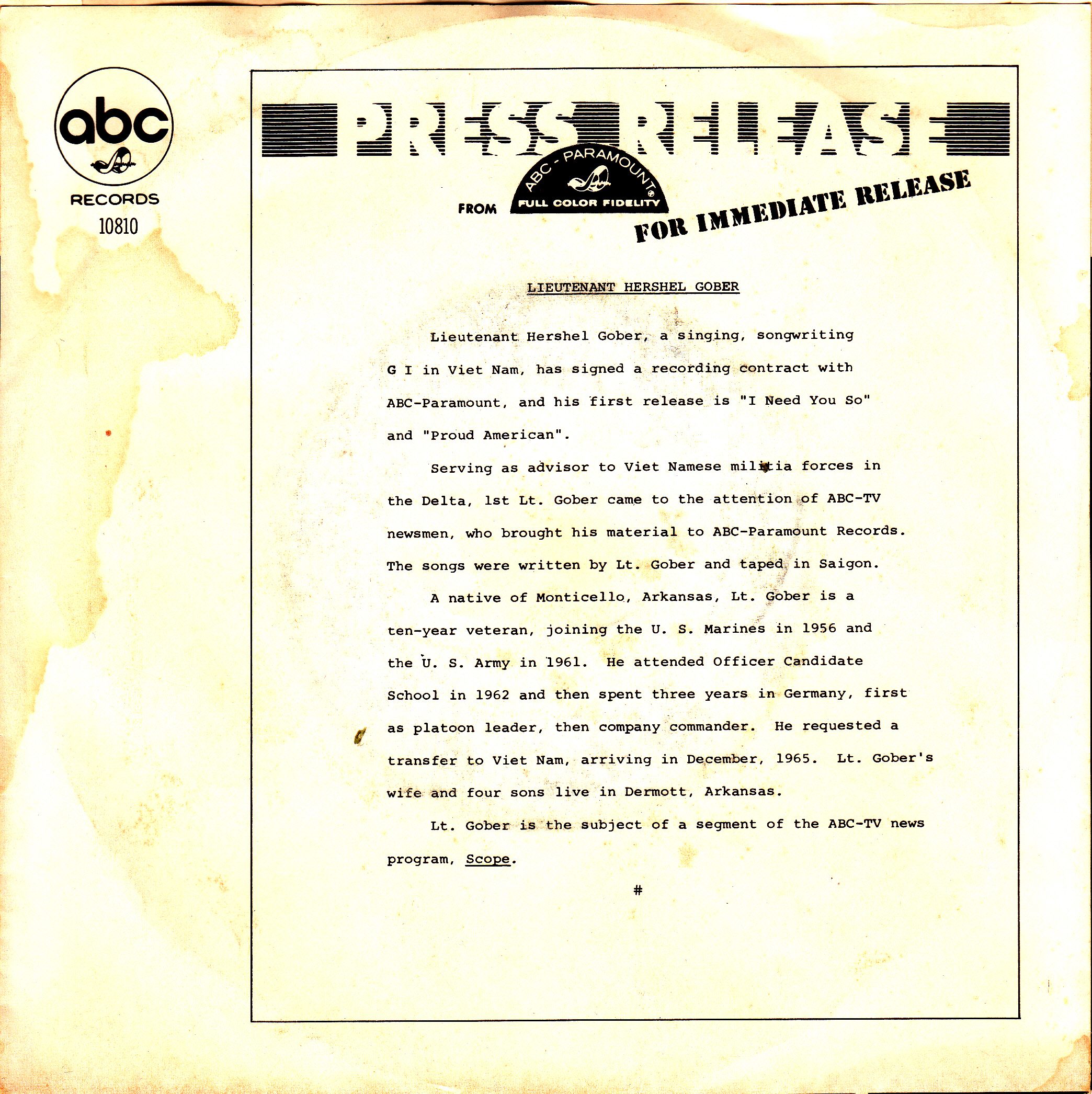
The picture sleeve (ABC Records 10810) shows "Lieutenant Hershel Gober" in fatigues sitting on the grass playing an electric guitar, with a rifle beside him. The reverse is printed as an ABC-Paramount "Press Release – For Immediate Release": Gober, "a singing, songwriting G I in Viet Nam" serving as advisor to Vietnamese militia forces in the Delta, came to the attention of ABC-TV newsmen; the songs were written by him and taped in Saigon.
It adds that he is a native of Monticello, Arkansas, joined the U.S. Marines in 1956 and the U.S. Army in 1961, arrived in Viet Nam in December 1965, and was the subject of a segment of the ABC-TV news programme "Scope". [From the record sleeve and labels]
The picture sleeve front shows a photograph of "S/Sgt. Barry Sadler" in Special Forces beret and uniform under the RCA Victor "His Master's Voice" logo.
The back, headed Christmas "Special", lists 47-9008 "I Won't Be Home This Christmas" (2:14) and "A Woman Is a Weepin' Willow Tree" (2:28), with notes in English and French describing the A-side as the ballad of a soldier writing a letter to his family, sung by Sadler "who has lived the experience", and the backer as folksy. [From the record sleeve and labels]
The song "The Reporter of Wars"
In country, military
Billboard, 7 January 1967: "The Army's Special Forces has contributed a second 'Green Beret' to the ranks of the music industry. Columbia Records has recorded and released two sides penned and performed by Gene Wyles, currently a captain in the elite army unit. Wyles Columbia recording, produced by Don Law and Frank Jones, was released last month without reference to Wyles occupation and outstanding war record. Jones feels that Wyles musical talents are solid enough to stand on their own merits, without exploiting the singer's full-time career and heroic background. Wyles sings 'Follow Me', a controversial song challenging U.S. draft dodgers to join him in Vietnam, b/w 'The Reporter of Wars' for his record debut. The singing soldier found the theme for his country music style song as an officer candidate at OCS in Fort Benning, GA. Wyles was chosen to model for the fort's now-famous 'Follow Me' statue depicting a soldier leading his men into combat. The flip side is a tribute to the courageous journalist and photogs covering the Vietnam war".1
LPM/LSP-3547" (an RCA Victor Dynagroove recording) with its twelve tracks: The Ballad of the Green Berets / Letter from Vietnam / I'm a Lucky One / Garet Trooper / The Soldier Has Come Home / Salute to the Nurses / I'm Watching the Raindrops Fall / Badge of Courage / Trooper's Lament / Bamiba / Saigon / Lullaby. In Japan, Victor SS-1671 (Victor Company of Japan, Ltd.) issued the coupling as "悲しき戦場〜グリーン・ベレーのバラード" [Sad Battlefield – The Ballad of the Green Berets] / "ベトナムからの手紙" [Letter from Vietnam], sleeve headed "話題の焦点!! 全米ヒット・パレードにも急上昇!!" [The talk of the town!!
Shooting up the US hit parade!!]; its gatefold prints Japanese notes saying the song sold 400,000 copies in its first two weeks and that Sadler, a 25-year-old New Mexican with seven years in the Air Force and Special Forces, served in Vietnam from spring 1965 and lives at Fort Bragg with his wife Lavenia and son Thor, together with the English lyrics of both songs (price ¥370).
A later SS-1671 pressing subtitles the song as the theme of the Warner Bros.-Seven Arts film "グリーンベレー" (The Green Berets) and comes in a film tie-in sleeve with John Wayne and David Janssen, film credits (directed by John Wayne, produced by Michael Wayne, from the novel by Robin Moore, music by Miklós Rózsa), a synopsis, and notes stating that Sadler joined the Air Force in 1958, went to Vietnam with the Green Berets in 1964, was wounded in the leg by a poisoned bamboo-stake trap on patrol in spring 1965, that the record, released in January 1966, reached No. 1, and that its proceeds went to war-orphan homes (price ¥400); its company sleeve is Reprise-branded, "Manufactured by Victor Record Company Ltd., Japan by agreement with Cosdel Inc."
The German RCA Victor 47-9688 sleeve couples the song with "Badge of Courage" under "Original-Aufnahme Nr.1 in Amerikas Hot 100", credited to Staff Sergeant Barry Sadler. The Spanish RCA Victor 3-10152 (RCA Española, S.A., Torre de Madrid; Depósito Legal M. 3702-1966) pairs "The Ballad of the Green Berets (Balada de los boinas verdes)" (Sargento Barry Sadler–Robin Moore), 2:26, 3F6ZW-0001, with "Saigon" (Sargento Barry Sadler), 2:27, 3F6ZW-0002, credited to Sargento Barry Sadler, "Arr. y Dirección: Sid Bass", the back printing a "traducción literal al español" of the lyrics. [From the record sleeve and labels]
Fanfare / country, patriotic, soldier's perspective. South Carolina.
Story about the fighting GIs. I'm serving in Vietnam. Fighting spirit is there.
Paytime - night on the town (R&R)
Next day back to work. Medics, truck driver, green berets, marines, navy, airforce - one big team
db Records RCR-65-22 (SoN 35041), 2:55; (B. Haney); Clay Music, BMI; distribution by Richland custom recording, Columbia, South Carolina. [From the record label]
Also issued on Cherry Records 4503 as by Sgt. Bill Haney, 2:47, (William J. Haney), McCloud Music BMI, 1705 Church St., Nashville, Tenn., with a different B-side. [From the record label]
1967
The a-side consists of two "homemade" recordings, the first by Bleeker in the US speaking about religion, he then sings a song which references Vietnam, and talks about heading out to war. The second recording Bleeker made in Vietnam, addressed to his parents, describing his experiences in Saigon etc. The b-side is a recording from his family's church memorial service. The minister comments on Vietnam, criticising the anti-war movement.
The front cover carries a studio portrait of Bleeker in Marine Corps dress uniform, signed "2nd Lt. Larry Bleeker". A typed insert headed "2nd Lt. Larry Bleeker Testimonial Record" offers the record at $4.00 each c/o Walter Sutherland, 301 N. Franklin, Ames, Iowa 50010, and lists Side 1 as "2nd Lt. Bleeker testimony: University Freshman, University Senior, After Commissioned, From combat zone - Viet Nam" and Side 2 as "Memorial Service, Dr. Paul Tassell".
The insert reprints an Ames Daily Tribune clipping dated 10-30-67, "Ames Marine was killed in Vietnam", reporting that Marine Corps Second Lt. Larry Bleeker, 24, son of Mr. and Mrs. Hiram W. Bleeker, was killed by sniper fire in a defensive position, that he was a 1961 graduate of Ames High School and a 1966 graduate of Iowa State University, active in the Navigators, Campus Crusade for Christ and Intervarsity, and that he had made tape recordings for friends and family, quoting one sent to his parents: "Mom, Dad, I want you to know I'm ready to go...
I'm ready to live, die or to do either for the glory of Jesus Christ." It also reprints a letter to the editor by David H. MacIntrye from The Antelope, Kearney State College, Kearney, Nebraska, describing "II Lt. Lawrence D. Bleeker, 24, known to his buddies as 'Bleek'", killed in Vietnam on October 26 "downed by a sniper's bullet", who "went to Vietnam as a Marine because he believed with all his heart that God wanted him to take the gospel of Peace to Marines." [From the record sleeve and labels]
Veteran, served in Vietnam 1965-66. Probably released 1966-67
Country. Narrated by a soldier in the army - just returned home from Vietnam.
Discovered that his best friend died out there - the price of freedom.
Religious references.
Artist from Pennsylvania, USA. Hawaiian descent
Served in Air Force as an Airman 1st Class in Guam
Song released when he was 23
Country, soldier's perspective.
Orders to go - what's it like in Vietnam?
Not a war to end all wars.
Different sides
Honor the fallen soldiers
Interview
Hymn to a Returning Soldier (King, Ric)
A-side:
Fanfare, soldier's perspective.
Glad to be home from Vietnam - drive through the town, recalls old time, hang-outs, old friends, his girlfriend, his dog, his football coach, the banker etc. But it is in fact his funeral that the town has gathered for - KIA.
Some early descriptions of PTSD (even though the narrator is dead) - cannot forget the jungle, nightmares about Vietnam.
B-side: instrumental.
Soul, funk
Soldier's perspective - can't wait to see my sweetheart
I'm coming home, that's why I keep on marching
War Is Hell (Carter, Frank)
Country. Charlotte, North Carolina.
Combat, soldier's perspective. Both sides.
A-side: received draft card. Went to training, shipped to Vietnam.
Viet Cong all around, bad place to play the guitar!
B-side: leans towards anti-war.
Hymn to a Returning Soldier (King, Ric)
A-side:
Fanfare, soldier's perspective.
Glad to be home from Vietnam - drive through the town, recalls old time, hang-outs, old friends, his girlfriend, his dog, his football coach, the banker etc. But it is in fact his funeral that the town has gathered for - KIA.
Some early descriptions of PTSD (even though the narrator is dead) - cannot forget the jungle, nightmares about Vietnam.
B-side: instrumental.
War Is Hell (Carter, Frank)
Country. Charlotte, North Carolina.
Combat, soldier's perspective. Both sides.
A-side: received draft card. Went to training, shipped to Vietnam.
Viet Cong all around, bad place to play the guitar!
B-side: leans towards anti-war.
1968
Herrington married Chris Noel, a Hollywood actress and radio show host, as reported in her home town paper, the Palm Beach Daily News (4 January 1969).1 Noel became a DJ for the Armed Forces Radio Network in 1965, with a show called "A Date with Chris", recorded in the US on 33rpm LPs, and then sent onto US Vietnam radio stations. Some people viewed the show as America's answer to Hanoi Hannah, the North Vietnamese radio DJ (of which there are several songs about, including on the 1973 album Roger McGuinn).2 North Vietnam actually put a $10,000 bounty on her head. In December 1966 she joined Bob Hope on his tour in Vietnam (see the album On the Road to Vietnam), and performed there on several other occasions. It was at Camp Goodman, in South Vietnam (near Saigon) that Noel met Herrington: "then a lieutenant who was there, Ty Herrington, said, 'Miss Noel, would you like to see our camp?' Shortly after that day he became my escort officer. After a couple of more tours we were in love and we got married".3 However, the marriage ended badly:
- 1 Palm Beach Daily News, 4 January 1969 ↩
- 2 Daily News, 4 January 1969 ↩
- 3 historynet.com: The vietnam interview a date with chris noel ↩
The song "Here I Am" looked at a lonely soldier away from home, missing his sweetheart. The track started with a spoken-word introduction: "a feeling that all soldiers have shared since the beginning of time is the feeling of being alone and far from home. In Vietnam I had this feeling, so I wrote this song" . Thus, a fairly typical soldier boy song of the 1960s period. Of greater interest, he narrated the song "Picture of a Man" (Tee Pee Records # 834T-4533) from the perspective of an American soldier who became friendly with a South Vietnamese man. The US soldier described how the Viet Cong attacked the man's son at an outpost. The US soldier found the body: "I saw him hanging on a barbed wire fence...his head was blown off...I never shed so many tears" . The man "attacked by over 300 Viet Cong" , attempted to "keep his country free" . While it is interesting for an American folk song to focus on the loss of a Vietnamese life, it sought to defended the existence of South Vietnam against the communist Viet Cong forces, and hence justifying the role of the US soldier. Therefore, this can be viewed as military propaganda. Re-issued in 1970 (Picture of a Man - Buddah Records # BDA 152), his title on the record went from "Capt." to "Major".
The song "Saigon Warrior" is a comedy addressed to American GIs, which Gober wrote while touring around the hospitals in Vietnam. The lyrics criticised those who spent a lot of time in Saigon: "helping fight a war, pushing a pencil my finger is getting sore" . It also focused on GIs visiting prostitutes in the Saigon bars, referencing the famous "Tu Do Street" , the main location of these establishments. Tu Do translated as "Liberty", called that between 1955 and 1975. Formerly known as Catinat street (pre-1955), Hanoi re-named it Dông Khoï ("General Insurrection") after the fall of Saigon.2
This may be some sort of variation on another song, with the same name, but similar theme: "Saigon Warrior" performed by Maggie, an unknown Australian artist, recorded in-country during the war - one of the rare female performances from the Vietnam War. According to the article "Songs of the Vietnam War: An Occupational Folklore Tradition", by Dr. Les Cleveland (1986)1:
According to the 1991 compilation In Country: Folk Songs of Americans in the Vietnam War, compiled Lydia Fish, which featured a version by US veteran Saul Broudy:
The song "Here I Am" looked at a lonely soldier away from home, missing his sweetheart. The track started with a spoken-word introduction: "a feeling that all soldiers have shared since the beginning of time is the feeling of being alone and far from home. In Vietnam I had this feeling, so I wrote this song" . Thus, a fairly typical soldier boy song of the 1960s period. Of greater interest, he narrated the song "Picture of a Man" (Tee Pee Records # 834T-4533) from the perspective of an American soldier who became friendly with a South Vietnamese man. The US soldier described how the Viet Cong attacked the man's son at an outpost. The US soldier found the body: "I saw him hanging on a barbed wire fence...his head was blown off...I never shed so many tears" . The man "attacked by over 300 Viet Cong" , attempted to "keep his country free" . While it is interesting for an American folk song to focus on the loss of a Vietnamese life, it sought to defended the existence of South Vietnam against the communist Viet Cong forces, and hence justifying the role of the US soldier. Therefore, this can be viewed as military propaganda. Re-issued in 1970 (Picture of a Man - Buddah Records # BDA 152), his title on the record went from "Capt." to "Major".
The song "Here I Am" looked at a lonely soldier away from home, missing his sweetheart. The track started with a spoken-word introduction: "a feeling that all soldiers have shared since the beginning of time is the feeling of being alone and far from home. In Vietnam I had this feeling, so I wrote this song" . Thus, a fairly typical soldier boy song of the 1960s period. Of greater interest, he narrated the song "Picture of a Man" (Tee Pee Records # 834T-4533) from the perspective of an American soldier who became friendly with a South Vietnamese man. The US soldier described how the Viet Cong attacked the man's son at an outpost. The US soldier found the body: "I saw him hanging on a barbed wire fence...his head was blown off...I never shed so many tears" . The man "attacked by over 300 Viet Cong" , attempted to "keep his country free" . While it is interesting for an American folk song to focus on the loss of a Vietnamese life, it sought to defended the existence of South Vietnam against the communist Viet Cong forces, and hence justifying the role of the US soldier. Therefore, this can be viewed as military propaganda. Re-issued in 1970 (Picture of a Man - Buddah Records # BDA 152), his title on the record went from "Capt." to "Major".
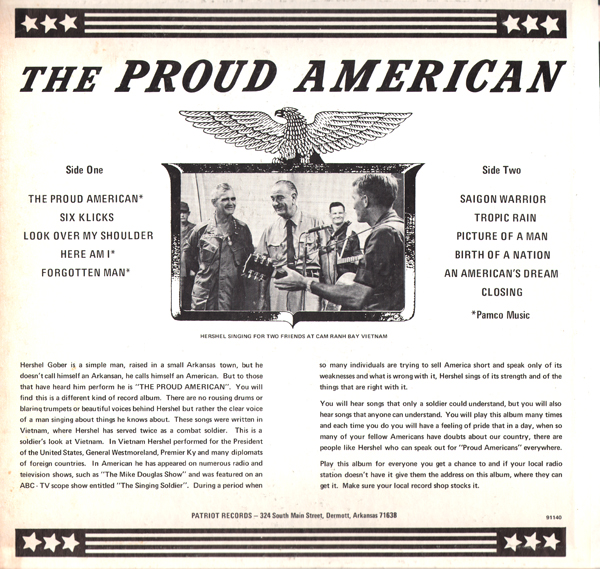
The LP The Proud American, Patriot Records 91140, Dermott, Ark., blue labels, 33 1/3 RPM: side one "Proud American" 2:45, "Six Klicks" 2:50, "Look Over My Shoulder" 3:46, "Here Am I" 4:00, "Forgotten Man" 2:45; side two "Saigon Warrior" 5:56, "Tropic Rain" 3:54, "Picture of a Man" 3:28, "Birth of a Nation" 3:10, "An American's Dream" 5:02, "Closing"; "All songs written and recorded by Hershel Gober", with Pamco Music credited for "The Proud American", "Here Am I" and "Forgotten Man".
The front cover shows Gober in Army uniform playing guitar at a microphone before a waving American flag; the back has a photograph captioned "Hershel singing for two friends at Cam Ranh Bay Vietnam" and notes saying the songs were written in Vietnam, where he served twice as a combat soldier, that he performed there for the President of the United States, General Westmoreland and Premier Ky, and that he appeared on "The Mike Douglas Show" and in an ABC-TV Scope programme entitled "The Singing Soldier"; Patriot Records, 324 South Main Street, Dermott, Arkansas 71638.
Also pictured is the ABC-Paramount single 45-10810 (AMP 45-13233), promotion copy not for sale: "Proud American" (1st Lt. Hershel Gober), 2:35, Pamco Music BMI, produced by Bob Thiele, arranged and conducted by Peter DeAngelis, in an ABC Records 10810 picture sleeve titled "I Need You So / Proud American — Lieutenant Hershel Gober" showing him seated in fatigues with an electric guitar, the back printed as an ABC-Paramount press release describing him as a singing, songwriting GI and adviser to Vietnamese militia forces in the Delta whose songs were taped in Saigon. [From the record sleeve and labels]
He is a Veteran of over 19 years in the Army. Two conflicts, Korea and Vietnam. Holds two Purple Hearts, Army Commendation Medal, Bronze Star Medal, Combat Infantry Badge, plus others, and has played over 400 shows for the sick and wounded in Vietnam, Korea, and the USA. Dee Lark Records"; and below the label: "D.J.'s: If this record is not available locally, $1.00 to Dee Lark Records, Box 134, Oak Grove, Ky.
42262 brings record postage paid. Thanks". [From the record sleeve and labels]
US military, war years, in country voices
The picture sleeve front, "The Marine's Ballad by GySgt. Bob Lay USMC", shows a red and blue drawing of a helmeted Marine with rifle above a map of the United States filled with photographs of Marines in action, landing craft and a parachutist; designed by Laura Wooten.
The back shows a portrait of Lay in dress uniform and notes that he has entertained since high school, was among the first Marines in Viet Nam (April 1964), returned for a second tour in February 1968, and wrote these two songs to render credit to the Marines serving there; the record is dedicated "to all Marines". [From the record sleeve and labels]
1969
This rare and unique recording of active service females performing a song in Vietnam, was given from Emily Strange to the editor of the Vietnam War Song Project, Justin Brummer, to post the song on YouTube, and to Hugo Kessing, for use in his book chapter "Understanding the Vietnam Era Through Music" (2013). Emily Strange wrote on 11 November 2011, "I never care about making money with my writings or songs. The people most interested are those who served in Nam and students writing reports for school. Nam Vets long ago paid the price for my songs and students need to understand the war".
The VWSP passed the song onto Erin R. McCoy, Associate Professor of English at the University of South Carolina Beaufort, for her book "A War Tour of Viet Nam: A Cultural History" (McFarland & Company, 2021). McCoy notes on p.102-03: "the duo recorded the song on tape, and Emily... had sent Dr. Brummer a copy. 'Incoming'" "features acoustic guitar and vocals and is hauntingly pretty... The particulars of 'Incoming' confirm that this is a war song created in the midst of war... Strange and Hagar... bemoan their decision to go to Viet Nam, using wit to describe their good-hearted motivations... They simultaneously convey lightness (via gallows humor) and weariness at the constant sirens and mortar shelling.... Their song offers us a momentary glimpse into the life of an American woman's role in a combat zone in Vietnam".2
Jonas returned from Vietnam in 1969 and recorded the album FSH Volume I (Goldust Records # LPS156), a collection of contemporary folk songs, influenced by US folksong revival of the 1960s.4 He also recorded during the Vietnam War years the 1971 album FSH Volume II - "YGBSM" (Goldust Records # LPS157) and the 1973 album Two Sides of Dick Jonas (Goldust Records # LPS-162). Included on this 1969 album was the song "Fighter Pilot's Christmas" in which the narrating soldier sent a Christmas message home to his family. A re-recorded version appeared on the 1991 compilation In Country: Folk Songs of Americans in the Vietnam War (Flying Fish Records # # FF 70552), part of the Vietnam Veterans Oral History and Folklore Project.5 Also note that on his 1971 album FSH Volume II - "YGBSM", discussed below, he wrote the song "Battle Hymn of the Red River Rats" which referenced P.O.W.s.&
Jonas returned from Vietnam in 1969 and recorded the album FSH Volume I (Goldust Records # LPS156), a collection of contemporary folk songs, influenced by US folksong revival of the 1960s.4 He also recorded during the Vietnam War years the 1971 album FSH Volume II - "YGBSM" (Goldust Records # LPS157) and the 1973 album Two Sides of Dick Jonas (Goldust Records # LPS-162). Included on this 1969 album was the song "Fighter Pilot's Christmas" in which the narrating soldier sent a Christmas message home to his family. A re-recorded version appeared on the 1991 compilation In Country: Folk Songs of Americans in the Vietnam War (Flying Fish Records # # FF 70552), part of the Vietnam Veterans Oral History and Folklore Project.5 Also note that on his 1971 album FSH Volume II - "YGBSM", discussed below, he wrote the song "Battle Hymn of the Red River Rats" which referenced P.O.W.s.&
The front cover shows an engraved eagle over a Stars-and-Stripes shield on a blue panel beside the title "FSH Volume I", with a Liberty Bell device. All selections written by Richard E. Jonas and published by Enchantment Music Co., BMI; musicians Jake Brooks (drums), Jim Bob Sedgwick (guitar) and Emmit Brooks (bass); recorded at Emmit Brooks Recording Studio, Mesilla Park, New Mexico, engineer Emmit Brooks.
The back carries a photograph of "Capt. Richard Jonas" in flight suit playing guitar beside an aircraft, with a note that he has flown the Phantom II over three continents and flew one hundred combat missions over North Vietnam. A signed dedication by Dick Jonas "To the 433D Tactical Fighter Squadron, 8th Tactical Fighter Wing, United States Air Force" speaks of flying "one hundred times into the enemy's homeland", of being one of Satan's Angels and of the Wolf Pack, and ends "I salute you, brave comrades, and I bid you God Speed."
Side 1: Tales That I Can Tell, The Ballad of Robin Olds, Little Town Up North, Son of Satan's Angels, Thud Pilot;
Side 2: Yankee Air Pirate, Will There Be a Tomorrow, Banana Valley, The MiG-21, A Fighter Pilot's Christmas. [From the record sleeve and labels]
The sleeve notes say the songs were written in part by Staff Sergeant James R. Raney, pictured on the cover, with his older brother Ed (honourably discharged from the U.S. Air Force) and younger brother Bill (serving in the U.S. Marine Corps) also contributing, and that they give "an honest look at our fighting men in Vietnam". They describe "The Jump" as a factual narration of the first combat jump of the Vietnam conflict, "Prayer for Dust Off" as a thank-you to the helicopter crews, and "Trooper's Green" as an imaginary place where all 173d troopers go when they die, and close by noting that James R. Raney was on his way back to Vietnam for his third tour, "All three times he volunteered to go."
Side 1: Ballad of the 173d, Prayer for Dust Off, Johnson's Gone to Hell, The Trooper's Green, Bugles at Twilight, Great Jumpmaster in the Sky;
Side 2: The Jump, The Immortal Sgt. Hanks, Corporal Barnes, Ol' Lead Bottom, Brother, Oh Dear Brother. [From the record sleeve and labels]
Matrix (etched): A ATP 5502-1 / B ATP 5503-1. Kurrt Watkins credited Written-By, Performer, and saxophone (uncredited). Discogs notes: 'Copy righted 23 July 1969'. Discogs genre Funk / Soul; styles Rhythm & Blues, Soul. Justin owns a copy (bought 2022-10-01, spreadsheet spells 'Kuurt').
Picture sleeve (front: photo of Kurrt Watkins with tenor saxophone); back: "Written and played by Kurrt Watkins – All rights reserved – Copy righted 23 July 1969"; red Side 1 label, 45 R.P.M. Kurrt Watkins was a US serviceman; released in Thailand (source: a book – reference to follow from Justin). [From the record sleeve and label]
1970
This album focused on the anti-war movement, in particular those who were members of the US armed forces - recorded at Fort Hood (Texas), Fort Benning (Georgia), and Fort Bragg (North Carolina). The album started out with a recruitment song, "Join the GI movement" , written by Barbara Dane: "I am a GI rebel as brave as I can be....come and join the GI movement" . The song "Ballad of Richard Campos" , written by Daniel Valdez, paid tribute to a man killed in Vietnam: "in a terminal in Oakland lies the brown body of a man, dead at 27, dead and gone to heaven, killed far away in Vietnam" . The song "Last Drink With Don" (lyrics written by Fred Gardner, and music by Barbara Dane) took a poetic approach: "here's to the butterfly in the tropics of Tonkin...and here's to the sky that is not filled with planes" . The album also covered "Just Another Day" by Bill Frederick (on the 1967 album Hey, Hey, LBJ), while the song "Hallelujah, I'm a Bum" made references to the Kent State killings, Richard Nixon, and the imprisonment of Bobby Seale and Huey P. Newton of the Black Panthers (see that section).
This album focused on the anti-war movement, in particular those who were members of the US armed forces - recorded at Fort Hood (Texas), Fort Benning (Georgia), and Fort Bragg (North Carolina). The album started out with a recruitment song, "Join the GI movement" , written by Barbara Dane: "I am a GI rebel as brave as I can be....come and join the GI movement" . The song "Ballad of Richard Campos" , written by Daniel Valdez, paid tribute to a man killed in Vietnam: "in a terminal in Oakland lies the brown body of a man, dead at 27, dead and gone to heaven, killed far away in Vietnam" . The song "Last Drink With Don" (lyrics written by Fred Gardner, and music by Barbara Dane) took a poetic approach: "here's to the butterfly in the tropics of Tonkin...and here's to the sky that is not filled with planes" . The album also covered "Just Another Day" by Bill Frederick (on the 1967 album Hey, Hey, LBJ), while the song "Hallelujah, I'm a Bum" made references to the Kent State killings, Richard Nixon, and the imprisonment of Bobby Seale and Huey P. Newton of the Black Panthers (see that section).
The front shows a line of helmeted GIs walking and flashing peace signs. The 16-page booklet opens with a photograph of Barbara Dane at the Oleo Strut, Fort Hood, Texas (photo by Carolyn Mugar), and contains "About the GI Movement" by Irwin Silber, on the GI coffee houses and underground papers; "If This Be Treason..." by Barbara Dane, describing singing for soldiers and Marines at the Oleo Strut, Ft. Dix and an Oceanside USO; notes on each song; full lyrics with credits; "Barbara Dane: Singer for the GI Movement" by Howard Levy; and "Barbara Dane Speaks to the GI Movement", reprinted from The Fatigue Press, GI newspaper, Fort Hood, Texas, an autobiographical letter signed "With all my love, Barbara".
It is illustrated with GI-newspaper headlines ("GI's Unite!", "Fort Riley Rebellion", "Brag Briefs"), cartoons and the statement "The opinions expressed in this paper are not necessarily those of the Dept. of the Army!", and closes with the Paredon Records manifesto.
Side I: Join the GI Movement (words Barbara Dane, after Aunt Molly Jackson's "I Am a Union Woman"); Hallelujah, I'm a Bum (new words 1970 by B. Dane and Irwin Silber); Ballad of Richard Campos (Danny Valdez); Go Tell It on the Mountain (Freedom Song from Mississippi 1964, brought up to date by B. Dane); Just Another Day (Bill Frederick); We Shall Not Be Moved, with Italian and Spanish verses.
Side II: The Resistance Hymn (tune Patriot Game, words adapted by B. Dane from "The Hello People"); Insubordination; Last Drink with Don (words Fred Gardner, music Barbara Dane); Bring 'Em Home (music and tag line Pete Seeger, new words by B. Dane and GIs from Ft. Hood, 11/9/69), with a footnote glossing "FTA" as the Army's "Fun, Travel and Adventure" and the GIs' "Fuck the Army!". [From the record sleeve and labels]
Also of interest, the album included a re-worked version of the song "Bring Them Home" , composed by Pete Seeger, which argued that the war was unjust, and that it was patriotic to bring home the soldiers and end the war. It contained the line "in Chicago or Vietnam, they're tryin' to get us to be the man" - which may be a reference to the Chicago 1968 demonstrations.
The front shows a line of helmeted GIs walking and flashing peace signs. The 16-page booklet opens with a photograph of Barbara Dane at the Oleo Strut, Fort Hood, Texas (photo by Carolyn Mugar), and contains "About the GI Movement" by Irwin Silber, on the GI coffee houses and underground papers; "If This Be Treason..." by Barbara Dane, describing singing for soldiers and Marines at the Oleo Strut, Ft. Dix and an Oceanside USO; notes on each song; full lyrics with credits; "Barbara Dane: Singer for the GI Movement" by Howard Levy; and "Barbara Dane Speaks to the GI Movement", reprinted from The Fatigue Press, GI newspaper, Fort Hood, Texas, an autobiographical letter signed "With all my love, Barbara".
It is illustrated with GI-newspaper headlines ("GI's Unite!", "Fort Riley Rebellion", "Brag Briefs"), cartoons and the statement "The opinions expressed in this paper are not necessarily those of the Dept. of the Army!", and closes with the Paredon Records manifesto.
Side I: Join the GI Movement (words Barbara Dane, after Aunt Molly Jackson's "I Am a Union Woman"); Hallelujah, I'm a Bum (new words 1970 by B. Dane and Irwin Silber); Ballad of Richard Campos (Danny Valdez); Go Tell It on the Mountain (Freedom Song from Mississippi 1964, brought up to date by B. Dane); Just Another Day (Bill Frederick); We Shall Not Be Moved, with Italian and Spanish verses.
Side II: The Resistance Hymn (tune Patriot Game, words adapted by B. Dane from "The Hello People"); Insubordination; Last Drink with Don (words Fred Gardner, music Barbara Dane); Bring 'Em Home (music and tag line Pete Seeger, new words by B. Dane and GIs from Ft. Hood, 11/9/69), with a footnote glossing "FTA" as the Army's "Fun, Travel and Adventure" and the GIs' "Fuck the Army!". [From the record sleeve and labels]
This album featured the song "Hey, Mr. Draft Board" (Elektra Records # EKS 74069), which took an anti-war perspective, with the narrator stating that "I don't want to go" and calling it a "dirty war" . The narrator complained about being drafted, but not being able to vote. The narrator also suggested that those who started the war, the politicians, did not fight it, and thus it was not fair. The lyrics were backed by a military marching drum beat. At the end of the track, it included a spoken-word clip of a Vietnam veteran, being asked what he thought about the war: "I just come back from there, I think it stinks" . Another man said that: "I'm damn fed up with the damn war over in Vietnam, I lost two brothers in the damn thing" .
1971
This album FSH Volume II - "YGBSM" (Goldust Records # LPS157) was recorded in 1971, shortly after his first album FSH Volume I (Goldust Records # LPS156), recorded in 1969 - a collection of contemporary folk songs, influenced by the US folk revival of the 1960s, as well as including some country music influences.4 He also recorded during the Vietnam War years the 1973 album Two Sides of Dick Jonas (Goldust Records # LPS-162). He featured on the 1991 compilation In Country: Folk Songs of Americans in the Vietnam War (Flying Fish Records # # FF 70552), part of the Vietnam Veterans Oral History and Folklore Project.5 The song "Battle Hymn of the Red River Rats" , featured on the 1971 album, paid tribute to the US pilots in Vietnam. This included a line about the prisoners of war (P.O.W.s): "look around, there are a few empty chairs...some fight on from a cell" .
This album FSH Volume II - "YGBSM" (Goldust Records # LPS157) was recorded in 1971, shortly after his first album FSH Volume I (Goldust Records # LPS156), recorded in 1969 - a collection of contemporary folk songs, influenced by the US folk revival of the 1960s, as well as including some country music influences.4 He also recorded during the Vietnam War years the 1973 album Two Sides of Dick Jonas (Goldust Records # LPS-162). He featured on the 1991 compilation In Country: Folk Songs of Americans in the Vietnam War (Flying Fish Records # # FF 70552), part of the Vietnam Veterans Oral History and Folklore Project.5 The song "Battle Hymn of the Red River Rats" , featured on the 1971 album, paid tribute to the US pilots in Vietnam. This included a line about the prisoners of war (P.O.W.s): "look around, there are a few empty chairs...some fight on from a cell" .
The back carries a photograph captioned "Dick Jonas, Fighter Pilot", showing him in flight suit in front of an F-4 Phantom nose, and a sleeve essay that opens "A fighter pilot is a lot like a little boy" and explains the pilot's motivation through his faith in America, his oath to defend the Constitution, his presidential commission and the code of the American fighting man ("I am prepared to give my life in their defense").
"Sea Island R & R" is marked as a duet by Dick Jonas and his wife, Charlotte.
Side 1: Battle Hymn of the Red River Rats 2:47, Wolf Pack's Houseboy 3:02, Blue Four 2:33, Pine Cones and Oak Leaves 2:00, Normandy's Sand 2:28, Homeward Bound 2:01;
Side 2: Sea Island R & R 1:56, Old Weird Harold 3:10, Uncle's Nephews 2:04, I 'Druther Be an F-4 Jock 1:24, Short-Timing Sailor Boy 2:07, Love Angel 3:33. [From the record sleeve and labels]
Military, in-country.
Recorded 1970
Military, in-country.
Recorded 1970
Side One: The Inventory 4:23, Jolly Green 2:44, Mighty Dust Off 1:57, Dear Ma'am 2:07, I Fly the Line 2:40, Crack Went the Rifle 3:57; Side Two: Da Nang Lullaby 2:52, Saigon Girls 2:17, Puff 3:26, Tchepone 4:04, Republics Ultra Hog 2:27, The Devil Clapped His Hands 3:05.
The front cover, "Bull Durham's Songs of S.E.A. – Twelve of the best songs to come out of South East Asia", has a bamboo frame, a colour photograph of Durham in a patched flight suit with an acoustic guitar, and a cartoon bull playing a guitar under palm trees; this copy is signed "Bull Durham" in marker. [From the record sleeve and labels]
Fanfare, patriotic. Veteran.
WW1 - grandfather spoke to son, need war to stay free. Fighting for liberty.
WW2 - dad told us about the war in Europe, it has to be won.
Now - he is off to Vietnam, hopefully the last father to speak to son about going to war.
Let people protest the war if they want, it's their right to.
1972
The most memorable and startling track is "Napalm Sticks to Kids" , a vivid account of US forces indiscriminately dropping bombs on Vietnam, hitting pregnant women, children, and other civilians. The focus of the song is chemical weapon Napalm B - a jellied gasoline mixture, with polystyrene, benzene, and gasoline. Declared a war-crime since 1980, the US government extensively used this weapon during the Vietnam conflict, dropping 388,000 tons on Indochina between 1963 and 1973.
The record booklet credited the song to "Air Force and Army GIs attached to the 1st Air Cavalry in Vietnam. Recited by Sgt. John Boychuk....a group of GIs sat down one night in a hootch in Vietnam to write these words. Each person made a verse about an incident in which he had taken part and the poem expresses their collective bitterness toward the military that had turned them into murderers". Some have questioned the booklet's claim regarding the origins of this song - in terms of who wrote it and the nature in which it was composed. Several Vietnam veterans have claimed that this song was commonly heard 'in-Country', and used in a "humorous" way. However, this particular record and version of the song were used to present an anti-war perspective about the war in Vietnam, and express opposition to the use of napalm, as seen on the LP cover and in the booklet that came with the record.
The song made a special reference to the company Dow Chemical, which produced napalm and agent orange under a 1965 government contract. Several other suppliers stopped production of these weapons because of protests and bad publicity. But Dow Chemical continued as the sole provider of napalm and agent orange because of its commitment to the government.
The 16-page booklet lists the members alphabetically (A1C John Carson, A1C Dave Davis, Sgt. Tom Derreck, Sgt. Patrick Henry, A1C George Herkert, A1C Al Kramer, A1C Joe Massaro, Carolyn Mugar, Vic Pacania, Airman Penny Rand, A1C Jim Schaffer, A1C Tom Spaulding) and opens with an introduction calling it the first GI anti-war project to produce its own record, urging listeners to write to the group and subscribe to its paper, The Helping Hand, Box 729, Mountain Home, Idaho 83647.
"The Covered Wagon: Finding the Power to Affect Our Destinies", notes by Mark Lane, recounts the founding of the Covered Wagon GI project and coffeehouse in spring 1971, the burning of the first coffeehouse in November 1971, the arrest of nine members outside the Rodeway Inn in Boise at a dinner honouring General William Westmoreland in August 1971, the group's conscientious-objector counselling (68 honourable C.O. discharges in a year), and profiles of members including Tom Spalding, Steve Hawkins, Tom Mason, Jim Schaffer, Steve Miller, Gary Aker, Tom Tierney, Penny Rand and John O'Connor.
Each song is printed with full lyrics, credits, time and a short introduction; photographs show the Helping Hand committee, the "March Against Genocide", Moratorium Day banners at the 391st TAC Fighter Wing barracks on October 13, 1971, and the original Covered Wagon coffeehouse with a GI-painted copy of Picasso's "Guernica".
Recorded at the Covered Wagon; mixing and re-engineering by Jonathan Thayer, A-1 Sound Studio; booklet edited by Barbara Dane; photographs by Carolyn Mugar and Covered Wagon; booklet production by Collective Graphics Workshop; printing by Faculty Press; production supervised by Barbara Dane. [From the record sleeve and labels]
On this 1972 album featured the song "The Chicago Conspiracy" (Apple Records # SW 3391) which addressed both the 1968 Chicago demonstrations and the "Chicago Eight" - the narrator listed all eight of the high-profile protesters arrested and charged, including Bobby Seale, which many other songs excluded in favour of the "seven". The song placed blame on the Chicago mayor: "Daley made this place a city of disgrace" . The narrator said that the arrests and trial revealed that "we're not free in this society" . It encouraged the listener to "kill..fight...never run" and to keep "marching against the great injustice" .
1973-1975: Paris Peace Accords to the Fall of Saigon
- 23 January 1973: Nixon announces peace agreement: 'peace with honor'.
- 27 January 1973: Paris Peace Accords signed.
- 27 January 1973: Draft official ended in favour of voluntary enlistment.
- 12 February 1973: Operation Homecoming.
- 29 March 1973: Final US troops leave Vietnam.
- 30 April 1973: Halderman and Ehrlichman resign over Watergate.
- 19 June 1973: Case-Church Amendment.
- 14 August 1973: Cambodia bombing halted, in compliance with Congressional ban.
- 7 November 1973: Congress passed War Powers Act.
- 9 August 1974: Richard Nixon's resigns as president. Gerald Ford takes over.
- 13 December 1974: North Vietnam violates peace agreement.
- 10 March 1975: North Vietnamese offensive on South.
- 30 April 1975: US Embassy in Saigon fully evacuated.
- 1 erosonic.com ↩
1973
The front shows Dick Jonas in a flight suit with squadron patches, seated by a flowering hedge with an acoustic guitar; cover photography by David M. Hornbaker.
Side One: The Wrench Bender's Revolt 2:50, God Bless the Gun Plumber 2:26, Thanh Hoa Bridge 1:43, The Ballad of Jeb Stuart 3:01, Pull the Boom from the Gashole 3:27, Angelina 2:47; Side Two: Old Henry's Hoss 2:34, Sharecroppin' 2:52, Seven Little Chartreuse Men 2:39, Saydee Bel 2:12, Seaboard Line 2:01, Loving Her Was Easier (Than Anything I'll Ever Do Again) (K. Kristofferson) 2:46; all other selections written by Dick Jonas and published by Enchantment Music Co., BMI.
Musicians: Dick Jonas, rhythm guitar; Calvin Turbeville, steel guitar; Jake Brooks, drums and lead guitar; Emmit Brooks, bass; recorded at Emmit Brooks Recording Studio, Mesilla Park, New Mexico, engineer Emmit Brooks. Emmit Brooks's sleeve note recalls meeting Jonas in August 1969 at Holloman Air Force Base, recording FSH Volume I and Volume II of songs from his tour of duty in Southeast Asia, involvement in the POW-MIA campaign, and permission for "Battle Hymn of the Red River Rats" to be used in the film "Summer of '72"; it presents the album as "fighter pilot and good ole boy". [From the record sleeve and labels]
By All of the Above, a Virginia based band, featuring Keith John, Marc Clements, Bill Graves, and Andrew Wilson.1 Song composed by Andrew Wilson, a Vietnam veteran, who wrote after returning to the US.2
Fanfare, P.O.W. Military perspective.
A-side: they say that the war is over - no glory, no victory.
Glad it's over - I buried 18 friends.
I'm in a filthy prison camp, but returning home
B-side: back in the world
1974
1975
Psychedelic rock Mexican-American group founded in Texas, said to have recorded this album in one 10-hour session in San Antonio, TX, featuring Eugenio Jaimez, Sonny Ramirez, Ruben Ramirez, and Carlos Salazar. Lead singer Eugenio Jaimez, from Cotulla, TX, where President Lyndon B. Johnson once taught at the Welhausen Mexican School, was wounded in the Vietnam War. Now living in Loredo, Texas, he described the album as a: "remembrance of a hellish war that many of our brothers met with by chance". (1) The album started with describing his agricultural background with "Work Your Hand to the Bone", on to serving in the Vietnam War with the track "Pleiku", and then returning to the US with "Going Home".
For the Truth and the Right (Sadler, Barry)
A-side: Military perspective. Fanfare. 1975.
Walked through Arlington Cemetery - saw the unknown soldier.
50,000 men dead (i.e. Vietnam): bless them all
Criticism of the politicians
Need b-side.
The picture sleeve front shows a black-and-white portrait of Sadler in a beret with the Special Forces flash, titled "Bless Them All b/w For the Truth and the Right".
The back reads "S/Sgt. Barry Sadler of 'The Ballad of the Green Berets' fame is back again! Listen Up America For Those That Are Gone 'Bless Them All'". [From the record sleeve and labels]
This album contained four songs that dealt with Vietnam War issues. These are "It Could Have Been Me" by Holly Near about the Kent State, Ohio demonstration, which also appeared on her LP A Live Album (see the sub-list); Oscar Brand's "A Very Nice Country" about Americans living in Canada in exile (because of draft avoidance and opposition to the war); "Ballad of the Unknown Soldier" by Barbara Dane. Finally, it included the song "Play Your Guitars, American Friends" by Alfonso Ray Riate, a Vietnam veteran who had been a P.O.W. Dane wrote in the record booklet that: "I first heard Al Riate sing as he stood with two other former POWs on the platform of a rally for amnesty in Washington, D.C. He was simply glowing with the joy of finally being there....I immediately asked him if he would record one of the Vietnamese songs...Al...confirmed the fact that far more fellow POWs felt as they did than identified with the officers who had kept themselves apart in sour disdain of the Vietnamese, with their sights on their future military careers".2
Riate was born on 29 April 1945 in Sebastopol, California, USA, and died on 28 November 1984, in Lynwood, CA, USA. He joined the US Marine Corps in December 1964 at the age of 19. His father came from the Philipines, and his mother was a Native American from California. The army reported Riate M.I.A. on 26 April 1967 following a battle in Quang Tri Province in the vicinity of Hill 861. On 12 July 1967 he was reported K.I.A., but body not recovered (B.N.R.). A memorial plaque erected says: "1945-1967". However, the army eventually reported that he was in fact a P.O.W. He returned to the US on 16 March 1973.3 The army charged Riate for collaborating with the enemy, but the charges were dropped in 1973.4
Composed in Hanoi in December 1969 by Phạm Tuyên, a well-known North Vietnamese songwriter, about an anti-war demonstration in the US, which became popular across North Vietnam.5 It started out with an English spoken-word introduction from Riate, who told the listener that he had served "six years as an American prisoner of war in Vietnam" . He then recited the song in Vietnamese, which took an anti-war, peace perspective, calling on Americans to march and play songs of protest against US intervention in Vietnam.
- 1 What Now People, Vol. 1 - Paredon 2001 ↩
- 2 What Now People, Vol. 1 - Paredon 2001 ↩
- 3 Find a Grave ↩
- 4 Chicago Tribune, 3 July 1973, p. 1: "Army set to drop POW case" ↩
- 5 Wikipedia: Phạm Tuyên ↩
Post-War: 1976-present
Themes especially found in the post-Vietnam War era are lyrics about post-traumatic stress disorder, prisoners of war and the missing in action, the plight and treatment of veterans, and agent orange.The 1980s especially saw a revival of interest in the Vietnam War, which had subsided in the mid to late 70s following the US withdrawal. Both films and music sought to reflect on the impact the war had on American society and to ask "why did the North win?" A Reagan-era trend of nationalism grew, an attempt to overcome the "Vietnam Syndrome" - the perception that domestic controversies over the war led to the US taking a less interventionist position in US foreign affairs. This term also applied to veterans, who may have felt guilt or shame about the war, influenced by the domestic climate they returned to in the US.1
Ronald Reagan spoke about this on 18 August 1980: "for too long, we have lived with the Vietnam Syndrome..As the years dragged on, we were told that peace would come if we would simply stop interfering and go home..We dishonor the memory of 50,000 young Americans who died..we give way to feelings of guilt as if we were doing something shameful, and we have been shabby in our treatment of those who returned. They fought as well and as bravely as any Americans have ever fought in any war. They deserve our gratitude, our respect, and our continuing concern".2 Many war films of the period fitted into this climate of trying to overcome the Vietnam Syndrome, such as First Blood [Rambo] (1982), Uncommon Valor (1983), and Missing in Action (1984).
1976
- contemporary folk, released in Austin, Texas, USA, post-war, anti-war, protest
- Paints picture of US presence in Vietnam
- Reference to Vietnamese refugees in US.
- Also lists Vietnamese cities and areas, including My Lai
- "Little Rocks and Big Holes (In the Road)" is side A. Recorded at MacAdams Bros., Austin; Texas Deck Music (BMI); no printed writer credit. Dubious Records 66 x 33, Side 1, BMI, 4:23; "Fourth of July in Chu-Lai" by Bill Oliver, published by Texas Deck Music, ℗ 1976 Bill Oliver. Musicians: Bill Oliver (vocal, guitar, harmonica), Glen Waldeck (drums), Nancy Needles (viola), Rich Latimer (bass), David Dodson (electric guitar); engineers Alan MacAdams and Dick Snider.
The cream label shows a drawing of a farmer ploughing behind a draught animal, with the slogan "Speak for Themselves". [From the record sleeve and labels]
1978
The booklet says the song was written for the first anniversary of her death. [From the record sleeve and booklet]
1981
Patriotic, post-war
California
Parade and yellow ribbons to welcome home 52 hostages held in Iran, 8 men gone.
Hell in Iran reminds me of Vietnam, disabled vet, held prisoner.
Remember friend killed in action (K.I.A.) in Vietnam.
I'm a VFW from Vietnam at home in the USA
1982
The song "Who are the names on the Wall?" (Windmill Productions # UR-4324) referred to the memorial wall in Washington D.C. The narrated recalled several of the people he knew, and how they were K.I.A.: "I've seen so many...Don Michael was on that Wall" . The narrated noted that "one guy got blown away on his first day" . This track also contained PTSD references, such as the veteran "who go back to 'Nam every night, when they're supposed to be asleep" . At the end of the song, the narrator concluded with the question: "did it ever really matter at all? Hell yes it mattered" .
- 1 Wall, The (The Vettz) ↩
- 2 engineersvietnam.com (archived copy) ↩
- 3 ReverbNation (link no longer available) ↩
- 4 efolkmusic.org: Wayne barker (link no longer available) ↩
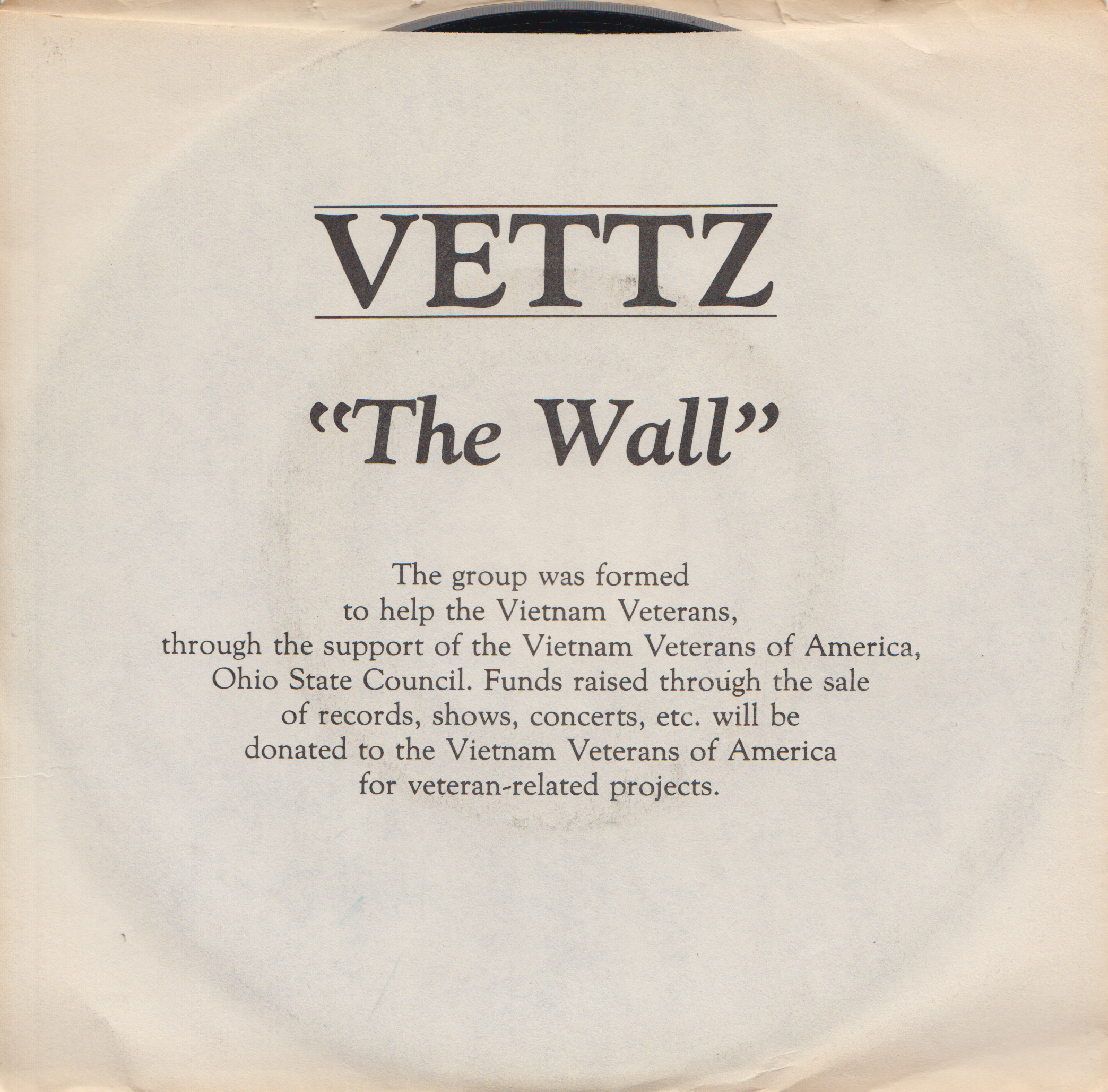
The picture sleeve front is a drawing of an American flag and a rose before a wall repeating "The Wall", captioned "A Salute to the Vietnam Veterans — by Festival".
The back gives the writers in full (Lyle Zoerb, Ray Roth, Britt Small; Dan Daley), the full lyric of "The Wall", and notes that Britt Small served as a paratrooper with the 173rd Airborne Brigade in South Vietnam in 1970, where he was awarded the Purple Heart and the Army Commendation Medal, and that Festival appeared at the National Salute to the Vietnam Veterans in Washington, D.C., in November 1982, singing at the Vietnam Memorial and giving a concert at the base of the Washington Monument.
Band line-up: Britt Small (lead vocal, bandleader), Mark Reinig (drums), Becky Reinig (keyboards), Ray Roth, Jr. (bass), Stan Funston and Dann Hohn (guitar), Don Struve and Les Wetzel (trumpet), Russ Wetzel (trombone), Curt Pottratz (tenor sax), John Hafner (bari sax), with "Taps" by Don Struve; produced by Britt Small; front cover design by Phillip Van Voorst; "Max Stout Records, A Division of Festival Family Enterprises, Ltd."
The sleeve is signed in ink by Britt Small. [From the record sleeve and labels]
1983
Military - veteran
Written and recorded by Navy pilot Ed Bankston
Pensacola, Florida, USA.1
A1 I Roll (Red Rippers, The)
A2 Soldier of Fortune
A3 Firefight
A4 Who Remembers
A5 Vietnam Blues
B1 The Dark and Bloody Road
B2 She’s Been Down
B3 Body Bag
B4 Over the Edge
Military - veteran
Written and recorded by Navy pilot Ed Bankston
Pensacola, Florida, USA.1
A1 I Roll (Red Rippers, The)
A2 Soldier of Fortune
A3 Firefight
A4 Who Remembers
A5 Vietnam Blues
B1 The Dark and Bloody Road
B2 She’s Been Down
B3 Body Bag
B4 Over the Edge
1984
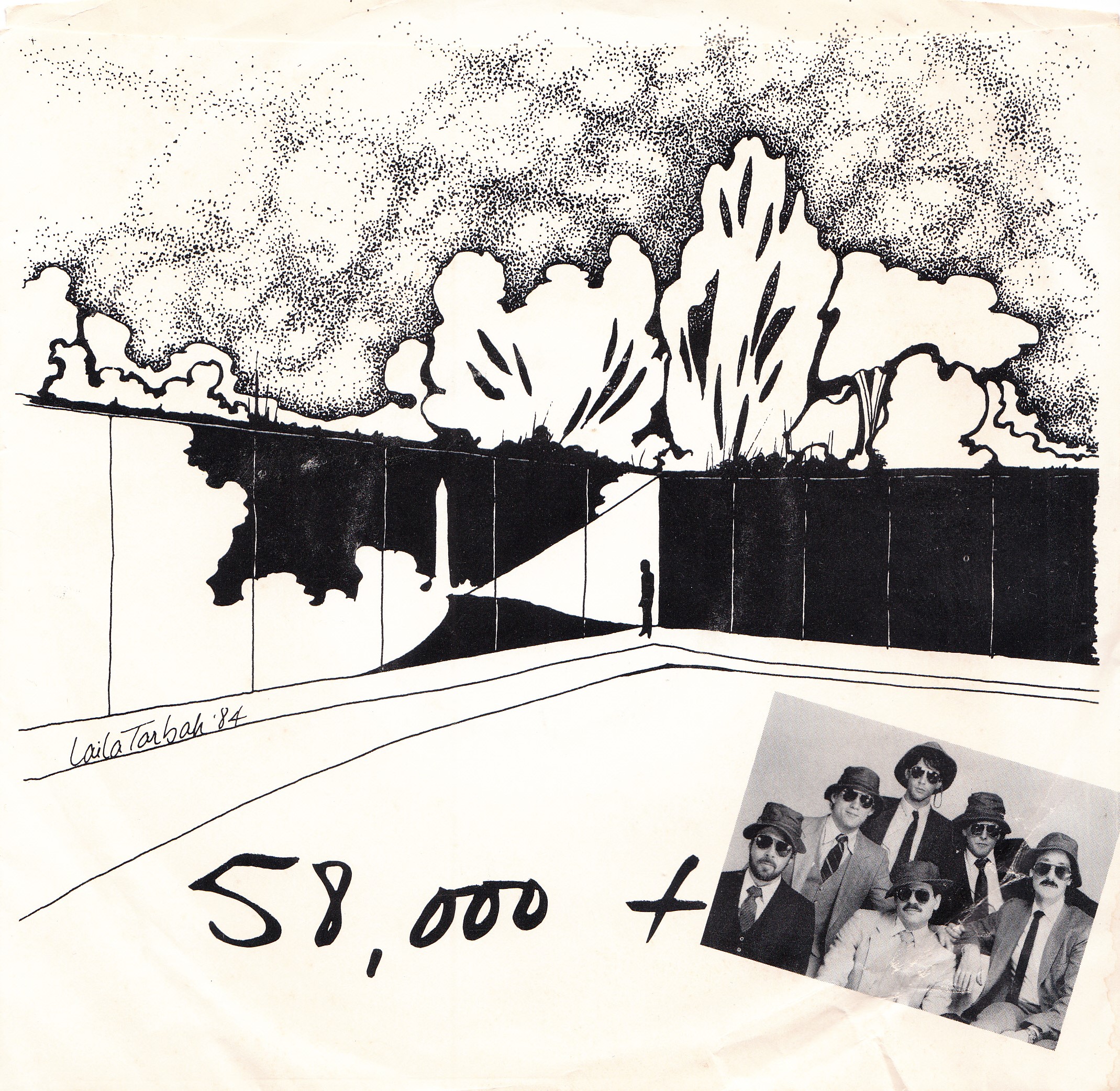
The picture sleeve carries a pen-and-ink drawing of the Vietnam Veterans Memorial wall with the Washington Monument reflected in it and a lone figure standing before it, signed "Laila Tarbah '84", with the hand-lettered title "58,000 +" and a photograph of the six-man group in suits, ties, sunglasses and bush hats. [From the record sleeve and labels]
The picture sleeve (©1984) shows a black-and-white photograph of Larry Green singing at a microphone with a guitar, wearing a badge-covered hat and a shirt embroidered "Larry Rhythm/Vocals", with his autograph and the caption "Singer, Songwriter, Recording Artist"; management, booking and fan club Earl Dixon Entertainment, Inc. The back lists: songs written by Larry Green; arrangements by Larry Green, Jeff Wise and Jim Roberson; band Heavy Country (Wally Burnette, bass guitar; Jeff Wise, steel guitar; Tom Rogers, harmonica; Danny Menzies, drums; Mike Parker, lead guitar; Joey Martin, rhythm guitar; Myron Prosser, fiddle); engineer Jim Robeson, Bias Recording Company, Inc., Alexandria, Va. [From the record sleeve and labels]
1985
1986
The back carries McKenna's note, signed "Bill McKenna, 'Wild Willie', 233-4008": his tour of duty changed him forever, the 22 months "in-country" and the condemnation he met on returning home, and his offering of these memories so that veterans "may share again the pride in each other that only we can know". Service printed: '68–'69, 7th Engineer Battalion, 1st Mar. Div., I Corps; '69, 3rd Amtrac Bat., 3rd Mar.
Div., I Corps. Dedicated "to all my brothers who served, especially to Animal, Doc, Lee, Freddie, Sonny, Mavrellis, Savo, Turk, Crazy Paul Harrington, Jim Mason, Matey and the more than 58,000 who were left behind." Tracks: side one Vietnam: Still Part of Who I Am, Billy's Friend, Kentucky Boy, The Veteran; side two R & R Woman, Vietnam Memories, Flashback, Không biết, America, Jake's Song. [From the record sleeve and labels]
- A-side: memorial wall, patriotic tribute
- B-side: P.O.W.s still in Vietnam, do they know the war is over?
Picture sleeve "Requiem": vocals Sam Jacobs, keyboards Don Baba, guitars Steve Dudas, bass Ed Alton, drums Billy Thomas; additional keyboards Greg Jackson; background vocals Bobby Caldwell, Mavis Vegas Davis, Linda Foote, Mark Hudson, Dave Jolliffe, Liza Miller, Michael Turner and Billy Thomas. Engineered by Jeff Harris; mixed by Jeff Hudson and Mark Hudson; recorded and mixed at the Village Recorder in April 1986. Dedicated "to our brothers and sisters who have died and to those of us who lived... Welcome Home!"; a major portion of the price went to "The Requiem Project" for Vietnam veterans' support groups (c/o The Village Recorder, West Los Angeles). Lyric insert with both songs. [From the record sleeve and labels]
Post-war 80s. Pop rock. Sacramento, California.
Veteran still living with Vietnam - PTSD.
Reference to M.I.A.'s.
A war without reason - people who died were innocent.
Picture sleeve front: the title in red over blue, with the title repeated in white lines and stars across the sleeve.
Sleeve back: "Dedicated to all people affected by the Vietnam War"; words and music © Doug Ranno, copyright PA892369 1986, published BMI Ranno Records 1986; produced by Doug Ranno with special thanks to Mike Mallett and Tom Phillips; recorded at Harbor Studios, Sacramento, California; manufactured by Sonic Arts; design by Diane Brown; special thanks to Michael Kelley, Tony Allen and Mike Mallett.
Ranno Records, P.O. Box 221427, Sacramento, California 95822-8429. [From the record sleeve and labels]
"this collection of songs is dedicated to the men and women who served in Southeast Asia during the Vietnam War, and to their families, many who whom continue to struggle with the aftereffects of an unpopular guerilla war. To my husband, Bobby Lee, an in-country Vietnam veteran...is my inspiration. A special thanks to the veterans who donated their time and efforts (including back-up vocals) towards making this project possible, and to the veterans, of Vet Center 226, and to the Vietnam Veterans of America"This is followed by a statement from Bobby Lee, about the song "Angel in the Green":
"Too little has been said about the women who served in the Armed Force of the United States of America...much too little. Perhaps it is our fault...the fault of men, especially veteran men. We hide our good feeling...such as pride, honor, and gratitude. Angel in the Green is...about the women I served with, women who elected to leave the security of a traditional world to serve their country; to risk their futures and their lives...these women are veteran in every respect, I salute them with pride."The song "From a Cross to a Star" dealt with the memorial wall in D.C. and the missing in action (M.I.A. issue). A country track, it took a religious perspective, with the narrator recalling a man and woman who visit the "cold slab of stone" everyday. Their son is apparently still classified as M.I.A., with a cross by their name. The couple prayed that the cross would turn to a star. The song does not mention P.O.W.s.
All tracks Vietnam related.
All tracks Vietnam related.
All tracks Vietnam related.
All tracks Vietnam related.
All tracks Vietnam related.
All tracks Vietnam related.
All tracks Vietnam related.
All tracks Vietnam related.
1987
The song "Finally Welcomed Home" started with some memorable sounds of the 60s, with a clip of Country Joe & The Fish performing "I Feel Like I'm Fixin' to Die Rag" at the festival Woodstock: 3 Days of Peace & Music: "terrible jam, way down yonder in Vietnam", followed by a quote from JFK: "bring this situation back to what it was" and then LBJ: "this is a different kind of war, there are no marching armies and solemn declarations". Next, a spoken-word intro, which referenced the memorial wall: "those were the sounds of the 10,000 day war, here's a reminder of what we were fighting for, but first lets bow our head in silence, for those names upon that stone, here's to the rest of us, we finally made it home". The song itself was a nostalgic look through American culture, suggesting that the soldiers were fighting to protect the American way of life.The song "Goodbye to West Virginia" described a young man being drafted by Uncle Sam to fight in the "hell of Vietnam". The lyrics provided a combat description: "deadly silence, flash of fire", which took the young man's youthful smile away. The soldier was K.I.A. and "now his name is inscribed on that black stone wall". His body was returned to his home in West Virginia.
The label states: "This material was written and performed by Vietnam Veterans for All Veterans, Especially those who served in The Vietnam Era."
The picture sleeve for "Finally Welcomed Home" shows a tinted combat photograph of two soldiers standing in a smoke-filled jungle clearing beside a covered body on the ground. [From the record sleeve and labels]
Narrative, post-war 80s. Patriotic.
Walk proud - forget about Vietnam
You did your duty.
1988
The front cover shows Bobby Ross in a cowboy hat beside the bronze figures of a soldiers' memorial; the back shows the inscription of the Vietnam Veterans Park memorial ("From 1961 to 1975, more than 49,000 Tennesseans served in Southeast Asia…") and a "Seal / LRRP / Big Red One" triangle emblem.
Credits: Don Hoffman, executive producer; Bobby Ross, producer and lead vocals; Mike Stidolph and Dick Bradley, associate producers; musicians include Eddie Bayers and Michael Young (drums), Mark O'Connor (fiddle, mandolin, mandola), Sonny Garrish (steel guitar, dobro), Bela Fleck (banjo), Terry Lee McMillan (harmonica), Reggie Young and Brent Rowan (guitars), Willie Rainsford (piano); background vocals include Stella Parton (courtesy of Airborne Records); photographer Mike Allen; engineer Jeff West.
Ross dedicates his performance to "the men of the Air-O-Rifle Platoon, 2/17 Cavalry, 101st Airborne Division, 1968, in I corps, South Vietnam", and the Nashville firms who helped make the album say to all Vietnam vets "At last, Welcome Home and God Bless". The lyric insert prints full lyrics with writer credits: Finally Welcomed Home (Don Hoffman, Judi Hoffman, Jeff Raymond), Back to Blue Jeans Again, Saigon State of Mind, Goodbye to West Virginia, The Reunion and The Voice of America (George Jeffrey), Too Close to the Line and The Home of Billy D. (George Jeffrey & Rick Cooper), Me and Oscar (Robert T. Alsterberg/Richard Helm), No Home for the Brave (In the Land of the Free) (George Jeffrey & Mel Besher); copyrights 1987, Too Close to the Line 1988. [From the record sleeve and labels]
- 1 Google News Archive ↩
- 2 archive.today ↩
- 3 inyork.com (link no longer available) ↩
1989
The song "God Bless America Tonight" (Fraternity Records # F-3546) - a patriotic, country pop, post-war 80s song about the memorial wall in D.C. contained some very interesting thoughts on the war. It is narrated from the perspective of a veteran who visited D.C., listening to the questions of his dead comrades. A dead soldier asked "did we finally win their freedom?" , meaning the South Vietnamese, thus the position of the US government's objective in the 60s & 70s to establish a non-communist South Vietnam. It then contained the line "did they finally let us fight?" - implying that the government / military establishment were preventing the soldiers from conducting the war properly, thus presenting that as an explanation as to why they lost the war. The narrated concluded that "there is something wrong here, with this country" . The song also dealt with the mistreatment of Vietnam War veterans, with the dead soldier saying: "did she treat my brothers right" . Released in Cincinnati, Ohio. Composed by Wayne Barker Jr. Produced by Wayne Barker Jr. and Ron Czarnecki. Engineer: Dale "Smitty" Smith.
- 1 Wall, The (The Vettz) ↩
- 2 engineersvietnam.com (archived copy) ↩
- 3 ReverbNation (link no longer available) ↩
- 4 efolkmusic.org: Wayne barker (link no longer available) ↩
The next song, "Just the Dream of Them All Alive" , came in at nearly 7-minutes long, told the story of a dream, in which the songwriter was at the wall, and the soldier's written there stepped out and started dancing to the music. The music provided comfort to both the living and the dead. The songwriter told the dead soldiers that "I won't let the world forget".
The next song, "Just the Dream of Them All Alive" , came in at nearly 7-minutes long, told the story of a dream, in which the songwriter was at the wall, and the soldier's written there stepped out and started dancing to the music. The music provided comfort to both the living and the dead. The songwriter told the dead soldiers that "I won't let the world forget".
1990
Ten years later they released the song "American Heroes" (Fraternity Records # F-3557), a soaring patriotic tribute to those that fought in Vietnam "for the freedoms of each woman, child, and man" . Interestingly, they also praised those back home for being heroes, such as the demonstrators: "I fought for this great land...like the four dead in Ohio, and the others who took a stand" . The group concluded by calling for unity to help the US go forward. With regards to praising the role of the Vietnam veterans, this can be seen as part of the 1980s / 90s attempts to overcome the 'Vietnam Syndrome', a trend often seen in post-war songs and films - the perception that domestic controversies over the war led to the US taking a less interventionist position in US foreign affairs. This term also applied to veterans, who may have felt guilt or shame about the war, influenced by the domestic climate they returned to in the US.5
- 1 Wall, The (The Vettz) ↩
- 2 engineersvietnam.com (archived copy) ↩
- 3 ReverbNation (link no longer available) ↩
- 4 efolkmusic.org: Wayne barker (link no longer available) ↩
- 5 The Columbia History of the Vietnam War (David L. Anderson, 2010) ↩
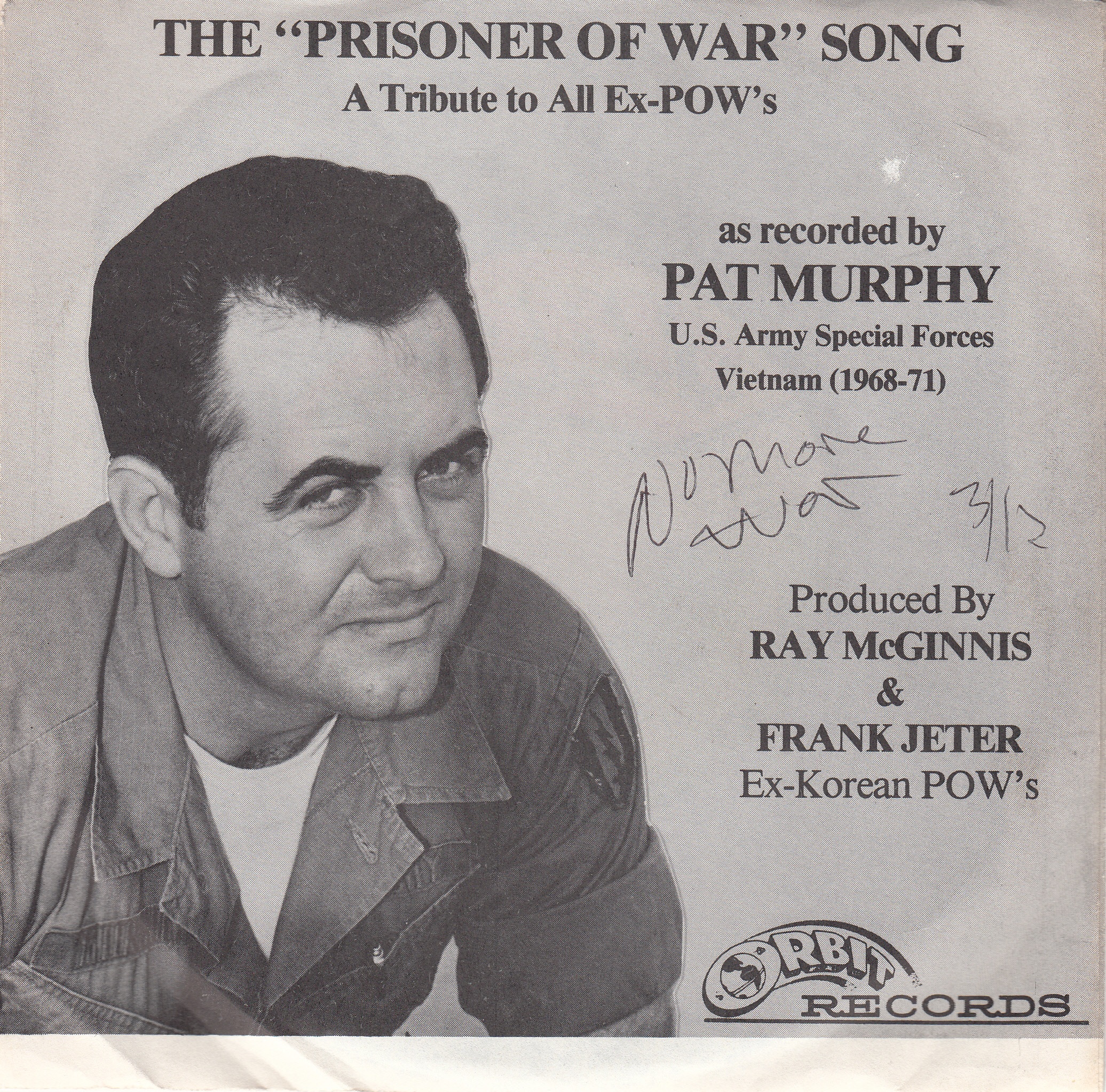
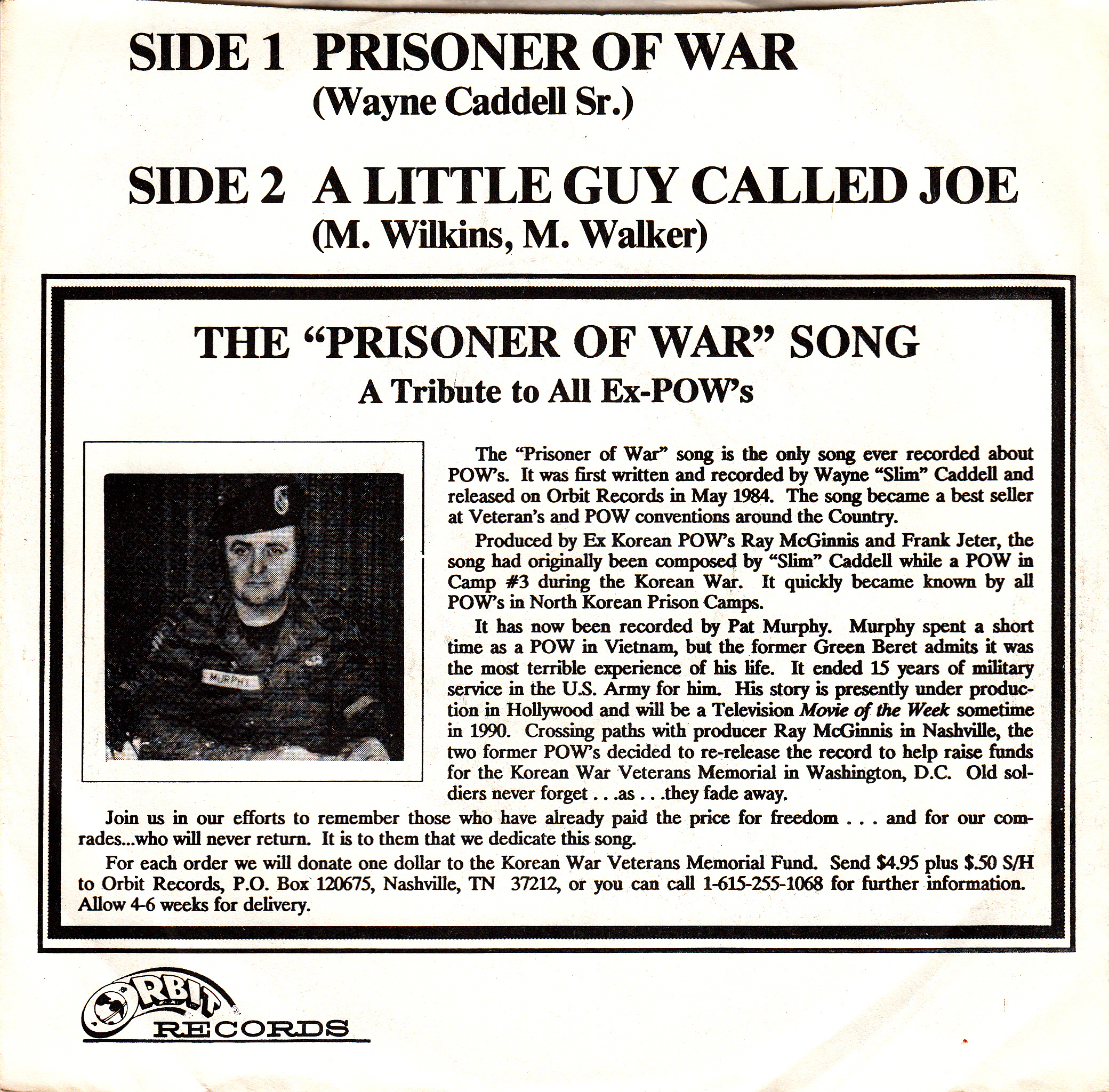
The picture sleeve front, headed The "Prisoner of War" Song, "A Tribute to All Ex-POW's", shows a photograph of Pat Murphy in fatigues, credited "U.S. Army Special Forces, Vietnam (1968-71)", produced by Ray McGinnis & Frank Jeter, "Ex-Korean POW's", and is inscribed in ink "No more war".
The back lists Side 1 "Prisoner of War" (Wayne Caddell Sr.) and Side 2 "A Little Guy Called Joe" (M. Wilkins, M. Walker), with a photograph of Murphy in a beret; its notes say the song was first written and recorded by Wayne "Slim" Caddell, composed while a POW in Camp #3 during the Korean War, and released on Orbit in May 1984, and that this re-release by two former POWs raised funds for the Korean War Veterans Memorial in Washington, D.C., with one dollar per order donated to the memorial fund. [From the record sleeve and labels]
1991
Post-war 90s. Country pop, Vietnam veteran.
Recorded when living in Nashville, Tennessee. From Sacramento area, California.
Soldiers from WW1 and WW2 received G.I. loans, bought houses and got jobs.
But when they came back from Vietnam - no welcome home, forgotten, 'crazy vets', no loans.
The label states: "This material was written and performed by Vietnam Veterans for All Veterans especially those who served in the Vietnam Era." Echo Summit Records, 11 Music Sq. E., Nashville, TN 37203, (615) 244-8725. [From the record sleeve and labels]
- "dedicated to all P.O.W./M.I.A. abandoned by the government of the United States of America in WWII, Korea and Vietnam"
- Narrators father captured during the war
- Could still be alive in one of the camps
- ESR 002 (U-30396M), A side, gold label with POW★MIA "You Are Not Forgotten" emblem and ESR mountain logo; "Daddy's Red Ribbons" (CSM John R. Holland-US Army Ret./Bobby Ross), 3:32, © Echo Summit Music, BMI; 1st Lt. Bobby Ross (Ret. 101st Airborne, USA); produced by Bobby Ross, engineer Ed Simonton.
The label states: "This material was written, produced, & performed by Vietnam Veterans and dedicated to all POW/MIA's abandoned by the government of the United States of America in WW II, Korea & Vietnam." Rim text: "(615) 244-8725 • Echo Summit Records • 11 Music Sq. E. • Nashville, TN 37203." [From the record sleeve and labels]
1996
1997
1999
2001
2002
2003
2005
2006
2007
2010
- 1 Antiwar Songs ↩
2013
2017
2021
Film soundtrack
Film soundtrack
Unknown date
The front cover shows a green felt banner reading "Life Is Good Yea!" with a peace sign, a guitar, a butterfly and four dancing figures (cover banner by Virginia Hemmrick).
The back cover note tells that Ted Studebaker of West Milton, Ohio, told his draft board he could not conscientiously accept military service but was willing to go to Vietnam, went with the Vietnam Christian Service to help the mountain people of Di Linh, taking a guitar and a small tape recorder instead of weapons, married Pakdy, a volunteer from Hong Kong, and was shot dead when a Vietcong unit attacked Di Linh about a week later, on April 26, 1971; it quotes him: "I have never heard of a President pinning a medal of honor on a pacifist."
The record was produced from cassette recordings he sent home to family and friends, conceived by his brother Gary and Steve Engle; produced by Gary and Sue Studebaker, tape mastering and record production supervised by Steve Engle, tape and disc mastering at Annex Studios, Hollywood (mastering engineer John Anderson), records and cover by Custom Records, Los Angeles. Photographs show Studebaker playing guitar and villagers "Watching the rice huller and polisher".
The tracklist prints "Vietnameese Song" and lists three tracks as "Howard and Ted" after "Howard Royer and Ted". [From the record sleeve and labels]
The front shows Jerry Hayes in a suit seated on a stool with an acoustic guitar, with the slogans "A Must In Your Collection", "'A Sure Hit' by Jerry Hayes – Words and Music", "Featuring Ballad of Barney" and "Toro Records brings this bright new star to you with vivid memories", and "Enjoy the instrumentals of Smokey Montgomery, Freddie Crane, Phil Baugh, Junior Graham, Dale Cook"; this copy carries a handwritten signature on the front.
Back credits: Marvin "Smokey" Montgomery, arrangements; Freddie Crane, piano; Phil Baugh, guitar; Junior Graham, bass; Dale Cook, drums, each with a short biography.
Side 1: Thoughts of Home 2:18, I Can Still Remember 3:45, One Last Memory 2:13, I Praise the Vet 2:15, Diary of Private Jones 3:40;
Side 2: Thanks to Them 2:33, Wanted Man 3:20, Johnny's Going Home 2:21, Seven Lonely Years 2:30, Ballad of Barney 4:15. Publisher Mockingbird Music, B.M.I.; recorded at Sumet-Bernet Sound Studios, Dallas, Texas, by Phil York and Gene Caton; master disc by Dick McGrew Recording; words and music by Jerry Hayes; copyright Toro Records, 2525 New Orleans Pl. #149, Dallas, Texas 75235; E. W. Wilson, Manager.
The sleeve notes say Hayes served with the 3rd Marine Amphibious Force in Vietnam and that "his words tell a revealing story in 'Back From Nam'". [From the record sleeve and labels]
Military, about brother K.I.A. in Vietnam. Artist later also K.I.A.
Dallas, Texas, USA. Killed Thừa Thiên-Huế, Vietnam.
Wall of Faces1
- Artist from Vermont
- Military, vet, peace / anti-war, country
- According to obituary, served two term in the Vietnam War: "Lester served two tours in Vietnam with the United States ARMY. Following the ARMY, Lester got married, and started his singing career and making records in Nashville".1
- Mother cries as soldier goes off to war
- Must go, but what for, freedom or peace?
- How many more must die?
- The politicians don't want to stop this "crazy" war
- A-side: So many died, no more war for our children
- Helicopter sound effects
- Agent Orange - still fighting the war
- B-side: we fought the war, let's talk
- Impact of PTSD, overcome Vietnam syndrome
- Olean Viet Nam Memorial Record WRA3-106, stereo, 45 RPM, made in Canada; A "No More Viet Nams" 2:55, B "No Use Pretending No More" 3:40; Viet Nam Vets Band: David R. Chapin (lead vocals, rhythm guitar), Frank J. Sisson (lead guitar/bass, vocals), Daniel B. Ganoung (drums, vocals), Frank Falkowski (keyboards, vocals), Dennis Chamberlain (bass/lead guitar, vocals). No date on the label. [From the record label]
The picture sleeve shows Dorster singing in uniform with ribbons, garrison cap and raised hand, under the heading "Sgt. Tommy Dorster — 'The Fighting Soldier From Vietnam'"; sleeve and A-side label are autographed in ink by Tommy Dorster. [From the record sleeve and labels]
The picture sleeve shows Dorster singing in uniform with ribbons, garrison cap and raised hand, under the heading "Sgt. Tommy Dorster — 'The Fighting Soldier From Vietnam'"; sleeve and A-side label are autographed in ink by Tommy Dorster. [From the record sleeve and labels]
- Vet's perspective, contemporary folk
- Two brothers in Vietnam, one lived, one died
- Impact on family
- What was Vietnam?
- Reference to the memorial wall
- High Caliber Records U-23166M, side B, time 3:30, ASCAP; (Sam C. Courtney and Randall Newnam); Jeff Farris lead guitar, Randy Newnam lead vocals; producer Sam Courtney; High Caliber Records, P.O. Box 4330, Cary, N.C. 27519. [From the record label]
The compilation of course included several songs about the Vietnam Veterans Memorial Wall in D.C. including "The Big Parade" by 10,000 Maniacs, "Long Black Wall" by Johnny Anthony, "More Than a Name on the Wall" by the The Statler Brothers, "The Wall" by Michael McCann, "Finally Welcomed Home" by Bobby Ross, "Who Are the Names on the Wall" and "Time to Lay It Down (aka The Wall)" by Michael J. Martin & Tim Holiday, "The Women on the Wall" by John Black, "Ride to the Wall" by Paul Revere & The Raiders, and "Salute the Boys of Vietnam" by J.C. Weaver.
Documentary, interviews, and field recordings of the US Pacific Fleet in Vietnam (#CPF-107). It includes soldiers in Vietnam recalling various events, such as operations, being under attack, shot down and recovered, escaping from ambushes, and information on the process of flying planes and returning aircrafts to the navy deck. The sleeve describes each track in specific detail, with regards to who is being interviewed / speaking, and the situation: " A1: North Vietnam's Kep Airfield Under Navy attack is recounted by Navy Pilots LCDR Ken Jurgensen and LTJG Roger Van Dyke of Lemoore, California. A2: Navy Fireman Kenneth Bracey of Cedar Rapids, Iowa, relives the story of his first encounter with Viet Cong during minesweeping operations on South Vietnam's Long Tau river. A3: The rescue of two pilots shot down over North Vietnam is described by LT Perry Gard of St. Petersburg, Florida. A4: Hospital man Samuel D. Bottaro of Onawa, Iowa, relates his experiences while treating Marines in the field and at South Vietnam's Dong Ha Aid Station. A5: LCDR Hugh McGee of Fairfield, Connecticut, shot down while aiding in the rescue of a downed Navy pilot, recalls his own rescue from the waters off North Vietnam. B1: CDR Hank Bailey of Lemoore, California, comments on the versatile Spad, a propeller-driven aircraft, recently phased out of Naval service. B2: A Navy River Patrol Boat's encounter with Viet Cong in South Vietnam's Mekong Delta is told by enginemen Joe Williams of Long Beach California, and James Plaster of Springfield, Missouri. B3: The briefing received by Navy Pilots aboard attack aircraft carriers in North Vietnam is discussed by CDR Paul Gillcrist of Freeport, New York. B4: Gunners Mate Jack Anderson of Blanchard, Oklahoma, a Navy river patrol boat crewman and winner of the Bronze Star, describes his escape from a Viet Cong ambush in the Mekong Delta of South Vietnam. B5: The Intricate process of returning Navy aircraft to flight decks of Seventh Fleet carriers after missions over North Vietnam is explained by Air Controller Harry Trumble of Hanford, California.
Lyric theme data
Lyric content themes tagged on the songs in this collection — parent themes with their sub-themes (number of records). Click a theme for its definition and all records carrying it.
Show all 37 themes ▾Key stats
443 songs · 137 releases · 102 artists · 97 labels · 1964–2021 · 1 more list entries have no record page yet and are not counted here
- 1991 is the peak year, with 55 songs.
- 1966–69 holds 85 of the 398 dated songs — one in five in four years.
- 203 were released during the war years (to 1975); 240 came after.
- 45 records are undated.
- 102 artists for 443 songs. The most represented is Dick Jonas, with 31.
- 27 of the artists are still unidentified beyond the record: no line-up, no biography.
- Five are credited to various artists — compilations and cast recordings.
- Songwriter gender is recorded for 194 of the 443 songs: 172 by men, 15 by women and seven by mixed teams — women wrote 8% of those.
- By performer: 403 men, 16 not identified, eleven women and eleven mixed groups (recorded for 441).
- 142 named songwriters. The most often credited is Richard E. Jonas, with 22.
- 46 of the 97 labels appear exactly once; Flying Fish has the most, with 27.
- 27 sit on a major or well-known imprint — RCA Victor, Capitol, Columbia, King of Music, Apple, Cameo, Elektra, MGM. The other 416 are on independent, regional or private labels.
- 27 are private pressings with no label at all.
- 21 45s put both of their sides into this list.
- 435 of the 443 are American. New York leads with 67, then California 23 and New Mexico 18.
- New York City accounts for 63 records, more than any other city; Las Cruces has 18, Nashville 15.
- Eight come from outside the US: four Japanese, two Puerto Rican, one from Thailand, one Vietnamese.
- By perspective: 240 post-war; 88 home front or soldier's perspective; 81 patriotic, pro-government or anti-protest; 34 peace, protest and anti-war.
- 136 distinct sub-themes across 443 songs.
- Vet is the single biggest subject — 228 songs, more than half.
- Next come Soldier's Perspective (197), Patriotic (115), Anti-War (40) and Combat (39).
- One is answer record to “Green Beret”.