Veterans Memorial Wall Songs
Context
An additional memorial, "The Three Soldiers" (also known as the "Three Service Men"), a bronze statue, designed by Frederick Hart, was unveiled on Veterans Day, 11 November 1984. It is also located on the National Mall, part of the Vietnam Veterans Memorial Wall. It was commissioned to appease those who opposed Maya Lin's design, the Wall, with a more traditional, heroic sculpture. The three men are identifiable as European American (center), African American (right), and Latino American (left) - this is said to be the first African-American representation on the National Mall. The "Vietnam Women's Memorial" was added on 11 November 1993, a bronze statue, showing three women helping a wounded soldier.
Song Themes
One particular theme is the 1980s Reagan-era trend of nationalism, or attempt to overcome the "Vietnam Syndrome" - the perception that domestic controversies over the war led to the US taking a less interventionist position in US foreign affairs. This term also applied to veterans, who may have felt guilt or shame about the war, influenced by the domestic climate they returned to in the US.1Ronald Reagan spoke about this on 18 August 1980: "for too long, we have lived with the Vietnam Syndrome..We dishonor the memory of 50,000 young Americans who died..They deserve our gratitude, our respect, and our continuing concern".2 Many war films of the period fitted into this climate of trying to overcome the Vietnam Syndrome, such First Blood [Rambo] (1982), Uncommon Valor (1983), and Missing in Action (1984).
The early 1990s, and then early 2000s saw another revival of interest in the Vietnam War, in song, films, and literature, often compared to contemporary events and wars, such as the First Gulf War in 1990, and the US War in Afghanistan (2001–present), and the Iraq War (2003–2011), and in turn, more attention was paid to the Vietnam Veteran Memorial Wall.
1982
The picture sleeve front is a drawing of an American flag and a rose before a wall repeating "The Wall", captioned "A Salute to the Vietnam Veterans — by Festival".
The back gives the writers in full (Lyle Zoerb, Ray Roth, Britt Small; Dan Daley), the full lyric of "The Wall", and notes that Britt Small served as a paratrooper with the 173rd Airborne Brigade in South Vietnam in 1970, where he was awarded the Purple Heart and the Army Commendation Medal, and that Festival appeared at the National Salute to the Vietnam Veterans in Washington, D.C., in November 1982, singing at the Vietnam Memorial and giving a concert at the base of the Washington Monument.
Band line-up: Britt Small (lead vocal, bandleader), Mark Reinig (drums), Becky Reinig (keyboards), Ray Roth, Jr. (bass), Stan Funston and Dann Hohn (guitar), Don Struve and Les Wetzel (trumpet), Russ Wetzel (trombone), Curt Pottratz (tenor sax), John Hafner (bari sax), with "Taps" by Don Struve; produced by Britt Small; front cover design by Phillip Van Voorst; "Max Stout Records, A Division of Festival Family Enterprises, Ltd."
The sleeve is signed in ink by Britt Small. [From the record sleeve and labels]
The song "Who are the names on the Wall?" (Windmill Productions # UR-4324) referred to the memorial wall in Washington D.C. The narrated recalled several of the people he knew, and how they were K.I.A.: "I've seen so many...Don Michael was on that Wall" . The narrated noted that "one guy got blown away on his first day" . This track also contained PTSD references, such as the veteran "who go back to 'Nam every night, when they're supposed to be asleep" . At the end of the song, the narrator concluded with the question: "did it ever really matter at all? Hell yes it mattered" .
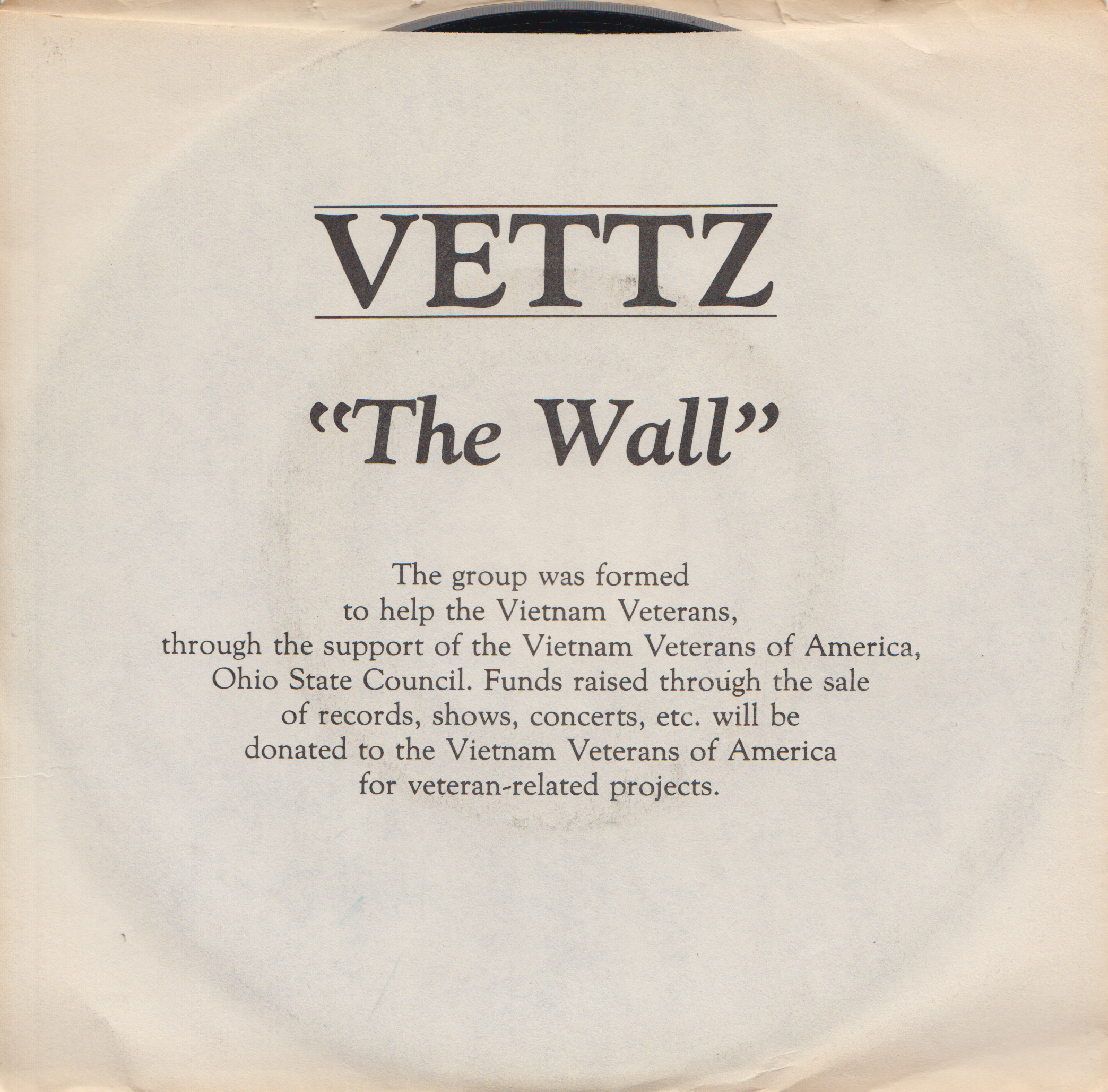
- 1 Wall, The (The Vettz) ↩
- 2 engineersvietnam.com (archived copy) ↩
- 3 ReverbNation (link no longer available) ↩
- 4 efolkmusic.org: Wayne barker (link no longer available) ↩
1983
Composed in 1982 by Michael Jerling, born 17 April 1952, in Joliet, Illinois, USA, and currently based in Saratoga Springs, New York, USA12 The record was released on this Fast Folk Musical Magazine various artist compilation in 1983 - this was a New York-based magazine and record album publisher, from February 1982 to 1997, a songwriter / performer cooperative. It also published many political and social contemporary songs, playing a similar role to Broadside Magazine in the 1960s. This song also featured on his 1998 compilation Early Jerling (Waterbug Records # WBG 0043), and on the 2002 compilation Fast Folk: A Community of Singers and Songwriters (Smithsonian Folkways Recordings # SFW40135). The song was covered in 1989 by Richard Meyer on Fast Folk Musical Magazine (Vol. 5, No. 3) - Live at the Bottom Line 1989 (Fast Folk # FF 503), discussed below.
The picture sleeve front is a black-and-white photograph of a man in a white shirt standing at the polished black wall, other visitors reflected in its surface, captioned "Vietnam's Wall of Reflection / Did You Ever".
The back shows a photograph of the four-piece band in western shirts with guitars, steel guitar and drumsticks, captioned "Tom Stiles and Country Revue". An enclosed reply postcard (13¢ Robert Morris "Patriot" postage, © USPS 1981) is addressed to Rome Recording Co., 1414 E. Broad St., Columbus, Ohio 43205, and on the reverse lists both titles, "Recorded by ..Tom Stiles and Country Revue", with lines for "Your Comments Please" and "Thank You". [From the record sleeve and labels]
1984
The picture sleeve (©1984) shows a black-and-white photograph of Larry Green singing at a microphone with a guitar, wearing a badge-covered hat and a shirt embroidered "Larry Rhythm/Vocals", with his autograph and the caption "Singer, Songwriter, Recording Artist"; management, booking and fan club Earl Dixon Entertainment, Inc. The back lists: songs written by Larry Green; arrangements by Larry Green, Jeff Wise and Jim Roberson; band Heavy Country (Wally Burnette, bass guitar; Jeff Wise, steel guitar; Tom Rogers, harmonica; Danny Menzies, drums; Mike Parker, lead guitar; Joey Martin, rhythm guitar; Myron Prosser, fiddle); engineer Jim Robeson, Bias Recording Company, Inc., Alexandria, Va. [From the record sleeve and labels]
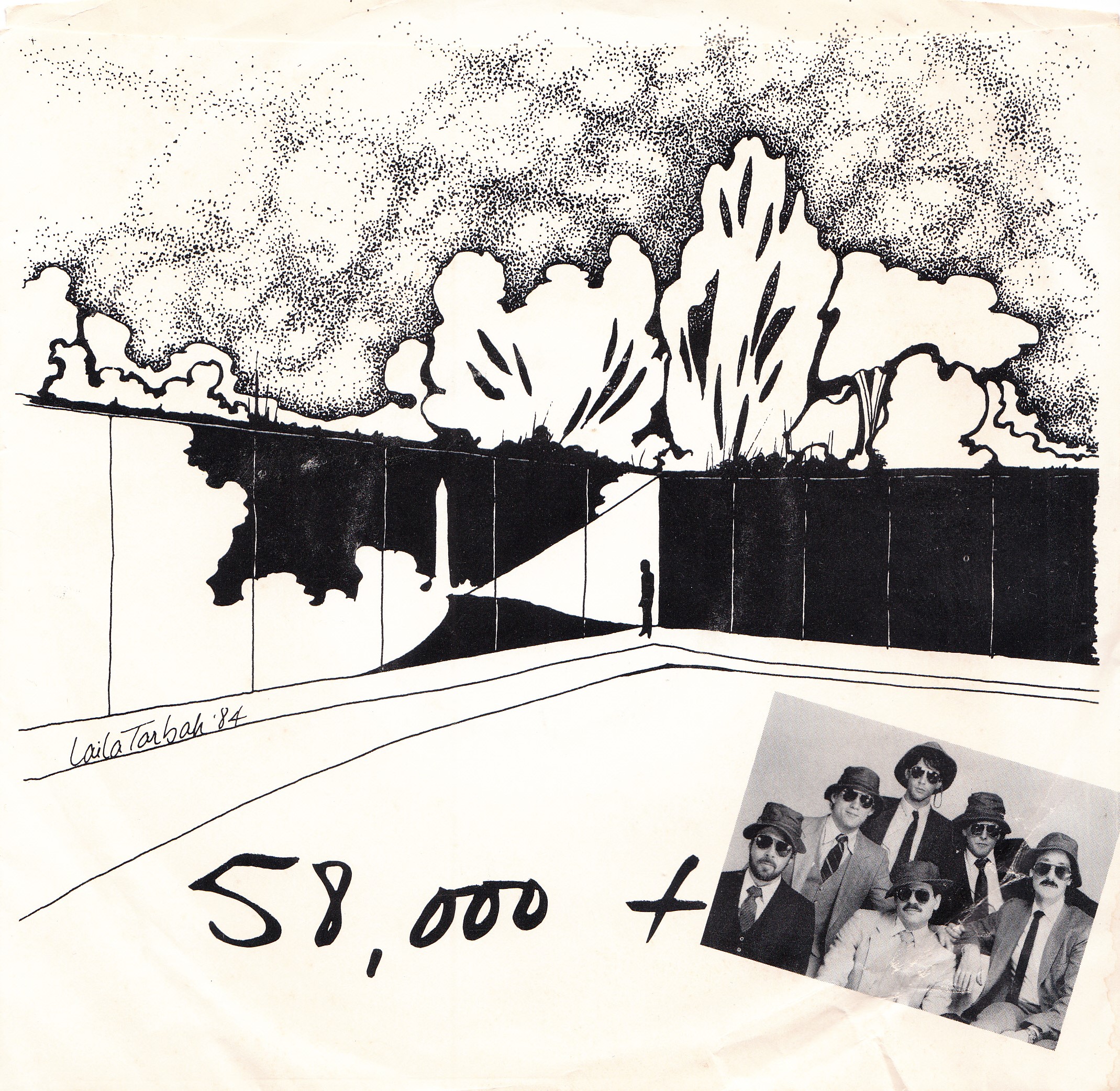
The picture sleeve carries a pen-and-ink drawing of the Vietnam Veterans Memorial wall with the Washington Monument reflected in it and a lone figure standing before it, signed "Laila Tarbah '84", with the hand-lettered title "58,000 +" and a photograph of the six-man group in suits, ties, sunglasses and bush hats. [From the record sleeve and labels]
1985
"In Washington D.C. a monument stands to honor those who lost their lives in Vietnam, their names are carved in granite on what the survivors have renamed the Wall, this song is dedicated to that memory. I saw him standing all alone that night, staring at the Wall, there were so many names to try and read, but he searched through them all. Then he spotted a wilted flower that someone had wedged in a tiny crack, it was by a name he seemed to know, he smiled as he stepped back, and I watched as he stepped out and touched the flower with his hand. With tears in his eyes, he whispered, help me understand.
I walked up and asked him his name, he softly said Billy Roe, he was dressed in uniform, said he fought in Vietnam several years ago. He said my life has been so confusing, but I'm trying to make the change, it's just that I miss my wife so very much. Then what he said seemed strange, he said, you know, all my old friends are here, I can see now the time is finally right, then he turned and said goodbye to me.
I felt a force pull me to the Wall, to tell me something I should know, and then I saw that wilted flower begin to grow. I could now plainly see the name of Private Billy Roe, who died fighting in combat in Vietnam sixteen years ago. I guess for some it's not as easy, but what they have lives on. But that night. Billy Roe finally found his home".
The picture sleeve, "©Copyright 1985 Country Party Music", prints the title in red script over pale-blue drawings of the flag, the Statue of Liberty and figures from American history, with the full lyric signed "Rich Rhuems, Antique Records": the Spirit of America recalls Lexington, Lincoln, the world wars, Korea and Kennedy, and declares "I am every name on the great black wall" and "although we didn't want to go to Viet Nam, we all knew that's how it had to be". [From the record sleeve and labels]
1986
"these song were written to honor American soldiers whom names are on the Wall, to express concern for those who are still missing in action, and to say thank you to all who served our country during the Vietnam era...the lyrics were written on Christmas Eve as I thought of the many Americans whose Christmas would be saddened by memories of those whose names are on the Wall"
Picture sleeve front prints the lyrics of "The Wall" and "Missing in Action" with the dedication: "These songs were written to honor the American soldiers whose names are on THE WALL, to express concern for those who are still MISSING IN ACTION, and to say 'Thank You' to all who served our country during the Vietnam Era." Back: Danny Ratcliff (vocals, rhythm guitar, bass, keys), Jim Hale (steel), Dave Crisp (drums), Joseph Ferguson (engineering, mix, lead guitar); a note signed by Max Sidders, publisher, that the song was suggested by his son Bob and the lyrics written on Christmas Eve 1985; thanks to the Midwestern Songwriters Association; proceeds to aid Vietnam veterans through V.V.A.
Chapter #188, Portsmouth, Ohio; A.S.C.A.P. copyright 1986; sticker with Max E. Sidders' Urbana, Ohio address. [From the record sleeve and labels]
- A-side: memorial wall, patriotic tribute
- B-side: P.O.W.s still in Vietnam, do they know the war is over?
Picture sleeve "Requiem": vocals Sam Jacobs, keyboards Don Baba, guitars Steve Dudas, bass Ed Alton, drums Billy Thomas; additional keyboards Greg Jackson; background vocals Bobby Caldwell, Mavis Vegas Davis, Linda Foote, Mark Hudson, Dave Jolliffe, Liza Miller, Michael Turner and Billy Thomas. Engineered by Jeff Harris; mixed by Jeff Hudson and Mark Hudson; recorded and mixed at the Village Recorder in April 1986. Dedicated "to our brothers and sisters who have died and to those of us who lived... Welcome Home!"; a major portion of the price went to "The Requiem Project" for Vietnam veterans' support groups (c/o The Village Recorder, West Los Angeles). Lyric insert with both songs. [From the record sleeve and labels]
An interesting track that dealt with several common post-war issues - the "Vietnam syndrome", P.O.W.'s, Post-Traumatic Stress Disorder (PTSD), and the Vietnam wall memorial in Washington D.C. The song told the story of Jim being drafted to fight in Vietnam in 1964, and "without a word, like his dad" he marched off to war - a reference perhaps to the Second World War or Korean War. Whichever case, the song attempted to connect the American generations that fought for their country. The narrator said that Jim went to "fight for freedom" , and that he did his duty: "no one could call him yellow" . Shortly after arriving in Vietnam, the North Vietnamese "captured and displayed" him "in Hanoi" , and therefore a P.O.W. While "locked up in a cage for over a year" he lived in terrible conditions: "cold, tired and hungry" . After returning to the US, Jim suffered from his war time experiences: "his mind plays tricks with fear" . He found it difficult to sleep and Jim's "nightmares linger on" - thus describing PTSD. Finally, as discussed above, the song sought to reverse the perceived mistreatment of veterans, highlighting their bravery and loyalty to the country, and thus overcoming the Vietnam syndrome: "we salute you and your past...you're heroes at last" . And for the ones that died, the "black wall lists them one by one" , remembering the role that they played.
"this collection of songs is dedicated to the men and women who served in Southeast Asia during the Vietnam War, and to their families, many who whom continue to struggle with the aftereffects of an unpopular guerilla war. To my husband, Bobby Lee, an in-country Vietnam veteran...is my inspiration. A special thanks to the veterans who donated their time and efforts (including back-up vocals) towards making this project possible, and to the veterans, of Vet Center 226, and to the Vietnam Veterans of America"This is followed by a statement from Bobby Lee, about the song "Angel in the Green":
"Too little has been said about the women who served in the Armed Force of the United States of America...much too little. Perhaps it is our fault...the fault of men, especially veteran men. We hide our good feeling...such as pride, honor, and gratitude. Angel in the Green is...about the women I served with, women who elected to leave the security of a traditional world to serve their country; to risk their futures and their lives...these women are veteran in every respect, I salute them with pride."The song "From a Cross to a Star" dealt with the memorial wall in D.C. and the missing in action (M.I.A. issue). A country track, it took a religious perspective, with the narrator recalling a man and woman who visit the "cold slab of stone" everyday. Their son is apparently still classified as M.I.A., with a cross by their name. The couple prayed that the cross would turn to a star. The song does not mention P.O.W.s.
1987
The song "Finally Welcomed Home" started with some memorable sounds of the 60s, with a clip of Country Joe & The Fish performing "I Feel Like I'm Fixin' to Die Rag" at the festival Woodstock: 3 Days of Peace & Music: "terrible jam, way down yonder in Vietnam", followed by a quote from JFK: "bring this situation back to what it was" and then LBJ: "this is a different kind of war, there are no marching armies and solemn declarations". Next, a spoken-word intro, which referenced the memorial wall: "those were the sounds of the 10,000 day war, here's a reminder of what we were fighting for, but first lets bow our head in silence, for those names upon that stone, here's to the rest of us, we finally made it home". The song itself was a nostalgic look through American culture, suggesting that the soldiers were fighting to protect the American way of life.
The label states: "This material was written and performed by Vietnam Veterans for All Veterans, Especially those who served in The Vietnam Era."
The picture sleeve for "Finally Welcomed Home" shows a tinted combat photograph of two soldiers standing in a smoke-filled jungle clearing beside a covered body on the ground. [From the record sleeve and labels]
The song "Goodbye to West Virginia" described a young man being drafted by Uncle Sam to fight in the "hell of Vietnam". The lyrics provided a combat description: "deadly silence, flash of fire", which took the young man's youthful smile away. The soldier was K.I.A. and "now his name is inscribed on that black stone wall". His body was returned to his home in West Virginia.
The label states: "This material was written and performed by Vietnam Veterans for All Veterans, Especially those who served in The Vietnam Era."
The picture sleeve for "Finally Welcomed Home" shows a tinted combat photograph of two soldiers standing in a smoke-filled jungle clearing beside a covered body on the ground. [From the record sleeve and labels]
1988
The first song "Three Service Men" (Loon Hill Records) is the only record on here to focus on the "The Three Soldiers" (also known as the "Three Service Men" ) bronze statue, designed by Frederick Hart unveiled on Veterans Day, 11 November 1984. It is located on the National Mall, part of the Vietnam Veterans Memorial Wall. It was commissioned to appease those who opposed Maya Lin's design, the Wall, with a more traditional, heroic sculpture. The three men are identifiable as European American (center), African American (right), and Latino American (left) - this is said to be the first African-American representation on the National Mall.1 In the song, the narrator, from the perspective of a Vietnam veteran, connected the two memorials, noting that the three soldier "stare upon the Wall of sadness" . The narrator said that he "had some friends on that Wall" and he thanked "the lord that I made it back at all" . It contained anti-war sentiment, hoping in the future that "there is no new war" , and wondering "why they died at all" .
Credits: producer George Pickard; strings/vocal arrangement Mark Donovan and Eileen Stamnas; drums Kevin Strawn; guitar Johnny Davis; engineer Wilis Allen; recorded at Club Studios, Reno, Nevada. The black-and-white picture sleeve, "Written by George Pickard and Matt Pickard", is a pen drawing, signed and dated '89, of a man and child at a dark memorial wall with flowers at its base, a man and boy with a ball beside a brick house, and a photograph of a smiling helmeted soldier inscribed "I love you — Dad". [From the record sleeve and labels]
- 1 45cat ↩
- 1 Google News Archive ↩
- 2 archive.today ↩
- 3 inyork.com (link no longer available) ↩
1989
The song "God Bless America Tonight" (Fraternity Records # F-3546) - a patriotic, country pop, post-war 80s song about the memorial wall in D.C. contained some very interesting thoughts on the war. It is narrated from the perspective of a veteran who visited D.C., listening to the questions of his dead comrades. A dead soldier asked "did we finally win their freedom?" , meaning the South Vietnamese, thus the position of the US government's objective in the 60s & 70s to establish a non-communist South Vietnam. It then contained the line "did they finally let us fight?" - implying that the government / military establishment were preventing the soldiers from conducting the war properly, thus presenting that as an explanation as to why they lost the war. The narrated concluded that "there is something wrong here, with this country" . The song also dealt with the mistreatment of Vietnam War veterans, with the dead soldier saying: "did she treat my brothers right" . Released in Cincinnati, Ohio. Composed by Wayne Barker Jr. Produced by Wayne Barker Jr. and Ron Czarnecki. Engineer: Dale "Smitty" Smith.
- 1 Wall, The (The Vettz) ↩
- 2 engineersvietnam.com (archived copy) ↩
- 3 ReverbNation (link no longer available) ↩
- 4 efolkmusic.org: Wayne barker (link no longer available) ↩
The next song, "Just the Dream of Them All Alive" , came in at nearly 7-minutes long, told the story of a dream, in which the songwriter was at the wall, and the soldier's written there stepped out and started dancing to the music. The music provided comfort to both the living and the dead. The songwriter told the dead soldiers that "I won't let the world forget".
1990
The "Long Black Wall" by Richard Meyer, a contemporary folk artist, born in 1952, and died in New York, USA on 14 May 2012, was a long-term editor of Fast Folk - this was a music magazine and record album publisher from February 1982 to 1997, a songwriter / performer cooperative. It also published many political and social contemporary songs, playing a similar role to Broadside Magazine in the 1960s. This song was a cover, composed by Michael Jerling in 1982, and released in 1983 on the LP: CooP Fast Folk Musical Magazine (Vol. 2, No. 4) - Political Song, discussed above.
1991
1992
A1| Susan Graham White - "Facing the Wall"
A2| Cleve Francis - "Reflections on the Wall"
A3| Joel Mabus - "Touch a Name on the Wall"
A4| Barbara Jarrell - "Heal Over Vietnam"
A5| Pat Garvey - "Sons and Daughters"
A6| Richard Gill - "Soldiers of the Clouds"
B1| Pat Garvey - "Still Waiting at the Wall"
B2| Paula Jones - "Brother of Mine"
B3| Marie Zerby - "I Touched His Name Upon the Wall"
B4| Olin Murrell - "The Wall"
B5| The New Arkadelphians - "The Wall: Between the Lines"
B6| Brenda Simpson - "Welcome Home"
1993
- 1 Chicago Tribune ↩
1994
1995
1996
The song "Beyond the Wall" by well-known country artist Charley Pride, born 18 March 1934 in Sledge, Mississippi, USA, and currently based in Dallas, Texas, USA. He is one of the very few African-Americans to become a member of the Grand Ole Opry. He was inducted into the Country Music Hall of Fame in 2000. He had a hugely successful career, with 52 top-10 hits on the Billboard Hot Country Songs chart, 30 of which made it to number one, becoming the best-selling performer for RCA Records since Elvis Presley.1 The song noted that there is "a story for every name written on that wall", and referred to the "special things" that visitors leave: such as a "ragged teddy bear" - a child's favourite toy, given to them by their father, killed in action?
1997
1998
1999
John McDermott, born on 25 March 1955 in Glasgow, Glasgow City, UK, and currently based in the USA, released the song "The Wall" ( Angel Records # 98981), a contemporary folk version of the song above (performed by Michael McCann , and written by Vietnam War veteran Tim Murphy), with a few alternative lyrics, including reference to the Lincoln Memorial in the first verse. Also see: Vietnam War: Veterans Memorial Wall Songs
2001
The other song, "Rolling Thunder" is of course a direct reference to the motorcycle run on Memorial Sunday, which said that they would "be heard throughout the land" and that they were taking a "stand, to honor fallen heroes" . The song described combat conditions, from the jungle to the DMZ, fighting the enemy in the dark. The narrated said that "our prisoners" were "tortured" -. The narrator also referenced the Tet Offensive, described as an event that some soldiers survived - this was a campaign launched by the North Vietnamese army and the VC on South Vietnam, on the Vietnamese New Year, 30 January 1968. It is viewed by historians as a watershed moment, feeding into the US "credibility gap", and providing support to those who wanted to end the war. Another interesting reference is the line that veterans were "spit on by the people who stood against the war" - this is the famous "spitting image", although no actual incidents have been documented, and this is considered to be a myth.34 Also note that the narrator criticised politicians, saying that they used the veterans.
2002
2005
2006
2010
The compilation of course included several songs about the Vietnam Veterans Memorial Wall in D.C. including "The Big Parade" by 10,000 Maniacs, "Long Black Wall" by Johnny Anthony, "More Than a Name on the Wall" by the The Statler Brothers, "The Wall" by Michael McCann, "Finally Welcomed Home" by Bobby Ross, "Who Are the Names on the Wall" and "Time to Lay It Down (aka The Wall)" by Michael J. Martin & Tim Holiday, "The Women on the Wall" by John Black, "Ride to the Wall" by Paul Revere & The Raiders, and "Salute the Boys of Vietnam" by J.C. Weaver.
2012
2013
2014
Springsteen wrote the song "The Wall" (Columbia Records # 88843015462) following a visit to the memorial, to see the names of two of his friends who were K.I.A. in Vietnam, both members of New Jersey rock & roll bands - Bart Haynes, the drummer in The Castiles, a group that Springsteen was a member of, and Walter Cichon, lead singer of The Motifs.1 The song noted that the former Defense Secretary Robert McNamara (under both JFK and LBJ) had said he was sorry for his part in the war. The narrated said "apology and forgiveness got no place here at all".
2016
Unknown date
The song concluded that his friends returned from Canada, having received Amnesty, while he received "a limp and a faded Purple Heart" . And thus the government could "shove" its "next war" . With regards to Amnesty - on 16 September 1974, President Gerald R. Ford offered a partial amnesty, with a program for draft dodgers, requiring them to work in alternative service from 6-24 months.2 In 21 January 1977, President Jimmy Carter, in his first day in office, offered pardons to anyone who had evaded the draft (and requested one).3
A-side: mistreatment of vets, PTSD, Agent Orange, helicopter sound-effects
Answered the call and fought for country. But spurned on return and lied to.
There's a monunent in DC, don't forget them.
B-side: Anti-war, memoriual wall in DC.
They bravely ansered the call, sent to die for reasons they did not understand.
Victims of the times. No more unjust wars, pray for peace
- Vet's perspective, contemporary folk
- Two brothers in Vietnam, one lived, one died
- Impact on family
- What was Vietnam?
- Reference to the memorial wall
- High Caliber Records U-23166M, side B, time 3:30, ASCAP; (Sam C. Courtney and Randall Newnam); Jeff Farris lead guitar, Randy Newnam lead vocals; producer Sam Courtney; High Caliber Records, P.O. Box 4330, Cary, N.C. 27519. [From the record label]
Fanfare. Canton, Illinois.
Memorial for soldiers gone.
Widows and mothers cry.
Men did not die in vein - but for freedom.
Vietnam-era war song
Lyric theme data
Lyric content themes tagged on the songs in this collection — parent themes with their sub-themes (number of records). Click a theme for its definition and all records carrying it.
Show all 28 themes ▾Key stats
126 songs · 76 releases · 71 artists · 55 labels · 1982–2016
- 1991 is the peak year, with 27 songs.
- 1989–92 holds 46 of the 117 dated songs — nearly one in three in four years.
- 1 were released during the war years (to 1975); 125 came after.
- Nine records are undated.
- 71 artists for 126 songs. The most represented is Sarge Lintecum, with 14.
- 23 of the artists are still unidentified beyond the record: no line-up, no biography.
- One is credited to various artists — compilations and cast recordings.
- Songwriter gender is recorded for 57 of the 126 songs: 49 by men, six by women and two by mixed teams — women wrote 11% of those.
- By performer: 111 men, ten women, four mixed groups and one not identified (recorded for 126).
- 73 named songwriters. The most often credited is John R. Black, with twelve.
- 37 of the 55 labels appear exactly once; Tempest has the most, with 14.
- Nine sit on a major or well-known imprint — CBS Associated, Columbia, Elektra, Geffen, Island, Mercury, RCA, Sire. The other 117 are on independent, regional or private labels.
- Six are private pressings with no label at all.
- Eight 45s put both of their sides into this list.
- 124 of the 126 are American. California leads with six, then New York six and Arkansas five.
- Charlotte accounts for five records, more than any other city; New York City has five, Boston two.
- Two come from outside the US: two British.
- By perspective: 125 post-war; one patriotic, pro-government or anti-protest.
- 65 distinct sub-themes across 126 songs.
- Vet is the single biggest subject — 84 songs, two thirds.
- Next come Vietnam Veterans Memorial Wall (79), Military (57), Patriotic (24) and K.I.A. (19).