Born In The U.S.A.
1984 · Columbia 38-04680 · Freehold, New Jersey
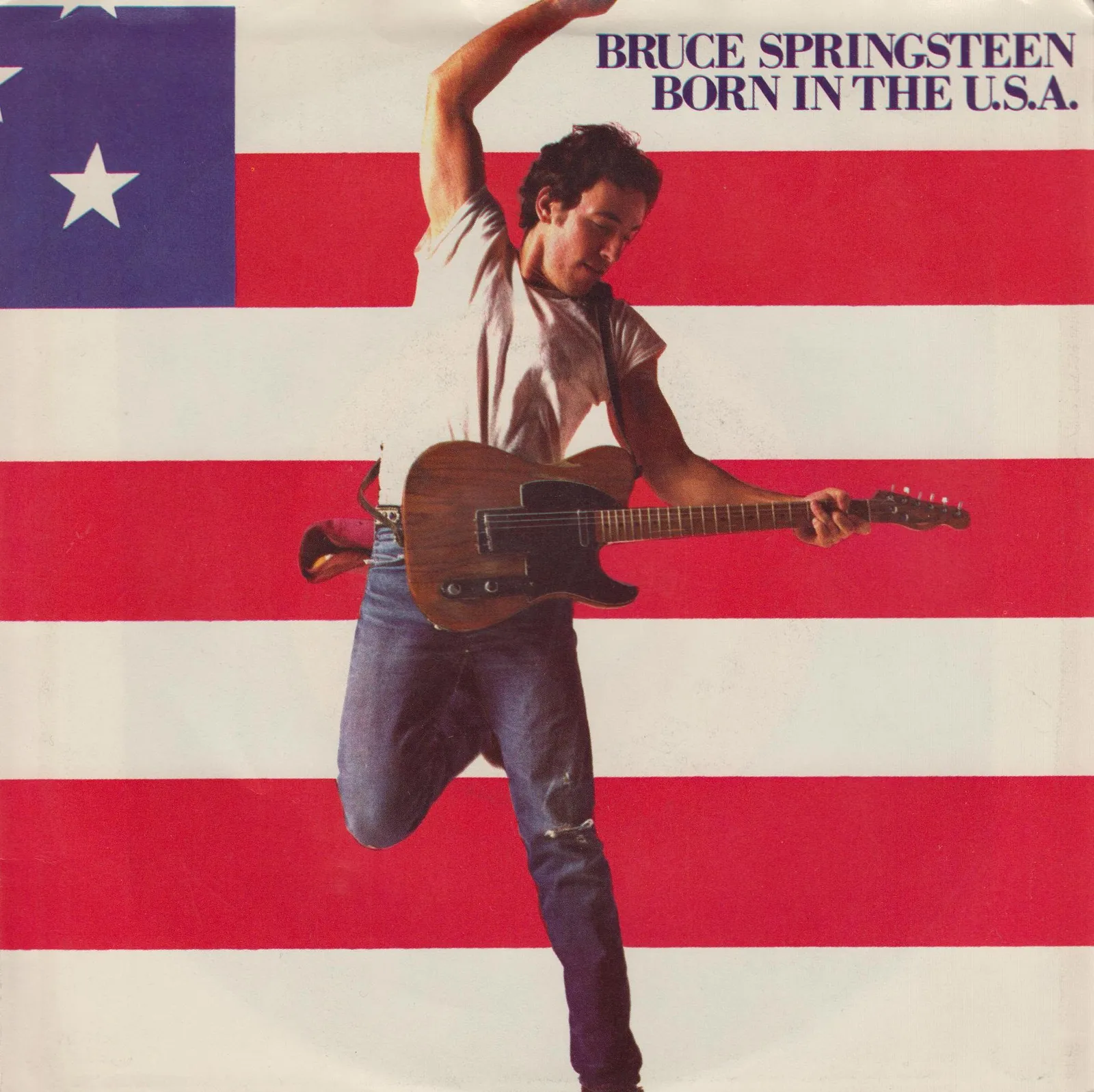
- Artist
- Bruce Springsteen
- Title
- Born In The U.S.A.
- Release
- Born In The U.S.A.
- Year
- 1984
- Label
- Columbia # 38-04680
- Format
- 7" · Single
- Language
- English
- Country
- Freehold, New Jersey, USA
- Songwriter
- Bruce Springsteen
- Genre
- Rock · Americana
- Primary theme
- Post-War
Annotation
Bruce Springsteen, born on 23 September 1949, in Long Beach, New Jersey, nicknamed the "Boss", is an Americana and heartland rock artist, known for his socially conscious lyrics, including many songs that reference Vietnam or feature a Vietnam veteran as the protagonist. This includes "Highway Patrolman" on Nebraska (1982); a double-sided Vietnam single, "Born in the U.S.A." and "Shut Out the Light" (1984); a cover of Edwin Starr's "War" (1986); "Youngstown" & "Galveston Bay", both on The Ghost of Tom Joad (1995); "The Wall" on High Hopes (2014); two songs on Tracks (1998), a compilation of rare material, called "Brothers Under the Bridges '83" and "A Good Man Is Hard to Find"; in 2006 he released a version of Pete Seeger's anti-Vietnam song "Bring Them Home" on We Shall Overcome: The Seeger Sessions [American Land Edition]. He also discussed the Vietnam War on the album Springsteen on Broadway (2018), especially with regards to the acoustic rendition of "Born in the U.S.A." His debut album Greetings From Asbury Park, N.J. (1973) contained many war references, such as "Lost in the Flood". Additionally, his song "Freedom Cadence" dealt with both the Vietnam War and the Iraq War, featuring in the closing credits of the 2017 film Thank You for Your Service.Springsteen continued the 1980s trend of reflecting on Vietnam with his blockbuster single "Born in the U.S.A." (Columbia Records # 38-04680), probably his most well-known song, making it into the pop charts in over 10 countries - peaking at # 1 in Ireland, # 2 in Australia, and # 5 in the UK. It reached # 9 in the US Billboard Hot 100. Featured on the album with the same name - Born in the U.S.A. (Columbia # QC 38653) - it reached # 1 in the US albums chart, and thus one of the most successful of the post-Vietnam War songs. Springsteen said on 2018 album Springsteen on Broadway that he was inspired to write the song after meeting Ron Kovic, who wrote the book Born on the Fourth of July. Kovic served in Vietnam, and then worked as a peace activist back in the US, for the Vietnam Veteran's Against the War (VVAW), eventually speaking at the 1976 Democratic National Convention about the poor treatment of veterans.1 Other cultural output, inspired by Kovic, included Oliver Stone's 1989 film Born on the Fourth of July, and Tom Paxton's Born on the Fourth of July. Despite its large distribution and radio play, this song often faced misinterpretation. As discussed above, the 1980s Reagan-era saw a trend of nationalism, or attempt to overcome the "Vietnam Syndrome" - the perception that domestic controversies over the war led to the US taking a less interventionist position in US foreign affairs. This term also applied to veterans, who may have felt guilt or shame about the war, influenced by the domestic climate they returned to in the US.2 Ronald Reagan spoke about this on 18 August 1980: "for too long, we have lived with the Vietnam Syndrome...We dishonor the memory of 50,000 young Americans who died...They deserve our gratitude, our respect, and our continuing concern".3 Many war films of the period fitted into this climate of trying to overcome the Vietnam Syndrome, such First Blood [Rambo] (1982), Uncommon Valor (1983), and Missing in Action (1984). Based on a limited reading of the anthemic chorus, the song sounded like a patriotic, nationalistic, flag-waving number. But the verses contained critical, bitter lyrics about America's role in Vietnam and the treatment of veterans. Narrated in the first person, a Vietnam veteran told about growing up in a "little hometown" when the government "put a rifle" in his hand to "kill the yellow man". On returning home, he is unable to find employment: "ten years burning down the road, nowhere to run". The veteran also noted that during the war he had a "brother at Khe Sahn" who had fought the Viet Cong, but while "they're still there, he's all gone" i.e. the US soldier died and they lost the war. The B-side song "Shut Out the Light" is also about the Vietnam War, but often overlooked, sitting next to the famous A-side. This track tells the story of a Vietnam veteran, who had just returned home: "on his porch they stretched a banner that said Johnny Welcome Home". But he suffered from PTSD. Sources1Wikipedia: Ron Kovic↩2The Columbia History of the Vietnam War (David L. Anderson, 2010)↩3Reagan Library (archived copy)↩
Annotation by Justin A. Brummer
Annotation — Bruce Springsteen Songs
Springsteen continued the 1980s trend of reflecting on Vietnam with his blockbuster single "Born in the U.S.A." (Columbia Records # 38-04680), probably his most well-known song, making it into the pop charts in over 10 countries - peaking at # 1 in Ireland, # 2 in Australia, and # 5 in the UK. It reached # 9 in the US Billboard Hot 100. Featured on the album with the same name - Born in the U.S.A. (Columbia # QC 38653) - it reached # 1 in the US albums chart, and thus one of the most successful of the post-Vietnam War songs. Springsteen said on 2018 album Springsteen on Broadway that he was inspired to write the song after meeting Ron Kovic, who wrote the book Born on the Fourth of July. Kovic served in Vietnam, and then worked as a peace activist back in the US, for the Vietnam Veteran's Against the War (VVAW), eventually speaking at the 1976 Democratic National Convention about the poor treatment of veterans.1 Other cultural output, inspired by Kovic, included Oliver Stone's 1989 film Born on the Fourth of July, and Tom Paxton's Born on the Fourth of July. Despite its large distribution and radio play, this song often faced misinterpretation. As discussed above, the 1980s Reagan-era saw a trend of nationalism, or attempt to overcome the "Vietnam Syndrome" - the perception that domestic controversies over the war led to the US taking a less interventionist position in US foreign affairs. This term also applied to veterans, who may have felt guilt or shame about the war, influenced by the domestic climate they returned to in the US.2 Ronald Reagan spoke about this on 18 August 1980: "for too long, we have lived with the Vietnam Syndrome...We dishonor the memory of 50,000 young Americans who died...They deserve our gratitude, our respect, and our continuing concern".3 Many war films of the period fitted into this climate of trying to overcome the Vietnam Syndrome, such First Blood [Rambo] (1982), Uncommon Valor (1983), and Missing in Action (1984). Based on a limited reading of the anthemic chorus, the song sounded like a patriotic, nationalistic, flag-waving number. But the verses contained critical, bitter lyrics about America's role in Vietnam and the treatment of veterans. Narrated in the first person, a Vietnam veteran told about growing up in a "little hometown" when the government "put a rifle" in his hand to "kill the yellow man". On returning home, he is unable to find employment: "ten years burning down the road, nowhere to run". The veteran also noted that during the war he had a "brother at Khe Sahn" who had fought the Viet Cong, but while "they're still there, he's all gone" i.e. the US soldier died and they lost the war.Sources1Wikipedia: Ron Kovic↩2The Columbia History of the Vietnam War (David L. Anderson, 2010)↩3Reagan Library (archived copy)↩
Annotation by Justin A. Brummer
Annotation — Bruce Springsteen Songs
The B-side song "Shut Out the Light" is also about the Vietnam War, but often overlooked, sitting next to the famous A-side. This track tells the story of a Vietnam veteran, who had just returned home: "on his porch they stretched a banner that said Johnny Welcome Home". But he suffered from PTSD.
Annotation by Justin A. Brummer
Lyrics
English: Born down in a dead man's town / The first kick I took was when I hit the ground / You end up like a dog that's been beat too much / Till you spend half your life just covering up / Born in the U.S.A., I was born in the U.S.A. / Got in a little hometown jam / So they put a rifle in my hand / Sent me off to a foreign land to go and kill the yellow man / Born in the U.S.A., I was born in the U.S.A. / Come back home to the refinery / Hiring man says 'Son if it was up to me' / Went down to see my V.A. man... / Had a brother at Khe Sahn fighting off the Viet Cong / They're still there he's all gone / He had a woman he loved in Saigon / I got a picture of him in her arms / Now down in the shadow of penitentiary, out by the...refinery / I'm ten years burning down the road / Nowhere to run / Ain't got nowhere to go / Born in the U.S.A. So it's, it's 1980, I'm 30 years old, I'm on another cross country trip with a buddy of mine, and we stop outside of Phoenix to gas up, go into a small town drugstore, I'm riflin' through a rack of paperback books, I come across a book called "Born on the Fourth of July" by a Vietnam veteran named Ron Kovic. Now this book was a testimony of the experience he'd had as a combat infantry man in southeast Asia. Week or two later, I'm bunked in at the fabulous Sunset Marquis Motel in Los Angeles. I been seein' a young guy with shoulder-length hair sittin' in a wheelchair by the pool for several days. So uh, one afternoon, he rolled up to me and…
Notes
Columbia 38-04680 (ZSS 173067), 45 RPM, stereo, ℗ 1984 Bruce Springsteen; "Born In The U.S.A." (B. Springsteen), 4:39, "Taken from the Columbia Lp: 'Born In The U.S.A.' QC 38653"; produced by Bruce Springsteen, Jon Landau, Chuck Plotkin and Steve Van Zandt, recorded by Toby Scott, mixed by Bob Clearmountain. The picture sleeve front shows Springsteen leaping with a guitar against a full-frame American flag. The back prints the full lyrics of "Born In The U.S.A." (words and music by Bruce Springsteen, ASCAP), including the lines "Had a brother at Khe Sahn fighting off the Viet Cong" and "He had a woman he loved in Saigon", and announces the B side "Shut Out the Light" (words and music by Bruce Springsteen) with the note "This song does not appear on the Born In The U.S.A. album". Manufactured by Columbia Records, CBS Inc., 51 W. 52 St., New York; art direction and design by Andrea Klein…
About the artist
Born Freehold, New Jersey, USA (23 September 1949). Currently Rumson, New Jersey.