Our Men in Nam
1988 · Loon Hill · USA
- Artist
- Ed Curran
- Title
- Our Men in Nam
- Release
- Three Service Men / Our Men in Nam
- Year
- 1988
- Label
- Loon Hill
- Format
- 7" · Single
- Language
- English
- Country
- USA
- Songwriter
- Ed Curran
- Genre
- Pop · Pop
- Primary theme
- Post-War
Annotation
Post-80s double-sided Vietnam War-related record, in the pop / singer-songwriter genre, it took a patriotic perspective, dealing with P.O.W.s and the Vietnam Veterans memorial wall and statue in Washington D.C. Nothing in known yet about Ed Curran, who composed and performed both sides - record was released in Dracut, Massachusetts, USA, and the record label address (68 Loon Hill Road) appears to be a home / residence, so it is a private label, probably the home of either the artist, or the producer, Fred Vigeant. The first song "Three Service Men" (Loon Hill Records) is the only record on here to focus on the "The Three Soldiers" (also known as the "Three Service Men") bronze statue, designed by Frederick Hart unveiled on Veterans Day, 11 November 1984. It is located on the National Mall, part of the Vietnam Veterans Memorial Wall. It was commissioned to appease those who opposed Maya Lin's design, the Wall, with a more traditional, heroic sculpture. The three men are identifiable as European American (center), African American (right), and Latino American (left) - this is said to be the first African-American representation on the National Mall.1 In the song, the narrator, from the perspective of a Vietnam veteran, connected the two memorials, noting that the three soldier "stare upon the Wall of sadness". The narrator said that he "had some friends on that Wall" and he thanked "the lord that I made it back at all". It contained anti-war sentiment, hoping in the future that "there is no new war", and wondering "why they died at all".The b-side song, "Our Men in Nam" dealt with the P.O.W. issue, which took the position that "there are men still over there", a view which featured prominently in 1980s P.O.W. songs, and fitted into several war films of the period, such as First Blood [Rambo] (1982), Uncommon Valor (1983), and Missing in Action (1984). The narrator noted that when he saw the black flag, he thought of the men left behind in Vietnam - this was a reference to the National League of Families POW/MIA flag, also known as the POW/MIA flag, or the POW flag, created in 1972.2 The narrator said that the P.O.W.s are "going through hell", as were their families, and that they are "brave and will survive". Interestingly, the narrated said that the war had been over for many years and that it was time to adjust: "as a country we must move on". Then contradictory, the narrator said that "we know there's no men over there", but that "we will always keep searching" - providing an unclear, mixed message to the listener. The lyrics also contained references to Post-Traumatic Stress Disorder (PTSD), often found in 1980s Vietnam War songs: "my memories are still there". The song concluded with helicopter sound-effects.Sources1Wikipedia: The Three Soldiers↩2Wikipedia: National League of Families POW↩
Annotation by Justin A. Brummer
Annotation — P.O.W. / M.I.A. Songs
Post-80s double-sided Vietnam War-related record, in the pop / singer-songwriter genre, it took a patriotic perspective, dealing with P.O.W.s and the Vietnam Veterans memorial wall and statue in Washington D.C. Nothing in known yet about Ed Curran, who composed and performed both sides - record was released in Dracut, Massachusetts, USA, and the record label address (68 Loon Hill Road) appears to be a home / residence, so it is a private label, probably the home of either the artist, or the producer, Fred Vigeant. The first song "Three Service Men" (Loon Hill Records) is the only record on here to focus on the "The Three Soldiers" (also known as the "Three Service Men") bronze statue, designed by Frederick Hart unveiled on Veterans Day, 11 November 1984. It is located on the National Mall, part of the Vietnam Veterans Memorial Wall. It was commissioned to appease those who opposed Maya Lin's design, the Wall, with a more traditional, heroic sculpture. The three men are identifiable as European American (center), African American (right), and Latino American (left) - this is said to be the first African-American representation on the National Mall.1 In the song, the narrator, from the perspective of a Vietnam veteran, connected the two memorials, noting that the three soldier "stare upon the Wall of sadness". The narrator said that he "had some friends on that Wall" and he thanked "the lord that I made it back at all". It contained anti-war sentiment, hoping in the future that "there is no new war", and wondering "why they died at all".The b-side song, "Our Men in Nam" dealt with the P.O.W. issue, which took the position that "there are men still over there", a view which featured prominently in 1980s P.O.W. songs, and fitted into several war films of the period, such as First Blood [Rambo] (1982), Uncommon Valor (1983), and Missing in Action (1984). The narrator noted that when he saw the black flag, he thought of the men left behind in Vietnam - this was a reference to the National League of Families POW/MIA flag, also known as the POW/MIA flag, or the POW flag, created in 1972.2 The narrator said that the P.O.W.s are "going through hell", as were their families, and that they are "brave and will survive". Interestingly, the narrated said that the war had been over for many years and that it was time to adjust: "as a country we must move on". Then contradictory, the narrator said that "we know there's no men over there", but that "we will always keep searching" - providing an unclear, mixed message to the listener. The lyrics also contained references to Post-Traumatic Stress Disorder (PTSD), often found in 1980s Vietnam War songs: "my memories are still there". The song concluded with helicopter sound-effects. Sources1Wikipedia: The Three Soldiers↩2Wikipedia: National League of Families POW↩
Annotation by Justin A. Brummer
Annotation — Veterans Memorial Wall Songs
The b-side song, "Our Men in Nam" dealt with the P.O.W. issue, which took the position that "there are men still over there", a view which featured prominently in 1980s P.O.W. songs, and fitted into several war films of the period, such as First Blood [Rambo] (1982), Uncommon Valor (1983), and Missing in Action (1984). The narrator noted that when he saw the black flag, he thought of the men left behind in Vietnam - this was a reference to the National League of Families POW/MIA flag, also known as the POW/MIA flag, or the POW flag, created in 1972.2 The narrator said that the P.O.W.s are "going through hell", as were their families, and that they are "brave and will survive". Interestingly, the narrated said that the war had been over for many years and that it was time to adjust: "as a country we must move on". Then contradictory, the narrator said that "we know there's no men over there", but that "we will always keep searching" - providing an unclear, mixed message to the listener. The lyrics also contained references to Post-Traumatic Stress Disorder (PTSD), often found in 1980s Vietnam War songs: "my memories are still there". The song concluded with helicopter sound-effects.Sources2Wikipedia: National League of Families POW↩
Annotation by Justin A. Brummer
Lyrics
English: The war has been over for many a year / And we know there are men still over there / We will always keep searching until the end of time / That's the least we can do for our men in Nam / When I see the black flag waving on high / I think of the men we left behind / Their families still wait, their children have come / Those lonely feelings that are unknown / They are going through hell, that we know / And I pray that some day the men will show / The jungles are quit, my memories are still there / But know my thoughts are in despair, but they are brave and will survive / But as a country we must move on / The war has been over for many a year / And we know there's no men over there / We will always keep searching to the end of time / That's the least we can do for our men in 'Nam / When I see the black flag waving on high, I think of the men we left behind...
Notes
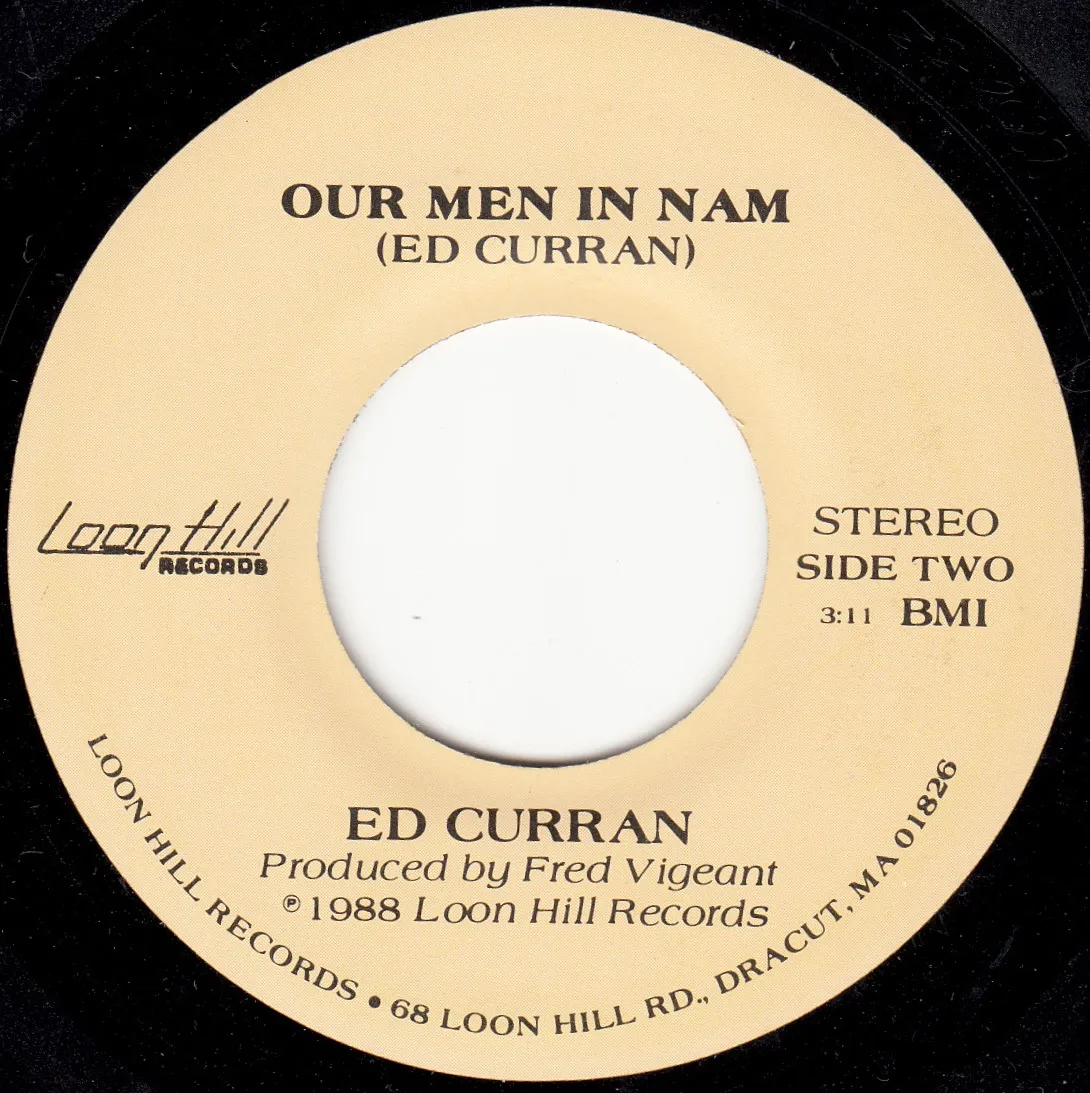
Loon Hill Records, Side Two, stereo, cream label, 68 Loon Hill Rd., Dracut, MA 01826; "Our Men in Nam" (Ed Curran), 3:11, BMI, ℗ 1988 Loon Hill Records; produced by Fred Vigeant. [From the record sleeve and labels]