Big Black Wall
Aftermath AMH 101 · Georgia, USA
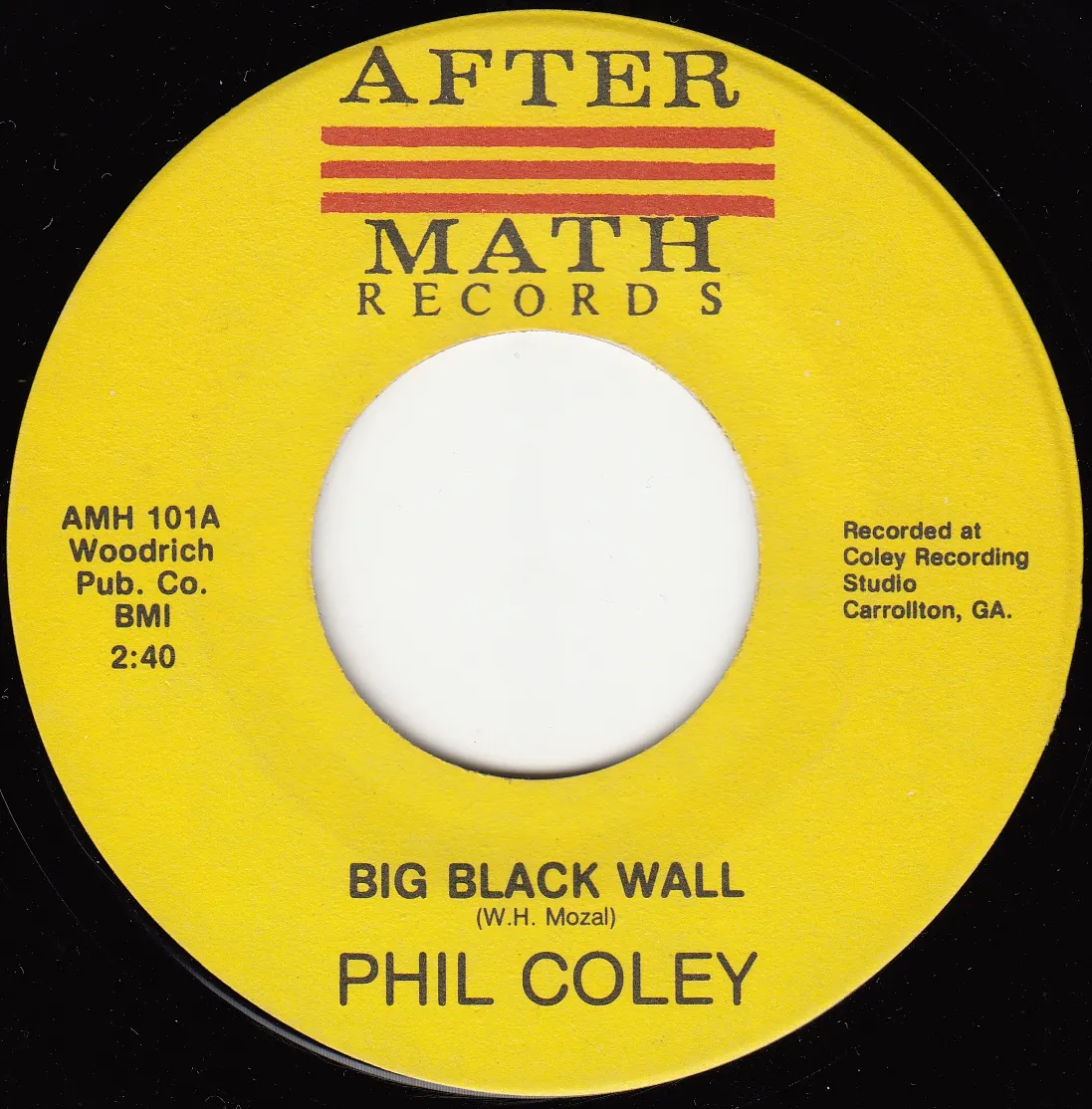
- Artist
- Phil Coley
- Title
- Big Black Wall
- Release
- Big Black Wall / Don't Go Blamin' Me for Vietnam
- Label
- Aftermath # AMH 101
- Format
- 7" · Single
- Language
- English
- Country
- Georgia, USA
- Songwriter
- W.H. Mozal
- Genre
- Country · Country
- Primary theme
- Post-War
Annotation
Phil Coley, based in Bowdon, Georgia, released this pop-rock / country doubled-sided Vietnam War single, recorded at Coley Recording Studio, Carrollton, Georgia.1 The A-side song "Big Black Wall" (Aftermath Records # AMH 101) focused on a vet going to the memorial wall in Washington D.C., to see the names of his buddies from Vietnam. It recalled several names, where they came from, and what they did in Vietnam. While in-country they "promised we'd all get together" back in the states. He was the first to leave Vietnam, but his friend were K.I.A., concluding with the line "who would believe I'd have to come to D.C. to see them on a big black wall?". Composed by W. H. Mozal.The song "Don't Go Blamin' Me for Vietnam", a fascinating post-war look at the war, addressed several Vietnam War images and perceptions. This included draft evasion, by fleeing to Canada, and subsequent amnesty; the mistreatment of veterans; veterans and drug addiction; the role played by politicians. The song also referenced napalm, and medals (the Silver Star and Purple Heart). The narrator started by recalling how he was drafted to go to war while his friends headed off to Canada, avoiding the same fate. His father thought it was best, and the narrator didn't like the cold weather up north, so he reluctantly "packed my bags and went south to Vietnam". The vet then described returning to the US in San Diego where he was greeted by "this hippie" who said "welcome home Mr. Baby Killer". The narrator said that he "didn't take part in no brutality", and that he got "better treatment from the Vietcong", and thus leading into the chorus and title of the song, with the message that the veterans were not to blame, and that they have been mistreated back in the US. In fact, the narrator pointed the finger at the politicians: "there's a lot of politicians you ought to be blaming", and they were the ones who "we should have Napalmed". The narrator also suggested that it was their fault that the war was lost, which is why South Vietnam ended up "in the hands of the Viet Cong". The narrator then said that the image that all veterans are "on dope...still shooting heroin or snorting coke" is a misperception, but people are unwilling to consider otherwise. The song concluded that his friends returned from Canada, having received Amnesty, while he received "a limp and a faded Purple Heart". And thus the government could "shove" its "next war". With regards to Amnesty - on 16 September 1974, President Gerald R. Ford offered a partial amnesty, with a program for draft dodgers, requiring them to work in alternative service from 6-24 months.2 In 21 January 1977, President Jimmy Carter, in his first day in office, offered pardons to anyone who had evaded the draft (and requested one).3Sources1Dollar Country: Phil Coley, Big Black Wall / Don't Go Blamin' Me For Vietnam↩2Politico: Ford offers amnesty to Vietnam deserters and draft evaders, 16 September 1974 (This Day in Politics)↩3Politico: President Carter pardons draft dodgers, 21 January 1977 (This Day in Politics)↩
Annotation by Justin A. Brummer
Annotation — Veterans Memorial Wall Songs
Phil Coley, based in Bowdon, Georgia, released this pop-rock / country doubled-sided Vietnam War single, recorded at Coley Recording Studio, Carrollton, Georgia.1 The A-side song "Big Black Wall" (Aftermath Records # AMH 101) focused on a vet going to the memorial wall in Washington D.C., to see the names of his buddies from Vietnam. It recalled several names, where they came from, and what they did in Vietnam. While in-country they "promised we'd all get together" back in the states. He was the first to leave Vietnam, but his friend were K.I.A., concluding with the line "who would believe I'd have to come to D.C. to see them on a big black wall?". Composed by W. H. Mozal.Sources1Dollar Country: Phil Coley, Big Black Wall / Don't Go Blamin' Me For Vietnam↩
Annotation by Justin A. Brummer
Annotation — Draft Songs
Phil Coley, based in Bowdon, Georgia, released this pop-rock / country doubled-sided Vietnam War single, recorded at Coley Recording Studio, Carrollton, Georgia.1 The A-side song ]"Big Black Wall" (Aftermath Records # AMH 101) focused on a vet going to the memorial wall in Washington D.C., to see the names of his buddies from Vietnam. Composed by W. H. Mozal.The song "Don't Go Blamin' Me for Vietnam", a fascinating post-war look at the war, addressed several Vietnam War images and perceptions. This included draft evasion, by fleeing to Canada, and subsequent amnesty; the mistreatment of veterans; veterans and drug addiction; the role played by politicians. The song also referenced napalm, and medals (the Silver Star and Purple Heart). The narrator started by recalling how he was drafted to go to war while his friends headed off to Canada, avoiding the same fate. His father thought it was best, and the narrator didn't like the cold weather up north, so he reluctantly "packed my bags and went south to Vietnam". The vet then described returning to the US in San Diego where he was greeted by "this hippie" who said "welcome home Mr. Baby Killer". The narrator said that he "didn't take part in no brutality", and that he got "better treatment from the Vietcong", and thus leading into the chorus and title of the song, with the message that the veterans were not to blame, and that they have been mistreated back in the US. In fact, the narrator pointed the finger at the politicians: "there's a lot of politicians you ought to be blaming", and they were the ones who "we should have Napalmed". The narrator also suggested that it was their fault that the war was lost, which is why South Vietnam ended up "in the hands of the Viet Cong". The narrator then said that the image that all veterans are "on dope...still shooting heroin or snorting coke" is a misperception, but people are unwilling to consider otherwise. The song concluded that his friends returned from Canada, having received Amnesty, while he received "a limp and a faded Purple Heart". And thus the government could "shove" its "next war". With regards to Amnesty - on 16 September 1974, President Gerald R. Ford offered a partial amnesty, with a program for draft dodgers, requiring them to work in alternative service from 6-24 months.2 In 21 January 1977, President Jimmy Carter, in his first day in office, offered pardons to anyone who had evaded the draft (and requested one).3Sources1Dollar Country: Phil Coley, Big Black Wall / Don't Go Blamin' Me For Vietnam↩2Politico: Ford offers amnesty to Vietnam deserters and draft evaders, 16 September 1974 (This Day in Politics)↩3Politico: President Carter pardons draft dodgers, 21 January 1977 (This Day in Politics)↩
Annotation by Justin A. Brummer
Lyrics
English: Mary came from West Virginia, he drove the colonel's jeep / Ernie came from Pennsylvania, he never could stand the heat / Staff Sergeant John came from Houston, he had six kids... / We were all together in Vietnam, and I can't wait to see them again / The lieutenant came from Chicago, he knew my brother in school / Poncho came from Alamogordo, said...mama never raise no fool / Danny always talked about Ronda, he loved his girlfriend / We were all together in Vietnam and I can't wait to see them again / We promised we'd all get together once we got back to the states / We'll keep in touch with each other until we all agreed on a place / I was the first to leave, I said don't worry you'll make it as I waved goodbye to my friends / We were all together in Vietnam, looks like I'm finally gonna see them again / I'm standing here on Constitution Avenue, next to Henry Bacon Dr / I know there here now, there waiting for me / I'm the last one to arrive / It's been a long time, yeah I feel a little nervous, I can't wait to see them... / But who would believe I'd have to come to D.C. to see them on a big black wall? Now after high school I knew they would draft me for sure / So all summer all long I never felt too secure / Well I got my letter just the other day, I thought I might as well get this out of the way / Wouldn't you knew they were sending me off to the war / Now my friends decided they were going up to Montreal / And when they called me up they said, 'man were…
Notes
After Math Records AMH 101, yellow label, recorded at Coley Recording Studio, Carrollton, GA.; A-side (AMH 101A) "Big Black Wall" (W.H. Mozal), 2:40; B-side (AMH 101B) "Don't Go Blamin' Me for Vietnam" (W.H. Mozal), 3:16; both Woodrich Pub. Co., BMI. [From the record sleeve and labels]