Picture of a Man
1968 · Patriot 91140 · Dermott, Arkansas
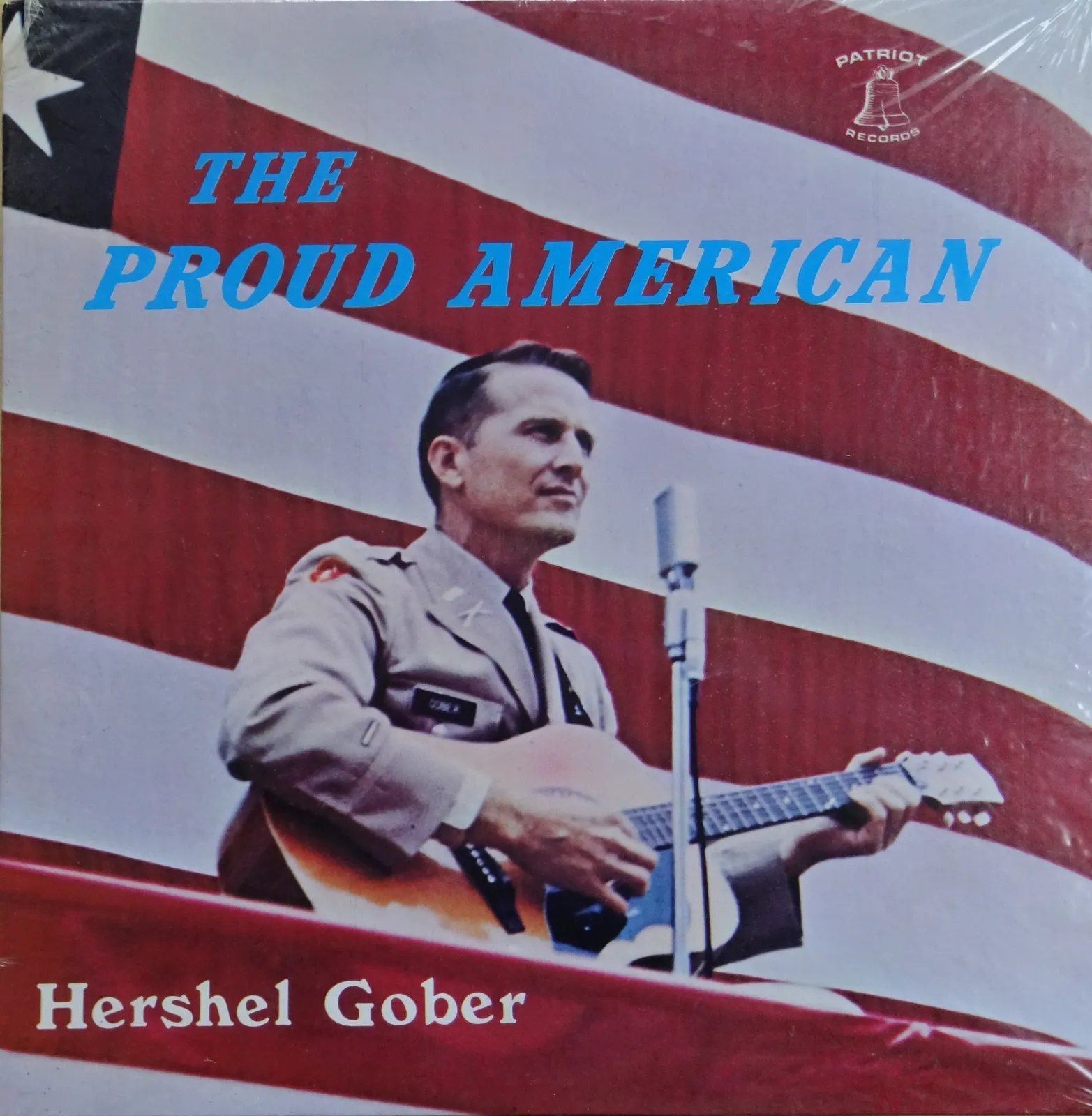
- Artist
- Hershel Gober
- Title
- Picture of a Man
- Release
- The Proud American
- Year
- 1968
- Label
- Patriot # 91140
- Format
- LP · Album
- Language
- English
- Country
- Dermott, Arkansas, USA
- Songwriter
- Hershel Gober
- Genre
- Folk · Contemporary Folk
- Primary theme
- US 'Patriotic' / Pro-Government / Anti-Protest Songs
Annotation — US Military & Veteran Songs
Hershel Gober followed in the footsteps of Barry Sadler, producing songs while serving in the US army. They were mainly positive, patriotic tracks, but also dealing with the plight of the soldier. He did two terms in Vietnam between 1965 and 1969 - firstly as an Infantry Adviser to the South Vietnamese Army (1965-1966), and secondly as an Infantry Company Commander (1969). He received the Soldier’s Medal, Bronze Star, Purple Heart, and Parachutist Badge. He later served as US Deputy of Veteran Affairs during the Clinton Administration (1993-2000).1 Interestingly, he actually started his career in the late 1950s as a rockabilly singer called Hershel Almond. While in Vietnam he took part in a project run by Major General Edward Lansdale of the US Army, which produced songs to win the "hearts and minds" of the Vietnamese people.23 Lansdale recorded many folk songs of Americans in Vietnam, which are stored at the American Folklife Center (Library of Congress).45 The song "Here I Am" looked at a lonely soldier away from home, missing his sweetheart. The track started with a spoken-word introduction: "a feeling that all soldiers have shared since the beginning of time is the feeling of being alone and far from home. In Vietnam I had this feeling, so I wrote this song". Thus, a fairly typical soldier boy song of the 1960s period. Of greater interest, he narrated the song "Picture of a Man" (Tee Pee Records # 834T-4533) from the perspective of an American soldier who became friendly with a South Vietnamese man. The US soldier described how the Viet Cong attacked the man's son at an outpost. The US soldier found the body: "I saw him hanging on a barbed wire fence...his head was blown off...I never shed so many tears". The man "attacked by over 300 Viet Cong", attempted to "keep his country free". While it is interesting for an American folk song to focus on the loss of a Vietnamese life, it sought to defended the existence of South Vietnam against the communist Viet Cong forces, and hence justifying the role of the US soldier. Therefore, this can be viewed as military propaganda. Re-issued in 1970 (Picture of a Man - Buddah Records # BDA 152), his title on the record went from "Capt." to "Major".Sources1veterans.arkansas.gov (archived copy)↩2In the Midst of Wars (Edward Geary Lansdale, 1991)↩3BBC: Asia pacific↩4Library of Congress, American Folklife Center: Vietnam War collections guide (archived copy)↩5Buffalo State University↩
Annotation by Justin A. Brummer
Annotation — US Military & Veteran Songs
Hershel Gober followed up his 1966 Vietnam-related singles with a full-length album. The title The Proud American (Patriot Records # 91140) stated its patriotic stance. The back of the record said that: "These songs were written in Vietnam, where Hershel has served twice as a combat soldier. This is a soldiers' look at Vietnam". It then showed a picture of Gober performing to his "friends" at the Cam Ranh Air Base - President Johnson, General Westmoreland, and the South Vietnamese President Nguyen Cao Ky. The back of the record also attacked the protest movement who were "trying to sell America short and speak only of its weaknesses and what is wrong with it". It then praised Gober who "sings of its strength".1 The song "Saigon Warrior" is a comedy addressed to American GIs, which Gober wrote while touring around the hospitals in Vietnam. The lyrics criticised those who spent a lot of time in Saigon: "helping fight a war, pushing a pencil my finger is getting sore". It also focused on GIs visiting prostitutes in the Saigon bars, referencing the famous "Tu Do Street", the main location of these establishments. Tu Do translated as "Liberty", called that between 1955 and 1975. Formerly known as Catinat street (pre-1955), Hanoi re-named it Dông Khoï ("General Insurrection") after the fall of Saigon.2 This may be some sort of variation on another song, with the same name, but similar theme: "Saigon Warrior" performed by Maggie, an unknown Australian artist, recorded in-country during the war - one of the rare female performances from the Vietnam War. According to the article "Songs of the Vietnam War: An Occupational Folklore Tradition", by Dr. Les Cleveland (1986)1: According to the 1991 compilation In Country: Folk Songs of Americans in the Vietnam War, compiled Lydia Fish, which featured a version by US veteran Saul Broudy: A song called "Saigon Warrior" (Broudy 1969) sung to the tune of "Sweet Betsy From Pike" is a variant of a World War 2 composition which could be used to complain about base camps, training establishments, or headquarters anywhere in the world. For instance, a version sung in the New Zealand Army during World War 2 (and still in circulation in 1986) was entitled "Waiouru's a Wonderful Place"... The "Saigon Warrior" variant of this song collected in Vietnam by Broudy... Broudy states that the text was transcribed from a tape-recorded performance by Maggie, an Australian woman. This suggests that it may either have been part of some Australian-inspired entertainment, or it may have originated with the ANZAC forces in Vietnam. Dinky dau is a corruption of the Vietnamese die cai dau, literally sick the head, hence, meaning crazy. This makes no sense unless it is related to a traditional Australian folk ballad, current in World War 1 and 2, entitled "The Lousy Lance-Corporal" (Cleveland 1959, 1961, 1975, 1982; Tate 1982) which makes repetitive use of the expression "dinky die" as a chorus. This is a slang term meaning truly, emphatically, indisputablyThere are many military folksongs about rear echelon personnel. This one is descended from a British Army World War I song entitled "The Lousy Lance-Corporal." It circulated widely in Southeast Asia in both Army and Air Force tradition. It was sung by an Australian woman named Maggie as part of a song competition which provided the entertainment at a commanders' conference held at the Nha Trang headquarters of the 17th Aviation Group, in April, 1967. A tape of the concert was given to Saul Broudy by helicopter pilot and singer Gene Easley, who was later killed in action. (2)Sources1Proud American (Hershel Gober) (Back)↩2saigon-vietnam.fr: Tu do street↩
Annotation by Justin A. Brummer
Notes
Tee Pee Records 834T-4533, red label, "A Subsidiary of Target Records, Appleton, Wis.", produced by Target Productions, ALPO Music; "Here Am I" (H. Gober), T45-34, 2:27, matrix UK4M-2906, backed with "Picture of a Man" (H. Gober), T45-33, 3:20, matrix UK4M-2905; credited to Capt. Hershel Gober. The LP The Proud American, Patriot Records 91140, Dermott, Ark., blue labels, 33 1/3 RPM: side one "Proud American" 2:45, "Six Klicks" 2:50, "Look Over My Shoulder" 3:46, "Here Am I" 4:00, "Forgotten Man" 2:45; side two "Saigon Warrior" 5:56, "Tropic Rain" 3:54, "Picture of a Man" 3:28, "Birth of a Nation" 3:10, "An American's Dream" 5:02, "Closing"; "All songs written and recorded by Hershel Gober", with Pamco Music credited for "The Proud American", "Here Am I" and "Forgotten Man". The front cover shows Gober in Army uniform playing guitar at a microphone before a waving American flag; the back…
About the artist
Born 21 December 1936, Monticello, Arkansas, USA
Themes
Patriotic · Military · Soldier's Perspective · Anti-Communism · VC
From the release The Proud American
In collections
US 'Patriotic' / Pro-Government / Anti-Protest Songs [War Years] · US Military & Veteran Songs