Collections › Blues songs
Blues songs
84 songs · chronological · A–Z by artist
Annotations and notes by Justin A. Brummer
Entries are numbered (#1, #2 …) for reference on this page; the numbers shift when entries are added or split.
A collection of blues songs referencing the Vietnam War
This forms part of the larger Vietnam War Song Project, an interpretive examination of over 6,500 Vietnam War songs identified, revealing how the war's significance is represented through music. The project also collects spoken-word recordings about the conflict. This unique collection of voices advances scholarship by providing insights into people’s views about the war over time as represented in music, looking at diverse communities and vibrant music scenes. It is crucial in developing our knowledge of the war and the humanities, through the use of a digital research platform.Note: The VWSP has identified, to date, 80+ songs in the blues genre.
YouTube playlist: Vietnam - Blues
Citation: Justin A. Brummer, Vietnam War Song Project (VWSP) — Blues songs, vietnamwarsongproject.com/list/blues-songs, accessed 12 November 2026
Introduction
To date, 80+ Vietnam War songs in the blues genre has been identified by the VWSP.
The songs in this collection most often deal with: Anti-War, Draft, Soldier's Perspective, Civil Rights.
1 of 2
The blues had fallen out of popularity in the 1950s, but found a new audience amongst the 60s generation, who shared its anti-war, Civil Rights, and messages of social change, which are found in its lyrics.
In the 1960s many blues singers turned their attention to the Vietnam conflict. Historically, blues musicians often sang about topical events, such as economic depression, war, and presidential politics. Many of the songs expressed a deep anxiety about their friends and family being drafted, as well as concern for domestic social issues, such as the connection between civil rights and the role played by African-Americans in the army.
In the 1960s many blues singers turned their attention to the Vietnam conflict. Historically, blues musicians often sang about topical events, such as economic depression, war, and presidential politics. Many of the songs expressed a deep anxiety about their friends and family being drafted, as well as concern for domestic social issues, such as the connection between civil rights and the role played by African-Americans in the army.
For other songs by African-Americans see:
• Vietnam War: Soul, Gospel, & Funk Songs
Coming soon:
• Vietnam War: Jody Songs
• Vietnam War: Civil Rights Songs
• Vietnam War: Soul, Gospel, & Funk Songs
Coming soon:
• Vietnam War: Jody Songs
• Vietnam War: Civil Rights Songs
Pre-Gulf of Tonkin: 1960-1963
1961
#1 Wilbert Harrison Drafted 1961 · Single · Drafted / My Heart Is Yours · Fury [New York] # 1055 · USA
Annotation
Wilbert Harrison, blues and R&B artist, born on 5 January 1929 in Charlotte, North Carolina, USA, he died on 26 October 1994 in Spencer, North Carolina, USA. Released in 1961, the song "Drafted" (Fury Records # 1055) was just before the main period of the Vietnam War - no specific war is mentioned, however it is a good piece of contemporary blues representing the possibility of being drafted at the time. Reluctantly, the narrator informs his partner that "I got to meet that recruitin' sergeant" . He wonders whether it will be "the army or the marines...the navy or the air force" - either way, he request "dear, don't forget our lover's vow" .Annotation by Justin A. Brummer
Notes
Fury Records 1055, matrix F 2009, 45 R.P.M., "Preview Copy"; "Drafted" (W. Harrison), 2:25, Fast Music - Wilberton Music; "Sehorn & Robinson Production". [From the record sleeve and labels]Lyrics
English
Hut-two-three-four
Hut-two-three-four
Hut-two-three-four
Goodbye, my darlin', I have been drafted
Hey, a face says I've got to go
Goodbye my darlin', I have been drafted
Hey, a face says I've got to go
My dear it hurts me so
How much you'll never know
And I really hate to go
Hut-two-three-four
Hut-two-three-four
Hut-two-three-four
Goin' by train or by plane
I got to meet that recruitin' sergeant
Goin' by train or by plane
I got to meet that recruitin' sergeant
On land or on sea
No matter where I may be
My darlin', please, please, wait for me
Yeah, yeah, yeah, yeah
Ah, but you know, yeah
Mercy!
Hеy, ho
Hey, ho
Yeah, yeah, yеah
Hut-two-three-four
Hut-two-three-four
Hut-two-three-four
Might in be in the army or the marines
I'm drafted, and that's no dream
Might be in the navy or the air force
Whichever one I've got no choice
I'm in the service now
I guess I'll make it somehow
Dear, don't forget our lover's vow
I'm in the service now
I guess I'll make it somehow
Dear, don't forget our lover's vow
I'm in the service now
I guess I'll make it somehow
Genres: ♪ BluesSoul Blues
#2 Lightnin' Hopkins War Is Starting Again 1961 · Single · Got Me a Louisiana Woman / War Is Starting Again · Ivory # 91272 · USA
Credited on the record as Lightning Hopkins and His Guitar.
Annotation
Lightnin' Hopkins, born Sam Hopkins on 15 March 1912, in Centreville, Texas, recorded extensively from the 1940s-1970s, typically playing blues in the style that came out of his native Texas, like Blind Lemon Jefferson (acoustic / electric Texas blues). Often singing about topical events, such as the Korean War and Great Depression, in the mid-late 1960s he turned his attention to Vietnam. He died in Houston Texas on 30 January 1982.1 He released several Vietnam War-related songs (see the info box below)On this 1962 LP featured the song "War Is Starting Again" (Vee-Jay Records # LP-1044), also released on the 1961 single Got Me a Louisiana Woman / War Is Starting Again ({Label185167] # 91272), which may have been too early to specifically be in reference to the Vietnam conflict. The narrator expressed fear of war coming, "well, I got news this morning, right now they need a million men" . This song also included a "Jody" reference - the term "Jody" originated from "Joe the Grinder" (dated c.1939) - a mythical man in blues and jazz tunes who seduced the wives and girlfriends of soldiers, prisoners, and those away from home. "Grinder" was an old slang word for sex (dated c.1647). It is thought to have been introduced into the army by African-Americans during the Second World War, used in military cadences (marches), such as "ain’t no use in going home, Jody’s got your girl and gone" - shouted out by a military officer, and repeated by the group of marching soldiers in unison. This type of marching later got the nickname of "jodies" or "jody calls". In this case, the narrator is the Jody: "you know my girlfriend got a boyfriend in the army, that fool gotta go overseas" . Hopkins later uses a similar line in the 1969 song "Please Settle in Viet Nam" .
Vietnam War songs by Lightnin Hopkins:
In 1962 Hopkins released the song "War Is Starting Again" on the album Lightnin' Strikes (Vee-Jay Records # LP-1044). In 1969, he released the anti-war single "Please Settle in Viet Nam" (Joliet # 205). He also recorded the song "Vietnam War" with his cousin Billy Bizor on the album Blowing My Blues Away in 1968. In fact, Hopkins released his own version of that song, called "Viet Nam War (Pt.1) & (Pt.2)" on the 1968 album Talkin' Some Sense (Jewel Records # LPS 5001). Finally, in 1970 Hopkins produced the song "Questionnaire Blues" on film, released in 1970 on video, but unreleased on audio format.
Annotation by Justin A. Brummer
Notes
Ivory Records 91272B, 45 R.P.M.; "War Is Starting Again" (Hopkins - Semiens), 2:45, Allee Music Publ., BMI; "Lightning Hopkins and His Guitar". Label decorated with two elephant drawings. [From the record sleeve and labels]Lyrics
English
Woe, you know this world done get tangled now, baby
Woe, you know I believe they fixin' to start a war again
Woe, you know this world done get tangled now
Yeah, I believe they gonna start war again
Yeah, there'll be a mothers start to worry
Yes, there'll be many a girls will lose a friend
Well, I got news this morning
Right now they need a million men
Woe, I got news this mornin'
Right now they need a million men
Woe, you know, I been overseas once
Oh, Lightnin' don't want to go there again
Lord have mercy!
All right!
Yeah, you know my girlfriend got a boyfriend in the Army
That fool gotta go overseas
You know I don't hate it so bad because you know
That's a better break for me
This world's a-tangled
Yeah, the finally had a war again
Genres: ♪ BluesTexas Blues
1962
#3 Memphis Willie B. Uncle Sam Blues 1962 · Album · Hard Working Man Blues · Prestige Bluesville # BVLP 1048 · USA
Annotation
Acoustic Blues artist, born on 4 November 1911 in Shelby County, Tennessee, USA, he died on 5 October 1993 in Memphis, Tennessee. He released the early Vietnam War-era draft song, "Uncle Sam Blues" (Bluesville Records #1048), in which the narrator explained to his daughter that "Uncle Sam's havin' trouble overseas" . He continues that "the doctor done okayed me...I got to check with my local board" . Released in 1962, it was probably a little early to be specifically about Vietnam, but an interesting reflection of the contemporary prospect of being drafted to war and the impact on home life.Annotation by Justin A. Brummer
Lyrics
English
You know, I've got bad news for you, little girl, I'm gonna tell you what it's all about
You know, I've got bad news for you, little girl, Lord, and I'm gonna tell you what it's all about
You know, Uncle Sam's havin' trouble overseas, and Lord, they want me to help him out
The doctor done okayed me, Lord, and I'm glad there was nothin' wrong
The doctor done okayed me, little girl, I'm glad there wasn't nothin' wrong
But only thing I hate, I got to leave you here alone
I'm gonna get up early in the mornin', Lord, I got to check with my local Board
I got to get up early in the mornin', I got to check with my local Board
Lord, I'm so sorry, but, little girl, I got to go
Hold out, baby, maybe I'll be back someday
Hold out, baby, maybe I'll be back someday
Lord, don't let nobody drive my little girl astray
I know you hear that train wistle blowin', callin' little Willie, I know
Hear that train whistle blowin', callin' little Willie, I know
Baby, you know how it is, you know, I'm booked out and I'm bound to go
So now, bye-bye, little girl, don't forget to write
So bye-bye, little girl, don't forget to write
Lord, I be thinkin' of you, each, both dayr and night
Themes: Draft Reluctance Draft
Genres: ♪ BluesCountry Blues
#4 Luke Miles War Time Blues 1962 · Single · Long Gone / War Time Blues · Smash # S-1755 · USA
Annotation
Luke Miles, musician in the Electric Texas Blues genre, thought to be a protégé of Lightnin' Hopkins, having moved to Houston, Texas in the 1950s. He was born on 8 May 1925 in Lachute, Louisiana, USA, and died on 22 November 1987 in Los Angeles, California, USA. The song "War Time Blues" (Smash Records # S-1755), recorded on 5 February 1962 in Los Angeles, featuring Sonny Terry on harmonica, and Brownie McGhee on acoustic guitar, dealt with the draft in the build-up to escalation in the Vietnam War under JFK, although it's more of a Cold War song, referencing the Russia leader, Никита Хрущев [Nikita Khrushchev]. The narrator expressed reluctance to be drafted, " "When I get my examination card, I want the doctor to tell me I'm too doggone old".Annotation by Justin A. Brummer
Notes
Credited on Discogs as Luke "Long Gone" Miles, Smash Records S-1755, 7" 45 RPM. Discogs release 8863693 is a promo pressing "Long Gone" (2:57) / "War Time Blues" (2:50). Discogs also lists S-1755 as "Let Me Play With Your Poodle" (2:18) / "War Time Blues" (2:50), released Jul 1962 (release 3841404), with Tampa Red ("Tampa Redd") as Written-By at release level (applies to Poodle). Wikipedia lists both couplings in 1962. Justin owns a copy (Smash S-1755, bought 2026-06-01, $8).Lyrics
English
Well you know the war is raging
It's raging more and more everyday
And that's why I'm glad I'm growing older
So I can try to stay away
Man I don't wanna go
When I get my examination card, I want the doctor to tell me I'm too doggone old
Well you know they got the planes
They got them climbing like squirrels
And the fellow they call Khrushchev, got them out of this world
That's why I don't want no army
Oh man, I don't wanna go
Well, when I get my examination card, Willie, oh man, I want the doctor to tell me I'm too doggone old
Go ahead play it Brown, for me
Boy you know how I feel now
Back me up, that's what I'm walking about, play that guitar Willie
You know I wouldn't mind going to the army
But they like to shot and kill
And when I'm dead and gone some woman be drawing my will
That's why I don't want no army, oh man I don't wanna go
When I get my examination card, I want the doctor to tell me I'm too doggone old
Themes: Draft Soldier's Perspective
Also in: ▤ Draft Songs
#5 Eddie Carson Bombs of Destruction 1962 · Single · Bombs of Destruction / Leave Me Alone · Versa # 1203 · USA
Annotation
Blues and soul artist Eddie Carson, born on 25 August 1923 in North Carolina, USA, and died on 29 May 1990 in Toledo, Ohio, USA, released the Cold War, atomic bomb-related song, "Bombs of Destruction" (Versa Recording # 1203), released in 1962 in the early Vietnam War period. According to music historian Guido Van Rijn in his 2007 book Kennedy’s Blues: African - American Blues and Gospel Songs on JFK, the song may have been a response to the Cuban Missile crisis.1 The narrator notes "rumours, rumours of war" and the threat of atomic destruction: "those bloody bombs... may someday... destroy the world" , taking an anti-war position.Sources
Annotation by Justin A. Brummer
Notes
Versa Recording 1203 (102023, side A, MW889), stereo, green label, 2033 Dorr - Toledo, Ohio 43607; "Bombs of Destruction", 2:40, BMI-1462; Eddie Carson, arranged by Rober Smith and Eddie Carson; "Noble's Production—2033 Dorr". [From the record sleeve and labels]Lyrics
English
You know, there is trouble all around the world today
And not a pretty, pretty sight to see
And rumours, rumours of war
Just to destroy humanity
That's why I'm writing you this letter in words, words of a song
I wanna tell the world, the whole world of today: it won't be long
Now you know those bloody, those bloody bombs that hangs high, high over our heads
They may someday, someday destroy the world
And make our own, our own death beds
Now you can hide, you can hide in your bomb shelters
And if you do, and if do survive
You can see the world, the whole world of today destroyed before your very eyes
Now, you know, I was a war orphan, and it hasn't been, hasn't been too long ago
But I've seen, I've seen what bombs can do to this country, this country that I love so
Now, we've had, we've had too many wars, and there's many, many more to come
So stop, think a minute won't you
The next might, just might be the one
Theme: Atomic
#6 Bo Diddley Mr. Khrushchev 1962 · Album · Bo Diddley · Checker # LP 2984 · USA
Annotation
Bo Diddley, famous Electric Blues artist, also associated with Rhythm & Blues and Rock & Roll, born Ellas Otha Bates, on 30 December 1928 in McComb, Mississippi, USA. He released the Cold War track "Mr. Khrushchev" (Checker Records # LP 2984) released just as the Vietnam War was building up, another interesting reflection of the contemporary period which creates context for later, specific Vietnam War songs. The title of course referred to the Russia leader, Никита Хрущев [Nikita Khrushchev], and the lyrics reference the US president, John F. Kennedy. In this case, the narrator wanted to go to war, "I want to go overseas, I want to see Khrushchev", in order to hep the president, "JFK can't do it by his self". Annotation by Justin A. Brummer
Notes
Track A2 'Mr. Khrushchev' (credited E. McDaniel). Mono LP, black label. Producer Ralph Bass; supervised by Phil Chess; engineer Ron Malo; cover Don Bronstein. Published by Arc Music (BMI, misprinted 'BIM' on some label tracks). Lacquer cut at Ter Mar Studios; pressed by Plastic Products; Chess Producing Corp. / Checker Record Corp.Lyrics
English
I think I want to go to the army (Hut 2, 3, 4)
I think I want to go overseas (Hut 2, 3, 4)
I want to see Khrushchev (Hut 2, 3, 4)
I want to see him all by myself (Hut 2, 3, 4)
Hey, Khrushchev (Hey, Khrushchev)....
He don't believe that water's wet
If he did he could've stopped those tests (Hut 2, 3, 4)
JFK can't do it by his self (Hut 2, 3, 4)
C'mon fellas, let's give him a little help (Hut 2, 3, 4)
We as Americans to understand (Hut 2, 3, 4)
We got to unite and protect our land
We got to keep us on alert (Hut 2, 3, 4)
To keep our families from getting hurt
Hey, Khrushchev (Hey, Khrushchev)....
We fightin' over a six-wheel bus
My bald-headed crew just parked on up
We as Americans to understand (Hut 2, 3, 4)
We got to unite and protect our land
We got to keep us on alert (Hut 2, 3, 4)
To keep our families from getting hurt
Hut, 2, 3, 4, yeah! [Drill chatter]
Get in line there!
Lord have mercy! Get inline and walk right!
Your mom can't help you now! Ain't nothing like home!...
#7 Teddy Reynolds and The Twisters I Thought the War Was Over 1962 · Album · The Twist · Crown # CLP 5245 · USA
Annotation
Teddy Reynolds, Blues artists, especially known for playing the piano, born on 12 July 1931 in Houston, Texas, USA, and died on 1 October 1998 in Houston, Texas, USA. He grew up in Houston's 'Third Ward', played piano in bootleg houses and joined the house band at the Third Ward nightclub Shady's Playhouse, playing with Electric Texas Blues artists Johnny Copeland, Albert Collins and other Texas artists, such as Joe Medwick and Amos Milburn. He recorded in the 50s and 60s, especially as a session player at Houston's Peacock Records. He played with Grady Gaines & The Texas Upsetters on the 1990 album Gulf Coast Blues, Volume One.1In 1962 he released the song "I Thought the War Was Over" (Crown Records # CLP 5245) - the narrator refers to the "last war" - which could be a reference to the Korean War or World War Two. In any case, "Mr. K said that don't mean a thing", a reference to President John F. Kennedy. In a resigned fashion, the narrator accepts "this world is all mixed up", and that he will be returning to the "old war plant".
Sources
Annotation by Justin A. Brummer
Notes
Track B5 'I Thought The War Was Over'. Mono LP, black label with multi-color Crown logo (Crown Records, Bihari brothers). A stereo issue exists as Crown CST 247 (no year on Discogs). Discogs styles: Twist, Rhythm & Blues. No writer credits on Discogs. A 2011 Master Classics Records digital reissue also exists.Lyrics
English
I thought the war was over
Mr. K. said that don't mean a thing...
Well this world is all mixed up and you know I'm not to blame
Well I'm working hard baby, you gotta treat me like a king...
Well I'm back on my old war plant y'all
And I'm doing the same old thing
Well you can come back home baby if you promise to be good...
'Cause the last war, I gave you everything I could
Themes: Draft Soldier's Perspective
Also in: ▤ Draft Songs
#8 Big Joe Williams Army Man Blues 1962 · Album · Blues For 9 Strings · Prestige Bluesville # BVLP-1056 · USA
Annotation
Big Joe Williams (1903-1982), delta blues guitar player, born Joseph Lee Williams, in Crawford Mississippi, used a nine-string acoustic guitar, giving his delta style an interesting, unique sound. He released the song "Army Man Blues" (Bluesville Records # BV 1056) in the early 60s, pre-Gulf of Tonkin period, about receiving the draft call, noting "when you get twenty-one boy you know you're in the government's hands". The song actually references Europe, "I got a big gun way in the European country". This is particularly interesting, because 8 years later he re-recorded the song, updating the lyrics for the Vietnam conflict: "If we don't stop the war in Vietnam I believe we'll drop that old atom bomb" - on the 1970 album Thinking of What They Did to Me (Arhoolie Records # 1053), discussed below.Annotation by Justin A. Brummer
Notes
Track B4 'Army Man Blues'. Personnel: Big Joe Williams (guitar, vocals), Willie Dixon (bass), Larry Johnson (harmonica). Producer Kenneth S. Goldstein; recorded by Mel Kaiser; liner notes Martin Williams. Blue and silver Prestige Bluesville deep-groove label, 203 S. Washington Ave., Bergenfield, N.J. Matrix BVLP 1056 A / B, etched RVG.Lyrics
English
Well I heard a voice this morning I never did hear before
Uncle Sam was calling us, said 'Big Joe, I swear you gotta go'
To the army man, yeah you know the United States been raising sand
Well when you get twenty-one boy you know you're in the government's hands
I got a handful of nickels, pocketful of dimes
House full of children...
But I'm in the army... well the Yanks over there raising sand
I got a big gun yonder hid away out in the woods
I got a big gun way in the European country, hid away out in the woods
If my gun don't do no good boy, I swear I would drop the bomb
Well now the rooster told the hen, 'I want the hens all go lay'
Said 'No, but my man is in the army, I got to go work for the WPA
I'm in the army man
I'm over there raising sand
Yeah, when your age gets twenty-one, you're in the government's hand
Themes: Draft Soldier's Perspective
Also in: ▤ Draft Songs
1963
#9 Snooky Pryor Uncle Sam Don't Take My Man 1963 · Single · Uncle Sam Don't Take My Man / Boogie Twist · J.O.B. # 1126 · USA
Annotation
Snooky Pryor, born James Edward Pryor on 15 September 1921 in Lambert, Mississippi, USA. He died on 18 October 2006 in Cape Girardeau, Missouri, USA. Known for his harmonic playing, he was part of the Chicago Blues scene. He served in the US army during World War Two. The song "Uncle Sam Don't Take My Man" (J.O.B. Records # 1126), released on Chicago, Illinois record label notes "every time I pick up a paper, I can read something about the war" . It looked at the domestic perspective, "I can just hear women screaming and crying" . Also note the reference to the atomic bomb, a reflection of the Cold War era: "Yes I believe I'll drop the bomb" .Annotation by Justin A. Brummer
Lyrics
English
Yeah did you hear about the news up north?
It was everybody's Santa Claus
Well, every time I pick up a paper, I can read something about the war
I can just hear women screaming and crying
Uncle Sam, please don't take my man
Yes, the men ain't qualified for the army and the man don't understand
Well just look at them big guns yonder
Them big guns hid out in the woods
Look over yonder
Yes I believe I'll drop the bomb cause a space ship won't do no good
Play it now, oh but just look over there
Themes: Soldier's Perspective Draft
Genres: ♪ BluesChicago Blues
#10 J. D. Short Fighting for Dear Old Uncle Sam 1963 · Compilation · Blues From The Mississippi Delta · Folkways # FA 2467 · USA
Annotation
LP, split between two artists rather than a collaboration, features the song "Fighting for Dear Old Uncle Sam" (Folkways Records # FA 2467) by Delta Blues artist J.D. Short, born on 26 February 1902 in Port Gibson, Mississippi, USA, and died on 21 October 1962 in St. Louis, Missouri, USA. He played guitar and the harmonica. He moved to St. Louis in the mid-20s, and recorded music in the 30s. Serving in World War Two, like many of his contemporaries, he disappeared for a couple decades, before re-emerging in the late 50s, early 60s blues revival. This song seems to be in reference to World War Two, "may go down in South Pacific, going down in a European land", but released in the early Vietnam War-era, thus included here. In contained vivid combat descriptions, "in some old foxhole... boys, we was afraid to raise our heads". Annotation by Justin A. Brummer
Notes
On the various-artists compilation; track A5. Split LP credited Son House & J. D. Short; side A (A1-A5) by J. D. Short, side B by Son House (from Library of Congress archives). J.D. Short tracks recorded by Samuel B. Charters on 3 July 1962 in St. Louis, Missouri.Cover design Ronald Clyne; photography David Gahr; lacquer cut Peter Bartok; plated at Dulcet Tone Corporation. Includes full-size booklet with notes and complete lyrics.
Matrix FA2467 A PB / FA2467 B P.B DT.
Reissued as Verve Folkways FV-9035 (1966).
Lyrics
English
Tell me war is all over, yes, gonna be right here...
Well on account of so many women now, totting away the soldiers' monthly pay
I may go down in South Pacific, going down in a European land
Where some ever I go down swinging boys, I'm going down fighting for dear old Uncle Sam
So dark was the night now, people, cold, cold was the ground
Me and my buddies in some old foxhole, we had to keep our heads all down
Well, machine guns and cannon roaring
Boys, we was afraid to raise our heads
You know if bayonets cost a million dollars, boy, now you know we'd have all been dead
Yes, the first of the month now, salute the lieutenant and get our pay
There's a little piece of paper laying on the side, sign it, send your wife home allotment pay
Some day they'll be so glad when the boys all come back home again
You'll get so many soldiers on the plane
The soldiers ain't gonna be your friend
Honey the war is all over
Ain't nothing but a little shout
'Cause the war is all over, you just don't know what it's all about
Themes: Soldier's Perspective Draft
Also in: ▤ Draft Songs
War Years (1964-1972)
1964
#11 Arthur Weston Uncle Sam Called Me (I Got To Go) 1964 · Pea Vine Whistle · Testament # LP 2209 · USA
Annotation
Blues artist, which according to Wirz's American Music may have been born on 12 January 1912 in Missouri, and died on 2 February 1996 in Belleville, Saint Clair County, Illinois1 Recorded in 1964, the song "Uncle Sam Called Me (I Got to Go)" (Testament Records # TCD 6005) was unreleased at the time, and appeared on this archival album, about being drafted: "Uncle Sam called me to the United States army" . The narrator looked at the impact on home life. First, he warned his girlfriend: "Pearly May... I don't know if I'll ever be back" , and second, he described his mother, who "begin to scream...and holler, lord have mercy on my child" . The narrator concluded with the devastating view of the US: "you know that Uncle Sam knew I was born to die" . Sources
Annotation by Justin A. Brummer
Lyrics
English
Uncle Sam called me
Yes boys, you know I sure got to go
Yeah Uncle Sam called me
Yes boys, you know I sure got to go
He called me to the United States army
Yes boys, you know I sure got to go
Yes Uncle Same called me this morning when the clock was striking four
He said, 'Fall out of your bunk boys, and get back out there in the rain and snow...
Yes called me to the United States army...
Yes you know I had a little woman, her name was Pearly May
Uncle Sam called me to the United States army
I have to go stay
Yes I'm gonna tell you one more thing Pearly May
I know you sure ain't gonna like...
I don't know if I'll ever be back...
Well mother begin to scream, scream, and holler saying 'lord have mercy on my child'
I told her 'hush hush now mother, don't you cry
Cause you know that Uncle Sam knew I was born to die
Lord look at the big gun yonder
You know it is sitting way out west
But whenever you get in touch with Uncle Sam
He gonna learn you all about the rest
Theme: Draft
Genres: ♪ BluesDelta Blues
Also in: ▤ Draft Songs
1965
#12 J.B. Lenoir Vietnam 1965 · Album · Alabama Blues · CBS # 62593 · USA
Annotation
Despite J.B. Lenoir's laid back acoustic blues style, during his 1960s period he wrote and played many angry political songs about racism and war - a pioneer of the protest movement. Born in Monticello, Mississippi in 1929, he worked with Elmore James in New Orleans, before moving to Chicago in the late 1940s, playing with Muddy Waters and becoming a notable figure in the Chicago blues scene. He died a couple years after the recording of this album, in 1967, at the age of 38. Lenoir only released this album, Alabama Blues, in his lifetime. Recorded on 5 May 1965, in Chicago Illinois, it contained many references to the civil rights movement and other political events. It was not issued in the US at the time, but only in France, Germany, and Australia. The song "Vietnam" (CBS # 62593) dealt with the draft card arriving and then a man being sent out to Vietnam: "got my questionnaire...Uncle Sam...need you in Vietnam" - questionnaire is the term often used to refer to the draft in blues songs. He expressed reluctance to go to war, and at the end of the song, he made a general peace statement: "I wonder when will all wars come to an end?" .
The song is adapted from his 1951 "Korean Blues" (Chess Records # 1449). Also note he released the 1954 single "I'm in Korea / Eisenhower Blues", another example of his focus on contemporary events. Lenoir also recorded a song called "Vietnam Blues" in 1966, released on the album Crusade (Polydor # 24-4011) in 1970. A live version from 1965, called "Everybody Crying About Vietnam" featured on the album Bye Bye, Bird...Solo Blues (Scout # SC-1) - probably released around 1968-69.
Annotation by Justin A. Brummer
Lyrics
English
Lord I got my questionnaire
Uncle Sam gonna send me away from here
J.B. you can hide, but you cannot run
They need you in Vietnam
Sweetheart, please don't you worry
I've just begun to fly in the air
Now if the Vietnams shoot me down over there
Lord you find my body buried somewhere
I wonder when will all wars come to an end?
Now, if the Vietnams shoot me down in sin
My son Jerry will rise up and fight again
Genres: ♪ BluesAcoustic Chicago Blues
#13 J.B. Lenoir Everybody Is Crying About Vietnam 1965 · Album · Bye Bye, Bird...Solo Blues · Scout # SC-1 · USA
Annotation
The song "Everybody Crying About Vietnam" (Scout # SC-1) by J.B. Lenoir - an alternative version of "Vietnam Blues" - recorded live during a European tour with the American Folk Blues Festival, October 1965, in Hamburg, Germany. However, it looks like the producers and record label owners, Horst Lippman and Johannes Rau, did not release this record until around 1968-69. The original studio version "Vietnam Blues", recorded in 1966, first appeared on the 1970 album Crusade (Polydor # 24-4011) - discussed below. The lyrics of the two songs are fairly similar, although Lenoir went into more detail about Civil Rights legislation. He posed the question to the president: "if you don't want to give us our Civil Rights, why do you send us to fight?". This represented the connection between Civil Rights / race relations and the role of African-Americans in Vietnam. It also included a spoken word introduction, in which Lenoir imagined the sounds of war. Note: this is different to the J.B. Lenoir song "Vietnam" which featured on the 1965 album Alabama Blues (CBS # 62593), discussed above.Annotation by Justin A. Brummer
Lyrics
English
I want you to hear what I hear, I hear some explosions, and a lot of bombs and guns shooting, lets go over to Vietnam
Everybody is crying about Vietnam...
Tell me, the Civil Rights Bill was killed in the House
People let me tell you about me beliefs
I never did believe the Bill was alive....
Mr. President, if you don't want to give us our Civil Rights, why do you send us to fight?
Themes: Anti-War Civil Rights
Genres: ♪ BluesChicago Blues
#14 J.B. Lenoir Vietnam Blues 1965 · Album · Down in Mississippi · L+R # LR 42.012 · USA
Annotation
The song "Vietnam Blues" , another blues song by J.B. Lenoir about the Vietnam conflict. Originally recorded on 2 September 1966 at Sound Studio, Chicago, Illinois, for the German recorded producers Horst Lippman and Johannes Rau, under the supervision of the bluesman Willie Dixon. It featured the drummer Freddie Below. However, it seems that they did not release the record at the time. It probably made its first appearance in 1970, on the album titled Crusade (Polydor # 24-4011). For the 1980 reissue by L+R Records (# LR 42.012) they renamed album Down in Mississippi (taken from the first track title). Both of the J.B. Lenoir songs discussed ("Vietnam" and "Vietnam Blues" ) are on Vietnam Blues: The Complete L+R Recordings - a compilation of both Alabama Blues and Down in Mississippi - these are acoustic albums, with no bass and electric guitar, and with occasional drums, thus returning to the pre-war blues sound. This song drew a connection between Vietnam and Civil Rights in the US. Lenoir questioned why people complained about Vietnam, but ignored or forget the problems that black Americans faced in their own country: "everybody cryin' about Vietnam, the law killing me down in Mississippi" . Lenoir called on the president to "clean up your own house" . A 1965 live version of this song, called "Everybody Crying About Vietnam" appeared on the album Bye Bye, Bird...Solo Blues (Scout # SC-1) released around 1968-69.
Annotation by Justin A. Brummer
Lyrics
English
Vietnam, Vietnam, everybody cryin' about Vietnam
The law killing me down in Mississippi, nobody seems to give a damn
Oh god if you can hear my prayer now
Help my brothers over in Vietnam
The poor boys fighting and killing
Maybe killing their own brothers...
Mr. President, you always cry about peace but you must clean up your own house before you leave
How can you tell the world how we need be and you still mistreating and killing poor me?
Themes: Anti-War Civil Rights
Genres: ♪ BluesAcoustic Chicago Blues
1966
#15 Allen Orange V.C. Blues 1966 · Single · V. C. Blues / Where the Lonely People Are · Sound Stage 7 # SS45-2573 · USA
Annotation
A 1960s/70s blues singer, well-known for his collaborations with Allen Toussaint. He founded the record label House of Orange in Nashville, Tennessee. The song "V.C. Blues" (Sound Stage 7 # 2573) took the perspective of a soldier in Vietnam, speaking to his loved ones back home. He informed her that the "V.C. is shooting at me" and that he really wanted to return to "the good old USA" . "V.C." referred to the Viet Cong - the political and military (mainly guerrilla) resistance to the US and South Vietnamese government from within South Vietnam. The soldier expressed a degree of patriotism: "I love...my country, for this I don't mind dying" . He also recalled various events that he would miss out on: "I won't be home this Christmas...and Thanksgiving...4th of July" . Produced by J.R. Enterprises. Composed by Orange/Terry.Annotation by Justin A. Brummer
Notes
Sound Stage 7 45-2573 (S-544), white label marked "Disc Jockey — Not for sale"; "V. C. Blues" (Orange-Terry), time 2:16, Cape Ann Music, BMI; produced by J. R. Enterprises; "A division of Monument Record Corp." [From the record sleeve and labels]Lyrics
English
Stay home girl for you will be safe in your mother's arms
Because I'm over here in Vietnam baby and the V.C. is shooting at me
I want you back in the good old USA...
I won't be home this Christmas darling
And Thanksgiving may pass me by over here
There are a lot of fireworks and it's not the 4th of July...
If I don't live to see you, remember that I love you
And my country, for this I don't mind dying
Genres: ♪ BluesSoul Blues
#16 Johnny Shines So Cold in Vietnam 1966 · Album · Masters of Modern Blues Volume 1 · Testament # T-2212 · USA
Annotation
Johnny Shines, American Delta blues guitar player from Memphis, Tennessee, who specialised in slide guitar, toured with Robert Johnson in the 1930s and had the odd recording session in 1940s Chicago, although nothing was released at the time. But with the revival of folk and blues in the 1960s, Johnny Shines recorded this album featuring the track "So Cold in Vietnam" (Testament Records # T-2212), narrated from the perspective of a soldier, who missed his sweetheart. Annotation by Justin A. Brummer
Lyrics
English
It's so cold in Vietnam
Worst than I can say
I know my baby will be happy when I sent her an engagement ring
I wonder what's the matter because I can't get no meat
Well some black cat will be walking down my street...
Well my mama is not happy
Sometimes I feel like crying
Theme: Soldier's Perspective
Genres: ♪ BluesDelta Blues
#17 King Soloman Please Mr President 1966 · Single · Please Mr. President / Mr. Bad Luck · Kent # K 45x446 · USA
Annotation
The track "Please Mr. President" (Kent Records # K 45x446) by the blues man King Soloman, apparently based on the West Coast, recording with the Los Angeles label Kent (this is a different artist than the well-known soul singer Solomon Burke, ending with a "mon" rather than "man", also sometimes referred to as "King Solomon"). Released in 1966 with Lyndon B. Johnson in the White House, the narrator of the song bitterly complained to the president about being sent to Vietnam. He loved his country and "never did get the notion to burn up my draft card" , yet he warned the women of American that "Uncle Sam...sure can take your man" . At the end of the song the soldier takes to hugging his pack and rifle to comfort him. Annotation by Justin A. Brummer
Notes
Kent K 45x446 (K 446-1), "Ultra High Fidelity", Hi-Fi, grey label; "Please Mr. President" (Collins), 2:55, BMI, Modern Music Pub. Co.; artist credited as King Soloman. [From the record sleeve and labels]Lyrics
English
Uncle Sam ain't no woman
Oh he sure can take your man
I'm begging you please Mr. President
Oh send me back home again
Yes I love my country
But leaving you was so hard
I never did get the notion to burn up my draft card
I like to hug my pack and rifle
And make-believe it is you
Until we can be together again baby it is the best thing that I can do
Themes: Soldier's Perspective Draft
Genres: ♪ BluesSoul Blues
Also in: ▤ Draft Songs
#18 Bus Brown Mr. L.B.J. 1966 · Single · Mr. L.B.J. / When the Lady Sings the Blues (In Memoir to Billy Holiday) · Burman # B0001 · USA
Notes
Burman Records B0001 A, cream label; "Mr. L. B. J." (Brown & Burman), Gent's Pub. Co., BMI, 2:53; arranged by Yusef Salim; recorded by Bradley Recording Co. [From the record sleeve and labels] #19 Robert Pete Williams This Is a Mean Old World to Me 1966 · Album · Louisiana Blues · Takoma # B 1011 · USA
Annotation
Country Blues artist Robert Pete Williams, born on 14 March 1914 in Zachary, Louisiana, USA, and died on 31 December 1980 in Rosedale, Louisiana, USA. The song "This Is a Mean Old World to Me" (Takoma Records # B 1011) contains the devastating line "I'm sorry the day I was born" because of the tough time he faced. This included receiving the draft call: "I got my questionnaire, lord, I'm in the army now" - questionnaire is the term often used to refer to the draft in blues songs. The narrator also noted his sons being in the war: "I got a few sons going over yonder to face the machine gun". The song concludes with the narrator pondering "I don't believe I'll see my mother's face again". Note: Robert Pete Williams also released the single "Viet Nam Blues" (Ahura Mazda Records # 45-AMS-101) in 1970, featuring on the 1971 album Robert Pete Williams (Ahura # AMS 2002).Annotation by Justin A. Brummer
Notes
Track B3 'This Is A Mean Old World To Me'. Mono LP. Robert Pete Williams: guitar, vocals, Written-By (release level). A&R John Fahey and Big Sunflower; booklet notes by Blind Owl Wilson and Elijah P. Holloway (8-page 8x8 booklet). Recorded at Big Sunflower/White Witch Studios; published by Hodolog Music (BMI). Matrix TAKOMA B1011-A / B1011-B. Wikipedia: recorded 1966.Lyrics
English
This is a mean old world to me
I'm sorry the day I was born a boy child
Every time you pick up the news it's something going on wrong...
I know for myself, sure is a worried man
I got a few sons going over yonder to face the machine gun in another world...
I am sorry the day I was born a child boy, lord in this world...
This is a mean old world to me...
I got to leave my mother, I got to go all across that deep blue sea
To face them old machine guns
I got my questionnaire, lord, I'm in the army now
Amongst them old machine guns
I don't believe I'll see my mother's face again
Theme: Draft
Also in: ▤ Draft Songs
#20 Badger King Napalm Blues 1966 · Single · Napalm Blues / Drownin' Rain · Union of Man · USA
Annotation
Badger King, born Michael Lynn Coelho on 3 January 194 in Fresno, California, USA, and died 12 April 1987.12 A contemporary folk artist, who participated in anti-Vietnam War demonstrations in the 60s, released the blues style song "Napalm Blues" about chemical weapon Napalm B - a jellied gasoline mixture, with polystyrene, benzene, and gasoline. Declared a war-crime since 1980, the US government extensively used this weapon during the Vietnam conflict, dropping 388,000 tons on Indochina between 1963 and 1973.123 It lyrics contain a graphic description of its devastating impact: "it's a gasoline jelly, burn your arms and your legs, and your back and your belly" . It compares the use of napalm to Hitler's use of gas during World War Two: "well Hitler had the gas, US has the bomb" . The narrator called for an end to the war: "all you people fighting... lay down your guns" . Sources
Annotation by Justin A. Brummer
Notes
Union of Man, 45 RPM; "Napalm Blues" (B. King), time 1:45. Plain yellow label with no catalogue number or publisher printed. [From the record sleeve and labels]Lyrics
English
Well the Vietnamese people ain't got no shoes
All they got is napalm blues
Well you heard about napalm
It's a gasoline jelly
Burn your arms and your legs
And your back and your belly
Well the US airplane drops it all on the ground
Until the woman and children burn..,
Every time I think about it
I feel mighty lost
If the bombs keep coming the whole world is gonna go
Well Hitler had the gas
US has the bomb
End this war but they fight on and on and on
So all you people fighting in this war
Won't you lay down your guns and fight no more
Well the Vietnamese people ain't got no shoes
All they got is napalm blues
Genre: ♪ Blues
#21 Junior Wells Vietcong Blues 1966 · Single · Chicago / The Blues / Today! Vol. 1 · Vanguard # VRS-9216 · USA
Annotation
Junior Wells, born Amos Wells Blakemore Jr. (1934-1998) in Memphis Tennessee, moved to Chicago in the late 1940s and based his career in the Chicago soul scene, well-known for his vocals and harmonica. On this album featured the live performance "Viet-Cong Blues" (Vanguard Records # VRS-9216), performed at the 1966 American Folk Blues Festival. An alternative version was later released on single, called "Vietnam-Blues" (1967), discussed below. Also note that Wells released the song "The Hippies Are Trying" (1968), a Vietnam-era pro-hippie and peace song.Annotation by Justin A. Brummer
Lyrics
English
I woke up early this morning
I was feeling kind of blue
My landlady said you got a letter here, and I began to sing the blues
It was from my brother, don't you know
The boy is laying down in Vietnam
Lord, they said, you don't have no reason to fight baby
But lord knows you think you're right
But you got to be wrong
You wake up early in the morning
You don't have nothing to eat
You can't buy yourself no clothes
Lord know who you can meet
My brother is in Vietnam, that's why I'm singin' these blues
You might not have no respect for your country darling
That's why I'm singin' these blues
The mothers, all the wives, all the fathers that have sons in Vietnam
You hear me? This is to
Themes: Soldier's Perspective Anti-War
#22 Sylvia Maddox Viet Nam Blues 1966 · Single · Got to Be Free / Viet Nam Blues · Duke # 408 · USA
Annotation
The track "Viet Nam Blues" appears to be the only single by the obscure R&B / soul singer Sylvia Maddox. Released on the Memphis, Tennessee label Duke Records (#408) in 1966, the song expressed a mother's loneliness, because "Uncle Sam has taken my baby...to Vietnam" .Annotation by Justin A. Brummer
Notes
Duke 408 (UV 7227), orange label, 45 RPM; "Viet Nam Blues" (S. Crite), 2:30, Don Music Co., BMI. [From the record sleeve and labels]Lyrics
English
Uncle Sam has taken my baby
Shifted him to Vietnam
Ain't it so lonely here
When you take so many mother's sons
You can't love him, you can't hug him
You can't hold him close at night
You can't do little things the way you should
Well I'm sitting here writing letters
Theme: Anti-War
Genres: ♪ BluesSoul Blues
1967
#23 Junior Wells Vietnam Blues 1967 · Single · Vietnam Blues / Roll 'Em Pete · AMIGA # 4 50 599 · Germany
Annotation
Junior Wells, born Amos Wells Blakemore Jr. (1934-1998) in Memphis Tennessee, moved to Chicago in the late 1940s and based his career in the Chicago soul scene, well-known for his vocals and harmonica. The song "Vietnam-Blues" (AMIGA # 4 50 599) by Junior Wells expressed sympathy for those dying and took an anti-war stance. The narrator began to "sing the blues" for his "brother...in Vietnam" , and for all the "mothers, all the wives, all the fathers" who had a son or husband fighting the war. The narrator suggested that those supporting the war "got to be wrong" , and it noted that some people had "no respect for" the "country" because of the war. Wells performed an alternative version of the song at the 1966 American Folk Blues Festival, which subsequently appeared on the 1966 album Chicago / The Blues / Today! Vol. 1 (Vanguard Records # VRS-9216), under the title "Viet-Cong Blues" . Wells also released the song "The Hippies Are Trying" (1968), a Vietnam-era pro-hippie and peace song.
Annotation by Justin A. Brummer
Notes
Amiga 4 50 599 A, VEB Deutsche Schallplatten, red and cream label, BIEM N 504 2125, M 45; "Vietnam-Blues" (Wells–Wells), Junior Wells (voc, harmonica) "und Solisten des 'American Folk Blues Festival 66'", "Mitschnitt einer öffentlichen Veranstaltung".The front of the picture sleeve shows Wells playing harmonica into a microphone under the psychedelic lettering "Vietnam Blues / Roll 'em Pete".
The back gives the flip side as "Roll 'em Pete" (Big Joe Turner–Big Joe Turner) by Big Joe Turner (voc) with the festival soloists. Both sides are described as recorded live at a public performance in the Friedrichstadt-Palast on 16.10.66.
The back also carries an Amiga "Tanzmusik-Schallplatten-Angebot Januar 1967" listing, "VEB Deutsche Schallplatten · 108 Berlin", and "Gestaltung: Vonderwerth". [From the record sleeve and labels]
Lyrics
English
I woke up early this morning
I was feeling kind of blue
My landlady said you got a letter here, and I began to sing the blues
It was from my brother, don't you know
The boy is laying down in Vietnam
Lord, they said, you don't have no reason to fight baby
But lord knows you think you're right
But you got to be wrong
You wake up early in the morning
You don't have nothing to eat
You can't buy yourself no clothes
Lord know who you can meet
My brother is in Vietnam, that's why I'm singin' these blues
You might not have no respect for your country darling
That's why I'm singin' these blues
The mothers, all the wives, all the fathers that have sons in Vietnam
You hear me? This is to
Theme: Anti-War
#24 Big Amos Going to Vietnam 1967 · Single · I'm Gone / Going to Vietnam · M.O.C. # 45-665 · USA
Annotation
The blues track "Going to Vietnam" (M.O.C. Records # M.O.C.) by Big Amos Patton, from Sardis, Mississippi, and nephew of the famous 1920s-1930s delta bluesman Charley Patton, it was recorded in Memphis Tennessee, but is very much set to the style of the electric, Chicago blues (like Muddy Waters & Junior Wells). The lyrics told a straight forward narrative of a man being drafted to Vietnam, expressing fears about his lover staying true to him. There is no question of draft dodging, opposition to war, or patriotism, just the simple point that "Uncle Sam called me...And I've got to go" . Annotation by Justin A. Brummer
Notes
M.O.C. 45-665 (HI 2493), "Promotional Copy", sunburst label; "Going to Vietnam" (Amos Patton), 2:49, Pub: JEC Publishing Corp., BMI; produced by Willie Mitchell; "Recorded in Memphis"; distributed by London Records, Inc., made in U.S.A. [From the record sleeve and labels]Lyrics
English
Get up in the morning, straight to Vietnam
I hate to leave you darling...
Uncle Sam called me and I've got to go...
I know you're going to miss me...
Please write and tell me how you're getting along...
I'm going to Vietnam
Uncle Sam gonna send you a paycheck
Themes: Soldier's Perspective Draft
Genres: ♪ BluesSoul Blues
Also in: ▤ Draft Songs
#25 Nina Simone Backlash Blues 1967 · Album · Nina Simone Sings The Blues · RCA Victor # LSP-3789 · USA
Annotation
The song "Backlash Blues" (RCA Victor # LPM-3789), composed by Nina Simone and Langston Hughes in 1966, and appearing on this 1967 album, referenced the Vietnam War in the first verse, making a connection between the war and Civil Rights: "you... send my son to Vietnam, you give me second class houses and... schools, do you think that all colored people are just second class fools?" . Like J.B. Lenoir, this song questioned why the government sent African-Americans to fight in Vietnam, while back home in the US, African-Americans faced discrimination, and were treated as second class citizens through segregation. The lyrics and notation later appeared in Broadside # 88, January 1968.Annotation by Justin A. Brummer
Lyrics
English
So, Mr. Backlash, Backlash
Who do you think I am?
You raise my taxes
Freeze my wages
Send my son to Vietnam
You give me second class houses
And second class schools
Do you think that all colored people are just second class fools?
Themes: Anti-War Civil Rights
Genres: ♪ BluesBlues Jazz
#26 Mark Comfort Damn Vietnam (Part 1) 1967 · Single · Damn Vietnam (Part 1) / Damn Vietnam (Part 2) · O.D.A.C. · USA
Credited on the record as Mark Comfort and Guitar.
Annotation
Born Mark Everett Comfort on 6 February 1934 in Oklahoma, USA, he was a Civil Rights activist and member of the Black Panthers in Oakland, California - the well-known African-American political organisation, founded by Bobby Seale and Huey P. Newton in October 1966. He died on 6 November 1976 in Sprague River, Oregon, USA. He was arrested in 1967 at a demonstration, along with Newton and Seale. According to the Black Panthers magazine, "Panther Ambush", which published an advert of the 7" record, the song was released to raise money to pay for bail, writing "Above is jacket of Mark Comfort's latest 45 (not pistol) record on sale locally at Shakespeare's. It was issues frankly to raise bail for Mark. That's a good cause".1
Both sides were called "Damn Vietnam", but it's one song split into both sides - it's a significant representation of the Black Panther movement and its role in opposition to the Vietnam War, noting the hypocrisy of fighting for freedom in another part of the world, while African-Americans faced discrimination in the US. Starting with the a-side track "Damn Vietnam" (A-side), it started out with presenting an anti-war perspective, with the well-known 60s phrase, "well you can tell Uncle Sam, I don't give a damn about the Vietnam". It then moved into the Civil Rights territory, questioning why African-American should fight against communism, when they need to "fight against some crackers in the Southern land".
The B-side track "Damn Vietnam" (B-side) also tackled the Civil Rights issue, opining the military or government were killing black soldiers on the front line, "extermination...black boys in the front line, dying for what, I don't know". Furthermore, Comfort criticised American imperialism, arguing the hypocrisy of spreading freedom throughout the world, "it's been 350 years and I ain't got my freedom yet".
Sources
Annotation by Justin A. Brummer
Notes
O.D.A.C., maroon label printed in silver with no catalogue number: "Damn Vietnam", Mark Comfort and Guitar. The picture sleeve shows a black-and-white photograph of Mark Comfort in profile, wearing a beret with an insignia badge, a jacket and waistcoat, with the title "damn vietnam", his name and "odac". [From the record sleeve and labels]Lyrics
English
Well we've been talking about war ever since we can remember
Every since man built the face of the earth there been some kind of war
And it doesn't seem like it ever solve anything
And so this particular song I'm gonna sing today is about another war
Taking place ten thousand miles away, Vietnam
Well you can tell Uncle Sam, I don't give a damn about the Vietnam...
And don't give a damn about Uncle Sam
He may be your Uncle, but he sure ain't mine...
Already got enough Tom, and we sure don't need some Sam....
Well he tell us we fighting for our freedom, cause we fightin' against communism
Well I'm gonna stay right here and fight against some crackers in the Southern land
Well I'm gonna stay right here and fight for my freedom against them Southern crackers
Right here in the USA
I don't give a damn about Vietnam
I don't give a damn about Uncle Sam
English
Well send us black boys overseas, telling 'em he gotta fight some Vietnamese...
When they're fighting against the same man that we fighting right here in the USA
Well I call it extermination, extermination...black boys in the front line
Dying for what, I don't know
Well if you want to fight, stay right here with me in the USA
Fight them Southern crackers down in Southern lands
Don't give a damn about Vietnam, don't give a damn about Vietnam
And I don't give a damn about Uncle Sam, cause he may be your Uncle
But he sure ain't mine...well young American boys overseas and dying
Well USA, don't seem like it can survive, got to have a war somewhere....
Spreading imperialism all over the world, and he's doing it in the name of justice
And I say it's a damn lie, it's been 350 years and I ain't got my freedom yet
None of my black brothers, and none of my black sisters
And none of the poor people either haven't got their freedom in the USA
So you can say, well I don't give a damn about Vietnam
Well I don't give a damn about Uncle Sam
Cause I ain't going, I'm staying here, fight them crackers in the Southern land...
For my freedom and equality and the USA
Genre: ♪ Blues
#27 Mark Comfort Damn Vietnam (Part 2) 1967 · Single · Damn Vietnam (Part 1) / Damn Vietnam (Part 2) · O.D.A.C. · USA
Credited on the record as Mark Comfort and Guitar.
Annotation: see “Damn Vietnam (Part 1)” above (same release).
Genre: ♪ Blues
#28 Steve Mann Vietnam Blues 1967 · Straight Life · Custom Fidelity # CFS-1675 · USA
Annotation
Steve Mann, born on 2 May 1943 in California, USA, he died on 9 September 2009 in San Pablo, California, USA. In 1965 he was a member of the experimental rock group The Mothers of Invention, playing guitar and harmonica. On this album featured the song "Vietnam Blues" (Custom Fidelity Records # CFS-1675) - he has the writing credit but it contains some familiar lines from other songs on this list, such as the first line: "Uncle Sam ain't no woman, but he sure can take your man" , as well as "I got my questionnaire, they're gonna lead me off to war" . The narrator requests upon his death to "write hero on my grave" . Also of note is a couple references to the number of troops in Vietnam, firstly saying "they got 300,000 in the service" , and then later "they got 400,000....in some place I read about called Vietnam" .Annotation by Justin A. Brummer
Lyrics
English
Well Uncle Sam ain't no woman, but he sure can take your man...
Well they got 300,000 in the service, doing something they don't understand
I got my questionnaire, they're gonna lead me off to war...
When I'm dead an gone baby, you can write hero on my grave...
Because if I have to go down fighting, I just want to be a H-E-R-Hero is all I crave
Uncle Sam ain't no woman, but he sure can take your man...
Well they got 400,000 in the service, in some place I read about called Vietnam
Theme: Draft
Also in: ▤ Draft Songs
1968
#29 Madame Nellie Robinson Viet Nam 1968 · Single · Viet Nam / Mini Your Dress Is Too Short · Gospel Corner # 127 · USA
Annotation
In the blues / gospel track "Viet Nam" (Gospel Corner Records # GC-127) Madame Nellie Robinson pleaded for the conclusion of the Vietnam War - "settle this war in Vietnam" - in order to stop people from dying: "lord have mercy, a child is dying" . It considered the pain felt by those fighting: "soldiers laying in mud" . It also looked at the family and friends of soldiers in the US: "mothers and fathers at home crying" . Robinson signed to the label Gospel Corner, based in Los Angeles, California, by Brother Hudson in 1968, a subsidiary of Proverb Records.1 Composed by Madame Nellie Robinson. Produced by Bro. Henderson. Sources
Annotation by Justin A. Brummer
Notes
Gospel Corner Records GC-127-B, "Subsidiary of Proverb Records", 5328 So. Central Ave., Los Angeles 11, Calif., green label; "Viet Nam" (Madame Nellie Robinson), time 2:25, Lil-Etta Music, BMI; produced by Bro. Henderson. [From the record sleeve and labels]Lyrics
English
Vietnam, lets pray to settle this war in Vietnam
Soldiers laying in mud holes moaning
Mothers and fathers at home crying
Lord have mercy, a child is dying
Vietnam, Vietnam, lets pray to settle this war in Vietnam
I got a letter yesterday saying 'mother I'll be home soon'
The next day I received a telegram saying your son is dead and gone
Theme: Anti-War
Genres: ♪ BluesGospel Blues
#30 Brother Will Hairston The War in Vietnam 1968 · Single · The War in Vietnam / When I'm Gone · Knowles # K-106 · USA
Annotation
Brother Will Hairston, blues gospel artist, born on 22 November 1919 in Brookfield, Mississippi, USA (died 7 March 1988), known as the Hurricane of the Motor City, released several topical, history records, including the JFK tribute, Story of President Kennedy, and the MLK and Civil Rights single, Rev. King Had a Time / Alabama Bus. Also related to Civil Rights, he released one of the rare pre-MLK assassination songs, March on to Montgomery about the Selma to Montgomery march. The song "The War in Vietnam" (Knowles Recording Co. # K-106) took an anti-war position in the first line, and repeated throughout, "oh lord, stop the war in Vietnam" . It noted the government's war objectives: "Congress says they are dying for victory" and "Uncle Sam says they are dying for liberty" . However, the narrator rejected this, focused on the death and suffering: "our soldiers they are dying" . Of course, it also contained religious sentiment as often found in these gospel / blues songs: "our soldiers, they are praying in fox holes" . Also note the reference to the atomic bomb: "real worried about that atomic bomb" - a reflection of the Cold War period. Released on his own Detroit, Michigan label.
Annotation by Justin A. Brummer
Notes
Knowles Recording Co., Detroit, Mich. 48212, K 106 A, 45 RPM; Brother Will Hairston, "The Hurricane of the Motor City", phone 871-0144; "The War in Vietnam", with pianist Magnolia Tillman and drummer Washboard Willie. Red label. [From the record sleeve and labels]Lyrics
English
Oh, lord, stop the war in Vietnam, oh lord
Oh lord, stop the war in Vietnam
Oh, then we will all rise together and face the rising sun
Oh lord, stop the war in Vietnam
Our soldiers they are dying in Vietnam, oh lord
Our soldiers they are dying in Vietnam...
Congress says they are dying for victory
But Uncle Sam says they are dying for liberty...
Our mothers are here in America on their knees
'Bring my son back, saviour, if you please...
My sons are still around
I don't know when he'll go
I have a very funny feeling the mailman knocked upon my door....
Everybody's real worried about that atomic bomb
Ain't none of 'em worried about the day my lord will come...
Our soldier, they are praying in fox holes...
My son wrote a letter, he was still alive
You know the army sent a telegram
'He was killed at half past five'
Oh, then we will all rise together and face the rising sun
Oh lord, stop the war in Vietnam
#31 John Lee Hooker I Gotta Go to Vietnam 1968 · Album · Urban Blues · MCA # MCAD-10760 · USA
Annotation
The well-known and influential blues singer / songwriter John Lee Hooker, known for playing an Electric Blues style of the Delta Blues, born on 22 August 1917 in Clarksdale, Mississippi, USA, he died on 21 June 2001 in Los Altos, California, USA. Although born in Mississippi, he largely lived and worked in Detroit. Chicago blues grew in the northern US cities in the post-war electric period. Despite mainly using an electric guitar and performing in the cities of the north, Hooker's style more closely resembled the southern rural blues, such as delta, country, and folk blues. He recorded a few Vietnam War-related tracks - in 1969, he released the single "I Don't Want to Go to Vietnam" (Bluesway Records # 61023) - see below. He also released the song "The World Today" , in collaboration with Canned Heat on the 1971 album Hooker 'n Heat. He recorded the song "I Gotta Go to Vietnam" on 29 May 1969 at the Vault Recording Studios, Los Angeles, California. Not released at the time, it later appeared as a bonus track on the 1993 CD reissue Urban Blues (MCA Records # MCAD-10760) - he released the original LP in 1968: Urban Blues (Bluesway Records # BLS 6012).1 Hooker took the tradition blues tune "Rollin' & Tumblin" and adapted it for the Vietnam conflict, telling the listener that "Uncle Sam need me" , and so he had to "go to Vietnam" - the track did not express patriotism or opposition to this. The narrator also wanted his girl to "be good" during his military service.
Sources
Annotation by Justin A. Brummer
Lyrics
English
I rolled and I tumbled, I cried the whole night long
I rolled this morning baby, I didn't know right from wrong
I'm going away baby, but I'll be back someday
I've been called to the army baby, lord I got to go
Uncle Sam need me, I gotta go to Vietnam
Uncle Sam called me, Lord knows I got go
You be good baby, I'll get back home to you
Don't let nobody tear my good name down
Theme: Draft
Genres: ♪ BluesElectric Blues
Also in: ▤ Draft Songs
#32 Lightnin' Hopkins Viet Nam War (Pt. 1) & (Pt. 2) 1968 · Album · Talkin' Some Sense · Jewel [Shreveport] # LPS 5001 · USA
Annotation
Lightnin' Hopkins, born Sam Hopkins on 15 March 1912, in Centreville, Texas, recorded extensively from the 1940s-1970s, typically playing blues in the style that came out of his native Texas, like Blind Lemon Jefferson (acoustic / electric Texas blues). Often singing about topical events, such as the Korean War and Great Depression, in the mid-late 1960s he turned his attention to Vietnam. He died in Houston Texas on 30 January 1982.1 Hopkins released several Vietnam War-related songs (see the info box below).On this album is the song "Viet Nam War (Pt.1) & (Pt.2)" (Jewel Records # LPS 5001), recorded on 17 January 1968, a few month before the song "Vietnam War", performed with his cousin Billy Bizor on the album Blowing My Blues Away in 1968, discussed above. Essentially, it is an alternative version of the same song. Recorded at the ACA Recording Studio in Houston, Texas, it displayed the fear of a draft letter arriving from President Johnson (LBJ). It featured Billy Bizor on the harmonica.
Vietnam War songs by Lightnin Hopkins:
In 1962 Hopkins released the song "War Is Starting Again" on the album Lightnin' Strikes (Vee-Jay Records # LP-1044). In 1969, he released the anti-war single "Please Settle in Viet Nam" (Joliet # 205). He also recorded the song "Vietnam War" with his cousin Billy Bizor on the album Blowing My Blues Away in 1968. In fact, Hopkins released his own version of that song, called "Viet Nam War (Pt.1) & (Pt.2)" on the 1968 album Talkin' Some Sense (Jewel Records # LPS 5001). Finally, in 1970 Hopkins produced the song "Questionnaire Blues" on film, released in 1970 on video, but unreleased on audio format.
Annotation by Justin A. Brummer
Lyrics
English
Mama says, 'son, how can you be happy when your brother way over in Vietnam?'
I told her: 'He may get lucky and win some money before he die
He may bring some money back home'
Mama looked at me, she said that ain't no way to talk about your brother when he my child too
See, Mr. Johnson is telling everybody just exactly what he want them to do
Alright my child, what if Uncle Sam were to call you boy
I would miss you so much I may die
Themes: Soldier's Perspective Draft
Genres: ♪ BluesTexas Blues
Also in: ▤ Draft Songs
#33 Lowell Fulsom The Letter 1968 · Single · The Letter / Let's Go Get Stoned · Kent # K 45x486 · USA
Credited on the record as Lowell Fuson.
Annotation
Lowell Fulson, blues guitarist, often associated with Electric Blues on the West Coast, was born on 31 March 1921 in Tulsa, Oklahoma, USA. He died on 6 March 1999 in Long Beach, California, USA. The song "The Letter" (Kent # K 45x486) is narrated from a soldier's perspective, writing to his sweetheart, "all I need is your best wishes" . He reveals in the final line, "please try not to forget me, I'm over here in Vietnam" .Annotation by Justin A. Brummer
Notes
Pink Kent "Hi-Fi" label, K 45x486 (K 486-1), marked "Plug Side" and "Promotional Copy – Not For Sale"; "The Letter" (Fulsom), BMI, Modern Music Pub. Co., time 2:23; produced and arranged by Maxwell Davis. [From the record sleeve and labels]Lyrics
English
I hear someone calling me, it seem so far away
It sounds like my baby, need me home to stay
Now what did you say, what did you say
If need me home, just give me a few more days
I know I'm a long way from you, somewhere in this distant land
But all I need is your best wishes and I hope you'll understand...
Try not to forget me, just keep me on your mind
And go to a church on a Sunday, and pray for me some time...
I guess I'll close this letter, hoping you'll understand
Please try not to forget me, I'm over here in Vietnam
Theme: Soldier's Perspective
Genres: ♪ BluesElectric Blues
#34 Junior Wells The Hippies Are Trying 1968 · Single · The Hippies Are Trying / You're Tuff Enough · Blue Rock # B-4052 · USA
Annotation
Junior Wells, born Amos Wells Blakemore Jr. (1934-1998) in Memphis Tennessee, moved to Chicago in the late 1940s and based his career in the Chicago soul scene, well-known for his vocals and harmonica. He also wrote and recorded the song "Vietnam-Blues" , released as a single in 1967, a live version of which appeared on the 1966 album Chicago / The Blues / Today! Vol. 1, performed at the American Folk Blues Festival, under the title "Vietcong Blues" . The song "The Hippies Are Trying" (Blue Rock Records # B-4052) was a a Vietnam-era pro-hippie peace song, referencing the need for "more love" and "flower children" .Annotation by Justin A. Brummer
Notes
Blue Rock (Mercury) B-4052, matrix 1-41942, blue label; "The Hippies Are Trying" (Daniels, Moore), 4:09, Jadan Music - MRC Music Inc., BMI; produced by Jack Daniels, arranged by Charles Stepney; "From Blue Rock's album, 'You're Tuff Enough Junior Wells' SRB-64002". [From the record sleeve and labels]Lyrics
English
The hippies are trying
They're doing the right thing
Just take a look around you
See the shape that things are in
We need more flower children
And more love, that's true
We wouldn't be so blues
There are no confusions in a world that's true
We don't have to worry when we know what love can do
We need more pretty flower children
And more lovers too
We wouldn't be so blue
We all do wrong every once in a while...
We need more flowers children
And more lovers too
We wouldn't be so blue...
I want you to tell me...
How can you be so mean...
Lord have mercy
I just got to know...
Themes: Counter-Culture & Hippies Peace
#35 Odetta Peace and Harmony 1968 · Single · Peace and Harmony / Until It's Time for You to Go · Verve Forecast # KF 5087 · USA
Artist background
vocals by Odetta - born Odetta Holmes on 31 December 1930 in Birmingham, Alabama, USA (and died on 2 December 2008 in New York, NY, USA), contemporary folk, blue artist, prominent in the protest and Civil Rights movement, sometimes referred to as "The Voice of the Civil Rights Movement".Notes
Verve Forecast KF5087 (104,910), "Disc Jockey Record - Not for Sale"; "Peace and Harmony" (Shelley - Ellis), 2:42, Spiral Record Corp., ASCAP; A Groscourt Prod. Rim: "MGM Records - A Division of Metro-Goldwyn-Mayer, Inc." [From the record sleeve and labels] Themes: Anti-War Civil Rights
#36 John Lee Hooker I Don't Wanna Go to Vietnam 1968 · Single · I Don't Wanna Go to Vietnam / Mean Mean Woman · Bluesway # 61023 · USA
Annotation
Artist background
The well-known and influential blues singer / songwriter John Lee Hooker, known for playing an Electric Blues style of the Delta Blues, born on 22 August 1917 in Clarksdale, Mississippi, USA, he died on 21 June 2001 in Los Altos, California, USA. Although born in Mississippi, he largely lived and worked in Detroit. Chicago blues grew in the northern US cities in the post-war electric period. Despite mainly using an electric guitar and performing in the cities of the north, Hooker's style more closely resembled the southern rural blues, such as delta, country, and folk blues. He recorded a few Vietnam War-related tracks - in 1969, he recorded the song "I Gotta Go to Vietnam", although it only appeared as a bonus track to the 1993 CD reissue of the 1968 album Urban Blues (MCA Records # MCAD-10760). He also released the song "The World Today" , in collaboration with Canned Heat on the 1971 album Hooker 'n Heat. Annotation by Justin A. Brummer
Notes
Bluesway 45-61023 ("Bluesway ... is where it's at!", ABC Records logo), side AMP 45-15381; "I Don't Wanna Go to Vietnam" (John Lee Hooker), Pamco Music, Inc., BMI, 3:25; "From Bluesway LP 6023 'Simply the Truth'"; produced by Bob Thiele. "A Product of ABC Records, Inc., New York, N.Y. 10019 • Made in USA." [From the record sleeve and labels]Lyrics
English
I'm sittin' down here thinkin', I don't wanna go to Vietnam
I have all these troubles at home, I don't wanna go to Vietnam
I read the news every day, I read about Vietnam...
I got so much friends in Vietnam, I might not never see them no more....
I have my wife and my family...
We got so much trouble at home, we don't need to go to Vietnam
Genres: ♪ BluesElectric Blues
1969
#37 Billy Bizor with Lightnin' Hopkins Vietnam War 1969 · Album · Blowing My Blues Away · Home Cooking # HCS 111 · USA
Annotation
The bluesman Billy Bizor, born in Centerville, Texas in 1913, released the track "Vietnam War" (Home Cooking LP 111) - the same song, but a different recording of "Viet Nam War (Pt. 1) & (Pt.2)" by Lightnin' Hopkins on the album Talkin' Some Sense (Jewel Records # LPS 5001), discussed below. This track, recorded on 15 April 1968 at the ACA Recording Studio in Houston, Texas, just a year before he died in April 1969 (in the same city), also featured his cousin Hopkins (lead vocals and electric guitar). Bizor on the harmonica, and the very faint piano playing by Elmore Nixon. The lyrics told a heartfelt conversation between a mother and her son on the home front in the US. The son pondered whether his brother, in Vietnam, might earn money in the army, hoping that he could send it home. But the mother told him that "ain't no way" to talk about his brother. Moreover, Uncle Sam might call him up next. The song referenced President Johnson (LBJ) sending people to war. Suggested by Pablinchi.Vietnam War songs by Lightnin Hopkins:
In 1962 Hopkins released the song "War Is Starting Again" on the album Lightnin' Strikes (Vee-Jay Records # LP-1044). In 1969, he released the anti-war single "Please Settle in Viet Nam" (Joliet # 205). He also recorded the song "Vietnam War" with his cousin Billy Bizor on the album Blowing My Blues Away in 1968. In fact, Hopkins released his own version of that song, called "Viet Nam War (Pt.1) & (Pt.2)" on the 1968 album Talkin' Some Sense (Jewel Records # LPS 5001). Finally, in 1970 Hopkins produced the song "Questionnaire Blues" on film, released in 1970 on video, but unreleased on audio format.
Annotation by Justin A. Brummer
Lyrics
English
Mama says, 'son, how can you be happy when your brother way over in Vietnam?'
I told her: 'He may get lucky and win some money before he die
He may bring some money back home'
Mama looked at me, she said that ain't no way to talk about your brother when he my child too
See, Mr. Johnson is telling everybody just exactly what he want them to do
Alright my child, what if Uncle Sam were to call you boy
I would miss you so much I may die
Themes: Soldier's Perspective Draft
Genres: ♪ BluesTexas Blues
Also in: ▤ Draft Songs
#38 Arthur "Big Boy" Crudup Questionnaire Blues 1969 · Album · Look On Yonder's Wall · Delmark # DS-614 · USA
Annotation
Delta Blues and Electric Blues artist, born on 24 August 1905 in Forest, Mississippi, USA, he died on 28 March 1974 in Nassawadox, Virginia, USA. This album contained the song "Questionnaire Blues" (Delmark Records # DS-614) - the term often used to refer to the draft. It was recorded on 25 May 1967 in Chicago, Illinois, featuring Crudup on vocals and guitar, and Ransom Knowling on bass. This song is in fact a re-recorded version of "Give Me a 32-20" (1942), released about World War Two. Note: In a similar way. Crudup recorded "This War Is Awful" (1969) in the Vietnam War-era, which was also a re-recorded version of a World War Two song, "Cool Disposition" (Bluebird Records # 34-0738), released on single in 1945. The narrator notes receiving the draft card, disappointed to leave his girlfriend, but "don't want to break the county law". He then describes how when he starts the training, with a gun in his hand, he "gonna kill me somebody, cause the world can't understand".Annotation by Justin A. Brummer
Notes
Track A2 'Questionnaire Blues'. Stereo LP. Personnel: Arthur Crudup (vocals, guitar), Edward El (guitar), Ransom Knowling and Dave Myers ('Dave Meyers') (bass), Lawrence 'Judge' Riley (drums). Producer/supervision/liner notes Bob Koester; recorded by Ed Cody; photography George Wilkerson; cover Zbigniew Jastrzebski. White label, blue print, 'Seven West Grand St.' address; back cover tribute to Ransom Knowling (d. 1967).Lyrics
English
I got my questionnaire
Lord, they need me in the war
I got my questionnaire
Lord, they need me in the war
I hate to leave my baby
Don't want to break the county law
Yes when I start the drilling, I got a gun in my hand
Yes when I start the drilling, now with a gun lord in my hand
I'm gonna kill me somebody, cause the world can't understand
Now they have taken me to the riverfront
Across the deep blue sea
My baby is wondering what's become of me
I got my questionnaire
Lord, they need me in the war
I want to leave my baby
I don't want to break the county law
Yeah I just want to know, why I have to go
And leave my baby crying, 'daddy please don't go'
I got my questionnaire
And they need me in the war
I don't wanna leave my baby
Hate to break the county law
Theme: Draft
Also in: ▤ Draft Songs
#39 Kurrt Watkins and Soul Sister 7 I Ain't Buying No Saigon Tea 1969 · Single · I Ain't Buyin No Saigon Tea / Theme For Billy · Not On Label · Thailand
Annotation
Unknown biographical details about this artists. The record was released in Thailand, copy-righted 23 July 1969 - Kuurt Watkins may have been an active service G.I., or recent veteran, and if so, likely serving in the Vietnam War due to the theme found in the lyrics of the song, "I Ain't Buying No Saigon Tea" , about prostitution in Saigon, South Vietnam. It's also possible that he was a US artist, who played for US soldiers in Bangkok, while not necessarily serving in military himself. As mentioned, the song looked at Saigon nightlife, with US G.I.s visiting bars, and possibly engaging prostitutes: "well I took a trip to Saigon... tried to kiss a girl, she yelled 'GI, please be nice'". Annotation by Justin A. Brummer
Notes
Thai pressing, no label name or catalogue number.Matrix (etched): A ATP 5502-1 / B ATP 5503-1. Kurrt Watkins credited Written-By, Performer, and saxophone (uncredited). Discogs notes: 'Copy righted 23 July 1969'. Discogs genre Funk / Soul; styles Rhythm & Blues, Soul. Justin owns a copy (bought 2022-10-01, spreadsheet spells 'Kuurt').
Picture sleeve (front: photo of Kurrt Watkins with tenor saxophone); back: "Written and played by Kurrt Watkins – All rights reserved – Copy righted 23 July 1969"; red Side 1 label, 45 R.P.M. Kurrt Watkins was a US serviceman; released in Thailand (source: a book – reference to follow from Justin). [From the record sleeve and label]
Lyrics
English
Rum here, pretty baby, sit down on your daddy's knee
Yes I'll give you all my money
Buy you hairspray baby
But ain't buying no Saigon tea
When I first arrived in Vietnam they put me in Ch Chi
And all I heard from dawn to dusk was 'buy me Saigon tea'
Well I took a trip to Saigon and bought some shrimps and rice
Tried to kiss a girl, she yelled 'GI, please be nice'
Well the girls they say we're butterfly and call us boo-koo sao
And if you try to hug a girl she call you dinky dao
I was sitting donw in Bung Tao feeling sad and blue
Tried to touch a girl one night
She yelled 'GI what you do'
Also in: ▤ US Military & Veteran Songs
#40 T-Bone Walker Vietnam 1969 · Album · Every Day I Have the Blues · BluesTime # BTS-9004 · USA
Annotation
Electric Texas Blues artist, T-Bone Walker, born Aaron Thibeaux Walker on 28 May 1910 in Linden, Texas, USA, and died on 16 March 1975 in Los Angeles, California, USA. Beginning his career in the Dallas, Texas area in the 1920s, Blind Lemon Jefferson was a family friend of his mother and step-father, both musicians. In 1930s he worked on the West Coast scene, and spent time in the 40s in Chicago.12 The song "Vietnam" (BluesTime # BTS-9004), composed and produced by Bob Thiele, took an anti-war position, narrated from the soldier's perspective: "I'm still in Vietnam... I just want this war to stop" . He called the politicians "insane" , pleading with the "president and Congress" to "end it soon" .Sources
Annotation by Justin A. Brummer
Notes
BluesTime BTS-9004, a Flying Dutchman label (Bob Thiele). [From Rate Your Music]Lyrics
English
I'm still in Vietnam baby, there's something you can do
Fighting and playing war pretty mamma
I'm always thinking of you
Write your letters baby
And tell your friends to do the same
Try and get the politicians, pretty mama to stop being so insane
If the president and the Congress would only hear my plea
They'd end it soon pretty mama
And send me home free
There's too much killing pretty mama
Well that's no good
I want my baby back pretty mama
The way I know I should
I don't want to die and be sent home in a long pine box
Don't want to fight no more, pretty mama
I just want this war to stop
Theme: Anti-War
Genres: ♪ BluesElectric Texas Blues
#41 Lightnin' Hopkins Please Settle In Viet Nam 1969 · Single · Please Settle in Viet Nam / Once a Gambler · Joliet # 205 · USA
Credited on the record as Lightning Hopkins.
Annotation
Lightnin' Hopkins, born Sam Hopkins on 15 March 1912, in Centreville, Texas, recorded extensively from the 1940s-1970s, typically playing blues in the style that came out of his native Texas, like Blind Lemon Jefferson (acoustic / electric Texas blues). Often singing about topical events, such as the Korean War and Great Depression, in the mid-late 1960s he turned his attention to Vietnam. He died in Houston Texas on 30 January 1982.1 He recorded several Vietnam War-related songs, see the info box below.Hopkins recorded the song "Please Settle in Viet Nam" in Berkeley, California, under the direction of Chris Strachwitz (the founder of the Californian label Arhoolie Records), on 20 May 1969, for the session which produced the album Lightnin'! (Poppy # PYS-60,002). But the song did not appear on the album. Strachwitz released "Please Settle in Viet Nam" on this single (Joliet # 205) and then later on the album Lightning Hopkins in Berkeley (Arhoolie # 1063).1
In the lyrics, Hopkins wanted to see "an ending to the war" and called on the government to settle the Vietnam issue. It also included a little twist. Hopkins said that his girlfriend actually had a man fighting in the war, and that he hoped "he'll stay forever" in the army, because he did not "want to leave that girl" . This idea is similar to the "jody" theme - a mythical man in blues and jazz tunes who seduced the wives and girlfriends of soldiers, prisoners, and those away from home. In this case, the narrator played the role of the "jody" . Hopkins used this same line in an earlier track, "War Is Starting Again" , from the 1962 album Lightnin' Strikes (Vee-Jay Records # LP-1044).
Vietnam War songs by Lightnin Hopkins:
In 1962 Hopkins released the song "War Is Starting Again" on the album Lightnin' Strikes (Vee-Jay Records # LP-1044). In 1969, he released the anti-war single "Please Settle in Viet Nam" (Joliet # 205). He also recorded the song "Vietnam War" with his cousin Billy Bizor on the album Blowing My Blues Away in 1968. In fact, Hopkins released his own version of that song, called "Viet Nam War (Pt.1) & (Pt.2)" on the 1968 album Talkin' Some Sense (Jewel Records # LPS 5001). Finally, in 1970 Hopkins produced the song "Questionnaire Blues" on film, released in 1970 on video, but unreleased on audio format.
Annotation by Justin A. Brummer
Notes
Joliet 205 A, Joliet Productions, Box 67201, Los Angeles, Calif. 90067, "Promotional Copy - Not for Sale"; "Please Settle in Viet Nam" (S. Hopkins), 2:50, Tradition Music / Joliet Music BMI; produced by C. Strachwitz, Arhoolie Prod.; artist credited as Lightning Hopkins. [From the record sleeve and labels]Lyrics
English
My mama prayed, she said please let that kingdom come
She said, please let it be an ending to the war, please settle in Vietnam
My girlfriend got a boyfriend fighting
She don't know when that man coming back home /' I said I hope he'll stay forever, cuz I ain't gonna leave, that girl alone
It's a shame...taking the young people out of the United States, taking them over to Vietnam
And they've got to stay
Uncle Sam does trenches, he does then way over in no man's land
Uncle Sam...little girl tell me, did he take your man?
Genres: ♪ BluesTexas Blues
#42 Big Joe Williams Army Man in Vietnam 1969 · Album · Thinking of What They Did To Me · Arhoolie # 1053 · USA
Annotation
Big Joe Williams (1903-1982), delta blues guitar player, born Joseph Lee Williams, in Crawford Mississippi, used a nine-string acoustic guitar, giving his delta style an interesting, unique sound. In the track "Army Man in Vietnam" (Arhoolie Records # 1053) he expressed a desire to "stop the war in Vietnam" because he feared that the government might "drop that atom bomb" , a reflection of Cold War tensions. The song also showed concern for young men, at the age of eighteen, drafted into the army and given a gun. Note the minor reference to Christmas: "some will be home for Christmas, some will hurt real bad" . Chris Strachwitz (founder of Arhoolie) recorded the song on 14 December 1969 at Arhoolie House in Berkeley, California. It featured Charlie Musselwhite on harmonica.1 This song, as discussed above, is an updated version of his 1962 track "Army Man Blues" on the album Blues for Nine Strings (Bluesville Records # BV 1056) which referred to being "in the European country" rather than Vietnam.
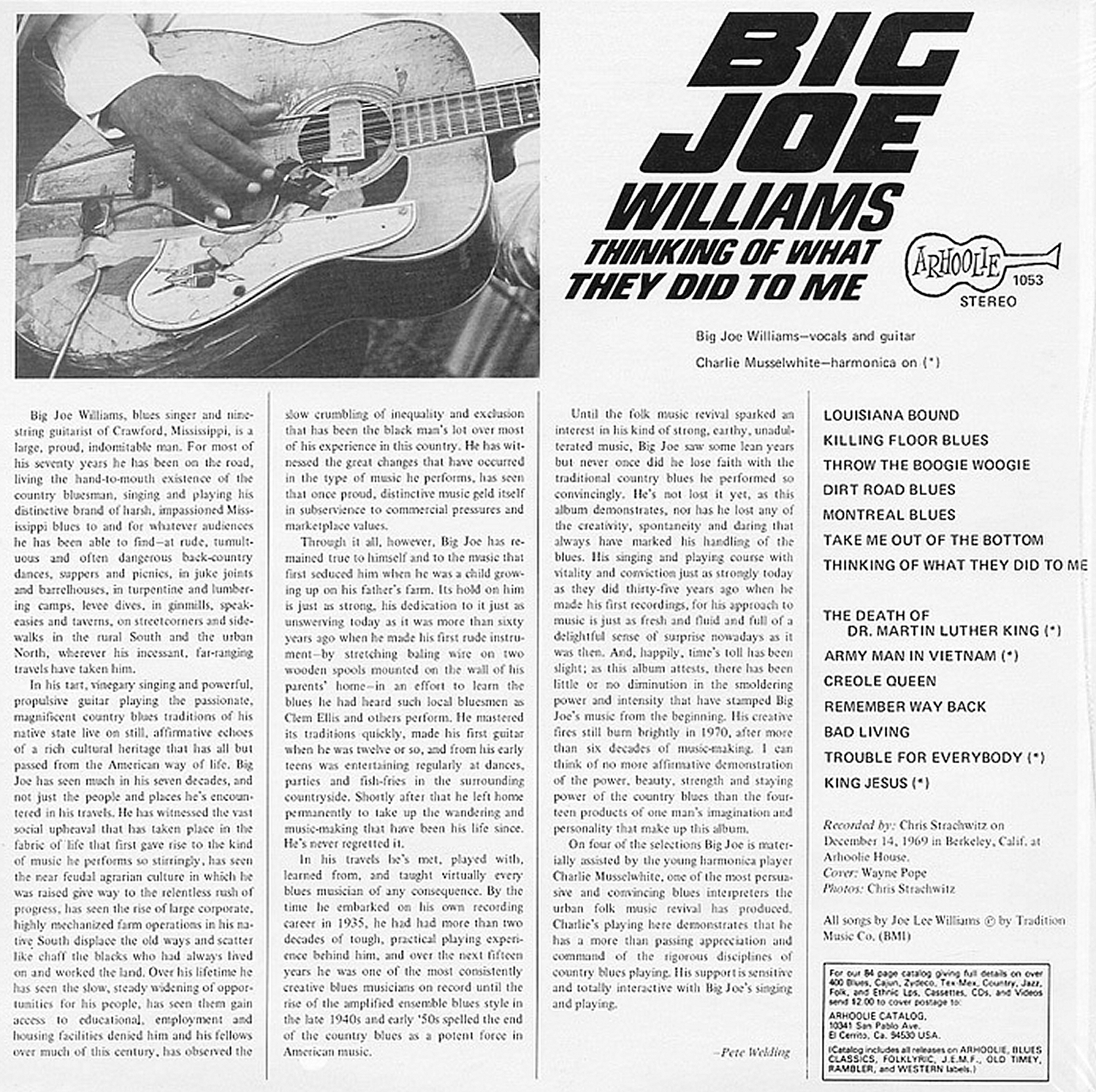
Annotation by Justin A. Brummer
Lyrics
English
Well I heard a voice one morning I'd never heard before
Uncle Sam called me boy, said boy get ready to go the army man...
When your son is 18 years old put a gun in his hand...
I got six boys and two of then on the front line...
If we don't stop the war in Vietnam I believe we'll drop that old atom bomb
Everybody will be on the street crying...
Some will be weeping, some will be mourning, some won't be home for Christmas, some will hurt real bad
Genres: ♪ BluesDelta Blues
1970
#43 Lightnin' Hopkins Questionnaire Blues 1970 · Unreleased · Unreleased · Not On Label · USA
Annotation
Lightnin' Hopkins, born Sam Hopkins on 15 March 1912, in Centreville, Texas, recorded extensively from the 1940s-1970s, typically playing blues in the style that came out of his native Texas, like Blind Lemon Jefferson, both the Acoustic Texas Blues and Electric Texas Blues. Often singing about topical events, such as the Korean War and Great Depression, in the mid-late 1960s he turned his attention to Vietnam. He died in Houston Texas on 30 January 1982.1According to blues music historian Guido Van Rijn, Hopkins also performed the song "Questionnaire Blues" on film, released in 1970 on video, but unreleased on audio format. Re-issued on DVD, "Rare Performances 1960-1979" (Vestapol Productions # 13022).1 The lyrics are transcribed in his book The Nixon and Ford Blues: African-American Blues and Gospel Songs on Vietnam, Watergate, Civil Rights and Inflation, 1969-1976 (Agram Blues Books, 2011), p.108. As suggested in the title, the narrator announces that "poor Lightnin' found his questionnaire... at my age Uncle Sam want me in the army" . In a possible Civil Rights message, as seen in other Vietnam War blues songs, he said "I don't wanna go 'cause I had too many fights over here" .
Vietnam War songs by Lightnin Hopkins:
In 1962 Hopkins released the song "War Is Starting Again" on the album Lightnin' Strikes (Vee-Jay Records # LP-1044). In 1969, he released the anti-war single "Please Settle in Viet Nam" (Joliet # 205). He also recorded the song "Vietnam War" with his cousin Billy Bizor on the album Blowing My Blues Away in 1968. In fact, Hopkins released his own version of that song, called "Viet Nam War (Pt.1) & (Pt.2)" on the 1968 album Talkin' Some Sense (Jewel Records # LPS 5001). Finally, in 1970 Hopkins produced the song "Questionnaire Blues" on film, released in 1970 on video, but unreleased on audio format.
Annotation by Justin A. Brummer
Lyrics
English
But folks it's like this about it you know
I looked in my mailbox and I found my questionnaire
You know that was pretty tough
At my age Uncle Sam want me in the army
I don't wanna go 'cause I had too many fights over here
But I guess I'll just take it easy
Go ahead and go on over there
Because they might be easier on me over there than they is here
Heh, have mercy
So I'm gonna play this song
It's gonna be low, slow and easy
I want you to pay a little attention
Looked in my mailbox this morning
Do you know I found my questionnaire?
Yeah I looked in my mailbox this morning
Poor Lightnin' found his questionnaire
You know Uncle Sam say, 'Lightnin' you ain't got no business here'
And I told him
Well, if I should go to the army
Who gonna take of my wife and child?
Had a partner standing by me, said, 'me brother'
Well if I should go to the army
Who gonna take care of my wife and child? You you know, if I should die on the battlefield
Nobody know that death I die
Themes: Draft Civil Rights
Genres: ♪ BluesTexas Blues
Also in: ▤ Civil Rights Songs▤ Draft Songs
#44 Matt Jones Hell No! I Ain't Gonna Go 1970 · Single · Hell No! I Ain't Gonna Go / Supersam · Relevant # RP 1 · USA
Annotation
Matt Jones, an African-American civil rights activist and contemporary folk / blues / R&B cross-over musician, acted as field secretary of the Student Non-Violent Coordinating Committee (SNCC), an important Civil Rights organisation in the 1960s, taking part in sit-ins and freedom rides, and organising voter registration.1 In 1964 he joined the The Freedom Singers, who played music to raise money for the SNCC. Their 1965 album The Freedom Singers Sing of Freedom Now! included a couple Vietnam tracks. The song "Hell No! I Ain't Gonna Go" (Relevant # RP 1), written by Matt Jones and Elaine Laron, took the title from the famous slogan and chant often seem at anti-war demonstrations in the 1960s and 70s. It had a blues structure, with soul and R&B instrumentation. In the song the narrator refused the draft call, declared the war a sham, and related it back to Civil Rights issues: "the Vietcong just like I am...I got business in Harlem" . Broadside magazine originally published the lyrics and music in # 82, July 1967. The song them appeared on the 1970 compilation Broadside Ballads Vol. 5: Time Is Running Out under both their names, although the single edition from the same year was attributed to Matt Jones.
Sources
- 1 JSTOR ↩
Annotation by Justin A. Brummer
Notes
Relevant RP 1-A; "Hell No! I Ain't Gonna Go", 3:22, by Matt Jones and Elaine Laron; Relevant Productions, P.O. Box 81, Lenox Hill Station, New York, N.Y. 10021 (212-BE 3-3300). [From the record sleeve and labels]Lyrics
English
I ain't gonna go to Vietnam
I ain't dying for Uncle Sam...
I ain't burning my brother to serve the man...
The Vietcong just like I am...
Lets run it down
Brother Brown, tell every cat just where it's at
I've had enough of Charlie's stuff
If he messes with me I'm gonna get rough
I ain't gonna go to Vietnam
That free world jazz is all a shame
I ain't gonna go to Vietnam
Cause the US army is the Ku Klux Clan
I ain't gonna go to Vietnam
I got business in Harlem, Watts, and Birmingham
#45 Guitar Slim Green This War Ain't Right 1970 · Album · Stone Down Blues · Kent # KST-549 · USA
Annotation
Guitar Slim Green, obscure blues artist, born on 25 July 1907 in Bryan, Texas, USA, and died 28 September 1975 in Los Angeles, California, USA. The song "This War Ain't Right" (Kent Records # KST-549) composed by Johnny Otis, takes an anti-war position, describing the conflict as a "lowdown dirty shame" . It notes the incursion into Cambodia under the Nixon-era, which re-stirred the anti-war movement: "I got a brother in Cambodia, and I got one dead in Vietnam" . Like some of the other blues & soul songs of the era, the song looked at the issue of Civil Rights and the treatment of African-American in the US, with the narrator noting "I've got to go kill a brown man for the white man" .Annotation by Justin A. Brummer
Lyrics
English
Lately people I've been thinking
It's a lowdown dirty shame
I've got a brother in Cambodia and I got one dead in Vietnam
They keep talking about freedom and we have got to go and fight
But I've heard this jive before and I know this war ain't right
Things ain't getting no better
I got trouble day and night
Now I've got to go kill a brown man for the white man
Listen, I know this war ain't right
Genres: ♪ BluesElectric Blues
#46 Leon Thomas Damn Nam (Ain't Goin' to Vietnam) Part 1 1970 · Single · Damn Nam (Ain't Goin' to Vietnam) Part 1 / Damn Nam (Ain't Goin' to Vietnam) Part 2 · Flying Dutchman # FD 26009 · USA
Annotation
Leon Thomas, born on 4 October 1937 in East Saint-Louis, Illinois, USA, and died on 8 May 1999 in New York, USA, an American Avant-Garde Jazz musician, released the song "Damn Nam (Ain't Goin' to Vietnam)" (Flying Dutchman # FD 26009), split into two tracks across this single. It featured on the 1969 album Spirits Known and Unknown (Flying Dutchman # FD-10115). The single received limited coverage in Billboard magazine.1This song had a blues structure and tone, taking a strong anti-war position: "it’s a dirty mean war" . The narrator declared "you can throw me in jail, but I ain’t goin’ to Vietnam" . The song particularly took note of the use of napalm and its indiscriminate use: "got to drop some napalm... never see the guy he’s got to kill" - chemical weapon Napalm B - a jellied gasoline mixture, with polystyrene, benzene, and gasoline. Declared a war-crime since 1980, the US government extensively used this weapon during the Vietnam conflict, dropping 388,000 tons on Indochina between 1963 and 1973.2345
Sources
Annotation by Justin A. Brummer
Notes
Flying Dutchman FD 26009, vocal, white promotional labels marked "Promotional — Not for Sale", 45 RPM; "A Product of Flying Dutchman Productions Ltd., 65 W. 55th St., New York 10019", "Distributed by Mainstream Records, Inc.", made in USA. "Damn Nam (Ain't Goin' to Vietnam) Part I" (Leon Thomas), Nuwaupu Publishing, ASCAP, 2:35, master no. ZTSP 148895/63749; "Part II" (Leon Thomas), 1:33, master no. ZTSP 148896/63749A. [From the record sleeve and labels]Lyrics
English
You can call me crazy
But I ain’t goin’ to Vietnam
You can do what you want
But I ain’t goin’ to Vietnam
’Cause it’s a dirty mean war and nobody seems to give a damn
They got boys upon the frontline and boys upon the backline too
They got boys upon the frontline and boys upon the backline too
They got so many weapons
What do they need from me and you
Lord Lord Lord, how can a man get a thrill
Won’t somebody tell me how is a man supposed to get a thrill
If he’s got to drop some napalm
And never see the guy he’s got to kill
How much does it cost to fly a man up to the moon
How much does it cost to fly a man up to the moon
When I think of the hungry children that I see every afternoon
So I’m singing, going crazy
But I ain’t goin’ to Vietnam
You can throw me in jail
But I ain’t goin’ to Vietnam
’Cause it’s a dirty mean war
And nobody seems to give a damn
Won’t somebody tell me
How is a man supposed to get a thrill
Lord Lord Lord how can a man get a thrill
If he’s got to drop some napalm
And never see the guy he’s got to kill
How much does it cost
To fly a man up to the moon
How much does it cost to fly a man up to the moon
When I think of the hungry children
That I see every afternoon
So you can call me crazy
But I ain’t goin’ to Vietnam
You can do what you want
But I ain’t goin’ to Vietnam
'Cause it’s a dirty mean war
And nobody gives a d-a-m-n damn
#47 Leon Thomas Damn Nam (Ain't Goin' to Vietnam) Part 2 1970 · Single · Damn Nam (Ain't Goin' to Vietnam) Part 1 / Damn Nam (Ain't Goin' to Vietnam) Part 2 · Flying Dutchman # FD 26009 · USA
Annotation: see “Damn Nam (Ain't Goin' to Vietnam) Part 1” above (same release).
#48 Memphis Slim Chicago Seven 1970 · Single · Chicago Seven / Boogie Woogie 1-9-7-0 · Warner Bros. # 7500 · USA
Annotation
The song "Chicago Seven" (Warner Bros. Records # 7500) by Memphis Slim (born Pete Chapman) - a highly regarded blues piano player from Memphis, Tennessee (1915-1988), who moved to Chicago in the late 1930s - dealt with political protest during the Vietnam War and Civil Rights. It appeared on the 1971 album Blue Memphis (Warner Bros. Records # WS 1899).1The title referred to several people arrested outside the Democratic National Convention in Chicago in August 1968 for inciting riots. Originally eight people stood trial, all high profile activists - Abbie Hoffman and Jerry Rubin from the hippie movement, the Black Panther leader Bobby Seale, political activists Rennie Davis, David Dellinger, John Froines, Lee Weiner, and Tom Hayden (married to Jane Fonda - together they released a documentary in 1973 about their visit to North Vietnam, called Introduction to the Enemy). The trial began on 24 September 1969, but soon after the Judge, Julius Hoffman, ordered Bobby Seale to be bound and gagged for contempt of court. He was tried separately, and thus the eight became seven (see the 1970 album Gagged and Chained: The Sentencing of Bobby Seale for Contempt).23456
The lyrics suggested that large coverage of the Chicago Seven, as well as the "four dead in Ohio" - a reference to the Kent State shootings on 4 May 1970 - was because those involved were white: "nobody seems worried about all the black blood spilled" , and thus a Civil Rights message. The song ended with a guitar solo and police siren sound-effects in the background. The guitar was played by Peter Green.
Sources
- 1 The Story of Boogie-Woogie: A Left Hand Like God (Peter J. Silvester, 2009) ↩
- 2 Chicago Tribune (archived copy) ↩
- 3 nybooks.com: A special supplement the trial of bobby seale ↩
- 4 Battleground Chicago (Frank Kusch, 2004) ↩
- 5 Revolts, Protests, Demonstrations, and Rebellions in American History [3 Volumes] (Steven L. Danver, 2011) ↩
- 6 Famous Trials (UMKC Law) ↩
Annotation by Justin A. Brummer
Notes
Warner Bros. Records 7500 (NA19565)S, white "Promotion – not for sale" label; "Chicago Seven" (Memphis Slim), 3:49; WB Music Corp. – ASCAP; produced by Philippe Rault, arranged by Jerry Long; "From the Warner Bros. album WS 1899 'Blue Memphis'"; made in U.S.A. [From the record sleeve and labels]Lyrics
English
Everybody is talking about Chicago Seven
Four dead in Ohio, that makes eleven
Nobody seems worried about all the black blood spilled
They'd begun to take notice when some of their own got killed
Now I'm from Chicago, but I'm not bragging
Just can't stand that police nagging
Because in Chicago there is one big grudge
Oh Chicago Seven, had a name like a judge...
What goes up and down...
People have gone back to the underground
#49 Swan Mellarks Dr. Martin Luther King 1970 · Single · Dr. Martin Luther King / Hard Times (Are Here Again) · Valberst # TM 4739 · USA
Annotation
Swan Mellarks, blues group based in Chicago, Illinois, released a tribute to Martin Luther King Jr., following the assassination - thus from 1968, but there is no date on the record. In the song "Dr. Martin Luther King" (Valberst Records # TM 4739) the narrator noted the "interest he had in mankind" and that he had a "great dream...for America" . Of particular note is the reference to the Vietnam War, calling on people "to live together" , because "in the war they died together... in Vietnam they were dying" . Note: on 4 April 1967, Martin Luther King Jr. delivered one of his most controversial speeches, "Beyond Vietnam: A Time to Break Silence" at Riverside Church in New York, in which he took a strong position against the war, opposing the policies of Lyndon B. Johnson. He shortly followed this up with the speech "Why I Oppose the War in Vietnam" , delivered at Ebenezar Baptist Church Atlanta, Georgia, on 16 April 1967, featured on the 1970 record Why I Oppose the War in Vietnam. Released on Black Forum Records (# BF-451) - a spoken-word sub-label of Motown Records. In 1971 this posthumously won the Grammy Award for Best Spoken Word Album.
King's opposition to the Vietnam War can be traced back to 1965, although most of his public speeches on the issue took place in 1967 and 1968, when he took part in many anti-war demonstrations, which caused tension between King and President Johnson. He opposed the war on the grounds of Vietnamese freedom, looking at the history of occupation under the French and Japanese. He also focused on the destructiveness of war - both for the soldier and civilians.
Annotation by Justin A. Brummer
Notes
Valberst Records, Chicago, Ill., TM-4739, green label; "Dr. Martin Luther King" (Thomas L.), 4:15, BMI; T. Little Prod.; arranged by T. Loveless and G. McCoy. [From the record sleeve and labels]Lyrics
English
K for kindness, Dr. King has in his heart, for his fellow man, regardless of their colour
For King, oh King, oh Dr. Martin Luther King
I is for inspiration, and the interest he had in mankind
Out of all the good things he done, still they tried to push him from behind
Oh King, oh King, oh, Dr. Martin Luther King
This is what Dr. King want us to do
To live together
To have a job everyday
Go to church on Sunday hand in hand
Because in the war they died together
Oh King, oh King, oh Dr. Martin Luther King...
For which he stood, he lived, and I believe he died
G is for greatness, the great dream he had for America
He lived, the whole world know he died...
In Alabama
In Mississippi they were marching for peace..
In Georgia... In Vietnam they were dying...
Sleep on Dr. Martin Luther King
Genres: ♪ BluesSoul Blues
1971
#50 Robert Pete Williams Vietnam Blues 1971 · Single · Goodbye Slim Harpo / Viet Nam Blues · Ahura Mazda # 45-AMS-101 · USA
Annotation
Country Blues artist Robert Pete Williams, born on 14 March 1914 in Zachary, Louisiana, USA, and died on 31 December 1980 in Rosedale, Louisiana, USA. He recorded the song "Viet Nam Blues" (Ahura Mazda Records # 45-AMS-101) in 1970 in Maringouin, Louisiana. Sung in free style, it is difficult to understand the lyrics, but it is another blues protest song. It mentioned a lack of information about US activities in Vietnam, which could be used as an example of the "credibility gap" between what the government said and the actual progress of the conflict. The song also featured on the 1971 album Robert Pete Williams (Ahura # AMS 2002). Also note Williams released the war-related song "This Is a Mean Old World to Me" (1966) on the album Louisiana Blues (Takoma Records # B 1011).Annotation by Justin A. Brummer
Notes
Ahura Mazda 45-AMS-101 (PRP 27142), light blue label; "Vietnam Blues" (R. Williams), time 3:24, Pub.: Zora Delta Music – BMI; produced by Parker A. Dinkins; printed in U.S.A. The picture sleeve reads "Goodbye Slim Harpo by Robert Pete Williams / Viet Nam Blues (Side 'B')", © 1971 Ahura Mazda Records. It shows a photograph of Williams holding up an acoustic guitar beside a pen portrait of him, signed and dated '71. [From the record sleeve and labels]Lyrics
English
Well where are we now? Vietnam...
We don't know what going on there...
Taking our Vietnam boys, I don't like this war that they call Vietnam
#51 Canned Heat & John Lee Hooker The World Today 1971 · Album · Hooker 'n Heat · United Artists # UAD 60157/8 · USA
Annotation
Blues collaboration, between well-known and influential blues singer / songwriter John Lee Hooker, known for playing an Electric Blues style of the Delta Blues, born on 22 August 1917 in Clarksdale, Mississippi, USA (he died on 21 June 2001 in Los Altos, California, USA), and Blues Rock group Canned Heat, formed in 1965 in Los Angeles, California, USA. John Lee Hooker released a couple other Vietnam War songs, both in 1969 - the single "I Don't Want to Go to Vietnam" (Bluesway Records # 61023), and the song "I Gotta Go to Vietnam", although this only featured as a bonus track to the 1993 CD reissue of the 1968 album Urban Blues (MCA Records # MCAD-10760). The song "The World Today" (United Artists Records # UAD 60157/8) looked at the so-called 'generation gap' of the times, "it's a brand new world today... old people, they're not hip to the modern days... leave the young kids alone" . The song notes conflict across the world, "world is in uproar... they're fightin' all over the world" , as well as tension at home, noting an era of demonstrations and protest, "they're fightnin' in every town, on campus... kind of fightin' for their rights" .
Annotation by Justin A. Brummer
Lyrics
English
I wonder why this world is sweet hell
I wonder why this world is in uproar
Everyday you read about somethin' new
They're fightin' all over the world
People fightin' all over the world
Race against race, they're fightin' everyday
I wonder when, disaster comin' to a end
I wonder when, I wonder when
This nightmare comin' to a end
I can't believe it's gonna last always
And every time I pick up a paper
I always read bad news...
I wonder when this nightmare is gonna end
You find so many young people
They're fightnin' in every town, on campus
You find so many young people
They're fightnin' in every town, on campus
I don't know, don't know, what they're right or wrong
But they're kind of fightin' for their rights, yeah, yeah, yeah
The old people leave the young kids alone
Let them run their own lives, yeah, yeah
The old folks leave the young kids alone
And let them run their own life
It's a brand new world today
Look at here now, you'll find some of them old people
They're not hip to the modern days
They want their kids to live like they live
But no, them days are gone
It's a brand new world
One way to solve their problem, it takes time
The old coots die out and leave it to the young kids
Be a beautiful world and then
There won't be no fighting on campus any more
'Cause my kids and your kids, when they grow up and get drunk
They'll understand, all old coots are gone in their grave
But as long as they live there's gonna be figitin' in every town
Hey, hey, in every campus, the young kids walkin' out
Hey, hey, hey, hey, the old folks when they're gone, when they're gone
It'll be a better world to live in
Genres: ♪ BluesElectric Blues
#52 Robert Pete Williams Trouble Way Over in Vietnam 1971 · Compilation · President Johnson's Blues · Agram Blues # AB 2020 · Netherlands
Annotation
This 2009 compilation (Agram Blues # AB 2020) by Guido Van Rijn, who has created a series of books and CDs about African-American blues and gospel songs about US Presidents (such as FDR, Truman, Eisenhower, Kennedy, LBJ, Nixon, Ford), included many songs about civil rights, but also 10 Vietnam War songs, including some rare releases, such as "Viet Nam" by Madame Nellie Robinson.1 The notes of the CD booklet said that: Booklet notes
Proportionally there were not more African American in Vietnam, but their death rate was thirty percent higher....People began burning their draft cards, and criticism of the once popular president became quite outspoken in blues and gospel lyrics. When Martin Luther King lashed out against the war in 1967, the president felt betrayed by his former civil rights ally. After the 1968 Tet offensive, Johnson’s approval rating dropped to 36%Sources
Annotation by Justin A. Brummer
Theme: Anti-War
#53 Murvell Johnson Viet Nam War 1971 · Single · You Got Me / Viet Nam War · Johnson # 45-101 · USA
Annotation
Murvell Johnson, another obscure blues artist, whose biography is currently unknown, in addition to no known date of recording, release, or location, who released the blues song "Viet Nam War" (probably late 60s - early 70s). The narrator repeated a similar line throughout, "I've got a dream, the Vietnam War is gonna come to an end" , thus leaning towards the anti-war side, as well as maybe presenting the perspective of someone directly affected by the war, either as a soldier or related to a participant, with the personal line: "it will be so much better for the entire family" . Annotation by Justin A. Brummer
Notes
Johnson 45-101 (SH-1084), red label with "Love Me" printed at left, vocal; "Viet Nam War" (Murvell Johnson), BMI, 3:10. [From the record sleeve and labels]Lyrics
English
That Vietnam War is gonna come to an end
I've got a dream, the Vietnam War is gonna come to an end...
It will be so much better for the entire family
I had a dream, the Vietnam War is gonna come to an end
I've had a dream, the Vietnam War is gonna come to an end...
It will be so much better for the whole entire family...
Theme: Anti-War
Genres: ♪ BluesSoul Blues
1972
#54 Percy Mayfield Right on Young Americans 1972 · Single · Right on Young Americans / The Devil Made Me Do It · RCA Victor # 74-0650 · USA
Artist background
Percy Mayfield, Electric Blues and Soul artist, born in Minden, Louisiana, USA (12 August 1920), and died in Los Angeles, California, USA (11 August 1984). The song "Right On Young Americans" (RCA Records # 74-0650) calls for respecting the views of the protesters and the younger generation, a nice reflection of the Vietnam-era generation gap: "talking to the students on campus... nobody want to listen to what they have to say" .Notes
RCA 74-0650 (APKM-5705), "Plug – Mono – Not for Sale" promo; "Right On Young Americans" (Mayfield), from the "Blues - And Then Some" album, 2:50 with a :10 intro, fade ending, Bucrenlis Music, BMI; arranged and conducted by Bert De Coteaux; produced by Getto Kitty Prod. Inc. (cat logo on label). Yellow RCA label in an RCA rainbow-and-clouds company sleeve (© 1971 RCA Records). [From the record sleeve and labels]Lyrics
English
Wake up please America, you're the greatest
If you don't hurry up I said, we'll be the latest
Well... treatment our fellow man wrong, making some wishing they'd never been born
Make law, break law... we need to hurry up, get on our knees...
People killing one another, won't be nobody left to fight
I was talking to the students on campus one day
But nobody want to listen to what they have to say
Common sense... time marches on
The world being young...
You'll wake up one morning, be has-been overnight...
Right on young America
When you're in power, let me fade in style
Wake up please America...
So right on young American, it will be yours after a while...
Themes: Anti-War Generation Gap
#55 Champion Jack Dupree Vietnam Blues 1972 · Album · Legacy of the Blues, Vol. 3 · Sonet # SNTF 626 · UK
Annotation
Champion Jack Dupree - born William Thomas Dupree (c.1910-1992) in New Orleans, he played blues piano in the boogie-woogie style, mainly based in Chicago, Illinois. He lived in London and worked in Europe through most of the 1960s. He sung about drugs, drink, and jail, as well as writing many political songs about US presidents (such as FDR, Truman and Kennedy) and the Civil Rights movement (including a composition about Martin Luther King). He recorded this album at Morgan Sound Studios, Willesden, Northwest London in 1971, and released in the UK in 1972 for Sonet (# SNTF 626). Released in the US in 1974 (GNP Crescendo Records # GNPS 10013).1 The 2004 CD reissue ... (Verve Records) included an alternative take of the Vietnam song discussed below. The recordings featured Peter Curtley (guitar); Paul Rowan (harmonica); Hughie Flint (drums).The song "Vietnam Blues" took an anti-war position. Dupree felt sympathy for "the people over in Vietnam" who suffered a "lot of pain" . He wanted the US government to "leave those poor people alone" and to "pull out and go home" . He believed that the war would "never end" and that the Vietnamese had a lot of friends: "the Chinese...the North Koreans, the Russians...and they got me too" . Dupress also sung about the pain felt by the mothers of US soldiers. It included a Civil Rights message, with a small line on the treatment of African-Americans in the US, saying that the Vietnamese had a problem "just like a got at home" - this coming from a man who left the US to live in Europe partly because of these issues.
The alternative version of the song, recorded during the same session as above, but not released until the 2004 CD re-issue, had some different interesting lyrics. Dupree called US action in Vietnam a "low down dirty shame" and that there "ain't no justice" . He warned the government that "you can't win every war" . Dupree also addressed the draft, saying that people "got no chance" , and would have to "dig" their "own grave" . He sung that "I'm so glad I was too old" to be drafted!
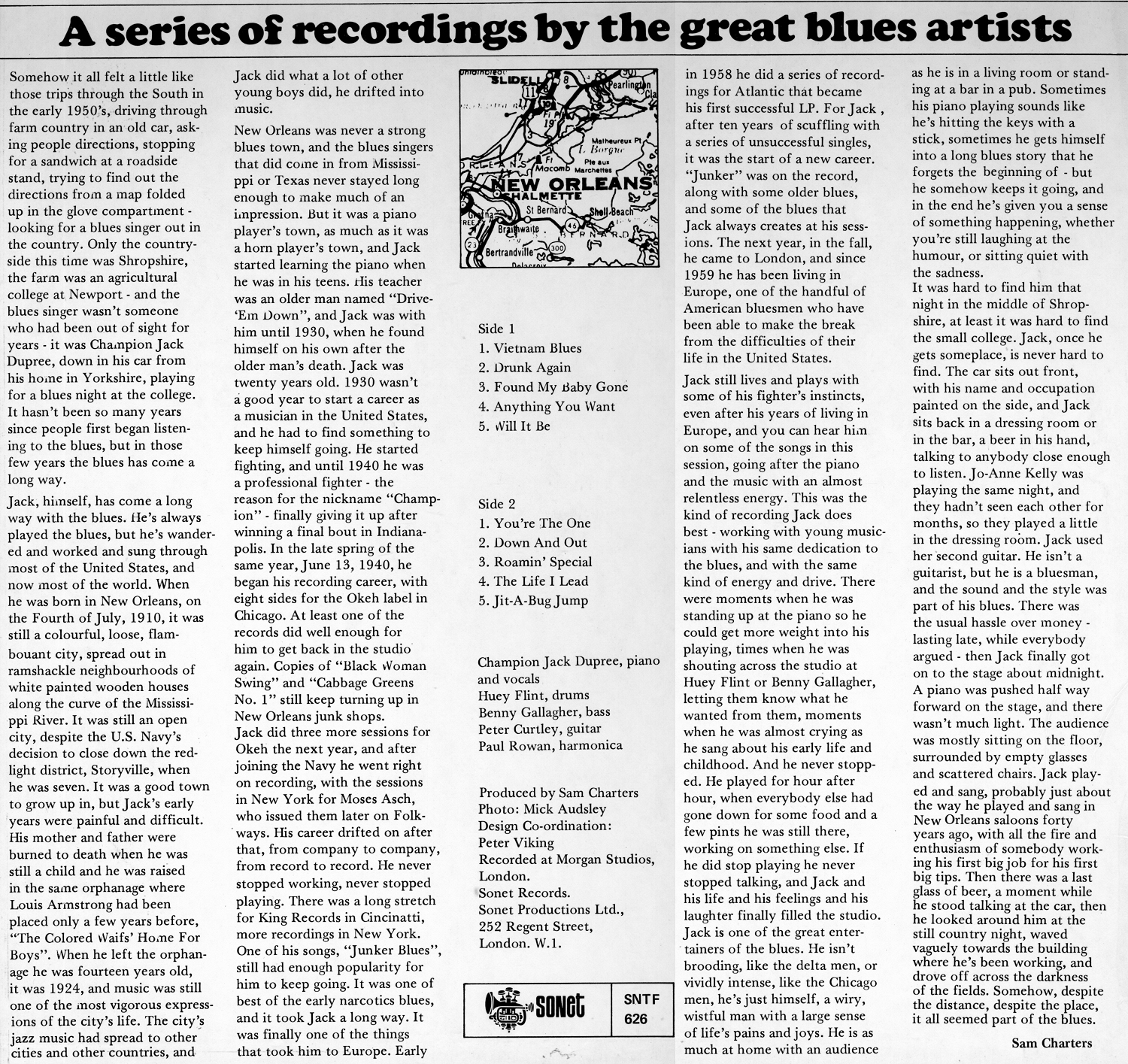
Annotation by Justin A. Brummer
Lyrics
English
Well, I feel so sorry for the people over in Vietnam
It's a whole lot of pain
Uncle Sam don't understand
Why don't you leave Vietnam?
Leave those poor poor people alone
They got a hell of a problem just like I got at home
Well I know a mother be glad to see her son come home
Yes Uncle Sam pack up pull out, and go home
The war in Vietnam, there's one war that will never end
The Vietnam people, they got a whole lot of friends
Yeah they got the Japanese, they got the Chinese...
The North Koreans, the Russians, the Africans too
And they got me too, when the lights come on all over the world again, well the people in Vietnam will have a whole lot of friends again
English
I feel so sorry for the people in Vietnam
The way they be treated, is a low down dirty shame...
What could we do when we got to go
We got no chance, say we don't want to go
When you got to go dig your own grave...
Ain't no justice at all, they get killed...
Innocent woman and children too, they kill them down just like you and me
We don't know why so much murder always on the mind
I don't see why Uncle Sam don't go home...
I'm so glad I was too old, too old...
Maybe one day Uncle Sam will understand that you can't win every war, even in Vietnam
Themes: Anti-War Civil Rights
#56 Champion Jack Dupree Vietnam Blues (Alt. Take) 1972 · Album · Legacy of the Blues, Vol. 3 · Sonet # SNTF 626 · UK
Annotation: see “Vietnam Blues” above (same release).
Themes: Anti-War Civil Rights
1973-1975: Paris Peace Accords to the Fall of Saigon
- 23 January 1973: Nixon announces peace agreement: 'peace with honor'.
- 27 January 1973: Paris Peace Accords signed.
- 27 January 1973: Draft official ended in favour of voluntary enlistment.
- 12 February 1973: Operation Homecoming.
- 29 March 1973: Final US troops leave Vietnam.
- 30 April 1973: Halderman and Ehrlichman resign over Watergate.
- 19 June 1973: Case-Church Amendment.
- 14 August 1973: Cambodia bombing halted, in compliance with Congressional ban.
- 7 November 1973: Congress passed War Powers Act.
- 9 August 1974: Richard Nixon's resigns as president. Gerald Ford takes over.
- 13 December 1974: North Vietnam violates peace agreement.
- 10 March 1975: North Vietnamese offensive on South.
- 30 April 1975: US Embassy in Saigon fully evacuated.
1973
#57 Freddie King Yonder Wall 1973 · Album · Woman Across the River · Shelter # SW-8910 · USA
Annotation
Freddie King covered the track "Yonder Wall" (Shelter Records # SW-8910), updating it for the Vietnam War. James "Beale Street" Clark originally composed and recorded the song, under the name "Get Ready to Meet Your Man" in 1945, about soldiers returning to the US after World War Two. Elmore James recorded a famous version in 1962: "Look on Yonder Wall" . King narrated his version from the perspective of a disabled man unable to fight the war: "hand me down my walking cane" . He had started a relationship with a woman whose "man been in Vietnam" , but who had since returned home to the US. This idea is similar to the "jody" theme - a mythical man in blues and jazz tunes who seduced the wives and girlfriends of soldiers, prisoners, and those away from home. In this case, the narrator played the role of the "jody". Annotation by Justin A. Brummer
Lyrics
English
Look on yonder wall
Hand me down my walking cane
I'm looking out your window
And you look upon your man
Your man been in Vietnam
I know you had it kind of rough
I don't know how many men he killed...
Yeah I love you baby, and you just won't treat me right
I give you all my money
And you walk the streets all night
Themes: Home Front Perspective Jody
Genres: ♪ BluesElectric Texas Blues
#58 Henry Johnson Join the Army 1973 · Album · The Union County Flash! · Trix # TRIX 3304 · USA
Annotation
One of the more obscure musicians on this list, Henry "Rufe" Johnson, born and died in Union, South Carolina (08 December 1908 - February 1974), a Piedmont Blues guitar, harmonica, piano, and banjo player - a style of Country Blues developed in Appalachian foothills region, including the Carolinas. This album, recorded in November / December 1972, during the war years, featured the song "Join the Army" (Trix Records # 3304), with Johnson on vocal and guitar, and Peg Leg Sam on harmonica.1 As the title describes, the narrator joins the army: "I went and joined the army". While gone, his partner left him: "thinking 'bout my baby... the girl hadn't been long left". He goes to visit his mother on his return from the army: "son, I didn't know I was gonna see you anymore". An intriguing line is when the narrator goes to catch the ship to go back to the USA and is advised to walk - is this a reference to racial discrimination?: "I went out to the ship... Uncle Sam he told me, boy, you'd do better walking the road". Sources
Annotation by Justin A. Brummer
Notes
Track A1. Henry Johnson guitar and vocals (Peg Leg Sam harmonica credited only on A3 and B4 per Discogs, not on Join The Army). Recorded in Union, S.C., 10 Nov 1972 (A1). Producers Pete Lowry and Henry Johnson; engineer Pete Lowry; mastered by Ray Hagerty; cover photo Jim O'Neal; design Raoul Vezina; sleeve notes Pete Lowry. Published by Baby Tate Music Co. (BMI). Matrix TRIX 3304A / TRIX 3304B (etched). A 1993 CD reissue (TRIX 3304) also exists on Discogs.Lyrics
English
I was out, out one day, out and out by myself
Thinking 'bout my baby and the girl hadn't been long left
Says I went and joined the army, yes, I joined it
Didn't stay there long
Before Uncle Sam come around , said, 'boy, go back home'
Says, I went out to the ship and I didn't get on board
Because Uncle Sam he told me, 'boy, you'd do better walking the road'
And I said to myself, 'I won't try the old army no more'
And I come back home and I walked to the door
Heard my mama say, 'Hello son, I didn't know I was gonna see you anymore
Theme: Soldier's Perspective
Genres: ♪ BluesCountry Blues
#59 James Armstrong Thank God, Calley Wasn't Black 1973 · Single · Thank God, Calley Wasn't Black / Big Four · CMC # CM-1013-1015 · USA
Annotation
The song "Thank God, Calley Wasn't Black" (CMC # CM-1015) was a fascinating track that combined the issues of race / Civil Rights and Vietnam. Sung by an African-American bluesy / soul artist, James Armstrong, the track defended Calley - "we are fighting here to kill or be killed" - and the narrator suggested that if Calley was black then his situation could be a lot worse than just house arrest - so this is also a reflection of 1960s / 70s race relations, as well as a Vietnam War song.Annotation by Justin A. Brummer
Notes
CMC CM-1015, teal label, 1119 E. Broadway, West Memphis, Ark.; "'Thank God, Calley Wasn't Black'" (Clide Fleming), E and M Publishing Co., BMI, time 2:43; arranged by Truitt & Porter, produced by Craft. [From the record sleeve and labels] Split single: A 'Big Four' by Sonny Blake (CM-1013), B 'Thank God, Calley Wasn't Black' by James Armstrong (CM-1015).B-side arranged by David Porter and Paul Truitt. Producer Craft (Dan Craft). Published by E. & M. Publishers (BMI). A white-label variant exists (Discogs 11066939).
Lyrics
English
There was a young man named Calley
Trying to make the army ?
Over there fighting and suffering
We are fighting here to kill or be killed
While people over here trying to make a stand
Calley is being judged...
Thank god Calley wasn't black...
He's got a small chance of being free
Thank god he is not black like me...
I wonder what the outcome will be
If I was in Calley's place
Would the world be concerned about me
Or would they just turn there face?
#60 Merry Airbrakes Draft Board Blues 1973 · Album · Merry Airbrakes · St. George International # ST 06 · USA
Annotation
Various artist compilation, featuring Jimmy Anderson, blues artist born on 21 November 1934 in Natchez, Mississippi, USA. He moved to Baton Rouge, Louisiana in the 50s and recorded in the region, including the song "Draft Board Blues" (Flyright Records # FLY 607), recorded 1962 in the pre-Vietnam War years under JFK, but unreleased at the time, appearing on this compilation.1 The narrator notes receiving the draft call for a "trip across the world" . He was "not gonna like it, cause I miss you" . Apparently the board gave him a choice, "the land, sea or the air" .Sources
Annotation by Justin A. Brummer
Lyrics
English
I got a letter this morning from local board 98
They said they wanted to see me and I'd better not be late
They say I'll take a trip and baby all around the world
I know I'm not gonna like it, 'cause I miss you, little girl
I got the draft board blues, yes the draft board blues
I got the draft board blues, the blues I just can't lose
They said I can take my choice, the land, sea, or the air
But I know I'm gonna be lonely
'Cause baby you won't be there
But baby someday if I'm lucky I'll be back little girl
I'll keep thinking of you baby
On my trip across the world
Themes: Soldier's Perspective Draft
1974
#61 Johnny Shines Blood Ran Like Wine 1974 · Album · Johnny Shines and Company · Biograph # BLP-12048 · USA
Annotation
Johnny Shines, American Delta blues guitar player from Memphis, Tennessee, who specialised in slide guitar, toured with Robert Johnson in the 1930s and had the odd recording session in 1940s Chicago, although nothing was released at the time. But with the revival of folk and blues in the 1960s, Johnny Shines recorded some material. In 1966 he released the Vietnam War song "So Cold in Vietnam" (Testament Records # T-2212), narrated from the perspective of a soldier, who missed his sweetheart. In 1974 he released the track "Blood Ran Like Wine" (Biograph Records # BLP-12048), in which he sung about a man in a difficult position, in the first person: "standing in water...walking in the blood" . It was then revealed that the narrator was fighting in a war: "no use in screaming and crying...in Vietnam" . Annotation by Justin A. Brummer
Lyrics
English
Well I was standing in water, way up above my knees
Well I prayed to the good lord, won't you help me if you please
Every man want to live, but sometimes I feel like dying
Well I'm walking in the blood, running down the street like wine...
There no use in worrying, no use in screaming and crying
Well keep on fighting here in Vietnam, while the blood runs down the street like wine
1975
#62 Pernell Charity War Blues 1975 · Album · The Virginian · Trix # TRIX 3309 · USA
Annotation
Obscure blues artist, Pernell Charity, born 20 November 1920 in Waverley, Virginia, USA. He died on 12 April 1979. He recorded this album, featuring the song "War Blues" (Trix Records # 3309) in October & November 1972 in Waverly, Virginia.12 It later appeared on the 1982 various artist compilation Virginia Traditions: Tidewater Blues (Blue Ridge Institute # BRI 006). The narrator describes receiving the draft card, or as often referred to song in the blues genre: "I got my questionnaire... I got to go to war". In this case the protagonist "don't mind being drafted", however he is worried to "leave these girls behind". Also of note, the narrator says he will put a "black cat bone way down in my shoe" - which is a hoodoo lucky charm.3Sources
Annotation by Justin A. Brummer
Notes
Track A2. Pernell Charity vocals and guitar. Recorded in Waverly, Virginia, 25 Oct 1972 (A2, per Discogs). Producers Pernell Charity, Kip Lornell, Pete Lowry; recorded and mixed by Pete Lowry; mastered by Ray Hagerty; liner notes Kip Lornell. Matrix TRIX 3309 A / TRIX 3309 B (etched). Lornell notes say Charity wrote War Blues himself and it evokes Sonny Boy Williamson's WWII-era recordings. 1995 CD reissue also on Discogs (6704633).Lyrics
English
Well, I got my questionnaire boys and my class card too
Now I've got to leave here, what am I going to do?
I got to go to the war
If I have bad luck I won't be back at all
Don't mind being drafted, don't mind being in line
Ain't but the one thing killing me, leave these girls behind
I got to go to the war
If I have bad luck I won't be back at all...
When I get my call boys I'm going to do
I'm going to get me a black cat bone way down in my shoe
I got to go to the war
If I have bad luck I won't be back at all
Don't mind being drafted, don't mind being in line
Ain't but the one thing killing me, leave these girls behind
I got to go to the war
If I have bad luck I won't be back at all
Themes: Draft Soldier's Perspective
Genres: ♪ BluesCountry Blues
Also in: ▤ Draft Songs
Post-War: 1976-present
Post-Vietnam War songs tend to focus on Vietnam veterans - highlighting particular stereotypes, such as psychological problems (for example, PTSD - post traumatic stress disorder), homelessness, drug addiction, and the struggle to re-adjust to society. Attention is also given to social division (between those who supported the war and not), and the lack of adequate government / institutional support for veterans.Other frequent topics include the Prisoner of War (P.O.W.) / Missing in Action (M.I.A.) issue, and Orange Agent, a defoliant dropped by the US on the South Vietnamese/Cambodian border (the "Ho Chi Minh Trail"), to destroy Vietcong cover (broad leaf plants etc). But the toxin had long term negative effects on those exposed (cancer & genetic defects). Several lawsuits were brought against the US government and chemical companies from the 1980s, therefore bringing greater attention in popular music to this issue.
Many song appeared in the immediate aftermath of the war, and then dipped in the mid-to late 70s. A revival occurred around the 1979 Iranian hostage crisis, which drove many comparisons to Vietnam and role of the US military in global affairs. A surge and revival of interest is seen in the 1980s Reagan era of seeking to overcome the 'Vietnam Syndrome'. In the 1990s, several songs compared the conflict to the First Gul War, and in 21st century, the Vietnam conflict has been used in song to reflect on current wars and problems, including the Afghanistan invasion and Iraq War.
1976
#63 Treves Blues Band Vietnam Blues 1976 · Album · Treves Blues Band · Red # VPA 112 · Italy
Annotation
Treves Blues Band - formed in 1974, in Milan, Italy, The song "Vietnam Blues" (Red Records # VPA 112) is a cover / re-working of the Champion Jack Dupree song, discussed above.Annotation by Justin A. Brummer
Notes
Recorded October 1976. Distributed by Editoriale Sciascia s.a.s., Rozzano (Milano). Lineup: Fabio Treves (lead vocals, harmonica), Lino 'Fats' Gallo (guitar), Walter Cazzaghi (bass), Piero Papotti (drums), Vittore Andreotti (piano), Dario Guidotti, Gerry De Sario, Tito Branca (saxes/flutes).Liner notes Fabio Santini. A second 1976 Italian pressing exists (release 38068152). A cover/re-working of Champion Jack Dupree's Vietnam Blues, recorded October 1976 for Red Records.
Cover of Vietnam Blues – Champion Jack Dupree.
Lyrics
English
I feel so sorry for the people over there in Vietnam...
Why don't they leave those poor people alone, they got a hell of a problem
Genres: ♪ BluesElectric Blues
Also in: ▤ European Songs
#64 Charlie Sayles Vietnam 1976 · Album · The Raw Harmonica Blues of Charlie Sayles · Dusty Road # LP 701 · USA
Annotation
Charlie Sayles, from Massachusetts, played harmonica in the Chicago Blues style. He served in Vietnam for two years - 1969 to 1971, in the 101st Airborne, 326 Company. He said that "every month in Vietnam you would see three actions...One would be pretty hairy, another would be terrifying and another would totally blow your mind. After two years of that I couldn't deal with America when I got home. Violence became natural to me".1 In the song "Vietnam" (Dusty Road # LP701) he recalled the loneliness and hell of war, while referring to back home in the city as "going to another Vietnam." Annotation by Justin A. Brummer
Lyrics
English
Oh Vietnam, on a Thursday afternoon down in the valley...
Birds in the sky there screeching on high...
Bombs off in the distance...
All alone, all alone Vietnam, hell of a place to be
You never know where the next bullet gonna be
One the funniest thing, your sad when you say goodbye
Down in Vietnam, in the mud and rain
I'm going to another Vietnam now, in the city the enemy is on the prowl, they don't look like me
Themes: Soldier's Perspective Military
Genres: ♪ BluesChicago Blues
Also in: ▤ US Military & Veteran Songs
#65 Wanda Lee College Town Needle Blues 1976 · Single · Boonville Pinto Pony / College Town Needle Blues · Oliver # 50 · USA
Annotation
Post-war 70s blues song, "College Town Needle Blues" by Wanda Lee - this is very obscure, with no information known about the artist and location, only the date printed on the record, "1976". It seems to be about a drug addicted soldier or the narrator is using war as a metaphor for drug addiction. The narrator notes "some have died to win the war, but I've lived to lose" , because of a "self inflicted glory hole in my arm" . The narrator warns: "soldiers take heed" .Annotation by Justin A. Brummer
Notes
Oliver Records 50 B (ARP 2822), side 2, stereo, orange label; "College Town Needle Blues" (Wanda Lee), 2:38; ℗ Wanda Lee 1976. [From the record sleeve and labels]Lyrics
English
Dear mom, writing this note
Remind you of my self addressed envelope
Was it lost in the mail?
Did you lose it in jail?
Well if you can please spare the time
Why don't you drop me a line
And fill it with some money until I can get make it on line
Needle blues
I'm all confused
Some have died to win the war
But I've lived to lose
Soldiers take heed
The enemies been freed
So aim for the high ground
You'll find yourself on the way down
With no strings left to shoot another man like me
P.S. in case you haven't guessed
The people here are stripped my soul from self inflicted glory hole in my arm
But they meant me no harm
And when times are so tough I won't need this stuff
One more hit can't hurt me since ain't had enough
Needle blues
I'm all confused
Some have died to win the war
But I've lived to lose
Soldiers take heed
I'm all confused
Some have died to win the war
But I've lived to lose
Soldiers take heed
The enemies been freed
So aim for the high ground
You'll find yourself on the way down
With no strings left to shoot another man like me
Theme: Drugs
Genre: ♪ Blues
1978
#66 James 'Guitar Slim' Stephens War Service Blues 1978 · Archival · Greensboro Rounder · Flyright # FLY LP 538 · USA
Annotation
Blues artist James 'Guitar Slim' Stephens, born on 10 March 1915 in Spartanburg, South Carolina, USA, he died on 10 February 1991 in Greensboro, North Carolina, USA. He recorded the song "War Service Blues" (Flyright Records # FLY 538) on 02 March 1975 in Greensboro, NC, with Stephens on guitar and vocals.1 Narrated from the perspective of a soldier drafted to war: "I'm in Class A...ain't gonna turn me down" - presumably a reference to the draft classification "1-A" - "eligible for military service", established in 1971 (under the Military Selective Service Act of 1967). The narrator laments "I might be blind, cripple and lame... this was keeps raging, I'm gonna soon be dead and gone". The song also looked at the home front / domestic impact: "mother's down on her knees praying for her child to return".Sources
Annotation by Justin A. Brummer
Notes
Track A3. Artist credited as Guitar Slim on Discogs. Stephens plays piano on this track (Discogs per-track credit; YouTube upload description: 'rec. March 2, 1975 by Kip Lornell; James Guitar Slim Stephens, voc, piano', Greensboro, NC). Liner notes Kip Lornell; remastered by Ron Geesin; design W. & M. Etherington; printed by Senol Printing Ltd. Matrix FLY LP 538 A-1 / B-1. UK release. YouTube upload runs 6:48 (no label duration).Lyrics
English
Don't cry baby, war is raging all over town
I'm in Class A baby, and they ain't gonna turn me down
My baby wondering what in the world is she gonna do
This old world war is raging, afraid it's gonna take her to
I'm overseas now baby, won't you pray for me
You know if this war keeps on raging, it's gonna be the death of me
My baby's wondering if I'm on the firing line
Says she keeps on praying
'Send back that man of mine'
Uncle Sam says, 'I'm sorry little girl, I can't help you none'
Oh poor Slim I'm sorry baby, I just can't help you none
You know I'm out on the firing line, woman, baby, I declare we're having fun.... Say, mother's down on her knees praying for her child to return...
I'll turn home one day
I might be blind, cripple and lame...
This was keeps raging
I'm gonna soon be dead and gone...".
Themes: Draft Soldier's Perspective
Also in: ▤ Draft Songs
1985
#67 The Robert Cray Band Sonny 1985 · Album · False Accusations · Demon # FIEND 43 · USA
Annotation
Blues Rock group, The Robert Cray Band, formed in 1974 in Eugene, Oregon, USA, led by Robert Cray, born on 1 August 1953 in Columbus, Georgia, USA. The post-war song "Sonny" (Hightone Records # HT 8005) picked up on the Jody theme discussed above - the term "Jody" originated from "Joe the Grinder" (dated c.1939) - a mythical man in blues and jazz tunes who seduced the wives and girlfriends of soldiers, prisoners, and those away from home. The narrator recalled his best friend Sony, "he got called to Vietnam" . He asked his friend to look out for his wife, but "we both lost our heads" and ended up in "her lonely, lonely bed" . Sonny returned, "proud of what he's done" , but injured, "he can't walk too good" . The narrator felt regret, "I'm so ashamed of what I've done" . Annotation by Justin A. Brummer
Lyrics
English
Sonny was my best friend
He got called to Vietnam
Said, "Watch out for my wife and baby"
"And I'll count on you when I'm gone"
I looked in every day
Just like Sonny said
Oh, and I'm not sure just when
We both lost our heads
And I'd hang around at night
And fill her lonely, lonely bed
Sonny made it home
And he's proud of what he's done
Oh, but he can't walk too good, no
And he'll never see the sun
And his pain is just beginning
I'm so ashamed of what I've done
Also in: ▤ Jody Songs
#68 Jimmy Anderson Draft Board Blues 1985 · Archival · Baton Rouge Blues (The Legendary Jay Miller Sessions Vol. 42) · Flyright # FLY 607 · UK
Annotation
The narrator notes receiving the draft call for a "trip across the world". He was "not gonna like it, cause I miss you". Apparently the board gave him a choice, "the land, sea or the air".
Annotation by Justin A. Brummer
Notes
Recorded 1962 (Jay Miller sessions); first issued on Flyright FLY 607 (UK, 1985, mono LP, side A track 3; sleeve notes by Bruce Bastin). Jimmy Anderson's singles of the period were on Excello and Zynn.Lyrics
English
I got a letter this morning from local board 98
They said they wanted to see me and I'd better not be late
Theme: Draft
Genres: ♪ BluesSwamp Blues
Also in: ▤ Draft Songs
1987
#69 The Iott & Price Band Vietnam 1987 · Single · Vietnam / Have You Heard · RIP # 101 · USA
Notes
RIP Records RIP 101, silver label with tombstone logo, Lansing, MI, (517) 882-7010; Side A, stereo, 45 RPM, ℗ 1987; "Vietnam" (M. Iott – B. Price), Mike Iott BMI, Bill Price BMI, time 4:00; produced by C. Leveque; credited on the label as "The Iott - Price Band".The front of the picture sleeve shows a photograph of soldiers shaking hands over barbed wire.
The back has a collage of service photographs and press cuttings on Dr. Tom Dooley and on Pfc. Daniel John Blomfelt, killed in Quang Tri Province in May 1968 ("'I'd die for this flag'"), with "Pictures by: Sigred Cichy". There is a handwritten dedication "To Renée, Good Luck in Life!!" in pen. [From the record sleeve and labels]
1990
#70 Sleepy John Estes Blind Man in the Tear Gas 1990 · Compilation · Delta Experimental Projects Compilation Vol 1 The Blues / Vol 2 Spring Poems · Fan Club # FC 064 CD · USA
Annotation
Various artist compilation, featuring the prominent and highly regarded Sleepy John Estes, known for Country Blues / Delta Blues music, born 25 January 1899 in Ripley, Tennessee, USA, and died 5 June 1977 in Brownsville, Tennessee, USA. The compilation featured the song "Blind Man in the Tear Gas" (New Rose Records # FC 064 CD - NR 761), recorded in 1972 in Collierville, Tennessee, featuring Sleepy John Estes on vocal and guitar, James Luther Dickinson on piano, and Ry Cooder on mandolin1 According to blues historian Guido Van Rijn, in his book "Nixon and Ford Blues", this track was written about protest demonstrations: "I first got to Washington... tear gas all in my eyes". Note the reference to then President Richard Nixon: "I heard Mr. Nixon spoke... every man or woman... ought to fight for his own rights".Sources
Annotation by Justin A. Brummer
Notes
On the various-artists compilation; track 11. Track 11 (Vol. 1: The Blues). Ry Cooder mandolin, East Memphis Slim piano (Discogs). Distributed by New Rose; price code NR 761; barcode 3 347120 022817; pressed by MPO; made in France. Compiled and recorded by Jim Dickinson. Compiles Vol. 1 (LP Fan Club FC 044, 1988) and Vol. 2 (LP FC 064, 1990). Discogs notes do not give a recording place for track 11.Lyrics
English
Now when I first got to Washington, you know, I was feeling all right
When I left I was feeling bad
It's bad, it's bad, blind man, messed up in the tear gas
Now I heard a racket, I went out on the outside
Tear gas all in my eyes
Now, one had me by the feet
The other one had me by the head
I told, 'I don't worry 'bout feet, just take care of my head'
I heard Mr. Nixon spoke, I think it's good advice
Every man or woman able to work ought to fight for his own rights
Now I went to the clinic
The doctor says I was all right
I just run the red light
Themes: Protest City & Community Violence
Genres: ♪ BluesCountry Blues
Also in: ▤ Richard Nixon & Watergate Songs
1994
#71 Arthur "Big Boy" Crudup This War Is Awful 1994 · Album · Meets the Master Blues Bassists · Delmark # DD-621 · USA
Annotation
Delta Blues and Electric Blues artist, born on 24 August 1905 in Forest, Mississippi, USA, he died on 28 March 1974 in Nassawadox, Virginia, USA. This 1994 album was a reissue of the 1970 Crudup's Mood, which contained the previously unreleased "This War Is Awful" (Delmark Records # DD-621), recorded on 10 November 1969 in Chicago, Illinois, with Arthur Crudup on vocals and guitar, and Ransom Knowling on bass.1 Recorded during the Vietnam War-era, it's in fact a re-recorded version of his World War Two song, "Cool Disposition" (Bluebird Records # 34-0738), released on single in 1945. It's narrated from the perspective of a man off to war, contemplating being divided from his partner: "this war is awful... cause me and my baby... to live in the world alone". At the end of the song, the narrator fears that his partner has left him, "I wanna kill me somebody, believe my baby's got another man". Note: Crudup also released the song "Questionnaire Blues", recorded in 1967, and released in 1968 on the album Look on Yonder's Wall (Delmark Records # DS-614), about the draft.Sources
Annotation by Justin A. Brummer
Notes
Track 4, previously unissued. Crudup vocals and guitar, Ransom Knowling bass; recorded 10 Nov 1969 (Knowling session) at Stereosonic Studios. Adapted from 'Crudup's Mood', Delmark LP 621. Producer/liner notes Robert G. Koester; recorded by Bill Cody and Stu Welder; design Kate Hoddinott. Glass mastered by Nimbus; barcode 0 38153-0621-2 5; SPARS AAD.Lyrics
English
This war is awful
It have upset so many homes
Yes it has cause me and my baby trying to live in this world alone
She got a cool disposition
Lord she drives my blues away
Now when this war is over maybe I'll come home some day
Now when she looks at me lord and pulls me in her arms
I just start screaming
Don't believe my life gonna last me long...
Well when I start to drilling now
With a gun, lord in my hand
I wanna kill me somebody
Believe my baby's got another man
Theme: Anti-War
1996
#72 Ronnie Earl & The Broadcasters Welcome Home (Dedicated to All the Vietnam Veterans) 1996 · Album · Grateful Heart: Blues & Ballads · Bullseye Blues # BB 9565 · USA
Annotation
The song "Welcome Home (Dedicated to All the Vietnam Veterans)" (Bullseye Blues # BB 9565) by Ronnie Earl, born 10 March 1953 in New York, USA.Annotation by Justin A. Brummer
Notes
Track 6, instrumental. Written by R. Earl (credit from Europe CD, Discogs 10264518). Recorded at Blue Jay Studio, Carlisle, June 1995; producer Neal Ward; mastered by Jonathan Wyner at M Works. Musicians: Ronnie Earl guitar, Bruce Katz piano/organ, Rod Carey bass, Per Hanson drums, David 'Fathead' Newman tenor sax (tracks 2, 3, 6-9). (P) Rounder Records Corp. Barcode 011661956520. Themes: Vet Coming Home
Genres: ♪ BluesElectric Blues
1998
#73 Billy Boy Arnold We All Got to Go 1998 · Compilation · Down Home Harp · Testament # TCD 6011 · USA
Annotation
1988 various artist compilation, featuring Chicago Blues artist Billy Boy Arnold, born on 16 September 1935 in Chicago, Illinois, USA, with the song "We All Got to Go" (Testament Records # TCD 6011), recorded in 1962 in the pre-Gulf of Tonkin period, but unreleased at the time, about going off to war: "Uncle Sam wanna use you a while". The narrator looked forward to the military uniform, "so you can be in style". It contained a reference to social-economic inequalities, and possibly, related to racist discrimination, with the narrator confronted by "a man with a crown, high class". Also of note is the narrator's excitement to fly a plane: "I got to fly one of them bomber planes" - Africa-American plane and helicopter pilots in the Vietnam War-era was rare, facing significant discrimination barriers.Annotation by Justin A. Brummer
Notes
On the various-artists compilation; track 2. Track 2. Billy Boy Arnold vocals and harmonica, Blind John Davis piano. Written by S.B. Williamson. Recorded in Chicago (Discogs notes: Chicago sessions 1962-1967); producer/recorded by Pete Welding; liner notes Frank Scott; mastered by Bob Stone. Manufactured and marketed by HMG/HighTone. All tracks previously unissued except track 3. Barcode 0 129286011-2 2.Lyrics
English
Now I want you to gather around boys, we all got to go
Now you know ain't no use in your worrying, you won't see your baby no more
Now you got to wear a uniform man, you got to be in style
Now you got to wear Uncle Sam's uniform, so you can be in style
Now you got to walk straight and carry a rifle, Uncle Sam wanna use you a while
Well now here come a man, a man with a crown, high class
Well now you got to walk straight down my boy
Pick up your feet and don't let 'em drag
Ain't no use in you smiling at me man, it ain't no use in you shaking my hand
Now I ain't gonna walk with you this time
I got to fly one of them bomber planes
Themes: Draft Soldier's Perspective
Also in: ▤ Draft Songs
2001
#74 Ronnie Earl & Irma Thomas New Vietnam Blues 2001 · Album · Ronnie Earl & Friends · Telarc Blues # CD-83537 · USA
Annotation
The song "New Vietnam Blues" (Telarc # CD-83537) by Ronnie Earl, born 10 March 1953 in New York, USA, and 60s/70s southern soul vocalist Irma Thomas, born 18 February 1941 in Ponchatoula, Louisianna, USA. The song reflected on the feelings of Vietnam veterans 30 years or so after the war, noting that they were not honoured when they returned to the US: "when he came home he wasn't honoured" , and so "all you Vietnam Vets...I want to thank you" .Annotation by Justin A. Brummer
Lyrics
English
I know a man who feels so low down I want to lend him a helping hand
Just to lift him off the ground, help him find his soul that he lost in Vietnam
I want to let him know he is not all by himself
When he came home he wasn't honoured...
Vietnam, Vietnam, was a cold place, It won't let your mind be free
I want to let all you Vietnam Vets know, I want to thank you for your victory
They say you didn't win the war, little do they know, you won it all by me
2003
#75 Cassandra Wilson Vietnam Blues 2003 · Unreleased · The Blues: A Musical Journey · Hip-O # B0000393-02 · USA
Annotation
For the Martin Scorsese produced series of the blues genre, Cassandra Wilson did a cover of J.B. Lenoir's "Vietnam Blues" (Columbia / Legacy # 512636 2). It also appeared on the soundtrack Soul of a Man (Columbia / Legacy # 512570 2) and in the film The Soul of a Man.Annotation by Justin A. Brummer
Notes
Also issued on Columbia / Legacy (512636 2), and on the soundtrack The Soul of a Man (Columbia / Legacy 512570 2).Lyrics
English
Vietnam Vietnam, everybody cryin' about Vietnam
Vietnam Vietnam, everybody cryin' about Vietnam
The law all the days (?) killing me down in Mississippi, nobody seems to give a damn
Oh God if you can hear my prayer now, please help my brothers over in Vietnam
Oh God if you can hear my prayer now, please help my brothers over in Vietnam
The poor boys fightin', killin' and hidin' all in holes
Maybe killin' their own brother, they do not know
Mister President you always cry about peace, but you must clean up your house before you leave
Oh how you cry about peace, but you must clean up your house before you leave
How can you tell the world how we need peace, and you still mistreat and killin' poor me
Theme: Anti-War
Genres: ♪ BluesBlues Jazz
2005
#76 Abner Jay Vietnam 2005 · Album · Terrible Comedy Blues · Poison Apple # 3420 · USA
Annotation
The song "Vietnam" (Poison Apple Records # 3420) by Abner Jay, released in 1968, told the story of a young man drafted to fight the "terrible" war in Vietnam. Jay famously played the "bones" - a musical style that involved playing percussive rhythms using dried out cow and chicken bones.1 Featured on the 2003 compilation One Man Band (Subliminal Sounds # SUBCD-7).Sources
- 1 rhythmbones.com ↩
Annotation by Justin A. Brummer
Notes
Also on the compilation One Man Band (Subliminal Sounds SUBCD-7, 2003).Lyrics
English
It's really terrible about this Vietnam War
A young boy was in here last night
He had just been drafted
He had to go to Vietnam...
And he had his girlfriend with him and she was crying...
It was hard when he left...
Vietnam, oh Vietnam
Look for me boys, here I come, I'm going away
Themes: Soldier's Perspective Draft
Genres: ♪ BluesCountry Blues
Also in: ▤ Draft Songs
2007
#77 Various Artists Kennedy's Blues 2007 · Compilation
Annotation
Compilation (Agram Blues # ABCD 2019) produced by Guido Van Rijn, who created a series of books and CDs about African-American blues and gospel songs about US Presidents (such as FDR, Truman, Eisenhower, Kennedy, LBJ, Nixon, Ford). While this edition is of course dominated by the assassination of JFK, it included several Cold War, pre-Gulf of Tonkin war songs, such as Wilbert Harrison's "Drafted" , Teddy Reynolds' "I Thought the War Was Over" , and Bo Diddley's "Mr. Khruschev" . The booklet notes:Booklet notes
Kennedy's Blues... aims to shed light on how the Kennedy presidency was experienced by African-Americans. This is achieved by an analysis of blues and gospel lyrics of the period... The lyrics of these often very rare records... are vital and hitherto neglected sources of oral historyAnnotation by Justin A. Brummer
#78 Backsliders Vietnam People 2007 · Album · Left Field Holler · Shock # BS6 · Australia
Annotation
Blues group formed in 1988 in Sydney, NSW, Australia, with a revolving line-up, but led throughout by Dom Turner. Featured on this album was the song "Vietnam People" , which in typical blues style, repeated each line of the lyrics, below. It paid tribute to the Vietnamese people, who for "a thousand years" have been "fighting for their rights" . Annotation by Justin A. Brummer
Notes
Tribute to the Vietnamese people; Dom Turner plays the Vietnamese dan nguyet on the album.Lyrics
English
The Vietnam people sure know how to fight...
A thousand years fighting for their rights...
The Vietnam people know education is the answer...
Got to teach the young mind, won't take any chances...
The Vietnam people sure do treat you fine
From Hai Phong to the... city line...
Genre: ♪ Blues
Also in: ▤ Australian & New Zealand Songs
2010
#79 Various Artists ...Next Stop Is Vietnam (The War on Record: 1961-2008) 2010 · Compilation
Annotation
The ultimate Vietnam War compilation, released by Bear Family Records, it includes 13 discs, 334 tracks, and a 304 page booklet. In fact you can spend 16 hours and 49 minutes listening to Vietnam War songs if you like. Hugo Keesing, a popular music collector and teacher (formerly at the University of Maryland) produced the compilation, finding, selecting, and evaluating most the songs included - his personal collection of Vietnam War songs stretches into the thousands. Also see The Keesing Collection on Popular Music and Culture.1 It is split into various themes, such as veterans, the patriotic, the draft, the protest movement, the plight of the soldiers etc. It includes multiple blues songs, such as "Vietnam" by J.B. Lenoir and "I Gotta Go To Viet Nam" by John Lee Hooker. The notes said: Booklet notes
From America's first, naive impressions of a country called Vietnam through the spirited musical debate over the morality of the war to the healing meditations on the conflict's lengthy aftermath, this set captures it all and moreSources
Annotation by Justin A. Brummer
#80 Sugar Blue Stop the War 2010 · Album · Threshold · Beeble # BB802 · USA
Annotation
Blues artist, born James Whiting, on 16 December 1949 in New York, USA. The song "Stop the War" (Beeble Music # BB802), released in 2010, is an anti-war track, not specifically mentioning a conflict, although the artist served in the Vietnam War (1970-73), so a Vietnam veteran's interpretation.1 The first line states his view, "they call it war, I call it murder". It focuses on hypocrisy, "in the name of freedom, to protect we must destroy". It notes the weapons have changed through history, but it's still war, "from the arrow to the uzi, mechanized insanity".Sources
- 1 Antiwar Songs ↩
Annotation by Justin A. Brummer
Notes
Track 4. Digipak; recorded at Rax Trax Studios, Chicago, IL; licensed to Beeble Music. Barcode 884501218641. Musicians: Sugar Blue vocals, Rico McFarland and Sergio Montaleni guitar, Ilaria Lantieri and Jesse Cross bass, James Knowles drums, Damiano Della Torre accordion/keyboards.Lyrics
English
They call it war, I call it murder, murder in the first degree
They’re spilling blood for profit and killing our democracy
It’s the devil retribution, and hell will be our destiny
Human bombs exploding, bullets aimed to set you free...
In the name of freedom, to protect we must destroy
Among the unknown soldiers lie our little girls and boys
One moment of silence for a lifetime of pain
Hope left unanswered, a promising future unclaimed
Stop the War, kill no more
Stop the War, kill no more
From tribal war to global war from kingdoms to democracies
From the arrow to the uzi mechanized insanity
Don’t care whose flag you die for, a graveyard is your destiny
Stop the War, kill no more
Stop the War, kill no more
Genres: ♪ BluesChicago Blues
Also in: ▤ US Military & Veteran Songs
2011
#81 Various Artists President Nixon's Blues 2011 · Compilation
Annotation
2011 compilation (Agram Blues # AB 2022) by Guido Van Rijn, who has created a series of books and CDs about African-American blues and gospel songs about US Presidents (such as FDR, Truman, Eisenhower, Kennedy, LBJ, Nixon, Ford), including many songs about the Vietnam War, Watergate, and economic troubles. Vietnam War songs include the rare "I Ain't Buyin No Saigon Tea" by Kurrt Watkins and Soul Sister 7, as well as some other more well-known tracks, such as "Please Settle in Viet Nam" by Lightnin' Hopkins, and "Vietnam Blues" by Robert Pete Williams. The booklet notes:Booklet notes
Although Nixon had run for president promising to end the war in Vietnam, it would take four years before a peace treaty was signed. Blues and gospel songs about the first part of the war were studied in President Johnson's Blues, the musicians' response to the continuing entanglement in Southeast Asia is discussed in this fifth volumeAnnotation by Justin A. Brummer
Unknown date
#82 Flora Molton The Sun Will Shine in Vietnam Single · The Sun Will Shine in Vietnam / I Heard It Through the True Vine · Molton # 2 · USA
Credited on the record as Flora Molton accompanied by Ed Morris.
Annotation
Flora Molton, born in Louisa County, Virginia in 1908, started out as a gospel singer, as well as preaching (following in the footsteps of her father). Partly blind from birth, she moved to Washington D.C. in the 1930s, switching to guitar in 1943. She spent most of the 1940s and 1950s playing country blues on street corners in D.C. Molton used an "Open D" ("Vastepol") tuning, and thus a basic guitar style, serving mainly as a background to her vocals. She used a metal ring, sliding it across the strings, to create a moaning sound. In the 1960s blues and folk revival Molton started to appear in coffee house, clubs, and festivals, and cut a couple 45s on her own label.1 Released in the early 1970s, the song "The Sun Will Shine in Vietnam" (Molton's Records # 0002) took an anti-war stance. Molton looked to the future, when the war would be over. But criticised the politicians for failing to bring peace, claiming that "the devil likes this condition" . It contained other religious references, such as "thou shall not kill" and that the "lord he is not pleased" . Interestingly, the lyrics also made a social-economic point, saying that the "blood spilled by the poor" was unfair, while the "rich man make the profit" . Sources

Annotation by Justin A. Brummer
Notes
Molton's Record, Record No. 0002, 463 Neal Street, NW, Wash. D.C.; "The Sun Will Shine in Vietnam" by Flora Molton accompanied by Ed Morris, 2:27, Lomton Music, BMI; "A Molton Production", produced by Kemp Brown. [From the record sleeve and labels]Lyrics
English
The sun gonna shine in Vietnam one day
The fighting will be over and the ? rolled away
The mighty politician says to be offering peace
You know the devil likes this condition and the lord he is not pleased
The sun gonna shine in Vietnam one day...
God sent us a prophet, he had these words to say
Thou shall not kill the mothers and the same is true today...
Rich man make the profit, the blood spilled by the poor
If the rich man would live by the word of god he would end this bloody war...
In Vietnam one day
Genres: ♪ BluesCountry Blues
#83 Myrtis Hardeman Speak to Vietnam Single · Speak to Vietnam / Mercy on Saigon · NRC # 45-007 · USA
Annotation
Described on the single as "The Blind Gospel Singer", released in Georgia, Atlanta, USA - otherwise nothing else is know about this artist - in fact, even the description is not entirely accurate, as it's Blues more than Gospel. Both sides of course are related to the Vietnam War, containing anti-war and religious sentiment. There is no date on the record in terms of its release, but there is a clue with regards to when it was written or even recorded. Firstly, it mentions the US president as being Lyndon B. Johnson (LBJ). Secondly, the lyrics reference a "Senator brother Kennedy... running for president" - presumable Robert F. Kennedy (RFK), who served as a US senator for New York from 1965-1968, up to the date of his assassination on 06 June '68. He officially entered the race for the Democratic presidential primary nomination on 16 March, shortly before LBJ dropped out of the race on 31 March '68. But, there were rumours of RFK entering the race before March, so people may have thought he was running before then. In any case, we can assume this song is from around this period.The song "Speak to Vietnam" (National Recording Corporation # 45-007) is addressed to the narrator's god: "lord bring peace over in Vietnam" . It focuses on the human suffering: "bombing people, shooting... innocent woman" . The song makes note of US president LBJ, as wanting to end the war: "well President Johnson said... bring peace over in Vietnam" . As discussed above, the narrator references RFK. He ran on a strong anti-Vietnam War platform during the Democratic presidential primary nomination race: "oh senator, brother Kennedy, he tried to stop the war" . Also of interest, is the reference to the atomic bomb: "if they drop the atom bomb there won't be anything left" .
Annotation by Justin A. Brummer
Notes
NRC 740 / 45-007, blue label headed "Myrtis Hardeman, 169 Elm St. Apt. 47, Atlanta, Georgia"; side 1 "Speak to Vietnam", side 2 "Mercy on Saigon", both credited to The Blind Gospel Singer; arranged by Walter Howard; produced by Harrison E. Smith. [From the record sleeve and labels]Lyrics
English
Oh lord, the holy bible speaks of rumours of war
No one can stop this war but my lord
I'm praying for it's over in Vietnam
Where they're bombing people, shooting... innocent woman, lord...
Bomb the cities, but many pray to hide
So many innocent people and soldiers lost their lives
Oh wives, husbands, lovers, fathers-in-laws, sons, cheering fathers over in Vietnam...
Some mothers, father-in-laws only son give their life in Vietnam
Oh lord...stop this fighting that's carrying on...
Make them lay their weapons down
Lord, there isn't a problem you couldn't solve
Oh lord bring peace over in Vietnam
Well President Johnson said... bring peace over in Vietnam...
Oh senator, brother Kennedy, he tried to stop the war
He said if this war ain't stopped, the worse to come...
If they drop the atom bomb there won't be anything left
Not even the one that dropped the bomb...
#84 Myrtis Hardeman Mercy on Saigon Single · Speak to Vietnam / Mercy on Saigon · NRC # 45-007 · USA
Credited on the record as Myrtis Hardeman, The Blind Gospel Singer.
Annotation
Described on the single as "The Blind Gospel Singer", released in Georgia, Atlanta, USA - otherwise nothing else is know about this artist - in fact, even the description is not entirely accurate, as it's Blues more than Gospel. Both sides of course are related to the Vietnam War, containing anti-war and religious sentiment. There is no date on the record in terms of its release, but there is a clue with regards to when it was written or even recorded. Firstly, it mentions the US president as being Lyndon B. Johnson (LBJ). Secondly, the lyrics reference a "Senator brother Kennedy... running for president" - presumable Robert F. Kennedy (RFK), who served as a US senator for New York from 1965-1968, up to the date of his assassination on 06 June '68. He officially entered the race for the Democratic presidential primary nomination on 16 March, shortly before LBJ dropped out of the race on 31 March '68. But, there were rumours of RFK entering the race before March, so people may have thought he was running before then. In any case, we can assume this song is from around this period.The song "Mercy on Saigon" also has a focus on the human suffering: "men, woman, and children, they're screaming and crying" , supporting an end to the war. Although, it contains a strange interpretation of the peace negotiations, calling on the North to surrender to the US: "why don't they surrender and obey, why can't they agree with what the president says" . With regards to LBJ, it present him as seeking peace: "Johnson...working for peace" , similar to the narrator's view on RFK: "Senator brother Kennedy... working for peace all over the land... he's the poor man's friend" . Also of note is the attention paid to medical workers, helping wounded and disabled soldiers: "doctors and nurses doing all they can...some don't have any legs..." .
Annotation by Justin A. Brummer
Notes
NRC 740 / 45-007, blue label headed "Myrtis Hardeman, 169 Elm St. Apt. 47, Atlanta, Georgia"; side 1 "Speak to Vietnam", side 2 "Mercy on Saigon", both credited to The Blind Gospel Singer; arranged by Walter Howard; produced by Harrison E. Smith. [From the record sleeve and labels]Lyrics
English
Got have mercy
What happened to Saigon
The way they're bombing people, oh my lord
Men, woman, and children, they're screaming and crying
People running, trying to save their lives
Killing people, bombing churches and the towns
People running and screaming, ain't no place to hide
Lord have mercy on Saigon
People trying so hard to dodge the bombs
Do your will lord, make them surrender
Let the people live
Lord have mercy now on Korea
Make them lose the ship and let them vote
So the United States won't have war no more /Why don't they surrender and obey
Why can't they agree with what the president says
President Johnson wants the world to know, working for peace everywhere he goes...
Senator brother Kennedy, was a man working for peace all over the land...
Senator brother Kennedy, he's the poor man's friend...
He's running for the president...
Do you will lord...
Doctors and nurses doing all they can
Trying to hard to help the wounded man
They bombed Saigon...
Well they picked them up, some don't have any legs, some don't have any arms, some don't have any eyes...
Mothers and fathers pray for their sons...
Lord have mercy, send the boys back home
Lyric theme data
Lyric content themes tagged on the songs in this collection — parent themes with their sub-themes (number of records). Click a theme for its definition and all records carrying it.
Show all 29 themes ▾Key stats
81 songs · 77 releases · 64 artists · 66 labels · 1961–2010 · 3 more list entries have no record page yet and are not counted here
Time period
- 1966 and 1968 share the peak, with eight songs each.
- 1966–69 holds 28 of the 78 dated songs — nearly one in three in four years.
- 66 were released during the war years (to 1975); 15 came after.
- Three records are undated.
Artists
- 64 artists for 81 songs. The most represented is Lightnin' Hopkins, with four.
- Three of the artists are still unidentified beyond the record: no line-up, no biography.
Songwriters
- Songwriter gender is recorded for 58 of the 81 songs: 53 by men, three by women and two by mixed teams — women wrote 5% of those.
- By performer: 71 men, nine women and one mixed groups (recorded for 81).
- 60 named songwriters. The most often credited is J.B. Lenoir, with four.
Labels
- 55 of the 66 labels appear exactly once; Kent has the most, with three.
- Twelve sit on a major or well-known imprint — Prestige Bluesville, RCA Victor, CBS, Folkways, MCA, Smash, United Artists, Vanguard. The other 69 are on independent, regional or private labels.
- Two are private pressings with no label at all.
- Three 45s put both of their sides into this list.
Locations
- 73 of the 81 are American. California leads with twelve, then Illinois twelve and Texas seven.
- Chicago accounts for ten records, more than any other city; Houston has six, Los Angeles five.
- Eight come from outside the US: three British, one Australian, one German, one Italian, one Dutch, one from Thailand.
Themes
- By perspective: 36 peace, protest and anti-war; 27 home front or soldier's perspective; 15 post-war; three patriotic, pro-government or anti-protest.
- 55 distinct sub-themes across 81 songs.
- Anti-War is the single biggest subject — 36 songs, nearly one in three.
- Next come Draft (29), Soldier's Perspective (26), Civil Rights (17) and Jody (4).