Why I Oppose the War in Vietnam
1970 · Black Forum BF-451 · Detroit, Michigan
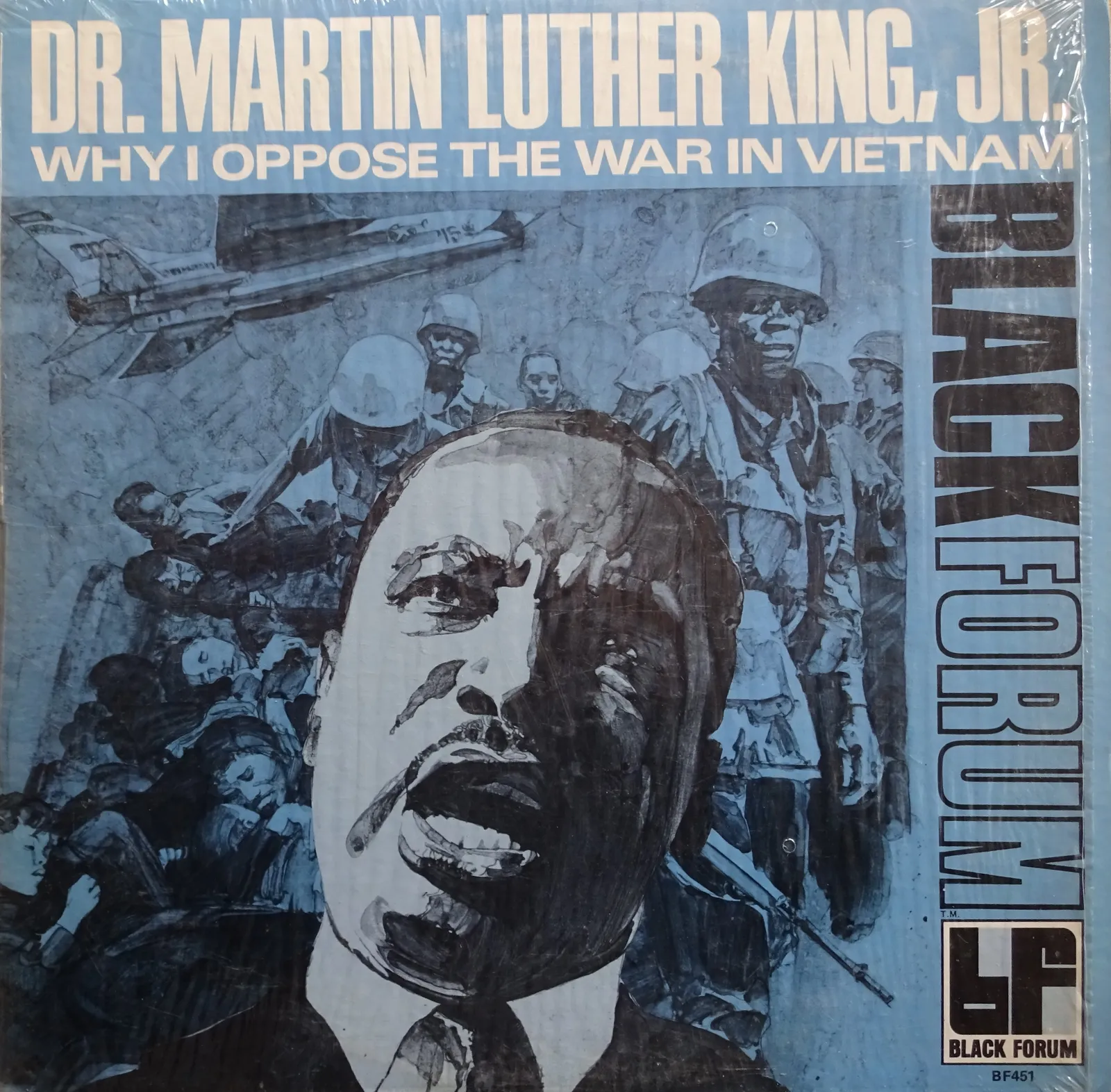
- Artist
- Dr. Martin Luther King Jr.
- Title
- Why I Oppose the War in Vietnam
- Release
- Why I Oppose the War in Vietnam
- Year
- 1970
- Label
- Black Forum # BF-451
- Format
- LP · Album
- Language
- English
- Country
- Detroit, Michigan, USA
- Songwriter
- Dr. Martin Luther King Jr.
- Genre
- Spoken Word · Spoken Word · Speech
- Primary theme
- Peace, Protest & Anti-War
Annotation
Martin Luther King, Jr., born in Atlanta, Georgia on 15 January 1929, took a leading role in the 1960s civil rights movement, receiving a Nobel Peace Prize in 1964 for promoting non-violence to fight racial inequality. He delivered his most famous speech, "I Have a Dream" on 28 August 1963 at the Lincoln Memorial in Washington D.C. - see the LP The Great March on Washington. He died on 4 April 1968, assassinated in Memphis, Tennessee. Exactly one year earlier, on 4 April 1967, he delivered his most controversial speech, "Beyond Vietnam: A Time to Break Silence" at Riverside Church in New York, in which he took a strong position against the war, opposing the policies of President Johnson. He shortly followed this up with the speech "Why I Oppose the War in Vietnam", delivered at Ebenezar Baptist Church Atlanta, Georgia, on 16 April 1967, featured on this record. Released by Black Forum Records (# BF-451), a spoken-word sub-label of Motown Records. They also released the documentary LP Guess Who's Coming Home: Black Fighting Men Recorded in Vietnam. In 1971 this posthumously won the Grammy Award for Best Spoken Word Album. King's opposition to the Vietnam War can be traced back to 1965, although most of his public speeches on the issue took place in 1967 and 1968, when he took part in many anti-war demonstrations, which caused tension between King and President Johnson. He opposed the war on the grounds of Vietnamese freedom, looking at the history of occupation under the French and Japanese. He also focused on the destructiveness of war - both for the soldier and civilians. King also heavily criticised the US for "the triple evils of racism, economic exploitation, and militarism", present in the Vietnam conflict, which brought together the issues of the war and civil rights. Note the reference to napalm.
Annotation by Justin A. Brummer
Annotation — Civil Rights Songs
Martin Luther King, Jr., born in Atlanta, Georgia on 15 January 1929, took a leading role in the 1960s Civil Rights movement, receiving a Nobel Peace Prize in 1964 for promoting non-violence to fight racial inequality. He delivered his most famous speech, "I Have a Dream" on 28 August 1963 at the Lincoln Memorial in Washington D.C. - see the LP The Great March on Washington. He died on 4 April 1968, assassinated in Memphis, Tennessee. Exactly one year earlier, on 4 April 1967, he delivered his most controversial speech, "Beyond Vietnam: A Time to Break Silence" at Riverside Church in New York, in which he took a strong position against the war, opposing the policies of President Johnson. He shortly followed this up with the speech "Why I Oppose the War in Vietnam", delivered at Ebenezar Baptist Church Atlanta, Georgia, on 16 April 1967, featured on this record. Released by Black Forum Records (# BF-451), a spoken-word sub-label of Motown Records. They also released the documentary LP Guess Who's Coming Home: Black Fighting Men Recorded in Vietnam. In 1971 this posthumously won the Grammy Award for Best Spoken Word Album. King's opposition to the Vietnam War can be traced back to 1965, although most of his public speeches on the issue took place in 1967 and 1968, when he took part in many anti-war demonstrations, which caused tension between King and President Johnson. He opposed the war on the grounds of Vietnamese freedom, looking at the history of occupation under the French and Japanese. He also focused on the destructiveness of war - both for the soldier and civilians. King also heavily criticised the US for "the triple evils of racism, economic exploitation, and militarism", present in the Vietnam conflict, which brought together the issues of the war and Civil Rights. Note the reference to napalm.
Annotation by Justin A. Brummer
Lyrics
English: They must see Americans as strange liberators / Do you realize that the Vietnamese people proclaimed their own independence in 1945 after a combined French and Japanese occupation? / And incidentally this was before communist revolution in China, they were led by Ho Chi Minh.... / Now they languish under our bombs and consider us, not their fellow Vietnamese, the real enemies.... / This business of burning human beings with napalm, killing our nation's homes with orphans and widows of injecting poisonous drugs of hate into the veins of peoples normally humane, sending men home from dark and bloody battlefields, physically handicapped and psychologically deranged can not be reconciled with wisdom, justice and love / See thousands of the children, homeless without clothes running in packs on the streets like animals / They see the children degraded by our soldiers as they beg for food.... / We have destroyed their two most cherished institutions, the family and the village, we have destroyed their land and their crops / I am disappointed with our failure to deal positively and forthrightly with the triple evils of racism, economic exploitation, and militarism / We are presently moving down a dead-end road that can lead to national disaster
Notes
Black Forum BF-451, side 1 H-1716 (Z4RM-2643), 18:46, side 2 H-1717 (Z4RM-2644), 23:12, both "Why I Oppose the War in Vietnam" (Dr. M. L. King, Jr.); produced by Junius Griffin; "Trademark Motown Record Corp. © 1970", "A Product of Motown Record Corp.". Cover designed by Curtis McNair with an illustration by Carl Owens of King against soldiers and a jet; printed in U.S.A., © 1970 Motown Record Corporation, Detroit, Michigan 48201. Junius Griffin's signed back-cover note states the album is taken from a sermon King delivered on 16 April 1967 at Atlanta's Ebenezer Baptist Church, where he shared the pulpit with his father, the Rev. M. L. King, Sr., and quotes it: "There comes a time when silence is betrayal." The note describes King's narrative of Vietnamese history, from the 1945 declaration of independence to the U.S. joining their oppressors. A panel describes Black Forum as "a medium…
About the artist
Born 15 January 1929, Atlanta, Georgia, USA. Died 4 April 1968, Memphis, Tennessee, USA. (Speech delivered on 16 April 1967, at Ebenezar Baptist Church Atlanta, Georgia)
Themes
Anti-War · Civil Rights · Napalm · MLK
In collections
Civil Rights Songs · Peace, Protest, & Anti-War Songs [War Years]