Entries are numbered (#1, #2 …) for reference on this page; the numbers shift when entries are added or split.
The Berkeley Barb, 1967, p. 3 — “Panther Ambush”: the jacket of Mark Comfort’s “Damn Vietnam” 45 (O.D.A.C.), “issued frankly to raise bail for Mark”
A collection of songs referencing Civil Rights and the Vietnam War
This forms part of the larger Vietnam War Song Project, an interpretive examination of over 6,500 Vietnam War songs identified, revealing how the war's significance is represented through music. The project also collects spoken-word recordings about the conflict. This unique collection of voices advances scholarship by providing insights into people’s views about the war over time as represented in music, looking at diverse communities and vibrant music scenes. It is crucial in developing our knowledge of the war and the humanities, through the use of a digital research platform.
Note: The VWSP has identified, to date, 260+ songs linking the war with the civil rights movement.
Citation:Justin A. Brummer, Vietnam War Song Project (VWSP) — Civil Rights Songs, vietnamwarsongproject.com/list/civil-rights-songs, accessed 12 November 2026
Lack of rights at home despite fighting for their country alongside US white citizens
Reference to both Vietnam & Civil Rights in the same song
May reference Civil Rights leaders, such as Martin Luther King Jr.
Typically found in the genres of soul, gospel, funk, and blues, and performed by African-Americans.
Passing mentions, to both Vietnam and Civil Rights-related issues
Time Period
A protester carries a 'No Vietnamese Ever Called Me Nigger - Stop the War Now!' sign at a New York anti-war march, 1967.
Pre-Gulf of Tonkin: 1960-1964 While many of these early US songs may have been intending to refer to US troops in Germany, or Korea, or representing general Cold War fears, they were released in the run-up to the "Vietnam era" and the Gulf of Tonkin incident (1964), which led to a major escalation of US involvement in the conflict, and thus included in this list, as cultural perspectives. The criteria is the same as for the war years - the songs included mention Vietnam, or the lyrics deal with war-related themes, such as combat, the US draft, weapons such as napalm, prisoners of war, demonstrations, references to soldiers and veterans, war & peace, and expressions of patriotism.
War Years: 1964-1975 Released during the key war years, the songs included mention Vietnam, or the lyrics deal with war-related themes, such as combat, the US draft, weapons such as napalm, prisoners of war, demonstrations, references to soldiers and veterans, war & peace, and expressions of patriotism.
While the war goes back to the 1954 Geneva conference, following the Gulf of Tonkin incident (1964), the US significantly expanded its presence in the region and its defence of South Vietnam, and thus using this date as the beginning of the core war years. These run to the collapse of South Vietnam (30 April 1975), in two periods: (a) 1964-1972, the years of major US combat involvement, up to the peace agreement; (b) 1973-1975, from the Paris Peace Accords (27 January 1973), which brought US troops and prisoners of war home, to the collapse of South Vietnam.
Post-War: 1976-present Themes especially found in the post-Vietnam War era are lyrics about post-traumatic stress disorder, prisoners of war and the missing in action, the plight and treatment of veterans, and agent orange, in the years after the collapse of South Vietnam and the unification of North and South Vietnam.
1960-1964
Secretary of Defense Robert McNamara, in post-midnight press conference at the Pentagon, describing Gulf of Tonkin incident, 04 August 1964.Key EventsIn July 1954 the Geneva Accords established a temporary boundary between the North and South of Vietnam, and provided for the gradual withdrawal of French troops. A few months later, in October 1955, South Vietnam declared itself a republic. The Eisenhower administration committed the US to preserving this independent, non-communist South Vietnam, which continued in the early 1960s under Kennedy and Johnson.
In the 1964 presidential election 2/3rds of Americans said that they paid little or no attention to Vietnam.1 However, the Vietnam conflict had started to rise in the news agenda. The US had over 15,000 personnel in South Vietnam - mainly military experts, for training and support. Furthermore, on 7 August 1964, the US Congress passed the Gulf of Tonkin Resolution, following a naval clash between North Vietnam and US forces, which permitted President Lyndon B. Johnson (1963-1969) to send conventional forces to Vietnam.2 Thus, Vietnam started to become a focal point in the news and with topical singers.
8 November 1960: John F. Kennedy defeats Richard Nixon in US presidential election
20 December 1960: National Liberation Front (NFL) or the Viet Cong is established
2 November 1962: South Vietnamese leader Diem executed in coup
22 November 1963: Lyndon Baines Johnson becomes US president following Kennedy assassination
2-4 August 1964: North Vietnam attacks US ships in Gulf of Tonkin
7 August 1964: Gulf of Tonkin Resolution passed by US Congress, permitting intervention
#1 Jeff Johnson What's Our World Coming To 1964 · Single · What's Our World Coming To / I Said It and I'm Glad · Dewl # 4268 · USA
Credited on the record as Jeff Johnson & the Shorthands.
Annotation
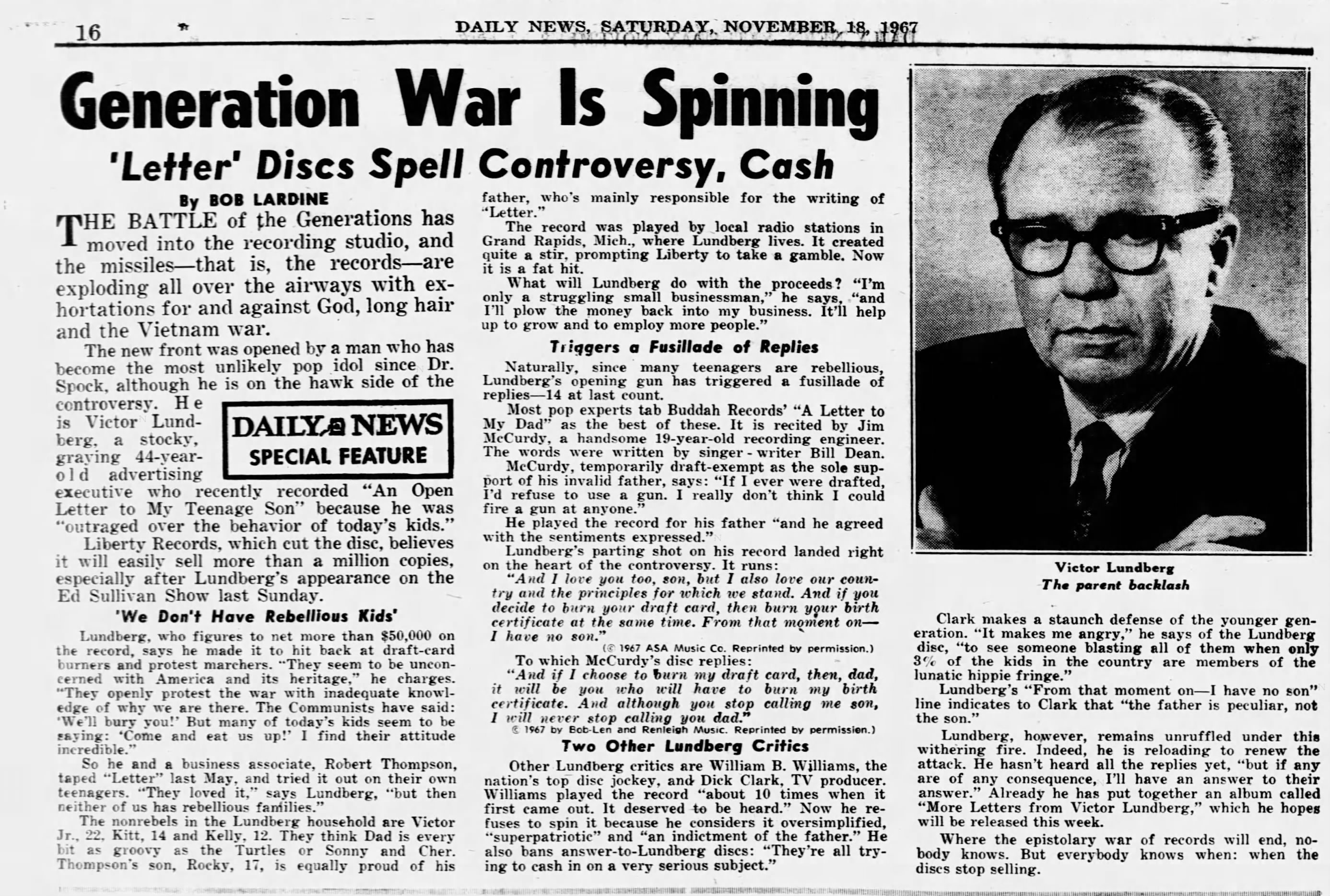
Jeff Johnson, country artist, born 3 November 1942 in Galesburg, Illinois, USA, and 26 January 2010 in Tucson, Arizona, USA. The song "What's Our World Coming To" , released in 1964 in Hollywood, California, was an early anti-protest, patriotic, religious themed record. It started with a Civil Rights message, noting that "Lincoln said let the slave go free" , but that today African-American do not "enjoy the same freedom as you and me" . It then moved to the Vietnam War: "Today in Vietnam, thousands of Americans are fighting to keep our country free" - thus taking a pro-government perspective. It then took an anti-protest view: "there are those who... won't fight for the red, white and blue, what's this world of ours coming to" .
Annotation by Justin A. Brummer
Notes
Dewl Records 4268, "513 W. Thomas Rd."; "What's Our World Coming To" (Jeff Johnson), 2:16, BMI, English Music; Jeff Johnson & the Shorthands; "Produced by Jerry Reece"; yellow label with crossed-sabres logo. [From the record sleeve and labels]
Lyrics
English
In 1863, Lincoln said let the slave go free
There supposed to enjoy the same freedom as you and me
But one look around you will tell you this ain't really true
What's this world of ours coming to
Greed and jealousy are getting stronger day by day
Why you know there are some who can hardly wait
For their relative to fade away, they say you know
All that money could sure make a lot of dreams come to
What's this world of ours coming to
Today in Vietnam, thousands of Americans are fighting
To keep our country free, to uphold America's heritage
For freedom and democracy, and there are those
Who live under but won't fight for the red, white and blue
What's this world of ours coming to
God and the bible are getting further and further away
People don't want to be bothered anymore to take the time and pray
But little do they know that only he can see them through
What's this world of ours coming to
And it won't be long not, until we meet our god, face to face
Then it won't matter how rich you are, what colour, creed or race
We'll have to answer to him for every single thing we do
Spoken word recording of the famous Freedom of Speech Movement that took place at the University of California 1964-1965, dealing with current issues of the day, including Civil Rights and the Vietnam War. The anti-Vietnam War protest movement, which put pressure on the White House and the Congress, actual grew and picked up momentum on the college campuses, with connections to broader pressure groups such as the Free Speech Movement (over the rights of students to politically organise on campus), and the Students for a Democratic Society (SDS), formed in the early 1960s.
The latter ran the "March Against the War in Vietnam" demonstrations in Washington D.C. on 17 April 1965 and 27 November 1965, the latter attended by around 20,000-25,000 people and well known musicians, including Joan Baez and Phil Ochs. The record runs through the chronology of events with recordings of the speeches: "We have been driven to the first civil disobedience on campus...after our liberties where chopped...should the faculty be trailing us or leading us?"
Annotation by Justin A. Brummer
Notes
KPFA-Pacifica Foundation, no catalogue number (runouts KPFA-1964-1/2). Rally and sit-in at Sproul Hall, arrests, faculty and Academic Senate meetings, Clark Kerr, and a Mario Savio interview.
New York Times front page, 03 March 1965, '160 U.S. and Saigon planes bomb 2 bases in North in record raid; continuing strikes expected', the beginning of Operation Rolling Thunder bombing campaign1Key Events1965 saw a significant US escalation under LBJ with the implementation of Operation Rolling Thunder - the sustained aerial bombardment of North Vietnam, to support the South Vietnamese government, pressure the North Vietnamese, and to target North Vietnamese transport, industry, and air defences. LBJ also committed an additional 50,000+ ground troops, which saw total US personal in South Vietnam increase to 184k+, up from only 23k+ in the previous year. In other news, Australia committed to support the US, sending a battalion to South Vietnam. Meanwhile, the anti-war movement gained pace, with major demonstrations taking place in Washington D.C., including the March on Washington for Peace in Vietnam.
2 March: US Rolling Thunder bombing campaign of North Vietnam kicks-off
8 March: Escalation of US combat troops in Vietnam
17 April: 20,000 attend anti-war demonstration in Washington D.C.
28 April: Australian PM Menzies send battalion to South Vietnam
4 May: LBJ requests additional $700m for the war
5 May: Berkeley students burn draft cards at city's draft board
27 May: New Zealand PM Holyoake announces sending first troops to S. Vietnam
28 July: LBJ commits additional 50,000 troop to Vietnam
31 August: LBJ criminalizes destruction of draft card
27 November:March on Washington for Peace in Vietnam demonstration
28 November: Philippines announces sending troops to S. Vietnam
24 December: LBJ halts bombing campaign
31 December: US personnel in S. Vietnam total 184k+, up from 23k+ from a year earlier.
#5 Dave Mandel Battle of Berkeley Talking Blues 1965 · Album · FSM's Sounds & Songs of the Demonstration! · Free Speech Movement # FSM-4 · USA
Annotation
This record (# FSM 004LP) included songs written by students about the Free Speech Movement (FSM) and its activities in October 1964 at the University of California, Berkeley (check out the FSM Digital Library). A dispute broke out between the Faculty and the students over the right to politically organise on campus - over issues like the Vietnam War and Civil Rights. Various sit-ins took place. This helped kick off the anti-war movement on the campuses. Also see the spoken word record Is Freedom Academic? A Documentary of the Free Speech Movement at the University of California, Berkeley - Fall 1964.
A narrator goes through the chronology of the events, in between speeches, songs, and sounds. Listen to the whole thing at UC Berkeley Library Social Activism Sound Recording Project: The Free Speech Movement and Its Legacy. Most of the songs are played to Bob Dylan melodies. The first song, "Battle of Berkeley Talking Blues" , by David Mandel, made humorous references to the October demonstrations, including the "traffic problem" on campus, which the Dean of the school had used to describe the protesters. Other songs were called "Free Speech Demonstration Talking Blues" , and "Lessons of Berkeley" . The final song "Bastion of Truth" by Kevin Langdon said that "this isn't the end of freedom's hard fight", suggesting that protesters would not just disappear after a few weeks. A look at the song "Join the FSM" displays some of the objectives of the movement:
Annotation by Justin A. Brummer
Notes
Free Speech Movement FSM-4. Side A: the Sproul Hall sit-in, the arrest of Jack Weinberg and speeches from the top of the police car; side B: songs by FSM students.
#6 Barry McGuire Eve Of Destruction 1965 · Single · Eve of Destruction / What Exactly's the Matter With Me · Dunhill # 45-D-4009 · USA
Annotation
The song"Eve of Destruction" (Dunhill Records # 45-D-4009), written by P.F. Sloan is a very topical, early protest song, looking at both the Civil Rights movement and war. It was one of the most commercially successful Vietnam songs, reaching #1 in the US Billboard Hot 100 on 25 September 1965 after six weeks in the charts.1. The song was covered by many other artists, and is often referenced in articles and books discussing Vietnam & Cold War cultural song history. On 14 August 1965, Billboard ran the headline "Record of Absurd Gets Serious Airplay", which commented that "a record depicting the frenetic plight of society today, written with biting incisiveness by a 19-year-old renegade from surfing music, is gaining acceptance over top 40 stations despite its 'controversial' lyrics... what is so remarkable about the single is its acceptance... During the past two year, three other singles of a controversial or sociological nature were refused play by U.S. stations".
The main reference to Vietnam reflected that while teenagers were drafted to war (minimum age 18), they may not have the opportunity to vote (21 in all states but 4): "old enough to kill, but not for votin'" . It also branched out into the wider Cold War conflict, reflected fears of atomic war, with just the push of a button. Moreover, it referenced the Civil Rights issue, calling for not just demonstrations, but a change in attitude, and perhaps legislation: "marches alone can't bring integration, when human respect is disintegratin'" . The Spokesmen in the single "The Dawn of Correction" directly replied to this in their answer record, discussed below: "you tell me that marches won't bring integration, but look what it's done for the voter registration" .
UK pressing RCA Victor RCA 1469 (matrix 70800), "New Orthophonic" High Fidelity, ℗ 1965, "USA No.: D-4009", Dick James M. Ltd., N.C.B., "Produced by Dunhill U.S.A.", made in England by The Decca Record Co. Ltd., writer printed as "P. F. Sloane", in an RCA Victor company sleeve. German pressing RCA Victor 45-9646 (45-00 802), GEMA, time 3'28, "Prod. by Lou Adler with Sloan & Barri", "Produced by Dunhill Records U.S.A.", Teldec licensee, in a picture sleeve with a portrait of McGuire.
Japanese pressing Victor SS-1629 (AMP-45-00802), Side 1, Japanese title 明日なき世界, b/w "What Exactly's the Matter With Me" (何のために, P. F. Sloan, 2:25); the sleeve front carries the slogans "ダンヒル・ヒット・シリーズ!!" and "全米ヒット・パレード第1位!!" (Dunhill Hit Series; No. 1 on the US hit parade), and the back gives the price ¥370 and Victor Company of Japan, Ltd. The inside sleeve notes by 福田一郎, dated October 1965, say the song reached No. 1 on the Billboard Hot 100 of 25 September and No. 4 in Melody Maker's Pop 50, that some US and UK stations kept it off the air, and quote a BBC spokesman, Mick Jagger (against), Jonathan King and the Kingston Trio (for); they describe P. F. Sloan as 19 years old.
A lyric insert prints the full English lyrics. [From the record sleeve and labels]
Lyrics
English
The eastern world, it is exploding, violence flarin', bullets loadin'
You're old enough to kill, but not for votin'...
If the button is pushed, there’s no runnin' away
There'll be no one to save, with the world in a grave...
In the first half, the narrator took a hawkish, patriotic stance, arguing that communism posed a threat to the Western democracies, and that if "red domination" was not stopped, then there "will be no need for voting in future generations" in the US. Therefore this backed the domino theory.1 The lyrics also supported the retaining of nuclear weapons. Barry McGuire had argued that the world faced destruction if the "button is pushed" . But The Spokesmen wanted to know "who's crazy enough to risk annihilation?" , and that "the buttons are there to ensure negotiation" . In other words it propagated the theory of Mutually Assured Destruction (MAD) - that rough arms parity between the superpowers meant that each side had the capability to destroy the other, thus neutralising the threat.2 Although hawkish, this view would have been supported by both the Republican and Democrat Party, and widespread in public opinion.
In the second half, the narrator switched from supporting Conservative causes, to those on the more left side of politics. The narrator praised Civil Rights demonstrations for increasing voting registration amongst African-Americans, in direct response to Barry McGuire: "you tell me that marches won't bring integration, but look what it's done for the voter registration" . The lyrics also praised the work of the United Nations and the Peace Corps, which many Conservatives in the 1960s would have disagreed with. Most interestingly, the lyrics applauded a trend of "self-governments replacing colonization" - almost ironic in that the song supported US intervention against communism, presumably including South Vietnam, in which the American presence had replaced that of the old colonial power France. Overall, the song criticised McGuire for being negative and ignoring that which "deserve commendation" , such as developments in medicine and farming, international cooperation, and the spread of democracy.
Decca 31844 (116,430), rainbow-stripe black label, "M'f'r'd by Decca Records Inc. New York, U.S.A."; "The Dawn of Correction" (J. Madara-D. White-R. Gilmore), Champion Music Corp. & Double Diamond Music (BMI) (3:28); The Spokesmen, vocal trio with instrumental accompaniment, arranged by Madara-White, produced by Madara-White Productions. [From the record sleeve and labels]
Lyrics
English
The western world has a common dedication
To keep free people from Red domination
And maybe you can't vote, boy, but man your battle stations
Or there will be no need for voting in future generations
So over and over again, you keep saying it's the end
But I say you're wrong, were just on the dawn of correction
There are buttons to push in two mighty nations
But who's crazy enough to risk annihilation?
The buttons are there to ensure negotiation
So don't be afraid, boy, it's our only salvation... /You tell me that marches won't bring integration
But look what it's done for the voter registration
Be thankful our country allows demonstrations
Instead of condemning, make some recommendations
I don't understand the cause of your aggravation
You mean to tell me, boy, it's not a better situation?...
#8 Jayhawkers Dawn of Instruction 1965 · Single · Dawn of Instruction / Searchin' · Deltron # 21 · USA
Annotation
Less well-known and successful than the above, the Michigan garage rock song "Dawn of Instruction" (Deltron # 21) also provided an answer to McGuire's "Eve of Destruction". Starting with the sound-effect of a bomb dropping, the narrator criticised McGuire for being negative and spreading fear, as he claimed that the US was "getting better" . The narrator went on to criticise those that avoided the draft: "you're the kind...to sit around moaning while better men are fighting" - hence why this song is included in the pro-government section. Also note the reference to Civil Rights legislation: "griping along can't bring integration...it takes work and time to pass legislation...we are all god's creation" .
Annotation by Justin A. Brummer
Notes
Deltron 21 (1227-45-0467-A), vocal, 45 RPM, yellow label with a lightning-bolt triangle logo; "Dawn of Instruction", Trusdale-BMI, time 3:41; Jayhawkers. [From the record sleeve and labels]
Lyrics
English
Things are good but getting better...
I don't believe we are on the eve of destruction
Surely feel that we're at the dawn of instruction
Sure we understand what you're trying to say
But we can't live in fear to see it your way
If ever we push the button, you're the kind...
To sit around moaning while better men are fighting...
#9 Tony Mammarella Eve of Tomorrow 1965 · Single · Eve of Tomorrow / Love Letter · Swan # S-4226 · USA
Credited on the record as Tony Mammarella and Chorus.
Annotation
Tony Mammarella, producer of Dick Clark's American Bandstand, and founder of the record label Swan, released the song "Eve of Tomorrow" (Swan Records # S-4226), a patriotic response to Barry McGuire's "Eve of Destruction"1 Born 2 September 1924 in Atlantic City, New Jersey, USA. Died November 1977 in Philadelphia, Pennsylvania, USA. It sought to present a positive take on world politics: "go hide on the dark of the day... tomorrow belongs to the brave" . It recalled previous wars fought by the older generation, seeking to make a connection to fighting in Vietnam: "it's the same gun your fathers fought with, just to give you a chance... and they gave you this chance to change things, in...Vietnam" . Also responding to McGuire remarks on the Civil Rights movement, Mammarella said that "three kids come from the north... they marched down to Mississippi and they died for what they knew was right" - a reference to the murders of three Civil Rights activist, James Chaney, Andrew Goodman, and Michael Schwerner on 21 June 1964 by the KKK.1 On mutually-assured destruction (MAD), he claimed: "nobody is going to push a button, as long as we have a button to push" .
Swan S-4226-E, black and silver label with the slogan "Don't Drop Out"; "Eve of Tomorrow" (A. S. Mammarella, B. Binnick), time 3:39, Bae Music, ASCAP; Tony Mammarella and Chorus; produced and arranged by Richard Barrett. [From the record sleeve and labels]
Lyrics
English
If you think it's the eve of destruction go hide on the dark of the day
It's only the eve of tomorrow, and tomorrow belongs to the brave
You call this the eve of destruction, your a man with a paper heart
And you belong where it's safe on the sidewalk, and complain when the marches start
Why did the three kids come from the north, they didn't have to join in the fight
But they marched down to Mississippi and they died for what they knew was right
You talk about hate in red China and say it's the same in an Alabama school
Well the hate down there is the exception, and red China they may hate the rule
And your afraid they may push that button and the bomb is gonna fall right on you
Well brother, nobody is going to push a button, as long as we have a button to push to
Take a good look at the gun they might hand you, it looks new but the barrel's been worn
It's the same gun your fathers fought with, just to give you a chance to be born
And they gave you this chance to change things, in...Chicago and even Vietnam
And nobody is going to make your mind up for you, so if you want to say uncle, make it Uncle Sam
#10 Phil Ochs Days of Decision 1965 · Album · I Ain't Marching Anymore · Elektra # EKS 7287 · USA
Annotation
As suggested from the title of this song, "Days of Decision" , on the album I Ain't Marching Anymore (Elektra Records # EKS 7287) appears to be an answer or closely related theme to McGuire's "Eve of Destruction": "lookin' for an answer they're never gonna find... these are the days of decision" - a call to protest against the "far-reaching rockets" . It also contained a Civil Rights message: "warnings of fire... from the three bodies buried in the Mississippi mud" - a reference to the murders of three Civil Rights activist, James Chaney, Andrew Goodman, and Michael Schwerner on 21 June 1964 by the KKK.1
#12 Alan Klein Age Of Corruption 1965 · Single · Age of Corruption / I'm Counting on You · Parlophone # R 5370 · UK
Annotation
UK-based contemporary folk artist, Alan Klein, born 29 June 1940 in Clerkenwell, London, also a member of The New Vaudeville Band, released the novelty song "Age of Corruption" , a response to Barry McGuire's "Eve of Destruction", sung to the same melody, which mocked protest singers for releasing political records, suggesting it was for commercial gain: "make it controversial so the DJ's will spin it, tell the world what's wrong with it in less than three minutes". As well as McGuire, it also called out Bob Dylan, Donovan, and Joni Mitchell: "now let's all bow down and pray to Bob Dylan, and Donovan, and Joni". On the issue of Civil Rights, he sarcastically sung "we gotta' bring in segregation, well, I ain't sure what that means, 'cause I ain't had no education", and on the Vietnam War: "we'll denounce all wars as just senseless killings".
Annotation by Justin A. Brummer
Notes
Released Nov 12, 1965. A promo copy (release 5129432) also exists.
Reissued on 'Well At Least Its British' (2008 CD) and the box set 'Gathered From Coincidence: The British Folk-Pop Sound Of 1965-66' (2018). Pop / Folk / Vocal. parody/answer to Barry McGuire's 'Eve of Destruction'; protest-song satire rather than directly about Vietnam A novelty response to Barry McGuire's 'Eve of Destruction' sung to the same melody, mocking protest singers as commercial opportunists; Dunhill Records blocked EMI's release in 1965 because it used P.F. Sloan's tune.
Lyrics
English
Let's record a song with words of protest in it
Make it controversial so the DJ's will spin it
Tell the world what's wrong with it in less than three minutes
So count up to three after me, and begin it
Let's jump on the bandwagon, my friends
Can't you see this is the age of corruption
We'll make it obscure, so no one can understand it
And then when we hear that the radio has banned it
And the record reviewers on the papers have panned it
We'll laugh all the way to the bank, like we planned it
Let's jump on the bandwagon, my friends
Can't you see
This is the age of corruption
We'll denounce all wars as just senseless killings
Purify your minds for the price of six shillings
Now let's all bow down and pray to Bob Dylan
And Donovan, and Joni, and [unknown]
And let's jump on the bandwagon, my friends
Can't you see
This is the age of corruption
Somewhere along the line, we gotta' bring in segregation
Well, I ain't sure what that means, 'cause I ain't had no education
Been too busy getting high, making [unknown] observations
Doin' one night stands, and touring TV stations
Fighting for your freedom, and attending demonstrations
And all the time, a weekly show is climbing up the ratings
And I'm blowin' in the wind
I'm trying to catch the wind
I'm chasin' the wind
And racin' the wind
Now I'm travelin' so fast
I'm passin' the wind
So let's jump on the bandwagon, my friends
Can't you see
This is the age of corruption
We gotta warn the eastern world to stop their eruptions
For it can only end in total nuclear destruction
And if it does, you'll be the one
To buy my records, read my poems
And listen to my mock[?] songs
Before we die
Before we fry
Blow sky-high
And say goodbye
The end is nigh
Let's jump on the bandwagon, my friends
Can't you see
This is the age of corruption"
We gotta warn the eastern world to stop their eruptions
#13 Mac Davis I Protest 1965 · Single · Bad Scene / I Protest · Capitol # 5554 · USA
Annotation
Mac Davis, country artist, born on 21 January 1942 in Lubbock, Texas, USA, and died 29 September 2020 in Nashville, Tennessee, USA. This record (Capitol Records # 5554) took a strong anti-protest perspective, mocking protest singers and the anti-war movement on both side. In the song "I Protest" , he declared "I protest against you protesters... you're only conforming to non-conformity" . The first track especially presented an anti-hippie perspective - criticism of hippie [or hippy] culture. Often presented as a youth movement, related to psychedelic music, drugs use (e.g. LSD and marijuana), long hair (both men & women), jeans, flairs, pop art, free love (sex, love-in), travelling, spirituality: "I won't grow myself a long black beard, wear a pair of grimy sandals which will make me look weird" . It contained a patriotic Vietnam-related message: "when I try to go and fight for the right to be free you're lying on your back" .
Annotation by Justin A. Brummer
Notes
Capitol 5554, yellow-and-orange swirl labels; "Bad Scene" (M. Davis), 2:28 (45-55390), and "I Protest" (M. Davis), 2:16 (45-55391), both Low-Sal Music, BMI, produced by Joe South; "Mfd. by Capitol Records, Inc., U.S.A." In a white Capitol company sleeve with the repeated "Capitol" logo. [From the record sleeve and labels]
Lyrics
English
Just because I wear a natural shoulder ivory league jacket
And a buttoned down shirt with a new jacket
Don't mean I'm un-liberated, I protest babe
Just because I won't grow myself a long black beard
Wear a pair of grimy sandals which will make me look weird
Don't mean I'm un-liberated, I protest babe
I protest against you protesters cause you're too blind to see
That you're only conforming to non-conformity
That makes you just as square as me
When I try to go and fight for the right to be free
You're lying on your back on the tracks in front of me...
Just because I won't stand in your picket line
Carrying a sign that looks exactly like the one behind me
#14 Mac Davis Bad Scene 1965 · Single · Bad Scene / I Protest · Capitol # 5554 · USA
Annotation
The B-side song, "Bad Scene" again mocked the anti-war movement and protest singers: "I got the right to be a singer for the cause until I know what the cause is about, until then I'll shout" . It referenced many 1960s issues, especially Civil Rights: "Alabama night riders... Ku Klux Klan meetings... segregated seating" .
Annotation by Justin A. Brummer
Notes
Capitol 5554, yellow-and-orange swirl labels; "Bad Scene" (M. Davis), 2:28 (45-55390), and "I Protest" (M. Davis), 2:16 (45-55391), both Low-Sal Music, BMI, produced by Joe South; "Mfd. by Capitol Records, Inc., U.S.A." In a white Capitol company sleeve with the repeated "Capitol" logo. [From the record sleeve and labels]
Also known as The SNCC Freedom Singers, formed December 1962 in Albany, Georgia, USA, they performed Civil Rights and protest gospel and spiritual songs. Its members included Cordell Reagon (tenor), Rutha Mae Harris (soprano), Charles Neblett (bass vocals), Bernice Johnson Reagon (alto), Matt Jones, and Bertha Gober. They were active in the Civil Rights protest movements, taking part in famous demonstrations, from the March on Washington to the Selma to Montgomery marches - documented on several records, such as "WNEW's Story of Selma".
The LP front cover featured images of the KKK and a burned-out school bus, and other symbolic pictures of the Civil Rights-era. The song "I'm a Demonstratin' G.I. From Fort Bragg" directly dealt with the issue of the Vietnam War and Civil Rights - composed by Matt Jones (born 17 September 1936 in Raleigh, North Carolina, USA, died 30 March 2011 in New York, NY, USA), after hearing about an African-American soldier who had participated in an anti-war demonstration in uniform: "if I can defend it overseas, why don’t you set my people free" .1 Note that Jones had released several songs about the mistreatment of Black Americans at home, and thus questioning why they should fight in the war to kill Vietnamese people. This included the 1970 song "Hell No! I Ain't Gonna Go". This also featured on the album "Broadside Ballads Vol. 5: Time Is Running Out".
Mercury MG-20924, Monaural (back cover "SR 60924/MG 20924", front "Hi-Fidelity MG 20924"), red label, "Vendor: Mercury Record Corporation"; "I'm a Demonstratin' G.I. From Fort Bragg" is side 2, track 1, 5:15.
The back cover states "All Selections written or adapted by The Freedom Singers", publisher for all selections MRC Music, Inc., produced by Franklin Fried and Chad Mitchell, A. & R. Chad Mitchell, edited by Milt Okun.
Sleeve notes by Studs Terkel describe the recording made at the 4th Annual Conference of SNICK (the Student Non-Violent Coordinating Committee), Atlanta, spring 1964, with John Lewis addressing the gathering, and introduce this song as the young MC's story of "the Negro soldier from Danville, Virginia" who "could not help demonstrating, in uniform or out".
The front cover is a torn-paper montage of civil-rights photographs in red: a closed lunch counter, a child reading, hooded figures and troops on courthouse steps. [From the record sleeve and labels]
The song "Everybody Crying About Vietnam" (Scout # SC-1) by J.B. Lenoir - an alternative version of "Vietnam Blues" - recorded live during a European tour with the American Folk Blues Festival, October 1965, in Hamburg, Germany. However, it looks like the producers and record label owners, Horst Lippman and Johannes Rau, did not release this record until around 1968-69. The original studio version "Vietnam Blues", recorded in 1966, first appeared on the 1970 album Crusade (Polydor # 24-4011) - discussed below. The lyrics of the two songs are fairly similar, although Lenoir went into more detail about Civil Rights legislation. He posed the question to the president: "if you don't want to give us our Civil Rights, why do you send us to fight?". This represented the connection between Civil Rights / race relations and the role of African-Americans in Vietnam. It also included a spoken word introduction, in which Lenoir imagined the sounds of war. Note: this is different to the J.B. Lenoir song "Vietnam" which featured on the 1965 album Alabama Blues (CBS # 62593), discussed above.
Annotation by Justin A. Brummer
Lyrics
English
I want you to hear what I hear, I hear some explosions, and a lot of bombs and guns shooting, lets go over to Vietnam
Everybody is crying about Vietnam...
Tell me, the Civil Rights Bill was killed in the House
People let me tell you about me beliefs
I never did believe the Bill was alive....
Mr. President, if you don't want to give us our Civil Rights, why do you send us to fight?
#17 J.B. Lenoir Vietnam Blues 1965 · Album · Down in Mississippi · L+R # LR 42.012 · USA
Annotation
The song "Vietnam Blues" , another blues song by J.B. Lenoir about the Vietnam conflict. Originally recorded on 2 September 1966 at Sound Studio, Chicago, Illinois, for the German recorded producers Horst Lippman and Johannes Rau, under the supervision of the bluesman Willie Dixon. It featured the drummer Freddie Below. However, it seems that they did not release the record at the time. It probably made its first appearance in 1970, on the album titled Crusade (Polydor # 24-4011). For the 1980 reissue by L+R Records (# LR 42.012) they renamed album Down in Mississippi (taken from the first track title). Both of the J.B. Lenoir songs discussed ("Vietnam" and "Vietnam Blues" ) are on Vietnam Blues: The Complete L+R Recordings - a compilation of both Alabama Blues and Down in Mississippi - these are acoustic albums, with no bass and electric guitar, and with occasional drums, thus returning to the pre-war blues sound.
This song drew a connection between Vietnam and Civil Rights in the US. Lenoir questioned why people complained about Vietnam, but ignored or forget the problems that black Americans faced in their own country: "everybody cryin' about Vietnam, the law killing me down in Mississippi" . Lenoir called on the president to "clean up your own house" . A 1965 live version of this song, called "Everybody Crying About Vietnam" appeared on the album Bye Bye, Bird...Solo Blues (Scout # SC-1) released around 1968-69.
Annotation by Justin A. Brummer
Lyrics
English
Vietnam, Vietnam, everybody cryin' about Vietnam
The law killing me down in Mississippi, nobody seems to give a damn
Oh god if you can hear my prayer now
Help my brothers over in Vietnam
The poor boys fighting and killing
Maybe killing their own brothers...
Mr. President, you always cry about peace but you must clean up your own house before you leave
How can you tell the world how we need be and you still mistreating and killing poor me?
President Lyndon Baines Johnson meets with the South Vietnamese Prime minister, Nguyen Cao Ky, at the Honolulu Conference, 8 February 1966Key EventsIn 1966 the US continued its extensive Rolling Thunder bombing campaigns of North Vietnam and the Ho Chi Minh Trail through Laos and Cambodia. Moreover, the escalation of the ground war continued, with an additional 200,000 US troops sent to Vietnam, taking the total to 385k+ by the end of the year. Johnson also encouraged its allies to send more troops to help the US - Australia, New Zealand, South Korea, Thailand, and the Philippines agreed. The UK and Canada refused. France officially denounced the war.
11 February: Johnson announces 200,000 troop increase
19 March: South Korea sends another 20,000 troops
1 September: French President de Gaulle denounces the war
31 December: US military personal in Vietnam reaches 385,300
1966
#18–20 Jacqueline Sharpe No More War 1966 · Album · Cutty Wren # CWR 101 · USA
3 of the 10 songs from this album in the archive are in this collection
Annotation
Artist background
Born Jacqueline Steiner (11 September 1924) in New York, USA, she was an American folk singer and social activist who played an active part in the 1950s and 1960s folk scene, collaborating with Pete Seeger on the 1954 album Hootenanny Tonight! (under her married name Jackie Berman). In 1966 she released the anti-Vietnam War album "No More War" (Cutty Wren Records # CWR 101).1 She died on 25 January 2019.2 The title track "No More War" centred around a speech given by Pope Paul VI to the United Nations General Assembly on 4 October 1965, captured on several LPs, including Mission to America, October 4, 1965 (Columbia Records # xx2). Broadside published the lyrics to "No More War" in # 75 in October 1966, accompanied by a lengthy explanation of the song.
The song "Chant for the Murdered" from the album No More War (Cutty Wren Records # CWR 101) tackled the issues of blind patriotism during the Vietnam War period, while mainly focused on the issue of Civil Rights: "one nation torn apart by hate and wrong... justice for some" . Note the reference to several high profile murders of Civil Rights activists, including Chaney, Goodman, and Schwerner: "my name is... Schwerner, and my name Jim Chaney, Andy Goodman" .
#18 Jacqueline Sharpe No More War 1966 · Album · Cutty Wren # CWR 101 · USA
Annotation
Artist background
Born Jacqueline Steiner (11 September 1924) in New York, USA, she was an American folk singer and social activist who played an active part in the 1950s and 1960s folk scene, collaborating with Pete Seeger on the 1954 album Hootenanny Tonight! (under her married name Jackie Berman). In 1966 she released the anti-Vietnam War album "No More War" (Cutty Wren Records # CWR 101).1 She died on 25 January 2019.2 The title track "No More War" centred around a speech given by Pope Paul VI to the United Nations General Assembly on 4 October 1965, captured on several LPs, including Mission to America, October 4, 1965 (Columbia Records # xx2). Broadside published the lyrics to "No More War" in # 75 in October 1966, accompanied by a lengthy explanation of the song.
The song "Chant for the Murdered" from the album No More War (Cutty Wren Records # CWR 101) tackled the issues of blind patriotism during the Vietnam War period, while mainly focused on the issue of Civil Rights: "one nation torn apart by hate and wrong... justice for some" . Note the reference to several high profile murders of Civil Rights activists, including Chaney, Goodman, and Schwerner: "my name is... Schwerner, and my name Jim Chaney, Andy Goodman" .
Title track (A6, 2:41 on RYM) of the 12-track LP Cutty Wren CWR-101, 1966, arrangements Walter Raim. [From Rate Your Music]
Lyrics
English
I pledge an allegiance to the flag
Oh you red white and blue
Of the United States with an exception or two
Of America, with its prison wars
And to the republic for which it stands or falls
One nation torn apart by hate and wrong
Under god, why have you forsaken me so long
With liberty and death you'll never know when it will come
And justice for some
Because I'm from Alabama, I'm from Harlem, New York City, I'm from Watts in L.A., Philadelphia, Mississippi...
My name is James Lee Jackson, and my name is Mickey Schwerner, and my name Jim Chaney, Andy Goodman, James Reeb, and my name is Willie Bruster, Viola Liuzzo, and my name is Medgar Evers, and my name is Jonathan Daniels
#20 Jacqueline Sharpe To the Right - March! 1966 · Album · No More War · Cutty Wren # CWR 101 · USA
Annotation
The song "To the Right - March" , also from the album No More War (Cutty Wren Records # CWR 101), mocked those that supported the war in Vietnam, accusing some of being racist and warmongering. It contained many key topics, from Anti-Vietnam War, to Civil Rights, the Cold War with Russians, reference to the Korea War and the atomic bomb, with the narrator declaring that "I'm white and free" and that "all these Jewish negro Catholics Protestant things against the war" should be sent to Russia or taken into an alley to set them straight.
Annotation by Justin A. Brummer
Lyrics
English
To the right, march, I'm a member of the 100% American volunteers
I'm marching to join up in the next few year
Let's free the yellow gooks, let's civilise the gooks
Let's hit the chinky commies smack in their stinking rears
I'm white and free and 43 and all of my blood is red
Not a single doubt has ever penetrated my higher head
My country never wrong
God blessed us because we're strong
Just give us a gone and an enemy and we'll fill them full of lead
All these Jewish negro Catholics Protestant things against the war
Send them back to Russia, China, Africa, Singapore
It's treason not to hate
Let's set the cowards straight
Just get them out the alley and let them know the score
Oh we should have beaten the Russian way back in '45
And then gone after China after the Korean jive
The world is in our way/ Let's drop a bomb today
Cause people can't go communist if none of them are alive
#21 The Ram Ram Go-Go Biz. Man Vietnam Cries U.S.A. 1966 · Single · Vietnam Cries U.S.A. / It's Nice to Be Home · Halagala # HG 30 · UK
Annotation
A British ska anti-war song from 1966 called "Vietnam Cries U.S.A." (Halagala # HG 30) which pleaded with President Johnson to stop the war: "we don't want no war in this world Mr. Johnson...stop bombing Vietnam" . Released on the rare, obscure British reggae label Halagala, formed by Terry Nelson in the 1960s - born in Guyana, he moved to London and wrote this song.12 Like J.B. Lenoir above, he particularly drew attention to the mistreatment of African-Americans: "you must set the Negroes free in the USA and we'll live by your laws and obey" - i.e. African-Americans answered the draft call, but they did not receive equal treatment in the US. The label released an instrumental version of this song, called "U.S.A. Out-Cry" (Halagala # HG 26), performed by what appears to be a house band of the label, called the Ram-Ram-Go-Go-Sound.
Halagala HG 30 AE, yellow and green label, 45 R.P.M., (P) 1966, "Copy-R.C."; "Vietnam Cries U.S.A." (Nel Fraser), credited to The Ram Ram Go-Go Biz. Man. [From the record sleeve and labels]
Lyrics
English
We don't want no war in this world Mr. Johnson
So lets stop all this war in Vietnam
You must set the Negroes free in the USA
And we'll live by your laws and obey
Mr. President, can you hear my plea
Mr. President, will you answer me...
Ah, Mr. Johnson can you hear me
Yes I'm apeaking to you from around the world
Yeah look man you have the ability to stop in Vietnam
I said look, you must stop all the negroes and set them free in United States of America
#22 Don Hinson The Protest Singer 1966 · Single · The Protest Singer / Peddlers of Hate · Treva # 222 · USA
Annotation
The song "The Protest Singer" (Treva # 222), released on a Hollywood, California label - but no further details known of this artist - took an anti-protest position, mocking musicians who wake up and "look around until I find something that is wrong" , and then write a song, which included the major issues of the day: "I sing about Vietnam, ban the bomb, end the war" , as well as Civil Rights: "I sing about segregation, integration, demonstration, legislation" . It referenced Barry McGuire's "Eve of Destruction", suggesting the protest singers were in it for the money: "I want to make my fortune before destruction's eve, long as people pay, I hope the problems stay" . The song also denounced hippie culture, often presented in song as a youth movement, related to psychedelic music, drugs use (e.g. LSD and marijuana), long hair (both men & women), jeans, flairs, pop art, free love (sex, love-in), travelling, spirituality: "can't take my time to comb my hair, shave or take a bath" . Also note the reference to the KKK, and the US president Lyndon B. Johnson.
Annotation by Justin A. Brummer
Notes
Treva Records 222, Suite #616, 6290 Sunset, Hollywood, Calif.; red label, 45 RPM, marked "Not for Sale" (the Protest Singer side also "Promotional Copy"). "The Protest Singer" (K. Johnson-D. Hinson), 1:56, Limelite Music-Garpax Music Inc. (BMI), matrix 59477; "Peddlers of Hate" (D. Hinson-K. Johnson), 2:00, Garpax Music Inc.-Limelite Music (BMI), matrix 59477-X. [From the record sleeve and labels]
Lyrics
English
I wake every morning, it's the early dawn
Look around until I find something that is wrong
Then write a song, it don't take long to write a protest song
I sing about segregation, integration, demonstration, legislation, communism, socialism, any ism is an ism, is alright with me
Can't take my time to comb my hair
Shave or take a bath
If restaurant owners laugh at me, they'll have to take the wrath of the protest sing
I could be cleaner, but I'm a protest singer
I sing about Vietnam, ban the bomb, end the war, and help the poor, the KKK, the PTA, and LBJ is A-okay with me
Now I'm the protest singer, this you can believe
I want to make my fortune before destruction's eve
Long as people pay, I hope the problems stay
I'm the protest singer
I sing about Red Chinese minorities, PhDs, low salaries, a race for space, the human race, day or night a quite riot is alright with me...
#23 The Spokesmen Better Days Are Yet to Come 1966 · Single · Better Days Are Yet to Come / Michelle · Decca # 31895 · USA
Annotation
Another song from the Spokesmen, "Better Days Are Yet to Come" (Decca # 31895), a follow-up to their single "The Dawn of Correction". Both songs featured on the album "The Dawn of Correction" (Decca # DL 4712). The Spokesmen were an American garage rock group, made up of John Medora, David White Tucker (of the band Danny & The Juniors) and Roy Gilmore. Again, this can be seen as answer to McGuire's "Eve of Destruction", with the title providing a more positive, alternative take: "there's rejection, insurrection, there's defection... listen to me everyone...better days are yet to come" . It also contained a pro-Civil Rights reference: "integration, liberation now on its way" .
Annotation by Justin A. Brummer
Notes
Decca Record No. 31895 (116,538*), "Broadcast under licence only · Compo Co. Ltd., Canada"; "Better Days Are Yet to Come" (John Madara-David White-Ray Gilmore), 3:00; The Spokesmen, vocal trio with instrumental accompaniment, musical director Jimmy Wisner; produced by Madara-White Productions; "From Decca Album DL 4712 The Dawn of Correction". [From the record sleeve and labels]
Lyrics
English
There's dissension, there's contention, there's abstention in the air
#24 Son of Mississippi The Voice of Alabama 1966 · Single · Flight NAACP 105 / The Voice of Alabama · Reb Rebel # 500 · USA
Annotation
Racist group, on the Crowley, Louisiana-based record label Reb Rebel - which contained an image of the confederate flag on its standard 7" releases. Founded by J.D. Miller - he was a self-proclaimed segregationist. Despite, this, he owned an interracial studio band, and recorded many African-American artists on other labels he owned. But this label was saved specially for offensive, hyper-racist material.1.
The A-side of this song "Flight NAACP 105)" was a spoken racist novelty about Civil Rights, mocking Martin Luther King, Jr. and African Americans. The B-Side "The Voice of Alabama" took an anti-government and anti-Vietnam War perspective, while featuring patriotic content - the basis of its arguments are State's rights and isolationism. On the issue of Civil Rights, the lyrics complained that federal law enforcement had entered the state: "why did you send combat ready troops all the way down here to my cotton field". In the Vietnam issue, the lyrics asked "why was my kid brother sent to Vietnam", concluding that "we've lost our freedom of speech, our state's rights". So this is one of the few records crossing into both the anti-war / anti-government, and patriotic song categories.
Rebel label, No. 500, Side 2, white label with blue print; "The Voice of Alabama" (J. Norris), Son of Mississippi; Jamil Music, P.O. Box 769, Crowley, La., BMI. [From the record sleeve and labels]
Lyrics
English
You say Sir that I ain't noting but an Alabama sharecropper
And as far as these marches and sit-ins is concerned
That I haven't got anything to say, well then tell me Sir
Why next fall when me and young'ens has got the cotton picking...
We still have taxes to pay
And are we not the same Americans that help defend this great country of ours
The Battle of the Belgium Bulge, North Africa, and on Korea's Pork Chop Hill
And if we are Sir, then why did you send combat ready troops all the way down here to my cotton field
Do you take us to be like Hitler's SS men, and would you treat us like some aggressors in some far off land
I hope not Sir
Because like Mr. Lincoln once said, a house divided among itself just ain't never gonna stand
Do you send combat ready troops to threaten all Americans
Or just a few chosen some
And if not Sir, then why was my kid brother sent to Vietnam
Would you have us come to the conclusion that we've lost our freedom of speech, our state's rights, our system of free government
And that we no linger have anything to say
If so Sir, then you must remember when you see the star and stripes proudly waving that it's patriotic Americans
Including some of us here in Alabama that helps keep it that way
#25 Pat Boone Wish You Were Here, Buddy 1966 · Single · Wish You Were Here, Buddy / Love for You · Dot # 16933 · USA
Annotation
The song "Wish You Were Here, Buddy" (Dot Records # 16933), used sarcasm to express his loyalty to the US soldier, support for government policies, and disgust with the protest movement. Narrated in the first person, from the perspective of a soldier in Vietnam, who wrote to his "buddy" back home - the lyrics switched between describing the situation in the war zone, to the soldier noting the activities in the US. So the soldier heard that his friend had been "leading those campus demonstrations" , busy with "sit downs, walk outs" , and had "struck a little match" to his "old draft card" . The soldier sarcastically commented that "I know you are not scared...you just stay home and leave the fighting to us" . The narrator humorously compared this to Cassius Clay - later known as Muhammad Ali - who tried and failed to obtain conscientious objector status in 1967 (refusing to turn up for induction), and subsequently convicted, famously saying "I ain't got no quarrel with them Vietcong" - this was seen as both a religious and Civil Rights message. This contrasted to his legendary career in the boxing ring: "you're a regular Cassius Clay" .1
The narrator also took pleasure in mocking the appearance of his friend: "you let your hair grow...you hardly have time to shave...you look so fine like, something crawled out of a cave" . Meanwhile, the soldiers in South Vietnam did "a job that must be done" , while "sleeping in the jungle and ducking real bullets" . The narrator then sent what seemed to be a menacing threat, that when he returned from Vietnam, he will "come looking for you" . Or, alternatively, if the soldier's buddy paid a visit to Vietnam, he would "introduce you to them Comms" .
Featured on the album Wish You Were Here, Buddy (Dot # DLP-3764) - the cover of which had a painting of a soldier sitting in the jungle, writing a letter home. At the time, Chicago Daily News folk and political columnist Mike Royko, winner of a Pulitzer Prize in 1972, took exception to Boone's song, because "as it turns out, Boone missed the joys of military life". During the Korean War, he avoided the draft as he had a family and studied in college. He described himself as a "partial conscientious objector".2
Black Dot "Ultra High Fidelity" label 45-16933 (MB-21546); "Wish You Were Here, Buddy" (P. Boone), time 1:58, Spoone Music Corp., ASCAP; produced by Nick Venet and Randy Wood, arranged and conducted by Ernie Freeman; Dot Records, Inc., Hollywood 28, Calif. [From the record sleeve and labels]
Lyrics
English
Well, hi there, buddy, thought I'd drop you a line
I haven't seen you for a hundred years /When you get time will you let me know if it's true what a fella hears
Heard you been leading those campus demonstrations
You're as busy as you can be
If the sit downs, walk outs and others aggravate you, bet you hardly ever think of me
Well, I'm on a little vacation in South Vietnam and expense paid trip for one
I got my own little rifle and a great uniform and a job that must be done
Well, we're sleeping in the jungle and ducking real bullets
And man, it's a lot of fun, wish you were here
I heard you let your hair grow, til it's hanging on your shoulders
And you hardly have time to shave
Bet the girls all flip cause you look so fine like, something crawled out of a cave
Heard Uncle Sam nearly scared you to death
But you fooled him just in time
Just struck a little match to your old draft card and you burned up a future like mine...
Oh, I know you're not scared, you're a real brave guy
You're a regular Cassius Clay
And I know you'd a fought when the country was young, but the world's just different today
Well, you just stay home and leave the fighting to us
And when the whole darn mess is through
I'll put away my rifle and the old uniform and I'll come looking for you...
I wanna introduce you to them Comms...
Come on over and we'll just hold em til you get here
#26 Burl Ives The Sixties 1966 · Single · The Sixties / Don't Forget Your Paddle-O · Decca # 31918 · USA
Annotation
Burl Ives - contemporary folk, novelty artist, born 14 June 1909 in Hunt City, Illinois, USA. Died 14 April 1995 in Anacortes, Washington, USA. The song "The Sixties" (Decca Records [USA] # 31918), a novelty track about the 1960s, looking at hippie counter-culture and protest movements, from Vietnam to Civil Rights and the atomic bomb: "shooting wars and freedom marches all over... thinking of the bomb" .
Annotation by Justin A. Brummer
Notes
Decca 31918 (116,938), pink promotional label marked "Promotion Copy – Not For Sale"; "The Sixties" (Boudleaux Bryant), 2:34, Acuff-Rose Publ., Inc. (BMI); vocal with chorus and orchestra directed by Owen Bradley. [From the record sleeve and labels]
Lyrics
English
Long hair boys and streaming females all over
Population explosion, no place folks can be alone
That's the sixties, six, six, sixties
Shooting wars and freedom marches all over
Moon shot pictures and UFOs and...vision phones
That's the sixties, six, six, sixties
Everyone uneasy, from the bottom to the top
Thinking of the bomb that they hope no ones gonna drop
#27 Simon & Garfunkel 7 O'Clock News/Silent Night 1966 · Album · Parsley, Sage, Rosemary and Thyme · Columbia # CS 9363 · USA
Annotation
The song "7 O'Clock News / Silent Night" is the well known Christmas hymn with a monologue of the news bulletin from 3 August 1966 played in the background. It included several references to Vietnam, in particular a speech by Richard Nixon. Officially out of politics since losing the 1960 presidential election, in 1966 Nixon re-emerged from the political wilderness, in an attempt to run for the presidency in 1968. He attacked the anti-war movement, as being unpatriotic and the "greatest single weapon working against the U.S." He also expressed fear that the war could go on for a significant period of time. Released as a single in Europe, in the US it featured on the 1966 album Parsley, Sage, Rosemary and Thyme (Columbia Records # CS 9363).
In Washington the atmosphere was tense today as a special subcommittee of the House Committee on Un-American Activities continued its probe into anti-Vietnam war protests
Demonstrators were forcibly evicted from the hearings, when they began chanting anti-war slogans
Former vice-president Richard Nixon says that unless there is a substantial increase in the present war effort in Vietnam the U.S. should look forward to five more years of war
In a speech before the convention of the Veterans of Foreign Wars in New York, Nixon also said opposition to the war in this country is the greatest single weapon working against the U.S.
#28 Bob Parris Bob Parris 1966 · Album · Berkeley Teach-in: Vietnam · Folkways # FW05765 · USA
Annotation
The LP "Berkeley Teach-in: Vietnam" (Folkways Records # FW05765) documented the largest Vietnam "teach-in" - an educational forum - which took place at UC Berkeley on 21-23 May 1965, which also crossed into the area of Civil Rights. According to the New York Times, 30,000 people attended the event, organised by the Vietnam Day Committee (VDC). It included speeches by Norman Mailer, who attacked the failure of the national conscience: "the most advanced technological nation in the civilised world was the one now closest to blood, to shedding the blood of Asian peasants....the grimmest truth maybe that half of America is at least willing to have a war in Vietnam". Senator Ernest Gruening (democrat) attacked President Eisenhower for breaching the Geneva Convention (ending the First Indo-China War between Vietnam and France) and the Lyndon Johnson (LBJ) administration for the escalation of the war. Various academics spoke, including the historian Issac Deutscher.
Cover photo by Bob Randolph, courtesy National Guardian, of the crowd before the speakers' platform; design by Ronald Clyne; the back lists the voices of Staughton Lynd, Aaron Wildavsky, Robert Scheer, Paul Potter, Paul Krassner, Bob Parris, Dr. Benjamin Spock, I. F. Stone, M. S. Arnoni, Norman Mailer, Mario Savio, Dick Gregory, Senator Ernest Gruening and Isaac Deutscher across four sides.
The 12-page booklet contains "Ten Theses on the Teach-ins", a chronology of the teach-in movement from the first teach-in at the University of Michigan on March 24-25, 1965 to the National Week of Teach-Ins in March 1966, and a note on the Berkeley teach-in ("Vietnam Days", May 21-22, 1965, 36 hours, some 50 speakers and a peak audience of about 12,000), followed by an introduction and excerpted text for each band.
It also reproduces press clippings (New York Daily News, The Denver Post editorial "CU's 'Teach In' Was Superb", a "The Dissenters" photo of the Berkeley audience, and The Varsity, Toronto, Oct. 12, 1965, "Million Hear U of T Teach-in"), a reading list, and acknowledgments to Pacifica Foundation's Radio Station KPFA for the tapes and to Moses Asch of Folkways. [From the record sleeve and labels]
Traditional pop / country. Greensboro, North Carolina, USA. Patriotic, anti-protest, pro-civil rights. "War in Vietnam is not our war - we are out of line" - that's what I've heard people say. Draft card burning and riots. But it's helping the communists. Appeasement. We must unite. Also must give right to African-Americans.
Notes
Tornado Records U.S.A. T-149 (TK4M-4756), 45 RPM, white label with red tornado logo; "The Commies Are Coming", writers Chaw Mank / Don Suiter / D. L. Perkins, 5:20, B-W Music, Inc. / Live-Wire Music (BMI); credited to Tommy Jones & The Hayriders. [From the record sleeve and labels]
#30 Bus Brown Mr. L.B.J. 1966 · Single · Mr. L.B.J. / When the Lady Sings the Blues (In Memoir to Billy Holiday) · Burman # B0001 · USA
Notes
Civil Rights, Vietnam War, pro-LBJ
Notes
Burman Records B0001 A, cream label; "Mr. L. B. J." (Brown & Burman), Gent's Pub. Co., BMI, 2:53; arranged by Yusef Salim; recorded by Bradley Recording Co. [From the record sleeve and labels]
Martin Luther King Jr. at a press conference following his famous anti-Vietnam War speech "Beyond Vietnam: A time to Break Silence", 4 April 1967, at Riverside Church in New York City. Motown Records released the speech on their sub-label Black Forum Records, titled "Why I Oppose the War in Vietnam" in October 1970, which won the 1971 Grammy for spoken-word.Key EventsUS troop numbers increased over 1967, as more large land offensives were launched, and bombing continued over North Vietnam (108,000 sorties, and 226,000 tonnage). Johnson created the Civil Operations Revolutionary Development Support (CORDS), to further integrate military operations with US pacification programs (to win 'hearts and minds'). The US also pursued a mass aid program for South Vietnam, with American goods and cash flowing into country, increasing the Americanisation of the south. While the pace and size of anti-war demonstrations in the US increased in 1967, including the well-known March on the Pentagon, a majority of public opinion (according to the polls) supported Johnson's escalation. Also note, prominent Civil Rights leader, Martin Luther King Jr. delivered significant speech declaring his opposition to the conflict in Vietnam.
13 February: US resumes bombing campaign of the North
22 February: Beginning of largest US offensive - Operation Junction City
8 March: Congress authorises $4.5 billion for the war
4 April: Martin Luther King anti-war speech
15 April: Mass anti-war demonstrations in New York ad other cities, attended by King
30 June: US troop levels reach 448,800
21 October: March on the Pentagon
31 December: 485,600 US troops in Vietnam
1967
#31 Richie Havens Handsome Johnny 1967 · Album · Mixed Bag · Verve # 2317 002 · USA
Annotation
American folk singer and guitarist, Richie Havens, born on 21 January 1941 in Brooklyn, New York, USA (he died on 22 April 2013 in Jersey City, New Jersey, USA) wrote the anti-war song "Handsome Johnny" (Verve Forecast # FTS-3006) which looked at how different weapons had been used throughout the history of modern warfare, from the musket in Concord, the flintlock in Gettysburg, the carbine used during the Second World War, and to "an M15, marching to the Vietnam War" . It also looked at the Civil Rights movement: "marching to the fields of Birmingham" , and ended with the hydrogen bomb and precision guided missiles. Havens, the first person to take the stage at the Woodstock Music Festival in 1969, played a three hour set, with this song appearing in the 1970 film Woodstock: 3 Days of Peace & Music.
Annotation by Justin A. Brummer
Notes
MGM K14141 (100,820), yellow "Special Disc Jockey Record" label marked "Not for Sale"; "Handsome Johnny" (Gossett-Havens), Unart Music, BMI, 3:52; "Prod. By John Court A Groscourt Prod.", "From the MGM Album 'Mixed Bag' SE 4698"; "MGM Records – A Division of Metro-Goldwyn-Mayer Inc. – Made in U.S.A.". It is held in an MGM Records company sleeve ("The Greatest Name in Entertainment!", manufactured by MGM Records Division, Metro-Goldwyn-Mayer, Inc., 1350 Avenue of the Americas, New York, N.Y. 10019). [From the record sleeve and labels]
Lyrics
English
Hey, look yonder, tell me what you see
Marching to the fields of Vietnam?
It looks like Handsome Johnny with an M15
Marching to the Vietnam War
Hey marching to the Vietnam war....
Hey, what's the use of singing this song, some of you are not even listening
#32 Nina Simone Backlash Blues 1967 · Album · Nina Simone Sings The Blues · RCA Victor # LSP-3789 · USA
Annotation
The song "Backlash Blues" (RCA Victor # LPM-3789), composed by Nina Simone and Langston Hughes in 1966, and appearing on this 1967 album, referenced the Vietnam War in the first verse, making a connection between the war and Civil Rights: "you... send my son to Vietnam, you give me second class houses and... schools, do you think that all colored people are just second class fools?" . Like J.B. Lenoir, this song questioned why the government sent African-Americans to fight in Vietnam, while back home in the US, African-Americans faced discrimination, and were treated as second class citizens through segregation. The lyrics and notation later appeared in Broadside # 88, January 1968.
Annotation by Justin A. Brummer
Lyrics
English
So, Mr. Backlash, Backlash
Who do you think I am?
You raise my taxes
Freeze my wages
Send my son to Vietnam
You give me second class houses
And second class schools
Do you think that all colored people are just second class fools?
#33 Mark Comfort Damn Vietnam (Part 1) 1967 · Single · Damn Vietnam (Part 1) / Damn Vietnam (Part 2) · O.D.A.C. · USA
Credited on the record as Mark Comfort and Guitar.
Annotation
Born Mark Everett Comfort on 6 February 1934 in Oklahoma, USA, he was a Civil Rights activist and member of the Black Panthers in Oakland, California - the well-known African-American political organisation, founded by Bobby Seale and Huey P. Newton in October 1966. He died on 6 November 1976 in Sprague River, Oregon, USA. He was arrested in 1967 at a demonstration, along with Newton and Seale. According to the Black Panthers magazine, "Panther Ambush", which published an advert of the 7" record, the song was released to raise money to pay for bail, writing "Above is jacket of Mark Comfort's latest 45 (not pistol) record on sale locally at Shakespeare's. It was issues frankly to raise bail for Mark. That's a good cause".1
Both sides were called "Damn Vietnam", but it's one song split into both sides - it's a significant representation of the Black Panther movement and its role in opposition to the Vietnam War, noting the hypocrisy of fighting for freedom in another part of the world, while African-Americans faced discrimination in the US. Starting with the a-side track "Damn Vietnam" (A-side), it started out with presenting an anti-war perspective, with the well-known 60s phrase, "well you can tell Uncle Sam, I don't give a damn about the Vietnam". It then moved into the Civil Rights territory, questioning why African-American should fight against communism, when they need to "fight against some crackers in the Southern land".The B-side track "Damn Vietnam" (B-side) also tackled the Civil Rights issue, opining the military or government were killing black soldiers on the front line, "extermination...black boys in the front line, dying for what, I don't know". Furthermore, Comfort criticised American imperialism, arguing the hypocrisy of spreading freedom throughout the world, "it's been 350 years and I ain't got my freedom yet".
O.D.A.C., maroon label printed in silver with no catalogue number: "Damn Vietnam", Mark Comfort and Guitar. The picture sleeve shows a black-and-white photograph of Mark Comfort in profile, wearing a beret with an insignia badge, a jacket and waistcoat, with the title "damn vietnam", his name and "odac". [From the record sleeve and labels]
Lyrics
English
Well we've been talking about war ever since we can remember
Every since man built the face of the earth there been some kind of war
And it doesn't seem like it ever solve anything
And so this particular song I'm gonna sing today is about another war
Taking place ten thousand miles away, Vietnam
Well you can tell Uncle Sam, I don't give a damn about the Vietnam...
And don't give a damn about Uncle Sam
He may be your Uncle, but he sure ain't mine...
Already got enough Tom, and we sure don't need some Sam....
Well he tell us we fighting for our freedom, cause we fightin' against communism
Well I'm gonna stay right here and fight against some crackers in the Southern land
Well I'm gonna stay right here and fight for my freedom against them Southern crackers
Right here in the USA
I don't give a damn about Vietnam
I don't give a damn about Uncle Sam
English
Well send us black boys overseas, telling 'em he gotta fight some Vietnamese...
When they're fighting against the same man that we fighting right here in the USA
Well I call it extermination, extermination...black boys in the front line
Dying for what, I don't know
Well if you want to fight, stay right here with me in the USA
Fight them Southern crackers down in Southern lands
Don't give a damn about Vietnam, don't give a damn about Vietnam
And I don't give a damn about Uncle Sam, cause he may be your Uncle
But he sure ain't mine...well young American boys overseas and dying
Well USA, don't seem like it can survive, got to have a war somewhere....
Spreading imperialism all over the world, and he's doing it in the name of justice
And I say it's a damn lie, it's been 350 years and I ain't got my freedom yet
None of my black brothers, and none of my black sisters
And none of the poor people either haven't got their freedom in the USA
So you can say, well I don't give a damn about Vietnam
Well I don't give a damn about Uncle Sam
Cause I ain't going, I'm staying here, fight them crackers in the Southern land...
#35 T. Valentine Massius Ray 1967 · Single · Massius Ray / Betty Sue · Val # 016 · USA
Credited on the record as T. Valentine and Company.
Annotation
The R&B novelty song "Massius Ray" (VAL # 016) - a play on "Cassius Clay" - later known as Muhammad Ali - who tried and failed to obtain conscientious objector status in 1967 (refusing to turn up for induction), and subsequently convicted, famously saying "I ain't got no quarrel with them Vietcong" - this was seen as both a religious and Civil Rights message.1 The narrator criticised Ali, because "the men will eat sleep, and even fight better when they know their hero, the great Massius Ray, is with them in Vietnam". Thus, the song took a patriotic perspective. The artist Thurman Valentine (T. Valentine) was born in 1932 in Helena, Arkansas, USA, and moved to Chicago, Illinois in the 1950s.
Label and catalogue number from the copy in the collection (Val 016). Discogs profile states he recorded 'Massius Ray' on his own label. AllMusic lists 'Massius Ray' as a T. Valentine song (styles: Comedy, Novelty). Discogs has a Valentine 45 'Hello Lucille Are You A Lesbian / Betty Sue' (r7999931) - same B-side title. Val Records 016-A, 45 RPM, black label with silver print; "Massius Ray" (T. Valentine), Fairshake Pub., time 2:30; credited to T. Valentine and Company. [From the record sleeve and labels]
Lyrics
English
I want you, Massius Ray, the army needs you in Vietnam
Well Uncle Sam, I'm the heavyweight champ of the whole wide world
I know, think of all the volunteers the army will get
When they know their hero Massius Ray is with them in Vietnam
Uncle Sam, I say one time for your six jet-bombers
Massius Ray, you're young, single, and healthy
You'll be morale builder
Why, the men will eat sleep, and even fight better
When they know their hero, the great Massius Ray, is with them in Vietnam
But Uncle Sam, I don't know how to fight outside of the ring
I'll teach you, give me those boxing gloves
Here, take this rifle
Now we'll know how great a fighter you really are
No, no Uncle Sam, don't send me to Vietnam, don't send me to Vietnam
I'll stop talking so much...
Is the great Massius Ray afraid of going to Vietnam?
#36 Jimmy Holiday I Wanna Help Hurry My Brothers Home 1967 · Single · We Forgot About Love / I Wanna Help Hurry My Brothers Home · Minit # 32023 · USA
Annotation
The song "I Wanna Help Hurry My Brothers Home" (Minit # 32023) is another very interesting soul track, that displayed patriotism, mixed with Civil Rights issues, as well as attacking the protest movement. Recorded by Jimmy Holiday (1934-1987), from Durant, Mississippi - he also wrote the song, with E. Wright and E. Jones. It started with the soldier giving up his home life "to fight that war in Vietnam" . The narrator then declared that "this is my country too, and I'll never forsake it, though I don't agree with all the laws" - while it showed loyalty and a sense of duty to his country, it sought to highlight racial inequality. Despite the mistreatment of African-Americans in the US, he wanted to do his duty in the integrated army. In a spoken-word section, the narrator directly addressed the protesters, telling them that "I just can't seem to find your pride" . He warned that if they did not fight in Vietnam, the battle could come home to the US, thus agreeing with the government's position on the domino theory. This single bubbled under the Billboard Hot 100 on 29 July 1967 at # 132.1
Minit 32023, side MN-890, black label, "A Division of Liberty Records, Inc., Los Angeles, California"; "I Wanna Help Hurry My Brothers Home" (J. Holiday–E. Wright–E. Jones), Metric Music Co., BMI, 2:55; producers Jimmy Holiday and Ed Wright. [From the record sleeve and labels]
Lyrics
English
I got to go now, I want you to pray for me
You see, I'm a young man, home with dad and mum
But I'm gonna give it all up to fight that war in Vietnam
I'm a simple man, with no ambition to roam
But I want to go fight now to bring my brothers home
This is my country too, and I'll never forsake it
Though I don't agree with all the laws I'll let know other country take it
I'm a simple man from the poor side of the track
But I want to help my brothers, so that they can hurry back...
For those who don't understand what I'm trying to say...
I'd like you to close your eyes for a moment...
Look, can you see that lady and do yo see that tear
Well, she is crying because she lost someone in Vietnam
Who was mighty dear....
Hey you, mister protester
I can see your sign because it is too big to hide... /I just can't seem to find your pride
You say that war is rough, I agree, it is a curse
But if there is fighting over here it would be a whole lot worse
#37 Eddy G Giles & The Jive Five While I'm Away (Baby Keep The Faith) 1967 · Single · Eddie's Go Go Train / While I'm Away (Baby Keep the Faith) · Murco # 1033 · USA
Credited on the record as Eddy "G" Giles and the Jive 5.
Annotation
The song "While I'm Away (Baby Keep the Faith)" (Murco # 1033) is another soul love song about a soldier leaving the US to fight in Vietnam. While the central theme is about a soldier requesting that his girlfriend stick by him, a fascinating few lines revealed a patriotism and support for the country's perceived ideals, despite a growing opposition to the war from African-Americans, and thus a Civil Rights message: "I had to go fight for the country we love dear... This is our country, land of liberty, justice for all" - was this a subtle Civil-Rights message? The song was composed and performed by Elbert ("Eddy") Wiggins Giles, from Shreveport, Louisiana, and recorded on the Dee Marais label Murco, sub-label of Peermont. Also released on the single "Eddie’s Go Go Train / While I'm Away (Baby Keep the Faith)" (Murco # 1034).
Annotation by Justin A. Brummer
Notes
Murco No. 1033, 45 RPM; "While I'm Away (Baby, Keep the Faith)" (Elbert W. Giles), 2:27, Heads Up Music-BMI; Eddy "G" Giles and the Jive 5, "Vocal with Charles Brown"; "Heads Up Prod."; "Dist. by Jewel Records - 728 Texas St. Shreveport, La."; yellow label. [From the record sleeve and labels]
Lyrics
English
It was sad the day I left home
Not knowing whether I'd return
But I had to go fight for the country we love dear
And while I was leaving, the girl I love was in tears
Darling don't worry, I'll make it alright
You just keep the faith and say a little prayer...
While I'm away I'll think of you everyday
If you love me you'll think the same way
This is our country, land of liberty, justice for all
The track "Where Do We Go From Here" (Soultown Records # P-103) put forward a strong critique of the US, with a small reference to the Vietnam conflict. Originally released on the small Los Angeles, Californian label Soultown, it was later issued in 1971 - I'll Take You Back (If You Promise) / Where Do We Go From Here (America) (Warner Bros. Records # 7538). Bobby Sanders - West Coast soul producer and owner of Soultown - produced the song, co-wrote it with Fulton Mitchell, and co-arranged it with Art Freeman. The narrator said that "we have conquered the atom bomb, almost Vietnam" , and that the US government continued "to practice hate" . The song referred to contradictions within the US, such as between the races and the social-economic classes, falling into the Civil Rights category. Thus, argued the narrator, the US "lacked unity" and that the country needed to "clean up" its "own backyard" . The track goes down in the anti-Vietnam camp, although it is not explicitly stated.
Annotation by Justin A. Brummer
Notes
Soultown Records S-13-A; "Where Do We Go from Here (America)" (Bobby Sanders - F. Mitchell), 2:49, Lenoir-Four Ways (BMI); Cool Sounds; "Arr. by Bobby Sanders-Art Freeman"; "Produced by Bobby Sanders the Sound of Hollywood"; yellow and black city-skyline label. [From the record sleeve and labels]
Lyrics
English
The black, the white, America, the land that we love
This is our country, yes it it
We have conquered the atom bomb, almost Vietnam
Where do we go from here
We teach other nations faith, while we continue to practice hate
If we would clean up our own backyard...
We have broken the marriage vows and everything the law allows...
We blame others for our own mistakes...
We have fought to be free but we don't have unity...
#39 Bill Frederick Hey, Hey, L.B.J. 1967 · Album · Hey, Hey LBJ: Songs of the US Antiwar Movement · Crisis # LP-001 · USA
Annotation
A collection of 12 anti-war songs (Crisis Records # LP-001) from 1967 written and performed by Bill Frederick aka Fred Stanton, from Philadelphia. The songs are strongly focused on attacking Lyndon B. Johnson. Frederick, well-known on the New York folk scene in the 1960s, had 12 songs published in Broadside magazine.1 The title song, "Hey, Hey LBJ" , repeated the famous chant popular at anti-war demonstrations throughout the mid-1960s: "how many kids did you kill today?" . Frederick went on to implicate several American companies that supplied the US government with materials used in Vietnam: "LBJ goes all the way with Dow, GM, and Boeing" - Dow refers to Dow Chemical, which produced napalm and agent orange.
Crisis Records, 1610 Wandering Drive, Monterey Park, Calif.; front cover titled "Hey, Hey... LBJ! and other Songs of the U.S. Antiwar Movement sung by Bill Frederick" over a photograph of a large antiwar march with banners reading "Bring the Troops Home" and "Jobs, Homes, Schools – War No More".
The back cover, headed "Comes Along Bill Frederick Declaring Peace on War" ("This is a Sing-In! This is a Wry Eye on the Number One Guy"), carries two photographs of Frederick with guitar and sleeve notes signed Joyce Ann Miller with a short paragraph on each song: "Ship Ahoy" grew from a heckler's question at an anti-war demonstration; "Empty" is an interview with an individual Vietnamese citizen; "The Dean Rusk Song" quotes the New York Times of 26 January 1966; "Hitler Ain't Dead" arose from the Dominican crisis; "Just Another Day" from student demonstrations against germ-warfare research at the University of Pennsylvania; "R. and R." gives a G.I.'s view; "Hands Off" is dedicated to G.I.s who opposed the war (Privates Petrick, Johnson, Mora, Samas and Capt. Levy); "Quiet Sound" recalls a silent WSP demonstration of February 1965; "And Freedom Too" quotes President Eisenhower on Indo-China (1953); "Exploitation Blues"; "Hey, Hey, L.B.J." grew from the chant of the April 15th Spring Mobilization in New York and San Francisco; "How Far Have We Come" sums up two hundred years of American history.
The notes describe Frederick as a twenty-four-year-old Philadelphian with a degree in physics, working toward a Ph.D. in molecular biology, who sang at teach-ins, rallies and coffee houses along the Eastern Seaboard. [From the record sleeve and labels]
Lyrics
English
Leave us alone! Leave us alone!
Just find yourself a country of your own
Kick my boots and kiss my hand
And I might not bomb your land
Go to sleep and stop you mischief little man...
Once there was a saviour and he lived in old Saigon
And the people really loved our man Diem
Cardinal Spellman gave him power
Helped along by Eisenhower...
Then the Generals took over and took over
There were coups and counter coups most every week
But we honoured our commitment
We never missed a shipment
If we had they would have sold us up the creek
But the Vietcong surprised
They almost terrorised us
Did you know their average age is seventeen?...
We are loosing badly on the ground
So we go to the air and we drop a couple thousand bombs a day
But the peasants slowly funnel into the commie tunnels
Oh how I wish the reds would go away
Now we want negotiations to secure this little nation
Crisis Records, 1610 Wandering Drive, Monterey Park, Calif.; front cover titled "Hey, Hey... LBJ! and other Songs of the U.S. Antiwar Movement sung by Bill Frederick" over a photograph of a large antiwar march with banners reading "Bring the Troops Home" and "Jobs, Homes, Schools – War No More".
The back cover, headed "Comes Along Bill Frederick Declaring Peace on War" ("This is a Sing-In! This is a Wry Eye on the Number One Guy"), carries two photographs of Frederick with guitar and sleeve notes signed Joyce Ann Miller with a short paragraph on each song: "Ship Ahoy" grew from a heckler's question at an anti-war demonstration; "Empty" is an interview with an individual Vietnamese citizen; "The Dean Rusk Song" quotes the New York Times of 26 January 1966; "Hitler Ain't Dead" arose from the Dominican crisis; "Just Another Day" from student demonstrations against germ-warfare research at the University of Pennsylvania; "R. and R." gives a G.I.'s view; "Hands Off" is dedicated to G.I.s who opposed the war (Privates Petrick, Johnson, Mora, Samas and Capt. Levy); "Quiet Sound" recalls a silent WSP demonstration of February 1965; "And Freedom Too" quotes President Eisenhower on Indo-China (1953); "Exploitation Blues"; "Hey, Hey, L.B.J." grew from the chant of the April 15th Spring Mobilization in New York and San Francisco; "How Far Have We Come" sums up two hundred years of American history.
The notes describe Frederick as a twenty-four-year-old Philadelphian with a degree in physics, working toward a Ph.D. in molecular biology, who sang at teach-ins, rallies and coffee houses along the Eastern Seaboard. [From the record sleeve and labels]
The song "Waist Deep in the Big Muddy" (Columbia Records # 4-44273) was about a platoon crossing a Louisiana river in 1942, which dangerously got deeper and deeper until the captain drowned. Only then did the platoon turn around. This song was symbolic of the Vietnam War and Lyndon Johnson's escalation, especially suggested in the final, sixth stanza, which made a contemporary note, calling the president a "big fool" . The song, initially published in Broadside # 74 in September 1966, was released on the 1967 album Waist Deep in the Big Muddy and Other Love Songs (Columbia Records # CS 9505). A-side, "Down By the Riverside" , was often used as an anti-war, and Civil Rights songs during the 1960s period.1
Columbia 4-44273, white "Not for Resale — Radio Station Copy" pressing; "Waist Deep in the Big Muddy" (P. Seeger), 2:54, matrix JZSP 119552, publisher "Meldoy Trails, Inc. (BMI)", backed with "Down by the Riverside", 3:13, matrix JZSP 119551, publisher: Public Domain; both produced by John Hammond. [From the record sleeve and labels]
#43 Tom Parrott The Freedoms We've Been Fighting For 1967 · Compilation · 'Broadside Ballads, Vol. 4: The Time Will Come and Other Songs from Broadside Magazine' · Broadside # BR 306 · USA
Annotation
Artist background
Tom Parrott, born in Washington D.C., USA, in 1944, a prominent member of the contemporary folk scene in the 1960s, wrote many political songs addressing the Vietnam War, such as the song"The Freedoms We've Been Fighting For" (1967), the song"Hole in the Ground" (1968), and two songs about the My Lai massacre: "The Massacres of My Lai (Song My) and Truong An" (1969) and "Pinkville Helicopter" (1971). He frequently appeared in Broadside, with eleven songs published.1 This was a mimeographed publication founded in 1962 by Sis Cunningham and Gordon Friesen, that promoted contemporary folk and protest songs. It also had a music label: Broadside Records. It usually published both lyrics and notations of songs, as well as articles and interviews about folk music, and newspaper clippings of current events. While many of the songs would have been played at the folk clubs and festivals, not all of them were recorded.
The contemporary folk song song "The Freedoms We've Been Fighting For" by Tom Parrott of course took an anti-war / peace perspective, highlighting the hypocrisy in American foreign policy, running through a series of historical events. This included Indigenous Americans: "we drove the Indians from their land... for they were not red men's freedoms that we were fighting for" , and onto the Civil Rights issue, noting that for the Civil War, "emancipation was the cause" , however, "the slavery of two hundred years lived another hundred more, for they were not Negro freedoms that we were fighting for" . On to the Vietnam War: "our boys in Viet Nam drive out the Viet Cong, behind them come the landlords to continue all their wrongs" .
The cover drawing, of the Kitchen Sing, O'Farrell Street, San Francisco (a heart on the wall reads "Love one another, the time is at hand"), is by Agnes Friesen; the cover lists Elaine White, Will McLean, Teatro Campesino, Chris Gaylord, Blind Girl Grunt, Paul Kaplan, Tom Parrott, Zachary 2 and Matthew Jones.
Side II, Band 3 is "I've Been Told" by Paul Kaplan (Kaplan), and Band 4 "Freedoms We've Been Fighting For" by Tom Parrott, with John Mackiewicz on 2nd guitar (Parrott). The eight-page "Broadside Vol. 4" booklet in the pocket opens with a note by Gordon Friesen describing this as the fourth in a series of records of performer/songwriters singing songs first printed in Broadside Magazine of New York, giving "a hearing to new songwriter/performers who are using music and lyrics to say something deep and vital and honest about the screwed-up world in which they find themselves", and ends "Long live folk music!"; it also lists the earlier albums BR 301–303 and the magazine's address, 215 West 98th St., New York (Agnes Cunningham, Editor).
Other pages include Will McLean's "Osceola's Last Words" with an editorial note comparing the Seminole war of the 1830s with Vietnam, a Reuters clipping "Vietcong Captives Cheer For Indians in Movies", Zachary 2's "Genocide" and El Teatro Campesino's "El Picket Sign". [From the record sleeve and labels]
Lyrics
English
We've fought a thousand battles. We've won a hundred wars
From the bloody ridge at Gettysburg to China's "Open Door"
And it's written in our history, it's recorded in our lore
All the wonder of the freedoms that we've been fighting for
We drove the Indians from their land, their hallowed grounds to till
They went if they were savvy
If they stayed they all were killed
And it didn't matter that this land belonged to them before
For they were not red men's freedoms that we were fighting for
And when we crossed the mountains to the California side
And gold was found at Sutter's Mill, no force could stem the tide
Freedom was the battle cry but greed was at the core
And they were not Mexican freedoms that we were fighting for
And when the Civil War came and fathers killed their sons
Emancipation was the cause for which it all was done
But the slavery of two hundred years lived another hundred more
For they were not Negro freedoms that we were fighting for
And when our boys in Viet Nam drive out the Viet Cong
Behind them come the landlords to continue all their wrongs
And a government of tyranny treats its country like a whore
Are they Oriental freedoms that we are fighting for?
And when we rise to speak our minds against the cancer's spread
We're told that we're responsible for the rising toll of dead
Then we're battered and we're beaten for we stand against this war
Tell me, where are all the freedoms that you say we're fighting for?
#44 Paul Kaplan I've Been Told 1967 · Compilation · 'Broadside Ballads, Vol. 4: The Time Will Come and Other Songs from Broadside Magazine' · Broadside # BR 306 · USA
Annotation
The record booklet described the artist: "Paul Kaplan is 18, from Chicago, was raised on Pete Seeger, Weaver, and Almanac records. He began writing and singing his own songs two years ago".
The cover drawing, of the Kitchen Sing, O'Farrell Street, San Francisco (a heart on the wall reads "Love one another, the time is at hand"), is by Agnes Friesen; the cover lists Elaine White, Will McLean, Teatro Campesino, Chris Gaylord, Blind Girl Grunt, Paul Kaplan, Tom Parrott, Zachary 2 and Matthew Jones.
Side II, Band 3 is "I've Been Told" by Paul Kaplan (Kaplan), and Band 4 "Freedoms We've Been Fighting For" by Tom Parrott, with John Mackiewicz on 2nd guitar (Parrott). The eight-page "Broadside Vol. 4" booklet in the pocket opens with a note by Gordon Friesen describing this as the fourth in a series of records of performer/songwriters singing songs first printed in Broadside Magazine of New York, giving "a hearing to new songwriter/performers who are using music and lyrics to say something deep and vital and honest about the screwed-up world in which they find themselves", and ends "Long live folk music!"; it also lists the earlier albums BR 301–303 and the magazine's address, 215 West 98th St., New York (Agnes Cunningham, Editor).
Other pages include Will McLean's "Osceola's Last Words" with an editorial note comparing the Seminole war of the 1830s with Vietnam, a Reuters clipping "Vietcong Captives Cheer For Indians in Movies", Zachary 2's "Genocide" and El Teatro Campesino's "El Picket Sign". [From the record sleeve and labels]
#45 Johnny Wright American Power 1967 · Single · American Power / Settle Back Down to Earth · Decca US # 32162 · USA
Annotation
The song "American Power" (Decca Records # 32162), released in July 1967 and written by the bluegrass songwriter Jim Anglin (member of the country duo the Anglin Twins), combined the issues of Vietnam with race relations, and thus also a Civil Rights song. Wright told the story of his friend's son dying in Vietnam. He then commented on a recent race riot, and called for people to unite and not to play into the hands of the enemy: "we must stick together or be destroyed from within" . A female chorus led by Wright's wife Kitty Wells kicked the song off, telling the listener that "American power, not black and not white...regardless of race, let's respect one another" . Wright followed this up with his spoken-word narrative.
Perhaps hoping to repeat the major success of Johnny Wright's 1965 "Hello Vietnam" single, which held the # 1 spot in the Billboard Hot Country charts, the label Decca Records ran a full-page advert in Billboard, announcing the "release of a moving and meaningful record". The advert went on to boldly claim that "never before has a recording captured in music and lyric a performance with so timely a message. Listen to it! We sincerely believe it is one of the most important records of our time!".1 However, it never made it above # 66 in the charts. A month later, Billboard ran another story that the music "industry sets up organisation to prevent encores of racial strife", which listed "American Power" as an important record for programming which would "hopefully do much to cool the heat of this long, hot summer".2
Decca 32162 (119,066), black label with rainbow band, "Mfr'd by Decca Records, a division of MCA Inc., New York"; "American Power" (Jim Anglin), Kitty Wells Publications (BMI), time 2:45; Johnny Wright, "Vocal with Chorus and Instrumental Accompaniment". Shown in two Decca company sleeves, one a red-striped Decca sleeve and the other headed "Music Wherever You Go" advertising Decca phonographs and guitars. [From the record sleeve and labels]
Lyrics
English
On the front page of the paper there is some mighty bad news
Sometimes I can't help wondering what this world is coming to
Some good friends of mine who live about two blocks away, their son was killed in Vietnam
And they are returning his body today
Their sad and bad news
But the worst of all, I must say, is the picture of a race riot here in our USA, with weapons in hand, hate in heart, trying to kill each other, and the only reason for this useless fighting, their skins are different colour
American power needs all its citizens help, we only please our enemy when we fight among ourselves
Let the old hate of yesterday be gone with the wind
We must stick together or be destroyed from within
#46 Victor Lundberg An Open Letter To My Teenage Son 1967 · Single · An Open Letter to My Teenage Son / My Buddy Carl · Liberty # 55996 · USA
Annotation
Victor Lundberg, an American businessman and radio newscaster in Michigan, took a conservative position on the cultural changes of the 1960s and youth culture - attacking drugs, secularism, sex, and immorality, along with his co-writer Robert R. Thompson. The song "An Open Letter to My Teenage Son" (Liberty Records # 55996) focused on Vietnam, taking the form of a letter. The song also featured on the 1967 album "An Open Letter" (Liberty Records # LST-7547). Lundberg declared his patriotism with the memorable / infamous line on draft card burners: "if you decide to burn your draft card, then burn your birth certificate at the same time. From that moment on, I have no son" . The song also referenced the Civil Rights issue: "some of my generation judge people by their race, their belief or the color of their skin, and that this is no more right than saying all teenagers are drunken dope addicts" .
Cashbox contained a review of the song under its "Best Bets" section, writing: "Inspirational narrative with some interesting points to make, but after a generally strong message opening the conclusion rings somehow false. Could see some exposure".1 It entered the Billboard charts on 11 November 1967. The label Liberty Records posted an advert in the magazine, saying that "overwhelming airplay and sales of Victor Lundberg's dramatic record reflects the concern of a nation in conflict and expresses every American's right to reply". It claimed to have sold 250,000 singles in two days.2
The Daily Record ran a piece on 18 November 1967, which noted that "the battle of the generations has moved into the recording studio".3. It quoted Lundberg saying that he released record because he was "outraged over the behavior of today's kids". The Miami Herald ran one of the strongest critique on 26 November 1967, under the headline: "Exploits and Insults Youth", with Sylvia Reece commenting: "What Mr. Lundberg does in his letter is spout a lot of homilies and cliches to his young son in the most pompous manner imaginable, against a hack arrangement of Battle Hymn of the Republic".4 The record stirred-up 1000+ articles for and against across US regional newspapers and publications in 1967 alone.
Just 13 days later, on 25 November 1967, the first "answer record" appeared - A Letter to Dad by Every Father's Teenage Son. The Lundberg track went on to spawn several other answer records listed below. Note that the Lundberg songs "My Buddy Carl" and "In the Slim of Vietnam" also dealt with the Vietnam issue.
Liberty 55996, black label with rainbow band, Liberty Records, Inc., Los Angeles, California; "An Open Letter to My Teenage Son" (Robert R. Thompson), 4:24, Asa Music Co. - ASCAP, LB-2467. Flip side "My Buddy Carl" (Robert R. Thompson), 3:27, Asa Music Co. - ASCAP, LB-2468. Housed in a Liberty company sleeve headed "Do you have these Liberty 'All-Time Hit' singles ... the records with back-to-back hits!", listing catalogue 54500-54524, with "Write for free complete catalog: Dept. 14, Liberty Records, 6920 Sunset Blvd., Los Angeles, Calif. 90028". [From the record sleeve and labels]
Lyrics
English
You ask my opinion of draft card burners...
All past wars have been dirty...bloody...
However, most have been necessary...
If you doubt that our free enterprise system in the United States is worth protecting...
Then it is doubtful you belong here...
I love you too, son, but I also love our country...
And if you decide to burn your draft card
Then burn your birth certificate at the same time
From that moment on, I have no son
You ask my opinion of draft card burners...
All past wars have been dirty...bloody...
However, most have been necessary...
If you doubt that our free enterprise system in the United States is worth protecting...
Then it is doubtful you belong here...
I love you too, son, but I also love our country...
#47 Victor Lundberg My Buddy Carl 1967 · Album · An Open Letter · Liberty # LST-7547 · USA
Annotation
The other song "My Buddy Carl" took the form of a soldier writing to his Congressman, even though he was too young to vote, asking for him to introduce a bill on abolishing segregation, so that he could be in heaven with his white buddy Carl, whom he fought beside in the war zone. This track, like Johnny Wright's"American Power" (see above), is an interesting reflection of the Vietnam War and the Civil Rights movement in the 1960s.
Annotation by Justin A. Brummer
Lyrics
English
I'm an American officer in Vietnam
It isn't an easy task
In fact, with the actions of some of my countrymen it isn't easy being an American even in America
By today's standards it may be important for some of you to know that I am a white American...
Two of my men were killed just a day apart by snipers...
I found a letter on the second boys he'd written to his Congressmen
Dear Sir, I'm writing to you because I have no mother or father...
Now I didn't vote for you because I am not old enough...
But if you can help me I promise I will when I'm 21
My buddy Carl got himself killed yesterday...
Carl and I talked a lot...
We planned to do things together...
Like trying to do something about all the hate and lawlessness...
Sir, Carl and I hoped that if we got killed over here
We'd get together in heaven, he worried that...heaven might be segregated...
Would you do me a favour, introduce a bill to integrate heaven...
The song "An Open Letter to My Dad" (Ion Records # 1-102), an interesting answer song to Lundberg, narrated from the perspective of the teenage son's sister, which to-date is the only answer record identified that is narrated by a woman. The original press release from the Ion Record Co. announced the song as "an eloquent plea for peace". But following a letter of complaint from a Maine radio station disc jockey, an Ion Records' executive sent a personal apology from the company stating that "this is a very hard letter for me to write as I know we did a great injustice to all right thinking Americans by releasing such a record....We apologize...I am afraid we were unduly influenced by the writer and did not screen this material as we should have...We realize this was a big mistake in releasing such a record and we accept the fact that we can not be criticized too harshly...I very humbly apologize again for this release, but also know we have no excuse except stupidity".
The track strongly condemned the war and needless napalming of innocent children, and therefore very much an anti-war song: "we recognise that all adults are... are seeking... to napalm innocent children in the name of democracy" . The narrator criticised her father for not listening and that he should not judge anyone by their hairstyle. The sister then turned to the generation gap, explaining that society had changed from when he grew-up. It displayed Cold War fears, by referencing the atom bomb and advances in space exploration: "identify with a generation that was born after the bomb and weaned on outer space" . The narrator also drew attention to religious hypocrisy with regards to killing, and expressed opposition to violence. And on the draft card burning? The sister argued that her brother did it because he loved mankind. It concluded with the same line as Lundberg - "From this moment on, one less man will shoulder one less gun" . The song also referenced the Civil Rights movement, noting the "murder" of "young Civil Rights workers" , making a connection and tying the anti-war movement to the fight for African-American Civil Rights. Backed by "The Battle Hymn of the Republic", similar to the Lundberg track.
Annotation by Justin A. Brummer
Notes
Ion Records 1-102-A, 45 RPM, pink label, 1592 Crossroads of the World, Hollywood, Calif.; "An Open Letter to My Dad" (Steven R. Wolf), 3:40, Detec Music Pub. Co. (BMI); produced by Ion Productions. [From the record sleeve and labels]
Lyrics
English
Dear Dad, you told my brother that you had no son
Perhaps you might have also have told him that you would listen to his point of view
You discuss long hair and beards, isn't the measure of an American more tangible than a single strand of hair?...
I ask you dad, to identify with a generation that was born after the bomb and weaned on outer space
Yes father, some of our values have changed from those that you clung onto in your youth
But remember too that the world in which we live is not the same when you were young
One finger on one button could not destroy the world
And no man saw with his own eyes our lonely planet from the heights of outer space...
Dad, you asked us to judge adults as individuals, and we will
We recognise that all adults are not drunken military imperialist, seeking to murder young Civil Rights workers, or napalm innocent children in the name of democracy
But we also know that we cannot sit silently on the side-lines in the face of such wanted acts of violence
Is god dead?
My brother asked this not because he doubted his own belief
But rather because he questioned the hypocrisy of yours
How is it that you can worship a god who has commanded 'Thou shall not kill', and then condemn your only son for refusing to go off to war...
You ask why it is my brother burned his draft card
And I would answer this, he is not anti-American, simply pro-mankind
Every war for every purpose has already been fought, ideology, religion, politics, territory, love, hate, justice, injustice
And to no avail, is it possible that there might not be a better way?
We are...excitement of an idea whose time has come, peace on earth
My brother loves you dad and I do to, but we also love our fellow man
So do not weep that you have lost a son, rejoice, from this moment on, one less man will shoulder one less gun
#49 Chris Howard An Open Letter to Dad 1967 · Single · An Open Letter to Dad / Dear Dad · Carole # CAR-1005 · USA
Annotation
Double-sided response record to Victor Lundberg's "An Open Letter to My Teenage Son". First up was the song "An Open Letter to Dad" by Chris Howard (Carole Records #CAR-1005), distributed by the larger, Los Angeles, California-based label GNP Crescendo Records. The narrator focused on religious hypocrisy, recalling going to church and Sunday school, and memorising the 10 commandments with his father, noting: "there wasn't one that said... though shall not kill, unless it's a communist" . The narrator moved on to questioning whether war is necessary: "I don't think if I lived a million years I could prove that mass killing is necessary" . It took an isolationist perspective, arguing that the money spent in Vietnam should be used at home in the US: "spending $35 billion a year in Vietnam while not spending enough here at home" . The song also contained a Civil Rights message: "I'm fighting against the bigotry and prejudice which almost had this country in a Civil War, black against white" .
Annotation by Justin A. Brummer
Notes
Carole Records CAR-1005, "A Division of Sidewalk Productions", "Distributed by GNP Crescendo Records". One side: Chris Howard, "An Open Letter to Dad" (Howard, St. Paul) (N-3482), 3:45, Neil Music-Mirby Music (BMI), Blue Flame Music (BMI); other side: Michael Paul, "Dear Dad" (Carpenter) (N-3483), 1:55, Neil Music-Mirby Music (BMI). [From the record sleeve and labels]
Lyrics
English
Dear father, thank you for answering my letter. I guess when I wrote I was looking for reassurance for some of the things you taught me as a child, it is getting so easy to forget. I remember the Sundays in church, and the walks afterwards in the park. I remember how secure I felt with my small hand clinging to yours as we talked of what I learned at Sunday skill. I learned the 10 commandments. Remember dad, you helped me memorise them. But there were only 10. There wasn't one that said I shall not covet my neighbours wife unless she's willing, I must not steel, unless you're sure you can get away with it, or though shall not kill, unless it's a communist
But you ask me not to judge your generation by those bigots and prejudice people that have created the bigotry and prejudice in which all of us have to live. I'm not judging them nor your generation. But I'm not going to pretend that the prostitution of the principals this country was founded on exist, it does. I do not accept your new commandments, nor your hypocrisy, nor your prejudice. There is nothing wrong with this country, it's what your generation is making of it. There is nothing wrong with my patriotism or my love for my country. But it's hard to love the majority of Americans if what American has become is what the majority wants.
And then you write that war is horrible and unjust, but through history proved necessary. I don't think if I lived a million years I could prove that mass killing is necessary. I shall fight. You say I must, as an American citizen. Fight for my rights, and fight to preserve a democratic heritage. You see dad, I'm fighting, as the American creed say, for freedom, justice, equality, and humanity, now and for all Americans. I'm fighting against the bigotry and prejudice which almost had this country in a Civil War, black against white. And you want me to support spending $35 billion a year in Vietnam while not spending enough here at home, could destroy us from within, in a Civil War.
Father, I am just one human being, with only the power of one human being, but with all of that strength I shall fight to distinguish myself as an intelligent human being, not man who only sticks to his principals only if they happen to fit what he is doing. I shall fight for this dignity and for my children to come, so that they may grow and live with the 10 commandments as they were written. Father, in closing, I would like to quote two lines from a prayer you taught me. Oh lord, make me an instrument of thou peace. Where there is hatred, let me sow love
#50 Happy Fats The Day of Indecision 1967 · Single · The Day of Indecision / My Little Lou Lou · Reb Rebel # 507 · USA
Annotation
Born Leroy LeBlanc on 30 January 1915, in Louisiana, Happy Fats belonged to the Cajun community - descendants of 17th-century French colonists.12 He released a series of controversial political and racist records in the 1960s, including "Birthday Thank You Tommy, From Viet Nam" (1965), which praised the fighting soldier in Vietnam, and attacked the anti-war movement for being un-patriotic. This was followed by "Veteran's Plea / Dear Mr. President" (1966) - the A-side of which dealt with Vietnam, while the B-side featured a racist monologue arguing against desegregation. In 1967 he released "The Day of Indecision" , the title of which can be seen as an answer to Barry McGuire's "Eve of Destruction", and in which he called for fighting communism in Vietnam and Laos, and praised Goldwater, Wallace, and Reagan for their patriotism (one of the earliest records referencing Reagan, then Governor of California). In 1972 he released a single supporting Wallace's campaign for the presidency - "Vote Wallace in 72". Moreover, he released a string of segregationist, anti-Civil Rights, anti-Great Society, and anti-LBJ singles, including "A Victim of the Big Mess (Called the Great Society)".
The song "The Day of Indecision" (Reb Rebel # 507) is another song title inspired by Barry McGuire's "Eve of Destruction", which presented a religious, patriotic, and racist perspective of politics, with those he disagreed with apparently facing punishment from god. As can be seen from the record label image, it featured the Confederate flag prominently. He praised "the men who are fighting in the jungles in Vietnam" , as well as those fighting "the communist in places like Laos and Vietnam" . But he criticised the "evil politicians" who "protect the commies" at home and "persecute the peoples rights and the clans" - presumably a defense of the racist KKK, based on this artist's anti-Civil Rights discography. As noted above, he praised Goldwater, Wallace, and Reagan for their patriotism (one of the earliest records referencing Reagan, then Governor of California) - while comparing the other politicians to Stalin, Hitler, and Mussolini, a somewhat disproportionate response and comparison. As well as supporting the KKK, it included multiple anti-Civil Rights messages, including "schemers who ... take the white, the black, the yellow, to fight and die and make their votes for them" .
Reb Rebel No. 507, Side 2, P.O. Box 769, Crowley, La.; "The Day of Indecision" (Le Blanc), 3:08, Jamil Music, BMI. The label is printed in red and blue with a Confederate battle flag either side of the Reb Rebel logo. [From the record sleeve and labels]
Lyrics
English
This is my country
We've had our days of decision
We've sat back and taken them in stride
But few of us have really thought about indecision...
As a god-fearing man I believe in the ? of hell
As a ? sinner, I'll know I'll have to pay
But will I be in the same place down there
With Stalin, Hitler, Mussolini, and the ones who are torturing us today
In a land that is so big and beautiful
What did our forefathers die for...
We are now pushed, battered, and persecuted
Be evil politicians ?
And when the histories books are written, we'll all go down and gone
Will the new patriots be included therein
National figures like Goldwater, Maddox, Wallace, Reagan...
Or will some politicians be written there, to make their fight once more
Maybe yes, but when they face the big book, they'll wish they were never born
They take our boys of every race to fight the communist in places like Laos and Vietnam
While over here they seems to protect the commies, and persecute the peoples rights and the clans
They are the schemers who work together where lights are dim
Take the white, the black, the yellow, to fight and die and make their votes for them
Yes, and I still get a tear in my eye, and a lump in my through when I hear 'America'
But the tune is kind of rickety
Like the wailing of a child for its mothers
And again ? hear the strains of 'Yankee Doodle' and 'Dixie'
I know that god will help the men who are fighting in the jungles in Vietnam
Men of every race
And I believe there is a place for them in heaven
For those who still fight here to save our place
For when the last trumpet is blown
And we are called to go
Our maker we must face
The true heroes names will be branded in the book of gold
And the ones that are breeding lies, dealings or votes will be banished from this place
Linea Rossa LR 45/5, Edizioni del Gallo SpA, Milan (via Sansovino 13), distributed by Vedette Records, May 1967; sleeve design Roberto Maderna, graphics Gallati; blue sleeve with white staff lines. B-side "Piccolo uomo (Della Mea–Ciarchi)", "Canta e suona Paolo Ciarchi, percussioni Ivan Della Mea"; A-side "Una cosa già detta". [From the record sleeve and labels]
American soldiers under attack in Saigon, during the Viet Cong Tet Offensive, launched on 30 January 1968, seen as a key turning point in the conflictKey EventsUS troops numbers in Vietnam continued to rise significantly in 1968, reaching 536,000 by December. Yet the most significant event occurred at the beginning of the year, with the launch of the Tet Offensive. Launched on 30 January by the Vietcong and North Vietnamese Army (NVA), on the Tet Lunar New Year, the wave of attacks on the South and on the US embassy in Saigon shocked the US public and led to a major re-assessment of the US role in Vietnam. In the November 1968 US presidential election, won by Richard Nixon, all the major candidates supported withdrawal. Unknown to the US public at the time, members of Charlie Company, 1st Battalion, 20th Infantry massacred 300-500 Vietnamese civilians at My Lai.
30 January: NVA and Vietcong launch Tet Offensive
16 March: My Lai Massacre led by Lt. William Calley [not released to public]
31 March: Johnson decides not to seek re-election
4 April: Assassination of civil rights leader Martin Luther King
10 May: Peace talks start in Paris
1 July: General Westmoreland replaced by General Abrams
28 August: Anti-war protest outside Democratic National Convention, Chicago
31 October: US Rolling Thunder bombing campaign halted
5 November: Richard Nixon elected US president
27 November: Henry Kissinger appointed National Security Adviser
1968
#52 Rex Gardner Sam Said Do It 1968 · Single · I Think / Sam Said Do It · Standard # 273 · USA
Notes
- Sam Said Do It (Gardner, Rex) - Narrative, traditional pop, Vietnam-era protest - Nashville, Tennessee. Label probably founded by Zeke Clements. - Produced by Clements - Taxes too high, too many demonstrations - Politicians not sorting it out , burning flags and racial discrimination
- Standard 273 (Gold Standard, Nashville); produced by Zeke Clements; published by Junellin Music Co. Narrative: taxes too high, too many demonstrations, flag burning and racial discrimination, and politicians not sorting it out.
Label: Standard Records 273-B, "Music Row", Music City U.S.A., Nashville, Tenn. 37203; time 2:13, recitation; written by George Stanley & Elizabeth Evans; Junellin Music Co. — BMI; produced by Zeke Clements. [From the record label]
#53 Peter, Paul and Mary Eugene McCarthy for President (If You Love Your Country) 1968 · Single · Eugene McCarthy for President (If You Love Your Country) / If You Love Your Country (Song and Speech Excerpts) · Pepamar # ZTSP 140676 · USA
Contemporary folk, anti-war. 1968 campaign song for Eugene McCarthy, who ran for the Democratic Party presidential nomination, against the president Lyndon B. Johnson, and then Robert F. Kennedy, and Hubert Humphrey - Humphrey eventually won, to take on the Republican Richard Nixon. Group featured Peter Yarrow - he married McCarthy's niece, whom he met on the campaign trail - Paul Stookey, and Mary Travers.
Annotation by Justin A. Brummer
Notes
White label with no company name; side A ZTSP 140676, "Eugene McCarthy for President (If You Love Your Country)", "Written and Performed by Peter, Paul and Mary"; side B ZTSP 140677, "If You Love Your Country – Song and Speech Excerpts", "Song: Peter, Paul and Mary / Excerpts: Eugene McCarthy"; both sides published by Pepamar Music Corp., ASCAP. No times are printed. [From the record sleeve and labels]
Lyrics
English
If you love your country and the things for which it stands
Vote for Eugene McCarthy and bring peace to this our land
It robes us of the honor that our country's known before
When we will not pursue a peace to end an unjust war
We are all responsible for what's done in this war
Democracy means we can decide, that's what our vote is for...
Our cities crumble from a bomb dropped on a foreign land
And politicians stand and watch and the planes of hate are fanned
But the dream has not yet died my friend, the times can still be changed
With courage we can right the wrongs and end our country's shame...
Now that he's said what's in our hearts, alone he took his stand
He's echoed by more timid men who ask to lead our land
No one is too young to help, no effort is too small
Everyone must are this time, we all must heed the call
#54 Peter, Paul and Mary If You Love Your Country (Song and Speech Excerpts) 1968 · Single · Eugene McCarthy for President (If You Love Your Country) / If You Love Your Country (Song and Speech Excerpts) · Pepamar # ZTSP 140676 · USA
Credited on the record as Peter, Paul and Mary, Eugene McCarthy.
"A war which the bishops of Vietnam have recently cried out 'in the name of god, let it end'. A war which has been denounced in the words of the Vietnamese poet who said in the name of humanity let the killing end. I will quote just a few line from his poem, 'a say farewell to the blazing, blackening place where I was born. Here is my breast, aim your gun at my friend and shoot. I offer my body, the body our mother bore and nurtured, destroy it if you will, destroy me if you will and build from my body whatever it is you were dreaming of. Who will be left to celebrate the victory of blood and fire'. And all American I think today should cry out, let this killing end".
Excerpt 2: "And this is the significant conclusion of the...commission's report, that we must begin immediately and on a massive scale to attack the causes of unrest and dissent and riots, and to proceed to bring into reach of all Americans all of those things what we call the good life. This was the second dream in the object of Martin Luther King's most recent effort. Now that he has been assassinated in the pursuit of this cause we can resolve only that even more strongly that we will dedicate ourselves to the end that equality may be come in America not a word, or not a phrase or not a desirable object, but in fat a reality in the United States of America".
Excerpt 3: "I think we've proved a number of things...that have happened...if all of us...hadn't decided to put democracy to the test. I suppose Lyndon Johnson would still be a candidate for the presidency. I don't know whether we'd be sitting down in Paris today to negotiate the war in Vietnam...My campaign...has set America free" .
Annotation by Justin A. Brummer
Notes
White label with no company name; side A ZTSP 140676, "Eugene McCarthy for President (If You Love Your Country)", "Written and Performed by Peter, Paul and Mary"; side B ZTSP 140677, "If You Love Your Country – Song and Speech Excerpts", "Song: Peter, Paul and Mary / Excerpts: Eugene McCarthy"; both sides published by Pepamar Music Corp., ASCAP. No times are printed. [From the record sleeve and labels]
Lyrics
English
If you love your country and the things for which it stands
Vote for Eugene McCarthy and bring peace to this our land
It robes us of the honour that our country's known before
When we will not pursue a peace to end an unjust war
We are all responsible for what's done in this war
Democracy means we can decide, that's what our vote is for...
Our cities crumble from a bomb dropped on a foreign land
And politicians stand and watch and the planes of hate are fanned
But the dream has not yet died my friend, the times can still be changed
With courage we can right the wrongs and end our country's shame...
Now that he's said what's in our hearts, alone he took his stand
He's echoed by more timid men who ask to lead our land
No one is too young to help, no effort is too small
Everyone must are this time, we all must heed the call
#55 Stanley Morgan's World Famous Ink Spots Here Comes the Prez When Humphrey Wins This Year 1968 · Single · Here Comes the Prez When Humphrey Wins This Year / Hubert Humphrey Speaks Out · Abbey # AGI-10015 · USA
Notes
- Pop campaign, anti-war, Civil Rights, Nixon, JFK, economic, education, poverty - A-Side: campaign song, vote Humphrey, he will end the war in Vietnam - End poverty, focus on education and economy - B-side: Spoken word speeches from Humphrey - Civil Rights, Vietnam - stop the bombing of the North - References Nixon and JFK - Focus on education - head start
#56 Jim Hartley Telling It Straight in '68 - Part 2 1968 · Single · Telling It Straight in '68 - Part 1 / Telling It Straight in '68 - Part 2 · Orange # W-1968 · USA
Credited on the record as Jim Hartley and The Orange State Playboys.
Annotation
A bluegrass political novelty about the 1968 election and the Vietnam War, which referenced the main candidates Richard Nixon and Hubert Humphrey, the outgoing president Lyndon B. Johnson, and backed the candidacy of George Wallace, the governor of Alabama, who ran on a racist platform, supporting segregation and discrimination. This song, on side two, "Telling It Straight in '68 - Part 2" (Orange # W-1968), which referenced the demonstrations outside the Democratic convention, not surprisingly took the side of the police and Mayor Richard J. Daley, calling the demonstrators "commies" . The song dealt with Vietnam, and issues around Civil Rights.
Annotation by Justin A. Brummer
Notes
Orange W-1968-A / W-1968-B, 45 R.P.M., orange labels; "Telling It Straight in '68" Part 1 and Part 2 (Hartley-Ostrin), by Jim Hartley and The Orange State Playboys; "A Jim Hartley production". [From the record sleeve and labels]
Lyrics
English
Well the Democrats held a big convention, they came from near and fall
It looked just like a circus...
The mayor stopped the riots, and his policemen kept control
So the commies called him Hitler, and the newsmen damned his soul
And the capital of our great nation the burned and looted with pride
The policemen had to stand and watch cause there hands were tied...
Now we mentioned the convention held in the stock yards in Illinois, with the big cattle barren from Texas
#57 Jim Hartley Telling It Straight in '68 - Part 1 1968 · Single · Telling It Straight in '68 - Part 1 / Telling It Straight in '68 - Part 2 · Orange # W-1968 · USA
Credited on the record as Jim Hartley and The Orange State Playboys.
Annotation: see “Telling It Straight in '68 - Part 2” above (same release).
Pro-Nixon, 1968 record, written by Fred De Moss - from Yorba Linda, where Nixon was also a resident. They apparently knew each other. In this records, the narrator said that Nixon would bring peace and fight aggression (Vietnam), and also help with Civil Rights. He compared Nixon to Lincoln.1
#59 Odetta Peace and Harmony 1968 · Single · Peace and Harmony / Until It's Time for You to Go · Verve Forecast # KF 5087 · USA
Artist background
vocals by Odetta - born Odetta Holmes on 31 December 1930 in Birmingham, Alabama, USA (and died on 2 December 2008 in New York, NY, USA), contemporary folk, blue artist, prominent in the protest and Civil Rights movement, sometimes referred to as "The Voice of the Civil Rights Movement".
Notes
Verve Forecast KF5087 (104,910), "Disc Jockey Record - Not for Sale"; "Peace and Harmony" (Shelley - Ellis), 2:42, Spiral Record Corp., ASCAP; A Groscourt Prod. Rim: "MGM Records - A Division of Metro-Goldwyn-Mayer, Inc." [From the record sleeve and labels]
#60 The Impressions Dont Cry My Love 1968 · Single · Don't Cry My Love / Sometimes I Wonder · ABC # 11135 · USA
Annotation
The song "Don't Cry My Love" (ABC Records # 11135), composed by Mayfield and Oscar Brown Jr. is narrated from the perspective of a soldier "going to war" to find his brother, and return to the US with him, alive. Interestingly, it contained a Civil Rights message. The soldier asked his loved ones at home not to worry and cry about them being in Vietnam, but to "spark others to fight for our respect and our long overdue....human right" . The track ended with the soldier criticising the war for being a "shame and a crime" and "wrongdoing" . The soldier could "see no reason for our fighting" . Produced and arranged by .... Billboard reported on the release of the single on 2 November 1968, describing it as a "solid blues ballad with a soulful vocal workout and exceptional production by Johnny Pate".1
ABC Records 45-11135, matrix AMP 45-14869, "A Product of ABC Records Inc., New York, N.Y. 10019 - Made in USA"; "Don't Cry My Love" (C. Mayfield, O. Brown, Jr.), 2:40, Camad, BMI; produced, arranged and conducted by Johnny Pate. [From the record sleeve and labels]
Lyrics
English
Don't cry my love, I'll be back
Don't cry my sister, now that's no way to act
I'm going to war, and find my brother
Bring him home safely for our worried mother
Don't cry my love, you just be true
Keep your mind on things more important...
Keep on smiling and spark others to fight
For our respect and our long overdue free human rights
#61 King Fighter Send Me Instead 1968 · Compilation · This is Calypso · RA # RA 1012 · Trinidad & Tobago
Annotation
King Fighter, born 10 March 1928 in Victoria, Demerara-Mahaica, Guyana, died 12 December 1999 in Grenada, also Known as Shurland Wilson, featured on this compilation with the patriotic calypso song "Send Me Instead" (Recording Artists Productions # 1012), in which he said that although he was "born in the land of Guyana" , he was grateful to the US, and thus was happy to be sent to fight in the Vietnam War. The song criticised US boxer and Civil Rights campaigner Muhammad Ali for refusing the draft call, calling him by his previous name: "if Cassius Clay don't need to go, send me" . Cassius Clay - later known as Muhammad Ali - tried and failed to obtain conscientious objector status in 1967 (refusing to turn up for induction), and subsequently convicted, famously saying "I ain't got no quarrel with them Vietcong" - this was seen as both a religious and Civil Rights message.1 The record was released in Port of Spain, Trinidad and Tobago.
#62 Russ Rayman Symbol of Peace 1968 · Single · Are We Really Civilized / Symbol of Peace · Utopia # 101 · USA
Credited on the record as Russ Rayman and Chorus.
Notes
Utopia/Texas Records 101, blue label with silver lettering; both sides "Vocal by... Russ Rayman and Chorus", words and music by Russ Rayman, arranged by Jimmy Haskall, Glad Music, BMI. 101-B-45: "Are We Really Civilized", time 2:57. 101-A-45: "Symbol of Peace", time 2:15. [From the record sleeve and labels]
Capitol 2082 (45-26789), orange-and-yellow swirl label, "Mfd. by Capitol Records, Inc., U.S.A."; "The Young Electric Psychedelic Hippie Flippy Folk & Funky Philosophic Turned on Groovy 12 String Band" (Barry Mann & Cynthia Weil), 3:20, Screen Gems-Columbia Music, BMI; produced by Barry Mann & Gorgoni for Our Prod. Co. Housed in a Capitol company sleeve. [From the record sleeve and labels]
Lyrics
English
We grew our hair and learned to play guitar a little bit
Wrote a song and made a record that became a top 10 hit
Now reporters ask us questions, our opinions make the news
And we haven’t read too many books, but we’ll still be glad to give our views
We’re experts on the Bomb and the war in Vietnam
Yes we are (Yes we are, yes we are, yes we are, yеs we are)
The nеw morality and police brutality
And more (And more, and more, and more, and more)
Just pick a subject and we’ll take a stand
Cause we’re The Young Electric Psychedelic Hippie Flippy Folk And Funky Philosophic Turned On Groovy 12 String Band
We’re strictly nonconformists, so we can’t look the same
And we all wear flowers, boots, and beads and will not play the game
We put on everybody because that’s very hip to do
And we’ve read our own publicity to read because to think it’s true
We’re experts suddenly on adult psychology
Yes we are (Yes we are, yes we are, yes we are, yes we are)
The whole suburban trap and the generation gap
And more (And more, and more, and more, and more)
Just pick a subject and we’ll take a stand
Cause we’re The Young Electric Psychedelic Hippie Flippy Folk And Funky Philosophic Turned On Groovy 12 String Band
#65 The Shurfine Singers Silent Night & the 11 O'Clock News 1968 · Single · Silent Night & the 11 O'Clock News / Go Tell It On the Mountain · Josie # 969 · USA
Annotation
The song "Silent Night & the 11 O'clock News" (Josie Records # 969) from gospel/soul singers Shurfine Singers takes a very similar approach to the well-known Simon & Garfunkel single 7 O'Clock News/Silent Night, playing the Christmas hymn "Silent Night" with a a news monologue in the background. Like that track, this news report is also from 1966, starting with an item about the Beatles proclaiming to be "more popular than Jesus", and then onto contemporary issues from Civil Rights to Vietnam.
The Vietnam section included news from Saigon, saying that the recent deaths took "the total number of American soldiers killed in Vietnam to over 5,000" - by the end of 1966 the official statistic was 6,143 combat deaths. By 1968 (the release date of this record), the total number of combat deaths had more than doubled to 16,592, a reminder to the listeners that so much had changed in two years.1
Josie Record No. 45-969 (Joz-570), "A Product of Jay-Gee Record Co., Inc., N.Y."; "Silent Night & the 11 O'Clock News" (Wendell Parker), Benell Music Corp. - Bold Lad Music - Cape Ann Music (BMI); vocal with inst. accomp.; produced by Wendell Parker. [From the record sleeve and labels]
Lyrics
English
News comes from Mississippi today... negro girl was beaten by white men because they went into a school... in Saigon the fighting continues heavy in Vietnam
American headquarters in Saigon announces today that there were 93 American killed in combat last week, this bringing the total number of American soldiers killed in Vietnam to over 5,000
A spokesman for the Pentagon said the US may have to send up to 2 million troops in to end the war within five years, he also stated that the war could drag on for 20 years unless troop commitments are raised
#66 Paul Gamble Rite Now (Part 1) 1968 · Single · Rite Now · P.G. # 601 · USA
Notes
Rite Now (Part 1) (Gamble, Paul) Rite Now (Part 2) (Gamble, Paul)
- Both sides, spoken word, protest, Civil Rights, draft - Racial disturbance: teenage said: faced with the draft. Heard about WW1 + WW2, what am I fighting for? - Foreign soldier said: when you return to US you face segregation. - Object to being called a black mercenary. Ho Chi Minh is not the enemy, but George Wallace is. - Dr. King has died fighting for us. Must join fight, no shirkers.
#68 Hershel Gober An American Dream 1968 · Album · The Proud American · Patriot # 91140 · USA
Annotation
Hershel Gober followed up his 1966 Vietnam-related singles with a full-length album. The title The Proud American (Patriot Records # 91140) stated its patriotic stance. The back of the record said that: "These songs were written in Vietnam, where Hershel has served twice as a combat soldier. This is a soldiers' look at Vietnam". It then showed a picture of Gober performing to his "friends" at the Cam Ranh Air Base - President Johnson, General Westmoreland, and the South Vietnamese President Nguyen Cao Ky. The back of the record also attacked the protest movement who were "trying to sell America short and speak only of its weaknesses and what is wrong with it". It then praised Gober who "sings of its strength".1
The song "Saigon Warrior" is a comedy addressed to American GIs, which Gober wrote while touring around the hospitals in Vietnam. The lyrics criticised those who spent a lot of time in Saigon: "helping fight a war, pushing a pencil my finger is getting sore" . It also focused on GIs visiting prostitutes in the Saigon bars, referencing the famous "Tu Do Street" , the main location of these establishments. Tu Do translated as "Liberty", called that between 1955 and 1975. Formerly known as Catinat street (pre-1955), Hanoi re-named it Dông Khoï ("General Insurrection") after the fall of Saigon.2
This may be some sort of variation on another song, with the same name, but similar theme: "Saigon Warrior" performed by Maggie, an unknown Australian artist, recorded in-country during the war - one of the rare female performances from the Vietnam War. According to the article "Songs of the Vietnam War: An Occupational Folklore Tradition", by Dr. Les Cleveland (1986)1:
A song called "Saigon Warrior" (Broudy 1969) sung to the tune of "Sweet Betsy From Pike" is a variant of a World War 2 composition which could be used to complain about base camps, training establishments, or headquarters anywhere in the world. For instance, a version sung in the New Zealand Army during World War 2 (and still in circulation in 1986) was entitled "Waiouru's a Wonderful Place"... The "Saigon Warrior" variant of this song collected in Vietnam by Broudy... Broudy states that the text was transcribed from a tape-recorded performance by Maggie, an Australian woman. This suggests that it may either have been part of some Australian-inspired entertainment, or it may have originated with the ANZAC forces in Vietnam. Dinky dau is a corruption of the Vietnamese die cai dau, literally sick the head, hence, meaning crazy. This makes no sense unless it is related to a traditional Australian folk ballad, current in World War 1 and 2, entitled "The Lousy Lance-Corporal" (Cleveland 1959, 1961, 1975, 1982; Tate 1982) which makes repetitive use of the expression "dinky die" as a chorus. This is a slang term meaning truly, emphatically, indisputably
Booklet notes
There are many military folksongs about rear echelon personnel. This one is descended from a British Army World War I song entitled "The Lousy Lance-Corporal." It circulated widely in Southeast Asia in both Army and Air Force tradition. It was sung by an Australian woman named Maggie as part of a song competition which provided the entertainment at a commanders' conference held at the Nha Trang headquarters of the 17th Aviation Group, in April, 1967. A tape of the concert was given to Saul Broudy by helicopter pilot and singer Gene Easley, who was later killed in action. (2)
#70 Hubert Humphrey Hubert Humphrey Speaks Out 1968 · Single · Here Comes the Prez When Humphrey Wins This Year / Hubert Humphrey Speaks Out · Abbey # AGI-10015 · USA
Notes
Abbey AGI-10015, plain white label; "Hubert Humphrey Speaks Out", Hubert Humphrey, LMS Publishing. [From the record sleeve and labels]
#71 The Mighty Stalin Immortal Message of Martin Luther King 1968 · Single · The Immortal Message of Martin Luther King / Miss Tourist Replies · Freedom # FR-002 · USA
Annotation
The calypso song "Immortal Message of Martin Luther King" (Freedom Records # FR-002) is of course a tribute to Civil rights leader Martin Luther King Jr., assassinated on 4 April 1968 in Memphis, Tennessee, USA. While recalling the activities of MLK and his fight for equal rights, it made the important point that African-American fight for the US in Germany and in the Vietnam War, and thus should be treated equally: "out of this land, from Germany to the...hole of Vietnam, what we did for America, now tell me why we can't eat in the same place as you?" The Mighty Stalin, also known as Black Stalin was born on 24 September 1941 in San Fernando, Trinidad and Tobago. His birth name was Leroy Calliste.
Annotation by Justin A. Brummer
Lyrics
English
Never live by a gun, one can die by one
This man Martin Luther King, a gentleman of grace, capability
Never knew the meaning of the word enemy...
All America, the negroes must get Civil Rights
This must be contined even although he's dead...
We want the whites to know we want them as friends not enemies...
From Texas down to Florida, New York, Georgia
The entire negroe population had Martin Luther King as their champion...
How can we forget this blasted day...
I have dream, I have a vision...
One day black and white will be living so happy...
Man was awarded a noble peace prize...
And out of this land, from Germany to the...hole of Vietnam
What we did for America, now tell me why we can't eat in the same place as you...
#72 The Impressions This Is My Country 1968 · Single · This Is My Country / My Women's Love · Curtom # 1934 · USA
Notes
Curtom CR 1934 (CR 1934 A), "We're a Winner" label; "This Is My Country" (Curtis Mayfield), 2:47, Camad Music, BMI; produced by Curtis Mayfield; "From the LP 'This Is My Country' CRS 8001"; exclusively distributed by Buddah Records, 1650 Broadway, N.Y.C. [From the record sleeve and labels]
#73 John Lee Hooker I Don't Wanna Go to Vietnam 1968 · Single · I Don't Wanna Go to Vietnam / Mean Mean Woman · Bluesway # 61023 · USA
Annotation
Artist background
The well-known and influential blues singer / songwriter John Lee Hooker, known for playing an Electric Blues style of the Delta Blues, born on 22 August 1917 in Clarksdale, Mississippi, USA, he died on 21 June 2001 in Los Altos, California, USA. Although born in Mississippi, he largely lived and worked in Detroit. Chicago blues grew in the northern US cities in the post-war electric period. Despite mainly using an electric guitar and performing in the cities of the north, Hooker's style more closely resembled the southern rural blues, such as delta, country, and folk blues. He recorded a few Vietnam War-related tracks - in 1969, he recorded the song "I Gotta Go to Vietnam", although it only appeared as a bonus track to the 1993 CD reissue of the 1968 album Urban Blues (MCA Records # MCAD-10760). He also released the song "The World Today" , in collaboration with Canned Heat on the 1971 album Hooker 'n Heat.
In the song "I Don't Wanna Go to Vietnam" (Bluesway Records # 61023) he reflected on his friends' involvement in Vietnam, the fear of the draft, and, like J.B. Lenoir, questioned why the US were in Vietnam when "we got so much trouble at home" - presumably a Civil Rights message as well. The song featured on the 1968 album Simply the Truth (Bluesway # BLS-6023).
Annotation by Justin A. Brummer
Notes
Bluesway 45-61023 ("Bluesway ... is where it's at!", ABC Records logo), side AMP 45-15381; "I Don't Wanna Go to Vietnam" (John Lee Hooker), Pamco Music, Inc., BMI, 3:25; "From Bluesway LP 6023 'Simply the Truth'"; produced by Bob Thiele. "A Product of ABC Records, Inc., New York, N.Y. 10019 • Made in USA." [From the record sleeve and labels]
Lyrics
English
I'm sittin' down here thinkin', I don't wanna go to Vietnam
I have all these troubles at home, I don't wanna go to Vietnam
I read the news every day, I read about Vietnam...
I got so much friends in Vietnam, I might not never see them no more....
I have my wife and my family...
We got so much trouble at home, we don't need to go to Vietnam
#74 Various Artists The Sound of Dissent 1968 · Album · The Sound Of Dissent · Mercury # SR-61203 · USA
Annotation
An excellent documentary record released in 1969, of field recordings, speeches, news clips, and interviews, backed by soul jazz instrumentation, covering the 1960s era of Civil Rights and Vietnam War protests, referencing Lyndon B. Johnson, Martin Luther King Jr., and Robert F. Kennedy, which included the track "Democratic National Convention" (Mercury Records # SR-61203), which comes in at 18:19 minute mark, or the first track of the B-side.
Annotation by Justin A. Brummer
Notes
Mercury Stereo SR 61203, "Playable on modern monaural equipment"; front cover of nested diamond shapes over a colour-inverted photograph of a demonstration crowd, with a "Peace" banner and placards including "Anarchy must not be permitted in the U.S.A."; "Mercury Record Corporation", Wacker Drive, Chicago, "Printed in U.S.A." on the edge. [From the record sleeve and labels]
Lyrics
English
This started with a news introduction: "there it goes, Chicago, that wonderful town, wonderful town of political conventions and anti-war demonstrations". Next it moved to a speech within the convention hall: "I can to you to talk to you about a man...a leader of experience...Hubert Humphrey" - the Democratic Party's nominee for president in 1968. Then another person speaks, representing Wisconsin, to the Convention about the riots: "Mr. Chairman, most delegates of this convention do not know that thousands of young people are being beaten on the streets of Chicago, for that reason, I request the suspension of the rolls". The chair of the meeting then shuts him down from talking.
The track then moves to a clip from a journalist on the front line of the demonstration: "there goes a big blast of tear gas, right over the crowd, I can't see...I can't cover this story anymore". Next came a quote from a member of the Illinois National Guard: "I have seen no incidents of policy brutality in working with us, I know they've certainly been antagonizing them, its been amazing to me that they kept their cool as much as they did, I know the press don't agree with us in some cases. But I think Chicago can be proud of the this police department". It ended with a quote from Civil Rights leader Whitney Young: "Up until now I have the feeling that white America, in particularly many of the press, felt that this was a creation of black people, that all this was in their minds, now they know this is on their heads
#75 Pete Seeger & Bernice Johnson Reagon Backlash Blues 1968 · Album · Pete Seeger Now · Columbia # CS 9717 · USA
Annotation
The song "Backlash Blues" on the album Pete Seeger Now (Columbia Records # CS 9717) - a cover of Nina Simone & Langston Hughes song, originally on the 1967 album Nina Simone Sings the Blues. Seeger on banjo, and Bernice Johnson Reagon providing vocals. The first verse made a connection between the war and Civil Rights: "you... send my son to Vietnam, you give me second class houses and... schools, do you think that all colored people are just second class fools?" .
Side 1 includes Talking Ben Tre (2:20), Backlash Blues (3:55) and The Torn Flag (BMI, 3:23, with Bernice Reagon); He's Long John is "performed by Bernice Reagon".
The front cover shows a hand rising from water holding a small psychedelic-striped American flag.
The front page of The Plain Dealer (Cleveland, Ohio), the first paper to publish the graphic photograph of dead villagers at Mỹ Lai in a mass grave, 20 November 1969 - taken by Ronald Haeberle, a U.S. Army sergeant. Time, Life, and Newsweek also ran stories that day, bringing world attention to the massacreKey EventsElected in November 1968 with a mandate to end the war, soon after his inauguration in January Nixon implemented a strategy of "Vietnamisation" - the gradual withdrawal of American forces and the strengthening of the Army of the Republic of Vietnam. This was part of the Nixon / "Guam" Doctrine, whereby the government would move away from interventionist policies - by December 1969, US troops levels in Vietnam fell by 115,000. Meanwhile, Nixon extended the war, by bombing Cambodia. This, plus news of the My Lai massacre, contributed towards an increase in opposition to the war.
25 January: Peace talks in Paris begin
17 March: Operation Menu - bombing of Cambodia
10-20 May: Battle at Hamburger Hill
14 May: Nixon announces Vietnamisation plan
8 July: The first US troop withdrawals, starting with 800 men
2 September: Ho Chi Minh dies
5 September: Lt. Calley charged with murder over My Lai Massacre
15 October: Moratorium to End the War in Vietnam
1969
#76 Johnny Holiday Show the Peace Sign 1969 · Single · Magic of the Mind / Show the Peace Sign · Bold [Massillon] # 3410 · USA
Notes
Notes
Soul, protest, anti-war, Civil Rights Don't judge man by colour, need love and peace. Put leaders from each country on the front line - than there'll be no war Make the peace sign
Notes
Bold Records 3410 NRB (Mono 711 BR), Massillon, Ohio; "Show the Peace Sign" (Nick R. Boldi), Carlman Music BMI, 2:00; produced by Nick R. Boldi, arranged by Gary Kekel, conducted by Charles Davenport. [From the record sleeve and labels]
- Gospel narrative. Soldier's perspective, religion, civil rights. - Watching TV: black soldier told he is fighting for freedom in Vietnam. - At home: teenagers fighting, saying "freedom now" in civil rights demonstrations. - Let the soldier's return to a land where all men are free
- King 45-6262, matrix K-13177, blue-and-silver label, "Vocal"; "A Soldier's Plea" (M. Anderson, J.M. Smith), 3:51, Andersmith-Lois (BMI); produced by Richard Simpson; "Distributed by Starday-King Records Inc." Housed in a King company sleeve with red chevrons and "King" logos, "King Records, Inc., 1540 Brewster Ave., Cincinnati, Ohio 45207." [From the record sleeve and labels]
Atco Records 45-6697, 45 RPM, vocal, white label, "CSG Processed Mono Master"; "The Patriotic Flag Waver" (Dr. John Creaux), Pub. Marzique-Joharv, BMI, arranged and produced by Harold Battiste, Jr., from Atco LP 33-270. One side is the Long Version (69-C-15358 SP), time 4:54; the other the Short Version (69-C-17229 SP), time 2:59. Mfg. by Atlantic Recording Corp., 1841 Broadway, New York, N.Y.; issued in a yellow-and-white Atco company sleeve. [From the record sleeve and labels]
Lyrics
English
My country, tis of thee
Sweet land of liberty
Of thee I sing"
"I wear a ten gallon hat
And I carry a baseball bat
Down on the corner of the 6th and Main Street
Stick all the communists in one neighborhood
Terrorize their children, will make you feel real good
Down on the corner of 6th and Main Street
I belong to the KKK and the NAACP and the John Birch Society
#80 Jeri Jorden Riots 1969 · Single · Riots / I Love You · Fox # 103 · USA
Credited on the record as Jeri Jorden, The Billy Roland Band.
Notes
Fox 103-1, 1865 Lobdell Pl., Los Angeles, Calif. 90026, "Promotional Copy – Not for Sale"; "Riots" (Richard C. Fox – Willard R. Fox), 2:05, Will Fox Record & Publishing Co. (ASCAP); Jeri Jorden with the Billy Roland Band; arranged by Willard R. Fox; produced by Fox Record Co. White label. [From the record sleeve and labels]
#81 Dawn 5th Day of June 1969 · Single · 5th Day of June / Ballad of Gene · Cadet # 5644 · USA
Notes
Cadet 5644, manufactured by Chess Producing Corp., Chicago, IL 60616; both sides written by D. Moseley, arranged and produced by Phil Gary, and credited "Dawn, a product of M.A.T.E.". "5th Day of June" (17822), Philly-Dog Music/Heavy Music, BMI, 2:39; "Ballad of Gene" (17823), Heavy Music, Inc., BMI, 2:44. [From the record sleeve and labels]
#82 The Green Berets We Must Make Things Right 1969 · Single · (Lord) Send Me Somebody / We Must Make Things Right · Uni # 55186 · USA
Notes
- We Must Make Things Right (Green Berets, The) - Soul / funk. - Civil right, anti-violence. Minor reference to the war. - Vietnam-era.
- Uni 55186 (.380), vocal, multicoloured swirl label, Universal City Records, a Division of MCA Inc., 8255 Sunset Blvd., Hollywood, Calif. 90046; "We Must Make Things Right" (P. Davis-C. Frazier), 2:42, June 16 Music Co., BMI; produced by Andre Williams, Jo Jo Productions. [From the record sleeve and labels]
#83 The War Babies War Baby 1969 · Single · War Baby / Together Forever · Uni # 55164 · USA
Notes
Soul, anti-war, Civil Rights I'm off to war, to a conflict I don't understand Why must my children be war babies too?
Notes
Uni 55164, "Promotion Copy - Not for Sale"; "War Baby", vocal, 2:27, Bengal Tunes Music Co., Inc., BMI; "A Fat Production", produced by Lynn Ourso and John Fred; Universal City Records, a division of MCA Inc., 8255 Sunset Blvd., Hollywood, Calif. 90046. Uni company sleeve. [From the record sleeve and labels]
#84 U.S. Apple Corps Prayer for Peace 1969 · Single · Prayer for Peace / Peace-Love · SSS International # SSS-840 · USA
Credited on the record as The U.S. Apple Corps.
Notes
Prayer for Peace (U.S. Apple Corps) Peace-Love (U.S. Apple Corps)
- Anti-war, psychedelic rock. Religion. Civil rights - Good book and Jesus taught peace. Let the fighting cease - The revolution is justified. End the war now.
- SSS International Records SSS-840, "A Division of The Shelby Singleton Corp., Nashville, Tenn., U.S.A."; both sides produced by Steve S. Singleton and recorded at Singleton Sound Studio, Nashville, Tennessee. "Prayer for Peace" (Dan Penn-Bill Rennie-Greg Reding), 2:32 (:41 intro), Dan Penn Music (BMI), matrix 711-1515; "Peace-Love" (Steve S. Singleton-Dennis Bryant-Tommy Norris), 2:50 (:16 intro), Shelby Singleton Music, Inc. (BMI), matrix 711-1517; artist credited as The U. S. Apple Corps. [From the record sleeve and labels]
Roscoe Robinson, soul and gospel artist, wrote and recorded this single on his own label, Gerri Records (named after his wife Geraldine), which he established in Chicago, 1965. Born in Arkansas, 1928, he is currently based in Alabama. He also performed with the gospel groups The Fairfield Four, The Five Blind Boys of Mississippi, & The Highway QC's.1
This soul song "Don't Forget the Soldiers (Fighting in Vietnam)" (Gerri Records # 002) started with mail being handed out to the soldiers in Vietnam, highlighting the importance of sending letters to the soldiers abroad (and another song address mail call time). As the title suggested, the song concerned itself with the plight of the soldier. In the main body of the song the narrator received a letter from his brother Tom, "fighting over in Vietnam" . He noted the young age: "he is only 22, still he had to go" - presumably drafted, and not a volunteer. Then the track recalled the difficulties in Vietnam: "lying in foxholes...bombs are falling...bullets are coming" . In the final part of the track, Robinson brought in the Civil Rights issue, telling people not to be so obsessed with colour: "stop worrying about who is white, stop worrying about who is black, we are human beings" . Robinson produced and composed the song.
Gerri Records, Chicago, 002, Side A, pink label; "Don't Forget the Soldiers (Fighting in Viet Nam)" (Roscoe Robinson), 3:10, Scoe Pub., BMI; produced by R. Robinson. [From the record sleeve and labels]
Lyrics
English
I got a letter from my brother Tom
The one who is fighting over in Vietnam
He my little brother, he is only 22
Still he had to go, fight for me and you
Thinking about the holidays it make feel bad
It's the first time away from mum and dad...
You don't know what a soldier goes through...
Don't forget the soldiers, fighting in Vietnam
Lying in foxholes, all day and night
Trying everything to win this fight
Bombs are falling from planes in the air
Bullets are coming from everywhere...
I've held my peace as long as I can
Now I'm really worried about my brother in Vietnam
We ain't going to win nothing killing a fellow man
#87 Karen Austin I Hear Voices 1969 · Single · I Hear Voices / How · MGM # K-14067 · USA
Notes
- Traditional pop protest, Vietnam & Civil Rights - A-side: voices of anger - sample from Vietnam War demonstration - Quotes from JFK, MLK, and RFK speeches - B-side: changes taking place, battlefields, campus, cities - Way of life failed to solved problems - Men should be treated equal and fairly.
- Karen Brammer [birth name] MGM K-14067, yellow "Special Disc Jockey Record — Not for Sale" promotional label; "I Hear Voices" (Lou Stallman - Sid Jacobson), 3:06, matrix 106,302, marked with a star; "How" (Lou Stallman - Sid Jacobson), 2:43, matrix 106,303; both Think Stallman Productions Ltd., BMI, and produced by Think Stallman Productions Ltd.; "MGM Records — A Division of Metro-Goldwyn-Mayer Inc. — Made in U.S.A."
Housed in an MGM Records company sleeve ("The Greatest Name in Entertainment!") bearing a "Special 88¢" price sticker. [From the record sleeve and labels]
#89 Prich Reflections Prior to Vietnam 1969 · Single · Jesus and Bobby Seale Are Liberals / Reflections Prior to Vietnam · FTA TLC # TS69-967 · USA
Annotation
Reflections Prior to Vietnam (Prich)
Annotation by Justin A. Brummer
Notes
45 rpm. Recorded at Technisonic Studios (Discogs company credit, listed under TS69-967 and TS69-968 – likely the side matrix numbers). Discogs genre: Funk / Soul; no writer credits on Discogs.
#90 Les McCann & Eddie Harris Compared to What 1969 · Single · Compared to What / Cold Duck · Atlantic # 2694 · USA
Annotation
The protest song "Compared to What" (Atlantic # 2694), written by soul vocalist Gene McDaniels, became a hit with this jazz version, recorded live at the 1969 Montreux Jazz Festival. Inspired by the civil rights and Vietnam War protest movement, McDaniels' angry lyrics first appeared on the opening track of Roberta Flack's debut album First Take (see the single Compared to What). McCann and Harris took Flack's delicate soul version and added strength to the beat, which took their album Swiss Movement to the top of the jazz charts. The song went on to be covered by over 250 artists, such Mr. Flood's Party (Compared to What) and Ray Charles (Compared to What).12 The narrator noted "the President, he’s got his war, folks don’t know just what it’s for" .
#92 The Society for the Prevention of Cruelty to Human Beings, People, Persons & Homo Sapiens Oh Mr. Nixon 1969 · Single · Oh Mr. Nixon / Claire De Looney · Doré # 823 · USA
Credited on the record as The Society For The Prevention Of Cruelty To Human Beings, People, Persons & Homo Sapiens.
Notes
- Nixon novelty - mentions George Wallace, Cassius Clay avoiding the draft (Vietnam), Castro and the missile crisis, and Jackie Kennedy.
- Doré 823 (Hollywood), promo; B-side "Claire De Looney" by The Zanies.
Label: written by B. J. Hunter; Meadowlark Music Inc., ASCAP; time 2:23; 45-LJB-571; arranged by John Greek. "Thanks George Jay" and "Stacey" are handwritten on this copy. [From the record label]
Richard Nixon announces the US incursion into Cambodia, an expansion of the war, 30 April 1970. This sparked major demonstrations across the US.Key EventsOfficial peace talks continued in Paris, and Kissinger opened a secret channel with his North Vietnamese counterpart Le Duc Tho. Meanwhile, Nixon stunned Americans by announcing the US and South Vietnamese incursion into Cambodia, which sparked mass demonstrations in the US and firmly turned public opinion against the war in Vietnam. During the protest at Kent State University, Ohio, four students were shot and killed. The Congress also reacted to the Cambodia incursion, with a series of legislative restrictions on US operations in Cambodia, Laos, and Vietnam. Captain Medina was charged over the My Lai Massacre, and Lt. William Calley's trial began.
21 February: Kissinger talks with Le Duc Tho begin
30 April: Nixon announces the incursion into Cambodia
1 May: Nixon calls protesters "bums"
4 May: 4 Student killed at Kent State Ohio, by National Guardsmen
24 June: Congress repeals the Gulf of Tonkin Resolution
12 November: Trial of Lt. William Calley began
22 December: Cooper-Church Amendment
1970
#93 Beadfreak Eve of Destruction 1970 · Single · Eve of Destruction / Crazy Motocycle Freak · Rotten Rat # 45-R-1001 - 2 · USA
Notes
Rotten Rat Records 45-R-1001, black label with a rat-on-motorcycle logo; "Eve of Destruction" (P. F. Sloan), 3:25, Trousdale Music Publishers, Inc., BMI; arranged by Corburn, Mellis & DeMilta; executive producer Gary J. Mellis; Rotten Rat Records, P.O. Box #209, Kensington Sta., Brooklyn, N.Y. 11218. [From the record sleeve and labels]
The Woodstock Music & Art Fair billed as "An Aquarian Exposition: 3 Days of Peace & Music", regarded as a great music event with many references to Civil Rights and Vietnam, such as from Richie Havens, Country Joe McDonald and concluding with Jimi Hendrix's version of "Star Spangled Banner" which many interpreted (amongst other things) as a comment on the need for change in American policies like the Vietnam War (Cotillion # SD3-500). Check out the film Woodstock: 3 Days of Peace & Music.1
#95 Gil Scott-Heron Comment #1 1970 · Album · Small Talk at 125th and Lenox · Flying Dutchman # FDS 131 · USA
Annotation
In the track "Comment #1" (Flying Dutchman # FDS 131) Scott-Heron talked about the history of America with particularly reference to slavery, false freedoms and false revolution: "Democracy, liberty, and justice were revolutionary code names...in the mother country's crotch and behold a baby girl was born, nurtured by slave holders and whitey racists it grew and grew and grew screwing indiscriminately" . He then turned his attention to the anti-war movement - in particular, white college kids who "vomit up slogans to stay out of Vietnam" - but who, according to Scott-Heron, did not face the struggles that African-Americans did everyday. Thus, a reflection of 1960s Civil Rights and race relations.
Annotation by Justin A. Brummer
Lyrics
English
Young, very young, teeny bopping revolt on weekend young
Dig by proxy what a mental ass kicking they receive
Through institutionalized everything and vomit up slogans to stay out of Vietnam
They seek to hide their relationship with the world's prostitute
Alienating themselves from everything except dirt and money with long hair
#96 Guitar Slim Green This War Ain't Right 1970 · Album · Stone Down Blues · Kent # KST-549 · USA
Annotation
Guitar Slim Green, obscure blues artist, born on 25 July 1907 in Bryan, Texas, USA, and died 28 September 1975 in Los Angeles, California, USA. The song "This War Ain't Right" (Kent Records # KST-549) composed by Johnny Otis, takes an anti-war position, describing the conflict as a "lowdown dirty shame" . It notes the incursion into Cambodia under the Nixon-era, which re-stirred the anti-war movement: "I got a brother in Cambodia, and I got one dead in Vietnam" . Like some of the other blues & soul songs of the era, the song looked at the issue of Civil Rights and the treatment of African-American in the US, with the narrator noting "I've got to go kill a brown man for the white man" .
Annotation by Justin A. Brummer
Lyrics
English
Lately people I've been thinking
It's a lowdown dirty shame
I've got a brother in Cambodia and I got one dead in Vietnam
They keep talking about freedom and we have got to go and fight
But I've heard this jive before and I know this war ain't right
Things ain't getting no better
I got trouble day and night
Now I've got to go kill a brown man for the white man
Martin Luther King, Jr., born in Atlanta, Georgia on 15 January 1929, took a leading role in the 1960s Civil Rights movement, receiving a Nobel Peace Prize in 1964 for promoting non-violence to fight racial inequality. He delivered his most famous speech, "I Have a Dream" on 28 August 1963 at the Lincoln Memorial in Washington D.C. - see the LP The Great March on Washington. He died on 4 April 1968, assassinated in Memphis, Tennessee.
Exactly one year earlier, on 4 April 1967, he delivered his most controversial speech, "Beyond Vietnam: A Time to Break Silence" at Riverside Church in New York, in which he took a strong position against the war, opposing the policies of President Johnson. He shortly followed this up with the speech "Why I Oppose the War in Vietnam" , delivered at Ebenezar Baptist Church Atlanta, Georgia, on 16 April 1967, featured on this record. Released by Black Forum Records (# BF-451), a spoken-word sub-label of Motown Records. They also released the documentary LP Guess Who's Coming Home: Black Fighting Men Recorded in Vietnam. In 1971 this posthumously won the Grammy Award for Best Spoken Word Album.
King's opposition to the Vietnam War can be traced back to 1965, although most of his public speeches on the issue took place in 1967 and 1968, when he took part in many anti-war demonstrations, which caused tension between King and President Johnson. He opposed the war on the grounds of Vietnamese freedom, looking at the history of occupation under the French and Japanese. He also focused on the destructiveness of war - both for the soldier and civilians. King also heavily criticised the US for "the triple evils of racism, economic exploitation, and militarism" , present in the Vietnam conflict, which brought together the issues of the war and Civil Rights. Note the reference to napalm.
The note describes King's narrative of Vietnamese history, from the 1945 declaration of independence to the U.S. joining their oppressors. A panel describes Black Forum as "a medium for the presentation of ideas and voices of the worldwide struggle of Black people to create a new era". [From the record sleeve and labels]
Lyrics
English
They must see Americans as strange liberators
Do you realize that the Vietnamese people proclaimed their own independence in 1945 after a combined French and Japanese occupation?
And incidentally this was before communist revolution in China, they were led by Ho Chi Minh....
Now they languish under our bombs and consider us, not their fellow Vietnamese, the real enemies....
This business of burning human beings with napalm, killing our nation's homes with orphans and widows of injecting poisonous drugs of hate into the veins of peoples normally humane, sending men home from dark and bloody battlefields, physically handicapped and psychologically deranged can not be reconciled with wisdom, justice and love
See thousands of the children, homeless without clothes running in packs on the streets like animals
They see the children degraded by our soldiers as they beg for food....
We have destroyed their two most cherished institutions, the family and the village, we have destroyed their land and their crops
I am disappointed with our failure to deal positively and forthrightly with the triple evils of racism, economic exploitation, and militarism
We are presently moving down a dead-end road that can lead to national disaster
#98 Matt Jones Hell No! I Ain't Gonna Go 1970 · Single · Hell No! I Ain't Gonna Go / Supersam · Relevant # RP 1 · USA
Annotation
Matt Jones, an African-American civil rights activist and contemporary folk / blues / R&B cross-over musician, acted as field secretary of the Student Non-Violent Coordinating Committee (SNCC), an important Civil Rights organisation in the 1960s, taking part in sit-ins and freedom rides, and organising voter registration.1 In 1964 he joined the The Freedom Singers, who played music to raise money for the SNCC. Their 1965 album The Freedom Singers Sing of Freedom Now! included a couple Vietnam tracks.
The song "Hell No! I Ain't Gonna Go" (Relevant # RP 1), written by Matt Jones and Elaine Laron, took the title from the famous slogan and chant often seem at anti-war demonstrations in the 1960s and 70s. It had a blues structure, with soul and R&B instrumentation. In the song the narrator refused the draft call, declared the war a sham, and related it back to Civil Rights issues: "the Vietcong just like I am...I got business in Harlem" . Broadside magazine originally published the lyrics and music in # 82, July 1967. The song them appeared on the 1970 compilation Broadside Ballads Vol. 5: Time Is Running Out under both their names, although the single edition from the same year was attributed to Matt Jones.
Relevant RP 1-A; "Hell No! I Ain't Gonna Go", 3:22, by Matt Jones and Elaine Laron; Relevant Productions, P.O. Box 81, Lenox Hill Station, New York, N.Y. 10021 (212-BE 3-3300). [From the record sleeve and labels]
Famous Detroit, Michigan soul group, The Temptations, formed in 1961, and had a string of hits with Motown Records. With a somewhat revolving line-up throughout its history, with its classic line-up featuring David Ruffin, Melvin Franklin, Otis Williams, Eddie Kendricks, and Paul Williams. Their March 1970 album "Psychedelic Shack" featured the first version of the protest song "War", written by Norman Whitfield and Barrett Strong, made famous by Edwin Starr a few months later, reaching #1 in the Billboard charts. Again, written by Whitefield and Strong, the song "Ball of Confusion (That's What the World Is Today)" (Gordy Records # G 7099) was a successful protest song, reaching #3 in the Billboard charts on 4 July 1970: "people all over the world are shoutin' end the war" .1 It noted various issues of the day, including Civil Rights: "people movin'... because of the color of their skin... vote for me, and I'll set you free, segregation" . It also referenced ecology (pollution), hippies, taxes, unemployment, gun control, drugs, as well as "eve of destruction" - a reference to Barry McGuire's "Eve of Destruction" .
#100 Dr. William Truly, Jr. (The Two Wars Of) Old Black Joe 1970 · Single · (The Two Wars Of) Old Black Joe / King Is Not Dead · House of the Fox # HOF-2 · USA
Annotation
The monologue gospel / soul track "(The Two Wars Of) Old Black Joe" (House of the Fox # HOF-2), released on a Nashville, Tennessee label, was another Civil Rights / race relations track connected to the Vietnam War. It told the story of Old Back Joe, an African-American soldier who "had been to Vietnam" , won a Purple Heart medal for bravery, and had slept and ate along with everyone, "like any other infantry man" , no matter white or black. The soldier is killed in Vietnam, and his "flesh and bones" are returned to the US, "his country...his home" - thus highlighting that he was no different to the white soldiers. However, nobody greeted the body on its return, and the white people in his town do not want him buried next to their family, although they are eventually forced to by a judge. So this song primarily focused on the disparity between the treatment of African-Americans in the US, such as the continuation of segregation, and the role played by African-Americans in the Vietnam conflict.
The sleeve of the record said that the song was dedicated to Bill Henry Terry, K.I.A. in the Vietnam War, but refused burial at Elmwood Cemetery in Birmingham, Alabama, because he was African-American. His family filed a lawsuit and faced threats from the KKK.1. Furthermore, it was dedicated to Eugene Williams, K.I.A. in Vietnam, but denied burial in a "Caucasian‐only" cemetery in Florida.2
House of the Fox HOF-2 (HO-Fox-5566), "A Subsidiary of Lelan Rogers Enterprises, Inc., Nashville, Tenn., U.S.A."; "(The Two Wars Of) Old Black Joe" (Dr. William Truly, Jr., Danny Rogers), House of the Fox Music, BMI, 4:24, "From the album Dr. William Truly, Jr. 'Poet to All Mankind'"; "Proudly produced with humility and respect by Lelan Rogers".
The label top is printed with a fox-fur pattern.
The picture sleeve prints the song's opening verses and is dedicated to PFC Bill Terry, Birmingham, Alabama, and Spec. 4 Poindexter Eugene Williams, Ft. Pierce, Florida. [From the record sleeve and labels]
Lyrics
English
Old Black Joe had been to Vietnam
Had killed himself a thousand times
Old Black Joe was the bravest soldier you ever wanted to see
Had won a purple heart, maybe two, maybe three
He slept in a ditch and ate out of a can, like any other infantry man...
Then one day Old Black Joe was sitting on a hill
And that was the day he got himself killed
They shipped his flesh and bones in a box back to his home
No one was to greet him, no one was around
Sister, brother, not even the mayor of the town
His body just lay there for a day or two
Until the white folks figured out what to do
Didn't want to bury him in their white cemetery
Then came along a judge, and said 'I'll be damned'
This here boy has been to Vietnam...
This is his country, this is his home
Well the white folks fuss and cuss...
You should have see those folks...
To move the bodies of their kin
Brothers, sisters, and friends to the outside of town...
You know it takes a lot of hate to move the dead...
But there was no place to go...
So they all had to come back to bury those bodies next to Old Black Joe
- Artist from Arkansas. Nashville, Tennessee based.
- Country, patriotic, Civil Rights - War time, marched off to fight for us. - They fought side-by-side, the Indian, the black man, and the white man. - They were different but all love America and K.I.A. - places statues side-by-side
- Columbia 4-45102 (promo on Discogs); producer Billy Sherrill; published by Green Grass Music and Algee Music. An Indian, a black man and a white man march off to war, fight side by side and are killed; statues are placed side by side. B-side "White Collars" by Paul Richey.
Label: not for resale — radio station copy; JZSP 151153; 3:10; written by C. Putman; produced by Billy Sherrill; publisher Green Grass Music, Inc. (BMI). [From the record label]
President PT 325, side A (1448 x), 45 RPM, ℗ 1970, Made in England; "Black Skin Blue Eyed Boys" (E. Grant), 2.50, Grant Music/Ed. Kassner Music; produced by Eddy Grant. [From the record sleeve and labels]
#103 The Last Poets Run, Nigger 1970 · Album · The Last Poets · Douglas # 3 · USA
Annotation
Formed on 19 May 1968, the anniversary of the birth of Malcolm X, The Last Poets pioneered jazz poetry with social and political raps and rhythms, paving the way for the emergence of hip-hop. The collective, based in Harlem, New York, had several line-ups. Their debut 1970 album The Last Poets had two Vietnam War-related protest songs: "Run, Nigger" and "Surprises" . The 1971 album Right On! featured "Die Nigga" , referencing Vietnam and the murders of Chaney, Goodman, and Schwerner. The 1972 album Chastisment contained "Black Soldier" and "Hands Off" . Their 1977 album Delights of the Garden included the song "Ho Chi Minh" about Vietnam and 1970s protests.
#105 Dot Rhodes We Gotta Get Along 1970 · Single · We Gotta Get Along / Warm and Tender Love · Epic # 5-10655 · USA
Notes
Epic 5-10655 (JZSP 152810), 45 RPM, white and pink "Radio Station Copy" label; "We Gotta Get Along" (S. Rhodes - C. Chalmers), 3:13, Rhomers Music, Inc., BMI; produced by C. Chalmers. In an Epic company sleeve, "Manufactured by: Epic Records, CBS, Inc., 51 W. 52 Street, New York City". [From the record sleeve and labels]
All 3 songs from this album in the archive are in this collection
Annotation
This is of course regarding co-founder of the Black Panthers, Bobby Seale, born 22 October 1936 in Dallas, Texas, USA, one of the original high-profile activist arrested outside the 1968 Democratic National Convention in Chicago, along with seven others, called the "Chicago 8". However, the Judge of the trial, Julius Hoffman, ordered Bobby Seale to be bound and gagged for contempt of court on 5 November 1969. He was tried separately, and thus the eight became the "Chicago Seven". This record is a re-enactment of that moment (Certron # CSS2-2001). The first track "Bobby Seale Speaks Live" is the actual voice of Seale. The other two tracks, "Beginning of Trial" and "Trial Of Bobby Seale" were enactments.
Notes
It was described on the front of the LP as "a dramatic, historical re-enactment of the Chicago Conspiracy Trial, November 5, 1969, as it relates to Bobby Seale and the sentencing of Seale for contempt by Judge Julius Hoffmanback". The back of the LP said it was: "an enhancement to realism in reporting the details of that portion of the official transcript of the trial of the Chicago Seven as it related to Bobby Seale. The trial and the circumstances surrounding the trial are of a national, controversial nature, and therefore, of public interest. We feel that the subject matter is one that will appeal to the general public for information and study purposes, however it may related to the individual who listens"
#106 Bobby Seale Bobby Seale Speaks Live 1970 · Album · "Gagged and Chained" (The Sentencing of Bobby Seale for Contempt) · Certron # CSS2-2001 · USA
Annotation
This is of course regarding co-founder of the Black Panthers, Bobby Seale, born 22 October 1936 in Dallas, Texas, USA, one of the original high-profile activist arrested outside the 1968 Democratic National Convention in Chicago, along with seven others, called the "Chicago 8". However, the Judge of the trial, Julius Hoffman, ordered Bobby Seale to be bound and gagged for contempt of court on 5 November 1969. He was tried separately, and thus the eight became the "Chicago Seven". This record is a re-enactment of that moment (Certron # CSS2-2001). The first track "Bobby Seale Speaks Live" is the actual voice of Seale. The other two tracks, "Beginning of Trial" and "Trial Of Bobby Seale" were enactments.
Notes
It was described on the front of the LP as "a dramatic, historical re-enactment of the Chicago Conspiracy Trial, November 5, 1969, as it relates to Bobby Seale and the sentencing of Seale for contempt by Judge Julius Hoffmanback". The back of the LP said it was: "an enhancement to realism in reporting the details of that portion of the official transcript of the trial of the Chicago Seven as it related to Bobby Seale. The trial and the circumstances surrounding the trial are of a national, controversial nature, and therefore, of public interest. We feel that the subject matter is one that will appeal to the general public for information and study purposes, however it may related to the individual who listens"
Annotation by Justin A. Brummer
Notes
2LP gatefold, producer Dennis F. Shanahan. A1 Bobby Seale Speaks Live 2:33; A2 Beginning of Trial 15:10; sides B–D Trial of Bobby Seale (a dramatised re-enactment of the trial and of Judge Hoffman's contempt sentencing; the performers are not named).
#107 The Lumpen Free Bobby Now 1970 · Single · Free Bobby Now / No More · USA
Annotation
Black Panther group formed in 1970 in San Francisco, California, USA, with Bill Calhoun, Clark Bailey, James Mott, and Michael Torrance, which only released this rare 7" single, with the song "Free Bobby Now" (# BPP-4501), composed by Bill Calhoun, in support of Bobby Seale, after his arrest at the Vietnam War demonstration at the 1968 Democratic National Convention in Chicago, and so another Vietnam / Civil Rights song. The top of the single said "Seize the Time" and "Black Panther Party Productions". It featured on the 2012 compilation Listen, Whitey! the Sounds of Black Power 1967-1974, produced by Pat Thomas. It said that Bobby Seale carried a gun because "for four hundred years" African-American have faced threats and death, and it asked "how many more brothers must die".
Annotation by Justin A. Brummer
Lyrics
English
He walked the streets and carried the gun to save his people and family
From those who've killed us for four hundred years
We say, Bobby must be set free
Bobby must be set Free
They say that he killed a brother
But this we know, just cannot be
He's proven his love for his people
That's why Bobby must be set free
Bobby must be set free
How many more brothers must die before we all finally see
The oppressor has no rights we are bound to respect
That's why Bobby must be set free
Bobby must be set free
We won't sacrifice our Chairman 'cause his life means our destiny
Dick Gregory - an American comedian and social activist, who in 1968 ran for president for the Freedom and Peace Party. He was born 12 October 1932 in St. Louis, Missouri, USA, and died 19 August 2017 in Washington, DC, USA.12 He released a bunch of political comedy and spoken-word records, largely focused on Civil Rights, many of which referred to the Vietnam War, including Dick Gregory On: (1969), The Light Side: The Dark Side (1969), Dick Gregory's Frankenstein (1970), and At Kent State (1971) about the Kent State shooting in Ohio, where four student were killed.
This record, released on Poppy (# PYS-60,004) had two tracks related to the Chicago '68 Vietnam War demonstration, in the Civil Rights context. The first track "Tricks: Black Power; Money; Chicago Trial; Panthers" called it a "trick trial", and stressed the importance of it, with regards to justice and equality. While the older generation were concerned with law and order and making money, he called on young people to remember its importance:
2LP gatefold recorded at Bronx Community College; producer Kevin Eggers.
Lyrics
English
See that old trick trial in Chicago finally got over, Chicago Seven, used to be eight, but we know about that though. I hope you young folks understand that the Chicago trial was very important...what happened, listen to your mamma and daddy, they busy making money, they didn't know what went down in Chicago, but very important that you young folks in American understand what went down in Chicago, the jury went out to deliberate, and when the jury left the room, the judge sent everybody to jail...what happened, your mothers and fathers are busy worrying about law and order...
These old...degenerates...kill more people on American highways from drunken driving in one year than all the revolutionary action folks will kill in the whole world in the next 50 years. If you want to have a holiday in America, accident free, with no deaths?...Get some black kids, some white kids, get on television, say I'm SDS, I'm the Black Panthers, I'm Revolution # 9, we got a press conference, we want to ask everyone in America to demonstrate, protest against the war in Vietnam, on 4th of July, way we want you to protest...get drunk, get in your car, get on the highway, and kill someone...
That trial in Chicago was very important...the way Judge Hoffman acted in Chicago, he made Hitler look like he has a lot of play...the judge knew...from the evidence the government presented...the jury...would come back in with a hung jury than a conviction...the game was, the judges job was to send then to jail, so we had this thing, Chicago Trial
The second track "Bobby Seale / The Real Criminals" of course focused on the co-founder of the Black Panthers, Bobby Seale, noted to have been "shackled to a chair, hands cuffed, mouth taped" because he wanted to defend himself in the courtroom. Gregory made the point that if the same thing had happened Russia, Americans would be pointing fingers at the communist. He noted that serial killer Charles Manson was permitted to defend himself, as well as Jack Ruby, who assassinated Lee Harvey Oswald. He concluded that to be convicted in an American court room does not make you a criminal, and that Bobby Seale faced discrimination from a racist judge and court.
Notes
Bobby Seale walked to into the court room in Chicago...my lawyer is out in San Francisco is being operated on, would you postpone my trial...judge so no boy, go to trial today, your honor would it be okay if I act as my own lawyer, judge said no, you use them lawyers...Bobby Seale was indicted with seven other folks...a man tried to defend himself in a court room where the world wide press is watching ends up shackled to a chair, hands cuffed, mouth taped, what do you think happening in these court rooms in America where ain't nobody looking?...Had that trial being going on in Moscow, Russia...we would shrug out shoulders and say, that's communism for you...all a convict means is you've been convicted in an America court".
Annotation by Justin A. Brummer
Notes
2LP gatefold recorded at Bronx Community College; producer Kevin Eggers.
Lyrics
English
Bobby Seale shackled to a chair, hands cuffed, mouth taped, because he was trying to defend himself, regardless of what you think of the Black Panthers and Bobby Seale, that's not the issues, in an America court room, it is a defendants duty to defend himself, Jack Ruby killed Lee Harvey Oswald, with nationwide television...when it came to trial, he defended himself...that white boy from California, that Mason boy, that's accused of killing the Tate's...walked into that white racist court room...the issue was did he have the right to defend himself in an American court room, yes he did...
3 of the 10 songs from this album in the archive are in this collection
Annotation
Notes
FTA!: Songs of the GI Resistance (Paredon Records (# P-1003), released on the label founded by Barbara Dane and Irwin Silber in 1969, whose objective was to "seek out the music and speech, documentary or dialogue, that spring from the conscious artist who relates to people's movements, and which pour from all people in struggle".1 Dane was born on 12 May 1927 in Detroit, Michigan, USA. This record label released several albums either about the Vietnam War or that contained a Vietnam War song, which are discussed on this list. Also note that in 1969 Dane and Sliber published the book "The Vietnam Song Book" which included the notation and lyrics of one hundred anti-war songs collected from around the world.
This album focused on the anti-war movement, in particular those who were members of the US armed forces - recorded at Fort Hood (Texas), Fort Benning (Georgia), and Fort Bragg (North Carolina). The song "Ballad of Richard Campos" , written by Daniel Valdez, paid tribute to a Hispanic man killed in Vietnam: "in a terminal in Oakland lies the brown body of a man, dead at 27, dead and gone to heaven, killed far away in Vietnam" - thus a Hispanic Civil Rights track. Also on this album was the song "Hallelujah, I'm a Bum" which referenced the imprisonment of Bobby Seale and Huey P. Newton of the Black Panthers, related to the Chicago 1968 Vietnam War demonstration and Civil Rights.
#111 Barbara Dane Ballad of Richard Campos 1970 · Album · FTA! Songs of the GI Resistance · Paredon # P-1003 · USA
Annotation
Notes
FTA!: Songs of the GI Resistance (Paredon Records (# P-1003), released on the label founded by Barbara Dane and Irwin Silber in 1969, whose objective was to "seek out the music and speech, documentary or dialogue, that spring from the conscious artist who relates to people's movements, and which pour from all people in struggle".1 Dane was born on 12 May 1927 in Detroit, Michigan, USA. This record label released several albums either about the Vietnam War or that contained a Vietnam War song, which are discussed on this list. Also note that in 1969 Dane and Sliber published the book "The Vietnam Song Book" which included the notation and lyrics of one hundred anti-war songs collected from around the world.
This album focused on the anti-war movement, in particular those who were members of the US armed forces - recorded at Fort Hood (Texas), Fort Benning (Georgia), and Fort Bragg (North Carolina). The song "Ballad of Richard Campos" , written by Daniel Valdez, paid tribute to a Hispanic man killed in Vietnam: "in a terminal in Oakland lies the brown body of a man, dead at 27, dead and gone to heaven, killed far away in Vietnam" - thus a Hispanic Civil Rights track. Also on this album was the song "Hallelujah, I'm a Bum" which referenced the imprisonment of Bobby Seale and Huey P. Newton of the Black Panthers, related to the Chicago 1968 Vietnam War demonstration and Civil Rights.
The front shows a line of helmeted GIs walking and flashing peace signs. The 16-page booklet opens with a photograph of Barbara Dane at the Oleo Strut, Fort Hood, Texas (photo by Carolyn Mugar), and contains "About the GI Movement" by Irwin Silber, on the GI coffee houses and underground papers; "If This Be Treason..." by Barbara Dane, describing singing for soldiers and Marines at the Oleo Strut, Ft. Dix and an Oceanside USO; notes on each song; full lyrics with credits; "Barbara Dane: Singer for the GI Movement" by Howard Levy; and "Barbara Dane Speaks to the GI Movement", reprinted from The Fatigue Press, GI newspaper, Fort Hood, Texas, an autobiographical letter signed "With all my love, Barbara".
It is illustrated with GI-newspaper headlines ("GI's Unite!", "Fort Riley Rebellion", "Brag Briefs"), cartoons and the statement "The opinions expressed in this paper are not necessarily those of the Dept. of the Army!", and closes with the Paredon Records manifesto.
Side I: Join the GI Movement (words Barbara Dane, after Aunt Molly Jackson's "I Am a Union Woman"); Hallelujah, I'm a Bum (new words 1970 by B. Dane and Irwin Silber); Ballad of Richard Campos (Danny Valdez); Go Tell It on the Mountain (Freedom Song from Mississippi 1964, brought up to date by B. Dane); Just Another Day (Bill Frederick); We Shall Not Be Moved, with Italian and Spanish verses.
Side II: The Resistance Hymn (tune Patriot Game, words adapted by B. Dane from "The Hello People"); Insubordination; Last Drink with Don (words Fred Gardner, music Barbara Dane); Bring 'Em Home (music and tag line Pete Seeger, new words by B. Dane and GIs from Ft. Hood, 11/9/69), with a footnote glossing "FTA" as the Army's "Fun, Travel and Adventure" and the GIs' "Fuck the Army!". [From the record sleeve and labels]
Lyrics
English
If you love your Uncle Sam, bring 'em home....
Stop the war in Vietnam, bring 'em home...
45 thousand dead and gone and Uncle Sam is in the wrong
We want to end this war right now
Don't take a genius to figure out how
Let 'em fly, or let 'em float, peck 'em up in a bi-ass boat
They said it was a freedom fight, well now that's just about half right!
There’s just one big fallacy, it's our own GIs that wanna be free
GIs fight, and GIs die
Some get rich while Nixon lies
In Chicago or Vietnam, they're tryin' to get us to be 'the man'
Well buddy, I've got news for you
I got better things to do
We're goin' down to Houston town, turn this murderin' system 'round
The gen'rals would like us all to pray
But it looks like marchin's the only way
If they say that's not the way, we'll give 'em one big FTA
#114 Laura Nyro Christmas in My Soul 1970 · Album · Christmas and the Beads of Sweat · Columbia # KC 30259 · USA
Annotation
Singer/songwriter, born 18 October 1947, Bronx, New York, USA, died 8 April 1997, Danbury, Connecticut, USA, released this Christmas-themed album, which included the song "Christmas in My Soul" (Columbia Records # KC 30259), an anti-Vietnam war song. It expressed patriotism, while criticising the war: "I love my country as it dies, in war" . It contained the line "Black Panther brothers bound in jail...Chicago Seven and the justice scale" - clearly both a reference to those arrested in Chicago at the 1968 Democratic National Convention, and the Black Panther Bobby Seale, gagged and chained at the original trial of the Chicago Eight, and so a Civil Rights message.
Annotation by Justin A. Brummer
Lyrics
English
I love my country as it dies, in war and pain before my eyes
I walk the streets where disrespect has been
The sins of politics, the politics of sin, the heartlessness that darkens my soul...
Black Panther brothers bound in jail, Chicago Seven and the justice scale
Homeless Indian on Manhattan Isle
All God's sons have gone to trial and out of style on Christmas
#116 Swan Mellarks Dr. Martin Luther King 1970 · Single · Dr. Martin Luther King / Hard Times (Are Here Again) · Valberst # TM 4739 · USA
Annotation
Swan Mellarks, blues group based in Chicago, Illinois, released a tribute to Martin Luther King Jr., following the assassination - thus from 1968, but there is no date on the record. In the song "Dr. Martin Luther King" (Valberst Records # TM 4739) the narrator noted the "interest he had in mankind" and that he had a "great dream...for America" . Of particular note is the reference to the Vietnam War, calling on people "to live together" , because "in the war they died together... in Vietnam they were dying" .
Note: on 4 April 1967, Martin Luther King Jr. delivered one of his most controversial speeches, "Beyond Vietnam: A Time to Break Silence" at Riverside Church in New York, in which he took a strong position against the war, opposing the policies of Lyndon B. Johnson. He shortly followed this up with the speech "Why I Oppose the War in Vietnam" , delivered at Ebenezar Baptist Church Atlanta, Georgia, on 16 April 1967, featured on the 1970 record Why I Oppose the War in Vietnam. Released on Black Forum Records (# BF-451) - a spoken-word sub-label of Motown Records. In 1971 this posthumously won the Grammy Award for Best Spoken Word Album.
King's opposition to the Vietnam War can be traced back to 1965, although most of his public speeches on the issue took place in 1967 and 1968, when he took part in many anti-war demonstrations, which caused tension between King and President Johnson. He opposed the war on the grounds of Vietnamese freedom, looking at the history of occupation under the French and Japanese. He also focused on the destructiveness of war - both for the soldier and civilians.
Annotation by Justin A. Brummer
Notes
Valberst Records, Chicago, Ill., TM-4739, green label; "Dr. Martin Luther King" (Thomas L.), 4:15, BMI; T. Little Prod.; arranged by T. Loveless and G. McCoy. [From the record sleeve and labels]
Lyrics
English
K for kindness, Dr. King has in his heart, for his fellow man, regardless of their colour
For King, oh King, oh Dr. Martin Luther King
I is for inspiration, and the interest he had in mankind
Out of all the good things he done, still they tried to push him from behind
Oh King, oh King, oh, Dr. Martin Luther King
This is what Dr. King want us to do
To live together
To have a job everyday
Go to church on Sunday hand in hand
Because in the war they died together
Oh King, oh King, oh Dr. Martin Luther King...
For which he stood, he lived, and I believe he died
G is for greatness, the great dream he had for America
#117 Frederick Douglass Kirkpatrick Good Mornin' Brother Hudson 1970 · Compilation · Broadside Ballads Vol. 5: Time Is Running Out · Folkways # FW05312 · USA
#118 Lightnin' Hopkins Questionnaire Blues 1970 · Unreleased · Unreleased · Not On Label · USA
Annotation
Lightnin' Hopkins, born Sam Hopkins on 15 March 1912, in Centreville, Texas, recorded extensively from the 1940s-1970s, typically playing blues in the style that came out of his native Texas, like Blind Lemon Jefferson, both the Acoustic Texas Blues and Electric Texas Blues. Often singing about topical events, such as the Korean War and Great Depression, in the mid-late 1960s he turned his attention to Vietnam. He died in Houston Texas on 30 January 1982.1
According to blues music historian Guido Van Rijn, Hopkins also performed the song "Questionnaire Blues" on film, released in 1970 on video, but unreleased on audio format. Re-issued on DVD, "Rare Performances 1960-1979" (Vestapol Productions # 13022).1 The lyrics are transcribed in his book The Nixon and Ford Blues: African-American Blues and Gospel Songs on Vietnam, Watergate, Civil Rights and Inflation, 1969-1976 (Agram Blues Books, 2011), p.108. As suggested in the title, the narrator announces that "poor Lightnin' found his questionnaire... at my age Uncle Sam want me in the army" . In a possible Civil Rights message, as seen in other Vietnam War blues songs, he said "I don't wanna go 'cause I had too many fights over here" .
Vietnam War songs by Lightnin Hopkins:
In 1962 Hopkins released the song "War Is Starting Again" on the album Lightnin' Strikes (Vee-Jay Records # LP-1044). In 1969, he released the anti-war single "Please Settle in Viet Nam" (Joliet # 205). He also recorded the song "Vietnam War" with his cousin Billy Bizor on the album Blowing My Blues Away in 1968. In fact, Hopkins released his own version of that song, called "Viet Nam War (Pt.1) & (Pt.2)" on the 1968 album Talkin' Some Sense (Jewel Records # LPS 5001). Finally, in 1970 Hopkins produced the song "Questionnaire Blues" on film, released in 1970 on video, but unreleased on audio format.
#122 Memphis Slim Chicago Seven 1970 · Single · Chicago Seven / Boogie Woogie 1-9-7-0 · Warner Bros. # 7500 · USA
Annotation
The song "Chicago Seven" (Warner Bros. Records # 7500) by Memphis Slim (born Pete Chapman) - a highly regarded blues piano player from Memphis, Tennessee (1915-1988), who moved to Chicago in the late 1930s - dealt with political protest during the Vietnam War and Civil Rights. It appeared on the 1971 album Blue Memphis (Warner Bros. Records # WS 1899).1
The title referred to several people arrested outside the Democratic National Convention in Chicago in August 1968 for inciting riots. Originally eight people stood trial, all high profile activists - Abbie Hoffman and Jerry Rubin from the hippie movement, the Black Panther leader Bobby Seale, political activists Rennie Davis, David Dellinger, John Froines, Lee Weiner, and Tom Hayden (married to Jane Fonda - together they released a documentary in 1973 about their visit to North Vietnam, called Introduction to the Enemy). The trial began on 24 September 1969, but soon after the Judge, Julius Hoffman, ordered Bobby Seale to be bound and gagged for contempt of court. He was tried separately, and thus the eight became seven (see the 1970 album Gagged and Chained: The Sentencing of Bobby Seale for Contempt).23456
The lyrics suggested that large coverage of the Chicago Seven, as well as the "four dead in Ohio" - a reference to the Kent State shootings on 4 May 1970 - was because those involved were white: "nobody seems worried about all the black blood spilled" , and thus a Civil Rights message. The song ended with a guitar solo and police siren sound-effects in the background. The guitar was played by Peter Green.
Warner Bros. Records 7500 (NA19565)S, white "Promotion – not for sale" label; "Chicago Seven" (Memphis Slim), 3:49; WB Music Corp. – ASCAP; produced by Philippe Rault, arranged by Jerry Long; "From the Warner Bros. album WS 1899 'Blue Memphis'"; made in U.S.A. [From the record sleeve and labels]
Lyrics
English
Everybody is talking about Chicago Seven
Four dead in Ohio, that makes eleven
Nobody seems worried about all the black blood spilled
They'd begun to take notice when some of their own got killed
The New York Times publishes the Pentagon Papers, on Sunday, 13 June 1971Key EventsUS and South Vietnamese forces invade Laos, to cut off the Ho Chi Minh trail, while Nixon continued to withdraw US troops from Vietnam, which sink to 156,800 by the end of December. The publication of the Pentagon Papers, a top-secret study on the history of US involvement in Vietnam, commissioned by the Secretary of Defense Robert McNamara in 1967, and leaked to the New York Times and other newspapers by Pentagon official Daniel Ellsberg in June 1971, increased the credibility gap and support for withdrawal from Vietnam.
30 January: Operation Lam Son - Laos incursion
29 March: Lt. Calley found guilty of My Lai murders
29 April: US death toll in Vietnam reaches 45,000
May:Gallup reports 68% support for withdrawal from Vietnam
13 June:New York Times publishes Pentagon Papers
15 June: Nixon takes legal action against the NYT
18 June:Washington Post starts publishing Pentagon Papers
30 June: Supreme Court votes 6-3 in favour of NYT and WP
15 July: Nixon announces that he will visit China
17 July: Nixon established 'Plumbers' unit to stop leaks
18 August: Australia and New Zealand announce withdrawal from Vietnam
22 September: Captain Medina acquitted over My Lai massacre
31 December: US troop numbers drop to 156,000
1971
#123 Charlie Haden Circus '68 '69 1971 · Album · Liberation Music Orchestra · Impulse! # AS-9183 · USA
Annotation
Experimental jazz artists, born on 6 August 1937 in Shenandoah, Iowa, USA, and died on 11 July 2014 in Los Angeles, California, USA, released this anti-war / Civil Rights record. In the linear notes of the record, Haden said that the composition "Circus '68 '69" (Impulse! # AS-9183) was related to the 1968 Democratic Party convention, Chicago:
Liner notes
"After the minority plank on Vietnam was defeated in a vote taken on the convention floor, the California and New York delegations spontaneously began to sing 'We Shall Overcome' in protest. Unable to gain control of the floor, the rostrum instructed the convention orchestra to drown out the singing. 'You're a Grand Old Flag' and 'Happy Days Are Here Again' could then be heard trying to stifle 'We Shall Overcome'. To me this told the story, in music, of what was happening in our country politically." (1)
Annotation by Justin A. Brummer
Lyrics
English
After the minority plank on Vietnam was defeated in a vote taken on the convention floor, the California and New York delegations spontaneously began to sing 'We Shall Overcome' in protest. Unable to gain control of the floor, the rostrum instructed the convention orchestra to drown out the singing. 'You're a Grand Old Flag' and 'Happy Days Are Here Again' could then be heard trying to stifle 'We Shall Overcome'. To me this told the story, in music, of what was happening in our country politically." (1)
#124 The Last Poets Die Nigga 1971 · Soundtrack · Right On · Juggernaut # JUG ST/LP-8802 · USA
Annotation
Artist background
Formed on 19 May 1968, the anniversary of the birth of Malcolm X, The Last Poets pioneered jazz poetry with social and political raps and rhythms, paving the way for the emergence of hip-hop. The collective, based in Harlem, New York, had several line-ups. Their debut 1970 album The Last Poets had two Vietnam War-related protest songs: "Run, Nigger" and "Surprises". The 1971 album Right On! featured "Die Nigga", referencing Vietnam and the murders of Chaney, Goodman, and Schwerner. The 1972 album Chastisment contained "Black Soldier" and "Hands Off". Their 1977 album Delights of the Garden included the song "Ho Chi Minh" about Vietnam and 1970s protests.
The song "Die Nigga" (Juggernaut Records # JUG ST/LP-8802) noted the frequent deaths of African-Americans, including the war in Vietnam, thus combining it with the Civil Rights issue: "lots'a niggas dying in Viet Nam" , as well as the murder of Chaney: "Niggas watched James Chaney die" .
#125 Marvin Gaye What's Happening Brother 1971 · Album · What's Going On · Tamla # STML 11190 · USA
Annotation
Marvin Gaye, born in Washington D.C. (2 April 1939), helped shape the sound of the Detroit-based Motown Records in the 1960s, and thus he became one of the most influential soul singers of the era. In the early 1970s with the album What's Going On, he worked on his own production, breaking away from the Motown team. It introduced the concept album to R&B, while it contained innovative music, using gospel, jazz, soul, and classical orchestration, as the songs flowed seamlessly together. In 1962 Gaye had released the single Soldier's Plea, which contained a patriotic message, with the soldier saying that "I'm over here fighting to keep us free" and "we all must do our share" . These lyrics contrasted significantly with What's Going On, about the hell of war and mistreatment of veterans, and thus an excellent representation of how views on the war changed over a period of ten years, from 1962 to 1971. Also note that in 1972 Gaye recorded the song "I Want to Come Home for Christmas" about a Vietnam P.O.W., which took an anti-war perspective.
The song "What's Happening Brother" (Tamla Records # TS-310), the second on this album, portrayed a man returning to the US from Vietnam and coming to terms with the changes in society. Marvin Gaye dedicated the song to his younger brother, who served in Vietnam for three years.1 The theme of the song would come to dominate post-Vietnam reflections on the war and veterans, and is thus one of the key songs of the Vietnam War. It is also one of the few Motown releases to provide a negative picture of the war, although many songs about the war had already been released on the label.2 Firstly, the veteran commented that "war is hell" and he wanted to know "when will it end" . Secondly, the veteran tried to re-integrate, such as asking questions about his baseball team - "will our ball club win the pennant?" - and whether people still hang out "where we used to go and dance" . The song also looked at the veteran's financial difficulties: "can't find no work, can't find no job...money is tighter" , reflecting the economic mistreatment of veterans. Although applied to all veterans, it also offered an African American perspective, and contained Civil Rights messaging: "when will people start gettin' together" .
#126 Marvin Gaye What's Going On 1971 · Single · What's Going On / God Is Love · Tamla # T 54201 · USA
Annotation
As discussed above, Marvin Gaye, born in Washington D.C. (2 April 1939), helped shape the sound of the Detroit-based Motown Records in the 1960s, and thus he became one of the most influential soul singers of the era. In the early 1970s with the album What's Going On, he worked on his own production, breaking away from the Motown team. It introduced the concept album to R&B, while it contained innovative music, using gospel, jazz, soul, and classical orchestration, as the songs flowed seamlessly together. Note that Gaye also released the Vietnam-related songs Soldier's Plea (1962) and "I Want to Come Home for Christmas" (1972).
The song "What's Going On" (Tamla Records # T 54201), the title track to the album above, also released as a single, included some war references - "we don't need to escalate you see, war is not the answer" - as well as documenting community violence and Civil Rights issues. Considered one of the greatest songs ever by various music publications, such as Rolling Stones, this single scored big in the charts, selling over two million records. As well as topping the R&B Billboard chart for five weeks, it crossed over to the Billboard Hot 100, reaching # 2.1
#127–129 Freddie Hubbard & Ilhan Mimaroglu Sing Me a Song of Songmy 1971 · Album · Atlantic # SD 1576 · USA
All 3 songs from this album in the archive are in this collection
Annotation
A very experimental jazz album (Atlantic # SD 1576) from Freddie Hubbard and Ilhan Mimaroglu, it tackled the themes of war, violence, and Civil Rights, and included spooky monologues and Vietnamese poetry recited by Fazıl Hüsnü Dağlarca. The title of the album referred to the mass killings of Vietnamese civilians in two hamlets in the village of Song My, known at the time as the Massacre at Songmy, currently called the My Lai massacre. The front cover is Pablo Picasso's painting "Massacre in Korea" (1951), which protested American involvement in that conflict and was a strong anti-war piece. Recorded September 14–16, 1971, at Regent Sound Studios, New York City.
The song "What a Good Time for a Kent State" (Atlantic # SD 1576) began with sparse piano playing with a poem. Then the trumpets and saxophones entered with a bang, and a choir sung the names of those killed at the Kent State demonstration - as mentioned above, only a few other tracks did this.
#127 Freddie Hubbard & Ilhan Mimaroglu What a Good Time for a Kent State 1971 · Album · Sing Me a Song of Songmy · Atlantic # SD 1576 · USA
Annotation
A very experimental jazz album (Atlantic # SD 1576) from Freddie Hubbard and Ilhan Mimaroglu, it tackled the themes of war, violence, and Civil Rights, and included spooky monologues and Vietnamese poetry recited by Fazıl Hüsnü Dağlarca. The title of the album referred to the mass killings of Vietnamese civilians in two hamlets in the village of Song My, known at the time as the Massacre at Songmy, currently called the My Lai massacre. The front cover is Pablo Picasso's painting "Massacre in Korea" (1951), which protested American involvement in that conflict and was a strong anti-war piece. Recorded September 14–16, 1971, at Regent Sound Studios, New York City.
The song "What a Good Time for a Kent State" (Atlantic # SD 1576) began with sparse piano playing with a poem. Then the trumpets and saxophones entered with a bang, and a choir sung the names of those killed at the Kent State demonstration - as mentioned above, only a few other tracks did this.
Annotation by Justin A. Brummer
Notes
Section of the side-long "Sing Me a Song of Songmy" suite; a choir sings the names of the four Kent State dead. Recorded July-August 1970, Regent Sound Studios, New York.
Lyrics
English
When you say two don't be so happy to exist by killing one time and again
#130 The Bells Sing a Song of Freedom 1971 · Single · Sing a Song of Freedom / Stay Awhile · Polydor # 15023 · USA
Notes
- Sing a Song of Freedom (Bells, The) - Contemporary folk, pop. - Peace, anti-war, civil rights. - "We don't want no war" . - Vietnam-era
- Polydor PD 2-15023 (POL 30194, 2121 027), manufactured by Polydor Incorporated, New York, N.Y.; "Sing a Song of Freedom" (Darin), 3:38, "From the Polydor LP 'Fly Little White Dove, Fly' (24-4510)"; produced by Cliff Edwards. [From the record sleeve and labels]
- Soul - political themes: - civil rights, war and peace, demonstrations, poverty, pollution. - References the death of Martin Luther King Jr. (MLK), and Robert F. Kennedy (RFK).
- Born 12 February 1935, Kansas City, Kansas, USA - Died 29 July 2011, Kittery Point, Maine, USA - Member of The Admirals & The Sultans in 1950s, a Omaha, Nebraska group.1
Atlantic 45-2805, matrix A-21821 SP, mono, 45 R.P.M., vocal; "Tell Me Mr. President" (G. Lewis), time 3:17, Pub. Cotillion, BMI; Eugene McDaniels, "Produced by Joel Dorn", "Strings & Horns Arranged by Thom Bell"; "Mfg. by Atlantic Recording Corp., 1841 Broadway, New York, N.Y."; red-and-white Atlantic company sleeve. [From the record sleeve and labels]
Born Enoch Hawthorne Gregory (13 December 1936 - April 2000) in Hertford, North Carolina, USA. Song recorded in Brooklyn, New York.
Soul - general history, mainly civil rights. Reference to African-Americans fighting in wars.
Notes
White "For the Archives Recording Co." scroll-logo label, record no. AR 1-68 A / B, "A Black River Production", Black River Music BMI; "Let the Soul Roll On" Pt. I (3:30) and Pt. II (2:36), both (E. Gregory); The Dixie Drifter with Black River Junction; arranger Horace Ott. [From the record sleeve and labels]
Scorpio Records S-101, 45 RPM, green label with scorpion logo; "(Charlie, Brother) We Got to Love One Another" (Andre Williams-D. Malone), Don Music Co., BMI; producers Oliver Sain and Sidney Wallace; "Nat'l Dist. by Duke Records Inc., Houston, Texas". [From the record sleeve and labels]
#135–137 Swamp Dogg Rat On 1971 · Album · Elektra # EKS 74089 · USA
All 3 songs from this album in the archive are in this collection
Annotation
Artist background
Soul singer Swamp Dogg, born Jerry Williams, Jr. in 1942 in Portsmouth, Virginia, across the Elizabeth River from Norfolk - a navy seaside town in which the 'Norfolk Sound' soul music developed in the early 1960s. He also recorded under the name Little Jerry Williams. He adopted the name Swamp Dogg in 1970: "I became Swamp Dogg in 1970 in order to have an alter-ego and someone to occupy the body while the search party was out looking for Jerry Williams, who was mentally missing in action due to certain pressures, mal-treatments and failure to get paid royalties" - from the linear notes of the 2005 compilation The Best of 25 Years of Swamp Dogg. Note that in 1972 he released the single Sam Stone (Cream # 1021), a cover of the John Prine song about the plight of a Vietnam veteran.
The album Rat On! (Elektra Records # EKS 74089) included many references to the social-political issues of the time, such as Civil Rights, war, and religion. The front cover also strangely featured Williams sitting on a rat. He later wrote that: "I turned out to be everything that Elektra didn't want - Anti-War, Pro-Black, Peace movement participant and very candid. As if this was not enough I designed the album cover with me mounted on the back of a smiling white rat, symbolizing the Black Man getting a ride for a change and called it "Rat On"" - from the linear notes of the 2000 compilation The Little Jerry Williams Anthology.
Firstly it included the song "Do You Believe" which questioned the audience on topical issues, including the Uncle Sam war machine: "in integration, and liberation...do you believe in the NAACP, the Ku Klux Klan, Uncle Sam?" - note NAACP stood for The National Association for the Advancement of Colored People. The standout track "God Bless America (For What)" questioned the disparity between the treatment of African-American in the US and the significant role they played in the conflict (Civil Rights): "oh what a joke is the statue of liberty...black folks still ain't free...kids growing up just to fight another war". This theme appeared in dozen of African-American Vietnam songs. The track "Remember I said Tomorrow" criticised the broken promises of politicians, such as Richard Nixon, who adopted a policy of bringing US soldiers home from Vietnam ("Vietnamisation" and the "Guam Doctrine") - yet he expanded the war into Cambodia and Laos, and the US continued to fight in Vietnam until 1973.
#135 Swamp Dogg Do You Believe 1971 · Album · Rat On · Elektra # EKS 74089 · USA
Annotation
Artist background
Soul singer Swamp Dogg, born Jerry Williams, Jr. in 1942 in Portsmouth, Virginia, across the Elizabeth River from Norfolk - a navy seaside town in which the 'Norfolk Sound' soul music developed in the early 1960s. He also recorded under the name Little Jerry Williams. He adopted the name Swamp Dogg in 1970: "I became Swamp Dogg in 1970 in order to have an alter-ego and someone to occupy the body while the search party was out looking for Jerry Williams, who was mentally missing in action due to certain pressures, mal-treatments and failure to get paid royalties" - from the linear notes of the 2005 compilation The Best of 25 Years of Swamp Dogg. Note that in 1972 he released the single Sam Stone (Cream # 1021), a cover of the John Prine song about the plight of a Vietnam veteran.
The album Rat On! (Elektra Records # EKS 74089) included many references to the social-political issues of the time, such as Civil Rights, war, and religion. The front cover also strangely featured Williams sitting on a rat. He later wrote that: "I turned out to be everything that Elektra didn't want - Anti-War, Pro-Black, Peace movement participant and very candid. As if this was not enough I designed the album cover with me mounted on the back of a smiling white rat, symbolizing the Black Man getting a ride for a change and called it "Rat On"" - from the linear notes of the 2000 compilation The Little Jerry Williams Anthology.
Firstly it included the song "Do You Believe" which questioned the audience on topical issues, including the Uncle Sam war machine: "in integration, and liberation...do you believe in the NAACP, the Ku Klux Klan, Uncle Sam?" - note NAACP stood for The National Association for the Advancement of Colored People. The standout track "God Bless America (For What)" questioned the disparity between the treatment of African-American in the US and the significant role they played in the conflict (Civil Rights): "oh what a joke is the statue of liberty...black folks still ain't free...kids growing up just to fight another war". This theme appeared in dozen of African-American Vietnam songs. The track "Remember I said Tomorrow" criticised the broken promises of politicians, such as Richard Nixon, who adopted a policy of bringing US soldiers home from Vietnam ("Vietnamisation" and the "Guam Doctrine") - yet he expanded the war into Cambodia and Laos, and the US continued to fight in Vietnam until 1973.
Annotation by Justin A. Brummer
Lyrics
English
Tomorrow we are going to pass a law that will make everything all right
With equal opportunity for everybody whether they are black or white
Tomorrow we're going to bring the boys home
The end of the war is on its way...
Tomorrow you'll even have freedom of speech
Just be careful what you say
Didn't I promise your forefathers they'll be end to hate and sorrow
Well then shake those fears and wipe away those tears
And remember I said tomorrow...
From the plantation fields to a ghetto slum you move at a steady pace...
I can feel your tears and understand your years of unlimited fears and sorrows
Your turn is coming around
So wipe away that frown, and remember I said tomorrow
#138 The Dynamic Hughes Gospel Singers Viet Nam 1971 · Single · Beautiful City / Viet Nam · Designer # 6913 · USA
Credited on the record as The Dynamic Hughes Gospel Singers featuring Jerry Hughes.
Annotation
Another Civil Rights / Vietnam track, "Viet Nam" (Designer # 6913) by the Dynamic Hughes Gospel Singers, which came out of Memphis, Tennessee, noted that "in Vietnam" people were "fighting together to save the nation" , whether black or white. Therefore, why was there continued racial conflict in the US? The narrator cried out at the end of the song: "no more segregation in this land" . Interesting to note that it contained patriotic sentiment: "fighting together to save the nation" .
#139 Helen Hollins Singers Sad Sad (War Is) 1971 · Single · Sad Sad (War Is) / Deliverance · HOB # 1355 · USA
Notes
HOB 1355 (S 71232 A), "HOB Is Gospel" sunburst label; "Sad Sad (War Is)" (Milton Hollins), 3:08, Our Children's Music/BMI; produced by John Bowden; recorded at Scepter Recording Studios, NYC; audio engineer Josh Pridgen; "A Product of Scepter Records, Inc." [From the record sleeve and labels]
#140 Troy Keyes If I Had My Way 1971 · Single · If I Had My Way / If I Had My Way (Instrumental) · VMP # VMP 109 · USA
Notes
- Soul, peace, anti-war, Civil Rights - Why so many men go far away to die? - People should live as one - Brothers and sisters under one sun
- VMP 109/110 (stereo issue VMP 108/111); written and produced by Troy Keyes, arranged by Richard Tee; recorded at Broadway Sound Studios. Why do so many men go far away to die? People should live as one, brothers and sisters under one sun.
Picture sleeve: line drawing (plantation, Klan march, Washington Monument, a soldier's bayonet at a seated child, Martin Luther King) titled "If I Had My Way"; the back prints the full lyrics, signed "— Troy Keyes —", under an epigraph by Gerold Boulding ("My eyes have seen injustice, Discrimination, Brothers against Brothers, and littered lots, where ragged children play"). Label: VMP 109, mono; Landy Publishing, BMI, 3:00; produced by Troy Keyes; recorded at B'Way Sound Studios, audio engineer Pat Jaques; arrangements by Richard Tee; product of V.M.P. Entertainment, Inc., Bklyn., N.Y. [From the record sleeve and label]
Lyrics
[English]
If I had my way, no one would interfere, oh no.
When little children play, if I had my way right.
The little baby wouldn't have to cry.
And so many young men wouldn't have to go so far away to die, die, die.
- Soul / funk. Anti-war, protest, civil rights. - Send our men to war so they get richer and we get poorer. - So stand and be counted, need revolution
- New Design Records ZS7 1001 (JZS7 1001-1), white label with pink triangle, marked "Promotional Copy"; "Stand and Be Counted" (A. Miles - B. Mardones - G. Golden), April Music, Inc./Jodi Boy Music & Silver Blue Music (ASCAP), time 2:21; produced by Alan Miles/Fred Matthews/Steve Tyrell; distributed by CBS Records / CBS, Inc., 51 West 52 Street, New York City. [From the record sleeve and labels]
- Mallard Records, Inc. MR-1 (9197), red and black label with mallard logo; "The Marching Hippies" (Mary Drake), 2:18, Country Boy Music, ASCAP; produced by Guy Drake; Mallard Records, Inc., P.O. Box 490, 1012-17th Ave. S., Nashville, Tenn. [From the record sleeve and labels]
- Soul. Motown sub-label MoWest - Los Angeles, California, USA.
-A-side: civil right, MLK, JFK, RFK, Christmas reference, Vietnam reference. Child featured. - B-side: names of people killed in WW1, WW2, Korea, Vietnam from all sides.
Country, patriotic, anti-protest, civil right. New Kensington, Pennsylvania, USA. Soldiers fight for everybody's freedom. But the protesters: "campus clowns" and "flower children" are not doing their part.
Notes
Vokes, New Kensington, Pa., VOKES-114, yellow label, 45 RPM, stereo, matrix 1244-45-114-A and 33801; "Battalion Boots" (Clint Felker), Clint Felker - BMI, time 2:45; credited to Clint Felker and The Common People. [From the record sleeve and labels]
#148 Graham Nash Chicago 1971 · Single · Chicago / Simple Man · Atlantic # 11 017 · UK
Annotation
The song "Chicago" (Atlantic # 10 017), probably the most well-known of the tracks about the 1968 demonstrations outside the Democratic Nation Convention in Chicago, and the subsequent trial of the Chicago Seven / Eight. Released by singer/songwriter Graham Nash, born 2 February 1942 in Blackpool, Lancashire, UK, and currently based in Manhattan, New York, USA. The song featured on his 1971 debut solo album Songs for Beginners (Atlantic # SD-7204), which also had the Vietnam War-related song "Military Madness" on it. A live version of the song is featured on the Crosby, Stills, Nash & Young album 4 Way Street (Atlantic #SD 2-902), discussed below. It began with referencing the Bobby Seale controversy: "brother's bound and gagged...chained him to a chair" . It questioned how that could happen in a country known for freedom. The song's repeated phrase "won't you please come to Chicago" called on people to take a stand.
Annotation by Justin A. Brummer
Notes
Atlantic 45-2804 (A-21949 SP), side A, 45 R.P.M., vocal, red and black label; "Chicago" (Graham Nash), 2:55; Pub. Giving Room Music, BMI; produced by Graham Nash; "From Atlantic LP 7204"; Mfg. by Atlantic Recording Corp., 1841 Broadway, New York, N.Y. Housed in an Atlantic Records company sleeve. [From the record sleeve and labels]
Lyrics
English
So your brother's bound and gagged
And they've chained him to a chair
Won't you please come to Chicago just to sing
In a land that's known for freedom how can such a thing be fair
Won't you please come to Chicago...
We can change the world, rearrange the world
It's dying to get better
Politicians sit yourselves down
There's nothing for you here
Won't you please come to Chicago for a ride
Don't ask Jack to help you 'cause he'll turn the other ear
Won't you please come to Chicago or else join the other...
It's dying - if you believe in justice
Dying - and if you believe in freedom
Dying - let a man live his own life
Dying - rules and regulations, who needs them
Open up the door, somehow people must be free
I hope the day comes soon
Won't you please come to Chicago
Show your face, from the bottom of the ocean to the mountains of the moon...
#149 Roy C Open Letter to the President 1971 · Single · Got to Get Enough / Open Letter to the President · Alaga # 1006 · USA
Annotation
Soul singer Roy C., born Roy Charles Hammond in Georgia, 1939, pleaded with the US president to end the war in Vietnam, in the protest song "Open Letter to the President" - released in 1971 on the New York label Alaga Records (# 1006) which he founded a year before in 1970. Thus, he presumably addressed his open letter to Richard Nixon, in the White House since January 1969. Roy C. recorded under the name The Honey Drippers, releasing the 1973 single Impeach the President, about Nixon and the Watergate scandal. Earlier in his career he performed in the 1950s group The Genies. In the first two verses of the song Roy C. imagined a world in which there would be "no more fighting in Vietnam" and that "everybody gonna be free" . In the spoken-word segment at the end of the track, Roy C. called on the president to pay attention to all the protesters in the street and to "bring all our boys home" . Note the reference to South Africa, one of the early songs to highlight apartheid. It also referred to the treatment of African-American in the US, and thus, another song that combined the issues of Vietnam and civil rights.
Annotation by Justin A. Brummer
Notes
Alaga Records AL 1006-B, 45 RPM, compatible stereo, Box 118, Central Station, Jamaica, N.Y. 11345; "Open Letter to the President" (R. Hammond-J. Hines), 3:00, Johnson-Hammond Music, BMI; "A Roy C.-J. Hines Prod." [From the record sleeve and labels]
Lyrics
English
People get ready
There is a new day coming
Everybody gonna be free
A new day for you and me
They'll be no more fighting in Vietnam
Everybody gonna be free all over this land
Listen, Mr President, this is an open letter to you
I want to know why don't you stop the fighting
And bring all our boys home
But Mr. President can't you see all the protesters in the street....
They want to be free, everybody wants to be free
Way down in Georgia, they want to be free
South Africa, they want to be free
New York...up and down the street of Harlem they want to be free
#150 Canned Heat & John Lee Hooker The World Today 1971 · Album · Hooker 'n Heat · United Artists # UAD 60157/8 · USA
Annotation
Blues collaboration, between well-known and influential blues singer / songwriter John Lee Hooker, known for playing an Electric Blues style of the Delta Blues, born on 22 August 1917 in Clarksdale, Mississippi, USA (he died on 21 June 2001 in Los Altos, California, USA), and Blues Rock group Canned Heat, formed in 1965 in Los Angeles, California, USA. John Lee Hooker released a couple other Vietnam War songs, both in 1969 - the single "I Don't Want to Go to Vietnam" (Bluesway Records # 61023), and the song "I Gotta Go to Vietnam", although this only featured as a bonus track to the 1993 CD reissue of the 1968 album Urban Blues (MCA Records # MCAD-10760).
The song "The World Today" (United Artists Records # UAD 60157/8) looked at the so-called 'generation gap' of the times, "it's a brand new world today... old people, they're not hip to the modern days... leave the young kids alone" . The song notes conflict across the world, "world is in uproar... they're fightin' all over the world" , as well as tension at home, noting an era of demonstrations and protest, "they're fightnin' in every town, on campus... kind of fightin' for their rights" .
Annotation by Justin A. Brummer
Lyrics
English
I wonder why this world is sweet hell
I wonder why this world is in uproar
Everyday you read about somethin' new
They're fightin' all over the world
People fightin' all over the world
Race against race, they're fightin' everyday
I wonder when, disaster comin' to a end
I wonder when, I wonder when
This nightmare comin' to a end
I can't believe it's gonna last always
And every time I pick up a paper
I always read bad news...
I wonder when this nightmare is gonna end
You find so many young people
They're fightnin' in every town, on campus
You find so many young people
They're fightnin' in every town, on campus
I don't know, don't know, what they're right or wrong
But they're kind of fightin' for their rights, yeah, yeah, yeah
The old people leave the young kids alone
Let them run their own lives, yeah, yeah
The old folks leave the young kids alone
And let them run their own life
It's a brand new world today
Look at here now, you'll find some of them old people
They're not hip to the modern days
They want their kids to live like they live
But no, them days are gone
It's a brand new world
One way to solve their problem, it takes time
The old coots die out and leave it to the young kids
Be a beautiful world and then
There won't be no fighting on campus any more
'Cause my kids and your kids, when they grow up and get drunk
They'll understand, all old coots are gone in their grave
But as long as they live there's gonna be figitin' in every town
Hey, hey, in every campus, the young kids walkin' out
Hey, hey, hey, hey, the old folks when they're gone, when they're gone
#151 Liserio and The Blue's Aspect So Many People Couldn't Be Wrong 1971 · Single · So Many People Couldn't Be Wrong / Hey Girl! Walking Down the Street · High Tower # HTW-102 · USA
#152 Coldwater Army Peace 1971 · Album · Agape # AS 2600 · USA
Notes
Album line, contains Vietnam references. Back of LP: "Dedicated to David M. Allen-Killed in Vietnam October 10, 1970" Civil rights, hippie. Generic peace album, Vietnam-era. [From Justin A. Brummer notes from RYM] Agape, Nashville, Tennessee. [From the Rate Your Music label page]
9-year-old Kim Phuc, as she runs down Route 1 near Trang Bang village, South Vietnam, after a US aerial napalm attack on suspected Viet Cong troops in the area. Taken on 8 June 1972 by Associated Press photographer Nick Ut.Key EventsAs North Vietnam launched a major ground offensive against the South (Eastertide), the US resumed massive bombing campaigns over North Vietnam, including Hanoi in Operations Linebacker I & II throughout 1972. Peace talks in Paris continued, broke down, and then resumed, with major concessions made on both sides. The US finally withdrew all its combat troops, although 24,000 advisers and administrators remained.
10 March: 101st Airbourne division withdrawn from Vietnam
March: North Vietnamese launch Eastertide Offensive
4 April: "Freedom Train" begins - major US bombing of North Vietnam
15 April: US Bombing of Hanoi and Haiphong harbour
9 May: Beginning of Operation Linebacker: mass bombing of North Vietnam
22 May: Nixon meets Brezhnev in Russia
17 June: Watergate break-in
14 July: George McGovern becomes Democratic presidential nominee
7 November: Richard Nixon re-elected US president
23 August: Last US combat troops leave Vietnam
18 December: Operation Linebacker II ("Christmas Bombings")
1972
#154 Billy Watkins We Need to Be Governed by McGovern 1972 · Single · We Need to Be Governed by McGovern / We Need You to Register and Vote · Kinsman # BW 001 · USA
- Soul. Los Angeles, CA. McGovern, anti-war. - A-side: McGovern believes in peace, civil right, youth. - No more dying in Vietnam - he promised to bring the boys home - B-side: 18 - you can vote now (1972 election). - Returning Vietnam veteran - please register to vote.
#155 Billy Watkins We Need You to Register and Vote 1972 · Single · We Need to Be Governed by McGovern / We Need You to Register and Vote · Kinsman # BW 001 · USA
Annotation: see “We Need to Be Governed by McGovern” above (same release).
#156 Gary Grande We've Got the Vote Now 1972 · Single · We've Got the Vote Now / You're Still His Woman · Jamie # 1401 · USA
Credited on the record as Gary Grande and the New Brass Revolution.
Notes
Jamie Records 1401 (J-GGR-1), red and black label marked "Plug Side", "Promotion Copy" and "Not For Sale"; "We've Got the Vote Now" (Gary Grande), 2:11, Algee Music, BMI; ℗ 1972 Jamie Record Co.; mfd. by Jamie Record Co., Phila., Pa. [From the record sleeve and labels]
#157 Marty Jensen Freedom's All We've Got 1972 · Single · Freedom's All We've Got / Bye Bye Baby · Sand # MJ-8784 · USA
Notes
Sand Records, 1801 15th St., Greeley, Colorado 80631, cream label with a mountain design; MJ-8784A (18648), Side 1, stereo; "Freedom's All We've Got", time 2:30; ℗ 1972 Martin Jensen, ASCAP; produced by M. Jensen. [From the record sleeve and labels]
#158 Royal Jesters Sing a Song for Peace 1972 · Single · Sing a Song for Peace / Manning Ave · Optimum # OP-106 · USA
Annotation
From San Antonio, Texas, USA, the Royal Jesters were a Mexican-American group combining doo-wop, pop, and soul, led by Oscar Lawson and Henry Hernandez, which they founded when in high school at the age of 15. They later founded the record label Optimum Records in San Antonio, to release their music. The organist, Luvine Elias Jr., said that the group "were the first Hispanics that actually did doo-wop".123 The track "Sing a Song of Peace" (Optimum Records # OP-106) was a generic Vietnam-era peace song, with an additional Civil Rights message, calling on people to live together, and that a "change is gonna come" .
Optimum Records OP-106-A, 162 Marlena Dr., San Antonio, Tex.; "Sing a Song for Peace" (Al Garcia), Neptune Music, 2:59; Royal Jesters, violins by Tieber Brounoff Continentals; produced by Henry Hernandez & Oscar Lawson, arranged by Al Garcia. [From the record sleeve and labels]
#159 The Last Poets Hands Off 1972 · Album · Chastisment · Blue Thumb # BTS 39 · USA
Annotation
Artist background
Formed on 19 May 1968, the anniversary of the birth of Malcolm X, The Last Poets pioneered jazz poetry with social and political raps and rhythms, paving the way for the emergence of hip-hop. The collective, based in Harlem, New York, had several line-ups. Their debut 1970 album The Last Poets had two Vietnam War-related protest songs: "Run, Nigger" and "Surprises". The 1971 album Right On! featured "Die Nigga", referencing Vietnam and the murders of Chaney, Goodman, and Schwerner. The 1972 album Chastisment contained "Black Soldier" and "Hands Off". Their 1977 album Delights of the Garden included the song "Ho Chi Minh" about Vietnam and 1970s protests.
This album (Blue Thumb Records # BTS 39) featured Jalal (aka Lightnin' Rod), and Suliaman El Hadi. It has been written that Jalal went to prison for refusing to fight in Vietnam.1Billboard reviewed this album on 8 July 1972: "very interesting LP from the Last Poets. It really is a 'chastisement' with comment on their war, the ghettos, stealing and other casualties of modern life. The subjects are well handled on a musical level...much social comment here with musical interpretation".2
The song "Hands Off" had the line "what manner of beast is this I ask who drops a napalm from the skies, then send my sons away to war to maim and kill and die" - a reference to chemical weapon Napalm B - a jellied gasoline mixture, with polystyrene, benzene, and gasoline. Declared a war-crime since 1980, the US government extensively used this weapon during the Vietnam conflict, dropping 388,000 tons on Indochina between 1963 and 1973.123 The Dow Chemical Company, the largest suppler of napalm to the US military, became a target of Vietnam protests (such as boycotts), particularly on university campuses.4
#160 The Last Poets Black Soldier 1972 · Album · Chastisment · Blue Thumb # BTS 39 · USA
Annotation
Artist background
Formed on 19 May 1968, the anniversary of the birth of Malcolm X, The Last Poets pioneered jazz poetry with social and political raps and rhythms, paving the way for the emergence of hip-hop. The collective, based in Harlem, New York, had several line-ups. Their debut 1970 album The Last Poets had two Vietnam War-related protest songs: "Run, Nigger" and "Surprises". The 1971 album Right On! featured "Die Nigga", referencing Vietnam and the murders of Chaney, Goodman, and Schwerner. The 1972 album Chastisment contained "Black Soldier" and "Hands Off". Their 1977 album Delights of the Garden included the song "Ho Chi Minh" about Vietnam and 1970s protests.
This album (Blue Thumb Records # BTS 39) featured Jalal (aka Lightnin' Rod), and Suliaman El Hadi. It has been written that Jalal went to prison for refusing to fight in Vietnam.1Billboard reviewed this album on 8 July 1972: "very interesting LP from the Last Poets. It really is a 'chastisement' with comment on their war, the ghettos, stealing and other casualties of modern life. The subjects are well handled on a musical level...much social comment here with musical interpretation".2
The song "Black Soldier" dealt with the Vietnam and Civil Rights, while also making references to demonstrations, National Guard violence, and the "jody" theme. The song started with a military cadence, which warned the soldiers that there "ain't no need in going back" to the US, because "Jody got our Cadillac" - the mythical man in blues, jazz and soul tunes who seduced the wives and girlfriends of soldiers, prisoners, and those away from home.3 This featured in dozens of soul and blues songs.
The next part of the song strongly criticised African-Americans who fought in Vietnam "helping your oppressor oppress another man" . While the narrator hoped for their safe return, demonstrated against the war for them, and mourned their deaths, he thought that the "question does arise on which side do you stand" . The narrator believed that they should be in the US helping to fight for equal rights. He referenced a series of civil right demonstrations in several cities - Boston, Detroit, Newark - labelled as "riots" . Furthermore, the lyrics mentioned confrontations with the National Guard - "National Guardsmen terrorise the ones you've left at home" - possibly referring to the death of students, at Kent or Jackson state, or maybe at Civil Rights demonstrations.
#161 Curtis Mayfield We Got to Have Peace 1972 · Single · We Got to Have Peace / Love to Keep You in My Mind · Curtom # CR 1968 · USA
Annotation
Mayfield released the song "We Got to Have Peace" (Curtom Records # CR 1968) on his own record label Curtom, which he founded with Eddie Thomas in 1967. It reached # 32 in the Billboard R&B chart on 4 March 1972.1 Like the The Impressions song "Don't Cry My Love", this also contained several possible references to Civil Rights, such as "meet and shake the other's hand...give us all an equal chance" . As suggested in the title, the main theme centred on bringing the war to an end, with the narrator noting the dead soldiers, and wishing that "we could bring back one" of them. The song also emphasized the importance of peace.
Curtom CR 1968 (CR 1968 A), yellow "We're a Winner" label; "We Got to Have Peace" (Curtis Mayfield), 3:33, Curtom Pub., BMI, from the LP "Roots" CRS 8009; produced by Curtis Mayfield; exclusively distributed by Buddah Records, 1650 Broadway, N.Y.C. [From the record sleeve and labels]
Lyrics
English
We got to have peace to keep the world alive and war to cease
We got to have joy, true in our hearts with strength we can't destroy
People hear us, through our voice
The world knows there's no choice
We're begging save the children, the little ones who just don't understand
The people in our neighbourhood they would if they only could meet and shake the other's hand
Work together for the good of the land
Give us all an equal chance, it could be such a sweet romance
The soldiers who are dead and gone, if only we could bring back one
#162 Barbara Stant That Man of Mine 1972 · Single · That Man of Mine / Shadow in Your Footsteps · Shiptown # 203275-6 · USA
Annotation
Barbara Stant, a soul and gospel singer from Norfolk, Virginia recorded a bunch of 45s in the 1960s/70s on the local label Shiptown, founded by Noah Biggs. In the song "That Man of Mine" (Shiptown # 203275), the narrator told of her husband who went to fight in Vietnam but "on Hamburger he died" - a reference to 'The Battle of Hamburger Hill', that took place in May 1969 between the US / South Vietnamese forces against the North Vietnamese. 72 Americans were killed in action (KIA), and 372 wounded in action (WIA). The US claimed 630 North Vietnamese died.1 A film was made about this battle in 1987 - Hamburger Hill.
The theme of this song is very similar to the well-known 1970 single "I Should Be Proud" by Martha and The Vandellas - in that song, the narrator received a telegram that her husband died in Vietnam. The military "shipped him home with medals of honor" - but the wife could not feel pride at the loss of her husband. This track took a different perspective. The wife received the Purple Heart, the Congressional Medal of Honor, and the flag. She declared that "I accept them because he deserved it" and that "I was so proud" . However - it did contain a Civil Rights protest message. It said that the soldier "fought for equal rights, but still he was summoned to...fight" for his country.
Shiptown 203,275, 45 RPM, orange label with ship's-wheel design; "That Man of Mine" (Jessie Jones), 2:59, publishing NimBig, BMI; Barbara Stant; A. & R. Wilson Williams and Amos Hunter, producer Noah Biggs; "Recorded at Brockington & Guess Studio, Norfolk, Va." [From the record sleeve and labels]
Lyrics
English
To you I present these medals, they are for your husband who gave is life far beyond the call of duty
Do you have any words you'd like to say
Yes I do: As I was so proud and his lips were so sweet and the words of a love that it spoke, I just can't repeat
He was so gentle and so kind
Although I accept these medals I would rather have him, that man of mine
He was up against poverty and fought for equal rights
But still he was summoned to...fight...
On Hamburger he died
Although I accept these medals, I would rather have him, that man of mine
Being the type of man that he was I know that he would not want me to stand here and express my love for him to the whole world
I know someone out there knows exactly how I feel...
Documentary LP, "Guess Who's Coming Home - Black Fighting Men Recorded Live in Vietnam" (1972), narrated and recorded by Wallace Terry, a US journalist and historian (born 21 April 1938 in New York City, USA, and died on 29 May 2003 in Fairfax, Virginia, USA) on Black Forum Records, a Motown Records subsidiary - this included narration from Terry, Interview and Field Recording from Vietnam, including from actual battle scenes. A unique document, capturing the views of African-Americans in combat. Listen to the a-side and b-side.
Annotation by Justin A. Brummer
Notes
Black Forum B 454L, a Motown subsidiary. Recorded, edited and narrated by Wallace Terry, with interviews and field recordings of African-American soldiers in Vietnam; producer Robert Chang; liner notes by Julian Bond. Part 1 (24:08), Part 2 (23:20).
#164 Loyce Cotton Everybody Wants to Be the President 1972 · Single · Try It, You'll Like It / Everybody Wants to Be the President · Aquarius # 1003 · USA
Notes
- Soul protest, Civil Rights, anti-war - Can you stop the war and bring peace into the world? - Will you hear the cry of the ghetto? - Will you bring inflation under control?
- B-side.
Label text: 'Prod. & Dist. By Pope Records'; 'Recorded At Nashville Sound, 9717 Jensen Dr., Houston, Tex. 77016'. Published by HouTex Pub. Co. Pressed by Houston Records (matrices LH-8445 / LH-8446). Writer Baron Guy (release-level credit on Discogs).
Label/recording city: Houston, Texas - not confirmed as the artist's home. Later single: It's The Little Things You Do (Pacemaker PM-1976, 1973). Aquarius Records 1003-B (LH-8446), yellow label; 7120 Scott, Houston, Tex. 77021; HouTex Pub. Co. BMI, time 3:20. [From the record label]
#165 Angels of Joy Mr. President 1972 · Single · Mr. President / Don't Let the Devil Fool You · Gospel Corner # GC-45-149 · USA
Notes
Mr. President
- Soul / gospel - plea to the president, "don't need world war three". - Mothers crying across the world - how long? - Also says jobs are so hard to find. - May also be referencing Civil Rights
- Gospel Corner Records GC-45-149. A promo/reissue pressing (Discogs 18322159) shows distribution by Kent Gospel Records, publisher Lil-Etta Music (BMI). Gospel Corner was a 1960s–70s Los Angeles gospel label, part of Proverb Records (label city, not artist's).
B-side 2:54. Gospel Corner Records GC-45-149, Side 1, white "Promotional – Not For Sale" / "Special Release" stereo label; Lil-Etta Music BMI, time 3:55; written by David Landis; produced by Brother Henderson; distributed by Kent Gospel Records. [From the record label]
#166 Bill Perry Things Have Got to Change 1972 · Single · Things Have Got to Change / Got to Make Her Mine · Enrica # 1022 · USA
Notes
- Released in New York, USA. Soul - Draft, Civil Rights, protest - Fought in a hard war - Many brothers died, but not treated how we should be - Not free in the US
- Enrica 1022-A, "High Fidelity", 45 RPM, 1674 Broadway, New York, N.Y. (gold label with pink Enrica panel); "Things Have Got to Change" (Bill Perry & Gwen Perry), Rae-Cox & Cooke Music Corp., ASCAP, 2:55; "Produced by Enrica Records Inc." [From the record sleeve and labels]
Finnish Folk Pop group Meripioneerit, influenced by the Nueva canción latinoamericana movement which developed in Latin America in the 1960s, usually with leftist political and social messages. This group formed and disbanded in 1972, and this was there only record (Love Records # LRLP 63). The title translates as "Vietnamese Birds" , with the front cover displaying images of doves. Album arranged and produced by Kaj Chydenius. Songs included "Nukkuvat Vietnamin linnut" ( "Sleeping Vietnamese Birds" ) and "Lähtekää jo, amerikkalaiset" ( "Leave Already, Americans" ). All songs on the album are Vietnam-related.
Track list: A1 Lenin-setä asuu Venäjällä (Uncle Lenin Lives in Russia) A2 Oath (Vala) A3 Sleeping Vietnamese Birds (Nukkuvat Vietnamin linnut) A4 Once Upon a Time a Little Boy (Oli kerran pikkuinen poika) A5 Song of a Black Soldier (Mustan sotamiehen laulu) A6 We Want to Live in This Country (Me haluamme elää tässä maassa) A7 You Ask, Friend, Why (Sinä kysyt, ystävä, miksi) B1 Who Killed Vietnamese Birds? (Kuka murhasi Vietnamin linnut?) B2 The Story of the Little Hero (Tarina pikku sankarista) B3 The Achievements of Western Military Science (Länsimaisen sotatieteen saavutukset) B4 They Came From Heaven (Niitä tuli taivaan täydeltä) B5 Leave Already, Americans (Lähtekää jo, amerikkalaiset) B6 President Barrientos' Midsummer Dances (Presidentti Barrientosin juhannustanssit)
Lyrics
English
We know western military science well
And we understand whom such science serves
When the American takes a child on his bayonet
And douses the villages with phosphorus
We know the gas that makes you laugh
And the second, which causes diarrhoea
The third makes you bald and the fourth takes your memory
The fifth leads, little by little, to metamorphosis
The sixth clogs the arteries and swells the brain
And the seventh makes the eyes bulge out of their sockets
The eighth is spread on distant villages
It leads to ever more miscarriages
They are a gift to us
From the United States of North America's
Monopoly capital
From war-crazed leaders
From irresponsible researchers
From senators, judges, murderers of negroes
From a little widow
Who invested her last savings in the war industry
And donated her interest income
To renewing the machines at the eye-testing institute for old cats
#169 Champion Jack Dupree Vietnam Blues 1972 · Album · Legacy of the Blues, Vol. 3 · Sonet # SNTF 626 · UK
Annotation
Champion Jack Dupree - born William Thomas Dupree (c.1910-1992) in New Orleans, he played blues piano in the boogie-woogie style, mainly based in Chicago, Illinois. He lived in London and worked in Europe through most of the 1960s. He sung about drugs, drink, and jail, as well as writing many political songs about US presidents (such as FDR, Truman and Kennedy) and the Civil Rights movement (including a composition about Martin Luther King). He recorded this album at Morgan Sound Studios, Willesden, Northwest London in 1971, and released in the UK in 1972 for Sonet (# SNTF 626). Released in the US in 1974 (GNP Crescendo Records # GNPS 10013).1 The 2004 CD reissue ... (Verve Records) included an alternative take of the Vietnam song discussed below. The recordings featured Peter Curtley (guitar); Paul Rowan (harmonica); Hughie Flint (drums).
The song "Vietnam Blues" took an anti-war position. Dupree felt sympathy for "the people over in Vietnam" who suffered a "lot of pain" . He wanted the US government to "leave those poor people alone" and to "pull out and go home" . He believed that the war would "never end" and that the Vietnamese had a lot of friends: "the Chinese...the North Koreans, the Russians...and they got me too" . Dupress also sung about the pain felt by the mothers of US soldiers. It included a Civil Rights message, with a small line on the treatment of African-Americans in the US, saying that the Vietnamese had a problem "just like a got at home" - this coming from a man who left the US to live in Europe partly because of these issues.
The alternative version of the song, recorded during the same session as above, but not released until the 2004 CD re-issue, had some different interesting lyrics. Dupree called US action in Vietnam a "low down dirty shame" and that there "ain't no justice" . He warned the government that "you can't win every war" . Dupree also addressed the draft, saying that people "got no chance" , and would have to "dig" their "own grave" . He sung that "I'm so glad I was too old" to be drafted!
1973-1975: Paris Peace Accords to the Fall of Saigon
The evacuation of CIA from Saigon during the collapse of South Vietnam in 1975Key EventsThe Agreement on Ending the War and Restoring Peace in Vietnam was signed at the International Conference Centre in Paris on 27 January 1973. The final US troops left Vietnam, and the draft was official ended. American Prisoners of War (POWs) also started to return to the US under Operation Homecoming. The Congress passed further legislation to prevent the use of US military forces in Southeast Asia, even if North Vietnam violated the ceasefire agreement. Throughout 1974 North Vietnam breaks the peace agreement, but the US expressed reluctance to get involved. A final offensive by the North in 1975 sees the North and South unified.
23 January 1973: Nixon announces peace agreement: 'peace with honor'.
27 January 1973: Paris Peace Accords signed.
27 January 1973: Draft official ended in favour of voluntary enlistment.
12 February 1973: Operation Homecoming.
29 March 1973: Final US troops leave Vietnam.
30 April 1973: Halderman and Ehrlichman resign over Watergate.
19 June 1973: Case-Church Amendment.
14 August 1973: Cambodia bombing halted, in compliance with Congressional ban.
7 November 1973: Congress passed War Powers Act.
9 August 1974: Richard Nixon's resigns as president. Gerald Ford takes over.
13 December 1974: North Vietnam violates peace agreement.
10 March 1975: North Vietnamese offensive on South.
30 April 1975: US Embassy in Saigon fully evacuated.
1973
#171 Curtis Mayfield Back to the World 1973 · Single · Back to the World / The Other Side of Town · Buddah # 2011 187 · USA
Annotation
Curtis Mayfield's concept album (Curtom Records # CRS 8015) dealing with American GIs returning back from Vietnam to America ("The World"), and a social commentary on early 70s America, including Civil Rights. It's one of the first, and most important, albums to deal with soldiers coming home from the war, released in 1973. It is a particularly bleak perspective. The title song "Back to the World" is dealt with immediately below, which specifically referred to a Vietnam veteran returning home. In the song "Future Shock" , a black man is faced with poverty: "We got to stop all men from messing up the land. Everybody, it's a future shock" . While the track "If I Were Only a Child Again" , Mayfield reflected on the realisation of war that as a child he did not comprehend.
Annotation by Justin A. Brummer
Notes
Buddah 2011 187, purple label, A side, 45, "Made in England"; "Back to the World" (Mayfield), Ivan Mogull Music, produced by Curtis Mayfield, "From the LP 'Back to the World' 2318 085", ℗ 1973 Curtom Records Inc. [From the record sleeve and labels]
Lyrics
English
Everything it seemed was so pure and true
I guess we were just too young to understand
The unselfish cause of death and war and roles of man...
People of the world hurling sticks and stones
Like the sore fates of one come up and break my bones
Grown ups, when will there be peace on earth? /Brother when will there be peace on earth?
- Soul, Vietnam-era. - Peace / anti-war song. - Civil rights. - "Why can't we get along" .
- Columbia 3-10031 (ZSS 157602), stereo, 45 RPM, orange-gradient label, ℗ 1973 CBS Inc.; "La La Peace Song" (J. Bristol - L. Martin), 3:27 (intro :10); arranged by H. B. Barnum, produced by Johnny Bristol. Issued in a black Columbia company sleeve, "Manufactured by Columbia Records / CBS Inc., 51 W. 52 Street, New York, N.Y." [From the record sleeve and labels]
#174–176 Holly Near Hang in There 1973 · Album · Redwood # RRS 3800 · USA
3 of the 10 songs from this album in the archive are in this collection
Annotation
Holly Near, prominent 60s/70s political contemporary folksinger / singer-songwriter, born 6 June 1949 in Ukiah, California, USA, and founder of the record label Redwood Records. Near released dozens of protest songs, focusing on war, Civil Rights, women's equality, human rights, ecology, and other social and cultural issues. This album, Hang in There primarily focused on the Vietnam War. Holly Near had frequently taken part in anti-war demonstrations, and in 1971 joined the FTA Tour ("Free the Army"), an anti-Vietnam War roadshow. Organised by Jane Fonda, Donald Sutherland, and Fred Gardner, it was seen as a response to Bob Hope's USO tour (On the Road to Vietnam). The footage resulted in the 1972 film F.T.A. [Fuck the Army], as well as featuring in the 2005 documentary Sir! No Sir!123 Also note that Near released the song "It Could Have Been Me" on the 1974 album "A Live Album" (Redwood Records # 3700), a response to the Kent State shooting. The song "No More Genocide" (Redwood Records # RRS 3800) took a strong anti-war position, questioning the death in Vietnam, and the purpose behind the war: "why do we say North and South?" . The narrator argued that "our history books so full of lies" - referencing Indigenous American and Hispanic history: "why the Indian dies, or why the Chicanos love the California land" . The song included a reference to Civil Rights / African-American discrimination in army recruitment: "why are so many of our soldiers black or brown?" . It also noted that it was the young that were sent to war by the old. It then addressed Ellsberg and the Pentagon Papers, recalling "two men from the world of secrecy" (of course Ellsberg, and his less famous colleague, Anthony Russo from RAND who helped smuggled the papers). The narrator noted "I read the Pentagon Papers, seeking truth in their history" , including a look at the US government objective in South Vietnam: "preserving a democracy" . The chorus, repeated at the end of the song, states "that's just a lie... no more genocide in my name" .
#174 Holly Near No More Genocide 1973 · Album · Hang in There · Redwood # RRS 3800 · USA
Annotation
Holly Near, prominent 60s/70s political contemporary folksinger / singer-songwriter, born 6 June 1949 in Ukiah, California, USA, and founder of the record label Redwood Records. Near released dozens of protest songs, focusing on war, Civil Rights, women's equality, human rights, ecology, and other social and cultural issues. This album, Hang in There primarily focused on the Vietnam War. Holly Near had frequently taken part in anti-war demonstrations, and in 1971 joined the FTA Tour ("Free the Army"), an anti-Vietnam War roadshow. Organised by Jane Fonda, Donald Sutherland, and Fred Gardner, it was seen as a response to Bob Hope's USO tour (On the Road to Vietnam). The footage resulted in the 1972 film F.T.A. [Fuck the Army], as well as featuring in the 2005 documentary Sir! No Sir!123 Also note that Near released the song "It Could Have Been Me" on the 1974 album "A Live Album" (Redwood Records # 3700), a response to the Kent State shooting. The song "No More Genocide" (Redwood Records # RRS 3800) took a strong anti-war position, questioning the death in Vietnam, and the purpose behind the war: "why do we say North and South?" . The narrator argued that "our history books so full of lies" - referencing Indigenous American and Hispanic history: "why the Indian dies, or why the Chicanos love the California land" . The song included a reference to Civil Rights / African-American discrimination in army recruitment: "why are so many of our soldiers black or brown?" . It also noted that it was the young that were sent to war by the old. It then addressed Ellsberg and the Pentagon Papers, recalling "two men from the world of secrecy" (of course Ellsberg, and his less famous colleague, Anthony Russo from RAND who helped smuggled the papers). The narrator noted "I read the Pentagon Papers, seeking truth in their history" , including a look at the US government objective in South Vietnam: "preserving a democracy" . The chorus, repeated at the end of the song, states "that's just a lie... no more genocide in my name" .
#177 Barbara Mason World War Three 1973 · Album · Lady Love · Buddah # BDS 5140 · USA
Notes
Buddah BDA 405, promotional "Dual '45'" marked "Not for Sale", with mono (BDA 405 A) and stereo (BDAS 405 A) sides; "World War Three" (B. Mason), 3:42, Blockbuster Music (BMI); arranged by Ronnie Baker; "From the LP 'Lady Love' BDS 5140"; ℗ 1974 by Buddah Records, Inc.; manufactured and distributed by Buddah Records Inc., 810 Seventh Ave., N.Y. 10019; in a black "Pleasure from the Buddah Group" company sleeve. [From the record sleeve and labels]
#178 James Armstrong Thank God, Calley Wasn't Black 1973 · Single · Thank God, Calley Wasn't Black / Big Four · CMC # CM-1013-1015 · USA
Annotation
The song "Thank God, Calley Wasn't Black" (CMC # CM-1015) was a fascinating track that combined the issues of race / Civil Rights and Vietnam. Sung by an African-American bluesy / soul artist, James Armstrong, the track defended Calley - "we are fighting here to kill or be killed" - and the narrator suggested that if Calley was black then his situation could be a lot worse than just house arrest - so this is also a reflection of 1960s / 70s race relations, as well as a Vietnam War song.
Annotation by Justin A. Brummer
Notes
CMC CM-1015, teal label, 1119 E. Broadway, West Memphis, Ark.; "'Thank God, Calley Wasn't Black'" (Clide Fleming), E and M Publishing Co., BMI, time 2:43; arranged by Truitt & Porter, produced by Craft. [From the record sleeve and labels] Split single: A 'Big Four' by Sonny Blake (CM-1013), B 'Thank God, Calley Wasn't Black' by James Armstrong (CM-1015).
B-side arranged by David Porter and Paul Truitt. Producer Craft (Dan Craft). Published by E. & M. Publishers (BMI). A white-label variant exists (Discogs 11066939).
#179 Jim Dandy and The Sugar Beats Bring Us Together 1973 · Single · She's Tuff / Bring Us Together · Dadjo # 3216 · USA
Notes
Bring Us Together (Dandy, Jim) Fol rock, anti-war, Civil Rights War going on, trouble at home - bring us together Poverty, ecology, need to save planet earth Peace and love [From Justin A. Brummer notes from RYM]
#180 Vernon Garrett Think People 1974 · Single · Jody Can Ease The Pain / Think People · Gator # G 1201 · USA
Notes
- Soul, both sides. - A-side: Jody theme - girl lonely, Jody will help. - B-side: think about the soldiers - Younger generation looking for a better way. - Civil Rights, poverty, moon race
- Producer Miles Grayson. A-side 'Jody Can Ease The Pain' (2:40) written by B. Lexing, E. Foster, M. Grayson; B-side 'Think People' written by Earl Foster. Matrix: X-39954 G1201AA D-3 / G1201-B DCT-3 X-3995. Soulfulkindamusic credits it to 'Vernon Garrett & The Soul Messengers', Gator 1201, 1974. Gator G1201 B, yellow label; Respect Music BMI, time 2:41; "Miles Grayson Production". [From the record label]
#181 The Staple Singers Washington We're Watching You 1974 · Single · Washington We're Watching You / My Main Man / There Is a God · Stax # SS-01559 · USA
Notes
- Washington We're Watching You - Reference to war
- Track A3. Producer Al Bell. Published by East/Memphis Music (BMI). Silver foil cover original; North Avalon address on labels.
Matrix: STXS-0924-2 SS-0643 / STXS-0925-3 SS-0644-R; lacquers cut at Ardent Studios (L. Nix / Bohannon); pressed by Sonic Recording Products.
Also issued on 7" promo Stax SS-01559 (1974, r13307888) and 7" Stax STA-1060 b/w 'A House Is Not A Home' (Discogs date 1982, r4510086).
Also on the album City in the Sky (Stax STS-5515, 1974). The copy in the collection is the later single, Stax STX-1060 (Side A, STX-1060-A), red "Promotion Copy – Not For Sale" stereo label, ℗ 1982 Stax Records, distributed by Fantasy Records, Berkeley, California; East/Memphis Music BMI, time 3:40; written by H. Banks / C. Hampton / R. Jackson. [From the record label]
Burning Star BSM-7401A, stereo, ℗ 1974, Burning Star Music (BMI), time 3:43; "Ballad of the Plastic Prince", lyrics by Bill Kaan, music composed and arranged by Robin St. Pierre; produced by Bill Kaan. [From the record sleeve and labels]
#183 Don Evans The Black American 1974 · Single · The Black American / Battle Hymn of the Republic · Jewel [Shreveport] # 843 · USA
Notes
- A-side, spoken word Civil Rights protest. - B-side, gospel instrumental
- Reference to slavery, Civil War. - African-American fought in many war, including WW1, WW2, Korea, Vietnam - Also MLK, space race, 70s energy crisis, Watergate / Nixon, culture.
- Jewel 843; narrated by Don Evans with The Black Americans (B-side "Battle Hymn of the Republic", instrumental); arranged by Don Logan; producers Otis Martin and Stan Lewis. African Americans fought in every war, Vietnam included; also slavery, MLK, the space race, the energy crisis and Watergate.
DJ copy; written by Adelle Jackson Martin; Su-Ma (BMI), SL2373, MAR74, ℗ 1974 Jewel Record Corp.; time 3:33; producers Otis Martin & Stan Lewis, arranger Don Logan; distributed by Jewel Records, Shreveport, Louisiana. [From the record label]
#184 Al Wilson La La Peace Song 1974 · Single · La La Peace Song / Keep on Lovin' You · Rocky Road # 30,200 · USA
Notes
Rocky Road Records 30,200 (2025-BW), orange label, "Exclusively distributed by Bell Records, a division of Columbia Pictures Industries, Inc. NYC", ℗ 1974 Colon-United Records, Inc.; "La La Peace Song" (J. Bristol - L. Martin), Bushka Music ASCAP, time 3:24; produced by Johnny Bristol, arranged by H. B. Barnum. [From the record sleeve and labels]
Soul / funk, anti-war. Reference to demonstrations. When will the bombs stop? Lets learn to love like we kill
Notes
Atlantic 45-2992, vocal, issued with mono (A-27581-PL) and stereo (ST-A-27581-PL) sides; "When the World's at Peace" (K. Gamble, P. Hurtt & B. Sigler), 3:05, Pub. Assorted, BMI; Bobby Newton; "Produced by Gilda Woods & Cathy Morrell for Jilmor Productions", "Arranged by Mike Terry"; ℗ 1974 Atlantic; "Mfg. by Atlantic Recording Corp., 1841 Broadway, New York, N.Y." [From the record sleeve and labels]
#186 Barbara Mason World War Three (Mono) 1974 · Single · World War Three · Buddah # BDA 405 · USA
Notes
Buddah Records BDA 405 promotional "Dual '45'" marked "Not for Sale", mono on one side (BDA 405 A) and stereo on the other (BDAS 405 A); "World War Three" (B. Mason), time 3:42 on both sides, Blockbuster Music (BMI), ℗ 1974 Buddah Records, Inc.; arranged by Ronnie Baker; "From the LP 'Lady Love' BDS 5140"; manufactured and distributed by Buddah Records Inc., 810 Seventh Ave., N.Y.
10019. In a black Buddah company sleeve with a Buddha figure and "Pleasure from the Buddah Group". [From the record sleeve and labels]
#187 Barbara Mason World War Three (Stereo) 1974 · Single · World War Three · Buddah # BDA 405 · USA
Notes
Buddah Records BDA 405 promotional "Dual '45'" marked "Not for Sale", mono on one side (BDA 405 A) and stereo on the other (BDAS 405 A); "World War Three" (B. Mason), time 3:42 on both sides, Blockbuster Music (BMI), ℗ 1974 Buddah Records, Inc.; arranged by Ronnie Baker; "From the LP 'Lady Love' BDS 5140"; manufactured and distributed by Buddah Records Inc., 810 Seventh Ave., N.Y.
10019. In a black Buddah company sleeve with a Buddha figure and "Pleasure from the Buddah Group". [From the record sleeve and labels]
#190 Bernice Johnson Reagon There's a New World Coming 1975 · Album · Give Your Hands to Struggle: The Evolution of a Freedom Fighter · Paredon # P-1028 · USA
#191 Joan Baez We Shall Overcome 1975 · Compilation · Generazione Vietnam · I Dischi Dello Zodiaco # VPA 8251 · USA
Notes
Patrocinato dal comitato Italia-Vietnam di Bologna. With booklet.
Track B8 of the compilation. From the Vietnam-themed compilation 'Generazione Vietnam', sponsored by the Comitato Italia-Vietnam di Bologna and released with a booklet on I Dischi dello Zodiaco (VPA 8251).
Cover of We Shall Overcome – Traditional. I Dischi dello Zodiaco VPA 8251, stereo, ℗ 1975, made in Italy, yellow labels; "Antologia storica di 16 canzoni di solidarietà cantate in Italia e nel mondo alle manifestazioni pacifiste degli anni '50-'60-'70". Patronage: Comitato Italia-Vietnam, Bologna; coordination Antonio Panieri, regional councillor; realisation Gianfranco Ginestri of the Canzoniere delle Lame; Italian musical direction Janna Carioli and Mirko Medici; cover a 1968 Cuban Ho Chi Minh portrait ("Menderos Cubano"), design Mario Barbagallo; produced by Editoriale Sciascia, August 1975; also on cassette VC 0732.
Back cover photos: a Bologna peace march ("Con il Viet-Nam fino alla vittoria" banner) and the Canzoniere delle Lame with Il Contemporaneo at the X World Youth Festival, Berlin.
Side A (Italian groups): 1 Liberiamo il Sud Vietnam (Inno Viet Cong, versione italiana; Sieng–Nicotra–Carioli–Ginestri) 2:16, Canzoniere delle Lame; 2 Lettera alla mia amica (Medici–Varini–Anonimo) 4:27, Il Contemporaneo di Modena; 3 Giù le mani dal Vietnam (Giuffrida–Nicotra–Boffardi–Carioli) 1:27, Lame; 4 Argento e oro (Medici–Varini–Beidler) 2:37, Contemporaneo; 5 Yankee, tornatevene a casa (Giuffrida–Nicotra–Boffardi–Carioli) 2:40, Lame; 6 Canto per Nguyen Van Troy (Medici–Varini–Xuan) 3:35, Contemporaneo; 7 Al poeta compagno Vinh Long (Giuffrida–Nicotra–Nocciolino) 2:23, Lame; 8 Giuramento (Medici–Varini–Khanh) 2:16, Contemporaneo.
Side B (international): 1 Giai-Phong-Mien-Nam (Sieng; Comitato Vietnam/Hanoi) 2:38, Coro partigiano, Vietnam; 2 La ballade de Ho Chi Minh (MacColl–Gansel–Grosz) 2:58, Francesca Solleville, France; 3 Los Vietnamitas (Puebla) 2:44, Carlos Puebla, Cuba; 4 Erkänn PRR (Östra FNL) 2:18, Norrköpings grupp, Sweden; 5 Vietnamesisches Siegeslied (Mitchell, FDJ) 2:14, Oktober Klub, GDR; 6 Por Vietnam (Carrasco–Gómez, DICAP) 2:13, Quilapayún, Chile; 7 Pirati dvatzatova vieka / I pirati del ventesimo secolo (Mazikaite, Melodia) 2:18, Dzilda Mazikaite, USSR; 8 We Shall Overcome (Seeger–Carawan–Hamilton–Horton) 3:23, Joan Baez, USA. [From the record sleeve and labels]
#192 Carlos Puebla Ya está despertando el negro 1975 · Album · Cuba: Songs for Our America · Paredon # P-1018 · Cuba
Annotation
Carlos Puebla, born on 11 September 1917 in Manzanillo, Granma, Cuba. He died on 12 July 1989, Havana, Cuba. He was a prominent member of the Nueva trova movement, the Cuban offshoot of Nueva canción latinoamericana, linked with leftist social and political movement in South & Central America. Released in 1975, all the songs on the album Cuba: Songs for Our America (Paredon Records # P-1018) focused on issues related to the US - such as its involvement in Puerto Rico, Panama, Vietnam, and problems at home, such as both African-American and Mexican-American Civil Rights. Released on Paredon Records, this record label was founded by Barbara Dane and Irwin Silber in 1969, whose objective was to "seek out the music and speech, documentary or dialogue, that spring from the conscious artist who relates to people's movements, and which pour from all people in struggle". (1) This record label released several albums either about the Vietnam War or that contained a Vietnam War song, which are discussed on this list, see the note below. Also note that in 1969 Dane and Sliber published the book "The Vietnam Song Book" which included the notation and lyrics of one hundred anti-war songs collected from around the world. This album included the song "El ejemplo de Vietnam" ("Example of Vietnam"), discussed above, featured on the 1973 album Carlos Puebla. A second Vietnam War-related song on this album was "Y está despertando el negro" ("Now the Black Man Is Awakening"), which combined the issues of African-American Civil Rights and the Vietnam War, focussing on the draft resistance movement. The narrator said that the US system tried to protect its investment by "enlisting and training the black man" as "cheap meat" to fight in the war. However, the narrator said that now the "black man is rising" - resisting the draft.
Annotation by Justin A. Brummer
Notes
Track A5 ("Now the Black Man Is Awakening"). Recorded in Cuba.
Lyrics
English
The black man is waking up
Now he is answering clubs with clubs
And fire with fire
The black man only asks on this earth far his little piece of sky
But he is answered with police clubs, with chains and with dogs
As long as the black man is quiet
As long as he keeps in his place
The rich man classifies him as a "good, poor nigger"
And because the rich man is the owner of the businesses and the money
He tries to protect his investment by enlisting and training the black man
And there goes the "cheap meat"
The tender flesh of the black man
That while alive is "bad", but in dying becomes "good"
But now the black man is rising with all his passion and fire
And things are changing, now that the black man has awakened
Post-Vietnam War songs tend to focus on Vietnam veterans - highlighting particular stereotypes, such as psychological problems (for example, PTSD - post traumatic stress disorder), homelessness, drug addiction, and the struggle to re-adjust to society. Attention is also given to social division (between those who supported the war and not), and the lack of adequate government / institutional support for veterans.
Other frequent topics include the Prisoner of War (P.O.W.) / Missing in Action (M.I.A.) issue, and Orange Agent, a defoliant dropped by the US on the South Vietnamese/Cambodian border (the "Ho Chi Minh Trail"), to destroy Vietcong cover (broad leaf plants etc). But the toxin had long term negative effects on those exposed (cancer & genetic defects). Several lawsuits were brought against the US government and chemical companies from the 1980s, therefore bringing greater attention in popular music to this issue.
Many song appeared in the immediate aftermath of the war, and then dipped in the mid-to late 70s. A revival occurred around the 1979 Iranian hostage crisis, which drove many comparisons to Vietnam and role of the US military in global affairs. A surge and revival of interest is seen in the 1980s Reagan era of seeking to overcome the 'Vietnam Syndrome'. In the 1990s, several songs compared the conflict to the First Gul War, and in 21st century, the Vietnam conflict has been used in song to reflect on current wars and problems, including the Afghanistan invasion and Iraq War.
1976
#193 Richard & Elizabeth Burton Father and Daughter Talk With God 1976 · Compilation · Bicentennial Album · Tri-State Recording Company # TSRC-6504 · USA
Credited on the record as Richard and Elizabeth Burton.
- Spoken narration, bicentennial record. - Patriotic, reference to Civil Rights in both tracks. - Vietnam and other wars. - Anti-protest
- Bicentennial Album, Tri-State Recording Company TSRC-6504, a gospel compilation with Teddy Huffam and The Gems, Dixie Melody Boys, The Hoppers and Singing Americans. Spoken narration.
#195 We the People Stand Up America! 1976 · Single · Venture # 7-4-1776 · USA
Notes
Venture Records 7-4-1776-B, mono, Southfield, Mich., white label; "Stand Up America!" (Jim Cissell) by We the People, time 3:20; publisher Counterpart-BMI; producers Holden, Hamilton, Roberts. [From the record sleeve and labels]
The song "(Ain't Gonna Let Nobody) Turn Me around" , live recording - Civil Rights songs updated with war lyrics, performed at prominent anti-war demonstrations.
Annotation by Justin A. Brummer
Notes
A&M SP-3704, 2 x LP, track A1, 2:50; recorded live July–August 1975 (Philadelphia Spectrum, Nassau Coliseum, Hollywood Bowl, Berkeley Greek Theatre and others); produced by David Kershenbaum. A shorter recording (1:26) is on "Brothers in Arms" (Gold Castle, 1991).
#197 Mike Pearson Amnesty 1977 · Single · Ragged Jeans / Amnesty · Capri # CP-51177 · USA
Notes
Capri Recording Co. CP-51177B, stereo, orange label, ℗ 1977 (BMI); "Amnesty" (Mike Pearson-Rufus Pearson), Inner City Trade/Jermarbe Pub., time 2:58; arranged and played by the Scott Brothers World; Inner City Trade/Mike Pearson Prod., distributed nationally by Music Bag Record Dist., 2743 E. 79th Street, Chicago, Il. 60649, (312) 768-9448. [From the record sleeve and labels]
#198 Vivian Walton Muhammad Ali Is the Greatest Champ of All 1979 · Single · Muhammad Ali Is the Greatest Champ of All / Everybody Is a Some Body · Morning Son # 11879 · USA
Notes
- blues gospel, draft, Civil Rights - tribute to Muhammad Ali - reference to his refusal to fight in the Vietnam War - he took a stand
- Morning Son Records 11879, pressed by Artist's Recording Co.; B-side with The Tabernacle Spirituals.
All 4 songs from this album in the archive are in this collection
Annotation
Theatrical re-enactment of the trial, created by Ron Sossi and Frank Condon, first staged at the Odyssey Theatre Ensemble in Los Angeles, California, USA in 1979. It was a double LP, the front of the LP said: "a theatrical arrangement of the original trial transcripts performed and recorded live by the Odyssey Theatre Ensemble". The LP said on the back that "it was recorded in performance at Capitol Records Studio 'A', Hollywood on 2-3 October 1979". Released on Capitol Records # SABB-12020. Narrator: John Stewart. Producer: Nikolas K. Venet.
#200 The Odyssey Theatre Ensemble Act One, Part One 1980 · Album · The Chicago Conspiracy Trial · Capitol # SABB-12020 · USA
Annotation
Theatrical re-enactment of the trial, created by Ron Sossi and Frank Condon, first staged at the Odyssey Theatre Ensemble in Los Angeles, California, USA in 1979. It was a double LP, the front of the LP said: "a theatrical arrangement of the original trial transcripts performed and recorded live by the Odyssey Theatre Ensemble". The LP said on the back that "it was recorded in performance at Capitol Records Studio 'A', Hollywood on 2-3 October 1979". Released on Capitol Records # SABB-12020. Narrator: John Stewart. Producer: Nikolas K. Venet.
Annotation by Justin A. Brummer
Notes
Capitol SABB-12020 (EMI), double LP in a gatefold sleeve, "A Theatrical Arrangement of the Original Trial Transcripts Performed and Recorded Live by the Odyssey Theatre Ensemble"; arrangement by Ron Sossi and Frank Condon, directed by Frank Condon, produced for the Odyssey Theatre by Ron Sossi; narration by John Stewart (courtesy of RSO Records).
Recorded in performance at Capitol Records Studio 'A', Hollywood, California, October 2 & 3 1979; produced by Nikolas K. Venet (Summerwind Productions), who "personally dedicates this production to Bertold Brecht, Nicholas Ray and Leonard Peltier"; performance engineers Jay Ranellucci and Hugh Davies, 2nd engineer Cecil Jones, mastered by Wally Traugott, master stereo mix and edit Jay Ranellucci.
Side one "Act One, Part One" 24:11, side two "Act One, Part Two" 27:44, side three "Act Two, Part One" 29:22, side four "Act Two, Part Two" 29:16.
The front cover is styled as a court document ("United States of America vs David T. Dellinger, Rennard C. Davis, Thomas E. Hayden, Abbott H. Hoffman, Jerry C. Rubin, Lee Weiner, John R. Froines, and Bobby G. Seale", No. 69CR180, "Violation: Title 18, United States Code, Section 371, 231 (a) (1) and 2 101") over a drawing of the judge with gavel; the back shows a courtroom scuffle photograph.
The gatefold photograph of the staged courtroom ("Setting: United States Courthouse, Chicago, Illinois, September, 1969 - February, 1970") labels each character with the actor, with full cast lists including George Murdock as Judge Julius Hoffman, Leopoldo Mandeville as Bobby Seale and Marty Davis as Mayor Richard Daley, and quotes Jerry Rubin's contempt-hearing exchange ending "It is good theater, Your Honor." [From the record sleeve and labels]
#201 The Odyssey Theatre Ensemble Act One, Part Two 1980 · Album · The Chicago Conspiracy Trial · Capitol # SABB-12020 · USA
Annotation
Theatrical re-enactment of the trial, created by Ron Sossi and Frank Condon, first staged at the Odyssey Theatre Ensemble in Los Angeles, California, USA in 1979. It was a double LP, the front of the LP said: "a theatrical arrangement of the original trial transcripts performed and recorded live by the Odyssey Theatre Ensemble". The LP said on the back that "it was recorded in performance at Capitol Records Studio 'A', Hollywood on 2-3 October 1979". Released on Capitol Records # SABB-12020. Narrator: John Stewart. Producer: Nikolas K. Venet.
Annotation by Justin A. Brummer
Notes
Capitol SABB-12020 (EMI), double LP in a gatefold sleeve, "A Theatrical Arrangement of the Original Trial Transcripts Performed and Recorded Live by the Odyssey Theatre Ensemble"; arrangement by Ron Sossi and Frank Condon, directed by Frank Condon, produced for the Odyssey Theatre by Ron Sossi; narration by John Stewart (courtesy of RSO Records).
Recorded in performance at Capitol Records Studio 'A', Hollywood, California, October 2 & 3 1979; produced by Nikolas K. Venet (Summerwind Productions), who "personally dedicates this production to Bertold Brecht, Nicholas Ray and Leonard Peltier"; performance engineers Jay Ranellucci and Hugh Davies, 2nd engineer Cecil Jones, mastered by Wally Traugott, master stereo mix and edit Jay Ranellucci.
Side one "Act One, Part One" 24:11, side two "Act One, Part Two" 27:44, side three "Act Two, Part One" 29:22, side four "Act Two, Part Two" 29:16.
The front cover is styled as a court document ("United States of America vs David T. Dellinger, Rennard C. Davis, Thomas E. Hayden, Abbott H. Hoffman, Jerry C. Rubin, Lee Weiner, John R. Froines, and Bobby G. Seale", No. 69CR180, "Violation: Title 18, United States Code, Section 371, 231 (a) (1) and 2 101") over a drawing of the judge with gavel; the back shows a courtroom scuffle photograph.
The gatefold photograph of the staged courtroom ("Setting: United States Courthouse, Chicago, Illinois, September, 1969 - February, 1970") labels each character with the actor, with full cast lists including George Murdock as Judge Julius Hoffman, Leopoldo Mandeville as Bobby Seale and Marty Davis as Mayor Richard Daley, and quotes Jerry Rubin's contempt-hearing exchange ending "It is good theater, Your Honor." [From the record sleeve and labels]
#202 The Odyssey Theatre Ensemble Act Two, Part One 1980 · Album · The Chicago Conspiracy Trial · Capitol # SABB-12020 · USA
Annotation
Theatrical re-enactment of the trial, created by Ron Sossi and Frank Condon, first staged at the Odyssey Theatre Ensemble in Los Angeles, California, USA in 1979. It was a double LP, the front of the LP said: "a theatrical arrangement of the original trial transcripts performed and recorded live by the Odyssey Theatre Ensemble". The LP said on the back that "it was recorded in performance at Capitol Records Studio 'A', Hollywood on 2-3 October 1979". Released on Capitol Records # SABB-12020. Narrator: John Stewart. Producer: Nikolas K. Venet.
Annotation by Justin A. Brummer
Notes
Capitol SABB-12020 (EMI), double LP in a gatefold sleeve, "A Theatrical Arrangement of the Original Trial Transcripts Performed and Recorded Live by the Odyssey Theatre Ensemble"; arrangement by Ron Sossi and Frank Condon, directed by Frank Condon, produced for the Odyssey Theatre by Ron Sossi; narration by John Stewart (courtesy of RSO Records).
Recorded in performance at Capitol Records Studio 'A', Hollywood, California, October 2 & 3 1979; produced by Nikolas K. Venet (Summerwind Productions), who "personally dedicates this production to Bertold Brecht, Nicholas Ray and Leonard Peltier"; performance engineers Jay Ranellucci and Hugh Davies, 2nd engineer Cecil Jones, mastered by Wally Traugott, master stereo mix and edit Jay Ranellucci.
Side one "Act One, Part One" 24:11, side two "Act One, Part Two" 27:44, side three "Act Two, Part One" 29:22, side four "Act Two, Part Two" 29:16.
The front cover is styled as a court document ("United States of America vs David T. Dellinger, Rennard C. Davis, Thomas E. Hayden, Abbott H. Hoffman, Jerry C. Rubin, Lee Weiner, John R. Froines, and Bobby G. Seale", No. 69CR180, "Violation: Title 18, United States Code, Section 371, 231 (a) (1) and 2 101") over a drawing of the judge with gavel; the back shows a courtroom scuffle photograph.
The gatefold photograph of the staged courtroom ("Setting: United States Courthouse, Chicago, Illinois, September, 1969 - February, 1970") labels each character with the actor, with full cast lists including George Murdock as Judge Julius Hoffman, Leopoldo Mandeville as Bobby Seale and Marty Davis as Mayor Richard Daley, and quotes Jerry Rubin's contempt-hearing exchange ending "It is good theater, Your Honor." [From the record sleeve and labels]
#203 The Odyssey Theatre Ensemble Act Two, Part Two 1980 · Album · The Chicago Conspiracy Trial · Capitol # SABB-12020 · USA
Annotation
Theatrical re-enactment of the trial, created by Ron Sossi and Frank Condon, first staged at the Odyssey Theatre Ensemble in Los Angeles, California, USA in 1979. It was a double LP, the front of the LP said: "a theatrical arrangement of the original trial transcripts performed and recorded live by the Odyssey Theatre Ensemble". The LP said on the back that "it was recorded in performance at Capitol Records Studio 'A', Hollywood on 2-3 October 1979". Released on Capitol Records # SABB-12020. Narrator: John Stewart. Producer: Nikolas K. Venet.
Annotation by Justin A. Brummer
Notes
Capitol SABB-12020 (EMI), double LP in a gatefold sleeve, "A Theatrical Arrangement of the Original Trial Transcripts Performed and Recorded Live by the Odyssey Theatre Ensemble"; arrangement by Ron Sossi and Frank Condon, directed by Frank Condon, produced for the Odyssey Theatre by Ron Sossi; narration by John Stewart (courtesy of RSO Records).
Recorded in performance at Capitol Records Studio 'A', Hollywood, California, October 2 & 3 1979; produced by Nikolas K. Venet (Summerwind Productions), who "personally dedicates this production to Bertold Brecht, Nicholas Ray and Leonard Peltier"; performance engineers Jay Ranellucci and Hugh Davies, 2nd engineer Cecil Jones, mastered by Wally Traugott, master stereo mix and edit Jay Ranellucci.
Side one "Act One, Part One" 24:11, side two "Act One, Part Two" 27:44, side three "Act Two, Part One" 29:22, side four "Act Two, Part Two" 29:16.
The front cover is styled as a court document ("United States of America vs David T. Dellinger, Rennard C. Davis, Thomas E. Hayden, Abbott H. Hoffman, Jerry C. Rubin, Lee Weiner, John R. Froines, and Bobby G. Seale", No. 69CR180, "Violation: Title 18, United States Code, Section 371, 231 (a) (1) and 2 101") over a drawing of the judge with gavel; the back shows a courtroom scuffle photograph.
The gatefold photograph of the staged courtroom ("Setting: United States Courthouse, Chicago, Illinois, September, 1969 - February, 1970") labels each character with the actor, with full cast lists including George Murdock as Judge Julius Hoffman, Leopoldo Mandeville as Bobby Seale and Marty Davis as Mayor Richard Daley, and quotes Jerry Rubin's contempt-hearing exchange ending "It is good theater, Your Honor." [From the record sleeve and labels]
#204 Haywire Eve of Destruction 1981 · Single · Eve of Destruction / Opec Oil · Heavy # 45-1981 · USA
Notes
Heavy Records 45-1981-A, black label; "Eve of Destruction" (P. F. Sloan), time 4:03, Trousdale Music Publishers Inc. (BMI); produced by T. H. McDonald.
The picture sleeve front shows a red line drawing of a two-headed camel under the band name, with "Eve of Destruction b/w OPEC Oil"; the back has a group photograph naming Marty Muise (drums/percussion), Bob Meekins (guitar/vocals), John Schmidt (bass/vocals) and Dave Tecce (guitar/vocals). Engineer Walter James; "1981 Heavy Productions". This copy is signed by all four members and inscribed "To Donna with love from". [From the record sleeve and labels]
The Post-Punk song "Noche de paz, noche en Vietnam" ( "Silent night, Night in Vietnam" ) (DRO # DRO-017) by Camaleones, from Spain. The lyrics are hand-written in the record booklet, which are hard to decipher. The narrator said that "a pact was made for this inferno war" , and it referenced Ronald Reagan, the racist US group the KKK, and NATO: "god entrusted to Ronald Reagan and took down his gang, Nato, the mafia, and the Ku-Klux-Klan" .
Annotation by Justin A. Brummer
Lyrics
English
No one lays down their arms, there is no one, a pact was made for this inferno war
God entrusted to Ronald Reagan and took down his gang
Nato
The mafia and the Ku-Klux-Klan
Converted into punk
That gives them a safety pin coco badges and a design
I was looking for so sublime that I can give it up
On December 28 this dream can be achieved by occupying the covers of the world garment
Spanish
Nadie depone las armas no hay, un pacto die plado pado esta guerro inferno
Dios confiado a Ronald Reagan y tombien a su cuadrilla
La otan
La mafia y el Ku-Klux-Klan
Convertidos en punk
Que les poresta un imperdible,coco chapas y un diseraz
Se busco tan sublime que cos puedo paricor
El 28 de dicembre este sueno se puede lograr ocudando las portadas de la prenja mundial
#206 Public Enemy Black Steel In The Hour of Chaos 1989 · Album · It Takes a Nation of Millions to Hold Us Back · Columbia # FC44303 · USA
Annotation
Popular and well-known East Coast Hip Hop group, with strong political & social-economic commentary, formed in 1985 in Roosevelt, New York, USA, including the members Chuck D, Flavor Flav, Terminator X, and Professor Griff. The song "Black Steel in the Hour of Chaos" (Def Jam Recordings # 38-68613) dealt with someone who received a draft card to fight in Vietnam: "I got a letter from the government... they wanted me for their army" . The lyrics criticised the war, the prison system, and racism, with several Civil Rights references, such as why should an African American fight in a war when they did not have equal rights at home: "here is a land that never gave a damn about a brother like me... I'm a Black man and I could never be a veteran" . This theme was usually found in blue and soul music from the 60s and 70s, and rarely repeated by other hip hop artists. Featured on the album It Takes a Nation of Millions to Hold Us Back (Def Jam Recordings # BFW 44303).
Annotation by Justin A. Brummer
Lyrics
English
I got a letter from the government the other day
I opened and read it, it said they were suckers
They wanted me for their army or whatever
Picture me givin' a damn, I said, "Never"
Here is a land that never gave a damn
About a brother like me and myself because they never did
I wasn't wit' it, but just that very minute
It occurred to me, the suckers had authority
Cold sweatin' as I dwell in my cell
How long has it been they got me sittin' in the state pen?...
#207 Geto Boys Fuck a War 1991 · Album · We Can't Be Stopped · Rap-A-Lot # 4XL 57161 · USA
Credited on the record as Ghetto Boys.
Annotation
Southern Hip Hop & Gangsta Rap group, formed in 1986 in Houston, Texas, USA. The song "Fuck a War" is one of dozens of 90s songs inspired by the First Gulf War (1990-91), also referred to as Operation Desert Shield and Operation Desert Storm, the names of US operations against Iraq, directed by the US president George H. W. Bush. The track begins with a phone call, informing the MC that he's been drafted to fight in the First Gulf War. The lyrics then outline his opposition to the conflict, arguing that the conflict is a waste of time. Furthermore, it contained an argument often seen in 60s / 70s Vietnam War songs, and highlighted by Martin Luther King Jr. in his opposition to the war - which is why should African Americans fight for the country when they do not receive equal rights at home, thus containing a Civil Rights message: "they puttin' niggas on the front line, but when it comes to gettin' ahead, they put us way behind" , and thus they declared: "yo, Bush! I ain't your damn ho" . The narrator then used Vietnam as a reference point for comparison: "in Vietnam a lot of niggas died young" . It also noted the Prisoner of War issue: "P.O.W.'s got hung" .
Annotation by Justin A. Brummer
Lyrics
English
Motherfuck a war, that's how I feel
Sendin' a nigga to a desert to get killed
'Cause two suckas can't agree on something
A thousand motherfuckers dying for nothing
You can't pay me to join an army camp
Or any other motherfuckin' military branch
Of this United goddamn States of that bitch America
Be a soldier, what for?
They puttin' niggas on the front line
But when it comes to gettin' ahead, they put us way behind
I ain't gettin' my leg shot off
While Bush's old ass on TV playin' golf
But when you come to my house with that draft shit
I'ma shoot your funky ass, bitch
A nigga'll die for a broil
But I ain't fightin' behind no goddamn oil
Against motherfuckas I don't know
Yo, Bush! I ain't your damn ho
The enemy is right here G, them foreigners never did shit me
All of those wasted lives
And only one or two get recognized
But what good is a medal when you're dead?
Tell Uncle Sam I said
I ain't goin' to war for a shit talkin' president
(Fuck, fuck, fuck a war)....
In Vietnam a lot of niggas died young
P.O.W.'s got hung
What the fuck do I know about a grenade
All I know is the couch and my 12 gauge
And what if that pin gets stuck?
Several more casualties show up
This shit remind me of a drive-by
More motherfuckers die by accident than on purpose, why?
The song "Wake Up" (Epic Records # Z 52959) focused on racism within the American government and counter-intelligence programs by the FBI. Interestingly, this included looking back to the Vietnam War / Civil Rights era, referencing Martin Luther King Jr.'s famous anti-Vietnam War speech: "you know they went after King, when he spoke out on Vietnam" - on 4 April 1967, MLK delivered his most controversial speech, "Beyond Vietnam: A Time to Break Silence" at Riverside Church in New York, in which he took a strong position against the war, opposing the policies of President Johnson. He shortly followed this up with the speech "Why I Oppose the War in Vietnam", delivered at Ebenezar Baptist Church Atlanta, Georgia, on 16 April 1967, featured on the record "Why I Oppose the War in Vietnam", released by Black Forum Records (# BF-451), a spoken-word sub-label of Motown Records. In 1971 this posthumously won the Grammy Award for Best Spoken Word Album. King's opposition to the Vietnam War can be traced back to 1965, although most of his public speeches on the issue took place in 1967 and 1968, when he took part in many anti-war demonstrations, which caused tension between King and President Johnson.
#209 Top Dog Vietnam-In-America 1994 · Single · Family Affairs / Vietnam-In-America · On the One # RSC 81618-8 · USA
Annotation
Southern Hip Hop artist, also known as Robert (Top Dog) Simmons Jr. The song "Vietnam-In-America" (On the One Records # RSC 81618-8) provided a portrayal of a struggling Vietnam War veteran in the US, mistreated, as well as racially discriminated against: "I thought the war was over but I can't tell, cause every time I see a gook I want to raise some hell, but a black man can't get a government loan" . The veteran declared: "I refuse to be victim of society" . Note: full lyrics needed.
Album line, contains Vietnam references. Compilation of racist songs from the Reb Rebel label, about Civil Right, MLK, Wallace, and Vietnam. Many of the songs released on single. [From Justin A. Brummer notes from RYM]
The song "The Pride" (Mercury Records # 314 532 944-2) focused on black pride and the Civil Rights movement of the 1960s - it referenced the James Brown song "Say It Loud - I'm Black and I'm Proud (Parts 1 & 2)" (1968), the assassination of Martin Luther King Jr.: "I was in third grade when Dr. King got slain" . It referenced the imprisonment of Bobby Seale, a Black Panther leader, arrested at the anti-Vietnam War demonstrations outside the Democratic National Convention in Chicago in August 1968 - one of the Chicago Eight, he was infamously gagged and chained in court. It also referenced the Woodstock music festival and the Kent State Vietnam War demonstration - which took place on 4 May 1970, in Ohio, where members of the Ohio State Guard shot and killed four students: "Free Huey, Eldridge, Bobby, Angela, Woodstock to Kent State, the music of the time for the mind" .
Annotation by Justin A. Brummer
Lyrics
English
Say it loud
James singing, "Black and I'm Proud"
I was in third grade when Dr. King got slain
And if I had to read a book about the facts
The fact is that the black would be overlooked, look
1967, I was seven, living proof
Of what I had learned in my youth
What a difference a score and a decade makes
Mistakes and Superbad breaks, wait
I ate the food in the lunch programs
And now I see the young strung out on grams
So I work on a go on and so on and soon communicate
To teach the young straight 'cause I got the pride
#213 Nas Doo Rags 2002 · Album · The Lost Tapes · Ill Will # CK 85275 · USA
Annotation
Influential and popular East Coast Hip Hop artist, with his highly-rated debut album Illmatic considered a 90s classic. Born Nasir Bin Olu Dara Jones on 14 September 1973 in Brooklyn, New York, USA. The post-war song "Doo Rags" (C2Records # 85275) contained a Civil Rights message, regarding the recruitment of African-American into the army: "political thugs...persuade us to pull trigger in army boots, yellin' join the armed forces" , while there is "war in the ghetto" and "murderers wearin' police uniforms, Confederate flags I burn" , a reference to policy brutality and racism. The narrator then moved onto Vietnam, noting "we lost the Vietnam War, intoxicated poisons" - presumably a reference to Agent Orange, the defoliant / herbicide used by U.S. forces during the Vietnam War, which had long term negative health effects on the Vietnamese and US soldier whom came into contact with the chemical. It is frequently referenced in post-war songs. It moved onto the image of the drug-addicted veteran: "needles in arms of veterans" .
Annotation by Justin A. Brummer
Lyrics
English
Political thugs in shark suits persuade us to pull triggers
In army boots, yellin', "Join the armed forces!"
We lost the Vietnam War, intoxicated poisons
Needles in arms of veterans instead of bigger fortunes
There's still a lot of nigga crawlin' in the corporate offices
War in the ghetto, we crabs in a barrel, they torture us
They won't be servin' the beast too long
The murderers wearin' police uniforms, Confederate flags I burn
Beat Street breakers were dancin' to the music I chose
And Peachtree, Atlanta crackheads was tootin' they nose
In frozen corners of Chicago
Loaded-up llamas, children with fo'-fo's and double-revolvers
We devil incarnates headed for jail
Where Shell gas company in South Africa be havin' us killed
Your paper money was the death of Christ
And all these shorties comin' up just resurrect your life
#214 J. Rawls Bobby Seale Bound and Gag 2003 · Album · Histories Greatest Battles, Campaigns & Topics · Female Fun # FF004 · USA
Annotation
J. Rawls, born 27 February 1974 in Columbus, Ohio, USA, currently based in Obetz, Ohio, USA, released this instrumental hip hop album with samples from history, including the song "Bobby Seale Bound and Gagged" (Female Fun Records # FF004). It started with a sample from Bobby Seale talking, and then moved on to a news clip.
.
Annotation by Justin A. Brummer
Lyrics
English
This is Bobby Seale, from jail, I'm a political prisoner, I'm awaiting trial...
Hoffman sentenced to four years...
Anytime a man is demanding his constitution rights human rights is not no contempt of court...
Violation of my right to a free trial...
Gagged, shackled, and bound to my chair...
Nothing less than what they intended...
Standing on the federal building...
Inside is the district court...there for the past six weeks, eight men...
The song "Happy Home" (Blacksmith Music # 0902663160 1 8) - a collaboration between Talib Kweli and Madlib - West Coast Hip Hop artist, born Otis Jackson Jr., born on 24 October 1973 in Oxnard, California, USA. It told the story of Talib Kweli's father, Perry Greene growing in the 1960s Civil Rights and Vietnam era - it described him escaping the segregated South, to the hippie New York folk scene: "through the Segregated South... Perry was out, livin' like a hippie in the sixties... headin' to The Village to see Bob Dylan" . His father then received the draft call: "got this draft card in the mail" . It contained a Civil Rights message, noting the draft resistance of Muhammad Ali: "the champ said, I ain't got no quarrel with them Viet Cong" - Ali had asked why he should fight brown people in Vietnam when black people did not receive equal rights at home. This had an impact on his father, encouraging him to become politically active: "people bleeding on TV is so tragic, creating the catalyst for the people to get active" . It concluded with Talib Kweli taking on the responsibilities and duties of his ancestors: "now I'm standing on the shoulders of my ancestors" .
Annotation by Justin A. Brummer
Lyrics
English
Back in the days it was hard for black actors
They had to lighten they skin with makeup like Max Factor
My grandfather Stan wasn't Nothin' But a Man
He fell in love with Jivote so he took her by the hand
They had two sons, Stanley and Perry
They go together like Brandy and Sherry or coke and Marion Berry
Simply put they don't always get along
They used to travel as a family doing shows singing songs
But this was through the Segregated South
And before someone got punched in they segregated mouth, Perry was out
Livin' like a hippie in the sixties, Pop's chillin
Headin' to The Village to see Bob Dylan, when he was top billin'
But Perry was not feelin' complete, he had to get on his feet
He said, "God willin', I can get into this school, that's smarter for real
Plus I got this draft card in the mail"
The champ said, "I ain't got no quarrel with them Viet Cong"
Momma leaning on caskets they shootin' blacks, faggots, and Catholics
People bleeding on TV is so tragic
Creating the catalyst for the people to get active
Got into NYU and took classes
The world was changing he knew he couldn't look past this
Who knew goin' to school would make him want to give his name to a girl
And have children that would change the world... I go out in the world and represent the family name
They used to hang my people from a tree like a candy cane
Now I'm standing on the shoulders of my ancestors
And I'm throwing up the sign of the times like hand gestures
#217 Myka 9 1969 2009 · Album · Fake Four # FFINC006 · USA
Annotation
Myko 9, West Coast Hip Hop / Conscious Hip Hop / Jazz Rap artist, born Michael Lafayette Troy on 16 January 1969 in Los Angeles, California. The song "1969" (Fake Four Inc. # FFINC006) referenced many political issues and events of the 60s/70s. including Civil Rights, the counter-culture, and two well-known Vietnam evens: (a) the Kent State shooting - which took place on 4 May 1970, in Ohio, where members of the Ohio State Guard shot and killed four students, and (b) demonstrations outside the Democratic National Convention in Chicago in August 1968: "the peace movement took Chicago late and they took four dead in Ohio" .
Annotation by Justin A. Brummer
Lyrics
English
Hippies, political, hippies to sexual revolution
Led Zeppelin, Woodstock plastics, innocence
Jimmy Hendrix, free love and indeed sunshine of your mind
The peace movement took Chicago late
And they took four dead in Ohio
The nakedness awakening a riot
Monty Python was flying in the circus
Bliss concerts, you know the doors are open
Anti-Vietnam War, Bob Dylan, Electric Kool-Aid Acid tests once more
Soul Shakedown, Further bus tour, Bob Marley, Weather The Storm
Ken Kesey, Jamaica and the shores
Alistair Crowley, Blowfly records
From Rocksteady to hardcore
The Gutter Punks that rock and roll adored
Every memory all around me
Every energy comes forward to show
What was all in me back in 1969
With my mother and my father's seed
Love movement to discovery
From the moments that I came to be when I began to breathe
#218 R.A. the Rugged Man Learn Truth 2013 · Album · Legends Never Die · Nature Sounds # NSD-159 · USA
Annotation
Artist background
R.A. the Rugged Man - East Coast Hip Hop / Hardcore Hip Hop artist, born Richard Andrew Thorburn on 10 January 1974 in New York, USA - whose father was Staff Sgt. John A. Thorburn, a Vietnam veteran - the subject of the song "Uncommon Valor: A Vietnam Story", which he performed in collaboration with Jedi Mind Tricks.1
On this album, the song "Learn Truth" (Nature Sounds # NSD-159), in collaboration with Talib Kweli, was a protest, anti-war song, referring to multiply historical events and atrocities, from the Former Yugoslavia, to the Iraq War, and back to World War Two, and of course the Vietnam War: "from Genghis Khan to Vietnam, I can smell the napalm" - a jellied gasoline mixture, with polystyrene, benzene, and gasoline. Declared a war-crime since 1980, the US government extensively used this weapon during the Vietnam conflict, dropping 388,000 tons on Indochina between 1963 and 1973.123 The song also contained Civil Rights messaging: "redneck Klan members doin' church bombings" .
#219 Marc Mac Saigon Say No 2013 · Album · Message From Soulville · Omniverse (series: Beats N Knowledge No. 3) # OMNICD05 · UK
Notes
Instrumental hip hop / funk concept album by Marc Mac (of 4hero) in his 'Beats N Knowledge' series, themed on the Black GI experience of the Vietnam era (track titles: Saigon Say No, War Baby Bloods, G.I. Resistance, Fort Bragg Revolution, Afro Pride Soldier, Front Line Colors). Released Jan 18, 2013; 'Limited to 500 copies.' A 2016 limited vinyl LP and a 2026 reissue exist. From the instrumental concept album Message From Soulville in the Beats N Knowledge series, themed on the Black GI experience of the Vietnam era; limited to 500 copies.
#220 Marc Mac War Baby Bloods 2013 · Album · Message From Soulville · Omniverse (series: Beats N Knowledge No. 3) # OMNICD05 · UK
Notes
Instrumental hip hop / funk concept album by Marc Mac (of 4hero) in his 'Beats N Knowledge' series, themed on the Black GI experience of the Vietnam era (track titles: Saigon Say No, War Baby Bloods, G.I. Resistance, Fort Bragg Revolution, Afro Pride Soldier, Front Line Colors). Released Jan 18, 2013; 'Limited to 500 copies.' A 2016 limited vinyl LP and a 2026 reissue exist. From 'Message From Soulville', an instrumental hip hop and funk concept album in the 'Beats N Knowledge' series themed on the Black GI experience of the Vietnam era, limited to 500 copies.
#221 Marc Mac G.I. Resistance 2013 · Album · Message From Soulville · Omniverse (series: Beats N Knowledge No. 3) # OMNICD05 · UK
Notes
Instrumental hip hop / funk concept album by Marc Mac (of 4hero) in his 'Beats N Knowledge' series, themed on the Black GI experience of the Vietnam era (track titles: Saigon Say No, War Baby Bloods, G.I. Resistance, Fort Bragg Revolution, Afro Pride Soldier, Front Line Colors). Released Jan 18, 2013; 'Limited to 500 copies.' A 2016 limited vinyl LP and a 2026 reissue exist. From the instrumental hip hop/funk concept album 'Message From Soulville' in the 'Beats N Knowledge' series, themed on the Black GI experience of the Vietnam era; limited to 500 copies.
#222 Marc Mac Afro Pride Soldier 2013 · Album · Message From Soulville · Omniverse (series: Beats N Knowledge No. 3) # OMNICD05 · UK
Notes
Instrumental hip hop / funk concept album by Marc Mac (of 4hero) in his 'Beats N Knowledge' series, themed on the Black GI experience of the Vietnam era (track titles: Saigon Say No, War Baby Bloods, G.I. Resistance, Fort Bragg Revolution, Afro Pride Soldier, Front Line Colors). Released Jan 18, 2013; 'Limited to 500 copies.' A 2016 limited vinyl LP and a 2026 reissue exist. From the instrumental concept album Message From Soulville in the Beats N Knowledge series, themed on the Black GI experience of the Vietnam era; limited to 500 copies.
Hip hop artist, born 23 January 1998 in Plantation, Florida, USA, died 18 June 2018 in Deerfield Beach, Florida, USA, shot dead at the age of 20 in a robbery at a motorcycle dealership. The song "Sounds of the Melting Pot" had an intro with sample of quotes from actors, with Elliott Gould saying "the irony is that most of the stores that were destroyed during the riots were owned by black people" . This is followed by Edward Furlong, who said "why trash your own neighborhood?" . Again, Elliott Gould replied that "it's an irrational act, it's like an expression of rage by people who feel neglected" . Then Beverly D'Angelo provided the reference to the 1968 Chicago demonstrations outside Democratic National Convention, saying: "exactly, I mean it's like we had in Watts or the riots in Chicago in '68" . But it concludes with Edward Norton saying: "I don't buy that for a minute....it's..an excuse...to go and loot a store, nothing more" ..
#224 Michael Nhat Jesus Was A Gook 2015 · Album · Heads on Sticks · Not On Label · USA
Annotation
Artist background
Experimental Hip Hop artist, born 12 November 1974 in Vietnam, and currently based in Los Angeles, California, USA. In the song "Jesus Was A Gook" , he turned his attention to the My Lai Massacre - the mass murder of between 300-500 civilians in the South Vietnamese area known as "Pinkville", containing the hamlets, known as My Lai 4 and My Khe 4, and throughout the area of Song My, by US forces on 16 March 1968.
He started, noting that some people focused on the patriotic exploits of John Wayne (who starred in the 1968 flag-waving Vietnam film The Green Berets), while his was Ron Ridenhour, a US soldier who helped uncover the massacre: "some people’s hero’s John Wayne, mine’s Ron Ridenhour, the man who found the power in himself to report the cowards" - possibly the only Vietnam War song to reference him.1 He sought to raise attention to the massacre because "nobody gives a fuck because they’re Vietnamese" . The lyrics went on to recall "the most shocking event in Vietnam" in which US soldiers "pushed us in a ditch while moms cried 'No VC'... shielding in their arms their kids" . It referred to the massacre as a "genocide by lies enforced" .
#225 Little Simz LMPD 2016 · Album · Stillness in Wonderland · Age 101 # AGE1011X · UK
Annotation
Conscious Hip Hop artist Little Simz, born Simbiatu Abisola Abiola Ajikawo on 23 February 1994 in Islington, London, UK. The song "LMPD" (Age 101 Music # AGE1011X) also tackled the Black Lives Matter movement, which sought to highlight racism, discrimination, and racial inequality against black people (2013-present): "still marching, screaming black lives matter" . It recalled the Civil Rights movement of the 1960s, referencing Martin Luther King, Jr. famous speech: "Luther King's soul is still patiently waiting for his dreams to come true" . Simz also noted the draft resistance of Muhammad Ali, another Civil Rights reference - Ali had asked why he should fight brown people in Vietnam when black people did not receive equal rights at home: "Ali deny Vietnam and stand firm, real and strong" .
Annotation by Justin A. Brummer
Lyrics
English
And Luther King's soul is still patiently waiting for his dreams to come true because it feels like the same ting again
Still I fight fire with fire, streets still hot like fire
What's the matter with matter?
Still marching, screaming black lives matter
And so many people trying to be an activist in society
These days what we really need is active spirituality
Cuh Bob done fight already, X done fight already
And Rosa Parks make we flying first class nice and steady
So if you want to fight that fight again then alright, my baby
But after the revolution must come the evolutionaries
#226 Run the Jewels Talk to Me 2016 · Single · Williams Street # AllLivesMatter-ass white folk" · USA
Annotation
Hardcore Hip Hop group, featuring Brooklyn, New York-based artist El-P (producer, vocals) and Atlanta, Georgia-based Killer Mike (vocals). The song "Talk to Me" (Williams Street) was a contemporary protest song about racism, which noted push-back against the Black Lives Matter movement, which sought to highlight racism, discrimination, and racial inequality against black people (2013-present): "my job is to fight for survival in spite of these #AllLivesMatter-ass white folk" , and that "brave men didn't die face down in the Vietnam muck so I could not style on you" .
Annotation by Justin A. Brummer
Lyrics
English
Born Black, that's dead on arrival
My job is to fight for survival
In spite of these #AllLivesMatter-ass white folk
This is spiritual warfare that you have been dealing with
This is not a fight that you have been dealing with flesh and blood but this is a fight against principalities and evil doers and unclean spirits
Brave men didn't die face down in the Vietnam muck so I could not style on you
I didn't walk uphill both ways to the booth and back to not wile on you
You think baby Jesus killed Hitler just so I'd whisper?
And you're safe and sound and these crooks tapped your phone to not have a file on you?
Huh
What, me worry? Nah, buddy, I've lost before, so what?
You don't get it, I'm dirt, motherfucker, I can't be crushed
#227 Joe Purdy Cairo Walls 2016 · Album · Who Will Be Next? · Mudtown Crier # MCREC-014 · USA
Notes
Cairo Walls (Purdy, Joe) And my brother was chased by the white hats And my brother was only nineteen And my brother was shot by a sniper And my brother he died in the street And my brother was beat by policeman and he died on a prison floor And my brother he fought in Vietnam And my brother was killed coming home from the war And my brother was killed in his hometown We wear the stars and stripes And they're painted in the heart of the country We saw America die It was written on the Cairo Walls [From Justin A. Brummer notes from RYM]
The song "Blue’s Freestyle/We Family" (Roc Nation # B0027184-02), with his daughter Blue Ivy Carter, contained a Civil Rights message, noting the draft resistance of Muhammad Ali, who had asked why he should fight brown people in Vietnam when black people did not receive equal rights at home: "I feel like Ali, Viet Cong never done shit to me" .
Annotation by Justin A. Brummer
Lyrics
English
I feel like Ali
Viet Cong never done shit to me, feel me?
More worried about Trump than anyone overseas, feel me?
I'm out in the art clubs out in London sipping tea, feel me?
#229 Buelah Palmer My Man in Vietnam Single · My Man in Vietnam / Cried Daddy Daddy · Bem Sole # 1005 · USA
Credited on the record as Buelah Palmer with 3rd Avenue.
Annotation
The song "My Man in Vietnam" (A Bem Sole Record # 1005), by an obscure deep soul/funk singer Beulah Palmer, signed to a Los Angeles, California based record label, asked "Mr. President, Mr. Congressman" to "please stop the war from going on" . Her man was in Vietnam, and she wanted him to return to the US safely. She also called for less "hatred and envy" and greater respect for the "races on this earth" - and so another Vietnam / Civil Rights / race relations track in the soul genre. She also warned against those with the "means to destroy the world" .
Annotation by Justin A. Brummer
Notes
"A Bem Sole Record", Bem Music Inc., 8900 S. Western Ave., Los Angeles; 1005, Side 2; "My Man in Vietnam" (Willie Harris), Bem Music, BMI, 2:03; Buelah Palmer with 3rd Avenue. Yellow label with drawing of a figure and a shoe sole. [From the record sleeve and labels]
Lyrics
English
Ooh, take of the boys in Vietnam
Please stop the war from going on
And when you're through, if you have time take care of this love of mine
Take care of the races on this earth
The nightmares they face from day of birth
I think of you all the time
Take care of this love mine
I've seen greed destroy life
And hatred and envy...
They have the means to destroy the world and take away the one I love...
#230 Alphonso Hamilton I Came Back (I Know I Am Equal) Single · I Came Back (I Know I Am Equal) / I Came Back (I Just Want Peace) · Gatewood # AH 203 · USA
Notes
- I Came Back (I Know I Am Equal) - Vietnam, civil rights songs
- Gatewood Record 203, yellow label, Flint, Mich. (313) 78-51683; Part 1 (AH 203 A) "I Came Back (I Know I Am Equal)", 3:30; Part 2 (AH 203 B) "I Came Back (I Just Want Peace)", 1:45; both written by A. Hamilton; Theme Prod., produced and arranged by Alphonso Hamilton. [From the record sleeve and labels]
#231 Alphonso Hamilton I Came Back (I Just Want Peace) Single · I Came Back (I Know I Am Equal) / I Came Back (I Just Want Peace) · Gatewood # AH 203 · USA
Annotation: see “I Came Back (I Know I Am Equal)” above (same release).
#232 The Love Machine Brother Show a Little Love Single · Brother Show A Little Love / Love Machine · Na-Cat # 211 · USA
Notes
- "Brother Show a Little Love"
- Soul, Civil Rights, Vietnam, peace, anti-war
- 7" 45 RPM. Producer – Cathy Strand, Nate Strand. Published By – Brynor Music, Inc. (BMI). B-side 'Love Machine' (2:35) written by Love Machine. Na-Cat Records: 1960s-1970s soul and blues label from Philadelphia, Pennsylvania (Discogs).
#233 Johnny Peoples and the Exciting Gospel Crowns of Brooklyn, NY I Want to Be Free Single · When Jesus Come / I Want to Be Free · Rae Cox # S-143 · USA
Notes
- Gospel, soul. - Vietnam, Civil Rights
- B-side. Organ: Robert Banks. Rae Cox Records Inc.; published by Enrica Music, Inc.; BMI. A-side 2:35. Justin owns a copy (bought Aug 2024, $35). Rae Cox S-143-B, red and grey label, 1674 Broadway, New York; Enrica Music, Inc. BMI, time 2:40; written by J. Peoples; organ Robert Banks; A/R Teddy McRae; from the album Rae-Cox 1126; produced by Rae Cox Records Inc. [From the record label]
- Soul, anti-war / peace. Civil rights. - Treat people equally - There's a war going on that we can't stop - Men on the fighting field thinking they are going to die
- Cancer Records No. 2372 (LH-8089), red label; "Peace on Earth" (Gilliam), 3:30, Swope Music, BMI; credited to Johnny Gilliam and Everything Nice; arranged and produced by Gilliam. [From the record sleeve and labels]
- Soul / teen pop. Maplewood, New Jersey, USA - Civil rights, patriotic - We answered the country's call to fight, many have died - So we must have equal rights
- Cream Mel-Par label: "Mel-Par Productions Presents the Theme for Freedom Marchers 'Let Freedom Ring'", marked "August 28th Washington March Issue", Maplewood, N.J.; 45 rpm, 45-1111, matrix 19086311; Mel-Par Music (BMI); by Phyllis Smith. No writer or running time is printed. [From the record sleeve and labels]
#237 Dick Kapusta Is This Free? Single · Is This Free? / A Forgotten People · Sara # J-1508 · USA
Credited on the record as Dick Kapusta and His Troubled Mind.
Notes
Sara J-1508, yellow label with script logo; "Is This Free?" (Kapusta — Waefler), Kirchstein Pub. Co., BMI; credited to Dick Kapusta and His Troubled Mind. [From the record sleeve and labels]
#238 Paul Parker Our Man From Alabam Single · Our Man From Alabam / An Open Letter to All · Glenn # 3202 · USA
Credited on the record as Paul Parker & The Unpredictables.
Notes
Glenn 3202, white labels headed "Harry Glenn Presents", Box 841, Hammond, Ind. 46325. "An Open Letter to All" (Harry Glenn-Bruce Wyatt), 2:10, Hits of Tomorrow, BMI, MV-GL 3202-M, "As Narrated by Doug Benton", under the heading "The George C. Wallace Pledge to All Americans". Flip side "Our Man From Alabam" (Harry Glenn-Paul Parker), 2:01, Hits of Tomorrow, BMI, MV-GL 3202-G, by Paul Parker & The Unpredictables, headed "Souvenir Record". [From the record sleeve and labels]
#239 Michael Pietzsch and Andromeda Ballad of Stoney Burns Single · Ballad of Stoney Burns / Watergate Bounce · Red River # 1 · USA
Credited on the record as Michael Pietzsch (Peach) with Andromeda.
Notes
Broadway musical Red River Record Co. 0001 (11161), Side 1, stereo; "Ballad of Stoney Burns" (Michael Pietzsch), Willow-Fair Music Co., ASCAP, time 3:34; produced by Norm Miller; credited to Michael Pietzsch (Peach) with Andromeda. [From the record sleeve and labels]
#240 Casey Jones Thank You Mr. President Single · Thank You Mr. President / Black Velvet · Le Cam # LC-342 · USA
Notes
LeCam Records, P.O. Box 11152, Ft. Worth, Texas 76110, LC-342A, LC-872, 45 RPM; "Thank You Mr. President" (Major Bill Smith), Softcharay Music, BMI, 2:13; Casey Jones. [From the record sleeve and labels]
Hope, red label, "Phone - 206-876-2836", mono, Side 1 (1-2057), 7" 45 RPM; "Motherhood, Apple Pie, and the Flag", Mary Juma. No writer, publisher or time is printed. [From the record sleeve and labels]
#242 Hal Southern Mom, Apple Pie, the Bible and the Flag Single · Mom, Apple Pie, the Bible and the Flag / Patriotism Proclamation · Rev # REV-0-X01 · USA
Notes
Rev REV-0-X01, red, white and blue label; A-side "Mom, Apple Pie, the Bible and the Flag" (Hal Southern), Hal Southern, 4:55; B-side "Patriotism Proclamation" (Juanne Dalton), Juanne L. Dalton, 2:52; both Mayon Music (ASCAP) and "Produced by Hal Southern". [From the record sleeve and labels]
#243 Ol' Mike & Terry Burford These Are the Times We're Living In Single · These Are the Times We're Living In / The Bear With the Chartreuse Hair · Kanwic # HFCS-175 · USA
Kanwic Records HFCS-175A, 45 RPM, "Compatible stereo/mono"; "These Are The Times We're Living In" (Mike Oatman), 2:42, Moreno Music, ASCAP; produced by Don Powell, A & R: Ed Macy. [From the record sleeve and labels]
#244 Mike Roman Mr. Politician Man Single · Mr. Politician Man / Me and My Song · Infinity # I-1001 · USA
Notes
Infinity Records I-1001 A (UR-116-A), mono, gold label, 44 Halford Place, Brentwood, Tenn. 37027; "Mr. Politician Man" (Roman), 2:43, Roman & Martin Productions, ASCAP; produced and arranged by Mike Roman, engineered by Les Ladd at RCA.
The insert, "Mr. Politician Man", written and recorded by Mike Roman, prints the full lyrics beside a pen drawing of a hand making a V sign with a grinning cigar-chomping politician clutching a pot of dollar bills marked "Mr. Politician" on one finger and a ragged Uncle Sam on the other; "Distributed by: Cutlass Records Inc., 813 16th Avenue S., Nashville, Tennessee 37203". [From the record sleeve and labels]
Lyrics
English
Told the voters when you met them, you would solve the war in Viet Nam,
Does your starch wilt when you let off all that steam?
- Garage rock, civil rights. - KKK - putting sheets on and chasing people of different skin colour. - Now I'm at war - no time for playing ghosts. - Carrying a gun in this hole, bullets flying. - If you want to be American, go to war, don't put a sheet on
- Rocket Records B 65219, orange label with a rocket logo; "Ghosts in the Night" (Raymond Mara & Bernard Chianco), Jastuc Music Co., BMI, time 2:57; credited to Raymond Mara and the Centars. [From the record sleeve and labels]
#247 Ronnie Cochran Vietnam (Freedom for Man) Single · Vietnam (Freedom for Man) / Total Electric · Bobshosky # B001 · USA
Credited on the record as Ronnie Gray & Ronnie Cochran.
Notes
Bobshosky Record Co. B001, 45 RPM, with a rubber-stamped "Power City Music BMI"; "Vietnam – Freedom For Man" (L. Bobshosky); vocalists Ronnie Gray & Ronnie Cochran; arrangement by Tim M. Bassett. [From the record sleeve and labels]
Lyrics
English
Let there be freedom for man
Let the world understand that we hold our commitments, to protect freedom in Vietnam
Let there be freedom for man, let us all give a helping hand
To secure peace in Vietnam, let there be freedom in Vietnam...
To be more dedicated, to be more committed, to give more sacrifice to promote freedom for man...
Let there be freedom of conscience, so the world may understand
Let there be more paternity, with more charity, with free advanced education and automation...
Let the laws represent in our schools with more principles, with more hope and faith
#248 Jerry Lee "Smoochy" Smith World Si-Tuation Single · The Alley / World Si-Tuation · Chimes # 1003 · USA
Notes
- Rockabilly / garage rock protest. - War going on in Vietnam, our soldier are fighting the Vietcong - Also draft card burning, red Chinese, KKK, Civil Rights, ecology
- Chimes Records 1003-B, 1518 Chelsea Ave, Memphis, Tenn., red label; "World Si-Tuation" (J. Smith-T. Gardiner), 2:30, Pub. Tom-Lee Pub. Co. Inc., BMI. [From the record sleeve and labels]
- Both Sides of the Tracks (Bussing God's Children)
- Country, Civil Rights, anti-bussing. - Also reference to father being a prisoner of war (P.O.W.) in North Vietnam. - Released in Grand Prairie, Texas, USA
"A Hundred Million Tears" - JFK reference
- Label: Unite-U.S. A-195, P.O. Box 666, Grand Prairie, Tex. 75050; title printed as "Both Sides The Tracks (Bussing God's Children)" (Bill Gold), time 3:16, mono 45 RPM; BMI, Uniteus Pub. Co. [From the record label]
Lyrics
English
Just a few months ago they buried my mum
And my daddy is a prisoner in North Vietnam
I've a brother of 7, and a sister just 3
And I'm left to lead them in a land they call free
But they're bussing the white kids, and they're bussing the blacks
They're bussing your children from both sides of the tracks
From both sides of the tracks
Yes lord, both sides of the tracks
They're bussing your children from both sides of the tracks
Now it makes us no different who goes to what school
Cause what makes us equal is your golden rule....
Way down in Dallas Texas
Where Kennedy was shot
They got some cold grey prison walls but his killer they have not
Instead they got my Georgie
The girl I want to marry
My every dream and all my love are just for her to carry
She shot a man and she killed him dead
Because he did neglect her
He beat her up and he let her down
And then he did reject her
So I picked her up and gave her love
And I took her by the hand
And I promised her from that day forth by her side I'd stand....
#250 Elbie Jay L.B.J. Single · Poppy Puppy Love / L.B.J. · Artemiss # 5987 · USA
Notes
- Country, racist, anti-Civil Rights, anti-LBJ - Reference to the Vietnam War, demonstrations
- Artemiss 5986/5987; arranged and produced by Toney A. Mann; Elbie Jay credited as writer. Racist, anti-civil rights and anti-LBJ, with references to the war and demonstrations.
Label: Artemiss, 22915-A Oak St., Newhall, Calif.; 5987, time 2:25; written by Elbie Jay; produced and arranged by Toney Mann; "Turnbull" is written on this copy. [From the record label]
#251 T'n T & Friends American Patriotism Single · Cry of the Whippoorwill / American Patriotism · United Tates # 45-102 · USA
Notes
- Country, patriotic narrative - I was proud to serve, carry the flag - But some in the country have lost pride. - I believe in peace and freedom, sons are serving as well - Bicentennial coming up (1976 - potentially post-war release?) - Stay away from communism - Help people no matter skin colour
- Country narrative: proud to serve and carry the flag, sons serving too, the coming Bicentennial, stay away from communism, help people whatever their skin colour.
Label: United Tates 45-102, stereo, Bill Lamb Prod. 37516; written by J. Tate; "T'n T & Friends, Jim Tate, vocal"; "Mickey" and "Sigman" are written on this copy. [From the record label]
#252 Larry Dismond The Canaan Land Single · Carry On My Brothers / The Caanan Land · Orbit Record Corporation # LD-302 · USA
Notes
- "The Canaan Land" - reference to men in Vietnam. Civil Rights - A-side tribute to JFK, MLK, RFK. - Released New York. - Soul
- Discogs title 'A Tribute To Our Fallen Leaders'. Cat. LD 301 / LD-302.
B-side spelled 'The Caanan Land'. Lyrics By – J. Dorsette, S. Baton (release-wide). Arranged By – Larry Dismond (B). Vocals – Larry Dismond. Design – Gary R. Leavitt; Sleeve Notes – Dominick Della Rocca. Published By – Mayors Music (B.M.I.). Note: 'Presented By Community Mayors Of New York State'.
Matrix: LD 301 A LW / LD 301 B LW.
A-side 2:30. Second upload: https://www.youtube.com/watch?v=1vomqmsM_DI Picture sleeve: "Carry On, My Brothers, Carry On and The Canaan Land, sung by Larry Dismond, Community Mayor of Harlem – a tribute-in-song to our fallen leaders", with photographs of John F. Kennedy, Dr. Martin Luther King Jr. and Robert F. Kennedy (so issued after June 1968); back sleeve prints both lyrics, presented by the Community Mayors of New York State, Inc. (Dominick Della Rocca, Executive Chief Mayor); jacket design Gary R. Leavitt.
Labels: LD-302 "The Caanan Land" (words by S. Baton & J. Dorsette, arr. Larry Dismond), time 2:35; LD-301 "Carry On My Brothers", time 2:30; Mayors Music B.M.I., an Orbit Record Corp. production, Box 32, Brooklyn, N.Y. 11223; instrumentalists G. Dorian, R. Dozier, H. Reeves, W. Green, G. & L. Etheridge, E. Johnson. [From the record sleeve and labels]
#253 Sensational Angels Trouble in This World Single · Trouble In This World / He'll Make A Way · Angel [Durham] # 6053-29 · USA
Notes
- Soul / gospel - too much fighting, too much killing - generic protest, maybe Civil Rights
- Label and catalogue number from the copy in the collection (Angel 6053-29). Discogs has a 'Sensational Angels' artist profile ('1970s-1980s gospel group from Durham, North Carolina') with singles on Angel Records, e.g. 'Brighten Up The Corner / There's A Man' (Angel 4123-22, 1974, recorded at Arthur Smith Studios, pressed by QCA; leads Clarence Elverton, George Crews).
Angel Records 6053-29A, Side One, black label with silver print, stereo; Clay Music Corp. BMI, time 2:20; written by R. Gee. [From the record label]
#254 KRS-One What I Know Archival · Not On Label · USA
Annotation
KRS-One (Lawrence Krisna Parker), born 20 August 1965 in Brooklyn, New York, USA, East Coast Hip Hop artist, who rose to prominence as a member of Boogie Down Productions. In 1989 he started The Stop the Violence Movement in response to violence in black communities, which brought together prominent hip hop artists. This came soon after the death of DJ Scott La Rock, another member of Boogie Down Productions. The song "What I Know" was unreleased, originally intended for his self-titled 1995 album. It referenced two students killed by Mississippi state and Jackson city police, at Jackson State college ("Jackson State Killings") on 15 May 1970, part of a Vietnam War and Civil Rights protest: "police killed two African students at Jackson State University" - as well as other instances of racial killings in the US, noting "for years America been killing us - sisters, brothers" . Note that Boogie Down Productions released the song Stop the Violence (1988), one of the first hip songs to mention Vietnam, discussed above.
Annotation by Justin A. Brummer
Lyrics
English
When you become serious about your hip hop
Let me know when I freak a flow that shows you the way to go
Unlike others what they sayin' is irrelevant
While KRS-One appeals more to the intelligent... I'm givin' you these dates tough you'd hate
But to evaluate your own mental state
You're gettin' older not younger
The system keeps you under
Concentrate on living this summer
Check it: 1963, the 15th of September
Four girls are bombed by the KKK
Remember, August 26, 1874
16 Africans are lynched in Tennessee, want some more?
May 14th, 1970
Police killed two African students at Jackson State University
And injured fourteen others
For years America been killing us - sisters, brothers
#255 Jerry Hayes Ballad of Barney Album · Back From Nam · Toro # TAS-501 · USA
Annotation
- Ballad of Barney
Annotation by Justin A. Brummer
Notes
Toro Records, stereo; no catalogue number printed on the sleeve.
The front shows Jerry Hayes in a suit seated on a stool with an acoustic guitar, with the slogans "A Must In Your Collection", "'A Sure Hit' by Jerry Hayes – Words and Music", "Featuring Ballad of Barney" and "Toro Records brings this bright new star to you with vivid memories", and "Enjoy the instrumentals of Smokey Montgomery, Freddie Crane, Phil Baugh, Junior Graham, Dale Cook"; this copy carries a handwritten signature on the front.
Back credits: Marvin "Smokey" Montgomery, arrangements; Freddie Crane, piano; Phil Baugh, guitar; Junior Graham, bass; Dale Cook, drums, each with a short biography.
Side 1: Thoughts of Home 2:18, I Can Still Remember 3:45, One Last Memory 2:13, I Praise the Vet 2:15, Diary of Private Jones 3:40; Side 2: Thanks to Them 2:33, Wanted Man 3:20, Johnny's Going Home 2:21, Seven Lonely Years 2:30, Ballad of Barney 4:15. Publisher Mockingbird Music, B.M.I.; recorded at Sumet-Bernet Sound Studios, Dallas, Texas, by Phil York and Gene Caton; master disc by Dick McGrew Recording; words and music by Jerry Hayes; copyright Toro Records, 2525 New Orleans Pl. #149, Dallas, Texas 75235; E. W. Wilson, Manager.
The sleeve notes say Hayes served with the 3rd Marine Amphibious Force in Vietnam and that "his words tell a revealing story in 'Back From Nam'". [From the record sleeve and labels]
Country, Civil Rights, patriotic, anti-war, Wallace campaign record (1972?) August, Georgia, USA. He will fight to keep our country free - vote for Wallace We are fighting a war across the sea: "In Vietnam, they die for no good use" (isolationist) Wall Street fat cats not paying taxes He fights for equal rights He won't play ping-pong in Red China [Ping-Pong Diplomacy]
Notes
Herb Howell Records 601-A, 327 Sims Ave., Augusta, Ga. 30906, 404/793-3855, orange label; "George Wallace" (Herb Howell), ASCAP, 2:30; Herb Howell Inc. Publishing, Augusta, Ga. [From the record sleeve and labels]
- Performed: Jan Snyder - Label: Air Records # S-2515 - Songwriter: James H. Burns
- Song poem, traditional pop. Patriotic, soldier's perspective. Civil Rights - Miami, Florida, USA - Soldier writing letter to sweetheart, in North Vietnam for six months. - Reading about draft card burners and "colored people" burning cities - they are wrong - Over here they would be shot. - Must stop them here (anti-communists?) - Need the US flag to wave across the world - K.I.A. while writing the letter
- A-side: Goodbye My Darling - is this about Vietnam?? Open ended.
- Air Records S-2515-2 (SoN 83932), 45 RPM, red label with radio-tower and AM/FM logo, 3170 S.W. 8th St., Miami, Florida; "The Last Letter From Heartbreak Viet Nam" (James H. Burns), Active (ASCAP), time 1:56; "Vocal—Jan Snyder". [From the record sleeve and labels]
#258 Mitzi McCall & Charlie Brill Miss Goody Two-Shoes Part 2 Single · Miss Goody Two-Shoes Part 1 / Miss Goody Two-Shoes Part 2 · Congressional # C-10001 · USA
Notes
Miss Goody Two-Shoes Part 1 (McCall, Mitzi & Charlie Brill) Miss Goody Two-Shoes Part 2 (McCall, Mitzi & Charlie Brill)
Novelty, comedy sketch. Shirley Temple - candidate for Congress. Lots of political issues: Vietnam, civil rights, drugs. References Ho Chi Minh, RFK, de Gaulle, Ronald Reagan, John Wayne.
Notes
Congressional Records C-10001, 45 RPM, white label marked "Promotional Copy" and "Not for Sale"; "Miss Goody Two-Shoes" Part 1 (CR-100), 2:48, and Part 2 (CR-101), 3:27, both (Hanrahan - Hahn), Grainger Music (ASCAP); credited to Mitzi McCall - Charlie Brill; "Conceived and Produced by Murray Cohn". [From the record sleeve and labels]
#259 Doug Benton An Open Letter to All Single · Our Man From Alabam / An Open Letter to All · Glenn # 3202 · USA
Notes
Glenn 3202, white labels headed "Harry Glenn Presents", Box 841, Hammond, Ind. 46325. "An Open Letter to All" (Harry Glenn-Bruce Wyatt), 2:10, Hits of Tomorrow, BMI, MV-GL 3202-M, "As Narrated by Doug Benton", under the heading "The George C. Wallace Pledge to All Americans". Flip side "Our Man From Alabam" (Harry Glenn-Paul Parker), 2:01, Hits of Tomorrow, BMI, MV-GL 3202-G, by Paul Parker & The Unpredictables, headed "Souvenir Record". [From the record sleeve and labels]
Folk, soldier's perspective. Anti-war, patriotic A-side: losing lots of lives in Vietnam. Mr. President, it's a senseless war. Riots between blacks and whites and police, send the troublemakers to Vietnam. I'm no communist, love my country. Buddy K.I.A. B-side: America is my home town. Don't need our children to kill. Respect for hippies
Notes
Plain white private-pressing label with no label name or catalogue number; "Serviceman's Letter to the President", J. S. Wescott, Side A, 45 RPM. [From the record sleeve and labels]
#261 Davilita & Mario Hernandez con el Sexteto Borinquen Viet Nam Album · Mi gran bandera: Canciones patrioticas · Festival [Puerto Rico] # FR-03 · Puerto Rico
Annotation
The track "Viet Nam" (Festival Records # FR-03) is a collaboration between the Puerto Rican artists Davilita - born 21 May 1912, and died 8 July 1986 in Bayamón, Puerto Rico; Mario Hernández - born 24 June 1924, and died 2 January 2013, in Río Piedras, Puerto Rico; and the group Sexteto Borinquen - formed in 1961, in Puerta de Tierra, Puerto Rico. This song focused on Puerto Rican patriotism, and independence, noting that if these men, sent to "fight without knowing why" were to fight "to liberate Borinquen [Puerto Rico]" , then they would no longer be called the "heroes of Vietnam" , but "subversives" . This is a very interested track, questioning why the Puerto Ricans must fight in the US army ( "they have to comply, they cannot refuse" ), yet do not have freedom in their own country.
Annotation by Justin A. Brummer
Notes
Festival Records FR-03, stereo, "Mi Gran Bandera (José de Diego) – Canciones Patrióticas de Davilita", con Davilita / Mario Hernández, Sexteto Borinquen (the label reads "Canta Davilita–Mario Hernández con el Sexteto 'Borinquen'"); Lado B track 4: "Viet-Nam" (Pedro Ortiz Dávila); Horóscopo label design, 33 1/3 RPM. The back-cover notes, by Amado Alonso García, introduce Davilita (Pedro Ortiz Dávila), born in Bayamón on 21 May 1913. [From the record sleeve and labels]
Lyrics
English
Going to Vietnam, taken away, all of them, to Vietnam
They’re from Puerto Rico, oh Lord in heaven, and off they go
They go there to fight without knowing why
They’re going to fight, they have to comply
They cannot refuse to offer their blood
In Vietnam, they’re from our country
Oh how many boys from here have to go!
And after they die, they’re called heroes of liberty
But if their fight was to liberate Borinquen [Puerto Rico]
Everything would change and the 'heroes of Vietnam' would be just called 'subversives'
- Traditional pop - Patriotic - we are proud of the flag - Faith in liberty, freedom - Pray to the lord above to end wars and for lasting peace (Vietnam-era) - Place for every race and creed (Civil Rights)
- Film City, 6087 Sunset Blvd., Hollywood, Calif. 90028, FC-4129-A, 45 RPM, Side 1; "Our Colors" (Julia Hardy), 2:15, Logma Music (BMI); Jimmie James. [From the record sleeve and labels]
Lyric content themes tagged on the songs in this collection — parent themes with their sub-themes (number of records). Click a theme for its definition and all records carrying it.
1968–71 holds 102 of the 228 dated songs — nearly one in three in four years.
225 were released during the war years (to 1975); 37 came after.
34 records are undated.
Artists
208 artists for 262 songs. The most represented is The Last Poets, with five.
50 of the artists are still unidentified beyond the record: no line-up, no biography.
Three are credited to various artists — compilations and cast recordings.
Songwriters
Songwriter gender is recorded for 145 of the 262 songs: 127 by men, nine by women and nine by mixed teams — women wrote 6% of those.
By performer: 203 men, 32 women, 21 mixed groups and six not identified (recorded for 262).
231 named songwriters. The most often credited are Frank Condon and Ron Sossi, with four each.
Labels
134 of the 177 labels appear exactly once; Atlantic has the most, with eight.
77 sit on a major or well-known imprint — Atlantic, Columbia, Capitol, Elektra, Buddah, Decca, Folkways, Mercury. The other 185 are on independent, regional or private labels.
Six are private pressings with no label at all.
Ten 45s put both of their sides into this list.
Locations
244 of the 262 are American. New York leads with 60, then California 40 and Texas 16.
New York City accounts for 50 records, more than any other city; Los Angeles has 20, Chicago eleven.
18 come from outside the US: eleven British, one Chinese, one Cuban, one Finnish, one Italian, one Puerto Rican, and others.
Themes
By perspective: 167 peace, protest and anti-war; 43 patriotic, pro-government or anti-protest; 37 post-war; 14 home front or soldier's perspective.
183 distinct sub-themes across 262 songs.
Anti-War is the single biggest subject — 152 songs, more than half.