Collections › Lundberg's "An Open Letter" & Answer Songs
Lundberg's "An Open Letter" & Answer Songs
14 songs · chronological · A–Z by artist
Annotations and notes by Justin A. Brummer
Exhibition Dear Son, Dear Dad: a gallery tour of this collection →Entries are numbered (#1, #2 …) for reference on this page; the numbers shift when entries are added or split.
Billboard advert, 11 November 1967, from Liberty Records, promoting the Lundberg single, claiming: "overwhelming airplay and sales of Victor Lundberg's dramatic record reflects the concern of a nation in conflict"1
Answer / Response Songs to Victor Lundberg's "An Open Letter to My Teenage Son"
This forms part of the larger Vietnam War Song Project, an interpretive examination of over 6,500 Vietnam War songs identified, revealing how the war's significance is represented through music. The project also collects spoken-word recordings about the conflict. This unique collection of voices advances scholarship by providing insights into people’s views about the war over time as represented in music, looking at diverse communities and vibrant music scenes. It is crucial in developing our knowledge of the war and the humanities, through the use of a digital research platform.Note: The VWSP has identified, to date, 14 songs relating to Victor Lundberg's "An Open Letter to My Teenage Son" and the answer records it inspired.
Sources
YouTube playlist: Lundberg - An Open Letter: Answer Songs
Citation: Justin A. Brummer, Vietnam War Song Project (VWSP) — Lundberg's "An Open Letter" & Answer Songs, vietnamwarsongproject.com/list/lundberg-s-an-open-letter-answer-songs, accessed 12 November 2026
Context
Beyond Answer to Open Letter and Draft, the songs in this collection most often also deal with: Patriotic, Draft Card Burning, Anti-Protest, Religion.
1 of 3
The Vietnam conflict dominated American foreign and defense policy in the 1960s and early 1970s, a key period of the Cold War. References to the conflict thus appear in songs, films, theatre, books, and art. On 4 June 1966, Billboard, a music trade magazine, reported that: "since January, well over 100 Vietnam records have been released.. With Vietnam still the over-riding issue.. the prospect for more war songs is certain".
On 11 November 1967, a Michigan radio newscaster, Victor Lundberg, saw his single "An Open Letter to My Teenage Son" hit the Billboard Hot 100, selling over 250,000 singles in two days. He declared to his son that "if you decide to burn your draft card then burn your birth certificate", because "from that moment on, I have no son". Thirteen days later, the specially formed group Every Father’s Teenage Son released the single "A Letter to Dad", in which the narrator explained his moral opposition to war. By the end of December, eight answer records appeared, showing that both sides viewed music as a powerful tool of communication. This father/son battle represented the line between the 'hawks' and 'doves', drawn in the music arena just as it existed in the streets and in Congress.
On 11 November 1967, a Michigan radio newscaster, Victor Lundberg, saw his single "An Open Letter to My Teenage Son" hit the Billboard Hot 100, selling over 250,000 singles in two days. He declared to his son that "if you decide to burn your draft card then burn your birth certificate", because "from that moment on, I have no son". Thirteen days later, the specially formed group Every Father’s Teenage Son released the single "A Letter to Dad", in which the narrator explained his moral opposition to war. By the end of December, eight answer records appeared, showing that both sides viewed music as a powerful tool of communication. This father/son battle represented the line between the 'hawks' and 'doves', drawn in the music arena just as it existed in the streets and in Congress.
1967
#1 Victor Lundberg An Open Letter To My Teenage Son 1967 · Single · An Open Letter to My Teenage Son / My Buddy Carl · Liberty # 55996 · USA
Annotation
Victor Lundberg, an American businessman and radio newscaster in Michigan, took a conservative position on the cultural changes of the 1960s and youth culture - attacking drugs, secularism, sex, and immorality, along with his co-writer Robert R. Thompson. The song "An Open Letter to My Teenage Son" (Liberty Records # 55996) focused on Vietnam, taking the form of a letter. The song also featured on the 1967 album "An Open Letter" (Liberty Records # LST-7547). Lundberg declared his patriotism with the memorable / infamous line on draft card burners: "if you decide to burn your draft card, then burn your birth certificate at the same time. From that moment on, I have no son" . The song also referenced the Civil Rights issue: "some of my generation judge people by their race, their belief or the color of their skin, and that this is no more right than saying all teenagers are drunken dope addicts" . Cashbox contained a review of the song under its "Best Bets" section, writing: "Inspirational narrative with some interesting points to make, but after a generally strong message opening the conclusion rings somehow false. Could see some exposure".1 It entered the Billboard charts on 11 November 1967. The label Liberty Records posted an advert in the magazine, saying that "overwhelming airplay and sales of Victor Lundberg's dramatic record reflects the concern of a nation in conflict and expresses every American's right to reply". It claimed to have sold 250,000 singles in two days.2
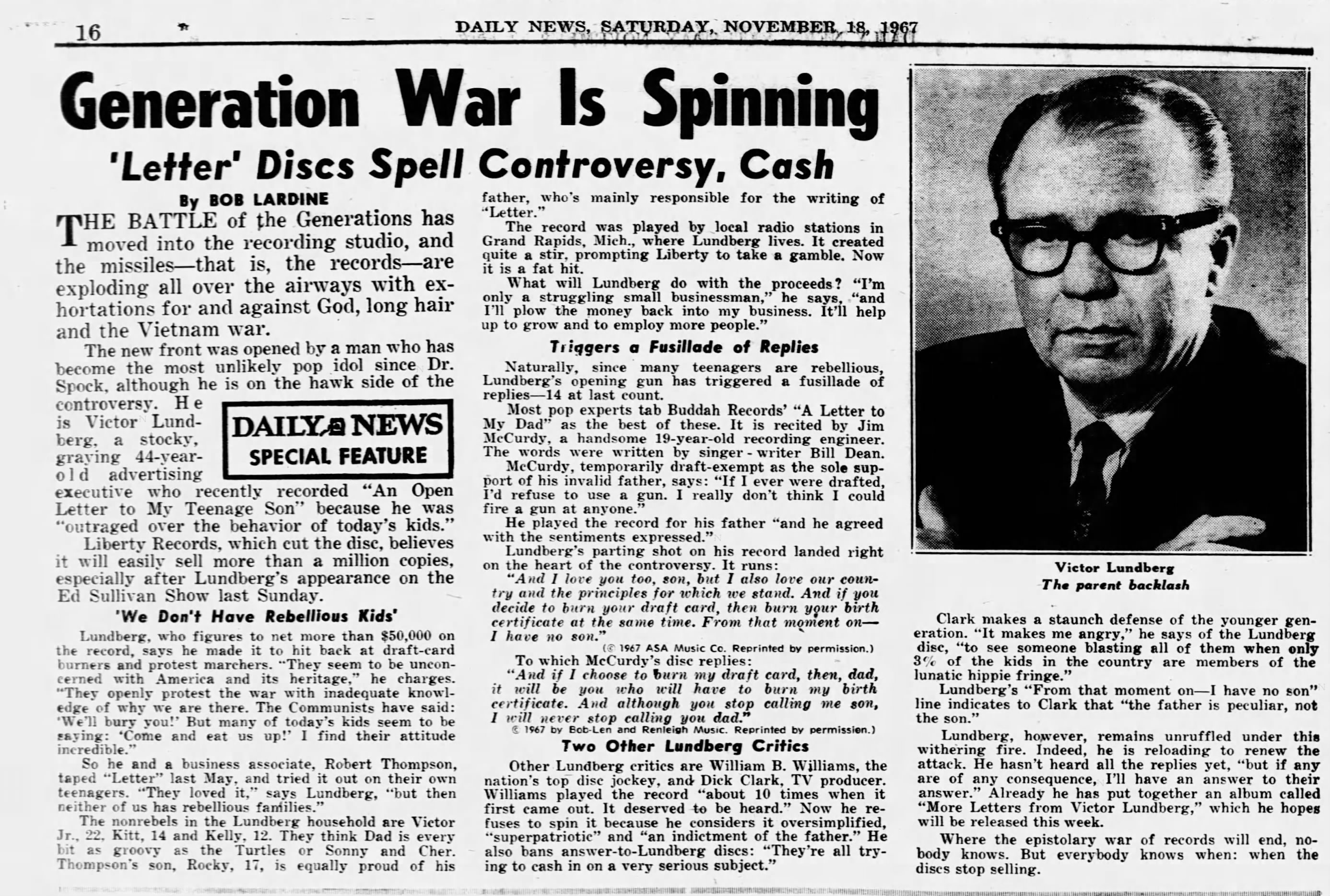
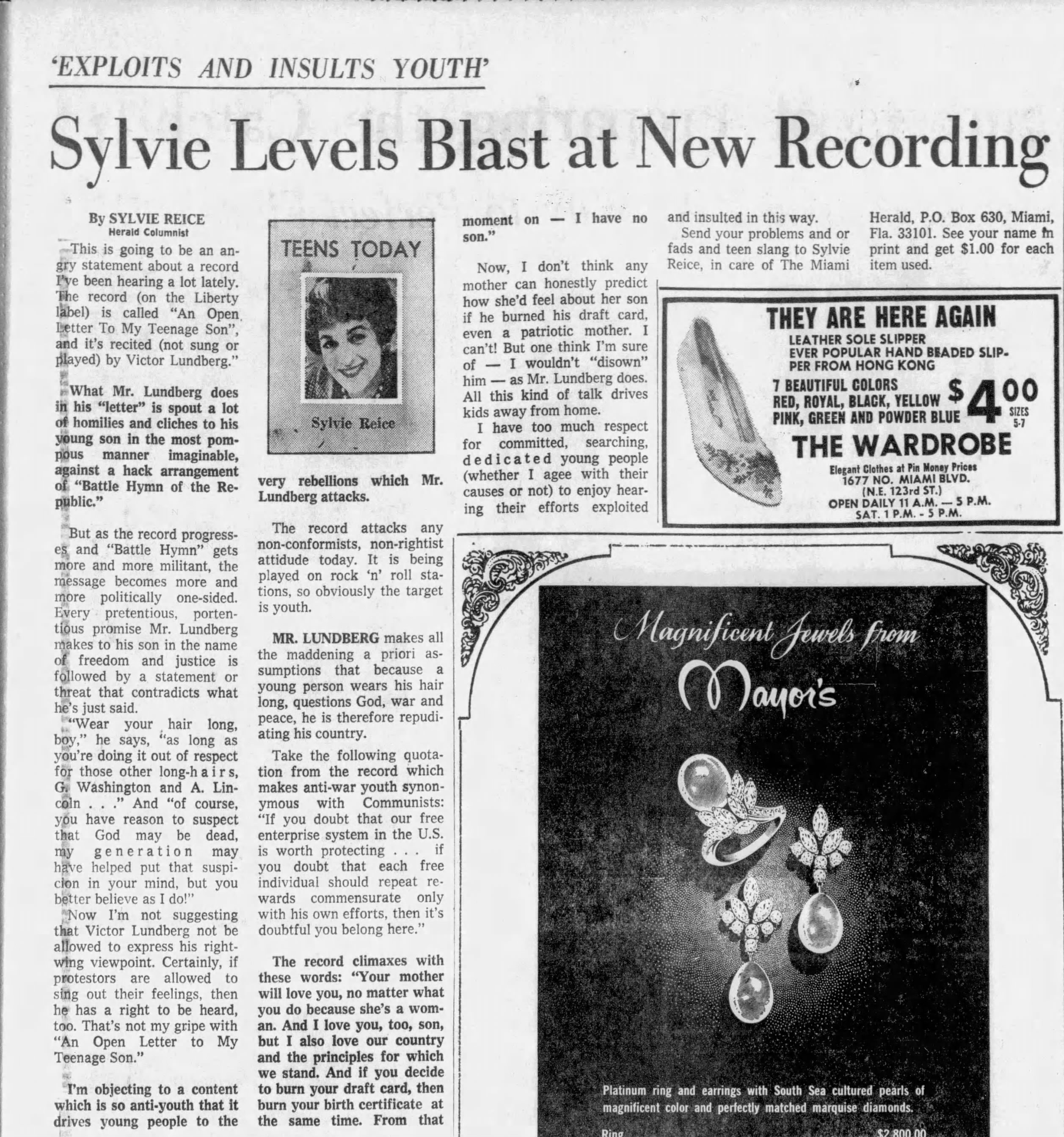
The Daily Record ran a piece on 18 November 1967, which noted that "the battle of the generations has moved into the recording studio".3. It quoted Lundberg saying that he released record because he was "outraged over the behavior of today's kids". The Miami Herald ran one of the strongest critique on 26 November 1967, under the headline: "Exploits and Insults Youth", with Sylvia Reece commenting: "What Mr. Lundberg does in his letter is spout a lot of homilies and cliches to his young son in the most pompous manner imaginable, against a hack arrangement of Battle Hymn of the Republic".4 The record stirred-up 1000+ articles for and against across US regional newspapers and publications in 1967 alone.
Just 13 days later, on 25 November 1967, the first "answer record" appeared - A Letter to Dad by Every Father's Teenage Son. The Lundberg track went on to spawn several other answer records listed below. Note that the Lundberg songs "My Buddy Carl" and "In the Slim of Vietnam" also dealt with the Vietnam issue.
Sources
Annotation by Justin A. Brummer
Notes
Liberty 55996, black label with rainbow band, Liberty Records, Inc., Los Angeles, California; "An Open Letter to My Teenage Son" (Robert R. Thompson), 4:24, Asa Music Co. - ASCAP, LB-2467. Flip side "My Buddy Carl" (Robert R. Thompson), 3:27, Asa Music Co. - ASCAP, LB-2468. Housed in a Liberty company sleeve headed "Do you have these Liberty 'All-Time Hit' singles ... the records with back-to-back hits!", listing catalogue 54500-54524, with "Write for free complete catalog: Dept. 14, Liberty Records, 6920 Sunset Blvd., Los Angeles, Calif. 90028". [From the record sleeve and labels]Lyrics
English
You ask my opinion of draft card burners...
All past wars have been dirty...bloody...
However, most have been necessary...
If you doubt that our free enterprise system in the United States is worth protecting...
Then it is doubtful you belong here...
I love you too, son, but I also love our country...
And if you decide to burn your draft card
Then burn your birth certificate at the same time
From that moment on, I have no son
Themes: Patriotic Draft Card Burning Answer to Open Letter Anti-Protest Religion Counter-Culture & Hippies
Genre: ♪ Narration
#2 Every Father's Teenage Son A Letter to Dad 1967 · Single · A Letter to Dad / Josephine's Song · Buddah # BDA-25 · USA
Annotation
On 11 November 1967 the surprise hit song"An Open Letter to My Teenage Son" (Liberty Records # 55996) entered into the Billboard charts, selling over 1 million records in six weeks. Narrated by Victor Lundberg, a conservative American, the record heavily criticised draft dodgers and the counter-culture. Most memorable of all, Lundberg had told his son that if he burned his draft card, then he might as well burn his birth certificate, because from that moment onwards "I have no son" . Soon afterwards several "answer records" appeared, including the track "A Letter to Dad" (Buddah Records # BDA 25), entering the charts on 25 November 1967 (just 13 days later). Billboard reported that "this teen rebuttal of the Victor Lundberg smash comes off as a well-thought-out answer, performed and arranged in the best of taste. It represents the young idea and should be given equal air time with the original with sales following the same successful pattern".1Written by Bill Dean and Ron Marshall, and narrated by Jim McCurdy, a 19 year old recording engineer, it addressed each point that Lundberg had raised. McCurdy told the Daily Record on 18 November 1967 that he played the record for his dad, and "he agreed with the sentiments expressed".2 However, it did not come even close to matching the sales of Lundberg, as predicted by Billboard (reaching only # 93 in the charts). Moreover, describing it as "the best of taste" may seem inappropriate to those who viewed it as an attempt to cash in on a popular issue, as well as the specially created name of the group, Every Father's Teenage Son - an attempt to represent all those on the anti-war side of the debate. The narrator of the song explained to his father that his love for the country meant that he would not use violence.
Annotation by Justin A. Brummer
Notes
Buddah Records BDA-25 (BUD 5047), multicoloured psychedelic label, "Promotional Copy – Not for Sale"; "A Letter to Dad" (Bill Dean & Ron Marshall), time 2:40, Bob-Len Music B.M.I.; "Produced by Inherit Productions for Kama-Sutra Productions." [From the record sleeve and labels]Lyrics
English
You used the phrase, 'fight for the right' two times in your letter
I pose that this one phrase is to blame for millions of lives and endless pain and suffering
It is not the lack of pride for my country but an abundance of respect for my fellow man which demands that I must promise myself not to use violence, no matter what...
And understanding the dangers of a too hardened patriotism
I choose to burn my draft card, then, Dad, it will be you who will have to burn my birth certificate, and although you stopped calling me son, I'll never stop calling you Dad
Genre: ♪ Narration
#3 Brandon Wade Letter From a Teenage Son 1967 · Single · Letter From a Teenage Son / Letter From a Teenage Son · Philips # 40503 · USA
Annotation
Next up as a response to Lundberg came the song "Letter From a Teenage Son" (Philips # 40503), which on 16 December 1967 bubbled under the Billboard 100, at # 120. The magazine reported on the track on 9 December 1967: "Backed by 21 members of the Chicago Symphony Orchestra playing Ravel's "Pavaanne", here is a cleverly thought out answer to Victor Lundberg's smash. Holds much interest, programming and sales appeal. The narration is well done and the thoughts conveyed add another dimension to the much recorded father-son debate".1 However, this went nowhere commercially, performing worse than the track above. The record sleeve featured a very smartly dressed young man, in shirt and jacket, with short hair (not the hippie character portrayed by Lundberg). The back cover displayed the lyrics of the track. The narrator attacked his father over the birth certificate / draft card issue as lacking in love and acceptance. He then explained that he did not want to burn his draft card, but that he had the right to do so under the freedom of expression principle. The narrator went on to criticise the loss of life in Vietnam: "the awful numbness of death in a distant jungle" . Also of note is the reference to the voting age: "you say that I am free...but you forget, I'm not old enough to vote" , an example of draft inequality.Sources
Annotation by Justin A. Brummer
Notes
Philips 40503 (1-40705), white-label "Promotional Copy – Not for Sale", mono version, "An Empire Production"; "Letter From a Teenage Son" (M. Sweeney), 2:49, Vapac Music Inc. & MRC Music Inc. (BMI); Brandon Wade, orchestra conducted by David Carroll.Picture sleeve front shows a black-and-white portrait of a young man with the title and "narrated by Brandon Wade with an appropriate musical background."
The back prints the full text of the letter, beginning "Dear Dad:" and signed "Your Son": the son rejects his father's idea of love, insists on the right to question the government, says he will not burn his draft card and will go if he must fight, but asks his father not to let "the sound of taps" silence those who ask "why?". Back also prints © 1967 Vapac Music Co. (BMI), M.R.C.
Music Inc. (BMI); "Philips Records/A Division of Mercury Record Productions, Inc. Vendor: Mercury Record Corporation." [From the record sleeve and labels]
Lyrics
English
Dear dad, I want you to know that I love you and mother very much, but after reading your letter, I realised that you and I mean entirely different things when we use the word love. You say God is love, that my mother will love me no matter what but if I should burn my draft card I am no longer your son! How can you even speak of love when you don't even seem to understand that the very first step in giving love is to accept someone as he is not as you would like him to be.
You say that I am free - that I have a voice in the government, but you forget, I'm not old enough to vote, you say you believe in your own rights, as well as the rights of others, yet you refuse to even listen to what I believe is the natural pursuit of my rights, doesn't the real test of a free nation and its democracy lie in the rights of its people to question their government? You say I'm ungrateful to this country, that has given me so much, that I doubt the principles upon which it was founded, that's not true at all, it's just that I doubt some of our new founded principles.
I live to see the day when people no longer think war is necesary, oh, I'll support any country fighting for the right to govern itself, but I'm no willing to lose my life in some far-off country when many of their own young men are unwilling to fight and die for their country. No father, I won't embarrass you or mother by burning my draft card but I reserve the right to express what I feel in my heart. If I have to fight in one of your so-called necessary wars, I'll go, but remember that thousands of American homes will never be the same, because the awful numbness of death in a distant jungle has stilled their laughter forever...don't...deaden the lips of those millions of Americans who believe in their country's right to ask, 'why'?
Genre: ♪ Narration
#4 Marceline An Open Letter to My Dad 1967 · Single · Ion # 1-102 · USA
Annotation
The song "An Open Letter to My Dad" (Ion Records # 1-102), an interesting answer song to Lundberg, narrated from the perspective of the teenage son's sister, which to-date is the only answer record identified that is narrated by a woman. The original press release from the Ion Record Co. announced the song as "an eloquent plea for peace". But following a letter of complaint from a Maine radio station disc jockey, an Ion Records' executive sent a personal apology from the company stating that "this is a very hard letter for me to write as I know we did a great injustice to all right thinking Americans by releasing such a record....We apologize...I am afraid we were unduly influenced by the writer and did not screen this material as we should have...We realize this was a big mistake in releasing such a record and we accept the fact that we can not be criticized too harshly...I very humbly apologize again for this release, but also know we have no excuse except stupidity".The track strongly condemned the war and needless napalming of innocent children, and therefore very much an anti-war song: "we recognise that all adults are... are seeking... to napalm innocent children in the name of democracy" . The narrator criticised her father for not listening and that he should not judge anyone by their hairstyle. The sister then turned to the generation gap, explaining that society had changed from when he grew-up. It displayed Cold War fears, by referencing the atom bomb and advances in space exploration: "identify with a generation that was born after the bomb and weaned on outer space" . The narrator also drew attention to religious hypocrisy with regards to killing, and expressed opposition to violence. And on the draft card burning? The sister argued that her brother did it because he loved mankind. It concluded with the same line as Lundberg - "From this moment on, one less man will shoulder one less gun" . The song also referenced the Civil Rights movement, noting the "murder" of "young Civil Rights workers" , making a connection and tying the anti-war movement to the fight for African-American Civil Rights. Backed by "The Battle Hymn of the Republic", similar to the Lundberg track.
Annotation by Justin A. Brummer
Notes
Ion Records 1-102-A, 45 RPM, pink label, 1592 Crossroads of the World, Hollywood, Calif.; "An Open Letter to My Dad" (Steven R. Wolf), 3:40, Detec Music Pub. Co. (BMI); produced by Ion Productions. [From the record sleeve and labels]Lyrics
English
Dear Dad, you told my brother that you had no son
Perhaps you might have also have told him that you would listen to his point of view
You discuss long hair and beards, isn't the measure of an American more tangible than a single strand of hair?...
I ask you dad, to identify with a generation that was born after the bomb and weaned on outer space
Yes father, some of our values have changed from those that you clung onto in your youth
But remember too that the world in which we live is not the same when you were young
One finger on one button could not destroy the world
And no man saw with his own eyes our lonely planet from the heights of outer space...
Dad, you asked us to judge adults as individuals, and we will
We recognise that all adults are not drunken military imperialist, seeking to murder young Civil Rights workers, or napalm innocent children in the name of democracy
But we also know that we cannot sit silently on the side-lines in the face of such wanted acts of violence
Is god dead?
My brother asked this not because he doubted his own belief
But rather because he questioned the hypocrisy of yours
How is it that you can worship a god who has commanded 'Thou shall not kill', and then condemn your only son for refusing to go off to war...
You ask why it is my brother burned his draft card
And I would answer this, he is not anti-American, simply pro-mankind
Every war for every purpose has already been fought, ideology, religion, politics, territory, love, hate, justice, injustice
And to no avail, is it possible that there might not be a better way?
We are...excitement of an idea whose time has come, peace on earth
My brother loves you dad and I do to, but we also love our fellow man
So do not weep that you have lost a son, rejoice, from this moment on, one less man will shoulder one less gun
Genre: ♪ Narration
#5 Keith Gordon A Teenager's Answer (Vocal) 1967 · Single · A Teenager's Answer (Vocal) / A Teenager's Answer (Instrumental) · Tower # 383 · USA
Annotation
Keith Gordon, in the track "A Teenager's Answer (Vocal)" (Tower Records # 383) took the approach of trying to convince Lundberg of the "flower-power" culture, saying that he wanted to "make love, not war" . He also said that the hip kids are true Americans. Like some of the tracks above, he mentioned the teachings of the bible. Furthermore, the narrator argued that in history rebels had made America great, such as George Washington against the British, and Abraham Lincoln against slavery. Released in Hollywood, California, US, as a promo record, it came with a picture sleeve that had the lyrics printed on it. The b-side featured an instrumental version. Composed by Hal Shrager, Sid Shrager, and Al Chorney. Arranged and conducted by Don Ralke ("A Ditto Production"). Falstaff Music Company Inc., BMI.Annotation by Justin A. Brummer
Notes
Tower 383, white "Promotional — Not for Sale" labels; A-side "A Teenager's Answer (Vocal)" (45-61718), 2:31, and flip "A Teenager's Answer (Instrumental)" (45-61719), 1:40, both written by Hal Shrager, Sid Shrager and Al Chorney, Falstaff Music Company, Inc., BMI; Keith Gordon, "Arranged and Conducted by Don Ralke", "A Ditto Production".The picture sleeve prints the title, artist and Tower 383 logo with the full lyric of a son's reply to his father ("Dad, I don't know where you got the idea I'd burn the American flag..."), defending long hair, flower power and protest ("'Make love, not war' — that's all we want to say...") and closing "A hip kid... can love his country too...". [From the record sleeve and labels]
Lyrics
English
Dad, I don't know where you got the idea I'd burn the American flag...
A hip kid - he loves his country too...
Sure, I believe in flower-power
But, dad, I'm askin' you: can't a flower-child love his country too?
Now, dad, you laughed at "love-ins" the other night
But we're just tryin' to make grown-ups see the light...
"Make love, not war" - that's all we want to say...
Is this so bad?
Doesn't the bible put it that way?
Dad we're not escapin', we're really tryin' to grow...
Why should we sell our souls just to bank a lot of dough?
Not ev'ryone's takin' "trips" dad, only a few, and even those kids love their country too...
Now what made America the great land it is today?
Rebels, dad, who felt they had something important to say...
Rebels like George Washington who set this country free
Rebels like Lincoln who fought against slavery
Now I march and demonstrate for the sake of some ideal...
And why shouldn't I, unless democracy's not real?
Dad, I just hope that somehow I'm gettin' thru to you!
A hip kid...can love his country too
Genre: ♪ Garage Rock
#6 Keith Gordon A Teenager's Answer (Instrumental) 1967 · Single · A Teenager's Answer (Vocal) / A Teenager's Answer (Instrumental) · Tower # 383 · USA
Notes
Instrumental version of "A Teenager's Answer (Vocal)" , the A-side.Notes
Instrumental version of "A Teenager's Answer (Vocal)", the A-side. Tower 383, white "Promotional — Not for Sale" labels; A-side "A Teenager's Answer (Vocal)" (45-61718), 2:31, and flip "A Teenager's Answer (Instrumental)" (45-61719), 1:40, both written by Hal Shrager, Sid Shrager and Al Chorney, Falstaff Music Company, Inc., BMI; Keith Gordon, "Arranged and Conducted by Don Ralke", "A Ditto Production".The picture sleeve prints the title, artist and Tower 383 logo with the full lyric of a son's reply to his father ("Dad, I don't know where you got the idea I'd burn the American flag..."), defending long hair, flower power and protest ("'Make love, not war' — that's all we want to say...") and closing "A hip kid... can love his country too...". [From the record sleeve and labels]
Genres: ♪ RockRock & Roll
#7 Dick Clair Hi, Dad (An Open Letter to Dad) 1967 · Single · Hi, Dad (An Open Letter to Dad) / Tell That Joke · Imperial # 66272 · USA
Annotation
The song "Hi, Dad (An Open Letter to Dad)" (Imperial Records # 66272), by Dick Clair, another very interesting answer record which took a comedy approach, poking fun at Victor Lundberg. Musically, the song is just a jazz piano, with Dick Clair speaking over it. Printed on the single is the date "11 December 1967". The track started with the son (the narrator) driving down the freeway, when all of a sudden he heard his father on the radio, dictating a letter. The narrator wondered why they did not just sit down, man to man. The narrator took a swipe at the money Lundberg would be making from his hit record and he brushed off Lundberg's comments about god. Moreover, he said that "draft card burning isn't my kind of gesture, picketing the Pentagon is more my thing" . Annotation by Justin A. Brummer
Notes
Imperial 66272 (IM-6413), "Audition Record" label, a product of Liberty Records, a Division of Liberty Records, Inc., Los Angeles, California; "Hi, Dad (An Open Letter to Dad)" (Richard Clair, Jenna McMahon, Ed Scott), 2:40, Asa Music Co., ASCAP. The label is date-stamped "DEC 11 1967". [From the record sleeve and labels]Lyrics
English
Hi dad...Chee, it's nice to hear from you, it's been years
I was kind of surprised you didn't send your letter through the mail instead of making a record
But then you always were a character and we've never been too close
There is no reasons for us not to just sit down and have a man to man talk
Hey, it's lucky I caught it, I never listen to the radio, I was driving down the freeway and it just happened to come on
Of course I knew it was you right away, who could mistake your voice...
I've only got a minute, I couldn't afford a group of musicians, but a friend of mine came along with me to play the piano....
It's kind of expensive these recording sessions...
But you always had a sharp eye for business...
Now lets see, the weather is good, that cold snap is finally over, not much else new
Dad I only heard the record once, not sure if I got it all straight, I had to take a turnoff the freeway right in the middle of it there
But I think you said that I can keep my hair long as long as I keep thinking thoughts like Washington and Lincoln
That god is probably alive, and that if I burned my draft card I'm not your son
You seemed a little testy there at the end
I think it is terrific you approve of long hair
I actually cut it dad, I got a crew cut just before I heard from you
Kind of sorry about it now, hadn't thought of that Washington/Lincoln comparison, that's groovy
I don't remember asking you if god is alive, that must of been Joey, sounds more like him
He was always the theologian in the family, but I'm glad to see you've given it a lot of thought
I appreciated hearing your views on that
You mentioned how much you enjoyed a summers day
Glad to see you are getting out of the bank once and a while...
You make a lot of concessions to the younger generation in your letter and I appreciate it dad
I think you got a little dogmatic at the end
But don't worry, draft card burning isn't my kind of gesture
Picketing the Pentagon is more my thing
Gosh I have a million things to say
They're giving me the old signal from the control booth, so guess I'll close
Pardon the diction...
Hope to hear from you soon, I'll keep my radio on
Genre: ♪ Narration
#8 Dick Clark Open Letter to the Older Generation 1967 · Single · Open Letter to the Older Generation / The Fable of Fun Country · Dunhill # D-4112 · USA
Annotation
The track "Open Letter to the Older Generation" (Dunhill Records # D-4112) was narrated by Dick Clark, a well known American television personality. He hosted the famous American Bandstand from 1956-1989, in which teenagers danced to a top 40 hit on television.1 Perhaps this association to teenagers led him to releasing this answer to Lundberg's "An Open Letter to My Teenage Son". It does not express a pro or anti war stance, although is clearly a protest song. It calls on the older generation to show a greater understanding for the youth of America, and to stop knocking them, because they "do their thing quite well" . The narration makes references to teen culture, drugs, the draftboard, and kids fighting in the army. Clark sarcastically notes "riots at the draftboard, blame it on the kids" , while highlighting the importance of free speech in a democracy: "they are not afraid to protest, free speech begs they should" .Sources
Annotation by Justin A. Brummer
Notes
Dunhill D-4112 (45-01156), black label; "Open Letter to the Older Generation" (words by Roy Freeman, music by George Tipton), 3:10, Claridge Music, Inc. (ASCAP); arranged and conducted by George Tipton, producers Frank Slay and Dick Clark. "Dist. by A.B.C.-Paramount Records, Inc.", made in U.S.A. [From the record sleeve and labels]Lyrics
English
The music that you are hearing is the sound of the teens...
What I've learned from my life spent with teens and their songs is when they ask what's right, we just tell them what's wrong
Since there is no common tongue for adults and teens we can't understand what our teenager means
All we do is give thanks that it isn't our child when we read the scare headline
That some kids have gone wild, selling grass in schoolyards...
Riots at the draftboard, blame it on the kids...
Blame the kids for acid, blame the kids for pot...
Blame the kids for hippies and bummer trips...
Now lets just stop for a moment and think about the kids we know
You couldn't really call them bad because it isn't so...
They fall in love, out of love, and into love again...
Our kids all seem to do their thing quite well
So how come we keep hearing that our youth as gone to hell?
Who is so afraid of them that we hear this big lie?...
It is you and I
They scare us with their questions with what they want to know...
They search for their solution...
They are not afraid to protest
Free speech begs they should
When they shout that 'war is bad', and we shout that 'no, it's good' we cry unpatriotic...
And then they go and fight and die and leave blood in foreign pools...
Embrace your sons and daughters now America, be proud
Genre: ♪ Narration
#9 Chris Howard An Open Letter to Dad 1967 · Single · An Open Letter to Dad / Dear Dad · Carole # CAR-1005 · USA
Annotation
Double-sided response record to Victor Lundberg's "An Open Letter to My Teenage Son". First up was the song "An Open Letter to Dad" by Chris Howard (Carole Records #CAR-1005), distributed by the larger, Los Angeles, California-based label GNP Crescendo Records. The narrator focused on religious hypocrisy, recalling going to church and Sunday school, and memorising the 10 commandments with his father, noting: "there wasn't one that said... though shall not kill, unless it's a communist" . The narrator moved on to questioning whether war is necessary: "I don't think if I lived a million years I could prove that mass killing is necessary" . It took an isolationist perspective, arguing that the money spent in Vietnam should be used at home in the US: "spending $35 billion a year in Vietnam while not spending enough here at home" . The song also contained a Civil Rights message: "I'm fighting against the bigotry and prejudice which almost had this country in a Civil War, black against white" . Annotation by Justin A. Brummer
Notes
Carole Records CAR-1005, "A Division of Sidewalk Productions", "Distributed by GNP Crescendo Records". One side: Chris Howard, "An Open Letter to Dad" (Howard, St. Paul) (N-3482), 3:45, Neil Music-Mirby Music (BMI), Blue Flame Music (BMI); other side: Michael Paul, "Dear Dad" (Carpenter) (N-3483), 1:55, Neil Music-Mirby Music (BMI). [From the record sleeve and labels]Lyrics
English
Dear father, thank you for answering my letter. I guess when I wrote I was looking for reassurance for some of the things you taught me as a child, it is getting so easy to forget. I remember the Sundays in church, and the walks afterwards in the park. I remember how secure I felt with my small hand clinging to yours as we talked of what I learned at Sunday skill. I learned the 10 commandments. Remember dad, you helped me memorise them. But there were only 10. There wasn't one that said I shall not covet my neighbours wife unless she's willing, I must not steel, unless you're sure you can get away with it, or though shall not kill, unless it's a communist
But you ask me not to judge your generation by those bigots and prejudice people that have created the bigotry and prejudice in which all of us have to live. I'm not judging them nor your generation. But I'm not going to pretend that the prostitution of the principals this country was founded on exist, it does. I do not accept your new commandments, nor your hypocrisy, nor your prejudice. There is nothing wrong with this country, it's what your generation is making of it. There is nothing wrong with my patriotism or my love for my country. But it's hard to love the majority of Americans if what American has become is what the majority wants.
And then you write that war is horrible and unjust, but through history proved necessary. I don't think if I lived a million years I could prove that mass killing is necessary. I shall fight. You say I must, as an American citizen. Fight for my rights, and fight to preserve a democratic heritage. You see dad, I'm fighting, as the American creed say, for freedom, justice, equality, and humanity, now and for all Americans. I'm fighting against the bigotry and prejudice which almost had this country in a Civil War, black against white. And you want me to support spending $35 billion a year in Vietnam while not spending enough here at home, could destroy us from within, in a Civil War.
Father, I am just one human being, with only the power of one human being, but with all of that strength I shall fight to distinguish myself as an intelligent human being, not man who only sticks to his principals only if they happen to fit what he is doing. I shall fight for this dignity and for my children to come, so that they may grow and live with the 10 commandments as they were written. Father, in closing, I would like to quote two lines from a prayer you taught me. Oh lord, make me an instrument of thou peace. Where there is hatred, let me sow love
Genre: ♪ Narration
#10 Michael Paul Dear Dad 1967 · Single · An Open Letter to Dad / Dear Dad · Carole # CAR-1005 · USA
Annotation
The second song, on the B-side was "Dear Dad" by Michael Paul (Carole Records #CAR-1005) which took an anti-war position - as mentioned above, distributed by GNP Crescendo Records. Similar to Dick Clair's "Hi, Dad (An Open Letter to Dad)", it began with a comedy approach, with the narrator expressing surprise that his father decided to share a letter over the radio. The father in this case, was apparently in charge of "missiles production" , and so part of the war machine. On the issue of draft card burning: "I didn't say anything about burning my draft card" , however, he didn't want "to drop bombs on women and children" . At the end of the song, the narrator declared that he would be joining the Peace Corps: "I hope you won't really burn my birth certificate... I'm going to need it... when I sign-up for the Peace Corps" .Annotation by Justin A. Brummer
Notes
Carole Records CAR-1005, "A Division of Sidewalk Productions", "Distributed by GNP Crescendo Records". One side: Chris Howard, "An Open Letter to Dad" (Howard, St. Paul) (N-3482), 3:45, Neil Music-Mirby Music (BMI), Blue Flame Music (BMI); other side: Michael Paul, "Dear Dad" (Carpenter) (N-3483), 1:55, Neil Music-Mirby Music (BMI). [From the record sleeve and labels]Lyrics
English
Dear dad, it was very good to hear from you again, it's been almost a year now. I was surprised to hear you reading that letter to me over the radio. I know you've been awfully busy dad with all that overtime working at the plant. Oh congratulations on your promotion, my mom says you're now in charge of missiles production. I sure was sorry to hear all the problems with the tax people. But mom says you've got one of the top lawyers in town, so he should be able to get you out of it okay. I know you hate to change Churches, but I guess it would be kind of awkward since their calling the minister to testify about your contributions.
Dad, I didn't mean to turn you off or upset you about my remarks about the war. I'm sure you must of misunderstood part of it, or maybe your secretary read it to you wrong. See I didn't say anything about burning my draft card. I just said that I didn't agree with us being there and would hate to have to drop bombs on women and children. Somehow that's not my idea of America or what it stands for. And I thought that I true patriotic should speak up and exercise his write to freedom of speech and to help shape the future of this country. You knew you wouldn't agree with what I thought, but I was sure you'd defend my right to say it. You've always taught me to stand up for what I believe in, whether other people agree with it or not.
I hope you won't really burn my birth certificate. Because you see, I'm going to need it next weekend, when I sign-up for the Peace Corps. Please write when you have time. By the way, I guess you better send a letter to me directly next time as they don't have many radios overseas. Affectionately, your son
Genre: ♪ Narration
#11 Bob Random An Open Letter to My Father 1967 · Single · An Open Letter to My Father / My Dog · Dagonet # 9 · USA
Annotation
Bob Random song "An Open Letter to My Father" (Dagonet DG-009), which has a teen pop / garage folk feel to it, another response to Lundberg. It started by trying to find common ground between the generations, agreeing with his points on long hair and beards. However, Random soon took a strong jibe at the older generation, accusing them of hypocrisy: "we've seen the difference between what a lot of our parents say and what they do. We can't settle for talking morality and then spend our lives cheating on it" . On the issue of burning draft cards, and then birth certificates, Random points out: "you can't turn me off... I don't believe you can turn people off" . He concluded that "we have to live" in the world "together" , and so there needs to be more respect across the generations. Composed by Steve Kandel and Jerry Berryhill. Annotation by Justin A. Brummer
Notes
Dagonet Records DG-009 (DG-9-A), white label; "An Open Letter to My Father" (Steve Kandel - Jerry Berryhill), 2:55, Asa Music (ASCAP); produced by J. Capehart of Tapp, engineer G. Fernandez, United Audio Recording Studios. [From the record sleeve and labels]Lyrics
English
Dear Dad, I've read your letter, and it's a good letter. But it answers a lot of questions, it doesn't me. Surely the important thing is freedom, and the freedom to be yourself, if that means to be bearded like Lincoln, or as long haired as Andrew Jackson. But it means more. It means that I and my generation want to try to become whatever we can. To learn about living, by living, not by listening.
The music we like, our sports, and friends, ands worries, these make our live. And they're as important to us as your business, your marriage, your friends are to you. We want to become real people dad, sincere people. And we know it isn't easy. Because we've been around. And I mean we've been around you and your generation. We've seen the difference between what a lot of our parents say and what they do. We can't settle for talking morality and then spend our lives cheating on it.
You tell me that god isn't dead, that god is love. Fine. But for most people god happens only on Sunday. And for those people god is dead. My generation is trying to find god inside ourselves, not just for a few hours a week, but for a whole lifetime. So maybe god is dead, just so he can be reborn again for us for now.
You know dad it's funny, when you talk about god, you talk about love and morality, and private belief. And then very suddenly you change when you talk about war. War you say isn't all that private, but war is for god, and it sure isn't love, but you say it's necessary. And that's where we disagree. That's where the big divide happens. I love my country, but I want it to show me a little love to. I owe my country everything that I am, but it owes everything that I'll become. Because what I become is what my country will become. And I want this country to be free enough to let all of us to decide if war is dirty, unfair, immoral, bloody, unnecessary.
Dad, you said if I ever decided to burn my draft card I'll stop being your son. I won't. You can't turn me off. And maybe that's the difference between us. I don't believe you can turn people off. Whatever I do will be because I am your son, and it will make more your son, not less. I'm not trying to attack your world, am just trying to make mine. And in my world, god isn't dead, neither am I, and neither are you. It's getting to be more my world everyday, and we have to live in it together, my father, and your son
Themes: Anti-War Answer to Open Letter
Genre: ♪ Narration
#12 Bobby Sims An Open Letter to My Teenage Son 1967 · Single · An Open Letter to My teenage Son / Keep the Ball Rollin · Hit [Nashville] # 312 · USA
Notes
Hit Records, Record No. 312 (7186), 45 R.P.M., black and silver label; "An Open Letter to My Teenage Son" (Robert R. Thompson), Asa, ASCAP. [From the record sleeve and labels] Themes: Patriotic Draft Card Burning Answer to Open Letter Anti-Protest Religion Counter-Culture & Hippies
Genre: ♪ Traditional Pop
1968
#13 Robert Tamkin A Teenage Son's Open Letter to His Father 1968 · Single · A Teenage Son's Open Letter to His Father / Hey God · Date # 2-1610 · USA
Annotation
The song "A Teenage Son's Open Letter to His Father" (Date # 2-1610) by Robert Tamkin, another response to Lundberg. This one started with the interesting scenario of the teenage boy being locked in prison, as a result of burning his drat card. However, it soon slipped into a father-son relationship story, about how both sides lacked understanding of each otherAnnotation by Justin A. Brummer
Notes
Date 2-1610, 45 RPM, matrix JZSP 137291, "Radio Station Copy", "Suggested Side"; "A Teenage Son's Open Letter to His Father" (Rev. B. Alberts, PhD), 3:45, publisher Parsay Pub. Co. (BMI); Robert Tamkin; "Produced by Rev. Bill Alberts, PhD"; Made in U.S.A. [From the record sleeve and labels]Lyrics
English
Dear dad, the guard bought me a letter today
The guards treat us pretty well in jail here
Once in a while one of them calls us coward and communists for burning our draft cards
I'm frightened dad, I feel so alone, empty inside
When I read your letter, about what you said, if I burned my draft card, I should burn my birth certificate too, because I'd no longer be your son. When I read that dad, I cried and cried. What's happened to us dad. You and I were never close. When I was a boy, it seems you were always away working. And when you were home you were usually too busy to have much to do with me. The only time I remember that you really cared for me was that time I got lost in the woods at the back of house. Remember, I was seven years old, you came looking for me, and you found me sitting under that big pine tree, scared and sobbing. I still remember the look of relief on your face when you saw me. You came up to me and there were tears in your eyes. You picked me and held me tight against you and took me home. I feel lost now dad.
What's happened to us? We just haven't been able to talk to each pother. The older I got, the more you and I ended up arguing when we did try to talk. I always felt that you wanted me to do things your way. But you never understand me, what I wanted. Whenever we disagreed about anything, you would always tell me I know more about these things than you do, and you usually did. But it was the way you would cut me off with these words rather than trying to understand me. I'm not just blaming you dad. Maybe I haven't understood you. Maybe I've taken you for granted. After a while I started to resent you when you were home. I saw you as someone to get favours from, not to do anything for. You always seem so sure of yourself. As if nothing bothered you, maybe you had concerns and problems of your own. But how would I know. I never asked you.
You say that mom loves me no matter what I do because she is a woman. That's just it dad. I need you to love me if I'm going to be a man. I've counted on mom too much in the past. I need to count on you. You said that god is not dead that god is love. I don't know that much about god, I cant see him. But I can see you. How can I feel that he is alive and loves me if you don't love your son anymore. I'm frightened dad, I'm feel so lonely. I burnt my draft card and I'm in jail. I need you now more than I ever have before
Genre: ♪ Narration
Unknown date
#14 Griffen's Paraders An Open Letter To My Teenage Son Album · Music of our American Heritage · Diplomat # DS 2438 · USA
Annotation
A cover of Victor Lundberg's An Open Letter to My Teenage Son - word for word.Annotation by Justin A. Brummer
Themes: Patriotic Draft Card Burning Answer to Open Letter Anti-Protest Religion Counter-Culture & Hippies
Genre: ♪ Narration
Lyric theme data
Lyric content themes tagged on the songs in this collection — parent themes with their sub-themes (number of records). Click a theme for its definition and all records carrying it.
Show all 7 themes ▾Key stats
14 songs · 13 releases · 13 artists · 12 labels · 1967–1968
Time period
- 1967 is the peak year, with twelve songs.
- One record is undated.
Artists
- 13 artists for 14 songs — almost every act appears exactly once. The most represented is Keith Gordon, with two.
- Eight of the artists are still unidentified beyond the record: no line-up, no biography.
Songwriters
- Songwriter gender is recorded for 9 of the 14 songs: eight by men and one by mixed teams.
- By performer: 13 men and one women (recorded for 14).
- 20 named songwriters. The most often credited are Hal Shrager and Robert R. Thompson and Sid Shrager, with two each.
Labels
- 10 of the 12 labels appear exactly once.
- Eight sit on a major or well-known imprint — Tower, Buddah, Date, Dunhill, Imperial, Liberty, Philips. The other 6 are on independent, regional or private labels.
- One 45 puts both of its sides into this list.
Locations
- All 14 are American. California leads with two, then Illinois one.
Themes
- By perspective: eleven peace, protest and anti-war; three patriotic, pro-government or anti-protest.
- 9 distinct sub-themes across 14 songs.
- Anti-Protest is the single biggest subject — 3 songs, one in five.
- Next come Counter-Culture & Hippies (3), Draft Card Burning (3), Patriotic (3) and Religion (3).
- 14 are answer records to “Open Letter”.