I Should Be Proud
1970 · Gordy 7098 · USA
- Artist
- Martha Reeves & the Vandellas
- Title
- I Should Be Proud
- Release
- I Should Be Proud / Love, Guess Who
- Year
- 1970
- Label
- Gordy # 7098
- Format
- 7" · Single
- Language
- English
- Country
- USA
- Songwriter
- Cosby, Hinton, Sawyer
- Genre
- Soul, Gospel & Funk · Soul
- Primary theme
- Peace, Protest & Anti-War
Annotation
The song "I Should Be Proud" (Gordy Records # 7098), written by Henry Cosby, Pam Sawyer and Joe Hinton and recorded by Motown girl group Martha and the Vandellas, is well known as one of the first anti-war songs released by the Motown label - just months before Edwin Starr's "War". Although it must be noted that Motown had released several other political songs related to the Vietnam War prior to this - such as The Valadiers' Greetings (This Is Uncle Sam) in 1961, later covered by the The Monitors on the Motown sub-label V.I.P. Records in 1966. And, of course, Motown released the Martin Luther King Jr. speech Why I Oppose the War in Vietnam in 1970 on their sub-label Black Forum Records. Billboard predicted on 28 February 1970 that the song would reach the top 60 of the Billboard Hot 100. The magazine described the song as a "blockbuster rocker with a compelling lyric line that will put her back on the charts in short order - pop and soul. Wild vocal workout". In the end it only reached # 80 (and # 45 on the R&B chart).1 "I Should Be Proud" featured on the 1970 album Natural Resources (Gordy # HS-1747-2). Martha Reeves took on the song because she lost her brother in Vietnam. She had previously recorded the song Forget Me Not in 1968 about the war, but that dealt with the plight of the soldier, neither pro or anti. So the narrator of this track received a telegram, informing her that "Private John C. Miller was shot down in Vietnam" and was "missing in action somewhere on the Delta line". Eventually she discovers that he has been killed - noting the number of deaths in Vietnam: "Private Johnny was killed in action, number 54327". The narrator then said that she could not be proud of his medals. He "wasn't fighting for me", she cried, but for "the evils of society". While not explicitly anti-war, the song sought to challenge the idea of the soldier dying for his / her country for an important cause, and thus becoming a hero. Instead, the narrator turned her anger on the government / army for sending the soldier to war in the first place when he could have been at home.Sources1Billboard, 28 February 1970↩
Annotation by Justin A. Brummer
Annotation — Soul, Gospel, & Funk Songs
The song "I Should Be Proud" (Gordy Records # 7098), written by Henry Cosby, Pam Sawyer and Joe Hinton and recorded by Motown girl group Martha and the Vandellas, is well known as one of the first anti-war songs released by the Motown label - just months before Edwin Starr's "War". Although it must be noted that Motown had released several other political songs related to the Vietnam War prior to this - such as The Valadiers' Greetings (This Is Uncle Sam) in 1961, later covered by the The Monitors on the Motown sub-label V.I.P. Records in 1966. And, of course, Motown released the Martin Luther King Jr. speech Why I Oppose the War in Vietnam in 1970 on their sub-label Black Forum Records. Billboard predicted on 28 February 1970 that the song would reach the top 60 of the Billboard Hot 100. The magazine described the song as a "blockbuster rocker with a compelling lyric line that will put her back on the charts in short order - pop and soul. Wild vocal workout". In the end it only reached # 80 (and # 45 on the R&B chart).1 "I Should Be Proud" featured on the 1970 album Natural Resources (Gordy # HS-1747-2). Martha Reeves took on the song because she lost her brother in Vietnam. She had previously recorded the song Forget Me Not in 1968 about the war, but that dealt with the plight of the soldier, neither pro or anti. So the narrator of this track received a telegram, informing her that "Private John C. Miller was shot down in Vietnam" and was "missing in action somewhere on the Delta line". Eventually she discovers that he has been killed - noting the number of deaths in Vietnam: "Private Johnny was killed in action, number 54327". The narrator then said that she could not be proud of his medals. He "wasn't fighting for me", she cried, but for "the evils of society". While not explicitly anti-war, the song sought to challenge the idea of the soldier dying for his / her country for an important cause, and thus becoming a hero. Instead, the narrator turned her anger on the government / army for sending the soldier to war in the first place when he could have been at home. Sources1Billboard, 28 February 1970↩
Annotation by Justin A. Brummer
Lyrics
English: I was under the dryer when the telegram came / 'Private John C. Miller was shot down in Vietnam' / Through my tears I read: 'No more information at this time / He's missin' in action somewhere on the Delta Line' / And they say that I should be proud / He was fightin' for me / They say that I should be proud / Those too blind to see / But he wasn't fightin' for me / My Johnny didn't have to fight for me / He was fightin' for the evils of society / Now I prayed night & day that my Johnny wouldn't die / Love, faith & hope was all that kept me alive / Then 6 weeks later came that cold & heartless letter / 'Private Johnny was killed in action, number 54327' / They shipped him home with medals of honor & glory / Even our local paper ran a front-page story / But the whole time gave him praisin' & said how honored I should be / But I don't want no superstar, just the...man they took from me
Notes
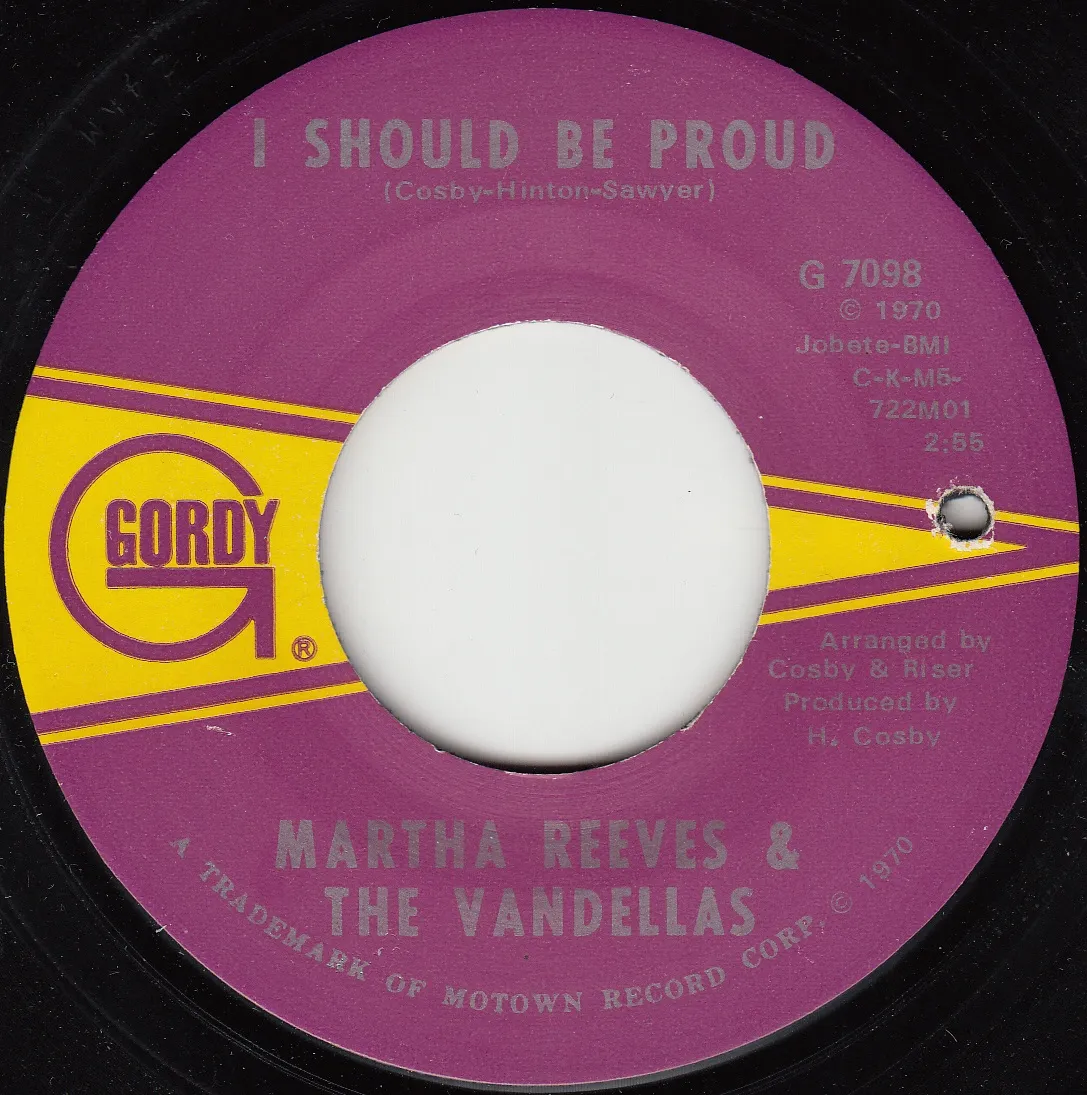
Gordy G 7098, purple-and-yellow label, © 1970, Jobete–BMI, matrix C-K-M5-722M01, 2:55; "I Should Be Proud" (Cosby–Hinton–Sawyer), arranged by Cosby & Riser, produced by H. Cosby. "A trademark of Motown Record Corp. © 1970." [From the record sleeve and labels]
About the artist
American Motown vocal group formed 1957 in Detroit, Michigan ('I Should Be Proud'). [Source: Wikipedia]
Themes
Anti-War · Purple Heart · Medals · M.I.A.
In collections
P.O.W. / M.I.A. Songs · Peace, Protest, & Anti-War Songs [War Years] · Soul, Gospel, & Funk Songs