Waist Deep in the Big Muddy
1967 · Columbia 4-44273 · New York City, New York
- Artist
- Pete Seeger
- Title
- Waist Deep in the Big Muddy
- Release
- Waist Deep in the Big Muddy / Down By the Riverside
- Year
- 1967
- Label
- Columbia # 4-44273
- Format
- 7" · Single
- Language
- English
- Country
- New York City, New York, USA
- Songwriter
- P. Seeger
- Genre
- Folk · Contemporary Folk
- Primary theme
- Peace, Protest & Anti-War
Annotation
The song "Waist Deep in the Big Muddy" (Columbia Records # 4-44273) was about a platoon crossing a Louisiana river in 1942, which dangerously got deeper and deeper until the captain drowned. Only then did the platoon turn around. This song was symbolic of the Vietnam War and Lyndon Johnson's escalation, especially suggested in the final, sixth stanza, which made a contemporary note, calling the president a "big fool". The song, initially published in Broadside # 74 in September 1966, was released on the 1967 album Waist Deep in the Big Muddy and Other Love Songs (Columbia Records # CS 9505). The Columbia Broadcasting System (CBS) famously censored the taping of the song for the television program The Smothers Brothers Comedy Hour, 12 September 1967, as explained by Seeger at his Ford Hall Forum concert (Boston) on 12 November 1967 - recorded on the album Sings and Answers Questions (Broadside Records # BRS 502), track # 3.1 Seeger had been blacklisted from commercial broadcasting for 17 years, since 1950, before being asked to perform on the show.2 The New York Times followed the story and it featured prominently on its pages, encouraging CBS to allow Seeger to perform the song, in full, in 1968.34 Billboard also took an active interest in the story at the time.5Sources1peteseeger.net (archived copy)↩2Broadside, 12 November 1967↩3The New York Times, 12 November 1967↩4The New York Times, 12 November 1967↩5Billboard↩
Annotation by Justin A. Brummer
Annotation — Civil Rights Songs
His body of songs referencing the Vietnam War is significant in both themes and volume [currently 20 identified]: "The Willing Conscript" (1963) "Beans in My Ear" (1966), "The Draft Dodger Rag" (1966), "Waist Deep in the Big Muddy" (1967), "Down By the Riverside" (1967), "Backlash Blues" (1968), "Talking Ben Tre" (1968), "The Torn Flag" (1968), "Anti-Vietnam Songs / Waist Deep in the Big Muddy / Arts in a Changing Society / Violence and Protest" (1968), "Bring Them Home" (1968), "Ballad of the Fort Hood Three" (1969), "I Feel Like I'm Fixin' to Die Rag" (1970), "Last Train to Nuremberg" (1971), "Uncle Ho" (1971), and "Our Generation" (1971). The song "Waist Deep in the Big Muddy" (Columbia Records # 4-44273) was about a platoon crossing a Louisiana river in 1942, which dangerously got deeper and deeper until the captain drowned. Only then did the platoon turn around. This song was symbolic of the Vietnam War and Lyndon Johnson's escalation, especially suggested in the final, sixth stanza, which made a contemporary note, calling the president a "big fool". The song, initially published in Broadside # 74 in September 1966, was released on the 1967 album Waist Deep in the Big Muddy and Other Love Songs (Columbia Records # CS 9505). A-side, "Down By the Riverside", was often used as an anti-war, and Civil Rights songs during the 1960s period.1Sources1A Pete Seeger Discography: Seventy Years of Recordings (David King Dunaway, 2010)↩
Annotation by Justin A. Brummer
Annotation — Pete Seeger Songs
The song "Waist Deep in the Big Muddy" (Columbia Records # 4-44273) was about a platoon crossing a Louisiana river in 1942, which dangerously got deeper and deeper until the captain drowned. Only then did the platoon turn around. This song was symbolic of the Vietnam War and Lyndon Johnson's escalation, especially suggested in the final, sixth stanza, which made a contemporary note, calling the president a "big fool". The song, initially published in Broadside # 74 in September 1966, was released on the 1967 album Waist Deep in the Big Muddy and Other Love Songs (Columbia Records # CS 9505). The Columbia Broadcasting System (CBS) famously censored the taping of the song for the television program The Smothers Brothers Comedy Hour, 12 September 1967, as explained by Seeger at his Ford Hall Forum concert (Boston) on 12 November 1967 - recorded on the album Sings and Answers Questions (Broadside Records # BRS 502), track # 3.2 Seeger had been blacklisted from commercial broadcasting for 17 years, since 1950, before being asked to perform on the show.3 The New York Times followed the story and it featured prominently on its pages, encouraging CBS to allow Seeger to perform the song, in full, in 1968.45 Billboard also took an active interest in the story at the time.6Sources2peteseeger.net (archived copy)↩3Broadside, 12 November 1967↩4The New York Times, 12 November 1967↩5The New York Times, 12 November 1967↩6Billboard↩
Annotation by Justin A. Brummer
Lyrics
English: Maybe you're still walking, you're still talking / You'd like to keep your health / But every time I read the papers that old feeling comes on / We're - waist deep in the Big Muddy / And the big fool says to push on I'm gonna lay down my sword and shield / Down by the riverside... / I ain't gonna study war no more / Ain't gonna study war no more.. / I'm gonna walk with that Prince of Peace / Down by the riverside... / I'm gonna lay down that atom bomb / Down by the riverside... / I ain't gonna study war no more / Ain't gonna study war no more
Notes
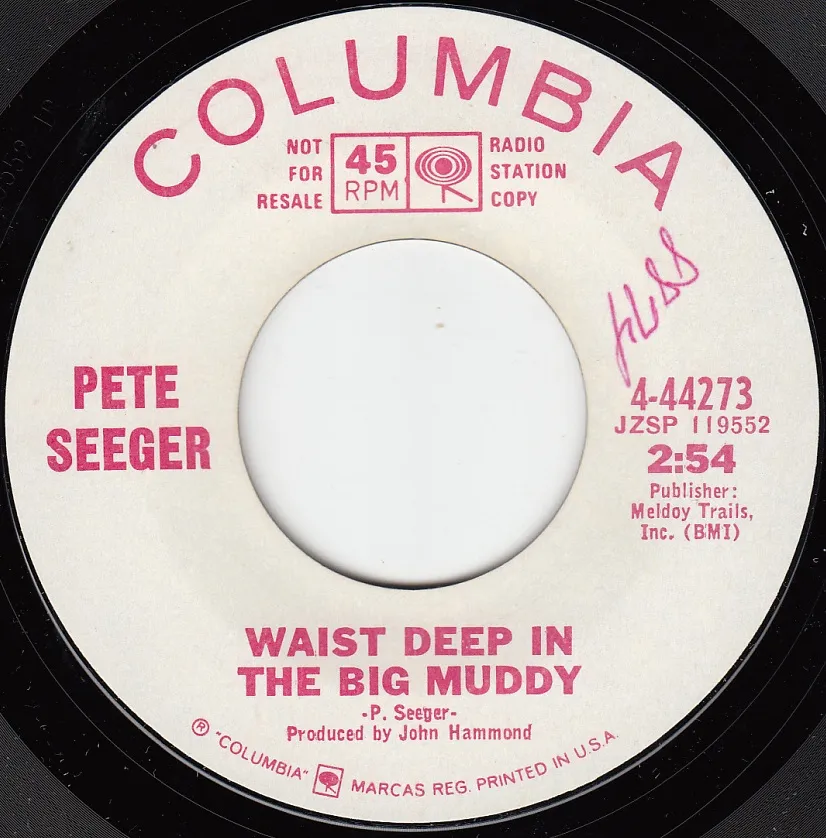
Columbia 4-44273, white "Not for Resale — Radio Station Copy" pressing; "Waist Deep in the Big Muddy" (P. Seeger), 2:54, matrix JZSP 119552, publisher "Meldoy Trails, Inc. (BMI)", backed with "Down by the Riverside", 3:13, matrix JZSP 119551, publisher: Public Domain; both produced by John Hammond. [From the record sleeve and labels]
About the artist
Iconic American contemporary folk singer, Pete Seeger (born 3 May 1919 in Manhattan, New York, USA, died on 27 January 2014, same location) played a key role in the 1950s contemporary folk revival and the 1960s anti-war and Civil Rights movement. He often wrote political songs, protesting against war, segregation, and calling for environmental protection. His body of songs referencing the Vietnam War is significant in both themes and volume: "The Willing Conscript" on the album Broadside Ballads Volume 2 (1963); "Beans in My Ear", "King Henry", and "The Draft Dodger Rag" on Dangerous Songs!?…
Themes
In collections
Civil Rights Songs · Peace, Protest, & Anti-War Songs [War Years] · Pete Seeger Songs