Spring Conscience
1972 · Paredon P-1015 · New York City, New York
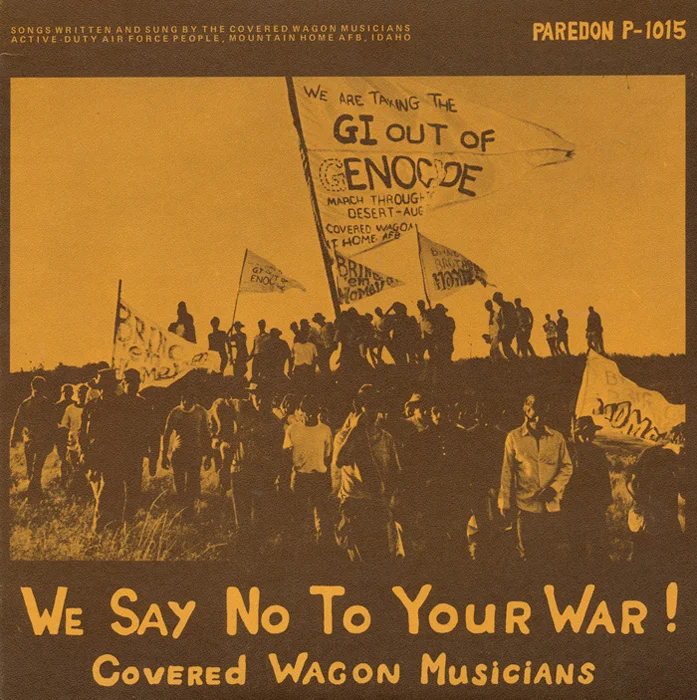
- Artist
- The Covered Wagon Musicians
- Title
- Spring Conscience
- Release
- We Say No to Your War!
- Year
- 1972
- Label
- Paredon # P-1015
- Format
- LP · Album
- Language
- English
- Country
- New York City, New York, USA
- Songwriter
- Jim Schaffer
- Genre
- Country · Contemporary Folk
- Primary theme
- Peace, Protest & Anti-War
Annotation — US Military & Veteran Songs
Another GI movement anti-war record (Paredon Records # P-1015), released on the label founded by Barbara Dane and Irwin Silber - all the songs were written and sung by active-duty GIs at the Mountain Home Air Force Base, Idaho. The group, formed in the spring of 1971, started their own publication called "Helping Hand".1 The most memorable and startling track is "Napalm Sticks to Kids", a vivid account of US forces indiscriminately dropping bombs on Vietnam, hitting pregnant women, children, and other civilians. The focus of the song is chemical weapon Napalm B - a jellied gasoline mixture, with polystyrene, benzene, and gasoline. Declared a war-crime since 1980, the US government extensively used this weapon during the Vietnam conflict, dropping 388,000 tons on Indochina between 1963 and 1973. The record booklet credited the song to "Air Force and Army GIs attached to the 1st Air Cavalry in Vietnam. Recited by Sgt. John Boychuk....a group of GIs sat down one night in a hootch in Vietnam to write these words. Each person made a verse about an incident in which he had taken part and the poem expresses their collective bitterness toward the military that had turned them into murderers". Some have questioned the booklet's claim regarding the origins of this song - in terms of who wrote it and the nature in which it was composed. Several Vietnam veterans have claimed that this song was commonly heard 'in-Country', and used in a "humorous" way. However, this particular record and version of the song were used to present an anti-war perspective about the war in Vietnam, and express opposition to the use of napalm, as seen on the LP cover and in the booklet that came with the record. The song made a special reference to the company Dow Chemical, which produced napalm and agent orange under a 1965 government contract. Several other suppliers stopped production of these weapons because of protests and bad publicity. But Dow Chemical continued as the sole provider of napalm and agent orange because of its commitment to the government.Sources1Covered Wagon Muscians - PAR01015↩
Annotation by Justin A. Brummer
Lyrics
English: Then we're overseas And we learned how to kill It's not a thing you know When you're small
Notes
Paredon P-1015; the front cover reads "Songs written and sung by the Covered Wagon Musicians, active-duty Air Force people, Mountain Home AFB, Idaho" over a photograph of marchers in the desert carrying banners reading "We are taking the GI out of genocide" and "Bring 'em home" (the booklet states the cover photo was taken during the forty-mile march from Mountain Home AFB to Boise in August 1971, on the anniversary of Hiroshima and Nagasaki). The 16-page booklet lists the members alphabetically (A1C John Carson, A1C Dave Davis, Sgt. Tom Derreck, Sgt. Patrick Henry, A1C George Herkert, A1C Al Kramer, A1C Joe Massaro, Carolyn Mugar, Vic Pacania, Airman Penny Rand, A1C Jim Schaffer, A1C Tom Spaulding) and opens with an introduction calling it the first GI anti-war project to produce its own record, urging listeners to write to the group and subscribe to its paper, The Helping Hand, Box…
About the artist
Group of active-duty US Air Force GIs based at Mountain Home AFB, Idaho (1971-72); recorded the antiwar album We Say No to Your War! (Paredon Records, 1972). [Source: Wikipedia / Discogs]
Themes
From the release We Say No to Your War!
In collections
Peace, Protest, & Anti-War Songs [War Years] · US Military & Veteran Songs