Ohio
1970 · Atlantic 45-2740 · New York City, New York
- Artist
- Crosby, Stills, Nash & Young
- Title
- Ohio
- Release
- Ohio / Find the Cost of Freedom
- Year
- 1970
- Label
- Atlantic # 45-2740
- Format
- 7" · Single
- Language
- English
- Country
- New York City, New York, USA
- Songwriter
- Neil Young
- Genre
- Singer Songwriter · Americana
- Primary theme
- Peace, Protest & Anti-War
Annotation
Neil Young wrote the protest song "Ohio" (Atlantic # 2740), performed by Crosby, Stills, Nash and Young - a super-group, formed in 1969 in Bethel, New York, USA, featuring David Crosby (vocals, guitar), Stephen Stills (vocals, guitar, keyboards, bass), Graham Nash (vocals, guitar, keyboards), and Neil Young (vocals, guitar, keyboards, harmonica). The narrator lamented and warned that soldiers and Richard Nixon were coming and "cutting us down". The line "what if you knew her and found her dead on the ground" brought to mind the John Filo photograph of Mary Ann Vecchio standing over the body of Jeffrey Miller after he was shot dead by the National Guard.1 In fact, Young wrote the song immediately after seeing the photo in a magazine. David Crosby said that he handed Young the magazine, who "looked at it, got out his guitar and wrote the song right there in front of me. On the porch in the sunlight. I called Nash - book the studio, now".2 The most popular of the songs dealing with the Kent State demonstration, the label rush released the single in early June 1970, having been recorded on 21 May 1970 at Record Plant Studio 3 in Hollywood (according to the linear notes of 2004's Greatest Hits). It has largely been considered the first record released about Kent State - but it's possible that Third Condition's Monday in May (The Kent State Tragedy) was released before or around the same time - discussed above. The single was reviewed as early as 20 June 1970 in Billboard, on p.54, described as rushed out with a "timely message" - that's 10 days after the Third Condition record.3 It peaked at # 14 in the Billboard Hot 100 (chart of 1 August 1970), was still at # 17 on 8 August, and was frequently played at anti-war rallies in the 1970s.4 Electric live versions featured on 4 Way Street and Journey Through the Past. Young recorded a solo acoustic version on Live at Massey Hall 1971. The B-Side "Find the Cost of Freedom", by Stephen Stills, has also been interpreted as an anti-Vietnam song.Sources1John Filo - Kent State↩2Shakey: Neil Young's Biography (Jimmy McDonough, 2013)↩3Billboard 1970-06-20↩4Billboard Hot 100, 8 August 1970 (p. 54)↩
Annotation by Justin A. Brummer
Annotation — Kent / Jackson State Songs
Neil Young wrote the protest song "Ohio" (Atlantic # 2740), performed by Crosby, Stills, Nash and Young - a super-group, formed in 1969 in Bethel, New York, USA, featuring David Crosby (vocals, guitar), Stephen Stills (vocals, guitar, keyboards, bass), Graham Nash (vocals, guitar, keyboards), and Neil Young (vocals, guitar, keyboards, harmonica). The narrator lamented and warned that soldiers and Richard Nixon were coming and "cutting us down". The line "what if you knew her and found her dead on the ground" brought to mind the John Filo photograph of Mary Ann Vecchio standing over the body of Jeffrey Miller after he was shot dead by the National Guard.1 In fact, Young wrote the song immediately after seeing the photo in a magazine. David Crosby said that he handed Young the magazine, who "looked at it, got out his guitar and wrote the song right there in front of me. On the porch in the sunlight. I called Nash - book the studio, now".2 The most popular of the songs dealing with the Kent State demonstration, the label rush released the single in early June 1970, having been recorded on 21 May 1970 at Record Plant Studio 3 in Hollywood (according to the linear notes of 2004's Greatest Hits). It has largely been considered the first record released about Kent State - but it's possible that Third Condition's Monday in May (The Kent State Tragedy) was released before or around the same time - discussed above. The single was reviewed as early as 20 June 1970 in Billboard, on p.54, described as rushed out with a "timely message" - that's 10 days after the Third Condition record.3 It peaked at # 14 in the Billboard Hot 100 (chart of 1 August 1970), was still at # 17 on 8 August, and was frequently played at anti-war rallies in the 1970s.4 Electric live versions featured on 4 Way Street and Journey Through the Past. Young recorded a solo acoustic version on Live at Massey Hall 1971. The B-Side "Find the Cost of Freedom", by Stephen Stills, has also been interpreted as an anti-Vietnam song.Maxima - Four Dead in Ohio (1970) Coast - Why (A Peace Medley) (1970) Isley Brothers - Ohio / Machine Gun (1970) Jaramago - Ohio (1970) C. D. K. & Company - Ohio (197?) Toxic Reasons - Ohio (1988) Dink - Ohio (1996) Dala - Ohio (2008) Darcie Miner - Ohio (2008)Sources1John Filo - Kent State↩2Shakey: Neil Young's Biography (Jimmy McDonough, 2013)↩3Billboard 1970-06-20↩4Billboard Hot 100, 8 August 1970 (p. 54)↩
Annotation by Justin A. Brummer
Annotation — Peace, Protest, & Anti-War Songs
Neil Young wrote the protest song "Ohio" (Atlantic # 2740), performed by Crosby, Stills, Nash and Young - a super-group, formed in 1969 in Bethel, New York, USA, featuring David Crosby (vocals, guitar), Stephen Stills (vocals, guitar, keyboards, bass), Graham Nash (vocals, guitar, keyboards), and Neil Young (vocals, guitar, keyboards, harmonica). The narrator lamented and warned that soldiers and Richard Nixon were coming and "cutting us down". The line "what if you knew her and found her dead on the ground" brought to mind the John Filo photograph of Mary Ann Vecchio standing over the body of Jeffrey Miller after he was shot dead by the National Guard.1 In fact, Young wrote the song immediately after seeing the photo in a magazine. David Crosby said that he handed Young the magazine, who "looked at it, got out his guitar and wrote the song right there in front of me. On the porch in the sunlight. I called Nash - book the studio, now".2 The most popular of the songs dealing with the Kent State demonstration, the label rush released the single in early June 1970, having been recorded on 21 May 1970 at Record Plant Studio 3 in Hollywood (according to the linear notes of 2004's Greatest Hits). It has largely been considered the first record released about Kent State - but it's possible that Third Condition's Monday in May (The Kent State Tragedy) was released before or around the same time - discussed above. The single was reviewed as early as 20 June 1970 in Billboard, on p.54, described as rushed out with a "timely message" - that's 10 days after the Third Condition record.3 It peaked at # 14 in the Billboard Hot 100 (chart of 1 August 1970), was still at # 17 on 8 August, and was frequently played at anti-war rallies in the 1970s.4 Electric live versions featured on 4 Way Street and Journey Through the Past. Young recorded a solo acoustic version on Live at Massey Hall 1971. The B-Side "Find the Cost of Freedom", by Stephen Stills, has also been interpreted as an anti-Vietnam song.Select covers: Maxima - Four Dead in Ohio (1970) Coast - Why (A Peace Medley) (1970) Isley Brothers - Ohio / Machine Gun (1970) Jaramago - Ohio (1970) C. D. K. & Company - Ohio (197?) Toxic Reasons - Ohio (1988) Dink - Ohio (1996) Dala - Ohio (2008) Darcie Miner - Ohio (2008) Sources1John Filo - Kent State↩2Shakey: Neil Young's Biography (Jimmy McDonough, 2013)↩3Billboard 1970-06-20↩4Billboard Hot 100, 8 August 1970 (p. 54)↩
Annotation by Justin A. Brummer
Lyrics
English: Tin soldiers and Nixon coming, we're finally on our own / This summer I hear the drumming, four dead in Ohio / Gotta get down to it, soldiers are cutting us down / Should have been done long ago / What if you knew her and found her dead on the ground / How can you run when you know? / Gotta get down to it, soldiers are cutting us down / Should have been done long ago / What if you knew her and found her dead on the ground / How can you run when you know? / Tin soldiers and Nixon coming / We're finally on our own / This summer I hear the drumming, four dead in Ohio.. / How many more? Tin soldiers and Nixon coming, we're finally on our own / This summer I hear the drumming, four dead in Ohio / Gotta get down to it, soldiers are cutting us down / Should have been done long ago / What if you knew her and found her dead on the ground / How can you run when you know? / Gotta get down to it, soldiers are cutting us down / Should have been done long ago / What if you knew her and found her dead on the ground / How can you run when you know? / Tin soldiers and Nixon coming / We're finally on our own / This summer I hear the drumming, four dead in Ohio.. / How many more?" Select covers: Maxima - Four Dead in Ohio (1970) Coast - Why (A Peace Medley) (1970) Isley Brothers - Ohio / Machine Gun (1970) Jaramago - Ohio (1970) C. D. K. & Company - Ohio (197?) Toxic Reasons - Ohio (1988) Dink - Ohio (1996) Dala - Ohio (2008) Darcie Miner - Ohio (2008) Select covers: Maxima - Four…
Notes
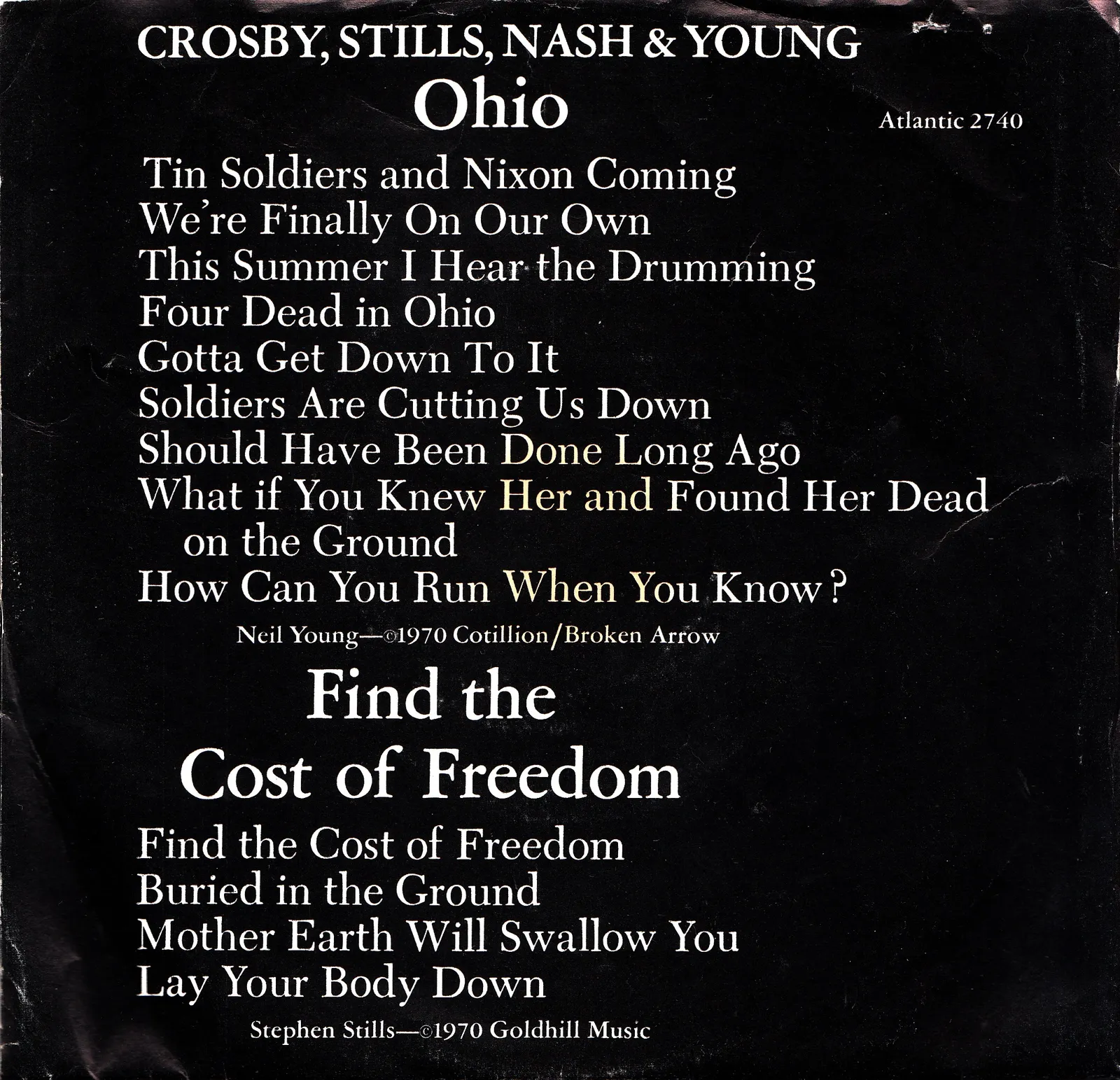
Atlantic 45-2740 (A-19330-PL), 45 rpm, vocal, "Mfg. by Atlantic Recording Corp., 1841 Broadway, New York, N.Y."; "Ohio" (Neil Young), 3:00, Cotillion/Broken Arrow (BMI); produced by Crosby, Stills, Nash & Young. The black picture sleeve prints the full lyrics of "Ohio" ("Neil Young – ©1970 Cotillion/Broken Arrow") and of the flip "Find the Cost of Freedom" ("Stephen Stills – ©1970 Goldhill Music"); the other side of the sleeve prints the preamble to the Bill of Rights and Article I (freedom of religion, speech and press, and the right of the people peaceably to assemble). [From the record sleeve and labels]
About the artist
American-Canadian rock supergroup formed 1969 in Los Angeles, California ('Ohio'). [Source: Wikipedia]
Themes
Kent State · Anti-War · Nixon · Demonstration
In collections
Kent / Jackson State Songs · Peace, Protest, & Anti-War Songs [War Years]