F111
1982 · Larrikin LRF2053 · Paddington, Australia
- Artist
- The Larrikins
- Title
- F111
- Release
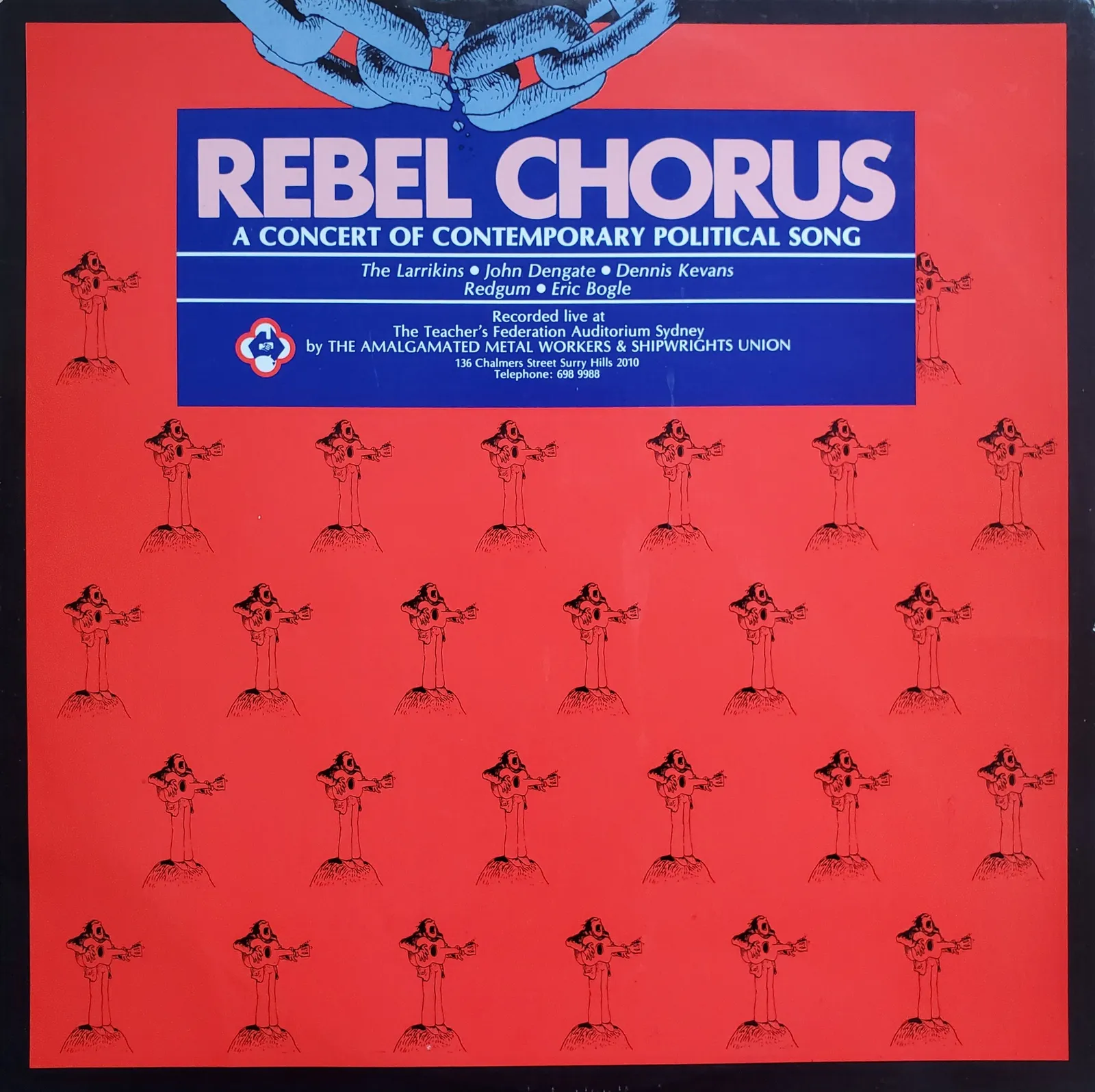
- Rebel Chorus: A Concert of Contemporary Political Song
- Year
- 1982
- Label
- Larrikin # LRF2053
- Format
- LP · Compilation
- Language
- English
- Country
- Paddington, Australia
- Songwriter
- Lyell Sayer, Clem Parkinson
- Genre
- Folk · Contemporary Folk
- Primary theme
- Post-War
Annotation
Double-LP of political songs and poetry, released in 1982 by the Amalgamated Metal Workers & Shipwrights Union, on Larrikin Records (# LRF2053), the record label founded by folk collector and performer Warren Fahey.1 This contained three anti-war tracks related to Vietnam. This included the song "F111", performed by the The Larrikins, and composed by Lyell Sayer, who recorded his own version, discussed immediately below.. The other two tracks are poems, by Denis Kevans (15 January 1939–2005), from Canberra, Australia. The first was "The Great Prawn War". The second title was the "Slouch of Vietnam", said to have been published and set to music in 1962, before Australia's major troop commitment in 1965, according to Kevans. The poem was recited at anti-war demonstrations in the 1960s/70s.23 Both poems mentioned featured in his 1982 book The Great Prawn War and Other Poems. A slouch hat, also known as Aussie bush hat is a distinctive Australian hat that has one side of the brim turned up or pinned to the side of the hat, often used in the military.4 The poem recalled previous wars: "far-off fields of Flanders... brave Gallipoli". However, these were different from the Vietnam conflict: "why should I share the napalm-guilt of blundering Uncle Sam" - a reference to chemical weapon Napalm B - a jellied gasoline mixture, with polystyrene, benzene, and gasoline. Declared a war-crime since 1980, the US government extensively used this weapon during the Vietnam conflict, dropping 388,000 tons on Indochina between 1963 and 1973.567 The narrator noted "peasant kids, who fight for rights and rice", thus arguing that the war was unjustified, and that the North Vietnamese were fighting for independence. The poem also contained the line "blinded the diggers' eyes". Digger is a military slang term for soldiers from Australia and New Zealand, which came to prominence during World War One, although some sources indicate it may have been used since the 1850s. Digger probably originally referred to a miner - extensive research has been conducted on the etymology of the term and its introduction into military terminology.89 Sources1theballadeers.com (archived copy)↩2greenleft.org.au: Slouch vietnam 0↩3JSTOR article↩4Wikipedia: Slouch hat↩5Napalm: An American Biography (Robert M. Neer, 2013)↩6Times Higher Education: Napalm an american biography by robert m neer↩7Napalm, An American Biography (book website)↩8Internet Archive (Wayback Machine)↩9Wikipedia: Digger (soldier)↩
Annotation by Justin A. Brummer
Annotation — Australian & New Zealand Songs
Double-LP of political songs and poetry, released in 1982 by the Amalgamated Metal Workers & Shipwrights Union, on Larrikin Records (# LRF2053), the record label founded by folk collector and performer Warren Fahey.1 This contained three anti-war tracks related to Vietnam. This included the song "F111", performed by the The Larrikins, and composed by Lyell Sayer, who recorded his own version, discussed immediately below. The other two tracks are poems, by Denis Kevans (15 January 1939–2005), from Canberra, Australia. The first was "The Great Prawn War". The second title was the "Slouch of Vietnam", said to have been published and set to music in 1962, before Australia's major troop commitment in 1965, according to Kevans. The poem was recited at anti-war demonstrations in the 1960s/70s.23 Both poems mentioned featured in his 1982 book The Great Prawn War and Other Poems. A slouch hat, also known as Aussie bush hat is a distinctive Australian hat that has one side of the brim turned up or pinned to the side of the hat, often used in the military.4 The poem recalled previous wars: "far-off fields of Flanders... brave Gallipoli". However, these were different from the Vietnam conflict: "why should I share the napalm-guilt of blundering Uncle Sam" - a reference to chemical weapon Napalm B - a jellied gasoline mixture, with polystyrene, benzene, and gasoline. Declared a war-crime since 1980, the US government extensively used this weapon during the Vietnam conflict, dropping 388,000 tons on Indochina between 1963 and 1973.567 The narrator noted "peasant kids, who fight for rights and rice", thus arguing that the war was unjustified, and that the North Vietnamese were fighting for independence. The poem also contained the line "blinded the diggers' eyes". Digger is a military slang term for soldiers from Australia and New Zealand, which came to prominence during World War One, although some sources indicate it may have been used since the 1850s. Digger probably originally referred to a miner - extensive research has been conducted on the etymology of the term and its introduction into military terminology.89 Sources1theballadeers.com (archived copy)↩2greenleft.org.au: Slouch vietnam 0↩3JSTOR article↩4Wikipedia: Slouch hat↩5Napalm: An American Biography (Robert M. Neer, 2013)↩6Times Higher Education: Napalm an american biography by robert m neer↩7Napalm, An American Biography (book website)↩8Internet Archive (Wayback Machine)↩9Wikipedia: Digger (soldier)↩
Annotation by Justin A. Brummer
Lyrics
English: "Now, Sir Robert Menzies was walking down the street / And thinking of our air force which was mostly obsolete / Our Canberra bombers are getting old as hell / We better call up Uncle Sam and see what he can sell / Well he said to Uncle Sammy, "We want to buy a plane / To save our lovely country from going down the drain / We want to scare some Asians, so see what you can do / The answer was, Bob, buddy, we've got just the thing for you /Oh, the F-one-double one it is a lovely plane / It flies at twice the speed of sound and scatters bombs like rain / It's wings go back and forward, it's the latest thing around / It's a pity that it isn't safe to take it off the ground. Bob said, "We'll take two dozen" / The plane they had to make / And soon they had one ready, its first flight for to take / Well it whistled down the runway with a dreadful roaring sound / And then broke up in little bits and fell back on the ground / They sent some off to Vietnam, the country to defend / To wipe out all the Viet Cong and cause the war to end / But Ho Chi Minh said / "Comrades, don't waste our precious shells / These brand-new planes the Yankees have all fall down by themselves.... They want crazy old age pensions / The cost will be too high / They'd rather buy an aircraft that is allergic to the sky / But still I can't help thinking, wouldn't it be nice / If they didn't waste our taxes on that flying opera house / After due consideration, I found a proper use / They should take one…
Notes
Double LP recorded live at the Teachers' Federation Auditorium, Sydney, for the Amalgamated Metal Workers & Shipwrights Union; label number LRF 2-053, matrix MX191707. Larrikin Records LRF 2-053, stereo double LP, 33⅓ RPM, cream labels with the red Larrikin "Real Music" logo, Larrikin Records Pty. Ltd., P.O. Box 162 Paddington, N.S.W. 2021, Australia, and the union emblem; record one side one MX191707, record two side one MX191709. Record one side one: Freedom on the Wallaby (Henry Lawson), Terania Creek (Kathy O'Sullivan), F111 and Life Wasn't Meant to Be Easy (both Lyell Sayer-Clem Parkinson) by The Larrikins, and Pot Pourri by Dennis Kevans, whose medley on the back cover includes "The Slouch of Vietnam"; side two is Red Gum, side three Dennis Kevans and John Dengate, side four Eric Bogle. The front cover, red with a pattern of guitar-playing figures under a broken chain, reads…
About the artist
Australia
Themes
ANZUS · Anti-War · Robert Menzies · Air Force · VC · Ho Chi Minh
From the release Rebel Chorus: A Concert of Contemporary Political Song