Credited on the record as La Lloroncita con Nieves Quintero y su Conj..
Papito en Vietnam
1967 · Pop Art 112 · New York City, New York
- Artist
- La Lloroncita
- Credited on the record as
- La Lloroncita con Nieves Quintero y su Conj.
- Title
- Papito en Vietnam
- Release
- Papito en Viet Nam
- Year
- 1967
- Label
- Pop Art # 112
- Format
- 7" · Single
- Language
- Spanish
- Country
- New York City, New York, Puerto Rico
- Songwriter
- Luz Celenia Tirado
- Genre
- Hispanic Music · Caribbean Folk Music · Jibaro · Bolero
- Primary theme
- Home Front Perspective / Soldier's Perspective
Annotation
Born Quetcy Alma Martínez De Jesús on 17 May 1956, in Arroyo, Puerto Rico, the track "Papito en Viet Nam" ("Daddy in Vietnam") (Pop Art Records # 112) is probably the most well-known Vietnam War song from Puerto Rico. Known as La Lloroncita, she was around 10 or 11 years old when she released this record.2 It appeared on the album Jibarita (Pop Art Records #LP 154). Both the single and album were released in New York, USA. The song was composed by Luz Celenia Tirado, born on 1 August 1928 in Puerto Rico. The song is in the Jibaro genre: "traditionally played by the eponymous mountain-dwelling Latin American culture that live primarily in Puerto Rico". Jíbaro is used in Puerto Rico to refer to the countryside people.2 Needless to say, this is sung from the perspective of a child whose father is "fighting in Vietnam". She referred to it as a "merciless war" and "terrible conflict", thus leaning towards the anti-war side.& Sources2prpop.org: La lloroncita↩
Annotation by Justin A. Brummer
Annotation — Children on Record
Born Quetcy Alma Martínez De Jesús on 17 May 1956, in Arroyo, Puerto Rico, the track "Papito en Viet Nam" ("Daddy in Vietnam") (Pop Art Records # 112) is probably the most well-known Vietnam War song from Puerto Rico. Known as La Lloroncita, she was around 10 or 11 years old when she released this record.2 It appeared on the album Jibarita (Pop Art Records #LP 154). Both the single and album were released in New York, USA. The song was composed by Luz Celenia Tirado, born on 1 August 1928 in Puerto Rico. The song is in the Jibaro genre: "traditionally played by the eponymous mountain-dwelling Latin American culture that live primarily in Puerto Rico". Jíbaro is used in Puerto Rico to refer to the countryside people.2 Needless to say, this is sung from the perspective of a child whose father is "fighting in Vietnam". She referred to it as a "merciless war" and "terrible conflict", thus leaning towards the anti-war side.Sources2prpop.org: La lloroncita↩
Annotation by Justin A. Brummer
Annotation — Puerto Rican Songs
Born Quetcy Alma Martínez De Jesús on 17 May 1956, in Arroyo, Puerto Rico, the track "Papito en Viet Nam" ("Daddy in Vietnam") (Pop Art Records # 112) is probably the most well-known Vietnam War song from Puerto Rico. Known as La Lloroncita, she was around 10 or 11 years old when she released this record.2 It appeared on the album Jibarita (Pop Art Records #LP 154). Both the single and album were released in New York, USA. The song was composed by Luz Celenia Tirado, born on 1 August 1928 in Puerto Rico. The song is in the Jibaro genre: "traditionally played by the eponymous mountain-dwelling Latin American culture that live primarily in Puerto Rico". Jíbaro is used in Puerto Rico to refer to the countryside people.2 Needless to say, this is sung from the perspective of a child whose father is "fighting in Vietnam". She referred to it as a "merciless war" and "terrible conflict", thus leaning towards the anti-war side. Sources2prpop.org: La lloroncita↩
Annotation by Justin A. Brummer
Lyrics
English: I'm sad and desolate, almost orphaned I'll say / Because my daddy went off to the merciless war / Desperate situation is what I suffer / Blessed I beg the infinite to take care of all those who are in the Vietnam war where daddy is / How can I not cry every time I'm singing / If I keep remembering that I can't hug him / He doesn't come to caress me like he did every little while / He doesn't bring me toys / He doesn't sing to me / Because fighting in Vietnam is where you find your daddy today / I remember with sadness when I saw him in his uniform / With his soldier's clothes very upright in his head / He stared at me with a mocking smile / He said to me, heart you must pray to god that your daddy comes home from Vietnam / Lord god of great power hear my petition / Is my humble plea to return / Make him finish the troop of that terrible conflict / And come back healthy to kiss him again / I miss playing, bring my daddy from Vietnam
Notes
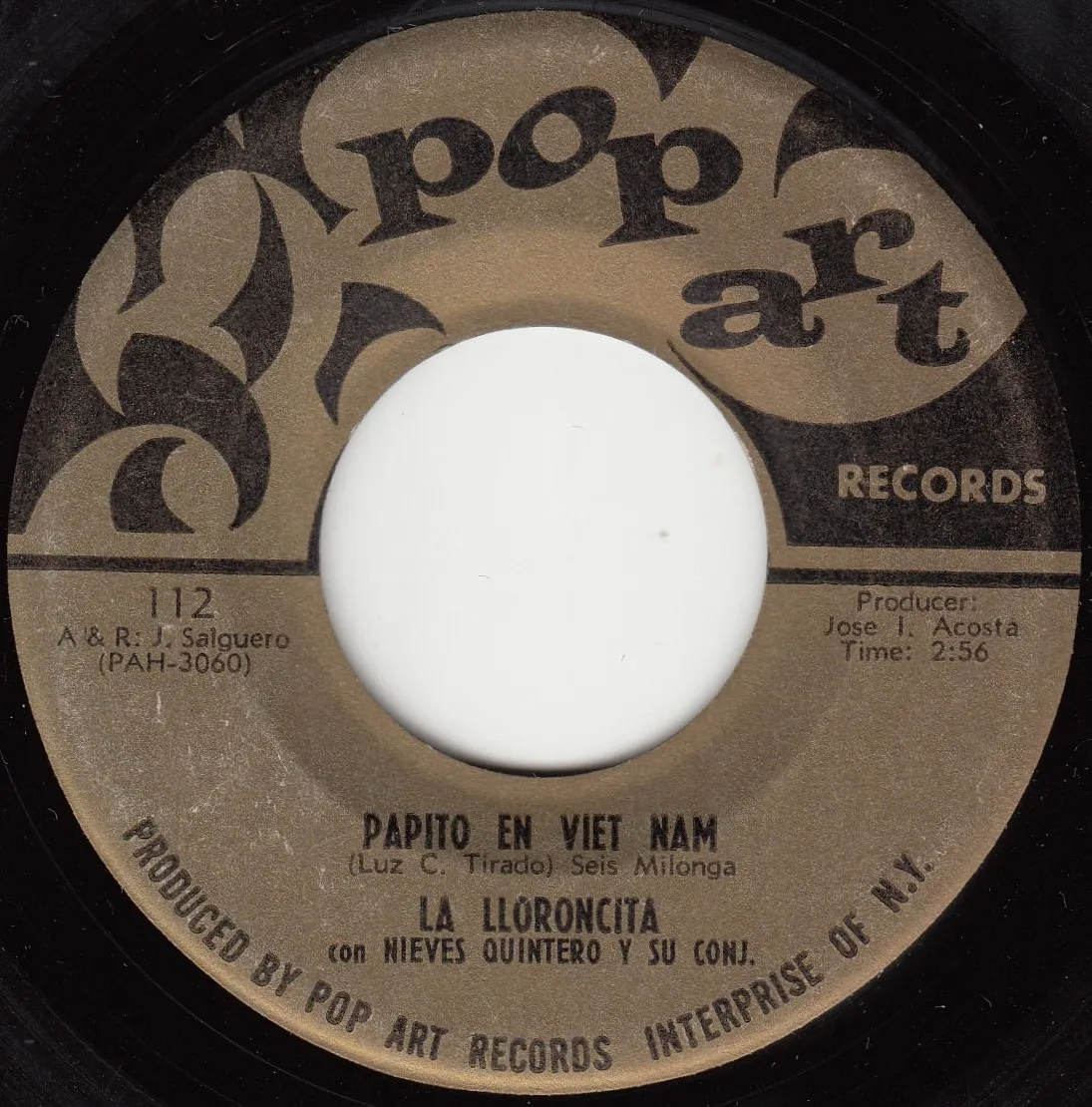
Seis milonga, as printed on the label. Pop Art Records 112 (PAH-3060), gold and black label; A & R: J. Salguero, producer Jose I. Acosta; "Papito en Viet Nam" (Luz C. Tirado), time 2:56; La Lloroncita con Nieves Quintero y su Conj. Rim text: "Produced by Pop Art Records Interprise of N.Y." [From the record sleeve and labels]
About the artist
Born Arroyo, Puerto Rico (17 May 1956). Birth name Quetcy Alma.
Themes
In collections
US Domestic Perspective Songs [War Years] · Children on Record · Peace, Protest, & Anti-War Songs [War Years] · Puerto Rican Songs