Day for Decision
1966 · Warner Bros. 5820 · Burbank, California
- Artist
- Johnny Sea
- Title
- Day for Decision
- Release
- Day for Decision / Mary Rocks Him to Sleep
- Year
- 1966
- Label
- Warner Bros. # 5820
- Format
- 7" · Single
- Language
- English
- Country
- Burbank, California, USA
- Songwriter
- Allen N. Peltier
- Genre
- Easy Listening · Easy Listening · Spoken Word
- Primary theme
- US 'Patriotic' / Pro-Government / Anti-Protest Songs
Annotation — McGuire's "Eve of Destruction" & Answer Songs
Another popular patriotic response to McGuire's "Eve of Destruction", the song "Day for Decision" (Warner Bros. Records # 5820) broke into the Billboard singles chart on 4 June 1966, bubbling under the Hot 100 at # 133.12 After four weeks, on 2 July 1966, the single peaked at # 35 in the Billboard Hot 100.3 In the same edition, Billboard printed a letter from a record company owner, praising the single, saying: "we believe the recoding industry owes a vote of thanks to Warner Bros. Records for its latest hit 'Day of Decision'. Of late there has been a tendency to consider patriotism corny, to call expressing love for the USA as square. We Americans have good reason to be proud of our heritage, and should not hide the pride we feel for our country....We applaud Johnny Sea for a superb rendition".4 It reached # 28 in the Billboard Country Chart on 2 July 1966.5 On 9 July 1966, it rose to # 20 in the Country chart.6 The album "Day for Decision" (Warner Bros. Records # W-1659) received a Grammy Nomination for Best Spoken Word, Documentary Or Drama Recording, losing out to Everett McKinley Dirksen (for his patriotic "Gallant Men").7 Johnny Sea (born John Allan Seay, Jr. in Gulfport, MS, 15 July 1940) narrated the song, composed by Allen Peltier, over a musical arrangement by Ernie Freeman. Produced by Gene Nash. The music included an oriental sound, intending to refer to Vietnam, and maybe China as well. It concluded with a choir singing "America the Beautiful". The song started out with the menacing, prophetic views of McGuire, declaring that "American is in real trouble" and that they were in the "age of the American cynic, the year of the unbeliever, the day of doubt". The narrator believed that problems were not in the "rice paddies of Vietnam", China, or other "win-less conflicts", but in the United States. And the problem in the US? The narrator criticised the lack of patriotism, claiming that people "stare at...shoelaces" when the national anthem played. He then went a step further, and suggested that the "newsreels of the discontented marching" (i.e. the anti-war movement) provided support to the "Viet Cong in the swampy jungles of Vietnam". Moreover, the "better red than dead cancer" spreading in the US (i.e. those who would rather live under communism than fight and die in a war), caused fear amongst the GIs in Vietnam (as opposed to "better dead than red") - these were competing Cold War slogans in the US and UK since the 1950s, often attributed to Bertrand Russel and the UK Nuclear Disarmament Movement.89 The lyrics also commented on the US political system - it said that the structure and ideals of the US government had not changed, but that the people had, and that this change threatened a "fragile" democracy. He also believed that public office had been corrupted by money.Johnny Sea – Day for Decision Buddy Starcher – Day of Decision Noel Ball – Day for Decision Lloyd Green – Day for Decision Jerry Barnes – Day for DecisionSources1Billboard, 4 June 1966↩2Billboard, 4 June 1966↩3Billboard, 2 July 1966↩4Billboard, 2 July 1966↩5Billboard, 2 July 1966↩6Billboard, 9 July 1966↩7Wikipedia: Grammy Award for Best Spoken Word Album↩8Safire's Political Dictionary (William Safire, 2008)↩9Better Red (Constance Coiner, 1995)↩
Annotation by Justin A. Brummer
Lyrics
English: The other day I heard someone say, 'you know, America is in real trouble' / It's true, old Glory has never fallen so close to the earth / Our embassies are being stoned, our diplomats are often in fear... / And were involved in a half-dozen nameless, win-less conflicts / Spilling American blood on foreign soil, our young men are dying / For ideals that don't seem to mean too much to Americans anymore / The truth is Americas real trouble doesn't lie in the rice paddies of Vietnam / In the masses of Red China, or in the diabolical intrigues to the south of us / The real trouble lies in the playgrounds of St. Louis / The...mansions of San Francisco and in the slums of Chicago... / In the small southern towns, the fishing villages of New England... / This is the age of the American cynic, the year of the unbeliever, the day of doubt Old fashioned love of God, country, and family is passe / We stare at our shoelaces when they play the national anthem / We wouldn't want to be seen at a political rally or a town hall meeting... / We've decided the only way to get into public office is to buy it... / Flag-waving singing patriotism has been condemned.... / Our form of government is the same... / The basic ideals and structure of America haven't changed / We have, you and me, our enemies know it / They've seen the newsreels of the discontented marching... / The new idea is: don't attack America wear it down... / This deadly 'let George do it' attitude lights the way for the…
Notes
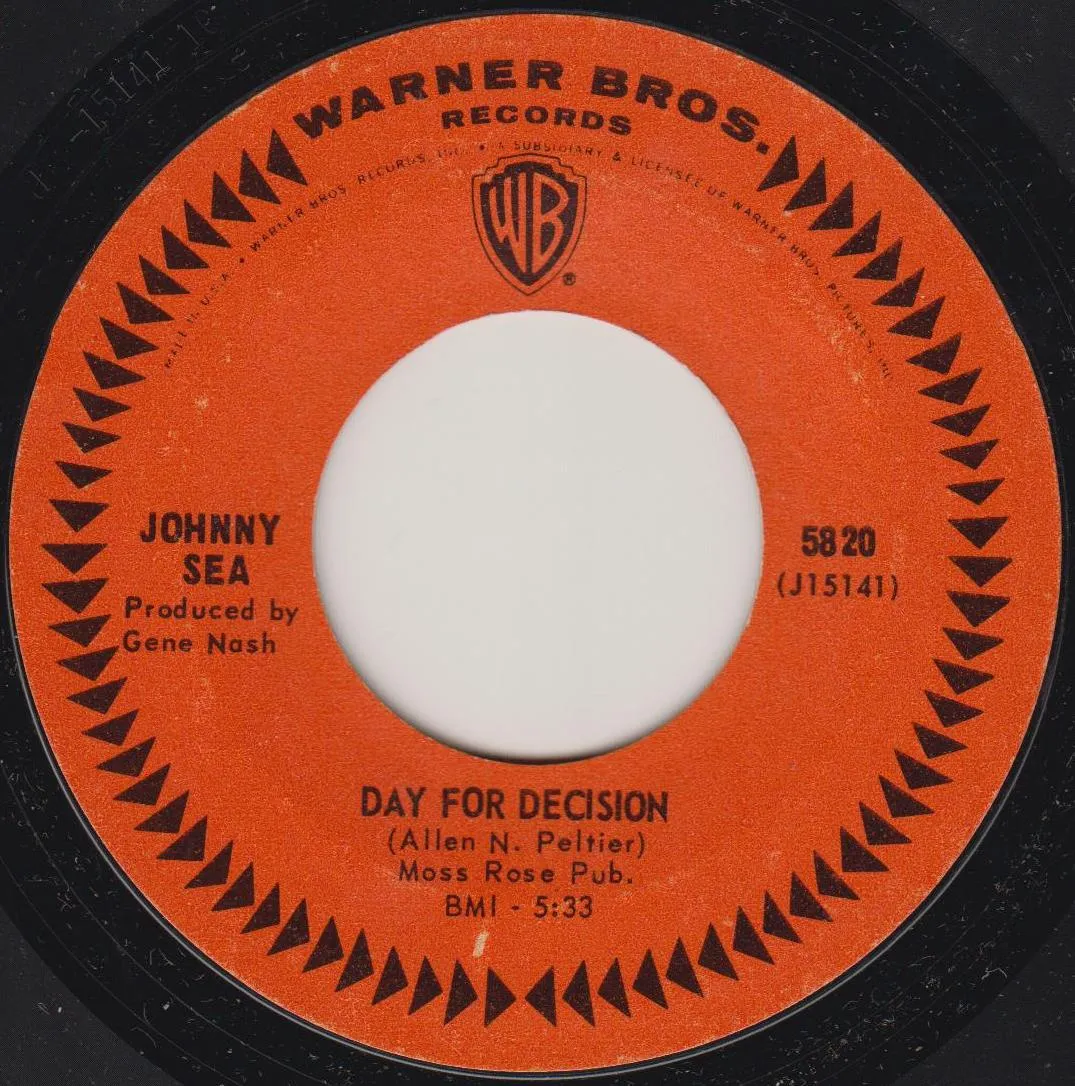
Warner Bros. 5820 (J15141), orange label with a ring of black triangles; "Day for Decision" (Allen N. Peltier), Moss Rose Pub., BMI, 5:33; Johnny Sea, produced by Gene Nash. Warner Bros. company sleeve printed with red triangles, "© 1964 Warner Bros. Records, Inc., a Subsidiary and Licensee of Warner Bros. Pictures, Inc." [From the record sleeve and labels]
About the artist
Johnny Sea (born John Allan Seay Jr., July 15, 1940, Gulfport, Mississippi; raised in Atlanta) was a country singer who debuted on the Louisiana Hayride in Shreveport. He scored a Top 20 hit with "Frankie's Man Johnny" (1959) and a Top 20 remake of Jimmie Davis's 1937 classic (1960), followed by "My Old Faded Rose" (1965, co-written by June Carter and Johnny Cash). His best-known record, the spoken-word single "Day For Decision" (Warner Bros. W1659, 1966, written by Allen Peltier), reached No. 14 country and became a pop Top 40/Grammy-nominated hit, widely characterized as a patriotic answer…
Themes
Patriotic · Answer to Eve of Destruction · Anti-Protest · Draft Card Burning · Demonstration · VC · WW2 · Flag · Draft
In collections
McGuire's "Eve of Destruction" & Answer Songs · Draft Songs · US 'Patriotic' / Pro-Government / Anti-Protest Songs [War Years]